 sciepub.com
 Quick Submission

Some Methodical Aspects of Studying Limits of Sequences
Bosovskyi Mykola1, Bochko Oksana1, , Tretyak Mykola1
1Bohdan Khmelnytskyy National University of Cherkasy, Cherkasy, Ukraine
Abstract
The article describes methods of studying the limits of sequences and theorems of the limits of the sequences. Aspects of studying the limits of the sequence, an offered roll-out of Limit of the sequence theme and the study of the basic theorems on the limits of sum, product and quotient of two sequences have been developed. Theoretical generalization has been performed and a new approach in the introduction and study of uncertainties as statements that complement the theorems has been suggested.
Keywords: methods of teaching mathematics, mathematical analysis, theory of limits, institute of higher education, theoretical analysis, limit of the sequence, limit of the quotient, limit of the sum, limit of the product, mathematical phrases, uncertainties
Copyright © 2015 Science and Education Publishing. All Rights Reserved.Cite this article:
- Bosovskyi Mykola, Bochko Oksana, Tretyak Mykola. Some Methodical Aspects of Studying Limits of Sequences. American Journal of Educational Research. Vol. 3, No. 12B, 2015, pp 16-19. http://pubs.sciepub.com/education/3/12B/4
- Mykola, Bosovskyi, Bochko Oksana, and Tretyak Mykola. "Some Methodical Aspects of Studying Limits of Sequences." American Journal of Educational Research 3.12B (2015): 16-19.
- Mykola, B. , Oksana, B. , & Mykola, T. (2015). Some Methodical Aspects of Studying Limits of Sequences. American Journal of Educational Research, 3(12B), 16-19.
- Mykola, Bosovskyi, Bochko Oksana, and Tretyak Mykola. "Some Methodical Aspects of Studying Limits of Sequences." American Journal of Educational Research 3, no. 12B (2015): 16-19.
| Import into BibTeX | Import into EndNote | Import into RefMan | Import into RefWorks |
1. Introduction
Providing the proper level of mathematical education is of special significance in modern society. Mathematical education for specialists in different areas (mathematicians, physicists, chemists, economists, engineers, teachers, etc.) is the main tool for mastering professional disciplines and the tool for future professional activities. The study of the science forms not only methodological but also psycho-physiological foundation of systematic, logical, and critical thinking, which are essential [5]. Theory of limits plays a special role in the mathematical preparation of a specialist. A prominent mathematician Felix Klein said [6] that all applied tasks which a student has to solve, are related with variables and require the competency to calculate the limits of the variables, their difference, the ratio of the differences when they are infinitesimals. Their use is of a general nature. That is why all (or nearly all) major scientific or engineering calculations are computing either the limits of the ratio of the infinitesimal (speed, acceleration, and density), or the limits of the sums of the infinitesimal (arc length, area, volume, and mass). Consequently, the operation of limiting transition which is a topic of mathematical analysis [7, 8, 9, 10, 11], is one of the most important computations in science and engineering. Understanding its nature and competence in applying it are the basis for mastering methods of mathematical analysis, for which function serves as a central object.
However, analysis of scientific, educational and methodical literature [4, 5] shows that the study of both limiting transitions in secondary and higher education institution is not up to the mark. Practice shows that pupils and students are experiencing significant difficulties mastering limiting transition. Their knowledge is often incomplete, inaccurate, and skills are imperfect. So there is a contradiction between the demands of the society as to the quality of the math education students training (the knowledge of the theory of limits including), and the current state with its scientific and methodological support.
2. Learning Basic Material
We believe that it is advisable to begin the presentation of the theory of limits in universities with the consideration of limit of sequences (functions of natural argument) [8], because:
1) these functions play a fundamental role;
2) all the basic facts of the theory of limits are clearly evident in the simplest situations;
3) all kinds of limits can be reduced essentially to a limit of a sequence. The construction of the complex process of limiting to the limit of the sequences is not only of special interest, but is also important because of the necessity every time to reverse back to the set the basic theorems on limits. In addition, it has been observed that under these circumstances the unity of those kinds of the limits is restored.
Version of rolling out «Limit of sequence» topic [3]
The sequence as a function of a natural argument.
1. Properties, which are appropriate for sequence  for big
  .
.
2. Statement « approaches infinity».
3. Behaviour of sequence  , when
  approaches infinity.
4. Definition of limit. Geometric illustration.
5. Infinite limits:  ,
,  .
.
6. Notes on definitions:
а) changing the value of  for infinite count of
  does not change the limit;
б) can not, as a rule, to change infinite count of  not changing the behaviour of
  when
when  ;
;
в) applying definition of the limit, it is essential to check that inequality  is carried not only for
  , but also for
  , hence for
  and greater values of
  ;
;
г) limit  itself could be one of the values, which takes value of
  . From other perspective, limit is not obliged being one of the values of
  , albeit is defined by them;
д) module of a sequence could be huge size, when  is big, but does not approaches to
  or
or  (e.g.
(e.g.  ). Sequence could approach to
  or
or  only in the case it keeps same sign starting from particular
  .
.
7. Fluctuating sequences (which are not approaching finite or infinite limit). Limited and unlimited fluctuations.
8. Some general theorems on limits.
а) theorem of limit of the sum of two convergent sequences.
б) statements which supplement this theorem
9. Theorem on limit of the product of two sequences and the statement, which supplement the theorem (proves similar theorems system, which refers to the product of two functions).
10. Theorem on the limit of quotient of two sequences and the statements that supplement this theorem.
11. Theorems on the limiting transition in the inequality and the statements that complement these theorems.
The experience of teaching mathematical analysis and further mathematics shows that for better mastery of the limit transition it is important that students (pupils) learn how to be fluent in the use of a number of phrases. Here are the most important ones:
Phrase 1: «For big values  ». When one says, that sequence
  has a property
  «for big values
  », or «for all big enough values of
  », or «for all values
  , starting from some», then keep in mind, that it is available to find such defined number
  , that
  has property
 for all values
  greater than
  .
.
Phrase 2: « approaches infinity». It is important to have complete understanding, that «
 » means only those
  which sequentially take indefinitely growing values. Besides, keep in mind that: а) symbol «
 » could mean nothing itself, but phrases with it sometimes have completely defined meaning; б) in every case when it is required to have a meaning in phrase with «
 », it is necessary to give the phase some meaning previously.
Phrase 3: «Sequence  has property
 for big values
  ». The statement (or «for
 , which approaches infinity») in the description means that
  , eventually, will assume values sufficiently large to ensure sequence
  has property
 . Hence, there is a question: «Which properties has the sequence
  for big enough values of
  ?», – also can be formulated so: «How does
 behave, when
  approaches infinity?».
Theoretical analysis [1, 2] shows that there could be five cases for limit of the sequence, each of them excludes:
1) sequence has a finite limit;
2) limit of a sequence equals  ;
;
3) limit of a sequence equals  ;
;
4) sequence fluctuation is limited;
5) sequence fluctuation is unlimited.
The fact we believe [3] is central in the topic «limit of the sequence» («Limit of the function»). Students have to understand its meaning and use it with ease. That is why it is important to roll out the topic not in the final form, but get it as a summary of a detailed overview of every particular case for the limit of the sequence. Besides, students have to understand and learn, that in case the task is to analyze behaviour of a sequence  when
when , then it means necessity to investigate: if the sequence has a defined limit; if the sequence has a infinite limit (
 or
or  ); if the limit exists (the sequence fluctuation is limited or unlimited). Each sequence has only one answer from all possible.
In studying the topic "limit of a sequence" it is important to highlight the central fact (the existence of only five cases of limit representation) and core direction of topic rolling out (from the particular to the general).
The presentation of material, related to each of the theorems on limit sequences, is advisable to build on such a generalized plan: 1) formulation of the problem; 2) suggestive reasoning; 3) knowledge base; 4) formulation of the theorem; 5) plan of the proof; 6) the proof of the theorem; 7) analysis of the conditions of the theorem.
Let put more focus on the seventh point of the plan.
2.1. The Theorem on the Sum of two Limit SequencesTheorem. If two sequences are convergent, then their sum is convergent; herewith limit of the sum equals sum of the limits:
 | (1) |
In formulating the basic theorems on limit of sequences (particularly theorem on the sum of two convergent sequences), it is necessary to create a number of supporting statements that explains substantially all the important cases of representation limit components (for mentioned theorem (bold square of Table 1) – seven statements in which limit representation cases are reviewed for each of the components). Roll out of this information in the table with two inputs (Table 1) gives the opportunity not only to organize that information, but also provide students with support for the knowledge application in standard and non-standard situations, particularly for understanding the origin of uncertainties (e.g.  etc.) and its correct treatment.
In particular, the record in the second row and second column of the table (in the highlighted square) reflects the content of the fundamental theorem. The information in the second row unfolds: if  has a finite limit, then sum
  behaves like second term. Blank part of the table is symmetrical to the main diagonal. Filled in table cells are present where the behavior of sum of two sequences is obvious. All cases should consist of statements that complement the basic theorem.





The statements that supplement this theorem:
1) If  has finite limit, and
  does not have such limit, then
  behaves like
 .
.
2) If  , and
, and  or has limited fluctuation, then
  .
.
3) If  ,
,  , then for sum
  are possible all cases: finite limit,
  ,
,  , limited fluctuation, unlimited fluctuation.
4) If  , and
, and  has unlimited fluctuation, then
  can approach
  or have unlimited fluctuation.
5) If  and
and  have unlimited fluctuation, then
  whether has unlimited fluctuation, whether approaches to the limit.
6) If  has limited fluctuation, and
  has unlimited, then
 has unlimited fluctuation.
7) If  and
and  has unlimited fluctuation, then for
  could be possible all the cases.
A statement 1 – 7 covers all significally different cases.
Theorem 1 could be expanded to the sum of three and more augends.
2.2. Theorem on Limit of Product of Two SequencesTheorem. If sequences  and
and  are convergent, then their product is also convergent; herewith limit of the product equal to the product of the limits:
  (
( when
when ).
).
To explore the behavior of the product of two sequences fully it is necessary to consider all the possible different pairs formed by the set of factors. When two sequences are multiplied, then in case there is a finite limit for any of them it is necessary to understand whether this is a nonzero limit, a zero one. Thus we need to consider the six cases of behavior of each sequence. Hence, we are to consider six cases of each sequence behaviour. However, there is no need for a separate study of cases, when  and
and , as a result in one case can be obtained of a simple change in another sign. Finally, we have five cases for each sequence included in the product (Table 2): 1) limit of sequence equals 0; 2) limit is finite and
 ; 3) limit is
 ; 4) sequence has limited fluctuation; 5) sequence has limited fluctuation.


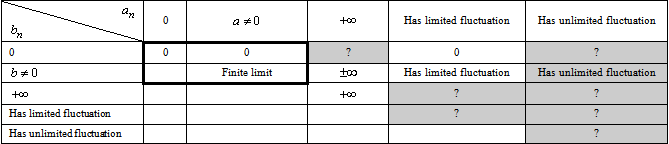


Because the factors that form the product are equal, the table is symmetrical about the main diagonal, thus - filled with only the table cells, which are located on the one side of the main diagonal. If the behavior of the product is clear, the result is listed in the table. The result highlighted in the upper left corner (2–3 square in the highlighted row, column 2–3), is the content of the fundamental theorem of the limit of the quotient. Other cases (highlighted in gray in the table) require separate investigation. Here are some of them.
1. If  (2 row of the Table 2), then for product
  possible following cases:
a) , when e.g.
  ;
;
b) , when e.g.
  ;
;
c) , when e.g.
  ;
;
d)  has limited fluctuation, when e.g.
  ;
;
e)  has unlimited fluctuation, when e.g.
  .
.
2. If  has unlimited fluctuation and
  (2 rows and 6 columns in the Table 2), then for product
  possible following cases:
a)  has limited fluctuation, when e.g.
  ;
;
b)  , when e.g.
  ;
;
c)  , when e.g.
  ;
;
d)  , when e.g.
  ;
;
e)  has unlimited fluctuation, when e.g.
 .
.
The review of the examples of other cases can be done for the students on independent study. It is important to set before them the following task: to investigate the convergence of sequence data and fill in Table 2.
Note that the investigation of all possible cases is appropriate since it ensures correct understanding of the behaviour of the product of two sequences given the behaviour of each is known.
2.3. Theorem on Limit of Quotient of Two SequencesTheorem. If  and
and  , then
  .
.
At the same time it states that under given conditions quotient is a convergent sequence and its limit is equal to the ratio of the dividend and the divisor, so it is able to change the order of the division operation and limiting transition with  and
and  .
.


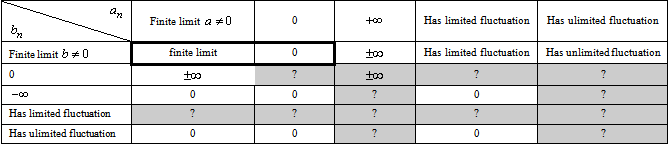

Due to the inequality of the dividend and the divisor (the divisor can not be equal to 0) the main diagonal in the table is not symmetric.
Work with the table includes the following steps: formulate, prove, and illustrate the examples of additional statements to the fundamental theorem, the content of which is defined in the upper left box (in the selected square). Additional statements are the statements that fill all table cells except cells that meet basic theorem (2nd row, the 2nd and 3rd columns).
3. Conclusions
Other theorems that supply the connections of the operation of the limiting transition with the structure of the set of real numbers (limiting transition inequalities of theorem on limit of the sum, product and quotient for function) have been studied similarly [3]. The information presented in the table with two inputs can not only help organize the knowledge, but also can provide the students with the foundation for the application of this knowledge in standard and non-standard situations, including understanding the appearance of (e.g.  etc.) and its accurate interpretation.
Acknowledgement
The work was supported by the Ministry of Education and Science of Ukraine (state registration number 0115U000639).
References
| [1] | Zorych, V.A, Mathematical analysis: textbook for mathematics and physics faculties and professions schools, p.1 Fazis, Moscow, 1997, 554. | ||
 In article In article | |||
| [2] | Hardy, G.H, Course of clear mathematics, IL, Moscow, 1949, 512. | ||
| In article | |||
| [3] | Bosovskyi, M.V, Continuity in studying the theory of limits in secondary and higher education: thesis, Cherkasy, 2010, 298. | ||
| In article | |||
| [4] | Tarasenkova, N.A, The theoretic-methodical principles of using of the sign and symbolic means in teaching mathematics of the basic school students: thesis, Bohdan Khmelnytsky National University of Cherkasy, Cherkasy, 2003, 630. | ||
| In article | |||
| [5] | Slepkan, Z.I, Scientific principles of educational process in high school, Vyshcha Shkola, Kyiv, 2005, 39. | ||
| In article | |||
| [6] | Kolmogorov, A.N, Mathematics - the science and the profession, Nauka, 1988, 288. | ||
| In article | |||
| [7] | Dorogovtsev, A.Y, Mathematical analysis, Vyshcha Shkola, Kyiv, 1985, 528. | ||
| In article | |||
| [8] | Ilyin, V.A, Mathematical analysis: textbook for students. enrolled in the special. “Mathematics”, “Applied Mathematics” and “Informatics”, Prospect, 2007, 660. | ||
| In article | |||
| [9] | Korovkin, P.P, Mathematical analysis. Part 1, Prosvieshcheniie, Moscow, 1972, 448. | ||
| In article | |||
| [10] | Kudryavtsev, L.D, Mathematical analysis, Vysshaya Shkola, Moscow, 1971, 614. | ||
| In article | |||
| [11] | Raikov, D.A, One-dimensional mathematical analysis, Vysshaya Shkola, Moscow, 1982, 415. | ||
| In article | |||
 CiteULike
 Mendeley
 StumbleUpon
 Delicious
 Facebook
 Twitter
 LinkedIn