 sciepub.com
 Quick Submission

The Use of Associative Images (models) for the Development of Comprehension in Sciences Education
Aiva Gaidule1, , Uldis Heidingers1
1Riga English Grammar School, Zvardes iela 1, Latvia
Abstract
Many definitions, explanations of physical, biological, chemical and mathematical processes, as well as formulae with exact designations and units are comprised in the information resources of science which are requisite for students of grammar schools. The multiplicity of the information to be acquired is plumping. Many students learn the new information in a certain mechanical way without comprehending the actual meaning of it. Therefore it is necessary to look for a solution of the problem by choosing such methodical aids which would stimulate the students to understand the information, as well as to link it with the previously acquired knowledge and experience. The student will be able to use only fully understood information for successful learning of the following themes. A simple possible solution for the mentioned problem is originated by a group of teachers from Riga English Grammar School (Latvia) in 2011. It is an alternative approach to the teaching process of science and mathematics. An equalization of complex science systems with processes or phenomena one can observe in everyday life lies in the foundation of this approach. It becomes possible to connect elementary knowledge about the order of the world with the more complicated science information to be acquired just using associations with daily processes. An association created in the framework of the above mentioned approach is called a perception model or just a model. The model can be formed as a drawing, animation, scheme, etc. The models are usually made by the students, the teacher acting as the organizer and guide of the exercise. The mentioned teaching/learning method has been used for teaching chemistry, physics, biology and mathematics in the Riga English Grammar School during already 3 school years. Several methodical approaches have been tested and improved, and very preliminary assessments of their efficiency have been made during this time. Methodical recommendations for teachers, the assessment criteria for the students’ models as well as work sheets for students were originated as the result of these activities. Our experience has confirmed that the origination of the associative images (models) stimulate students for better understanding the essence of ideas, processes and phenomena of science and mathematics. The exploitation of associative images in the teaching/learning process of science and mathematics is discussed in the present communication with an objective to acquaint interested people with the method and to stimulate the dissemination of it in grammar schools. The very first positive results are shown in it about the application of the discussed method in the mastering of science concepts. The communication is trying to answer the question about an easy possibility to stimulate the penetration of students in the essence of a subject to be acquired by the assistance of associative images (models) and the translation of the text of models into a foreign language. The communication can be deemed as a methodological recommendation to teachers. The introduction of the discussed simple method into the everyday practice of grammar schools might allow to achieve the mastering of students’ thorough knowledges and skills in a shorter time.
Keywords: acquirement of science, secondary school, comprehension, literacy, associative image (model)
Copyright © 2015 Science and Education Publishing. All Rights Reserved.Cite this article:
- Aiva Gaidule, Uldis Heidingers. The Use of Associative Images (models) for the Development of Comprehension in Sciences Education. American Journal of Educational Research. Vol. 3, No. 10, 2015, pp 1305-1310. http://pubs.sciepub.com/education/3/10/15
- Gaidule, Aiva, and Uldis Heidingers. "The Use of Associative Images (models) for the Development of Comprehension in Sciences Education." American Journal of Educational Research 3.10 (2015): 1305-1310.
- Gaidule, A. , & Heidingers, U. (2015). The Use of Associative Images (models) for the Development of Comprehension in Sciences Education. American Journal of Educational Research, 3(10), 1305-1310.
- Gaidule, Aiva, and Uldis Heidingers. "The Use of Associative Images (models) for the Development of Comprehension in Sciences Education." American Journal of Educational Research 3, no. 10 (2015): 1305-1310.
| Import into BibTeX | Import into EndNote | Import into RefMan | Import into RefWorks |
At a glance: Figures
1. Introduction
The information is a resource without limits nowadays; however one has to know using it properly. Many definitions, explanations of physical, biological and chemical processes, mathematical formulas with exact denominations and units are comprised in science courses in schools. The amount of information available to students and foreseen for mastering is sweeping. It presents difficulties for many students. Some of them try to “stuff into heads” the tremendous amount of information by mechanical memorizing. However, the knowledge acquired in this way does not have a lasting value; the memorized information is soon forgotten, and students meet difficulties to use it in concrete situations quite frequently, for example, for solving exercises of physics, chemistry and mathematics.
The assessment of the plenty of publications available in the literature about teaching/learning in schools discloses that the lack of students’ perception in subjects of science and mathematical is a topical problem both in Europe and elsewhere in the world. Scientists and teachers around the world are looking for theoretical and practical solutions of the problem [1-10][1]. Numerous teachers of grammar schools are searching for solutions of the mentioned problem in their everyday work. They are trying to connect somehow a new information with the earlier taught material in order to stimulate its better understanding. A student will be able to use only fully understood information during the learning process of the following themes.
Recently a group of teachers from the Riga English Grammar School has developed a possible simple solution for this urgent problem [11]. The solution might be considered as an alternative approach of teaching natural sciences and mathematics to the current teaching process in use. An equalization of complicated science systems to a certain process or phenomenon one can observe in everyday life form the bottom of the mentioned approach. It becomes possible for a student to build an interrelation between his previously gained knowledge about the world order and the complex information of science just by using the occurring associations. An association originated in this way and in the framework of the mentioned approach is called a comprehension model. It may be a drawing, an animation, a scheme and so on. It should be emphasized that models are made by the students, but the teacher act as an organizer and guide of the process of making models. A specialized website (www.goerudio.com) is elaborated, and comprehension models made by students are collected and systematized in it.
2. The Specific Features of an Associative Image (model)
The teaching/learning method mentioned above has been used for teaching chemistry, physics, biology and mathematics for already 3 school years in the Riga English Grammar School. Several methodological approaches have been tested and the very first assessment of their efficiency has been made. Main features of the comprehension model can be formulated on the basis of the obtained experience, and they are as follows.
• The theoretical accurateness of the information included in the description of the model. For example, a student has created a comprehension model for the concept of “chemical equilibrium”. It is a state of the system, in which the direct and reversed reaction are taking place with an equal rate. Consequently, two simultaneously occurring processes with equal rates and opposite directions should be represented in the student’s chosen associative model. A student had chosen a picture as an associative model with a boat and two people rowing it, but each of them doing it in the opposite direction.
• Simplicity. A successful comprehension model will be such an associative image where a simple, self-evident process or phenomenon from the everyday life will be used for the origination of an association with the discussed scientific information. The key of the success requires that the process or event used in the model differs sharply from the science process which it tries to explain and is not connected with the last in any way.
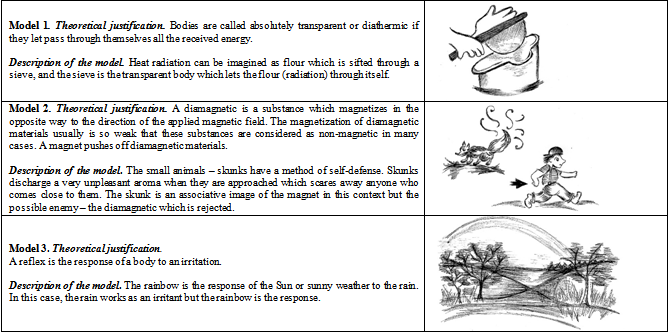
• Visual perceptibility. The model has to be visually attractive; however it should not be oversaturated with needless embellishments. The text should be short and concise. Three successful models made by students are presented in Table 1.




3. Results and Discussion
The application of associative images (models) may be deemed as an easy available supplementary aid for the deepening of students’ perception about the material to be mastered.
It should be emphasized that the above described method, just as any other teaching/learning technique, is not universal and applicable for every situation of the life. The learning process using the models can be divided into several following stages.

 Download as
It should be understood that models will never accomplish creating for all the concepts of natural sciences and mathematics. Therefore the teacher has to assess carefully the learning content of the given subject and the suitability of the included concepts for creating associations with a daily processes or phenomenon in the preparation stage.
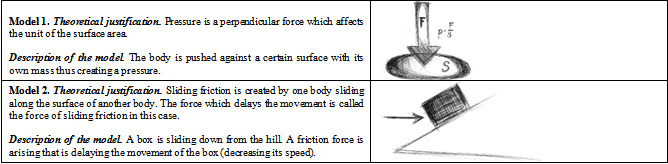
The evaluation of the accumulated practical experience about the creation of models has disclosed that the preparation process for the exploitation of models is of an utmost importance. A part of students have difficulties in the perceiving associations. The problem appeared clearly in first models made by students in an incorrect way. Examples of such incorrect models are presented in Table 2.




Moreover, discussions with students – authors of the models have revealed that quite frequently the concept for which the model has been created has stayed unplumbed in its terms. The quest for a solution of this situation has disclosed that the problem is not really in the content of learnable subject but rather in the underdeveloped literacy of the students. A student has read the description of a natural science concept or explanation but has not detected the main (key) information in this description. Therefore no creation of associations is possible. The concept in the perception of the student has remained as a simple combination of letters and words.
This problem is implicitly confirmed by the results of international study. Latvia is participating in the OECD Program for International Student Assessment (PISA) since 2000, as well as Latvia is a member state in the international program of the evaluation of students’ literacy – the Progress in Reading Literacy Study (PIRLS) since 1991. Results of several research cycles have shown that achievements in literacy competence of Latvian students are rather ordinary. Lithuanian students have demonstrated similar results to Latvian students whereas Estonian students have shown considerably higher level.
Teachers were obliged to do an extra work with the mentioned students in their attempts to solve the identified problem. They have helped students to find out the key information of natural science concepts, processes and phenomenon explanations that have formed further a basis for the perception of associations with natural processes.
The simplest method for the selection of the key information is underlining, coloring in, highlighting or displaying in another way only the most essential phrases in the text. For example, in one of the previous texts (see Table 1) the student has created the diamagnetic model and has used the phrase “Diamagnetic materials are pushed off by the magnet” as the key information.
Apart from the mentioned above, teachers have to agree with students upon the work completion terms and clearly cut assessment criteria of the model in the preparation early stage. Our acquired experience shows that the creation of models can be successfully implemented also by assigning it as a creative home exercise while acquiring a certain subject or preparing for a final test. The created model can substitute some final test of a specific subject in this case.
Students are always in hurry, and therefore it is important to provide a need for a student to consider the information comprised in the model more carefully, to look at it from different sides once and again. A simple and very useful way to maintain student’s attention to the model and the science concept or explanation for a little bit longer time is the translation of all the text into a foreign language. At the same time, a nice possibility appears to enlarge the students’ knowledge of the chosen foreign language while leaning themes of science. For example, students whose mother tongue is not English, including students in Latvia, can efficiently improve their skills of English during classes of science. The teaching and learning process of sciences in the Riga English Grammar School is in Latvian but students are acquiring English as their first foreign language already from the very beginning of their studies. Therefore the translation of models presents a nice possibility for students to apply their knowledge of English in other teaching subjects and to see practical benefits of learning a foreign language. Therefore students are encouraged to describe their models both in Latvian and in English in our school.
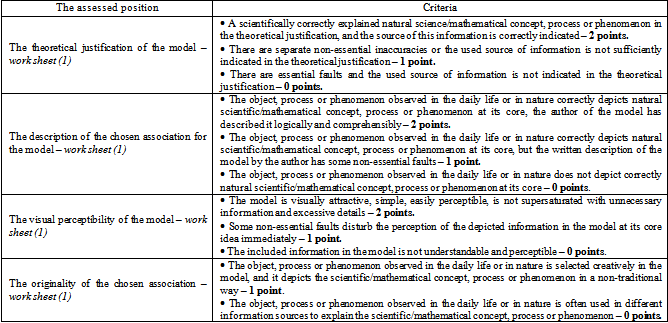
Teachers of the Riga English Grammar School have also elaborated a system of criteria for the evaluation of models elaborated by students (Table 3).



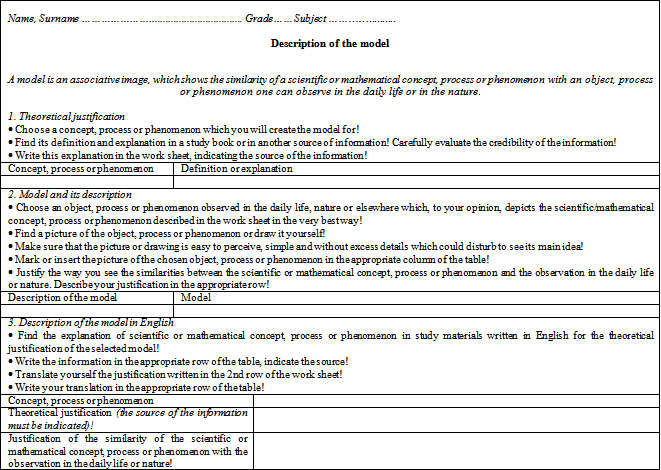
The time students are spending in classes of science and mathematics is quite limited and should be economized. A special work sheet (1) in an electronic format (Table 4) is worked out for students therefore to facilitate the elaboration of models; consecutive actions made step-by-step are described in it for a successful construction of a model once again. Internet resources are often used in the search for a theoretical justification of a model. Therefore students should be warned that the chosen information for the theoretical justification of models has to be credible and justified, and the warning should be stressed.

)

The evaluation of models elaborated by students has disclosed that some students have great difficulties with creating their own model but they can notice really well the successes and faults in the models made by their classmates, as well as propose reasonable and constructive suggestions for their improvements. Frequently the suggestions made by fellow classmates are taken into mind by students much more seriously than those of the teacher. Recommendations are obtained from these suggestions for the improvement and amelioration of the initially proposed models during the evaluation process by students. Discussions break out and the diversity of opinions appears quite often that motivate students to penetrate much more in the essence of concepts to be acquired. The discussed evaluation process can be carried out as an individual work or as a group work. A special work sheet – the student’s work sheet (2) Assessment of the model was elaborated in order to obtain a uniform view of all students on the evaluation process (Table 5).

)
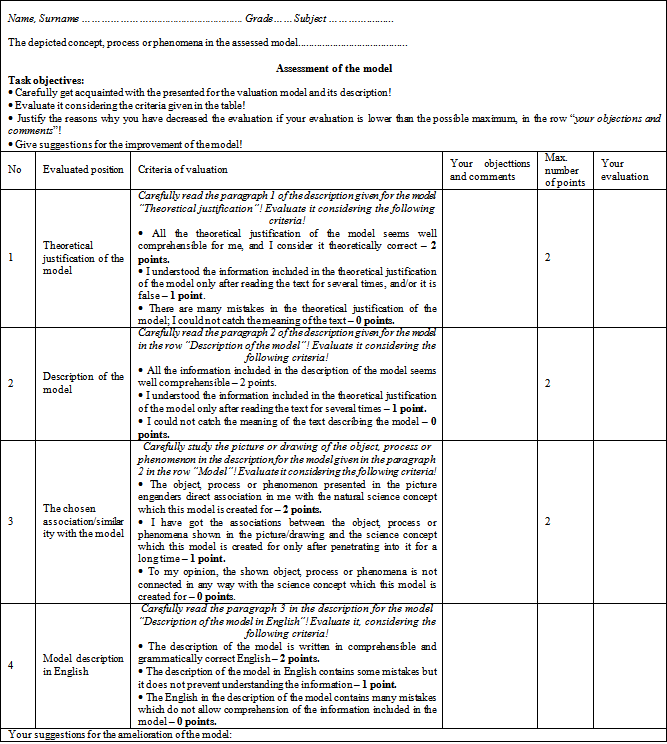

The experience in the work with science and mathematics models has been interconnected mainly with the process of their formation in Riga English Grammar School until now. The experience of teachers and students assures that the application of models helps to obtain a better perception of concepts. The teachers from different countries involved in the life-long education program “Gouerudio” supported by the European Commission have been introduced with the essence of the method, suggestions for its implementation in practice and the corresponding student’s work sheets. They have begun the formation of their own models of science concepts, processes and phenomena while working with the children, the experience and methodical suggestions elaborated in the Riga English Grammar School serving as a starting point for it. Wider studies are necessary for full comprehension of positive aspects and risks of the employment of the discussed method in future, as well as the performance of a statistical analysis and evaluation of the collected data.
At the same time, it should be indicated that another approach is also available – the exploitation of earlier made models as supplementary materials in the everyday teaching process in a usual way. The mentioned application is worth considering in future, and it is in progress in our Grammar School. The usage of associative images (models) may also be applicable for the deepening of students’ perception during the teaching/learning process of other themes of science and mathematics.
4. Conclusions
The primary experience is positive about the successful application of associative images (models) in the teaching/learning process of science and mathematics in a grammar school. The method allows expectations of the possibility to deepen students’ perception about the material to be mastered and to accelerate its learning. A translation of the text of the model into a foreign language reinforces the created association. Further investigations and evaluation of their results are needed before a large-scale application of the method in grammar schools.
Acknowledgements
Authors acknowledge the European Commission [“Gouerudio” project in the framework of the Life-long Learning Program (KA4 Dissemination and Exploitation of Results, and Exchange of Good Practice), No 543223-LLP-1-2013-1] for financial support of the research.
References
| [1] | Schütte K, Köller O.”Discover, Understand, Implement, and Transfer: Effectiveness of an intervention programme to motivate students for science”. International Journal of Science Education, 37(14), 2306-2325, 2015. | ||
 In article In article | View Article | ||
| [2] | Krämer P, Stefan H. Nessler SH, Schlüter K. “Teacher students’ dilemmas when teaching science through inquiry”. Research in Science & Technological Education, 33(3), 325-343, 2015. | ||
| In article | View Article | ||
| [3] | Franco-Mariscal AJ, Oliva-Martínez JM, Gil MLA. “Students’ Perceptions about the Use of Educational Games as a Tool for Teaching the Periodic Table of Elements at the High School Level”. J. Chem. Educ., 92 (2), 278-285, 2015. | ||
| In article | View Article | ||
| [4] | Dukerich L. “Applying Modeling Instruction to High School Chemistry to Improve Students’ Conceptual Understanding”. J. Chem. Educ., 92 (8), 1315-1319, 2015. | ||
| In article | View Article | ||
| [5] | Çetin M, Keser S. “The Teacher Leader in Context of Shared Leadership in Public Schools”. American Journal of Educational Research, 3 (8), 1027-1035, 2015. | ||
| In article | View Article | ||
| [6] | Alhomaidan AMA. “The Effectiveness of Concept Mapping on Learning: A Study in a Saudi College-Level Context”. American Journal of Educational Research, 3(8), 1010-1014, 2015. | ||
| In article | |||
| [7] | Talanquer V. “Chemistry Education: Ten Heuristics To Tame”. J. Chem. Educ., 91(8), 1091-1097, 2014. | ||
| In article | View Article | ||
| [8] | Goodnough K, Nolan B. “Engaging Elementary Teachers’ Pedagogical Content Knowledge: Adopting Problem-Based Learning in the Context of Science Teaching and Learning”. Canadian Journal of Science, Mathematics and Technology Education, 8(3), 197-216, 2008. | ||
| In article | View Article | ||
| [9] | Moore R. Creationism in the Biology Classroom: “What Do Teachers Teach & How Do They Teach It?” The American Biology Teacher, 70(2), 79-84, 2008. | ||
| In article | View Article | ||
| [10] | Van Driel JH, Beijaard D, Verloop N. “Professional development and reform in science education: The role of teachers' practical knowledge”. Journal of Research in Science Teaching, 38(2), 137-158, 2001. | ||
| In article | View Article | ||
| [11] | Vitkovskis R, Heidingers U, Jakubova I, Rikmane I, Krišmane A. “Method and Tool to Achieve Necessary Level of Comprehension.” US-China Education Review, 2(8), 727-732, 2012. | ||
| In article | |||
 CiteULike
 Mendeley
 StumbleUpon
 Delicious
 Facebook
 Twitter
 LinkedIn

