 OPEN ACCESS
  PEER-REVIEWED
Principals’ Transformational Leadership Skills in Public Secondary Schools: A Case of Teachers’ and Students’ Perceptions and Academic Achievement in Nairobi County, Kenya
Beatrice Ndiga1, Catherine Mumuikha2, , Fedha Flora2, Margaret Ngugi3, shem mwalwa4
1Education Department, Tangaza University, Nairobi, Kenya
2Education Department, Egerton University, Nairobi, Kenya
3Education Department, Laikipia University, Nairobi, Kenya
4Education Department, Catholic University of Eastern Africa, Nairobi, Kenya
Abstract
Due to reforms in the education sector, school managers need to appreciate the new policies and laws that guide school management, namely Children’s Act and Basic Education Act. Management of resources while ensuring accountability and integrity to the public is equally crucial. The reforms emanate from the Education changes brought about by the new constitution dispensation and the devolved system of Government. The managers of schools need to appreciate the new policies and laws that guide the management of schools such as: Education being a basic human right, therefore being free and compulsory and schools being disability friendly. There is also the element of participation which is important. Management of resources while ensuring accountability and Integrity to the public is equally crucial. Sessional Paper No 1 of 2005 emphasizes improving quality completion rates both at the primary and secondary school level of education (MOE: 2005). There have been reports about the literacy and academic achievement of students in the Kenya Certificate of Primary Education (KCPE) and Kenya Certificate of Secondary Education (KCSE) Examination that point towards a decline in academic standards. With all these, the overall outlook of school managers has to change. This paper explores the way forward to a better understanding and management of schools in a new kind of leadership, transformational leadership, hence the need for this study. The study aimed to establish teachers’ and students’ perceptions on the Principals’ transformational leadership in Nairobi County, Kenya and correlate these to student academic achievement. Transformational leadership among the principals in Nairobi were examined and correlated with the study dependent variable, the student academic achievement. The two research objectives that guided the study were: (1) To find out the extent to which the principals in Nairobi County exhibit transformational leadership (2) To determine the correlation between the principals’ transformational leadership and student academic achievement. A mixed method approach was adopted by the study where both naturalistic and descriptive survey designs were used. Qualitative approach was utilized to gather more in- depth information from the principals and other respondents. A total of 21 eligible public secondary schools were drawn from a sampling frame of 73 schools through stratified sampling method. A total of ten teachers, ten students and the principal from each eligible school were sampled and included in the study. A total of 21 principals from each eligible school were included in the study. The total sample size was therefore four hundred and forty one (441) respondents drawn from the selected 21 public secondary schools. Questionnaires and interview guides were employed to collect data. Likert items with a 5-point response scale ranging from strongly disagree to strongly agree were included in the questionnaire. The data was sorted out and analyzed by use of descriptive and inferential statistics. Correlations and T-test were used to examine how well the transformational leadership factors correlated with student achievement. The data was analyzed using Statistical Package for Social Sciences (SPSS) and Microsoft's Excel and data presented using tables. The results of the study indicated that (i) there was a moderate, negative correlation between student perception towards principals’ transformational leadership and student achievement, which was statistically significant (ii) there was a strong, positive correlation between teacher perception towards principals’ transformational leadership and student achievement, which was statistically significant. The study recommends action plan by TSC in establishing training needs and training principals in transformational leadership.
Keywords: principal, transformational leadership, individualized consideration (IC), intellectual stimulation (IS), perceptions
American Journal of Educational Research, 2014 2 (9),
pp 801-810.
DOI: 10.12691/education-2-9-15
Received December 30, 2013; Revised September 04, 2014; Accepted September 08, 2014
Copyright © 2013 Science and Education Publishing. All Rights Reserved.Cite this article:
- Ndiga, Beatrice, et al. "Principals’ Transformational Leadership Skills in Public Secondary Schools: A Case of Teachers’ and Students’ Perceptions and Academic Achievement in Nairobi County, Kenya." American Journal of Educational Research 2.9 (2014): 801-810.
- Ndiga, B. , Mumuikha, C. , Flora, F. , Ngugi, M. , & mwalwa, S. (2014). Principals’ Transformational Leadership Skills in Public Secondary Schools: A Case of Teachers’ and Students’ Perceptions and Academic Achievement in Nairobi County, Kenya. American Journal of Educational Research, 2(9), 801-810.
- Ndiga, Beatrice, Catherine Mumuikha, Fedha Flora, Margaret Ngugi, and shem mwalwa. "Principals’ Transformational Leadership Skills in Public Secondary Schools: A Case of Teachers’ and Students’ Perceptions and Academic Achievement in Nairobi County, Kenya." American Journal of Educational Research 2, no. 9 (2014): 801-810.
| Import into BibTeX | Import into EndNote | Import into RefMan | Import into RefWorks |
1. Introduction
Formal secondary education in Kenya is a sub-sector that consists of over 4,000 public secondary schools and about 600 private secondary schools with a total student population of over 850,000 (MOEST, 2009, p. 26). There has been a major concern on the secondary students’ achievement in the national examinations as measured by the Kenya Certificate of Secondary Education (KCSE). For instance, every year when the KCSE examinations results are released, records indicate that a large percentage of the students score grade “D” (Mean Score: 3.00 out of 12.00), at such times, fingers point at the school principal, seeking answers.
Secondary school principals in Kenya are appointed by the Teachers Service Commission (TSC), and run the day-to-day administrative operations of schools. The TSC monitors the teachers and the principals through quality assurance officers (QASO) who conduct regular inspections in schools and then feedback is provided to the Ministry of Education and the TSC. Due to the concerns by the government on the quality of education, and in an attempt to improve the quality of secondary school management and hence quality of education, the Ministry of Education, through the Kenya Education Management Institute (KEMI), rolled out a programme that made it mandatory for secondary school principals to attend a four months course, through distance learning, on school leadership with the aim of equipping them with a Diploma in Education on management of secondary schools with the aim of enhancing quality in education.
The areas proposed by KEMI as essential to school managers included amongst others; human resource management and staff motivation, financial management, procurement and stores, fraud and credit management, integrity and good governance, strategic leadership, curriculum management and ICT integration in Education (Republic of Kenya, 2011).The first KEMI Graduation was held in July 2013 where over 25,000 heads of both primary and secondary schools graduated with the diploma in education management.
At the end of year 2012, there were a total of seventy three public secondary schools in Nairobi County and approximately one hundred and sixty private secondary schools. According to the Ministry of Education (Republic of Kenya, 2011), Nairobi public secondary school enrolment figures are lower than those in most rural areas. Nairobi, despite having higher socio- economic indicators has been recording the lowest primary and secondary enrolment rate over the last five years. This can partly be explained by parents’ preference for learning institutions in other Counties, possibly due to the rural environments that are regarded by parents as being more conducive for learning (Abdalla, 2009, p. 26).
The researcher is aware that there can be a number of factors that could influence this phenomenon of parents’ preference of schools that are out of Nairobi, namely the perceived discipline of students in schools that are out of Nairobi and the fact that some parents may prefer boarding schools for their children so as to shield them from certain vices that are associated with towns. However, one of the main concerns of the parents is theacademic achievement of majority of students in Nairobi in that many schools record a mean score in the Kenya Certificate of Secondary Education (KCSE) that is below the average score required for university admission.
There have been cases of parents invading schools and insisting that non performing heads of schools should be transferred. In 2012, for example, over 201,086 (47.4%) students who sat for the KCSE examination scored grade D+ and below ; 107,653 (24.8%) scored grade C and C- while only 123,704 (28.6%) students scored grade C+ and above. The same trend was observed in 2011 and previous years. The situation is the same in Nairobi County, the capital city of Kenya (Kenya National Examinations Council, 2012).
Literature, established that the challenges experienced in public secondary schools, in terms of low teacher morale, uncooperative parents, low school academic achievement and un-conducive school environments can be addressed through change from the old way of doing things, to a new way – through transformational leadership. Transformational leadership, put briefly, provides intellectual direction and aims at innovating within the organization, while empowering and supporting teachers as partners in decision making (Conley & Goldman, 1994; Leithwood, 1994). Transformational leaders may challenge teachers to examine their assumptions about their work and to rethink instructional processes; they may establish expectations for quality pedagogy and support teachers’ professional growth (Leithwood, Jantzi &Steinbach, 1998).
The proponents of transformational leadership theories include amongst others, Burns (1978), Bass (1985, 1998) and Yukl (1999). The theory emphasizes the importance of leaders' inspiring subordinates' admiration, dedication, and unquestioned loyalty through articulating a clear and compelling vision. Transformational leadership is a model of leadership where the leaders inspire members to go beyond their task requirements. Transformational leaders are individuals, who are change oriented, are inspiring; good communicators; people who walk the talk; they are people who let go-and let others do! They adopt a participatory form of leadership, regard teamwork as of high priority and entice teachers to maximize input, which can be expressed in teacher commitment to duty, teachers’ involvement in monitoring of students’ progress and student achievement. Transformational leadership represents the essential quality for successful management. It creates adaptive, innovative and dynamic organizations that are transforming. Transformational leadership comprises any one of the following attributes: Idealized influence, where the leader influences followers only when she/he practices what she/he preaches. The leaders act as role models that followers seek to emulate. Such leaders always win the trust and respect of their followers through their action. Inspirational motivation refers to the ways leaders energize their followers. The Leadership views the future with optimism, stressing boarding schools for their children so as to shield them from certain vices that are associated with towns. However, one of the main concerns of the parents is the academic achievement of majority of students in Nairobi in that many schools record a mean score in the Kenya Certificate of Secondary Education (KCSE) that is below the average score required for university admission.
There have been cases of parents invading schools and insisting that non performing heads of schools should be transferred. In 2012, for example, over 201,086 (47.4%) students who sat for the KCSE examination scored grade D+ and below ; 107,653 (24.8%) scored grade C and C- while only 123,704 (28.6%) students scored grade C+ and above. The same trend was observed in 2011 and previous years. The situation is the same in Nairobi County, the capital city of Kenya (Kenya National Examinations Council, 2012).
Literature, established that the challenges experienced in public secondary schools, in terms of low teacher morale, uncooperative parents, low school academic achievement and un-conducive school environments can be addressed through change from the old way of doing things, to a new way – through transformational leadership. Transformational leadership, put briefly, provides intellectual direction and aims at innovating within the organization, while empowering and supporting teachers as partners in decision making (Conley & Goldman, 1994; Leithwood, 1994). Transformational leaders may challenge teachers to examine their assumptions about their work and to rethink instructional processes; they may establish expectations for quality pedagogy and support teachers’ professional growth (Leithwood, Jantzi &Steinbach, 1998).
The proponents of transformational leadership theories include amongst others, Burns (1978), Bass (1985, 1998) and Yukl (1999). The theory emphasizes the importance of leaders' inspiring subordinates' admiration, dedication, and unquestioned loyalty through articulating a clear and compelling vision. Transformational leadership is a model of leadership where the leaders inspire members to go beyond their task requirements. Transformational leaders are individuals, who are change oriented, are inspiring; good communicators; people who walk the talk; they are people who let go-and let others do! They adopt a participatory form of leadership, regard teamwork as of high priority and entice teachers to maximize input, which can be expressed in teacher commitment to duty, teachers’ involvement in monitoring of students’ progress and student achievement. Transformational leadership represents the essential quality for successful management. It creates adaptive, innovative and dynamic organizations that are transforming. Transformational leadership comprises any one of the following attributes: Idealized influence, where the leader influences followers only when she/he practices what she/he preaches. The leaders act as role models that followers seek to emulate. Such leaders always win the trust and respect of their followers through their action. Inspirational motivation refers to the ways leaders energize their followers. The Leadership views the future with optimism, stressing work and giving prompt feedback to the students and also being available for students to ask questions.
The findings from reviewed literature indicate that school leadership most advocated for, especially during this period of school reforms is transformational leadership. The researcher proposes therefore that schools would be transformed and that there would be an improvement in the quality of education and performance of students if school leadership embraces transformational leadership.
Burns (1978, p.110) was the first to advocate for a new kind of leadership referred to as Transformational leadership. This (extraordinary) leadership has been found to raise followers’ consciousness levels about the importance and value of designated outcomes and motivate followers to transcend their own immediate self- interest for the sake of the mission and vision of the organization. They raise the followers’ confidence levels and take into consideration the individual needs of the followers and these help the followers develop higher potential. Such engagement (emotional, intellectual and moral) encourages followers to develop and perform beyond expectations.
This current study assumes therefore that the transformative leader will be able to make the teachers work better by putting more effort in the preparation of their lessons; they will be motivated to demand that the students set high academic targets and students will have adequate motivation to put more effort in their academics and perform well. Research has established that transformational leadership increases followers’ commitment to work as compared to authoritarian or laissez fare leadership. Transformational leaders believe in the need for change. They, then articulate a vision of the future of the organization, and provide a model that is consistent with the vision.
1.1. Statement of the ProblemThe leadership of principals can be interpreted and defined through their teachers and students. This study assumes that principal leadership may have a significant influence on teacher engagement with students which results in a measured impact on student performance.
Nairobi, being the capital city of Kenya needs to produce quality graduates that can make a positive contribution towards the realization of vision 2030. The secondary school principal, especially in Nairobi, is envisaged as being pivotal in this endeavor. Principals in Nairobi need to exhibit exemplary leadership so as to propel their institutions to excellence. A large percentage of students who sit for the Kenya Certificate of Secondary Education examinations (KCSE) in Nairobi County tend to score grades that are below the minimum university entry requirement of C+. Results over the past 10 years indicate that the mean score of Nairobi County has been below this grade. (MOE, Nairobi Province Education Board, KCSE results analysis, 2012).
The education officials in Nairobi, the Directorate of Quality Assurance and Standards (DQASO), the District Education officers (DEOs) and the County Director of Education (CDE), in 2012, set out to work with principals of both public and private secondary schools to come up with strategies that can help improve the academic achievement of students in secondary schools. In 2011 the then Minister of Education made a recommendation to the Teachers’ Service Commission, that all underperforming principals and their deputies be transferred or demoted, all these moves allude to the concern of education authorities over principals’ leadership.
The problem in this study therefore was; what is the relationship between the secondary school principals’ transformational leadership with the study dependent variable, the student academic achievement?
1.2. Purpose and Objectives of the Study1. To find out the extent to which the principals in Nairobi County exhibit transformational leadership
2. To determine the correlation between the principals’ transformational leadership and student academic achievement
1.3. Research MethodologyThe study adopted both naturalistic and descriptive survey designs. A survey, according to Kothari (2003), is a method of securing information concerning an existing phenomenon from all or a selected number of respondents of the concerned universe. The descriptive survey design yields quantitative information that can be summarized through statistical analyses. Naturalistic research design was appropriate since the research was conducted in a natural school setting. According to Hutchinson (1990, p. 123-124), a combination of rigor and flexibility is the nature in the development of naturalistic inquiry.
The study was conducted in Nairobi County. The main administrative divisions of Nairobi are Western Eastern and Northern regions. The target population consisted of all principals, teachers and form four students in the 73 public secondary schools in Nairobi County. The study used both probability and non probability sampling techniques to draw the sample.
Non probability sampling technique, specifically purposive sampling was used in the selection of principals. Non probability sampling method refers to a technique where some elements of population have no chance of selection. It involves the selection of elements based on assumptions regarding the population of interest, which forms the criteria for selection. Hence, the selection of elements is non random (Creswell, 2005. p. 122). Kerlinger (1992, p. 510) explained purposive sampling as a type of non-probability sampling, which is characterized by the use of judgment and a deliberate effort to obtain representative samples by including typical areas or groups in the sample.
1.4. Sampling of SchoolsThe researcher used stratified sampling procedures to select the schools that formed the sample. The stratification was by gender and region of the school. Other considerations were also made that determined eligibility of the schools to be included in the sampling frame. These included: whether the school had presented students for KCSE examinations for a period of five years and over; the number of teachers in the schools which was to be over ten teachers and more so and; the teachers should have been in the station for more than one year. The sampling frame consisted of all the public secondary schools in Nairobi that met this criterion.
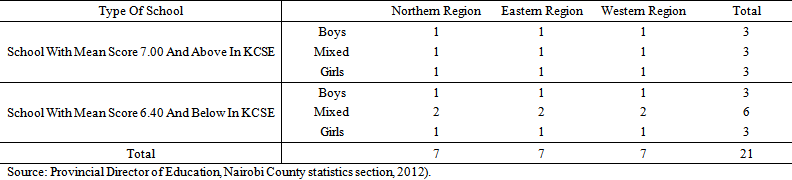
The schools were first grouped into three strata based on the major regions of Nairobi County namely, the Eastern, Western and Northern regions. According to Mugenda (1999, p. 43), a sample size of 30% of the target population is acceptable, representative and reliable. This percentage was used to work out the number of schools to be sampled from each of the three regions.
A total of 21 schools were sampled out of the 73 public secondary schools, this representing 30% of the total.


 PowerPoint Slide
 Larger image(png format)
 View current table in a new window
A total of 21 schools were sampled out of the total 73 public secondary schools, this representing 30% of the total.
The national schools were not included in the study since one region did not have any national school and also because the entry behavior of most students in national schools is higher compared to those of their counterparts in provincial schools. The national schools also have better learning facilities and resources as compared to the provincial schools and these could influence the student academic outcomes.
1.5. Sampling of TeachersThe list of teachers as it appears in the staff attendance register was used to draw the sample. According to the records from the County Director of Educations’ office, there were 990 teachers in the 73 Public secondary schools in Nairobi County (County Director of Education, Nairobi County statistics section, 2012).
A total of 25% of the teachers in Nairobi County was included in the sample, giving a total of 210 teachers out of a total of 990. The teachers in each school were selected through stratified sampling by dividing the teaching staff into both genders. The purpose of stratified sampling was to guarantee the desired distribution among the selected subgroups of the population. The ten teachers per school were selected through systematic sampling. Five teachers (50%) were selected from each gender. The sampling frame was numbered in sequential order from one to the total number of teachers in each school.
Students were stratified on the basis of gender i.e. Male and female, and then assigned a consecutive number from 1 to N. A total of ten students were selected from each school in each of the strata. In this study, randomization was done when sampling the teachers and students.
1.6. Sampling of PrincipalsThe principals of the participating schools were selected through non probability sampling since they were automatically selected. This made a total of twenty one 21 (100%) principals who were included in the study. Kerlinger (1992, p. 510) explained purposive sampling as a type of non-probability sampling, which is characterized by the use of judgment and a deliberate effort to obtain representative samples by including typical areas or groups in the sample. The disadvantage of this non probability sample is that it does not use random sampling which makes the sample unacceptable for generalizing back to the population. Dane (1990) points out that the main advantage of purposive sampling is that it allows the researcher to select people or events that were critical for the research. This non probability sampling was useful to the study because principals are the leaders of their schools and it is their leadership attributes that the research seeks to establish.
1.7. Sampling of StudentsA form four class list from each eligible school formed the sampling frame. Students were stratified on the basis of gender i.e. Male and female, and then assigned a consecutive number from 1 to N. A total of ten students were selected from each school.
1.8. Research InstrumentsThe researcher conducted Document Analysis, used Questionnaires and an Interview guide specifically for data collection.
1.9. Document AnalysisSchool documents that are relevant, schemes of work, registers, records of work covered, and attendance records were examined to ascertain that proper teaching take place in the secondary schools. This was done with a view to obtaining the principals’ supervisory role in curriculum implementation in the selected schools. In examining the records the researcher used a document analysis schedule. Documents from the County Director of Education were also examined to establish the overall performance in the County over the past 5 years.
Cronbach's Alpha was calculated to establish the reliability of the questions. The items were considered reliable if they yielded a reliability coefficient of 0.753 and above (Kouzes & Posner, 2002b). Cronbach’s alpha in this study was 0.869; the instrument was considered to have adequate reliability and was used.
Face Validity was used to determine the validity of the instruments Professionals and experts were given the questionnaires to examine and make recommendations.
1.10. Teachers, Students and Principals’ QuestionnairesThe first section (Section A) comprised the demographic information.
Section B of the Instrument solicits information on transformational leadership based on the full range leadership model that examines the extent to which transformational, transactional and laissez fare leadership is exhibited by the principals. It had questions seeking to establish the extent to which transformational leadership correlates to student achievement.
1.11. Assessment ScalesIn the current study, intellectual stimulation e.g., providing extra training and improving resources to inspire staff and individual consideration e.g. giving more authority and giving power and responsibility to make decision, to the teachers that lead to the expected teacher output such as improved teacher classroom management towards the achievement students was explored. These constructs of transformational leadership was rated on a scale of 1-5 by use of a Likert scale where 5 is the highest score for the positive scale.
2. Results
The data was collected from secondary school teachers, students and principals by use of questionnaires and interview guides. Some of the items in the questionnaires required the respondents to state the degree of agreement (A 5-point Scale with scores ranging from 1=strongly disagree to 5=strongly agree). This Likert scale was used to establish the respondents’ perceptions of the principals’ transformational leadership. Scores on the items were averaged to yield a summary score representing principals’ transformational leadership.
The study employed a mixed method approach. Both descriptive statistics and inferential statistics were used to summarize data. Descriptive statistics, namely frequency tables, means and percentages were used to summarize data so as to establish patterns emerging from the data. Inferential statistics, namely “Pearson’s r” correlation was used to determine the nature of relationship for each of the research variables. The results are presented in line with the research objectives:
To find out the extent to which the principals in Nairobi County exhibit transformational leadership Teachers' Perception of the Principals' Intellectual Stimulation the mean of the principals’ transformational leadership variable of Intellectual stimulation was calculated using SPSS.

 PowerPoint Slide
 Larger image(png format)
 View current table in a new window
The attribute of principals’ intellectual stimulation had a mean range from (M=3.62 to M=4.30), with an average mean of (M=4.02).
Teachers’ Perception of the Principals’ Individualized Consideration
The mean of the principals’ transformational leadership attribute of Individualized consideration was calculated using SPSS.

 PowerPoint Slide
 Larger image(png format)
 View current table in a new window
The range of the mean was from (M=3.51 to M=4.22), collectively being (M=3.64), which is an average score on the Likert scale. This score is important to the study in that it indicates that a number of the teachers agreed that their principals exhibited low levels of Individualized consideration.
Students’ perception of the principals’ Transformational Leadership Subscale of Intellectual Stimulation (IS) and Individualized Consideration(IC)
i. Intellectual Stimulation
The mean of the principals’ transformational leadership attribute of Intellectual stimulation was calculated using SPSS. This score is important to the study in that it indicates that majority of the students also agreed that their principals exhibited intellectual stimulation. Their perception therefore was that the principal encourages them to be innovative and creative.

 PowerPoint Slide
 Larger image(png format)
 View current table in a new window
Students’ perception of the attribute of Intellectual Stimulation had a mean range from (M=3.99 to M=4.34), with an average mean of (M=4.13: agree)

 PowerPoint Slide
 Larger image(png format)
 View current table in a new window
The range of the mean was from (M=3.76 to M=3.94), collectively being (M=3.36: agree), which is an average score since it is just above the mid (3.0) level on the Likert scale.
To determine the correlation between the principals’ transformational leadership and student academic achievement
A Pearson correlation was run to determine the relationship between student perception towards principals’ leadership style and student achievement.
Table 6. Correlation between Students’ Perception of Principals’ Transformational Leadership and Academic Achievement

 PowerPoint Slide
 Larger image(png format)
 View current table in a new window
The findings presented in Table 6 indicate that there was a negative correlation between student perception towards principals’ leadership and student achievement, which was not statistically significant (rho = -.032, p = .671) since p = .671, higher than 0. This indicates that the variables move in tandem. It was concluded that when student perceptions increase then the student achievement also decreases.
Table 7. Correlation between the Teachers’ Perception of Principals’ Transformational Leadership and Academic Achievement

 PowerPoint Slide
 Larger image(png format)
 View current table in a new window
These results indicate that the principals’ leadership may directly influence student academic achievement. A Pearson correlation was equally run to determine the relationship between teacher perception towards principals’ leadership and student achievement. The findings are presented in Table 7.
The findings indicated that there was a strong, positive correlation between teacher perception towards principals’ transformational leadership and student achievement, which was not statistically significant (rho = .057, p = .452). This indicates that the variables move in tandem. It was concluded that when teacher perceptions increase then the student achievement increases as well.
3. Discussions
Objective one set out to find out the extent to which the principals in Nairobi County exhibit transformational leadership, that was measured through teachers and students’ perceptions of their principals’ transformational leadership attributes of intellectual stimulation and individualized consideration. This score indicated that majority of the teachers agreed that their principals exhibited average intellectual stimulation. Their perception therefore was that the principal encourages them to be innovative and creative. They encourage new ideas from the teachers and never criticize them publicly for the mistakes committed by them. This gives the teachers room for innovation and personal growth. Jantzi and Leithwood (1996) contend that the best way to accomplish increasing the level of intellectual stimulation is for the principal to share knowledge with staff in the school, which encourages them to look at past problems in new ways so problem-solving, can occur. Intellectual stimulation occurs when the principals encourage teachers to reevaluate what they are doing for students in the school. They would need to re evaluate their teaching styles and general classroom management. The reflection can thus lead to professional development that provides opportunities for teachers to learn new information which would challenge their current practices.
Intellectual stimulation also occurs when the principal challenges teachers to re-examine assumptions they have about their job role (Mees, 2008). For example, the principal can challenge the teachers to make a contribution towards the management of student discipline or suggest strategies required to improve student academic achievement. When a principal focuses intellectual thought, knowledge, and insight toward building relationship between teachers and parents and teachers and students, these groups develop greater capacity to work together for the common good of the student. These efforts result in higher levels of trust among the teacher, parent, and student, with students generally accepting greater responsibility for their schooling. Therefore, principals should focus efforts on those behaviors and activities that foster intellectual stimulation. They should challenge staff to reexamine their assumptions about their work, including those related to building collaborative relationships with parents and students. They should challenge staff to think about how to better perform their work.
Principals should help teachers think of ways to more effectively implement the school’s programs and achieve the school’s mission and vision. Principals should provide materials to, and support conversations among teachers about teaching and learning. They should provide the opportunity for teachers to study data and compare their analyses with data from highly effective schools. In essence, principals must foster more reflective and deeper thought among teachers about the teachers’ assumptions and work.
On the other hand, a transformational principal rated with a high mean attribute of individualized consideration sees the value in developing personally or professionally (Bass, 1990), and showing concern about staff members’ needs and feelings (Jantzi & Leithwood, 1996; Leithwood et al.,1999). This in turn would have an impact on the teachers and how they execute their duties in the school. It entails helping people by giving personal attention to teachers (Bass, 1990), assisting individuals when they are struggling. This attribute entails the principal identifying the positive attributes of staff and students and publicly recognizing those who have contributed to school improvement. This is a valuable practice that can help in the enhancement of a good school culture and ultimately improvement in students’ academic achievement. In comparison however, the principals’ intellectual stimulation (M=4.02) was practiced more by the principals compared to individualized consideration (M=3.64). These findings concur with a study by Jacobson (2011) that established that intellectual stimulation and charisma were displayed rather frequently and that comparatively, principals’ individualized consideration was the least observed behavior. Perhaps, this can be explained by the notion that is humanly impossible and unworkable for one person (the principal) to give individual attention to every teacher in the school in every area of need.
A principal who understands the unique needs of each staff member and is thoughtful of each individual’s personal needs will be able to build personal relationships with these individuals. The caring and respectful personal relationship formed by being attentive to the personal needs of the teacher creates greater teacher motivation which is channeled into harder work on behalf of schools (Bass &Avolio, 1987).
Students’ perception of the attribute of Intellectual Stimulation had a mean range from (M=3.99 to M=4.34), with an average mean of (M=4.13: agree) .The students score for the principals’ intellectual stimulation(IS) was higher than the teachers’ score of the principals’ IS that was (M=4.02). The principals were reported to encourage new ideas from the students and never criticized them publicly for the mistakes committed by them. The scores of individualized consideration however was average and hence the need for principals to develop the attribute more. The students’ responses on this variable are lower than the score of the teachers (M=3.64) on the same variable.
Interesting to note that there is a negative correlation on relationship of student perceptions and student achievement and a positive correlation on teacher perceptions and student achievement. There is evidence that principals who exhibit transformational leadership do create a positive school climate and culture (Barnett, McCormick, & Conners, 2001; Leithwood & Jantzi, 2000b; Maehr et al., 1996), and indirectly improved student achievement (Hallinger & Heck, 1998; Jantzi & Leithwood, 1996; Verona & Young, 2001).
4. Summary
Relationship between student perception towards principals’ transformational leadership and student achievement
The study found that principals in Nairobi County exhibited low levels of transformational leadership. The findings as whether there is a relationship between student perceptions towards principals transformational leadership and student achievement indicated that there was a moderate, negative correlation between student perception towards principals’ leadership style and student achievement, which was statistically significant. This indicated that the variables do not move in tandem. It was concluded that when student perceptions increase then the student achievement decreases and vice versa. This can be attributed to the fact that students interact more with teachers than the principals unless when the principal is teaching directly. Interestingly enough, when the attributes of intellectual stimulation and individualized consideration were correlated with student achievement separately, positive correlation was observed.
Relationship between teacher perception towards principals’ transformational leadership and student achievement
The findings indicated that there was a strong, positive correlation between teacher perception towards principals’ transformational leadership and student achievement, which was statistically significant. This indicates that the variables move in tandem. It was concluded that when teacher perceptions increase then the student achievement increases as well and vice versa. When teachers are involved in decision making and general management of the school, they become motivated and put more effort in their work, ultimately making a positive influence on the students’ academic achievement.
Relationship between the principals’ attribute of individualized consideration, intellectual stimulation and student academic achievement.
The findings indicated that there was a, positive correlation between teacher perception of principals’ individualized consideration and student achievement, which was statistically significant. This indicated that the variables move in tandem. According to these findings, as principals’ individualized consideration increased, student academic achievement increases. The findings also pointed towards a positive correlation between the principals’ intellectual stimulation and academic achievement which was statistically significant. These findings also indicate that as the principals’ intellectual stimulation increases, student academic achievement also increased and vice versa.
5. Conclusion
The major task in this study was to investigate the relationship between the principals’ transformational leadership and students’ academic achievement in public secondary schools in Nairobi County, this being with the aim of ensuring quality education. Student academic achievement in Nairobi County has been on decline especially as observed by the performance of most public secondary schools in national examinations. The researcher reviewed previous studies with a view to establish academic gaps which the present study sought to bridge. The study employed both qualitative and quantitative research paradigms.
The target population included all the principals in public secondary schools, teachers and form 4 students in Nairobi County. The sample size was 21 principals, 210 teachers and 210 form 4 students drawn from the three regions in the county (Western, Eastern and Northern regions) making a sample size of 441 respondents. In the final analysis, 18 principals, 180 teachers and 179 students returned the questionnaires, making a total of 377 questionnaires. One of the important contributions of the present study is that it underscores the indirect relationship between the Principals’ leadership and student academic achievement. It also highlights that principals can succeed in making their schools effective through exhibiting transformational leadership and working closely with their teachers.
Based on the findings of this study, the following main conclusions were made:
Firstly, and conclusively, strong principal leadership was perceived to be one of the most important contributory factors to a school’s success and quality school management. This is because of the findings that have correlated transformational leadership to student academic achievement. Other important factors include a more disciplined environment, better academic approach in teaching and learning process, teachers’ dedication and cooperation, team spirit and good teacher-student relationship.
Secondly, this study reinforces previous findings that the principals’ influence on students’ academic achievement is indirect, and the principal has a significant relationship with other variable in the school environment that ultimately impact on student academic achievement. This is so because, the research established that most of the principals hardly taught in the school even though the curriculum based establishment (CBE) is usually calculated with the principals being expected to have a teaching load that corresponds to the size of the school (for example, in a single stream school, the principal is supposed to have a teaching load of at least 12 lessons per week, in a double stream school, the load is supposed to reduce to 8 lessons per week etc.). The research established a correlation that was statistically significant between principals’ transformational leadership and student academic achievement, especially when teacher perceptions were analyzed. It was interesting to note that student perceptions of the principals’ transformational leadership however did not move in tandem with student academic achievement. These findings point to other variables in the school that are influenced by school leadership that ultimately impact on student academic achievement, hence the indirect effect argument.
Thirdly, the study established that there were variations in teacher’s and students’ perception of their principal’s transformational leadership. Each teacher and student perceived his or her principal uniquely. This is consistent with other research that has contended that leadership is implicit in nature and based on information processing of individuals (Hall & Lord 1995).
Fourth, the researcher postulate that in order for improved school performance (as seen through student achievement) to take place, school principals should work closely with teachers. Principals spend more time with teachers whereby they provide direction and guidance, assess and provide needed resources, observe and evaluate performance, than with students. Thus, principal behaviors more directly affect teachers’ job satisfaction, commitment to work and performance, accordingly, the principals have stronger relations to outcomes associated with teachers than with students. The study revealed that it is important to have decisive and goal-oriented school leadership in the schools, which also really empowers the teachers in terms of true delegation of power.
According to the findings, it is evident that principals of public secondary schools today have to be transformational rather than being transactional so as to be able to manage the change process successfully. It has also become evident that school leadership cannot be regarded as the sole responsibility of the principal. Leadership should be regarded as team effort and permeate every role in the school.
This study concludes that many intervening variables affect student academic achievement, some of which the principal and the school have no control but, they do have control over how they manage the school and the culture and environment they create.
On the basis of the findings of the research, recommendations are made aimed at training and empowering principals of secondary schools with transformational leadership skills, and more so, the principals’ ability to develop and share an inspiring vision of the organization’s future. For instance, the principal needs to appreciate the importance of guiding staff to set targets and putting strategies in place to achieve the set targets. At the same time, the principals should behave in ways that bring out the best in individuals and teams. Recommendations were also made on the strategies to enhance student academic achievement in secondary schools in Nairobi County.
The results indicated that the transformational leadership attributes of intellectual stimulation and individualized consideration correlated with student academic achievement. The study therefore recommends the strengthening of these attributes in the principals through training so that student academic achievement can be enhanced.
References
| [1] | Abdalla,T., & Bujra, N. (2009). Social Policy, Development and Governance in Kenya. An Evaluation and Profile of Education in Kenya. Nairobi: Development Policy Management Forum (DPMF). | ||
 In article In article | |||
| [2] | Aduda, D. (2010, February 28). KCSE 2010 Results out. Daily Nation, p. 11. | ||
| In article | |||
| [3] | Amahukpati, C. (2009). Transformational Leadership and Teacher Job Satisfaction: A Comparative Study of Private and Public Tertiary Institutions in Ghana. (Unpublished M.Sc Thesis). University of Ghana, Ghana. | ||
| In article | |||
| [4] | Amoroso, P. (2002). The impact of principals Transformational Leadership Behaviour on Teacher commitment, and Teacher Job Satisfaction. (PhD Dissertation). New Jersey: Senton Hall University. | ||
| In article | |||
| [5] | Avolio, B. J., & Bass, B.M. (1988). Transformational leadership and Beyond. In J.G Hunt, B.R. Balanga. New York: Pergamon Press. | ||
| In article | |||
| [6] | Bandura, A. (1986). Social foundations of thought and action. Englewood Cliffs. N.Jersey: Prentice Hall. Barling, J., Weber, T., & Kelloway, E. (1996). Effects of transformational leadership training and attitudinal and financial outcomes: A field experiment. Journal of Applied Psychology, 81(6), 827-832. | ||
| In article | |||
| [7] | Barnett, K., McCormick, J., & Conners, R. (2001). Transformational leadership in Schools—panacea, placebo, or problem? Journal of Educational Administration, 39(1), 24-46. Retrieved March 1, 2010, from ProQuest Education Journals. | ||
| In article | CrossRef | ||
| [8] | Bass, B.M. & Avolio, B.J. (1994). Improving Organizational Effectiveness through Transformational Leadership, Sage Publications, Thousand Oaks, CA. | ||
| In article | |||
| [9] | Bogler, R. (2002). Two profiles of schoolteachers: a discriminate analysis of job Satisfaction. Teaching and Teacher Education, (18), 665-673. | ||
| In article | CrossRef | ||
| [10] | Borg, M. G. & Falzon, J. M. (1989). Stress and job satisfaction among primary school teachers in Malta. Education Review, 41, 271-279. 185 | ||
| In article | CrossRef | ||
| [11] | Burns, J. M. (1978). Leadership. New York: Harper & Row publishers. | ||
| In article | |||
| [12] | Caldwell, B. (1994). Leading the transformation of Australians schools. Educational Management and Administration, 22 (2), 76, 84. | ||
| In article | CrossRef | ||
| [13] | Conley,D. T.,& Goldman,P. (1994). Ten propositions for facilitative leadership. In J. Murphy& K. S. Louis (Eds.), Reshaping the principalship: Insights from transformational reform efforts (pp. 237-262). Thousand Oaks, CA: Corwin Press. | ||
| In article | |||
| [14] | Creswell, J. W. (1994). Research design: Qualitative and quantitative approaches. Thousand Oaks, CA: SAGE Publications. | ||
| In article | |||
| [15] | Creswell, J. (2002). Educational research: Planning, conducting, and evaluating Quantitative and Qualitative research. Upper Saddle River, NJ: Merrill Prentice Hall. | ||
| In article | |||
| [16] | Dolence, G., & Norris, D.M. (1995). Transforming higher education for colleges and University planning. USA: Ann Arbor. | ||
| In article | |||
| [17] | Ejimofor, F.O. (2005). Principals’ Transformational Leadership Skills and their teachers’ Job satisfaction in Nigeria. Unpublished Doctor of Philosophy Dissertation, Cleveland State University. | ||
| In article | |||
| [18] | Fleming, S. (1996). Leadership for teacher empowerment: the relationship between the Communication skills of principals, transformational leadership, and the Empowerment of teachers. Doctoral dissertation, University of New Orleans, New Orleans, USA. | ||
| In article | |||
| [19] | Fullan, M., & Miles, M. (1999). Getting school reform right. In Gultig, J., Ndhlovu, T. and Geisjel F, Sleeger P. and Van den Berg R. (1999). Transformational Leadership and the implementation of large scale innovation programs. Journal of Educational Administration 37(4). | ||
| In article | |||
| [20] | Hallinger, P., & Heck, R. (1999). Next generation methods for the study of leadership and school improvement, in Murphy, J. and Louis, K. (eds.), Handbook of Research on Educational Administration, 2nd edition, San Francisco, Jossey Bass, (141-62). | ||
| In article | |||
| [21] | Heyneman,G. & Loxley, K. (1983). “The Effect of Primary School Quality On Academic Achievement across Twenty Nine High Cost and Low Income Countries”. American Journal of Sociology. 88, 162-198. | ||
| In article | CrossRef | ||
| [22] | Hutchinson, S. (1990). Education and grounded theory. In Sherman, R.R. (Ed). Qualitative Press. | ||
| In article | |||
| [23] | Jacobson, S. (2011). Leadership Effects on Student Achievement and Sustained School Success. International Journal of Educational Management, 25(1), 33-44. | ||
| In article | CrossRef | ||
| [24] | Jantzi, D., & Leithwood, K. A. (1996). Toward an explanation of variation in teachers Perception of transformational leadership. Education Administration Quarterly, 32, 512-538. | ||
| In article | CrossRef | ||
| [25] | Karagu, N.M. (1992). “A Study of Perceptions of Head teachers and teachers pertaining to the role of Head teachers in Thika, Kenya. Unpublished PhD Dissertation, University of Nairobi. | ||
| In article | |||
| [26] | Kenya National Examinations Council (2012). The 2012 Kenya Certificate of Secondary Education (KCSE) Examination Essential Statistics. www.knec.co.ke. | ||
| In article | |||
| [27] | Kerlinger, F., & Lee, H.B. (2000). Foundations of Behavioral Research. U.S.A: Earl Mc Relationship Duration. Leadership & Organization Development Journal, 26 (6), 442-57. | ||
| In article | |||
| [28] | Leithwood, K., Jantzi, D., Steinbach, R. (1999). Changing leadership for changing times. Buckingham: Open University Press. | ||
| In article | |||
| [29] | Ministry of Education (2011). Provincial Director of Education, Analyzed KCSE Results 2008-2010). Mulford, B. (2003). The Role of School Leadership in Attracting and Retaining Teachers and Promoting. Innovative Schools and Students. Retrieved on April 23, 2012, from http://www.dest.gov.au/. | ||
| In article | |||
| [30] | Mwiria, K., Ngome, C., Ouma, D., Wawire, V., & Wesonga, D., (2007). Public and Private Universities in Kenya. New York: James Currey. | ||
| In article | |||
| [31] | Nsubuga, Y. (2003). Analysis of Leadership Styles and school performance of secondary Schools in Uganda. Patton, M.Q. (1990). Qualitative evaluation and research methods. (2nd Ed). California: SAGE. | ||
| In article | |||
| [32] | Pitner, N. J. (1988). The study of administrator effects and effectiveness. In N. Boyan (Ed.), Handbook of research in educational administration (pp.99-122). New York: Longman. | ||
| In article | |||

 CiteULike
 Mendeley
 StumbleUpon
 Delicious
 Facebook
 Twitter
 LinkedIn
 Print
Print