This study employs Network Analysis to examine the cognitive structure of teacher knowledge within the Technological Pedagogical Content Knowledge (TPACK) framework among 600 pre-service mathematics teachers in West Bengal. Utilizing the TPACK-Math Scale by Önal [1], the research explores the integration of eight knowledge domains: Content (CK), Pedagogical (PK), Technological (TK), and Contextual Knowledge (CNTK), along with their intersections. The network is remarkably dense, with a sparsity value of 0.143, indicating that 86% of theoretical relationships are empirically present. Technological Pedagogical Knowledge (TPK) emerged as the primary functional hub, showing the highest closeness (1.237) and strength (1.135). Pedagogical Knowledge (PK) acts as a critical bridge (betweenness = 0.917) connecting content mastery to technology. Both TK and CNTK exhibit negative centrality, suggesting these domains remain isolated from the broader pedagogical reasoning. Furthermore, Technological Content Knowledge (TCK) forms a siloed, redundant module with exceptionally high clustering coefficients (e.g., Zhang = 2.193). A negative correlation exists between TK and PCK (-0.071), suggesting that excessive focus on pure technology can inhibit the development of situated pedagogical expertise. The PK-CK axis remains the strongest relationship (weight = 0.480), serving as the framework’s foundational ‘spine’. The study concludes that while teachers have synthesized pedagogical and technological processes, professional development must transition from general technology training to network-rebalancing approaches. Recommendations include anchoring technology use in content-specific pedagogical goals and strengthening the links between technical skills and local classroom contexts to foster a more resilient and adaptive teaching expertise.
The integration of technology into modern education requires more than just technical proficiency; it demands a sophisticated synergy of various knowledge domains. Since Shulman 2 first established the framework for teacher knowledge encompassing content, pedagogy, and curriculum the field has evolved to address the digital era. This evolution led to the development of the Technological Pedagogical Content Knowledge (TPACK) framework by Mishra and Koehler 3, which describes the complex interplay between technology, teaching methods, and subject matter.
While numerous studies have explored different facets of TPACK globally, recent research has increasingly focused on specific educator populations, such as science teachers in Malaysia or elementary mathematics educators. However, there remains a need to understand the internal ‘cognitive architecture’ of these knowledge domains how they connect, overlap, or exist in isolation within a teacher’s mind.
This study investigates the TPACK framework among 600 pre-service mathematics teachers in West Bengal, India. Moving beyond traditional self-assessment scales, this research utilizes Network Analysis to map the knowledge base of these educators. By applying metrics such as centrality indices and clustering coefficients, the study identifies which knowledge domains such as Technological Pedagogical Knowledge (TPK) or Pedagogical Knowledge (PK) act as central hubs or critical bridges in the instructional process.
The ultimate goal of this analysis is to move beyond a ‘fragmented’ view of teacher expertise. By identifying ‘bubbles of nothing’ or isolated knowledge isolation like Technological Content Knowledge (TCK), the research provides a roadmap for more effective, context-sensitive professional development in the twenty-first century.
Shulman 2 established a framework for teacher knowledge that includes ‘content knowledge, general pedagogical knowledge (e.g., classroom management, group work), pedagogical content knowledge, curriculum knowledge, understanding of learners and their characteristics, awareness of educational contexts (e.g., schools and the broader community), and comprehension of educational ends, purposes, and values.’ Technological Pedagogical Content Knowledge (TPCK) is the combination of technology, teaching methods, and subject matter knowledge (Mishra & Koehler, 3). Koehler and Mishra 4 opined that TPCK is a broad strategy that brings together effective methods for teaching content and the basics of good teaching with technology and technology-assisted idea presentation. There have already been a number of studies on TPACK that looked at different aspects of it (Groth et al., 5; Guerrero, 6; Niess et al., 7; Özgün-Koca et al., 8; Gupta and Jan, 9; Kumar, 10; Mahato and Sen, 11, 12. Sen 13, 14 and Sen and Samanta 15, 16, 17, 18 underscored the importance of pedagogical content knowledge (PCK) within the framework of TPACK. Schmid et al. 19 conducted a study to evaluate preservice teachers’ self-reported TPACK regarding the incorporation of digital technology into their lesson plans. Gayen and Sen 20 performed a study emphasizing the imperative of incorporating technology into the educational process to improve learning outcomes. Chieng and Tan 21 undertook a study to examine Malaysian secondary science teachers’ perceptions regarding the incorporation of ‘information and communication technology’ within the TPACK framework. Bulut and Isiksal-Bostan 22 investigated a study concentrating on the evaluation of the TPACK self-assessment of pre-service elementary mathematics educators, particularly in the domain of geometry. The main goal of a study carried out by Ozudogru and Ozudogru 23 was to create and validate a TPACK scale intended to evaluate maths teachers’ knowledge levels across the different TPACK framework components. A study by Hsu and Chen 24 examined the variables affecting teachers’ technological, pedagogical, and content competency in the digital era. Sen and Saha 25 examined the TPACK profiles of 503 pre-service mathematics teachers in West Bengal using Mahalanobis Distance. Findings revealed that high reliability and strong PK-CK integration, yet identify TCK as a relative weakness. Crucially, no significant differences were found based on gender or residence.
Hevey 26 explained network analysis very interestingly in the form of a tutorial. Not all nodes in a network have equal importance in determining the network; ‘centrality indices’ provide a view of the importance of a node in relation to other nodes in the network (Freeman, 27; Borgatti, 28). For example, a central symptom has many connections in a network and hence can influence all the symptoms in the network through its activity in the symptoms network. On the other hand, a peripheral symptom is located at the periphery of the network and hence has fewer connections and less influence over the network. There are different ‘centrality indices,’ which provide different insights. To show the relative importance of the nodes, the indices may be displayed as ‘standardized z-score’ indices, and assessing centrality requires careful consideration of all the dimensions taken together. These indices can be used to model or predict various network processes, such as the volume of flow through a node or the network’s resilience to the removal of particular nodes. They are derived from the connection patterns in which the node in question is involved (Borgatti, 28). The following are the aspects of centrality that are most commonly examined. The number of connections connected to the node in question determines its degree of centrality (Freeman, 27). A node’s ‘weighted number’ and intensity of all its connections to other nodes are added up to determine its direct connections to other nodes. While degree provides information about the number of connections, strength can provide more context about the node’s importance. For example, a node with many ‘weak connections’ (high degree) might not be as ‘central to the network’ as one with fewer but ‘stronger connections.’ However, as noted by Opsahl et al. 29, concentrating only on ‘node strength’ as a gauge of significance can be deceptive since it ignores the quantity of ‘other nodes’ it links to. Therefore, when evaluating a node’s centrality, it is essential to take into account both ‘degree’ and ‘strength’ as indicators of a node’s degree of involvement within its surrounding network. By taking into consideration ‘indirect links’ that originate from a node, the ‘closeness index’ calculates a node’s connections to every other node in the network. A central node with a high closeness index will quickly experience changes occurring in ‘any segment of the network’ and can also quickly induce changes in various parts of the network. A high closeness index indicates a short average distance between a specific node and all other nodes (Borgatti, 28). The ‘betweenness index’ shows the importance of a node in the ‘average pathway’ that links other node pairs. If a node regularly serves as a link along the ‘shortest path’ between two other nodes, it can be considered pivotal in the network and play a major role in the connections that exist between these other nodes (Saramäki et al., 30; Watts & Strogatz, 31). According to Saramäki et al. 30, clustering is the degree to which a node is a part of a cluster of nodes. The ratio of current edges among a node’s neighbours to all possible edges among those neighbours is represented by the local clustering coefficient C (Bullmore & Sporns, 32). This coefficient illuminates a node’s ‘local redundancy,’ showing whether the removal of that node impacts the capacity of nearby nodes to influence one another. In both ‘undirected’ and ‘directed’ settings, the network’s overall ‘global clustering coefficient,’ also referred to as ‘transitivity,’ can be calculated.
Communities, which are groups of nodes with weak connections to nodes outside their group but strong internal connections, may also make up the entire network. Researchers must use formal statistical techniques to examine the underlying patterns in order to identify communities, rather than merely focusing on the visual arrangement of nodes. Fried 33 describes a number of methods to help with community detection. Since ‘latent variable models’ and ‘network models’ are mathematically equivalent, one method of figuring out how many communities there are is to use ‘exploratory factor analysis’ to analyze the ‘eigenvalues’ of the data’s components. Factor loadings show which nodes belong to which communities. The spinglass algorithm is a more advanced method, but it has some problems. For example, it only allows nodes to belong to one ‘community,’ which may not be true for nodes that belong to more than one community. It was noted that although more stable results were usually obtained when the walktrap algorithm was run repeatedly, nodes were still only permitted to belong to a single ‘community’. On the other hand, the ‘Clique Percolation Method (CPM)’ lets nodes be part of more than one ‘community’ (Blanken et al., 34). A ‘Barrat clustering plot’ in network analysis is a graph that shows the clustering coefficient for each node in a network using the ‘Barrat method.’ This method is designed to take into account weighted connections, which means it looks at how strong the relationships are between nodes when figuring out the clustering coefficient. In network analysis, the ‘Onnela clustering algorithm’ is a way to find groups of nodes in a network, especially when the connections are weighted. In financial networks, this method is often used, with the weights showing how strongly different assets are related to each other. It is mostly based on Jari Onnela’s weighted clustering coefficient calculation, which takes into account the strength of connections when figuring out how connected nodes are within a cluster. The ‘Watts-Strogatz’ network has a high clustering coefficient, which means that small groups of nodes that are closely related to each other tend to form cliques. As beta gets closer to its highest value of 1.0, hub nodes, or nodes with a high relative degree, become more common. The ‘Wattz-Strogatz’ measure is 0 for every node because it finds the shortest path to its neighbors. All of the values are the same because the direct paths are also the shortest paths between nodes in this correlation network. This study presented an algorithm for two-dimensional cluster analysis of component groups, initially developed by Zhang et al. 35. The algorithm consists of three procedures: the calculation of distance measures, a randomization statistical test, and the ordered clustering of components.
The primary objectives of the study are as follows:
• Evaluate the Integration of Knowledge Systems: The study aims to determine how well-integrated and cohesive the knowledge base of pre-service mathematics teachers is by examining global properties such as network sparsity.
• Identify Functional Hubs and Control Centres: Using centrality measures (betweenness, closeness, strength, and expected influence), the research seeks to identify which specific knowledge domains act as the primary engines of teacher expertise.
• Analyze Technological Pedagogical Knowledge (TPK): A key goal is to assess the dominance of TPK and its role as a mediator between raw technical skills and effective instruction.
• Examine the Role of Pedagogical Knowledge (PK): The study investigates PK’s function as a ‘bridge’ or ‘gatekeeper’ that facilitates the integration of content knowledge with technology.
• Identify Knowledge Isolation and Silos: The research aims to pinpoint isolated domains, specifically Technological Knowledge (TK) and Contextual Knowledge (CNTK), and detect siloed modules like Technological Content Knowledge (TCK) through clustering coefficients.
• Determine Direct Influences and Inhibitory Connections: By analyzing the weights matrix, the study seeks to measure the precise direct influence one domain has on another and identify ‘inhibitory connections’ where technical focus might crowd out pedagogical expertise.
• Provide Strategic Instructional Recommendations: The final objective is to propose targeted professional development interventions such as ‘network-rebalancing’ to bridge gaps and optimize teacher expertise for modern challenges.
The methodology for this study utilizes a systematic approach to map the cognitive connections of pre-service teachers through advanced statistical modelling.
The study employs a Descriptive Survey Method to gather data on the professional knowledge base of educators. The participant pool consists of 600 pre-service trainee teachers pursuing their B.Ed. degrees in West Bengal. These participants were selected via a Stratified Random Sampling method and specifically represent those who have chosen Mathematics as their primary method subject.
Ø Instrumentation and Data Collection
To measure the various domains of the TPACK framework, the researchers utilized the TPACK-Math Scale developed by Önal 1. This tool is designed to evaluate teacher knowledge across content, pedagogy, and technology, as well as their contextual intersections.
Ø Data Analysis and Statistical Techniques
The raw data was initially organized using MS Excel before being imported into JASP (version 0.18.1) for specialized analysis. The primary statistical technique used is Network Analysis, which allows for a detailed examination of the knowledge system’s structure. This analysis includes:
√ Global Network Properties: Calculating sparsity and the ratio of non-zero edges to determine the overall cohesion of the knowledge base.
√ Centrality Measures: Assessing Betweenness, Closeness, Strength, and Expected Influence to identify which knowledge domains serve as central hubs or bridges.
√ Clustering Coefficients: Utilizing four distinct algorithms like Barrat, Onnela, Watts-Strogatz (WS), and Zhang to identify local redundancies and siloed expertise within the network.
√ Weight Matrix: Analyzing the partial correlations between domains to determine the direct influence of one variable on another while controlling for the rest of the network.

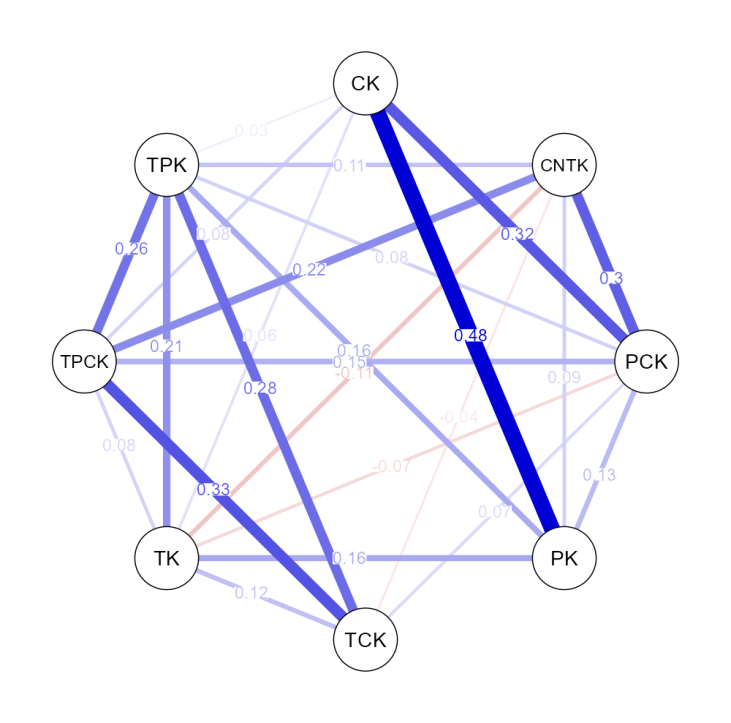
The first indicator of how well-integrated the knowledge system is provided by the global properties of the network. A network of 8 nodes with 24 out of 28 possible non-zero edges was specified in the summary table (Table 1), which resulted in a sparsity value of 0.143. In network science, sparsity is defined as the ratio of absent links to the total possible links within a graph. That the network is remarkably dense is indicated by a sparsity value of 0.143, as approximately 86% of the theoretical relationships between knowledge domains are empirically present in the teacher’s cognitive structure. That the teacher’s knowledge base is not fragmented but highly cohesive is suggested by this high level of connectivity. A ripple effect across the entire framework is highly likely to be triggered by an intervention or development in one domain (e.g., training in a new software tool), potentially influencing pedagogical decisions and content representations simultaneously. The importance of the bubbles of nothing (the 14.3% of missing edges) is reminded by the Swiss cheese analogy of sparsity. That certain domains remain functionally isolated is implied by the absence of four edges in this network (Figure 1), which can lead to cognitive dissonance when a teacher is forced to operate in those gap areas. For instance, if the connection between Technological Knowledge (TK) and Contextual Knowledge (CNTK) is missing or weak, high technical skill may be possessed by a teacher while the judgment to know when those skills are inappropriate for their specific classroom environment is lacked. Which knowledge domains act as the control centres of the teacher’s expertise is identified by centrality measures, which are the primary tools used in this analysis. Which nodes are most critical for the stability and efficiency of the network can be determined by researchers through the calculation of betweenness, closeness, strength, and expected influence.
Centrality measures are the primary tools used in this analysis to identify which knowledge domains act as the control centres of the teacher’s expertise. By calculating betweenness, closeness, strength, and expected influence, researchers can determine which nodes are most critical for the stability and efficiency of the network.

• The Dominance of Technological Pedagogical Knowledge (TPK)
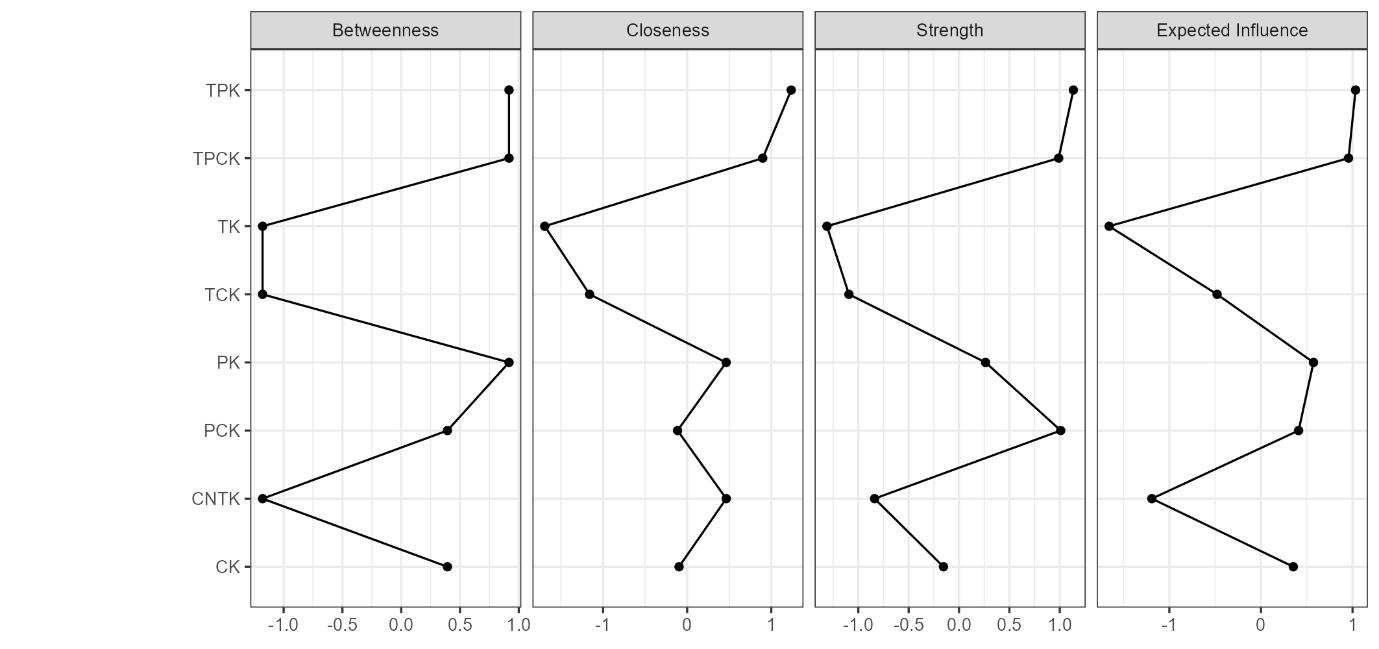
The dominance of Technological Pedagogical Knowledge (TPK) is noted as the most striking feature of the centrality table. The highest closeness (1.237), the highest strength (1.135), and the highest expected influence (1.033) in the entire network are exhibited by TPK. That a node can reach all other nodes through the shortest possible paths is suggested by high closeness in psychometric networks, while that its direct connections are the most intense is indicated by high strength. TPK is identified as the primary functional hub of the framework by this. For the population studied, the most influential factor in their overall knowledge base is suggested to be the ability to understand how technology impacts the process of teaching and learning. The integration of technology is powered by TPK acting as the cognitive engine, which serves as the mediator between raw technical skills (TK) and the ultimate goal of effective instruction (TPACK).
• The Role of Pedagogical Knowledge (PK) as a Critical Bridge
A unique profile with high betweenness (0.917) and high closeness (0.464) is demonstrated by Pedagogical Knowledge (PK). The extent to which a node lies on the shortest paths between other nodes is measured by betweenness centrality. A bridge or a gatekeeper is served by a node with high betweenness. That pedagogical expertise is the essential conduit through which content knowledge must pass to be effectively integrated with technology is suggested by PK’s high betweenness. Without strong PK, the network would likely be fragmented into isolated pockets of content mastery and technical skill, with no functional path connecting them.
• The Peripheral Paradox of TK and CNTK
In sharp contrast to TPK and PK, significantly negative centrality values are exhibited by both Technological Knowledge (TK) and Contextual Knowledge (CNTK). In particular, an expected influence of -1.658 and a closeness of -1.693 are shown by TK, while a betweenness of -1.179 is recorded. These negative scores are not indicators of a lack of knowledge, but rather of isolation. A common phenomenon in teacher professional development the isolation of the technical is reflected by this finding. While high levels of general technology proficiency may be held by teachers, those skills are often unplugged from their pedagogical reasoning and content expertise. That changes in a teacher’s general technical knowledge have little to no predictive impact on their ability to teach with technology is suggested by TK’s negative expected influence, reinforcing the idea that technology training must be situated within subject-specific contexts to be effective. Similarly, that for many educators, their understanding of context remains a separate, non-integrated layer of their professional identity is indicated by the negative centrality of CNTK (-1.191 Expected Influence). This context-blindness is viewed as a critical vulnerability; if CNTK is not central to the network, the teacher’s technological and pedagogical decisions may fail to be adapted to the specific needs of their students or the limitations of their school environment. A deeper look at the local redundancy within the network is provided by clustering measures, through which triangles of domains that are highly interconnected are identified. To ensure the robustness of the findings across different network topologies, four distinct algorithms like Barrat, Onnela, Watts-Strogatz (WS), and Zhang are used in the analysis.
• The TCK Clustering Outlier
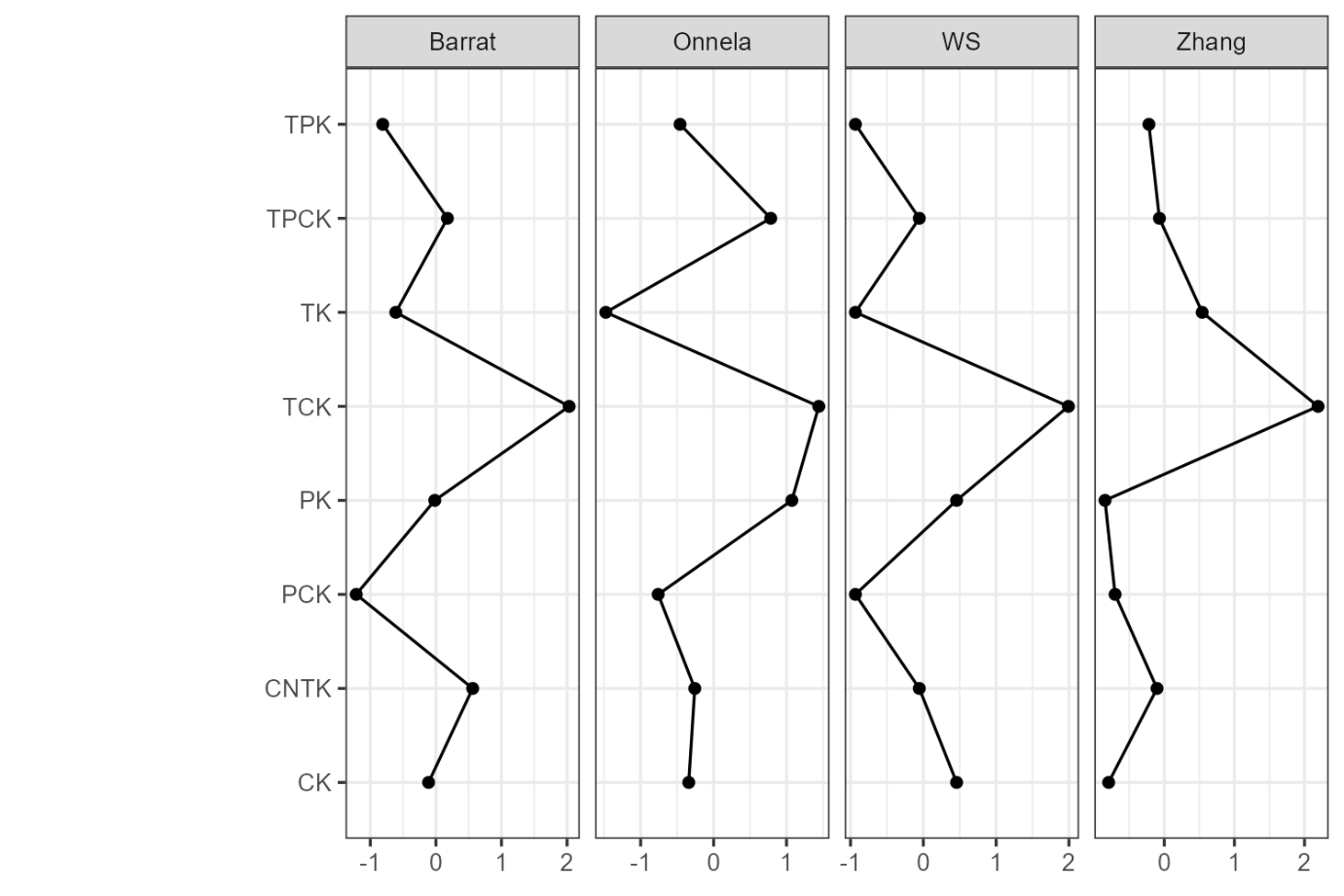
The exceptionally high value for Technological Content Knowledge (TCK) is identified as the most significant anomaly in the clustering data. Clustering coefficients of 2.033 (Barrat) and 2.193 (Zhang) are exhibited by TCK, which are drastically higher than any other variable in the system. The presence of a siloed expertise is indicated by high clustering in a node with low centrality (TCK’s strength is -1.093). That TCK forms part of a very tight, possibly redundant knowledge module is suggested by this. In practical terms, this could mean that the teacher’s understanding of technology-in-content is limited to a few specific, highly familiar tools or topics that are not well-connected to their broader pedagogical strategies. While a specific simulation for a specific science topic may be mastered by the teacher, that knowledge exists in a tight loop that does not inform their general teaching practice (PK) or their understanding of student context (CNTK).


• Variability and Algorithmic Divergence
The sensitivity of the network to the distribution of weights is revealed by the divergence between algorithms, such as the Zhang vs. Onnela values for TK (0.541 vs. -1.478). The presence of connections tends to be emphasized by the Zhang and WS algorithms, while the intensity (weights) of those connections is more sensitively measured by Barrat and Onnela. That while TK is connected to many other nodes, those connections are relatively weak or noisy is suggested by TK’s high Zhang value but low Onnela value. A "jack of all trades, master of none" profile is characterized by this, where a broad but shallow familiarity with various technologies is possessed by the teacher. The partial correlation between each pair of domains, controlling for the influence of all other variables in the network, is represented by the weights matrix. The most precise measure of the direct influence one domain has on another is provided by this.
• The Core Stability of the PK-CK Axis
The strongest positive relationship in the entire network is found between Pedagogical Knowledge (PK) and Content Knowledge (CK), with a weight of 0.480. That the fundamental synthesis of subject matter and teaching methodology remains the most stable and significant component of the teacher’s knowledge, despite the technological turn in education, is highlighted by this. The spine of the TPACK framework is formed by this axis; without it, the entire system would be collapsed into meaningless tool-use.
• The Emergence of the Integrated TPCK Construct
How the central TPACK domain (TPCK) is formed is also revealed by the weight matrix. Its strongest links are shared by TPCK with TCK (0.326) and TPK (0.264), rather than with the primary domains of TK, PK, or CK. Empirical support for the integrative view of TPACK is provided by this: TPCK is an emergent property that arises from the interaction of its sub-domains. TPACK is not jumped to by a teacher; it is built by first mastering how technology represents their content (TCK) and how technology supports their pedagogy (TPK).
• Inhibitory Connections and the Burden of Pure Technology
The presence of negative weights is identified as a critical and potentially overlooked finding in the matrix. Specifically, the link between Technological Knowledge (TK) and Pedagogical Content Knowledge (PCK) is negative (-0.071), as is the link between TK and Contextual Knowledge (CNTK) at -0.108. In psychological networks, inhibitory connections are represented by negative weights. This implies that as a teacher’s focus on purely technical, non-situated knowledge (TK) increases, their focus on pedagogical content knowledge and contextual factors may actually be crowded out or inhibited. That excessive training in general technology can be counter-productive is suggested by this Expertise Reversal Effect, as cognitive resources are drawn away from the nuanced, situated expertise required for effective teaching.
• Context as the Situated Filter
One of the highest weights in the network (0.302) is held by the link between Contextual Knowledge (CNTK) and Pedagogical Content Knowledge (PCK). That the teacher’s understanding of how to teach their subject is deeply intertwined with where and whom they are teaching is revealed by this connection. That Contextual Knowledge often functions as a survival mechanism is highlighted by recent research in regions like West Bengal, India, and various rural contexts in Southeast Asia. In environments with fragile connectivity, intermittent power supply, and infrastructural voids, the teacher’s TPACK is transformed into a form of adaptive expertise, where technology use must be constantly modified by them based on contextual reality. This situated abstraction, where traditional pedagogical strategies are filtered through the lens of local feasibility, is represented by the 0.302 weight between CNTK and PCK. Furthermore, that true TPACK is situated knowledge is underscored by the relationship between CNTK and the core TPCK domain (0.218). Without the context filter, TPACK remains a theoretical ideal; with it, a practical, enactment-based competency is formed.
• Systemic Synthesis and Instructional Recommendations
A highly integrated but significantly skewed knowledge system is revealed by the network analysis of the uploaded results. While the Central Hubs of TPK and TPCK are well-developed, a major bottleneck for the effective enactment of technology-enhanced learning is represented by the Inhibitory Isolation of TK and CNTK.
Strategic Interventions for Knowledge Rebalancing
To move from a dense but imbalanced network to a fully optimized expertise structure, professional development programs must move beyond technology workshops and a network-rebalancing approach must be adopted.
1. Bridging the TK-CNTK Inhibition: How specific technologies (TK) solve specific contextual problems (CNTK) must be explicitly shown by training. For instance, instead of how to use a tablet being taught, training should focus on how a tablet is used for inquiry-based learning in a classroom with limited internet access.
2. Activating the Peripheral CNTK: To move CNTK from a negative centrality position to a positive hub, teachers must be encouraged to engage in action research within their own classrooms. The links between context, pedagogy, and content are strengthened by this, ensuring that the teacher’s expertise is situated rather than abstract.
3. Leveraging the PK-CK Axis: All technology integration should be anchored in the strongest existing link (the 0.480 weight between PK and CK). Technology should never be introduced as a standalone topic but always as a tool for enhancing a specific pedagogical goal for a specific content area.
4. De-Siloing TCK: That TCK is being developed in isolation is suggested by its high clustering. These clusters should be opened by instructional designers by linking TCK representations to TPK strategies, ensuring that how content is taught with technology is as important as what content is taught with technology.
Based on the data and analysis provided in the document, the conclusions for each research objective are formulated as follows:
1. Integration of the Knowledge System: The knowledge base of pre-service mathematics teachers is found to be highly cohesive rather than fragmented. With a sparsity value of 0.143, approximately 86% of the potential connections between knowledge domains are active, suggesting that a ‘ripple effect’ across the entire framework is likely to be produced by an intervention in one area.
2. Identification of Functional Hubs and Control Centres. The investigation utilized centrality indices to pinpoint which specific domains dictated the stability and flow of teacher expertise. The findings revealed that: Technological Pedagogical Knowledge (TPK) functioned as the primary cognitive engine for the participants. It demonstrated the highest metrics across strength (1.135), closeness (1.237), and expected influence (1.033), confirming its role as the most influential component in the entire network. Pedagogical Knowledge (PK) was identified as a vital "bridge" or "gatekeeper" for the system. With a high betweenness score ($0.917$), the research concluded that PK served as the essential conduit allowing content mastery to be integrated with technical applications. Conversely, Technological Knowledge (TK) and Contextual Knowledge (CNTK) occupied isolated, peripheral positions. Their negative centrality values suggested that despite any technical proficiency the teachers possessed, these skills remained largely unplugged from their core pedagogical reasoning.
3. Analysis of Technological Pedagogical Knowledge (TPK). The research specifically focused on the dominance and mediating function of TPK within the TPACK framework. The analysis led to the following conclusions: TPK emerged as the primary functional hub, meaning it possessed the most intense direct connections and could reach other knowledge domains through the shortest possible paths. The study determined that TPK acted as a critical mediator, serving as the cognitive link that translated raw technical skills (TK) into the ultimate objective of effective instruction (TPACK). For this specific population of trainee teachers, the ability to grasp how technology modifies teaching and learning processes was the single most dominant factor shaping their overall professional knowledge base. Data from the weights matrix further supported this integration, showing that the central TPCK domain shared its strongest ties with TPK (0.264), reinforcing the idea that mastery in teaching with technology is a prerequisite for achieving fully integrated TPACK.
4. The Bridging Role of Pedagogy: Pedagogical Knowledge (PK) is concluded to be the essential ‘gatekeeper’ or bridge within the network. That the network would likely fragment into isolated pockets of content and technical skill with no functional path to connect them without strong pedagogical expertise is indicated by its high betweenness centrality.
5. Knowledge Isolation and Silos: Technological Knowledge (TK) and Contextual Knowledge (CNTK): A state of ‘peripheral paradox’ is existed in by these domains. Despite potential proficiency, they are functionally isolated from core pedagogical reasoning, meaning little impact on actual teaching performance is made by changes in a teacher's general technical skills. Technological Content Knowledge (TCK): A ‘siloed expertise’ is concluded for this domain. That specific digital tools for specific topics may be mastered by teachers without that knowledge informing their broader teaching strategies is suggested by its extremely high clustering despite low centrality.
6. Influence and Inhibitory Connections: Core Stability: The strongest and most stable relationship (weight of 0.480) remains the axis between Pedagogical Knowledge (PK) and Content Knowledge (CK), by which the ‘spine’ of the entire framework is formed. Inhibitory Effects: Evidence of an ‘Expertise Reversal Effect’ is found, where a teacher's focus on pedagogical content and context can actually be inhibited or ‘crowded out’ by an excessive focus on pure technical knowledge (TK).
7. The Role of Context: The ‘situated filter’ for teaching is identified as Contextual Knowledge (CNTK). That pedagogical decisions are deeply intertwined with the local realities and constraints of their specific classroom environments for these teachers is suggested by the strong link between CNTK and PCK (0.302).
Based on the network analysis of the pre-service mathematics teachers, the following professional development and instructional strategies are recommended to optimize teacher expertise:
• A Network-Rebalancing Approach should be implemented: Professional development should move beyond isolated technology workshops to focus on the integration of ‘siloed’ domains into the broader pedagogical structure.
• The TK-CNTK Gap should be bridged: How local contextual problems (CNTK) are solved by specific technical skills (TK) must be explicitly demonstrated by training, such as digital tools being used for inquiry-based learning in classrooms with limited internet access.
• Contextual Knowledge should be activated: Classroom action research should be encouraged for teachers to move CNTK from a peripheral position to a positive hub, ensuring their expertise is situated rather than abstract.
• Technology should be anchored in the PK-CK Axis: Since the strongest link (0.480) is between Pedagogy (PK) and Content (CK), technology should never be introduced as a standalone topic but always as a tool for enhancing specific pedagogical goals within a specific subject area.
• Technological Content Knowledge (TCK) should be de-siloed: TCK representations (how content is represented by technology) should be linked to TPK strategies (how teaching is supported by technology) by instructional designers to ensure general teaching practices are informed by specialized tools.
‘Pure’ Technical Overload should be avoided: Training programs should be wary of excessive general technology training that lacks situational context, as the development of nuanced pedagogical content knowledge may be inhibited or ‘crowded out’ by it.
| [1] | Önal, N. (2016). Development, validity and reliability of TPACK scale with pre-service Mathematics teachers. International Online Journal of Educational Sciences, 8 (2), 93-107. | ||
| In article | View Article | ||
| [2] | Shulman, L. S. (1987). Knowledge and Teaching: Foundations of the New Reform. Harvard Educational Review, 57, 1-22. | ||
| In article | View Article | ||
| [3] | Mishra, P., & Koehler, M. J. (2006). Technological pedagogical content knowledge: A framework for teacher knowledge. Teachers College Record, 108(6), 1017-1054. | ||
| In article | View Article | ||
| [4] | Koehler, M. J., & Mishra, P. (2009). What is technological pedagogical content knowledge? Contemporary Issues in Technology and Teacher Education, 9(1), 60-70. | ||
| In article | |||
| [5] | Groth, R., Spickler, D., Bergner, J., &Bardzell, M. (2009). A qualitative approach to assessing technological pedagogical content knowledge. Contemporary Issues in Technology & Teacher Education, 9(4), 392-411. Retrieved from http://www.citejournal.org/vol9/iss4/mathematics/article1.cfm. | ||
| In article | |||
| [6] | Guerrero, S. (2010). Technological Pedagogical Content Knowledge in the Mathematics classroom. Journal of Digital Learning in Teacher Education, 26(4), 132-139. | ||
| In article | |||
| [7] | Niess, M. L., van Zee, E. H., & Gillow-Wiles, H. (2010). Knowledge growth in teaching Mathematics/science with spread sheets: Moving PCK to TPACK through online professional development. Journal of Digital Learning in Teacher Education, 27(2), 42-52. | ||
| In article | View Article | ||
| [8] | Özgün-Koca, A. A., Meagher, M., & Edwards, M. T. (2009; 2010). Pre-service teachers’ emerging TPACK in a technology-rich methods class. The Mathematics Educator, 19(2), 10-20. Retrieved from http://math.coe. uga.edu/ TME/issues/ v19n2/ v19n2_OzgunKoca,%20Meagher,%20&%20Edwards.pdf. | ||
| In article | |||
| [9] | Gupta, S. & Jan, A. (2013). Attitude of B. Ed. pupil-teachers of science and arts stream towards creative teaching: A study. International Journal of Advancement in Education and Social Science, 1(1), 36 -11. | ||
| In article | |||
| [10] | Kumar, S. (2013). Attitude of B. Ed. student-towards creative teaching: A study of science and arts stream teachers. Review of research. Retrieve from https://www.semanticscholar.org/. | ||
| In article | |||
| [11] | Mahato, R. C., & Sen, S. (2023a). Relationship among Contexts Knowledge (CK1), Technological Pedagogical Content Knowledge (TPCK) and Attitude towards Creative Teaching for pre-service trainee teachers: A study on Mathematics method subject. International Journal of Creative Research Thoughts (IJCRT), 11(4), d301 – d314. | ||
| In article | |||
| [12] | Mahato, R. C., & Sen, S. (2023b). A study of Contexts Knowledge (CK1), Technological Pedagogical Content Knowledge (TPCK) and Attitude towards Creative Teaching (ACT) among the pre-service Mathematics trainee teachers in West Bengal, India. Journal of Emerging Technologies and Innovative Research (JETIR), 10(4), h35-h43. | ||
| In article | |||
| [13] | Sen, S. (2016). Content knowledge and pedagogical content knowledge in the tenth grade Mathematics Textbook of West Bengal Board of Secondary Education. International Journal of Advanced Education and Research, 1(10), 11-17. | ||
| In article | |||
| [14] | Sen, S. (2022). Content knowledge and pedagogical content knowledge in the unit graph of ninth grade Mathematics Textbook of West Bengal Board of Secondary Education. International Journal of Research Publication and Reviews, 3(1), 877-883. | ||
| In article | |||
| [15] | Sen, S. & Samanta, S. (2015a). Content knowledge and pedagogical content knowledge in thesixth grade Mathematics Textbook of West Bengal Board of Secondary Education. International Journal of Multidisciplinary Educational Research, 4(5(3)), 221-231. | ||
| In article | |||
| [16] | Sen, S. & Samanta, S. (2015b). Content knowledge and pedagogical content knowledge in the seventh grade Mathematics Textbook of West Bengal Board of Secondary Education. International Journal of Multidisciplinary Research and Development, 2(9), 36-40. | ||
| In article | |||
| [17] | Sen, S. & Samanta, S. (2015c). Content knowledge and pedagogical content knowledge in the eighth grade Mathematics Textbook of West Bengal Board of Secondary Education. Scholarly Research Journal for Interdisciplinary Studies, 3(19), 619-629. | ||
| In article | |||
| [18] | Sen, S. & Samanta, S. (2015d). Content knowledge and pedagogical content knowledge in the ninth grade Mathematics Textbook of West Bengal Board of Secondary Education. International Journal of Multidisciplinary Research and Development, 2(11), 228-232. | ||
| In article | |||
| [19] | Schmidt, M., Brianza, E., & Petko, D. (2021). Self-reported technological pedagogical content knowledge (TPACK) of pre-service teachers in relation to digital technology use in lesson plans. Computers in Human Behavior, 115, 106586. | ||
| In article | View Article | ||
| [20] | Gayen, P., & Sen, S. (2021). A study on technological pedagogical and content knowledge (TPACK) of pre-service language trainee teachers of Bankura and Purulia district of West Bengal. International Journal of Creative Research Thoughts (IJCRT), 9(4), 106-109. | ||
| In article | |||
| [21] | Chieng, Y. E., & Tan, C. K. (2021). A sequential explanatory investigation of TPACK: Malaysian science teachers’ survey and perspective. International Journal of Information and Education Technology, 11(5), 235–241. | ||
| In article | View Article | ||
| [22] | Bulut, A., & Isiksal-Bostan, M. (2019). Perceptions of pre-service elementary mathematics teachers on their technological pedagogical content knowledge (TPACK) regarding geometry. Journal of Computers in Mathematics and Science Teaching, 38(2), 153-176. | ||
| In article | View Article | ||
| [23] | Ozudogru, M. & Ozudorgu, F. (2019). Technological pedagogical content knowledge of mathematics teachers and the effect of demographic variables. Contemporary Educational Technology, 10(1), 1-24. | ||
| In article | View Article | ||
| [24] | Hsu, L., & Chen, Y. J. (2018). Teachers’ knowledge and competence in the digital age: Descriptive research within the TPACK framework. International Journal of Information and Education Technology, 8(6), 455–458. | ||
| In article | View Article | ||
| [25] | Sen, S., & Saha, B. (2026). TPCK of mathematics trainee teachers: A comparison using Mahalanobis distance. Journal of Research in Mathematics, Science, and Technology Education, 3(1), 51–65. | ||
| In article | View Article | ||
| [26] | Hevey, D. (2018). Network analysis: a brief overview and tutorial, Health Psychology and Behavioral Medicine, 6(1), 301–328. | ||
| In article | View Article PubMed | ||
| [27] | Freeman, L. C. (1978). Centrality in social networks conceptual clarification. Social Networks, 1(3), 215–239. | ||
| In article | View Article | ||
| [28] | Borgatti, S. P. (2005). Centrality and network flow. Social Networks, 27, 55–71. | ||
| In article | View Article | ||
| [29] | Opsahl, T., Agneessens, F., & Skvoretz, J. (2010). Node centrality in weighted networks: Generalizing degree and shortest paths. Social Networks, 32(3), 245–251. | ||
| In article | View Article | ||
| [30] | Saramäki, J., Kivelä, M., Onnela, J., Kaski, K., & Kertész, J. (2007). Generalizations of the clustering coefficient to weighted complex networks. Physical Review E, 75(2), 27–105. | ||
| In article | View Article PubMed | ||
| [31] | Watts, D. J., & Strogatz, S. H. (1998). Collective dynamics of “small-world” networks. Nature, 393 (6684), 440–442. | ||
| In article | View Article PubMed | ||
| [32] | Bullmore, E., & Sporns, O. (2009). Complex brain networks: Graph theoretical analysis of structural and functional systems. Nature Reviews Neuroscience, 10(3), 186-198. | ||
| In article | View Article PubMed | ||
| [33] | Fried, E. I. (2016). R tutorial: how to identify communities of items in networks. Retrieved from http://psych-networks.com/r-tutorial-identify-communities-items-networks/. | ||
| In article | |||
| [34] | Blanken, T. F., Deserno, M. K., Dalege, J., Borsboom, D., Blanken, P., Kerkhof, G. A., & Cramer, A. O. (2018). The role of stabilizing and communicating symptoms given overlapping communities in psychopathology networks. Scientific Reports, 8(1), 1–8. | ||
| In article | View Article PubMed | ||
| [35] | Zhang, W. J., Qi, Y. H., & Zhang, Z.G. (2004). An algorithm and network software used to detect homogeneity of ecological habitat and its randomization statistic test. Computer Applications and Software, 21(11), 66-69. | ||
| In article | |||
Published with license by Science and Education Publishing, Copyright © 2026 Subir Sen and Birbal Saha
 This work is licensed under a Creative Commons Attribution 4.0 International License. To view a copy of this license, visit
http://creativecommons.org/licenses/by/4.0/
This work is licensed under a Creative Commons Attribution 4.0 International License. To view a copy of this license, visit
http://creativecommons.org/licenses/by/4.0/
| [1] | Önal, N. (2016). Development, validity and reliability of TPACK scale with pre-service Mathematics teachers. International Online Journal of Educational Sciences, 8 (2), 93-107. | ||
| In article | View Article | ||
| [2] | Shulman, L. S. (1987). Knowledge and Teaching: Foundations of the New Reform. Harvard Educational Review, 57, 1-22. | ||
| In article | View Article | ||
| [3] | Mishra, P., & Koehler, M. J. (2006). Technological pedagogical content knowledge: A framework for teacher knowledge. Teachers College Record, 108(6), 1017-1054. | ||
| In article | View Article | ||
| [4] | Koehler, M. J., & Mishra, P. (2009). What is technological pedagogical content knowledge? Contemporary Issues in Technology and Teacher Education, 9(1), 60-70. | ||
| In article | |||
| [5] | Groth, R., Spickler, D., Bergner, J., &Bardzell, M. (2009). A qualitative approach to assessing technological pedagogical content knowledge. Contemporary Issues in Technology & Teacher Education, 9(4), 392-411. Retrieved from http://www.citejournal.org/vol9/iss4/mathematics/article1.cfm. | ||
| In article | |||
| [6] | Guerrero, S. (2010). Technological Pedagogical Content Knowledge in the Mathematics classroom. Journal of Digital Learning in Teacher Education, 26(4), 132-139. | ||
| In article | |||
| [7] | Niess, M. L., van Zee, E. H., & Gillow-Wiles, H. (2010). Knowledge growth in teaching Mathematics/science with spread sheets: Moving PCK to TPACK through online professional development. Journal of Digital Learning in Teacher Education, 27(2), 42-52. | ||
| In article | View Article | ||
| [8] | Özgün-Koca, A. A., Meagher, M., & Edwards, M. T. (2009; 2010). Pre-service teachers’ emerging TPACK in a technology-rich methods class. The Mathematics Educator, 19(2), 10-20. Retrieved from http://math.coe. uga.edu/ TME/issues/ v19n2/ v19n2_OzgunKoca,%20Meagher,%20&%20Edwards.pdf. | ||
| In article | |||
| [9] | Gupta, S. & Jan, A. (2013). Attitude of B. Ed. pupil-teachers of science and arts stream towards creative teaching: A study. International Journal of Advancement in Education and Social Science, 1(1), 36 -11. | ||
| In article | |||
| [10] | Kumar, S. (2013). Attitude of B. Ed. student-towards creative teaching: A study of science and arts stream teachers. Review of research. Retrieve from https://www.semanticscholar.org/. | ||
| In article | |||
| [11] | Mahato, R. C., & Sen, S. (2023a). Relationship among Contexts Knowledge (CK1), Technological Pedagogical Content Knowledge (TPCK) and Attitude towards Creative Teaching for pre-service trainee teachers: A study on Mathematics method subject. International Journal of Creative Research Thoughts (IJCRT), 11(4), d301 – d314. | ||
| In article | |||
| [12] | Mahato, R. C., & Sen, S. (2023b). A study of Contexts Knowledge (CK1), Technological Pedagogical Content Knowledge (TPCK) and Attitude towards Creative Teaching (ACT) among the pre-service Mathematics trainee teachers in West Bengal, India. Journal of Emerging Technologies and Innovative Research (JETIR), 10(4), h35-h43. | ||
| In article | |||
| [13] | Sen, S. (2016). Content knowledge and pedagogical content knowledge in the tenth grade Mathematics Textbook of West Bengal Board of Secondary Education. International Journal of Advanced Education and Research, 1(10), 11-17. | ||
| In article | |||
| [14] | Sen, S. (2022). Content knowledge and pedagogical content knowledge in the unit graph of ninth grade Mathematics Textbook of West Bengal Board of Secondary Education. International Journal of Research Publication and Reviews, 3(1), 877-883. | ||
| In article | |||
| [15] | Sen, S. & Samanta, S. (2015a). Content knowledge and pedagogical content knowledge in thesixth grade Mathematics Textbook of West Bengal Board of Secondary Education. International Journal of Multidisciplinary Educational Research, 4(5(3)), 221-231. | ||
| In article | |||
| [16] | Sen, S. & Samanta, S. (2015b). Content knowledge and pedagogical content knowledge in the seventh grade Mathematics Textbook of West Bengal Board of Secondary Education. International Journal of Multidisciplinary Research and Development, 2(9), 36-40. | ||
| In article | |||
| [17] | Sen, S. & Samanta, S. (2015c). Content knowledge and pedagogical content knowledge in the eighth grade Mathematics Textbook of West Bengal Board of Secondary Education. Scholarly Research Journal for Interdisciplinary Studies, 3(19), 619-629. | ||
| In article | |||
| [18] | Sen, S. & Samanta, S. (2015d). Content knowledge and pedagogical content knowledge in the ninth grade Mathematics Textbook of West Bengal Board of Secondary Education. International Journal of Multidisciplinary Research and Development, 2(11), 228-232. | ||
| In article | |||
| [19] | Schmidt, M., Brianza, E., & Petko, D. (2021). Self-reported technological pedagogical content knowledge (TPACK) of pre-service teachers in relation to digital technology use in lesson plans. Computers in Human Behavior, 115, 106586. | ||
| In article | View Article | ||
| [20] | Gayen, P., & Sen, S. (2021). A study on technological pedagogical and content knowledge (TPACK) of pre-service language trainee teachers of Bankura and Purulia district of West Bengal. International Journal of Creative Research Thoughts (IJCRT), 9(4), 106-109. | ||
| In article | |||
| [21] | Chieng, Y. E., & Tan, C. K. (2021). A sequential explanatory investigation of TPACK: Malaysian science teachers’ survey and perspective. International Journal of Information and Education Technology, 11(5), 235–241. | ||
| In article | View Article | ||
| [22] | Bulut, A., & Isiksal-Bostan, M. (2019). Perceptions of pre-service elementary mathematics teachers on their technological pedagogical content knowledge (TPACK) regarding geometry. Journal of Computers in Mathematics and Science Teaching, 38(2), 153-176. | ||
| In article | View Article | ||
| [23] | Ozudogru, M. & Ozudorgu, F. (2019). Technological pedagogical content knowledge of mathematics teachers and the effect of demographic variables. Contemporary Educational Technology, 10(1), 1-24. | ||
| In article | View Article | ||
| [24] | Hsu, L., & Chen, Y. J. (2018). Teachers’ knowledge and competence in the digital age: Descriptive research within the TPACK framework. International Journal of Information and Education Technology, 8(6), 455–458. | ||
| In article | View Article | ||
| [25] | Sen, S., & Saha, B. (2026). TPCK of mathematics trainee teachers: A comparison using Mahalanobis distance. Journal of Research in Mathematics, Science, and Technology Education, 3(1), 51–65. | ||
| In article | View Article | ||
| [26] | Hevey, D. (2018). Network analysis: a brief overview and tutorial, Health Psychology and Behavioral Medicine, 6(1), 301–328. | ||
| In article | View Article PubMed | ||
| [27] | Freeman, L. C. (1978). Centrality in social networks conceptual clarification. Social Networks, 1(3), 215–239. | ||
| In article | View Article | ||
| [28] | Borgatti, S. P. (2005). Centrality and network flow. Social Networks, 27, 55–71. | ||
| In article | View Article | ||
| [29] | Opsahl, T., Agneessens, F., & Skvoretz, J. (2010). Node centrality in weighted networks: Generalizing degree and shortest paths. Social Networks, 32(3), 245–251. | ||
| In article | View Article | ||
| [30] | Saramäki, J., Kivelä, M., Onnela, J., Kaski, K., & Kertész, J. (2007). Generalizations of the clustering coefficient to weighted complex networks. Physical Review E, 75(2), 27–105. | ||
| In article | View Article PubMed | ||
| [31] | Watts, D. J., & Strogatz, S. H. (1998). Collective dynamics of “small-world” networks. Nature, 393 (6684), 440–442. | ||
| In article | View Article PubMed | ||
| [32] | Bullmore, E., & Sporns, O. (2009). Complex brain networks: Graph theoretical analysis of structural and functional systems. Nature Reviews Neuroscience, 10(3), 186-198. | ||
| In article | View Article PubMed | ||
| [33] | Fried, E. I. (2016). R tutorial: how to identify communities of items in networks. Retrieved from http://psych-networks.com/r-tutorial-identify-communities-items-networks/. | ||
| In article | |||
| [34] | Blanken, T. F., Deserno, M. K., Dalege, J., Borsboom, D., Blanken, P., Kerkhof, G. A., & Cramer, A. O. (2018). The role of stabilizing and communicating symptoms given overlapping communities in psychopathology networks. Scientific Reports, 8(1), 1–8. | ||
| In article | View Article PubMed | ||
| [35] | Zhang, W. J., Qi, Y. H., & Zhang, Z.G. (2004). An algorithm and network software used to detect homogeneity of ecological habitat and its randomization statistic test. Computer Applications and Software, 21(11), 66-69. | ||
| In article | |||