In higher education, it is necessary to incorporate innovative teaching strategies that favor the motivation, active participation and academic performance of students. In this sense, gamification has emerged as a pedagogical alternative that integrates game elements in educational contexts with the purpose of strengthening teaching-learning processes. The objective of this study was to analyze the effect of the implementation of a didactic strategy based on gamification on the academic performance of first-semester students of the Experimental Sciences Laboratory I course of the bachelor’s degree in Diagnostic Biochemistry at the Cuautitlán Faculty of Higher Studies (FES Cuautitlán UNAM). The research was developed under a quantitative approach, with a quasi-experimental design with a non-equivalent comparison group. The academic results of a group that took the subject using a traditional methodology were compared with those of another group in which the gamification strategy was implemented. Descriptive and inferential statistics were used for data analysis, including Student’s T-test for independent samples, as well as the calculation of the effect size using the Cohen statistic and the percentage learning gain. The results showed an improvement in the academic performance of the gamified group (M = 8.00) compared to the traditional group (M = 6.87), with statistically significant differences in the unilateral test (p = 0.025) and a moderate-high effect size (d = 0.77). Likewise, a percentage gain in learning of 16.5% was identified. The results of the perception survey showed a positive assessment by the students of the implemented strategy, highlighting the increase in motivation, interest in the contents and active participation in laboratory activities. The findings suggest that gamification is an effective didactic strategy to improve academic performance and strengthen learning processes in university experimental teaching contexts.
In the context of university education, the need to rethink traditional teaching-learning approaches is increasingly evident, with one of the central challenges being the incorporation of innovative teaching strategies that promote student motivation, commitment and participation.
Gamification —understood as the use of game elements in non-playful contexts—has emerged as an effective didactic strategy 1. To increase student motivation, engagement, and academic performance. According to 2, gamification is understood as the deliberate application of game design principles and mechanics in educational activities to make them more attractive, dynamic, and relevant to students. An example of the use of gamification is Project "Zombiology" 3 that teaches geology and biology through a zombie apocalypse game.
Various empirical evidence and recent theoretical analyses have indicated that gamification goes beyond simple "edutainment", as it integrates elements that can facilitate cognitive, emotional, and social processes that are fundamental for meaningful learning 4, 5, 6. A key aspect of gamification is that it does not replace curricular content or diminish academic rigor 7; on the contrary, it requires a pedagogical design that aligns the elements of the game with the learning objectives and the needs of the student group 8, 9. This intentional integration positions gamification as a bridge between educational theory and the motivational interests of students immersed in a digital culture 10, 11, 12. The implementation of game elements in laboratory practices has been shown to improve the academic performance of university students 13, in addition to showing a favorable perception towards the use of gamification as a learning strategy 14.
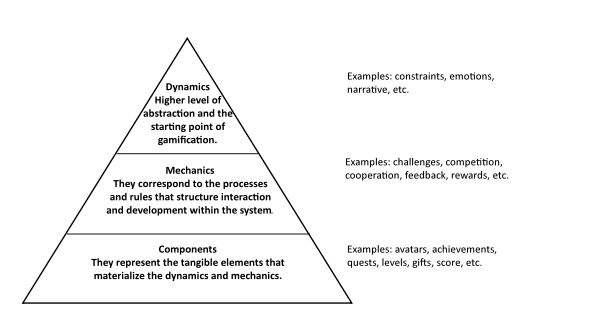
The elements of gamification can be organized into three hierarchical categories (Figure 1): dynamics, mechanics, and components 15. This classification allows us to understand how gamified experiences are structured and how the different elements of the game are articulated to generate processes of participation and commitment in users.
1. Dynamics: they represent the highest level of abstraction and constitute the starting point for the design of a gamified experience. At this level, elements such as narrative, emotions and social relationships that are sought to be promoted among participants are integrated.
2. Mechanics: corresponds to the processes and rules that structure the interaction and allow the development of action within the system. At this level, the way in which the participant gets involved and advances in the activity is determined, favoring their commitment and participation. Among the most used mechanics are rewards, rules, cooperation, competition, and challenges.
3. Components: they constitute the most concrete and observable level, since they represent the tangible elements that materialize dynamics and mechanics. This category includes resources such as avatars, missions or challenges, scoring systems, levels and rewards, among others.

Based on this conceptual structure, gamification can be applied in different contexts and highlights multiple benefits associated with its implementation 7. Among them are the increase in the motivation and commitment of the participants, the promotion of participation and continuous feedback, as well as the possibility of improving learning and the achievement of objectives when the activities are designed appropriately 16. However, inadequate implementation can generate counterproductive effects, such as the development of a superficial motivation based solely on external rewards. It can also lead to unethical behaviors if clear criteria are not established for its application, in addition to the risk of focusing attention on playful elements and neglecting the educational objectives that guide the teaching-learning process 17.
In the case of experimental teaching, university laboratories are fundamental spaces for the development of scientific skills, since they allow theoretical knowledge to be linked with observation, experimentation and problem solving. In this context, the subject Experimental Sciences Laboratory I, of the degree in Diagnostic Biochemistry, taught at the Faculty of Higher Studies Cuautitlán (FES Cuautitlán, UNAM), aims to solve problems in the field of experimental sciences, using experimental scientific methodology.
In this training space, it has been identified that students frequently present low academic performance, low motivation and limited clarity regarding the objectives of the experimental projects they must develop. Consequently, learning strategies based on memorization tend to predominate, which are not very effective for the deep understanding of scientific phenomena and for the development of experimental thinking skills.
In view of this situation, it is pertinent to explore didactic strategies that strengthen the teaching learning processes in the university experimental environment. In this sense, gamification represents a pedagogical alternative that could contribute to improving the motivation, participation and academic performance of students in this type of subject.
The objective of this research work is to analyze the effect of the implementation of the gamification didactic strategy on the academic performance of first-semester students of the Experimental Sciences Laboratory I course, of the degree in Diagnostic Biochemistry, at the Faculty of Higher Studies Cuautitlán (FES Cuautitlán, UNAM).
The research had a quantitative approach and was developed under an experimental design of the quasi-experimental type with a non-equivalent comparison group. To this end, the academic results of a group of first-semester students who took the subject Experimental Sciences Laboratory I during the 2025-II semester were compared using a traditional methodology, with the results obtained by another group that took the same subject in the 2026-I semester, in which a didactic strategy based on gamification was implemented.
The sample was non-probabilistic, including all the students enrolled in both groups. In this study, the implementation of a didactic strategy based on gamification was considered as an independent variable, while the dependent variable corresponded to the academic performance of the students, measured from the final grades obtained in the subject.
At the beginning of the course, students were informed about the way of working, as well as the general indications for the development of experimental activities. Likewise, it was communicated that, at the end of each experimental project contemplated in the program of the subject, recreational activities would be carried out aimed at reinforcing the contents addressed.
The control group, corresponding to the 2025-II semester, made up of 15 students, 60% men and 40% women % with an average age of 19 years, the contents were developed using a traditional teaching methodology. The experimental group, corresponding to the 2026-I semester, with 19 students, 52.6% men and 47.4% women with an average age of 18 years, implemented a didactic strategy based on gamification using various digital platforms, including Genially, Quizzes, Educa play and Word wall. These platforms were selected because they have free versions, have an intuitive user interface and are available in Spanish.
The activities developed through Quizzes, Educa play, and Word wall consisted of multiple-choice questionnaires with a maximum of ten questions (Annex 1), while the activity implemented in Genially corresponded to a "virtual Escape Room". This dynamic consisted of the sequential resolution of different challenges that allowed progress to be progressively advanced until they managed to "escape" from the virtual environment (Annex 2). In all cases, the activities included multiple-choice questions, true or false exercises, and application problems related to the academic content worked on during the experimental projects (Annex 3 and 4). The objective of these dynamics was for the students to correctly solve the activities in the shortest possible time, thus promoting participation, collaborative work, and conceptual reinforcement of the topics addressed.
Descriptive and inferential statistics were used to analyze the data obtained. First, basic descriptive means of the final grades of both groups were calculated, such as the arithmetic mean, standard deviation, variance and range of values. Subsequently, to determine if there were statistically significant differences between the academic results of both groups, Student's t-test was applied for two independent samples assuming unequal variances, a recommended statistical procedure when comparing means of independent groups with different sample sizes.
Likewise, to evaluate the magnitude of the effect of the didactic intervention, the effect size was calculated using Cohen’s d statistic 18, which allows estimating the pedagogical relevance of the difference observed between the groups. For this calculation, the combined standard deviation of both samples was used.
Additionally, the percentage gain of learning was estimated, to quantify the relative increase in academic performance associated with the implementation of the gamification strategy. Equation (1) was used for this purpose.
 | (1) |
A perception survey consisting of Likert-type questions (Table 1) was also applied to know the students' opinion regarding the use of gamification as a learning strategy in the laboratory.
Table 2 presents the results of the statistical analysis of the final grades obtained by the students using the student’s t-test for two independent samples, assuming unequal variances.
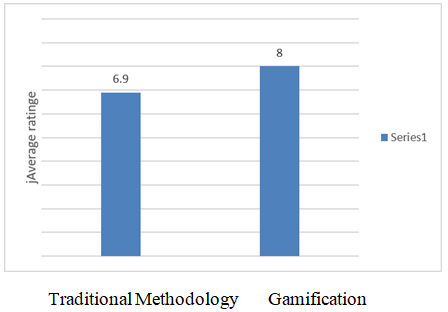
The results show that the group in which the gamification strategy was implemented obtained a higher average grade (M = 8.00) compared to the group that took the subject using a traditional teaching methodology (M = 6.87). Likewise, the variance observed in the gamified group was lower, which suggests greater homogeneity in the academic performance of the students.
The inferential analysis using Student's t-test (t = -2.07) indicates the existence of statistically significant differences between both groups in the unilateral test (p = 0.025). This result suggests that the implementation of the gamification strategy had a positive effect on the students' academic performance. On the other hand, in the bilateral test (p = 0.051), the value obtained is very close to the threshold of statistical significance (p < 0.05), which indicates a trend towards statistical significance. This behavior can be explained, in part, by the relatively small sample size and by the fact that the groups analyzed belong to different academic cohorts.
Additionally, the effect size was calculated using Cohen’s d statistics, to estimate the magnitude of the pedagogical impact associated with the implementation of the gamification strategy (Table 3).
According to the criteria for interpreting the effect size proposed by 18, Cohen's d values close to 0.2 are considered small effects, values around 0.5 correspond to moderate effects, and values close to or greater than 0.8 represent large effects 18. In the present study, a Cohen's d value = 0.77 was obtained, which indicates a moderate-high effect size. This result suggests that the implementation of gamification had a pedagogically relevant impact on students' academic performance.
The average academic performance between both teaching methodologies was compared (Figure 2).

The calculation of the percentage gain from learning (Equation 1) showed an increase of 16.5% in the average performance of the group that participated in the gamified experience compared to the group that took the subject using a traditional methodology.
Overall, these results suggest that the incorporation of gamification as a didactic strategy can contribute favorably to improving the academic performance of students in the subject Experimental Sciences Laboratory I. Table 4 presents the students' perception of the implementation of the gamification didactic strategy.
According to the results shown in Table 4, it is observed that 100% of the students consider that the recreational activities implemented through the digital platforms were clear and easy to understand. Likewise, the students indicated that these activities allowed them to better understand and reinforce the central theme of each experimental project, which is reflected in the results corresponding to questions 1 and 4.
94.1% of the students indicated that the gamification strategy increased their interest in the experimental projects developed in the subject. In addition, they considered that the integration of game elements, such as points, challenges and levels, contributed to making the development of the experimental activities more dynamic. Likewise, the students recognized that the playful activities represent a useful tool to strengthen their learning and expressed their interest in this strategy being implemented again in the laboratory. These results are evidenced in the answers obtained in questions 2, 5, 6 and 7.
Finally, in relation to the motivation towards participation, 88.2% of the students indicated that the dynamics applied contributed to them feeling more motivated to get involved in the course activities, as observed in question 3.
The results obtained in the present study allow us to establish that the implementation of a didactic strategy based on gamification contributes significantly to the improvement of the academic performance of students in the subject Laboratory of Experimental Sciences I of the degree in Diagnostic Biochemistry. The difference observed in the average grades between the experimental group and the control group, as well as the size of the moderate-high effect identified, show that the intervention is not only statistically relevant, but also pedagogically significant.
The decrease in the variance of the grades of the gamified group suggests that the strategy favors greater homogeneity in learning, which implies that a greater number of students achieve similar levels of academic performance. This finding is particularly relevant in educational contexts where the aim is to reduce learning gaps among students.
The percentage gain in learning reinforces the effectiveness of the implemented strategy, as it shows a substantial increase in academic performance compared to the traditional methodology. This result, together with the size of the calculated effect, allows us to affirm that gamification generates a positive impact on learning processes in the university experimental environment.
Regarding the perception of the students, the results show a highly favorable assessment of the gamification strategy, highlighting aspects such as the clarity of the activities, the increase in motivation, the interest in the content and the participation in the development of the experimental projects. These elements are essential to promote significant learning and consolidate the development of scientific skills.
However, it is important to consider some limitations of the study, including the size of the sample and the use of groups belonging to different academic periods, which may influence the generalizability of the results. In this sense, it is recommended that future research expand the number of participants and consider experimental designs with simultaneous groups to strengthen the validity of the findings.
Finally, it is concluded that gamification represents a relevant and viable didactic strategy for its implementation in experimental subjects in higher education, since it allows articulating cognitive, motivational and social aspects of learning, contributing to the comprehensive training of students.
Informed consent statement.
Consent was obtained from all subjects involved in the study.
Conflicts of interest.
The authors declare no conflicts of interest.
|
|
|
|
|
|
|
|
| [1] | Deterding, S., Dixon, D., Khaled, R., & Nacke, L. (2011). From game design elements to gamefulness: Defining" gamification". In Proceedings of the 15th international academic MindTrek conference: Envisioning Future Media Environments (pp. 9-15). ACM. | ||
| In article | View Article PubMed | ||
| [2] | García-López, I. M., Acosta-Gonzaga, E., & Ruiz-Ledesma, E. F. (2023). Investigating the impact of gamification on student motivation, engagement, and performance. Education Sciences, 13(8), 813. | ||
| In article | View Article | ||
| [3] | Guitton, M. J., & Cristofari, C. (2013). Zombiology. Science, 342(6158), 559-559. | ||
| In article | View Article PubMed | ||
| [4] | Domínguez, A., Saenz-de-Navarrete, J., de-Marcos, L., Fernández-Sanz, L., Pagés, C., & Martínez-Herráiz, J. J. (2013). Gamifying learning experiences: Practical implications and outcomes. Computers & Education, 63, 380–392. | ||
| In article | View Article | ||
| [5] | Hamari, J., Koivisto, J., & Sarsa, H. (2014). Does gamification work? A literature review of empirical studies on gamification. In 2014 47th Hawaii International Conference on System Sciences (pp. 3025–3034). IEEE. | ||
| In article | View Article | ||
| [6] | Landers, R. N. (2014). Developing a theory of gamified learning: Linking serious games and gamification of learning. Simulation & Gaming, 45(6), 752–768. | ||
| In article | View Article | ||
| [7] | Khaldi, A., Bouzidi, R., & Nader, F. (2023). Gamification of e-learning in higher education: A systematic literature review. Smart Learning Environments, 10, 10. | ||
| In article | View Article PubMed | ||
| [8] | Van Elderen, J., & Van der Stappen, E. (2019). The potential impact of gamification elements on the acceptance of technology in the context of education: A literature review. En A. Pucihar (Ed.), Proceedings of the 32nd Bled eConference: Humanizing technology for a sustainable society (pp. 178–201). University of Maribor Press. | ||
| In article | |||
| [9] | Sillaots, M. (2014). Achieving flow through gamification: A study on student engagement. In Proceedings of the International Conference on e-Learning (pp. 532–537). | ||
| In article | |||
| [10] | Caiza Herrera, M., Analuisa Jacome, E. G., López Viera, G. N., Changoluisa Pilaguano, J. F., Pilicita Asimbaya, M. R., & Merecí Merecí, Z. B. (2026). Gamificación en el aula de Educación General Básica: efectos del aprendizaje basado en juegos (ABJ) en la motivación académica. Revista Multidisciplinaria Prospherus, 3(1), 716–734. | ||
| In article | View Article | ||
| [11] | Millar, R. (2004). The role of practical work in the teaching and learning of science. En High school science laboratories: Role and vision (pp. 61–74). National Academies Press. | ||
| In article | |||
| [12] | Oliveira, D. S., Leite Junior, A. J. M., Alexandre, M. C. O., Pinheiro, F. G. C., & Holanda, A. K. M. (2025). Gamifying a general chemistry laboratory course as a strategy to improve the students’ motivation. Journal of Chemical Education, 102(10), 4508–4518. | ||
| In article | View Article | ||
| [13] | Manivel, R., Ramos, M., Sánchez, R & Campos, A. (2025). Gamificación como estrategia para mejorar el rendimiento académico en el laboratorio de Química Inorgánica. Scielo, 35(4). | ||
| In article | View Article | ||
| [14] | Pelizzari, F. (2023). Gamification in higher education. A systematic literature review. Italian Journal of Educational Technology, 31(3): 21-43. | ||
| In article | |||
| [15] | Hofstein, A., & Lunetta, V. N. (2004). The laboratory in science education: Foundations for the twenty-first century. Science Education, 88(1), 28–54. | ||
| In article | View Article | ||
| [16] | Werbach, K. & Hunter, D. (2012). For the win: How game thinking can revolutionize your business. Wharton Digital Press. | ||
| In article | |||
| [17] | Almeida, C., Kalinowski, M., Uchôa, A., & Feijó, B. (2023). Negative effects of gamification in education software: Systematic mapping and practitioner perceptions. Information and Software Technology, 156, 107142. | ||
| In article | View Article | ||
| [18] | Cohen, J. (1988). Statistical power analysis for the behavioral sciences (2nd ed.). Lawrence Erlbaum Associates. | ||
| In article | |||
Published with license by Science and Education Publishing, Copyright © 2026 Yvonne Rodríguez-Barocio and Adolfo Eduardo Obaya-Valdivia
 This work is licensed under a Creative Commons Attribution 4.0 International License. To view a copy of this license, visit
http://creativecommons.org/licenses/by/4.0/
| [1] | Deterding, S., Dixon, D., Khaled, R., & Nacke, L. (2011). From game design elements to gamefulness: Defining" gamification". In Proceedings of the 15th international academic MindTrek conference: Envisioning Future Media Environments (pp. 9-15). ACM. | ||
| In article | View Article PubMed | ||
| [2] | García-López, I. M., Acosta-Gonzaga, E., & Ruiz-Ledesma, E. F. (2023). Investigating the impact of gamification on student motivation, engagement, and performance. Education Sciences, 13(8), 813. | ||
| In article | View Article | ||
| [3] | Guitton, M. J., & Cristofari, C. (2013). Zombiology. Science, 342(6158), 559-559. | ||
| In article | View Article PubMed | ||
| [4] | Domínguez, A., Saenz-de-Navarrete, J., de-Marcos, L., Fernández-Sanz, L., Pagés, C., & Martínez-Herráiz, J. J. (2013). Gamifying learning experiences: Practical implications and outcomes. Computers & Education, 63, 380–392. | ||
| In article | View Article | ||
| [5] | Hamari, J., Koivisto, J., & Sarsa, H. (2014). Does gamification work? A literature review of empirical studies on gamification. In 2014 47th Hawaii International Conference on System Sciences (pp. 3025–3034). IEEE. | ||
| In article | View Article | ||
| [6] | Landers, R. N. (2014). Developing a theory of gamified learning: Linking serious games and gamification of learning. Simulation & Gaming, 45(6), 752–768. | ||
| In article | View Article | ||
| [7] | Khaldi, A., Bouzidi, R., & Nader, F. (2023). Gamification of e-learning in higher education: A systematic literature review. Smart Learning Environments, 10, 10. | ||
| In article | View Article PubMed | ||
| [8] | Van Elderen, J., & Van der Stappen, E. (2019). The potential impact of gamification elements on the acceptance of technology in the context of education: A literature review. En A. Pucihar (Ed.), Proceedings of the 32nd Bled eConference: Humanizing technology for a sustainable society (pp. 178–201). University of Maribor Press. | ||
| In article | |||
| [9] | Sillaots, M. (2014). Achieving flow through gamification: A study on student engagement. In Proceedings of the International Conference on e-Learning (pp. 532–537). | ||
| In article | |||
| [10] | Caiza Herrera, M., Analuisa Jacome, E. G., López Viera, G. N., Changoluisa Pilaguano, J. F., Pilicita Asimbaya, M. R., & Merecí Merecí, Z. B. (2026). Gamificación en el aula de Educación General Básica: efectos del aprendizaje basado en juegos (ABJ) en la motivación académica. Revista Multidisciplinaria Prospherus, 3(1), 716–734. | ||
| In article | View Article | ||
| [11] | Millar, R. (2004). The role of practical work in the teaching and learning of science. En High school science laboratories: Role and vision (pp. 61–74). National Academies Press. | ||
| In article | |||
| [12] | Oliveira, D. S., Leite Junior, A. J. M., Alexandre, M. C. O., Pinheiro, F. G. C., & Holanda, A. K. M. (2025). Gamifying a general chemistry laboratory course as a strategy to improve the students’ motivation. Journal of Chemical Education, 102(10), 4508–4518. | ||
| In article | View Article | ||
| [13] | Manivel, R., Ramos, M., Sánchez, R & Campos, A. (2025). Gamificación como estrategia para mejorar el rendimiento académico en el laboratorio de Química Inorgánica. Scielo, 35(4). | ||
| In article | View Article | ||
| [14] | Pelizzari, F. (2023). Gamification in higher education. A systematic literature review. Italian Journal of Educational Technology, 31(3): 21-43. | ||
| In article | |||
| [15] | Hofstein, A., & Lunetta, V. N. (2004). The laboratory in science education: Foundations for the twenty-first century. Science Education, 88(1), 28–54. | ||
| In article | View Article | ||
| [16] | Werbach, K. & Hunter, D. (2012). For the win: How game thinking can revolutionize your business. Wharton Digital Press. | ||
| In article | |||
| [17] | Almeida, C., Kalinowski, M., Uchôa, A., & Feijó, B. (2023). Negative effects of gamification in education software: Systematic mapping and practitioner perceptions. Information and Software Technology, 156, 107142. | ||
| In article | View Article | ||
| [18] | Cohen, J. (1988). Statistical power analysis for the behavioral sciences (2nd ed.). Lawrence Erlbaum Associates. | ||
| In article | |||