This qualitative descriptive study examined how secondary chemistry teachers demonstrate pedagogical content knowledge (PCK) and how the resulting profile can inform professional development. Eleven of 13 chemistry teachers in La Paz District, Schools Division of Agusan del Sur, met the inclusion criteria and participated. Data from an open-ended PCK questionnaire and focus group discussions were analyzed thematically; a supplementary seven-point self-assessment checklist was used descriptively to contextualize the qualitative evidence. Teachers reported checking prior knowledge, using diagrams, models, analogies, demonstrations, simulations, and familiar examples, aligning lessons with curriculum competencies, and using questioning, feedback, and reteaching. Stronger accounts connected a specific student difficulty with a chemistry representation, an instructional adjustment, and evidence of subsequent understanding. Development needs centered on more precise diagnosis of misconceptions, explicit movement among macroscopic, submicroscopic, and symbolic representations, contextualized planning under resource constraints, and clearer documentation of how assessment evidence changes instruction. The checklist was generally positive (overall item-weighted mean = 6.32), with Chemistry Content Representation lowest among the reported domain means (6.20); these self-ratings were interpreted as supplementary rather than as verified proficiency. The findings support sustained, chemistry-specific professional development organized around collaborative lesson design, diagnostic assessment, feasible practical work, coaching, classroom application, reflection, and revision.
Chemistry learning requires students to coordinate observable phenomena, particle-level explanations, and symbolic representations. This representational demand contributes to persistent difficulties in topics such as atomic structure, bonding, reactions, and quantitative chemistry 1, 2. In such settings, subject-matter knowledge alone is insufficient. Teachers must anticipate how learners are likely to interpret an idea, choose representations that make the idea accessible, align instruction with curricular intentions, and use assessment evidence to decide what to do next.
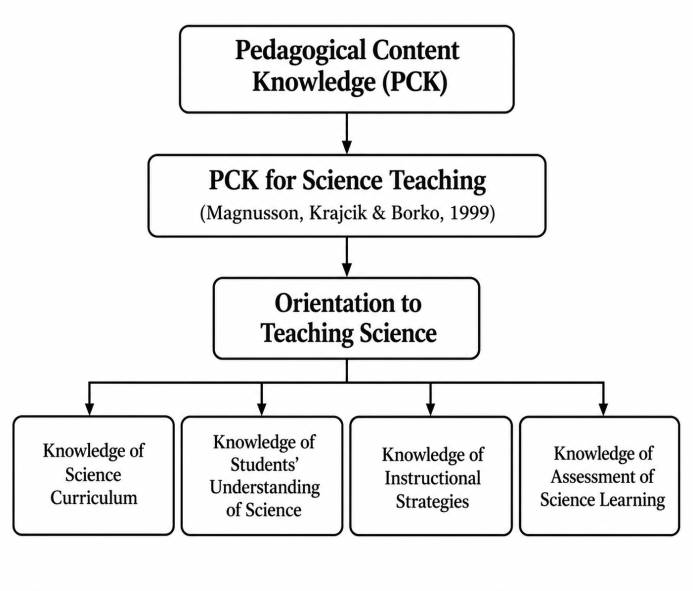
Shulman described pedagogical content knowledge (PCK) as the distinctive blending of content and pedagogy that enables teachers to transform disciplinary knowledge for learners 3. Science-specific elaborations identify knowledge of learners, instructional strategies, curriculum, assessment, and orientations toward science teaching as interrelated components of PCK 4. More recent work also treats PCK as dynamic professional knowledge that develops through experience, reflection, collaboration, and engagement with specific teaching problems 5, 6.
The Philippine science education context makes this issue consequential. National and international evidence has documented continuing challenges in scientific literacy, while local studies point to the importance of strengthening science pedagogy and sustained professional learning 7, 8. However, broad performance indicators do not explain how chemistry teachers reason about student misconceptions, representations, curriculum goals, and assessment in their own classrooms. A context-sensitive description of those practices is therefore useful for designing professional development that begins from demonstrated strengths and specific instructional needs rather than from a generic training agenda.
This study examined the reported PCK of secondary chemistry teachers in La Paz District, Agusan del Sur. It addressed three questions: (1) How do teachers demonstrate PCK in knowledge of students’ misconceptions and learning difficulties, instructional strategies and representations, curriculum and learning goals, and assessment practices? (2) What strengths and gaps are evident across these components? and (3) What professional development interventions are supported by the resulting PCK profile?
The study used the science-specific PCK model of Magnusson, Krajcik, and Borko 4 as its principal analytic lens. It is visualized in Figure 1 where four of its components were operationalized in the study: knowledge of students’ misconceptions and learning difficulties; instructional strategies and representations; curriculum and learning goals; and assessment practices. These domains were selected because they make visible the instructional reasoning through which chemistry content is transformed for learners.
The framework also recognizes that evidence of PCK is topic- and context-sensitive. A teacher may demonstrate detailed reasoning in one component or topic while providing only limited evidence in another. Accordingly, the study did not treat a single self-rating or brief response as a global measure of teacher quality. Qualitative manifestations were interpreted according to the depth, coherence, chemistry specificity, and linkage among learner thinking, instructional action, and evidence of learning.

A qualitative descriptive design was employed to examine teachers’ stated instructional reasoning and classroom practices. The study was conducted in four public secondary schools in La Paz District, Schools Division of Agusan del Sur. These schools operate within conditions that include varying learner readiness, limited laboratory facilities, and resource constraints, providing a relevant setting for examining how chemistry teachers adapt instruction.
3.2. Participants and SamplingPurposive sampling was used. Of 13 chemistry teachers considered, 11 met the inclusion criteria: current involvement in secondary chemistry teaching, at least one year of science or chemistry teaching experience, willingness to reflect on instructional practice, and voluntary informed consent. The study sought depth of description rather than statistical generalization.
3.3. Instruments and Data SourcesThe principal instrument was a semi-structured, open-ended PCK questionnaire developed from the study framework and reviewed by experts in science education, chemistry instruction, and qualitative research. Focus group discussions provided an additional source of narrative evidence. A supplementary seven-point self-assessment checklist was used descriptively. The checklist was not treated as a validated measure of national competency or classroom effectiveness.
3.4. Data Analysis and TrustworthinessOpen-ended responses and focus group data were analyzed thematically within the four PCK components. Interpretations emphasized the specificity of the chemistry problem described, the rationale for the instructional response, and the presence of evidence linking assessment to subsequent decisions. Trustworthiness was supported through triangulation of questionnaire and focus group evidence, member-oriented clarification procedures described in the study, an audit trail, reflexive documentation, and rich description of the research context.
3.5. Ethical ConsiderationsParticipation was voluntary and informed consent was secured before data collection. Participant codes replaced names, confidentiality was maintained, and audio recording of focus group discussions was undertaken only with permission. Participants were informed of their right to withdraw without penalty.
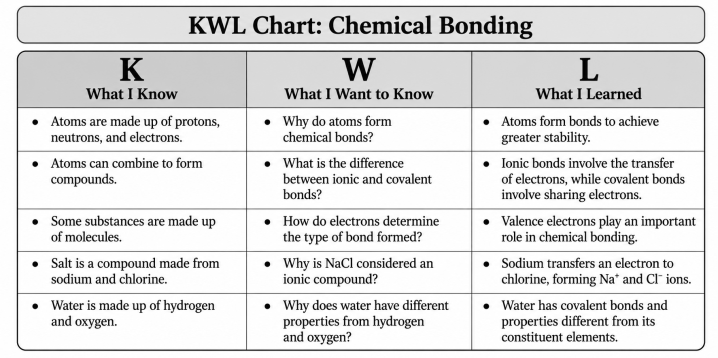
Teachers commonly reported checking prior knowledge through diagnostic questions, KWL charts, such as the one at Figure 2; review tasks, and examination of student errors. Their examples included misconceptions or difficulties involving atomic structure, ion formation, conservation of mass, classification of matter, chemical equations, and quantitative chemistry. The strongest narratives went beyond identifying a difficult topic: they described a particular student idea, an instructional response, and a follow-up check.
“A student said atoms lose or gain protons when they become ions.” (P11)
Other responses identified general difficulties without clearly distinguishing a misconception from a prerequisite gap or procedural error. This distinction matters because different diagnoses call for different instructional responses. The supplementary checklist mean for Knowledge of Student Thinking was 6.33, indicating positive self-perception, but the narrative evidence showed variation in diagnostic precision. Professional learning should therefore use actual or anonymized student responses and require teachers to infer the reasoning behind an incorrect answer before selecting a response.

Teachers reported using models, analogies, diagrams, demonstrations, simulations, and familiar experiences to make abstract chemistry more accessible. Stronger accounts explicitly connected what students could observe to particle-level explanations and then to chemical symbols or equations. This sequence is important because chemistry learning depends on coordinated movement among representational levels 1, 9.
“I normally start with something that students can see and observe, then explain what’s going on at the particle level, and then tie that to the chemical symbols or equation.” (P05)
Several teachers also described changing representations when students could follow a procedure but did not appear to understand the underlying concept. At the same time, some responses merely named a tool or analogy without explaining its chemistry-specific function or limitations. Chemistry Content Representation had the lowest reported domain mean (6.20), while the item on connecting macroscopic phenomena with submicroscopic explanations had a mean of 5.82. The convergence of narrative and checklist evidence supports a professional development emphasis on representational reasoning rather than simply increasing the number of teaching aids used.
4.3. Curriculum and Learning GoalsTen respondents referred to competencies, standards, or learning objectives when explaining how they identified important learning goals. Teachers also discussed prerequisites, sequencing from familiar experiences to abstract ideas, and adapting lessons to available resources. The qualitative evidence therefore supports curriculum awareness as a strength.
However, citing a competency did not always show how the competency had been translated into a conceptual learning goal, a coherent activity, and evidence of learning. Contextualization also varied. Some teachers used household or community examples, while one participant reported no experience contextualizing a chemistry lesson. Curriculum Saliency received the highest checklist mean (6.39), and the item on K to 12 curriculum alignment had a mean of 6.64. The development need is thus not basic awareness of curriculum, but the more demanding work of converting curriculum statements into scientifically sound, context-sensitive learning sequences.
4.4. Assessment PracticesTeachers reported questioning, quizzes, exit tasks, diagrams, performance activities, feedback, and reteaching. Stronger accounts linked the nature of a student error to a subsequent instructional decision and then checked whether understanding had improved.
“I don’t just look only at the marks, I also examine the types of mistakes that the students are making.” (P11)
Other accounts named assessment formats without specifying the intended chemistry understanding, criteria for interpretation, or follow-up evidence. Assessment Literacy averaged 6.35, again showing positive self-perception but uneven explanatory detail. The findings support an assessment cycle in which teachers elicit an explanation, interpret the reasoning behind it, select feedback or reteaching, and examine a revised explanation.
4.5. Integrated PCK ProfileThe table above presents the synthesis of evidence across the identified PCK components of the participating chemistry teachers. Across components, the clearest strength was responsive pedagogical decision-making: teachers described modifying explanations, pacing, activities, or feedback in response to learners. Yet the item on detecting misunderstanding during lesson delivery had a mean of 5.91. This suggests that flexibility is most productive when the evidence triggering an instructional adjustment is explicit and conceptually interpreted.
The overall item-weighted checklist mean was 6.32. Because the checklist represents self-assessment by the same 11 participants, the values should not be interpreted as validated proficiency levels or generalized to chemistry teachers nationally. The small spread among domain means also does not establish statistically significant differences. The principal contribution of the combined evidence is therefore diagnostic: it identifies where chemistry-specific reasoning is well articulated and where instructional links need to become more explicit.
The findings support professional development that is chemistry-specific, sustained, collaborative, and embedded in classroom work. Research on effective professional development similarly emphasizes content focus, active learning, collaboration, coaching, feedback, reflection, and sustained duration 10, 11, 12. Rather than offering isolated seminars on generic pedagogy, a program for these teachers should organize learning around difficult chemistry topics and the decisions teachers must make when students encounter them. Table 2 shows the proposed priorities for professional development of chemistry teachers.
A practical implementation cycle would begin with a difficult topic such as atomic structure, bonding, solutions, reactions, or mole concepts. Teachers would identify likely misconceptions and baseline student responses, collaboratively redesign the lesson and its representations, implement it with peer observation or coaching, inspect student explanations, and revise the lesson. The cycle can then be repeated within a professional learning community. Such a structure treats PCK as knowledge developed through design, enactment, evidence, and reflection rather than through attendance alone 5, 10.
Resource limitations should be incorporated into the design rather than treated as a separate problem. Where full laboratory work is not feasible, teachers and mentors should examine whether substitute materials, demonstrations, simulations, or locally available resources preserve the intended conceptual and inquiry goals. Technology can support visualization and inquiry, but its instructional value depends on the pedagogical and content reasoning guiding its use 13, 14, 15.
Secondary chemistry teachers in this study reported practices associated with all four examined PCK components. Their strongest accounts connected a specific learner difficulty to a representation or instructional adjustment and then to evidence of understanding. Across the data, teachers showed attention to prior knowledge, instructional flexibility, use of multiple representations, curriculum awareness, and assessment-based responses.
The study also identified development needs that are more specific than a general call for additional training: diagnosing the reasoning behind misconceptions, making explicit transitions among macroscopic, submicroscopic, and symbolic representations, translating curriculum competencies into contextualized learning sequences, and using assessment evidence to document and guide instructional change. The positive checklist ratings provide useful self-perception data but do not replace qualitative evidence of chemistry-specific reasoning.
Professional development should therefore be differentiated and continuous. A promising model is a repeated cycle of collaborative lesson design, classroom application, coaching or peer observation, examination of student thinking, reflection, and revision. Because the present evidence is self-reported and context-specific, future studies should add classroom observations, lesson artifacts, anonymized student work, and stronger validation of supplementary measurement tools before making claims about proficiency or effects on student achievement.
The recommendations emphasize strengthening chemistry teachers’ PCK through improved diagnosis of learners’ understanding, effective use of chemistry-specific representations and strategies, contextualized instruction, and evidence-based assessment. School administrators and science coordinators should provide collaborative planning, mentoring, peer observation, and appropriate resources aligned with teachers’ needs and school conditions. Professional development providers should implement a sustained, needs-based program that includes classroom application, reflection, feedback, and revision. Future researchers should strengthen methodological rigor through multiple sources of evidence, validated tools, transparent analysis, and intervention studies that examine changes in teacher practice and student learning.
The authors acknowledge the participating secondary chemistry teachers and the secondary schools of La Paz District, Schools Division of Agusan del Sur, for their contribution to the study.
| [1] | A. H. Johnstone, “Chemical education research in Glasgow in perspective,” Chemistry Education Research and Practice, vol. 7, no. 2, pp. 49–63, 2006. | ||
| In article | View Article | ||
| [2] | V. Talanquer, “Progressions in reasoning about structure and bonding,” Chemistry Education Research and Practice, vol. 21, no. 1, pp. 1–15, 2020. | ||
| In article | |||
| [3] | L. S. Shulman, “Those who understand: Knowledge growth in teaching,” Educational Researcher, vol. 15, no. 2, pp. 4–14, 1986. | ||
| In article | View Article | ||
| [4] | S. Magnusson, J. Krajcik, and H. Borko, “Nature, sources, and development of pedagogical content knowledge for science teaching,” in Examining Pedagogical Content Knowledge: The Construct and Its Implications for Science Education, J. Gess-Newsome and N. G. Lederman, Eds. Kluwer Academic Publishers, 1999, pp. 95–132. | ||
| In article | View Article | ||
| [5] | J. Gess-Newsome, “A model of teacher professional knowledge and skill including PCK: Results of the thinking from the PCK Summit,” in Re-examining Pedagogical Content Knowledge in Science Education, A. Berry, P. Friedrichsen, and J. Loughran, Eds. Routledge, 2015, pp. 28–42. | ||
| In article | |||
| [6] | K. K. H. Chan and A. Hume, “Towards a consensus model: Literature review of how science teachers’ pedagogical content knowledge is investigated in empirical studies,” in Repositioning Pedagogical Content Knowledge in Teachers’ Knowledge for Teaching Science, A. Hume, R. Cooper, and A. Borowski, Eds. Springer, 2019, pp. 3–76. | ||
| In article | View Article | ||
| [7] | OECD, PISA 2018 Results (Volume I): What Students Know and Can Do. OECD Publishing, 2019. | ||
| In article | |||
| [8] | W. M. Cordova and J. D. Linaugo, “Pedagogical content knowledge practices of public school science teachers,” Technium Social Sciences Journal, vol. 37, no. 1, pp. 37–50, 2022. | ||
| In article | View Article | ||
| [9] | A. Georgiadou and G. Tsaparlis, “Chemistry teaching in lower secondary school with methods based on: (A) psychological theories; (B) the macro, representational, and submicro levels of chemistry,” Chemistry Education Research and Practice, vol. 1, no. 2, pp. 217–226, 2000. | ||
| In article | View Article | ||
| [10] | L. Darling-Hammond, M. E. Hyler, and M. Gardner, Effective Teacher Professional Development. Learning Policy Institute, 2017. | ||
| In article | View Article | ||
| [11] | L. M. Desimone, “Improving impact studies of teachers’ professional development: Toward better conceptualizations and measures,” Educational Researcher, vol. 38, no. 3, pp. 181–199, 2009. | ||
| In article | View Article | ||
| [12] | B. Avalos, “Teacher professional development in Teaching and Teacher Education over ten years,” Teaching and Teacher Education, vol. 27, no. 1, pp. 10–20, 2011. | ||
| In article | View Article | ||
| [13] | P. Mishra and M. J. Koehler, “Technological pedagogical content knowledge: A framework for teacher knowledge,” Teachers College Record, vol. 108, no. 6, pp. 1017–1054, 2006. | ||
| In article | View Article | ||
| [14] | N. Rutten, W. R. van Joolingen, and J. T. van der Veen, “The learning effects of computer simulations in science education,” Computers & Education, vol. 58, no. 1, pp. 136–153, 2012. | ||
| In article | View Article | ||
| [15] | P. A. Ertmer and A. T. Ottenbreit-Leftwich, “Teacher technology change: How knowledge, confidence, beliefs, and culture intersect,” Journal of Research on Technology in Education, vol. 42, no. 3, pp. 255–284, 2010. | ||
| In article | View Article | ||
Published with license by Science and Education Publishing, Copyright © 2026 Ace Michael B. Magalso and Ma. Teresa M. Fajardo
 This work is licensed under a Creative Commons Attribution 4.0 International License. To view a copy of this license, visit
http://creativecommons.org/licenses/by/4.0/
| [1] | A. H. Johnstone, “Chemical education research in Glasgow in perspective,” Chemistry Education Research and Practice, vol. 7, no. 2, pp. 49–63, 2006. | ||
| In article | View Article | ||
| [2] | V. Talanquer, “Progressions in reasoning about structure and bonding,” Chemistry Education Research and Practice, vol. 21, no. 1, pp. 1–15, 2020. | ||
| In article | |||
| [3] | L. S. Shulman, “Those who understand: Knowledge growth in teaching,” Educational Researcher, vol. 15, no. 2, pp. 4–14, 1986. | ||
| In article | View Article | ||
| [4] | S. Magnusson, J. Krajcik, and H. Borko, “Nature, sources, and development of pedagogical content knowledge for science teaching,” in Examining Pedagogical Content Knowledge: The Construct and Its Implications for Science Education, J. Gess-Newsome and N. G. Lederman, Eds. Kluwer Academic Publishers, 1999, pp. 95–132. | ||
| In article | View Article | ||
| [5] | J. Gess-Newsome, “A model of teacher professional knowledge and skill including PCK: Results of the thinking from the PCK Summit,” in Re-examining Pedagogical Content Knowledge in Science Education, A. Berry, P. Friedrichsen, and J. Loughran, Eds. Routledge, 2015, pp. 28–42. | ||
| In article | |||
| [6] | K. K. H. Chan and A. Hume, “Towards a consensus model: Literature review of how science teachers’ pedagogical content knowledge is investigated in empirical studies,” in Repositioning Pedagogical Content Knowledge in Teachers’ Knowledge for Teaching Science, A. Hume, R. Cooper, and A. Borowski, Eds. Springer, 2019, pp. 3–76. | ||
| In article | View Article | ||
| [7] | OECD, PISA 2018 Results (Volume I): What Students Know and Can Do. OECD Publishing, 2019. | ||
| In article | |||
| [8] | W. M. Cordova and J. D. Linaugo, “Pedagogical content knowledge practices of public school science teachers,” Technium Social Sciences Journal, vol. 37, no. 1, pp. 37–50, 2022. | ||
| In article | View Article | ||
| [9] | A. Georgiadou and G. Tsaparlis, “Chemistry teaching in lower secondary school with methods based on: (A) psychological theories; (B) the macro, representational, and submicro levels of chemistry,” Chemistry Education Research and Practice, vol. 1, no. 2, pp. 217–226, 2000. | ||
| In article | View Article | ||
| [10] | L. Darling-Hammond, M. E. Hyler, and M. Gardner, Effective Teacher Professional Development. Learning Policy Institute, 2017. | ||
| In article | View Article | ||
| [11] | L. M. Desimone, “Improving impact studies of teachers’ professional development: Toward better conceptualizations and measures,” Educational Researcher, vol. 38, no. 3, pp. 181–199, 2009. | ||
| In article | View Article | ||
| [12] | B. Avalos, “Teacher professional development in Teaching and Teacher Education over ten years,” Teaching and Teacher Education, vol. 27, no. 1, pp. 10–20, 2011. | ||
| In article | View Article | ||
| [13] | P. Mishra and M. J. Koehler, “Technological pedagogical content knowledge: A framework for teacher knowledge,” Teachers College Record, vol. 108, no. 6, pp. 1017–1054, 2006. | ||
| In article | View Article | ||
| [14] | N. Rutten, W. R. van Joolingen, and J. T. van der Veen, “The learning effects of computer simulations in science education,” Computers & Education, vol. 58, no. 1, pp. 136–153, 2012. | ||
| In article | View Article | ||
| [15] | P. A. Ertmer and A. T. Ottenbreit-Leftwich, “Teacher technology change: How knowledge, confidence, beliefs, and culture intersect,” Journal of Research on Technology in Education, vol. 42, no. 3, pp. 255–284, 2010. | ||
| In article | View Article | ||