The post-pandemic era has observed numerous changes and has gone through multiple stages of evolution. This era has witnessed significant changes in psychological aspects, with a general increase in terms of depression, anxiety and stress. A descriptive survey is carried out in Sidho-Kanho-Birsha University, West Bengal, India. Data collected by administering on Big Five Inventory and DASS-21 scales on 600 postgraduate students. A stratified random sampling technique is considered for the collection of data. Comparison between male-female, rural-urban and arts-science students for the variables of Big Five Inventory (Extraversion, Agreeableness, Conscientiousness, Neuroticism and Openness to Experience) and DASS-21 (Stress, Anxiety and Depression) separately and together as a group has been taken up. Significant differences are found for Openness to Experience and Depression when gender is taken as dichotomous variable and t-test is administered. There are no significant differences for all other cases. The study uses Mahalanobis Distance to find out the dynamical nature of variables of Big Five Inventory and DASS-21, with no significant differences between male-female, rural-urban and arts-science students.
The virus, which has nearly taken over the entire planet, poses a serious threat to human civilization. People are facing difficult circumstances in the majority of the countries due to widespread lockdowns, physical segregation, self-quarantining, etc. People are experiencing mental illness, nervous breakdowns, and a plethora of other psychic disorders as a result. Stress, anxiety, and depression are now very common in this uncomfortable condition. People dealing with mental instability come from all walks of life and anywhere in the world. The People's regular lives were upended, and they now lead turbulent lives with higher levels of stress, anxiety, and sadness. Depression is a type of medical condition that affects our emotions and thoughts badly, whereas anxiety is the intense worry and terror towards many situations in our daily lives 1. Stress is “a particular relationship between the person and the environment that the person considers to be taxing or exceeding his or her resources and putting his or her well-being at risk” 2. This dire situation has had a significant impact on the education sector as well. The mode of instruction has changed from offline to online. The digital gap thus prevents many pupils from receiving a regular education. Students are thereby heading straight towards inevitable stress, worry, and sadness. They are at a pivotal moment in their lives.
Psychological research on personalities is especially helpful when analysing psychological variations in different areas of life. The degree to which an individual exhibits certain features at high or low levels is a common conceptualization of personality. A person’s traits are the recurring patterns of their motivations, emotions, ideas, and behaviours in many contexts 3. In other words, a person with a high trait score will demonstrate psychological states associated with that trait more frequently and to a higher degree than a person with a low trait score. When describing gender differences in personality traits, it is common to consider which gender, on average, scores better on each feature. For instance, it is well knowledge that women are friendlier than men 4, 5. This indicates that, on average, women tend to be more selfless, compassionate, and nurturing than men. The findings do not negate the possibility that men can also feel love, empathy, and generosity; indeed, there may be instances where certain men rate higher than some women on these attributes. The purpose of examining gender differences in personality is to clarify the distinctions in the typical behavior patterns of men and women, as individuals of both genders can experience a range of traits across the entire spectrum. Men and women experience states on opposite ends of the characteristic spectrum, although gender disparities in mean differences do not indicate this; on the contrary, considerable differences might exist together with a high degree of overlap between the distributions of men and women 6. The creation of a suitable taxonomy of personality traits has been a fundamental goal of personality psychology. Based on trait descriptors found in personality tests and natural language, a five-factor structure has been developed to account for trait covariation. The five factors model or Big Five categorizes traits into the broad domains of Extraversion, Agreeableness, Conscientiousness, Neuroticism, and Openness/ Intellect 7, 8, 9, 10. Comparison of different variables such as Extraversion, Agreeableness, Conscientiousness, Neuroticism, Openness, Stress, Anxiety and Depression between dichotomous variables is a process of study in education and psychology and many other fields. Several studies are done in this field by applying parametric and non-parametric tests like t-test, Mann-Whitney U Test etc. Mahalanobis Distance is a powerful and strong measure to know the distance between dynamical nature for a group of variables.
Personality variations between genders are frequently analysed using the Big Five framework. The Big Five do not, however, cover all of the significant differences in personality traits. Higher-order components, such as the Big Five, are comprised of more specific traits that fluctuate together due to the hierarchical organisation of features. Therefore, gender variations in personality traits can be examined at several levels of resolution in the research of gender differences. The majority of trait research has concentrated on two trait levels: A vast array of highly specialised characteristics, known as facets, are grouped together within the Big Five and (1) the Big Five domains as a whole. Regarding the identification and quantity of facets that comprise the Big Five, there is currently no agreement. Different methods, based on a logical analysis of psychological categories, have identified various sets of aspects or by systematic sampling from the space defined by pairs of Big Five factors 11. We used an empirically determined level of personality traits that lies between broad domains and narrow aspects in the current investigation. Compared to the Big Five, this level of personality organisation may be able to describe gender differences more precisely by highlighting distinctions that the Big Five tend to hide. Furthermore, compared to current facet models, it offers an experimentally supported taxonomy of lower level qualities that is more likely to provide a sufficient taxonomy of features. One factor should be sufficient to explain the common variance of the facets within a particular Big Five domain if the Big Five comprised the level of the personality hierarchy directly above the facets. But a large behavioural genetic investigation found that the common genetic variance among the features within each domain could only be explained by two different causes 12. For each of the Big Five dimensions, two phenotypic factors that resembled the genetic factors were discovered in a different study that used factor analysis of 15 distinct facets within each domain 13. According to this research, each of the Big Five has two distinct but connected facets, indicating a personality level that is above the numerous facet scales but below the broad domains. By examining the factor-score relationships among over 2000 items from the International Personality Item Pool (IPIP), the research 13 could characterize these traits. The subsequent labels were assigned to the dimensions: volatility and withdrawal denote neuroticism; enthusiasm and assertiveness represent extraversion; openness and intellect signify openness and intellect; diligence and orderliness illustrate conscientiousness; and compassion and politeness indicate agreeableness. Given that gender differences might occasionally be ambiguous at the Big Five level and can occasionally be significant and polar opposites at the facet level, the aspect level of traits may be particularly helpful for examining gender disparities. The aspects offer a more focused and non-arbitrary framework than the Big Five for analysing gender differences at the trait level. Numerous personality traits have been linked to gender differences in the past. The majority of meta-analyses and reviews look at gender variations in personality self-reports on Big Five and component aspects surveys 4, 5, 14.
Persons who live in rural surroundings typically have lower levels of subjective well-being and higher levels of loneliness than persons who live in urban contexts, according to a sizable body of research that has explored disparities between rural and urban settings in many elements of subjective well-being 15, 16. Few research, meanwhile, have looked into personality or psychological well-being distinctions between rural and urban areas. The most similar studies have demonstrated consistent relationships between personality traits at the regional level and population density, like Openness to Experience – more densely populated areas tend to be higher in Openness to Experience, for example 17, 18. Furthermore, to our knowledge, only one study has looked at the variations in psychological well-being between rural and urban areas. 19 investigated the differences in psychological well-being aspects between urban and rural teenagers in the Indian state of Haryana. The results showed that adolescents in urban areas typically exhibited greater levels of psychological well-being than those in rural areas. The scope of our present understanding of personality characteristic and psychological wellbeing variations between rural and urban areas is restricted.
To improve academic advice, two lines of psychological study have been conducted. An examination of the causes of students’ academic achievement was done in the first line, such as cognitive abilities, personality, motivation, etc. 20. Group variations in these same characteristics among students pursuing various academic disciplines have been studied in the second line.The Big Five personality traits Neuroticism, Extraversion, Openness, Agreeableness, and Conscientiousness have been examined recently to see if distinct academic specialisations draw distinct kinds of students 21. The idea that a student’s personality may determine the best “fit” between their major and school is a common justification used in this research. This theory has been advanced by Holland 22 among others. Should it be true that a student’s personality makes certain academic majors more appropriate for them than others, this information would be helpful for academic counselling and advising as well as for teaching in general.
Prasanta Chandra Mahalanobis created the Mahalanobis Distance during his studies on racial similarities, and it was initially released in 1936 23. The Mahalanobis Distance was used in research 24 to examine academic stress, mathematical anxiety, and mathematical self-efficacy in two groups of upper secondary school pupils. The researchers 25 carried out a study on Post Graduate Students on depression, anxiety, and stress during the COVID-19 pandemic.
The present study Comparison between male-female, rural-urban and arts-science students for the variables of Big Five Inventory (Extraversion, Agreeableness, Conscientiousness, Neuroticism and Openness to Experience) and DASS-21 (Stress, Anxiety and Depression) separately (by administering t-test) and together as a group (by calculating Mahalanobis Distance) is done. Significant differences are found for Openness to Experience and Depression when gender (male-female) is taken as dichotomous variable and t-test is administered.
After the close study of the available literature we have taken up the following objectives:
1.To compare the Extraversion, Agreeableness, Conscientiousness, Neuroticism, Openness, Stress, Anxiety and Depression between male and female students;
2.To compare the Extraversion, Agreeableness, Conscientiousness, Neuroticism, Openness, Stress, Anxiety and Depression between rural and urban students;
3.To compare the Extraversion, Agreeableness, Conscientiousness, Neuroticism, Openness, Stress, Anxiety and Depression between arts and science students;
4.To compare the dynamical nature of Extraversion, Agreeableness, Conscientiousness, Neuroticism, Openness, Stress, Anxiety and Depression considered together as a group of variables between male and female students;
5.To compare the dynamical nature of Extraversion, Agreeableness, Conscientiousness, Neuroticism, Openness, Stress, Anxiety and Depression considered together as a group of variables between rural and urban students;
6.To compare the dynamical nature of Extraversion, Agreeableness, Conscientiousness, Neuroticism, Openness, Stress, Anxiety and Depression considered together as a group of variables between arts and science students.
Considering the above mentioned objectives, following hypotheses may be considered:
From objective 1 we get eight hypotheses as follows:
H01: ‘There is no significant difference in Extraversion between male and female students’.
H02: ‘There is no significant difference in Agreeableness between male and female students’.
H03: ‘There is no significant difference in Conscientiousness between male and female students’.
H04: ‘There is no significant difference in Neuroticism between male and female students’.
H05: ‘There is no significant difference in Openness between male and female students’.
H06: ‘There is no significant difference in Stress between male and female students’.
H07: ‘There is no significant difference in Anxiety between male and female students’.
H08: ‘There is no significant difference in Depression between male and female students’.
From objective 2 we get eight hypotheses as follows:
H09: ‘There is no significant difference in Extraversion between rural and urban students’.
H010: ‘There is no significant difference in Agreeableness between rural and urban students’.
H011: ‘There is no significant difference in Conscientiousness between rural and urban students’.
H012: ‘There is no significant difference in Neuroticism between rural and urban students’.
H013: ‘There is no significant difference in Openness between rural and urban students’.
H014: ‘There is no significant difference in Stress between rural and urban students’.
H015: ‘There is no significant difference in Anxiety between rural and urban students’.
H016: ‘There is no significant difference in Depression between rural and urban students’.
From objective 3 we get eight hypotheses as follows:
H017: ‘There is no significant difference in Extraversion between arts and science students’.
H018: ‘There is no significant difference in Agreeableness between arts and science students’.
H019: ‘There is no significant difference in Conscientiousness between arts and science students’.
H020: ‘There is no significant difference in Neuroticism between arts and science students’.
H021: ‘There is no significant difference in Openness between arts and science students’.
H022: ‘There is no significant difference in Stress between arts and science students’.
H023: ‘There is no significant difference in Anxiety between arts and science students’.
H024: ‘There is no significant difference in Depression between arts and science students’.
From objective 4 we get the following hypothesis:
H025: ‘There is no significant difference in dynamical nature of Extraversion, Agreeableness, Conscientiousness, Neuroticism, Openness, Stress, Anxiety and Depression considered together as a group of variables male and female students’.
From objective 5 we get the following hypothesis:
H026: ‘There is no significant difference in dynamical nature of Extraversion, Agreeableness, Conscientiousness, Neuroticism, Openness, Stress, Anxiety and Depression considered together as a group of variables rural and urban students’.
From objective 6 we get the following hypothesis:
H027: ‘There is no significant difference in dynamical nature of Extraversion, Agreeableness, Conscientiousness, Neuroticism, Openness, Stress, Anxiety and Depression considered together as a group of variables arts and science students’.
Theoretical details
Ø Independent Sample t-test
Independent sample t-test is a test applied for two variables. It is a well-known test for comparison between two independent variables especially in educational measurement. Here, for each dichotomous variable (male-female, rural-urban, arts-science) eight t-tests are administered for extraversion, agreeableness, conscientiousness, neuroticism, openness to experience, stress, anxiety, and depression separately.
Ø Mahalanobis Distance
Human nature or behavior cannot be expressed by single property/variable. It may be considered as a sum of properties/variables and difference in dynamical nature of such variables is an important measure of comparison. As a result, when extraversion, agreeableness, conscientiousness, neuroticism, openness to experience, stress, anxiety, and depression are considered together as a measure of the present status of the students, it becomes more meaningful.
Let us consider
 |
Which is considered for dichotomous variables (Male vs Female, Rural vs Urban or Arts vs Science) consist of eight variables viz. extraversion, agreeableness, conscientiousness, neuroticism, openness to experience, stress, anxiety, and depression. So,  is 8X1 matrix and
  represent the transpose of
  and it is 1X8 matrix.
Denoting  as pooled variance-covariance matrix, we get
 (2.1)
(2.1)
Where  is the first set of variance-covariance matrix (as for example male students) for the variables extraversion, agreeableness, conscientiousness, neuroticism, openness to experience, stress, anxiety, and depression. Similarly,
 for second set. Here,
  represents the sample size of first sample and second sample respectively.
Now Mahalanobis Distance (MD) may be defined as
 (2.2)
(2.2)
From existing literature, it may be opined that if MD is less than 1, difference in dynamical character of several variables when considered for two sets of data is insignificant. When MD is greater than or equal to 1, difference in dynamical character of several variables when considered for two sets of data is significant.
Descriptive survey method is applied to curry out the research.
Tools used
n Big Five Inventory of Personality (BFI) by 26
n Depression Anxiety & Stress Scales by 27
Population: Post-graduate students of Sidho-Kanho-Birsha University, Purulia, West Bengal, India.
Sample and Sampling: Data collected from 600 samples by stratified random sampling.
Statistical Measure:Appropriate descriptive and inferential statistics (t-test and Mahalanobis Distance) are used for this research work.

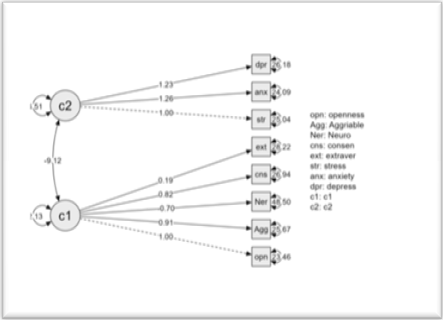
Path diagram is represented by Figure 1. Effect sizes are moderate between variables of Big Five inventory except extraversion. Similar results found in case of DAS and c2. Factor covariances represented shows that between c1 and c2 is significant and negative. As c1 and c2 are latent variables for Big Five Inventory and DAS respectively, they represent opposite qualities with the increase of numerical values as measured according to the norms of respective variables and scales. It is observed that residual variances are of moderate value which refers to the variance in a model that cannot be explained by the variables in the model are not very large. As a result, this consideration Big Five Inventory and DAS together is a valuable construction.
• Comparison between different variables
There are five components of personality viz. Extraversion, Agreeableness, Conscientiousness, Neuroticism and Openness. Stress, Anxiety and Depression are also three such variables considered with personality factors to test the hypotheses H01 to H08. Here, t-test has been adopted for comparison. Results of t-tests are listed in Table 1. Here, significant differences are found in the cases of Openness (H05)and Depression (H08). As a result, H05 and H08 are rejected. So alternative hypotheses “There is a significant difference in Openness between male and female students”and“There is a significant difference in Depression between male and female students”areaccepted. For both the cases mean scores for male is significantly greater than their female counterpart. Other null hypotheses H01, H02, H03, H04, H06 and H07 are accepted. That implies that Extraversion, Agreeableness, Conscientiousness, Neuroticism, Stress and Anxiety are independent of gender.
All the null hypotheses H09, H010, H011, H012, H013, H014, H015 and H016 are accepted. That implies that Extraversion, Agreeableness, Conscientiousness, Neuroticism, Openness, Stress, Anxiety and Depression are independent of residence.
All the null hypotheses H017, H018, H019, H020, H021, H022, H023 and H024 are accepted. That implies that Extraversion, Agreeableness, Conscientiousness, Neuroticism, Openness, Stress, Anxiety and Depression are independent of stream.
• Comparison regarding dynamical nature of the variables
By using Table 2 and 3 and by applying equations (2.1 and 2.2), we get MD which are listed in Table 4.
Now, let us consider objective 4 and thecorresponding hypothesis H025. Here, calculated value of MD is 0.5301 which is less than 1. That implies our null hypothesis H025 is accepted. As a result, no significant difference in dynamical nature of Extraversion, Agreeableness, Conscientiousness, Neuroticism, Openness, Stress, Anxiety and Depression considered together as a group of variables between male and female students is confirmed.
Recall objective 5 and the corresponding hypothesis H026. Here, calculated value of MD is 0.2024 which is again less than 1. That implies our null hypothesis H026 is accepted. As a result, no significant difference in dynamical nature of Extraversion, Agreeableness, Conscientiousness, Neuroticism, Openness, Stress, Anxiety and Depression considered together as a group of variables between rural and urban students is established.
Lastly, recall objective 6 and the corresponding hypothesis H027. Here, calculated value of MD is 0.2908 which is again less than 1. That implies our null hypothesis H027 is accepted. As a result, no significant difference in dynamical nature of Extraversion, Agreeableness, Conscientiousness, Neuroticism, Openness, Stress, Anxiety and Depression considered together as a group of variables between rural and urban students is established.
The comparison between dichotomous variables revealed that:
1. From the present study it was found that for Extraversion there is no significant difference between male and female students. The result is supported by 28, 29 but not supported by 4, 5, 14, 30.
2. For Agreeableness it was found that there is no significant difference between male and female students. The result is not supported by 4, 5, 14, 28, 29, 30, 31, 32.
3. For Conscientiousness it was found that there is no significant difference between male and female students. The result is supported by 28, but not supported by 4, 5, 29, 30, 32.
4. For Neuroticism it was found that there is no significant difference between male and female students. The result is not supported by 5, 14, 26, 29, 30, 32.
5. For Openness to Experienceit was found that there is significant difference between male and female students. Male students were found to be more open than the female students. This result contradicts the findings of 29, 30, 32.
6. For Stress it was found that there is significant difference between male and female students. The result is supported by 25, 33, 24, but the result is not supported by 33, 36, 37.
7. For Anxiety the result is supported by 25, 33, 34 but the result is not supported by 35, 37.
8. Differences are found for Depression and it is found that male students have significantly high Depression.The result is supported by 33, 35 but not supported by 25, 35, 37.
9. No significant differences were found between the rural and urban regarding Extraversion, Agreeableness, Conscientiousness, Neuroticism and Openness to Experience, Stress, Anxiety and Depression. The result was found to contradict the following studies 34, 38, 39.
10. No significant differences were found between the Science and arts students regarding Extraversion. The findings agree with the findings of 38, 41, 42, 43, while disagree with 44, 45.
11. No significant differences were found between the Science and arts students regarding Agreeableness. The findings agree with the findings of 40, 43, 44, while disagree with 40, 41, 45.
12. No significant differences were found between the Science and arts students regardingConscientiousness. The findings agree with the findings of 43, 42, 44, while disagree with 40, 41, 45.
13. No significant differences were found between the Science and arts students regardingNeuroticism. The findings agree with the findings of 21, 41 42, 43, 44, 45, while disagree with Clariana 40.
14. No significant differences were found between the Science and arts students regardingOpenness to Experience. The findings agree with the findings of 43, 45, while disagree with 29, 40, 41, 44.
15. No significant differences were found between the Science and arts students regardingStress. The findings disagree with the findings of 34, 37.
16. No significant differences were found between the Science and arts students regardingAnxiety. The findings disagree with the findings of 34, 37.
17. No significant differences were found between the Science and arts students regardingDepression. The findings disagree with the findings of 34, 37.
18. There is no significant difference in dynamical nature among the variables Extraversion, Agreeableness, Conscientiousness, Neuroticism, Openness, Stress, Anxiety, Depression, when considered together as a branch for the dichotomous variables; male-female, rural-urban and science-arts. The findings agree with the findings of 24, 46.
Personality factors are related to Depression, Anxiety and Stress for different Dichotomous Variables like, Gender, Residence and Stream of Study. In the present study, when single variables are compared for different Dichotomous Variables, they highlight both similarity and differences with the existing literature. Individual variables cannot express the totality of the behaviour when they are measured separately between Dichotomous Variables. To represent the totality of the behaviour, we should consider all the variables together as a measure. When Mahalanobis Distance is used as a measure of Multivariate analysis for a group of variables namely, Extraversion, Agreeableness, Conscientiousness, Neuroticism, Openness, Stress, Anxiety, Depression, no difference is observed. This is supported by existing literature.
As sample consist of PG level students, it would be very difficult to define and work with different societies. For present study, 8 variables are considered viz. Extraversion, Agreeableness, Conscientiousness, Neuroticism, Openness to Experience, Stress, Anxiety and Depression but only 2 variables Openness to Experience and Depression significantly differ between male and female students. Others 6 out of 8 variables showed insignificant differences. So, differences were not totally gender independent. Results are displayed in Table 1.
From Table 1 it is evident that all 8 variables are independent of residence and stream. The sample collected from SKBU was a mixed cultural sample (consist of different religion, different income group, different location of West Bengal and others states of India).
Funding: There is no funding for this research work.
Disclosure Statement: No potential competing interest was reported by the authors.
| [1] | Mahato, R. C., Sen, S., & Adhikari, A. (2023). A study of DASS-21 and the self-efficacy scale on post-graduate students. International Journal of Research Publication and Reviews, 4(6), 4249-4255. | ||
| In article | |||
| [2] | Lazarus, R. S. & Folkman, S. (1984). Stress, Appraisal, and Coping. Springer Publishing Company: New York, NY, USA. | ||
| In article | |||
| [3] | Fleeson, W., & Gallagher, P. (2009). The implications of Big Five standing for the distribution of trait manifestation in behavior: fifteen experience-sampling studies and a meta-analysis. Journal of Personality and Social Psychology, 97(6), 1097–1114. | ||
| In article | View Article PubMed | ||
| [4] | Feingold, A. (1994). Gender differences in personality: a meta-analysis. PsychologicalBulletin, 116, 429–456. | ||
| In article | View Article PubMed | ||
| [5] | Costa, P. T., Jr., Terracciano, A., & McCrae, R. R. (2001). Gender differences in personality traits across cultures: Robust and surprising findings. Journal of Personality and Social Psychology, 81(2), 322–331. | ||
| In article | View Article PubMed | ||
| [6] | Hyde, J. S. (2005). The gender similarities hypothesis. American Psychologist, 60(6), 581–592. | ||
| In article | View Article PubMed | ||
| [7] | Digman, J. M. (1990). Personality structure: emergence of the five factor model. Annual Review Psychology. 41, 417–440. | ||
| In article | View Article | ||
| [8] | John, O. P., Naumann, L. P., & Soto, C. J. (2008). Paradigm shift to the integrative Big Five trait taxonomy: history, measurement, and conceptual issues, in Handbook of Personality Psychology: Theory and Research, 3rd Edn, eds. O. P. John, R. W. Robins, and L. A. Pervin (New York: Guilford Press), 114–158. | ||
| In article | |||
| [9] | Varadwaj, K. & Rath, S. (2018). Cultural Consequences of Big Five Traits: Comparing Urban, Rural and Tribal Students. IOSR Journal of Humanities and Social Science (IOSR-JHSS), 23(5), 11-16. | ||
| In article | |||
| [10] | Vedel, A. (2016). Big Five personality group differences across academic majors: A systematic review. Personality and Individual Differences, 92, 1–10. | ||
| In article | View Article | ||
| [11] | Soto, C. J., & John, O. P. (2009). Using the California psychological inventory to assess the Big Five personality domains: a hierarchical approach. Journal of Research in Personality, 43(1), 25–38. | ||
| In article | View Article | ||
| [12] | Jang, K. L., Livesley, W. J., Angleitner, A., Reimann, R., & Vernon, P. A. (2002). Genetic and environmental influences on the covariance of facets defining the domains of the five-factor model of personality. Personality and Individual Differences, 33(1), 83–101. | ||
| In article | View Article | ||
| [13] | DeYoung, C. G., Quilty, L. C., & Peterson, J. B. (2007). Between facets and domains: 10 aspects of the Big Five. Journal of Personality and Social Psychology, 93(5), 880–896. | ||
| In article | View Article PubMed | ||
| [14] | Lippa, R. A. (2008). Sex differences in personality traits and gender-related occupational preferences across 53 nations: Testing evolutionary and social-environmental theories. Archives of Sexual Behavior, 39(3), 619-636. | ||
| In article | View Article PubMed | ||
| [15] | Burger, M. J., Morrison, P. S., Hendriks, M., & Hoogerbrugge, M. M. (2020). Urban-rural happiness differentials across the world. World Happiness Report, 2020, 66–93. | ||
| In article | |||
| [16] | Wang, F., & Wang, D. (2016). Place, geographical context and subjective well-being: State of art and future directions. In D. Wang & S. He (Eds.), Mobility, sociability and well-being of urban living. Springer. | ||
| In article | View Article | ||
| [17] | Elleman, L. G., Condon, D. M., Holtzman, N. S., Allen, V. R., & Revelle, W. (2020). Smaller is better: Associations between personality and demographics are improved by examining narrower traits and regions, Collabra: Psychology, 6(1), 1–19. | ||
| In article | View Article | ||
| [18] | Rentfrow, P. J., Jokela, M., & Lamb, M. E. (2015). Regional personality differences in Great Britain. PLOS ONE, 10(3), 1-20. | ||
| In article | View Article PubMed | ||
| [19] | Arya, T., & Sangwan, S. (2018). A study on psychological wellbeing of rural and urban adolescents. International Journal of Education and Management Studies, 8(4), 419–423. | ||
| In article | |||
| [20] | Richardson, M., Abraham, C., & Bond, R. (2012). Psychological correlates of university students’ academic performance: A systematic review and meta-analysis. Psychological Bulletin, 138(2), 353–387. | ||
| In article | View Article PubMed | ||
| [21] | Kaufman, J. C., Pumaccahua, T. T., & Holt, R. E. (2013). Personality and creativity in realistic, investigative, artistic, social, and enterprising college majors. Personality and Individual Differences, 54(8), 913–917. | ||
| In article | View Article | ||
| [22] | Holland, J. L. (1997). Making vocational choices: A theory of vocational personalities and work environments (3rd ed.). Odessa, FL, US: Psychological Assessment Resources. | ||
| In article | |||
| [23] | Mahalanobis, P. C. (1936). On the Generalized Distance in Statistics. The National Institute of Sciences of India, 2(1), 49-55. | ||
| In article | |||
| [24] | Mahato, R. C., & Sen, S. (2021). Application of Mahalanobis distance to determine the dynamical nature of academic stress, self-efficacy in mathematics and anxiety in mathematics. International Journal of Advances in Engineering and Management (IJAEM), 3(5), 1398-1401. | ||
| In article | |||
| [25] | Sen, S., Sau, P., Mahato, S., Satpati, S., Afreen, T., & Gayen, P. (2021). Depression, anxiety and stress of postgraduate students during Covid-19 pandemic: A study on postgraduate students of Sidho-Kanho-Birsha University, Purulia, West Bengal, India. International Journal of Research Publication and Reviews, 2(9), 586-591. | ||
| In article | |||
| [26] | John, O. P., & Srivastava, S. (1999). The Big-Five Trait Taxonomy: History, Measurement, and Theoretical Perspectives. In L. A. Pervin, & O. P. John (Eds.), Handbook of Personality: Theory and Research (Vol. 2, pp. 102-138). Guilford Press. | ||
| In article | |||
| [27] | Lovibond, P.F., & Lovibond, S. H. (1995). The structure of negative emotional states: comparison of the Depression Anxiety Stress Scales (DASS) with the Beck Depression and Anxiety Inventories. Behaviour Research and Therapy, 33(3), 335-43. | ||
| In article | View Article PubMed | ||
| [28] | Gaikwad, U. S. (2021). Gender difference between big five personality. The InternationalJournal of Indian Psychology, 9(1), 652-658. | ||
| In article | |||
| [29] | Hartmann, F. G. & Ertl, B. (2023). Big Five personality trait differences between students from different majors aspiring to the teaching profession. Current Psychology, 42, 12070–12086. | ||
| In article | View Article | ||
| [30] | Weisberg, Y. J., DeYoung, C. G., & Hirsh, J. B. (2011). Gender differences in personality across the ten aspects of the Big Five. Frontiers in Psychology, 2, 1-11. | ||
| In article | View Article PubMed | ||
| [31] | Markus, H. R., & Kitayama, S. (1991). Culture and the Self: Implications for Cognition, Emotion, and Motivation. Psychological Review, 98(2), 224–253. | ||
| In article | View Article | ||
| [32] | Rammstedt, B. (2007). The 10-item big five inventory: Norm values and investigation of socio demographic effects based on a German population representative sample.European Journal of Psychological Assessment, 23(3), 193–201. | ||
| In article | View Article | ||
| [33] | Jiang, L., Yan, Y., Jin Z-S., Hu, M-L., Wang, L., Song, Y., Li, N-N., Su, J., Wu, D-X., & Xiao, T. (2020). The Depression Anxiety Stress Scale-21in Chinese Hospital Workers: Reliability, Latent Structure, and Measurement Invariance across Genders. Fronteras in Psychology, 11, 1-9. | ||
| In article | View Article PubMed | ||
| [34] | Baviskar, M. P., Phalke, V. D., & Phalke, D. B. (2013). A Study of Socio Demographic Factors and their Association with Depression, Anxiety and Stress in Junior College Students in a Rural Area of India. IJSR - International Journal of Scientific Research, 2(12), 375-377. | ||
| In article | View Article | ||
| [35] | Pang, N.T.P., James, S., Giloi, N., Rahim, S.S.S.A., Omar, A., Jeffree, M.S., Hayati, F., Lim, M.C., Kassim, M. A. M., & Ng, J.R. (2021). Relationships between Psychopathology, Psychological Process Variables, and Socio demographic Variables and Comparison of Quarantined and Non-Quarantined Groups of Malaysian University Students in the COVID-19 Pandemic. International Journal of Environmental Research and Public Health, 18, 1-17. | ||
| In article | View Article PubMed | ||
| [36] | Graves, B. S., Hall, M. E., Dias-Karch, C., Haischer, M. H., & Apter, C. (2021). Gender differences in perceived stress and coping among college students. PLOS ONE, 16(8), 1-12. | ||
| In article | View Article PubMed | ||
| [37] | Wani, M. A., Sankar, R., Rakshantha, P., Nivatha, A. L. S., Sowparnika, C. E., & Marak L. D. B. (2016). Stress Anxiety and Depression among Science and Arts Students. International Journal of Education and Psychological Research (IJEPR), 5(3), 48-52. | ||
| In article | View Article | ||
| [38] | Joshi, O. S., & Ghorpade, N. (2020). A comparative study to assess the level of anxiety and depression among senior citizens living in urban area and rural area of Sangli district. Journal of Critical Reviews, 7(15), 4309-4312. | ||
| In article | |||
| [39] | Mishra, S., & Muduli, B. (2019). A comparative study on anxiety among college students from rural and urban areas. Scholarly Research Journal for Humanity Science & English Language, 9(46), 11368-11375. | ||
| In article | View Article | ||
| [40] | Clariana, M. (2013). Personality, procrastination and cheating in students from different University Degree Programs. Electronic Journal of Research in Educational Psychology, 11(2), 451–472. | ||
| In article | |||
| [41] | Kline, P., & Lapham, S. L. (1992). Personality and faculty in British universities. Personality and Individual Differences, 13(7), 855–857. | ||
| In article | View Article | ||
| [42] | Larson, L. M., Wei, M., Wu, T., Borgen, F. H., & Bailey, D. C. (2007). Discriminating among educational majors and career aspirations in Taiwanese undergraduates: The contribution of personality and self-efficacy. Journal of Counseling Psychology, 54(4), 395–408. | ||
| In article | View Article | ||
| [43] | Sánchez-Ruiz, M. J., Hernández-Torrano, D., Pérez-González, J. C., Batey, M., & Petrides, K.V. (2011). The relationship between trait emotional intelligence and creativity across subject domains. Motivation and Emotion, 35(4), 461–473. | ||
| In article | View Article | ||
| [44] | Vedel, A., Thomsen, D. K., & Larsen, L. (2015). Personality, academic majors and performance: Revealing complex patterns. Personality and Individual Differences, 85, 69–76. | ||
| In article | View Article | ||
| [45] | De Fruyt, F., & Mervielde, I. (1996). Personality and interests as predictors of educational streaming and achievement. European Journal of Personality, 10(5), 405–425. | ||
| In article | View Article | ||
| [46] | Gorain, S. C., Adhikari, A., Saha, B., & Sen, S. (2021). A Study on Internet Dependency, Social Isolation and Personality Using Mahalanobis Distance. EPRA InternationalJournal of Research and Development (IJRD), 6(9), 179-184. | ||
| In article | View Article | ||
Published with license by Science and Education Publishing, Copyright © 2025 Dr. Subir Sen, Prof. Birbal Saha and Dr. Anasuya Adhikari
 This work is licensed under a Creative Commons Attribution 4.0 International License. To view a copy of this license, visit
http://creativecommons.org/licenses/by/4.0/
This work is licensed under a Creative Commons Attribution 4.0 International License. To view a copy of this license, visit
http://creativecommons.org/licenses/by/4.0/
| [1] | Mahato, R. C., Sen, S., & Adhikari, A. (2023). A study of DASS-21 and the self-efficacy scale on post-graduate students. International Journal of Research Publication and Reviews, 4(6), 4249-4255. | ||
| In article | |||
| [2] | Lazarus, R. S. & Folkman, S. (1984). Stress, Appraisal, and Coping. Springer Publishing Company: New York, NY, USA. | ||
| In article | |||
| [3] | Fleeson, W., & Gallagher, P. (2009). The implications of Big Five standing for the distribution of trait manifestation in behavior: fifteen experience-sampling studies and a meta-analysis. Journal of Personality and Social Psychology, 97(6), 1097–1114. | ||
| In article | View Article PubMed | ||
| [4] | Feingold, A. (1994). Gender differences in personality: a meta-analysis. PsychologicalBulletin, 116, 429–456. | ||
| In article | View Article PubMed | ||
| [5] | Costa, P. T., Jr., Terracciano, A., & McCrae, R. R. (2001). Gender differences in personality traits across cultures: Robust and surprising findings. Journal of Personality and Social Psychology, 81(2), 322–331. | ||
| In article | View Article PubMed | ||
| [6] | Hyde, J. S. (2005). The gender similarities hypothesis. American Psychologist, 60(6), 581–592. | ||
| In article | View Article PubMed | ||
| [7] | Digman, J. M. (1990). Personality structure: emergence of the five factor model. Annual Review Psychology. 41, 417–440. | ||
| In article | View Article | ||
| [8] | John, O. P., Naumann, L. P., & Soto, C. J. (2008). Paradigm shift to the integrative Big Five trait taxonomy: history, measurement, and conceptual issues, in Handbook of Personality Psychology: Theory and Research, 3rd Edn, eds. O. P. John, R. W. Robins, and L. A. Pervin (New York: Guilford Press), 114–158. | ||
| In article | |||
| [9] | Varadwaj, K. & Rath, S. (2018). Cultural Consequences of Big Five Traits: Comparing Urban, Rural and Tribal Students. IOSR Journal of Humanities and Social Science (IOSR-JHSS), 23(5), 11-16. | ||
| In article | |||
| [10] | Vedel, A. (2016). Big Five personality group differences across academic majors: A systematic review. Personality and Individual Differences, 92, 1–10. | ||
| In article | View Article | ||
| [11] | Soto, C. J., & John, O. P. (2009). Using the California psychological inventory to assess the Big Five personality domains: a hierarchical approach. Journal of Research in Personality, 43(1), 25–38. | ||
| In article | View Article | ||
| [12] | Jang, K. L., Livesley, W. J., Angleitner, A., Reimann, R., & Vernon, P. A. (2002). Genetic and environmental influences on the covariance of facets defining the domains of the five-factor model of personality. Personality and Individual Differences, 33(1), 83–101. | ||
| In article | View Article | ||
| [13] | DeYoung, C. G., Quilty, L. C., & Peterson, J. B. (2007). Between facets and domains: 10 aspects of the Big Five. Journal of Personality and Social Psychology, 93(5), 880–896. | ||
| In article | View Article PubMed | ||
| [14] | Lippa, R. A. (2008). Sex differences in personality traits and gender-related occupational preferences across 53 nations: Testing evolutionary and social-environmental theories. Archives of Sexual Behavior, 39(3), 619-636. | ||
| In article | View Article PubMed | ||
| [15] | Burger, M. J., Morrison, P. S., Hendriks, M., & Hoogerbrugge, M. M. (2020). Urban-rural happiness differentials across the world. World Happiness Report, 2020, 66–93. | ||
| In article | |||
| [16] | Wang, F., & Wang, D. (2016). Place, geographical context and subjective well-being: State of art and future directions. In D. Wang & S. He (Eds.), Mobility, sociability and well-being of urban living. Springer. | ||
| In article | View Article | ||
| [17] | Elleman, L. G., Condon, D. M., Holtzman, N. S., Allen, V. R., & Revelle, W. (2020). Smaller is better: Associations between personality and demographics are improved by examining narrower traits and regions, Collabra: Psychology, 6(1), 1–19. | ||
| In article | View Article | ||
| [18] | Rentfrow, P. J., Jokela, M., & Lamb, M. E. (2015). Regional personality differences in Great Britain. PLOS ONE, 10(3), 1-20. | ||
| In article | View Article PubMed | ||
| [19] | Arya, T., & Sangwan, S. (2018). A study on psychological wellbeing of rural and urban adolescents. International Journal of Education and Management Studies, 8(4), 419–423. | ||
| In article | |||
| [20] | Richardson, M., Abraham, C., & Bond, R. (2012). Psychological correlates of university students’ academic performance: A systematic review and meta-analysis. Psychological Bulletin, 138(2), 353–387. | ||
| In article | View Article PubMed | ||
| [21] | Kaufman, J. C., Pumaccahua, T. T., & Holt, R. E. (2013). Personality and creativity in realistic, investigative, artistic, social, and enterprising college majors. Personality and Individual Differences, 54(8), 913–917. | ||
| In article | View Article | ||
| [22] | Holland, J. L. (1997). Making vocational choices: A theory of vocational personalities and work environments (3rd ed.). Odessa, FL, US: Psychological Assessment Resources. | ||
| In article | |||
| [23] | Mahalanobis, P. C. (1936). On the Generalized Distance in Statistics. The National Institute of Sciences of India, 2(1), 49-55. | ||
| In article | |||
| [24] | Mahato, R. C., & Sen, S. (2021). Application of Mahalanobis distance to determine the dynamical nature of academic stress, self-efficacy in mathematics and anxiety in mathematics. International Journal of Advances in Engineering and Management (IJAEM), 3(5), 1398-1401. | ||
| In article | |||
| [25] | Sen, S., Sau, P., Mahato, S., Satpati, S., Afreen, T., & Gayen, P. (2021). Depression, anxiety and stress of postgraduate students during Covid-19 pandemic: A study on postgraduate students of Sidho-Kanho-Birsha University, Purulia, West Bengal, India. International Journal of Research Publication and Reviews, 2(9), 586-591. | ||
| In article | |||
| [26] | John, O. P., & Srivastava, S. (1999). The Big-Five Trait Taxonomy: History, Measurement, and Theoretical Perspectives. In L. A. Pervin, & O. P. John (Eds.), Handbook of Personality: Theory and Research (Vol. 2, pp. 102-138). Guilford Press. | ||
| In article | |||
| [27] | Lovibond, P.F., & Lovibond, S. H. (1995). The structure of negative emotional states: comparison of the Depression Anxiety Stress Scales (DASS) with the Beck Depression and Anxiety Inventories. Behaviour Research and Therapy, 33(3), 335-43. | ||
| In article | View Article PubMed | ||
| [28] | Gaikwad, U. S. (2021). Gender difference between big five personality. The InternationalJournal of Indian Psychology, 9(1), 652-658. | ||
| In article | |||
| [29] | Hartmann, F. G. & Ertl, B. (2023). Big Five personality trait differences between students from different majors aspiring to the teaching profession. Current Psychology, 42, 12070–12086. | ||
| In article | View Article | ||
| [30] | Weisberg, Y. J., DeYoung, C. G., & Hirsh, J. B. (2011). Gender differences in personality across the ten aspects of the Big Five. Frontiers in Psychology, 2, 1-11. | ||
| In article | View Article PubMed | ||
| [31] | Markus, H. R., & Kitayama, S. (1991). Culture and the Self: Implications for Cognition, Emotion, and Motivation. Psychological Review, 98(2), 224–253. | ||
| In article | View Article | ||
| [32] | Rammstedt, B. (2007). The 10-item big five inventory: Norm values and investigation of socio demographic effects based on a German population representative sample.European Journal of Psychological Assessment, 23(3), 193–201. | ||
| In article | View Article | ||
| [33] | Jiang, L., Yan, Y., Jin Z-S., Hu, M-L., Wang, L., Song, Y., Li, N-N., Su, J., Wu, D-X., & Xiao, T. (2020). The Depression Anxiety Stress Scale-21in Chinese Hospital Workers: Reliability, Latent Structure, and Measurement Invariance across Genders. Fronteras in Psychology, 11, 1-9. | ||
| In article | View Article PubMed | ||
| [34] | Baviskar, M. P., Phalke, V. D., & Phalke, D. B. (2013). A Study of Socio Demographic Factors and their Association with Depression, Anxiety and Stress in Junior College Students in a Rural Area of India. IJSR - International Journal of Scientific Research, 2(12), 375-377. | ||
| In article | View Article | ||
| [35] | Pang, N.T.P., James, S., Giloi, N., Rahim, S.S.S.A., Omar, A., Jeffree, M.S., Hayati, F., Lim, M.C., Kassim, M. A. M., & Ng, J.R. (2021). Relationships between Psychopathology, Psychological Process Variables, and Socio demographic Variables and Comparison of Quarantined and Non-Quarantined Groups of Malaysian University Students in the COVID-19 Pandemic. International Journal of Environmental Research and Public Health, 18, 1-17. | ||
| In article | View Article PubMed | ||
| [36] | Graves, B. S., Hall, M. E., Dias-Karch, C., Haischer, M. H., & Apter, C. (2021). Gender differences in perceived stress and coping among college students. PLOS ONE, 16(8), 1-12. | ||
| In article | View Article PubMed | ||
| [37] | Wani, M. A., Sankar, R., Rakshantha, P., Nivatha, A. L. S., Sowparnika, C. E., & Marak L. D. B. (2016). Stress Anxiety and Depression among Science and Arts Students. International Journal of Education and Psychological Research (IJEPR), 5(3), 48-52. | ||
| In article | View Article | ||
| [38] | Joshi, O. S., & Ghorpade, N. (2020). A comparative study to assess the level of anxiety and depression among senior citizens living in urban area and rural area of Sangli district. Journal of Critical Reviews, 7(15), 4309-4312. | ||
| In article | |||
| [39] | Mishra, S., & Muduli, B. (2019). A comparative study on anxiety among college students from rural and urban areas. Scholarly Research Journal for Humanity Science & English Language, 9(46), 11368-11375. | ||
| In article | View Article | ||
| [40] | Clariana, M. (2013). Personality, procrastination and cheating in students from different University Degree Programs. Electronic Journal of Research in Educational Psychology, 11(2), 451–472. | ||
| In article | |||
| [41] | Kline, P., & Lapham, S. L. (1992). Personality and faculty in British universities. Personality and Individual Differences, 13(7), 855–857. | ||
| In article | View Article | ||
| [42] | Larson, L. M., Wei, M., Wu, T., Borgen, F. H., & Bailey, D. C. (2007). Discriminating among educational majors and career aspirations in Taiwanese undergraduates: The contribution of personality and self-efficacy. Journal of Counseling Psychology, 54(4), 395–408. | ||
| In article | View Article | ||
| [43] | Sánchez-Ruiz, M. J., Hernández-Torrano, D., Pérez-González, J. C., Batey, M., & Petrides, K.V. (2011). The relationship between trait emotional intelligence and creativity across subject domains. Motivation and Emotion, 35(4), 461–473. | ||
| In article | View Article | ||
| [44] | Vedel, A., Thomsen, D. K., & Larsen, L. (2015). Personality, academic majors and performance: Revealing complex patterns. Personality and Individual Differences, 85, 69–76. | ||
| In article | View Article | ||
| [45] | De Fruyt, F., & Mervielde, I. (1996). Personality and interests as predictors of educational streaming and achievement. European Journal of Personality, 10(5), 405–425. | ||
| In article | View Article | ||
| [46] | Gorain, S. C., Adhikari, A., Saha, B., & Sen, S. (2021). A Study on Internet Dependency, Social Isolation and Personality Using Mahalanobis Distance. EPRA InternationalJournal of Research and Development (IJRD), 6(9), 179-184. | ||
| In article | View Article | ||