This study examined the interplay of motivation, job satisfaction, and intent to stay among private basic education teachers in Cauayan City, Philippines, addressing persistent concerns over teacher retention in private schools. Guided by Self-Determination Theory and contemporary turnover literature, the study sought to model how intrinsic and extrinsic motivation, multidimensional job satisfaction, and teacher profiles collectively shape retention outcomes. Using a quantitative design and Partial Least Squares Structural Equation Modeling (PLS-SEM), the research validated the measurement model and tested the structural relationships among constructs. Results showed strong reliability and acceptable fit, with the model explaining 64% of the variance in job satisfaction and 25% in turnover intention. Motivation significantly increased job satisfaction and directly reduced turnover intention, while job satisfaction negatively predicted turnover intention with a smaller effect. Second-order analysis revealed that compensation and benefits, work environment, and coaching support were the most influential facets of job satisfaction. These findings indicate that motivation is the most powerful driver of retention, but structural supports remain essential. The study concludes that strengthening motivational drivers, improving workplace conditions, and enhancing professional support can meaningfully increase teachers’ intent to stay, offering actionable insights for private educational institutions aiming to stabilize their workforce.
Across sectors, organizations increasingly acknowledge that their greatest challenge is no longer adopting new technologies or optimizing processes, but sustaining a motivated, satisfied, and committed workforce. Global reports reveal that people-related risks—such as disengagement, dissatisfaction, and talent loss—now surpass operational or financial risks in threatening institutional stability 1. Employee turnover has become particularly costly, with replacement expenses estimated at 90 to 200 percent of an individual’s annual salary once hiring costs, lost productivity, and onboarding are considered 2, 3. Gallup’s latest engagement metrics further highlight the gravity of this issue, noting that one in six employees worldwide is actively disengaged, increasing the likelihood of absenteeism, presenteeism, and eventual separation from the organization 4.
In the education sector, these risks carry amplified consequences because teachers serve both as knowledge producers and frontline service providers whose motivation and job satisfaction directly influence the quality of teaching and student outcomes. Grounded in Self-Determination Theory, teacher engagement flourishes when schools satisfy educators’ needs for autonomy, competence, and relatedness 5. Yet global studies consistently document declining motivation and diminishing satisfaction among teachers, which intensify intentions to leave the profession 6, 7, 8, 9, 10, 11. Recent findings underscore this reality: only 12 percent of teachers in a major U.S. poll reported being “very satisfied,” citing overwhelming workloads and weak leadership support as key stressors 12. Similar trends recur in resource-limited educational systems where inadequate institutional support undermines teacher morale and retention 13, 14.
The Philippine context reflects these international patterns. Teacher attrition affects both the public and private sectors, with private basic education institutions—especially in growing second-class cities—experiencing intensified difficulty in retaining competent teachers. Educators frequently transition to public school positions or migrate overseas due to prospects of better compensation, clearer career advancement, and stronger professional support 15, 16. Beyond salary considerations, dissatisfaction with coaching quality, workload distribution, and collegial relationships further drives teachers away from private schools 17, 18. Despite these challenges, empirical studies examining how motivation and job satisfaction collectively shape teachers' intent to stay in private basic education contexts remain limited.
In response, the present study seeks to analyze how these interrelated constructs influence teacher retention in an understudied educational setting. Specifically, it profiles teachers’ socio-demographic and professional characteristics, measures their intrinsic and extrinsic motivation, evaluates multidimensional facets of job satisfaction such as diagnostic support, role clarity, compensation, task accomplishment, and work environment, and identifies predictors of their intent to stay in their respective schools. By generating localized, data-driven evidence, the study aims to provide administrators with actionable insights and strategic levers—extending beyond salary adjustments—to strengthen teacher engagement, enhance job satisfaction, and foster organizational stability within private basic education institutions in Cauayan City.
This study employed a quantitative research design using Partial Least Squares Structural Equation Modeling (PLS-SEM) to examine the interplay among teacher motivation, job satisfaction, and intent to stay in the organization among private basic education teachers in Cauayan City, Philippines. The approach was selected for its suitability in modeling complex relationships among latent constructs and for its robustness with smaller and non-normally distributed samples 19, 20.
The participants consisted of private basic education teachers from selected schools in Cauayan City. A purposive sampling technique was used to include educators with at least one year of teaching experience in their respective institutions. The final sample size met the recommended parameters for PLS-SEM, ensuring adequate statistical power. Ethical procedures were observed, including informed consent, voluntary participation, and confidentiality of responses.
Data were gathered using a structured survey questionnaire composed of four sections: (1) socio-demographic and professional profile; (2) intrinsic and extrinsic motivation scale adapted from Self-Determination Theory constructs; (3) multidimensional job satisfaction scale covering compensation and benefits, diagnostic support, role clarity, task accomplishment, and work environment; and (4) intent-to-stay scale based on established retention literature. All items used a Likert-type format and underwent expert validation and pilot testing to ensure clarity and reliability.
Data collection was conducted through both online and printed survey administration, coordinated with school administrators to ensure smooth dissemination. Completed responses were screened for completeness and accuracy before statistical processing.
For data analysis, the measurement model was first evaluated to assess indicator reliability, internal consistency, convergent validity, and discriminant validity. The structural model was then tested to examine the direct and indirect pathways linking motivation, job satisfaction, and intent to stay. Model fit indices, path coefficients, R² values, and effect sizes (f²) were generated to determine the strength and significance of relationships. Bootstrapping was employed to establish the stability of estimates.
PLS-SEM is a two-stage approach. The first stage is about the assessment of the measurement of the outer model component, while the second stage is about the evaluation of the structural or inner model component.
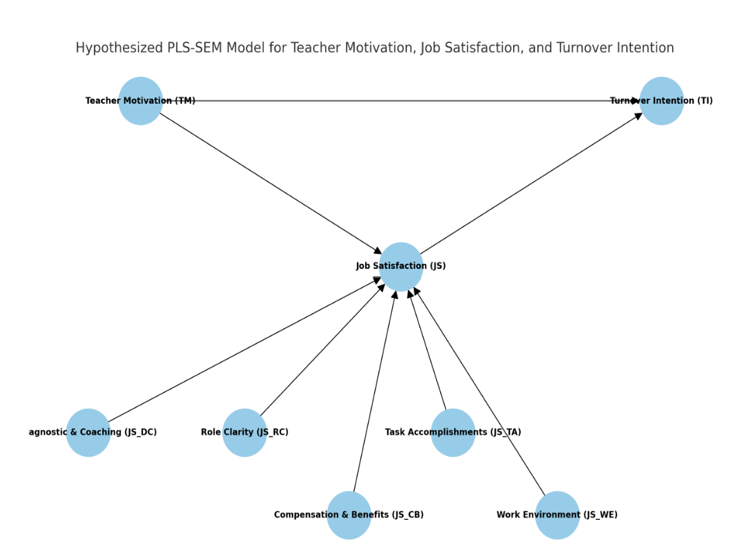
This study is anchored on the interplay between teacher motivation, job satisfaction, and turnover intention. Motivation has long been considered a driving force behind job performance and retention, particularly in education. Job satisfaction, which is multifaceted, includes dimensions such as diagnostic support and coaching, clarity of roles, compensation and benefits, task accomplishment, and work environment. Together, these components shape an educator's perception of their workplace and influence their decision to remain in or leave the profession.
In the proposed model, Teacher Motivation is posited to directly influence both Job Satisfaction and Turnover Intention. A higher level of motivation is expected to enhance satisfaction and reduce the likelihood of turnover. As a second-order construct, job satisfaction is composed of five reflective dimensions: Diagnostic and Coaching, Role Clarity, Compensation and Benefits, Task Accomplishment, and Work Environment. Each subdimension contributes to a holistic understanding of what makes teachers feel fulfilled and content in their roles.
The model, illustrated at Figure 1, is tested using Partial Least Squares Structural Equation Modeling (PLS-SEM), a robust statistical approach suited for complex models with reflective and formative constructs, and capable of handling mediation effects.

Reliability and Validity as Requirement for Model Building
Table 1 displays the findings related to the evaluation of the outer model component. This includes the assessment of both validity specifically convergent and discriminant validity and the reliability of the constructs used in the study. Construct reliability is determined by evaluating the internal consistency among reflective indicators and the construct they are intended to measure 21. According to Kock 22, a construct demonstrates adequate reliability when both the Composite Reliability (CR) and Cronbach’s Alpha (CA) values meet or exceed the threshold of 0.70. Convergent validity assesses whether the respondents interpret the items in a manner that aligns with the researcher’s intended meaning. In the context of Partial Least Squares Structural Equation Modeling (PLS-SEM), two key criteria are used to establish convergent validity: first, item loadings should be 0.50 or higher and statistically significant (p < 0.05), as loadings represent the strength of the relationship between each item and its corresponding construct. Second, the Average Variance Extracted (AVE) should be at least 0.50, which indicates that the construct explains more variance than the error term 21, 23. Table 1 provides a comprehensive summary of the results concerning the reliability and validity assessments.
The analysis presented in Table 1 evaluates the measurement quality of the constructs by assessing their convergent validity and internal consistency reliability. All constructs exhibit statistically significant factor loadings (p < 0.001), which confirms that each indicator meaningfully contributes to the measurement of its corresponding latent variable. Although most loadings exceeded the acceptable threshold of 0.50, a few items under Teacher Motivation (ranging from 0.466 to 0.785) and Work Environment (with a minimum of 0.330) fell below the ideal cutoff, suggesting that these specific items may not align as strongly with their constructs and might warrant future refinement or review.
In terms of Average Variance Extracted (AVE), which measures the proportion of variance captured by a construct relative to the variance due to measurement error, most constructs meet or exceed the recommended minimum of 0.50. For instance, Compensation and Benefits (AVE = 0.749) and Task Accomplishment (AVE = 0.753) exhibit excellent convergent validity. Similarly, Diagnostic and Coaching, Role Clarity, and Work Environment show acceptable AVE values. However, Teacher Motivation (AVE = 0.472) and Turnover Intention (AVE = 0.468) fall slightly below the threshold, indicating moderate convergent validity. This suggests that while the items are generally reflective of the intended constructs, a portion of variance remains unexplained, and further scale refinement might enhance the measurement precision.
With regard to reliability, all constructs surpass the minimum thresholds for Cronbach’s Alpha (CA) and Composite Reliability (CR), with values well above 0.70, confirming strong internal consistency. Notably, Teacher Motivation (CA = 0.928, CR = 0.937) and Compensation and Benefits (CA = 0.916, CR = 0.937) exhibit excellent reliability, indicating that the items within these scales consistently measure their intended constructs. Even constructs with slightly lower AVE, such as Turnover Intention (CA = 0.771, CR = 0.840), maintain acceptable reliability levels, supporting their inclusion in the model.
Generally, the measurement model demonstrates robust reliability across all constructs and generally acceptable convergent validity. While the slightly lower AVE values and factor loadings for certain items indicate areas for potential improvement, the overall results affirm the soundness of the instrument used in capturing the theoretical dimensions of teacher motivation, job satisfaction, and turnover intention.
3.2. Inner Model ComponentTo evaluate the robustness and adequacy of the proposed structural model, several model fit and quality indices were assessed. These indices provide insights into the overall validity, explanatory power, and predictive capability of the model, as well as the presence of multicollinearity and suppression effects. The following metrics were computed: Average Path Coefficient (APC), Average R-squared (ARS), Average Adjusted R-squared (AARS), Average Variance Inflation Factors (AVIF and AFVIF), Tenenhaus Goodness-of-Fit (GoF), Simpson’s Paradox Ratio (SPR), R-squared Contribution Ratio (RSCR), Statistical Suppression Ratio (SSR), and Nonlinear Bivariate Causality Direction Ratio (NLBCDR). These indicators collectively determine the model’s fit quality, predictive relevance, and internal consistency.
Model fit and quality indices
-----------------------------------------------------------
Average path coefficient (APC)=0.319, P<0.001
Average R-squared (ARS)=0.627, P<0.001
Average adjusted R-squared (AARS)=0.624, P<0.001
Average block VIF (AVIF)=2.324, acceptable if <= 5, ideally <= 3.3
Average full collinearity VIF (AFVIF)=39.219, acceptable if <= 5, ideally <= 3.3
Tenenhaus GoF (GoF)=0.643, small >= 0.1, medium >= 0.25, large >= 0.36
Simpson's paradox ratio (SPR)=1.000, acceptable if >= 0.7, ideally = 1
R-squared contribution ratio (RSCR)=1.000, acceptable if >= 0.9, ideally = 1
Statistical suppression ratio (SSR)=1.000, acceptable if >= 0.7
Nonlinear bivariate causality direction ratio (NLBCDR)=1.000, acceptable if >= 0.7
The results of the model fit and quality indices suggest that the proposed structural model exhibits a generally good fit and substantial explanatory power, with some limitations. The Average Path Coefficient (APC) of 0.319, which is statistically significant (p < 0.001), indicates that the relationships among the latent constructs are meaningful and moderately strong. This is further supported by the Average R-squared (ARS) value of 0.627 and the Average Adjusted R-squared (AARS) value of 0.624, both of which suggest that the model explains a substantial portion (approximately 62%) of the variance in the endogenous variables. The close proximity of ARS and AARS also implies that the model is not overfitted.
In terms of multicollinearity, the Average Block VIF (AVIF) value of 2.324 is within the acceptable range (≤5) and close to the ideal threshold (≤ 3.3), indicating that multicollinearity within predictor blocks is not a concern. However, the Average Full Collinearity VIF (AFVIF) is significantly elevated at 39.219, which far exceeds the acceptable and ideal values. This result points to a critical issue with collinearity among variables across the model and suggests that the data may contain redundant or overlapping constructs that need to be reviewed. Addressing this issue is important to ensure the stability and interpretability of the model estimates.
The Tenenhaus Goodness-of-Fit (GoF) value of 0.643 indicates a strong overall model fit, exceeding the threshold for a large effect size (≥ 0.36). Additionally, several quality indices show ideal values: the Simpson’s Paradox Ratio (SPR), R-squared Contribution Ratio (RSCR), Statistical Suppression Ratio (SSR), and Nonlinear Bivariate Causality Direction Ratio (NLBCDR) all scored 1.000. These results indicate that the model does not suffer from inconsistencies between aggregated and disaggregated data, all variables contribute positively to the explained variance, there are no suppressor effects, and the directionality of causal relationships among constructs is correctly specified.
Generally, the structural model is statistically robust and theoretically sound, with significant path relationships and strong explanatory power. Nonetheless, the high full collinearity indicated by the AFVIF warrants careful attention. Addressing this issue, perhaps through construct refinement or model respecification, will enhance the validity and reliability of the results.
8.3 Summary of the Parameter Estimates of the Structural Component of the Constructs of the Study
This section presents the parameter estimates of the structural component of the study, focusing on the direct and indirect relationships among the main constructs and their corresponding subconstructs. The analysis was conducted using structural equation modeling to test the hypothesized paths and determine the strength, direction, and statistical significance of the relationships.
Table 2 summarizes the path coefficients (β), p-values, and effect sizes (f²) for each hypothesized relationship. The evaluation includes both first-order (direct effects) and second-order constructs, allowing for a comprehensive understanding of how teacher motivation, job satisfaction, and turnover intention are interrelated, as well as how specific organizational factors such as diagnostic and coaching support, role clarity, compensation and benefits, task accomplishment, and work environment impact job satisfaction. The results are interpreted based on standardized criteria for statistical significance (p < .05 or p < .01) and Cohen’s benchmarks for effect size, indicating whether each hypothesis is supported.
The findings from the structural model provide meaningful insights into the direct and indirect relationships among the key constructs of the study. All hypothesized paths were found to be statistically significant, thereby supporting the proposed theoretical framework. Among the direct effects, the path from Teacher Motivation (TM) to Job Satisfaction (JS) (β = 0.798, p < 0.001, f² = 0.637) showed a strong positive relationship with a large effect size, indicating that teacher motivation is a powerful predictor of job satisfaction. Interestingly, TM also negatively predicted Turnover Intention (TI) (β = -0.335, p < 0.001, f² = 0.163), with a moderate effect size. This suggests that more motivated teachers are less likely to consider leaving their jobs. Additionally, Job Satisfaction (JS) also negatively influenced Turnover Intention (TI) (β = -0.191, p = 0.002, f² = 0.087), though the effect size was small to moderate. This indicates that while job satisfaction contributes to reducing turnover intention, its impact is less pronounced than that of direct motivation.
In the second-order construct analysis, various organizational factors were found to significantly influence Job Satisfaction (JS). Compensation and Benefits (CB) (β = 0.336, p < 0.001, f² = 0.285) and Work Environment (WE) (β = 0.325, p < 0.001, f² = 0.296) emerged as the strongest predictors, both with large effect sizes, highlighting their crucial roles in enhancing teacher satisfaction. Diagnostic and Coaching (DC) (β = 0.272, p < 0.001, f² = 0.228) also showed a significant positive effect with a moderate to large effect size, suggesting that supportive professional development and feedback mechanisms contribute meaningfully to satisfaction. Meanwhile, Role Clarity (RC) (β = 0.175, p = 0.004, f² = 0.095) and Task Accomplishment (TA) (β = 0.121, p = 0.033, f² = 0.089) were also positively associated with job satisfaction, although their effect sizes were smaller. These results underscore the multifaceted nature of job satisfaction, which is influenced not only by intrinsic motivation but also by tangible workplace conditions and support systems.
The results affirm that teacher motivation is both a direct enhancer of job satisfaction and a deterrent to turnover intention. Job satisfaction, in turn, also reduces turnover intention, albeit to a lesser extent. Furthermore, organizational factors such as a supportive work environment, competitive compensation, and effective coaching significantly contribute to fostering teacher satisfaction. These findings provide empirical support for interventions aimed at strengthening both individual motivation and institutional support structures to improve retention and morale among educators.
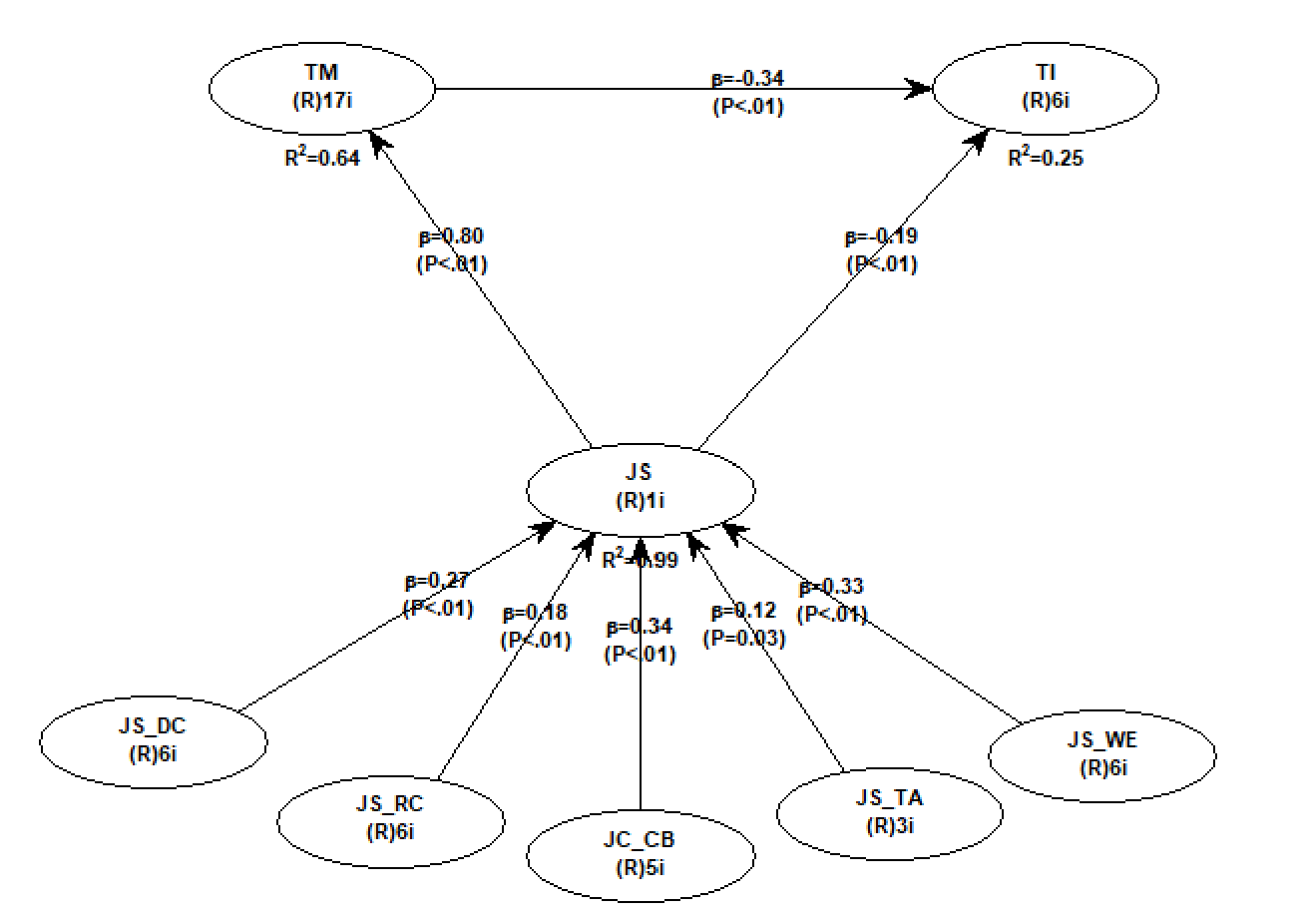
Figure 2 shows the developed theory based on the hypothesized framework in the context of the study.

The structural model diagram illustrates the interrelationships among the main constructs and subconstructs in the study. It shows that Teacher Motivation (TM) has a strong, positive, and significant direct effect on Job Satisfaction (JS) (β = 0.80, p < 0.01), explaining 64% of its variance (R² = 0.64). In turn, Job Satisfaction significantly predicts Turnover Intention (TI) negatively (β = -0.19, p < 0.01), while Teacher Motivation (TM) also directly and negatively influences Turnover Intention (TI) (β = -0.34, p < 0.01), with TI having an R² of 0.25.
The second-order constructs—Diagnostic and Coaching (DC), Role Clarity (RC), Compensation and Benefits (CB), Task Accomplishment (TA), and Work Environment (WE) are all significant predictors of Job Satisfaction, with CB (β = 0.34) and WE (β = 0.33) exerting relatively stronger effects. The explained variance in Job Satisfaction from these components is R² = 0.499, indicating a substantial model fit.
Overall, the diagram confirms the hypothesized model paths, highlighting that enhancing teacher motivation and the components of job satisfaction can significantly reduce turnover intentions.
This study modeled the relationships among teacher motivation, job satisfaction, and turnover intention among private basic education teachers in Cauayan City using PLS-SEM. The measurement model showed acceptable reliability and validity, confirming that the constructs were appropriately measured. The structural model demonstrated strong explanatory power, accounting for 64% of the variance in job satisfaction and 25% in turnover intention, with overall fit indices indicating a stable and coherent model.
Teacher motivation emerged as the most influential construct, significantly increasing job satisfaction and reducing turnover intention. Job satisfaction also negatively predicted turnover intention, though with a smaller effect, suggesting that while satisfied teachers are less likely to consider leaving, motivation remains the more powerful driver of retention. The second-order analysis further revealed that compensation and benefits, work environment, and coaching support are the strongest facets shaping job satisfaction, demonstrating that retention requires both intrinsic and structural support for teachers.
Thus, this study confirms that the interplay of motivation and satisfaction meaningfully influences teachers’ intent to stay, offering a practical framework for designing retention strategies. Strengthening motivation, improving workplace conditions, and enhancing professional support systems can help private basic education institutions maintain a committed and stable teaching workforce.
| [1] | World Economic Forum. (2023). Global risks report 2023: Insight report. https://www.weforum.org/reports/global-risks-report-2023. | ||
| In article | |||
| [2] | CIPD. (2022). Resourcing and talent planning survey 2022. Chartered Institute of Personnel and Development. https:// www.cipd.org/uk/knowledge/reports/resourcing-talent-planning/. | ||
| In article | |||
| [3] | Wallace, J. (2023). The hidden costs of employee turnover in 2023. Society for Human Resource Management (SHRM). https://www.shrm.org/resourcesandtools/hr-topics/talent-acquisition/pages/the-hidden-costs-of-employee-turnover.aspx. | ||
| In article | |||
| [4] | Gallup. (2023). State of the global workplace 2023 report. https://www.gallup.com/workplace/349484/state-of-the-global-workplace.aspx. | ||
| In article | |||
| [5] | Ryan, R. M., & Deci, E. L. (2020). Intrinsic and extrinsic motivation from a self-determination theory perspective: Definitions, theory, practices, and future directions. Contemporary Educational Psychology, 61, 101860. | ||
| In article | View Article | ||
| [6] | Karlen, Y., Merki, K. M., & Odermatt, F. (2023). The role of teachers’ motivation in supporting students’ self-regulated learning. Educational Psychology, 43(1), 1–16. | ||
| In article | |||
| [7] | Karlen, Y., Grabherr, J., & Roth, A. (2023). How teachers’ motivational profiles predict student self‑regulated learning. Learning and Instruction, 83, 101707. | ||
| In article | |||
| [8] | Snijders, I., Jansen, E., & Maulana, R. (2020). Why teachers stay: An international review of factors influencing teacher retention. Educational Research Review, 31, 100363. | ||
| In article | View Article | ||
| [9] | Snijders, I., Seemans, A., & Bosker, R. J. (2020). Teachers’ professional identity and job satisfaction: The role of school context and self-efficacy. Educational Studies, 46(6), 702–719. | ||
| In article | |||
| [10] | Snijders, I., Wisse, B., & Ruiter, J. A. (2020). Shared values and teacher retention: The mediating role of organisational identification. School Leadership & Management, 40(2–3), 182–200. | ||
| In article | |||
| [11] | Snijders, I., Wijnia, L., Rikers, R. M., & Loyens, S. M. (2020). Building bridges in higher education: Student–faculty relationship quality, student engagement, and student loyalty. International Journal of Educational Research, 100, Article 101538. | ||
| In article | View Article | ||
| [12] | Will, M. (2022, February 3). Why so many teachers are thinking of quitting. Education Week. https://www.edweek.org/teaching-learning/why-so-many-teachers-are-thinking-of-quitting/2022/02. | ||
| In article | |||
| [13] | OECD. (2021). Teachers and leaders in vocational education and training. OECD Publishing. | ||
| In article | View Article | ||
| [14] | UNESCO-IIEP. (2023). Teacher attrition in developing countries: Understanding the challenge and policy responses. International Institute for Educational Planning. https://www.iiep.unesco.org | ||
| In article | |||
| [15] | Fabella, F. P., Sanchez, P. M., & de Guzman, J. N. (2022). Push and pull: Why Philippine private‐school teachers transfer or exit. Philippine Journal of Education, 101(2), 45‑66. | ||
| In article | |||
| [16] | Hernando-Malipot, M. (2021, May 17). Public schools still preferred by many private school teachers – DepEd. Manila Bulletin. https:// mb.com.ph/ 2021/05/17/ public-schools-still-preferred-by-many-private-school-teachers-deped/. | ||
| In article | |||
| [17] | Tibay, J. J. M. (2022). Teaching at a cost: A phenomenological study on job dissatisfaction of public-school teachers. International Journal of Educational Management and Development Studies, 3(1), 68–85. | ||
| In article | |||
| [18] | Basilio-Estillore, M., Estacio, MB., & Bautista, RG. (2025). Motivational factors, job satisfaction, and turnover intentions of basic education teachers in private schools in Cauayan City, Philippines. American Journal of Educational Research, 13 (9), 432-437. | ||
| In article | View Article | ||
| [19] | Baniqued, WB., Cagatao, PPS., & Bautista, RG. (2024). Modelling the interplay of K-12 science teachers’ pedagogical practices. American Journal of Educational Research, 12(11), 420-426. | ||
| In article | View Article | ||
| [20] | Abella, CRG., Anoling, KM., Cagatao, PPS., & Bautista, RG. (2024). Modelling the interplay of science teaching dimensions from the lenses of science educators. American Journal of Educational Research, 12(4), 159-163. | ||
| In article | View Article | ||
| [21] | Fearnley, M., & Amora, J. (2020). Learning management system adoption in higher education using the extended technology acceptance model. IAFOR Journal of Education, 8(2), 89-106. | ||
| In article | View Article | ||
| [22] | Kock, N. (2020). Harman’s single factor test in PLS-SEM: Checking for common method bias. Data Analysis Perspectives Journal, 2, 1-6. | ||
| In article | |||
| [23] | Kock, Ned. (2015). Common method bias in PLS-SEM: A full collinearity assessment approach. International Journal of e Collaboration. 11. 1-10. | ||
| In article | View Article | ||
Published with license by Science and Education Publishing, Copyright © 2025 Michelle Basilio-Estillore, Madeilyn B. Estacio and Romiro G. Bautista
 This work is licensed under a Creative Commons Attribution 4.0 International License. To view a copy of this license, visit
http://creativecommons.org/licenses/by/4.0/
This work is licensed under a Creative Commons Attribution 4.0 International License. To view a copy of this license, visit
http://creativecommons.org/licenses/by/4.0/
| [1] | World Economic Forum. (2023). Global risks report 2023: Insight report. https://www.weforum.org/reports/global-risks-report-2023. | ||
| In article | |||
| [2] | CIPD. (2022). Resourcing and talent planning survey 2022. Chartered Institute of Personnel and Development. https:// www.cipd.org/uk/knowledge/reports/resourcing-talent-planning/. | ||
| In article | |||
| [3] | Wallace, J. (2023). The hidden costs of employee turnover in 2023. Society for Human Resource Management (SHRM). https://www.shrm.org/resourcesandtools/hr-topics/talent-acquisition/pages/the-hidden-costs-of-employee-turnover.aspx. | ||
| In article | |||
| [4] | Gallup. (2023). State of the global workplace 2023 report. https://www.gallup.com/workplace/349484/state-of-the-global-workplace.aspx. | ||
| In article | |||
| [5] | Ryan, R. M., & Deci, E. L. (2020). Intrinsic and extrinsic motivation from a self-determination theory perspective: Definitions, theory, practices, and future directions. Contemporary Educational Psychology, 61, 101860. | ||
| In article | View Article | ||
| [6] | Karlen, Y., Merki, K. M., & Odermatt, F. (2023). The role of teachers’ motivation in supporting students’ self-regulated learning. Educational Psychology, 43(1), 1–16. | ||
| In article | |||
| [7] | Karlen, Y., Grabherr, J., & Roth, A. (2023). How teachers’ motivational profiles predict student self‑regulated learning. Learning and Instruction, 83, 101707. | ||
| In article | |||
| [8] | Snijders, I., Jansen, E., & Maulana, R. (2020). Why teachers stay: An international review of factors influencing teacher retention. Educational Research Review, 31, 100363. | ||
| In article | View Article | ||
| [9] | Snijders, I., Seemans, A., & Bosker, R. J. (2020). Teachers’ professional identity and job satisfaction: The role of school context and self-efficacy. Educational Studies, 46(6), 702–719. | ||
| In article | |||
| [10] | Snijders, I., Wisse, B., & Ruiter, J. A. (2020). Shared values and teacher retention: The mediating role of organisational identification. School Leadership & Management, 40(2–3), 182–200. | ||
| In article | |||
| [11] | Snijders, I., Wijnia, L., Rikers, R. M., & Loyens, S. M. (2020). Building bridges in higher education: Student–faculty relationship quality, student engagement, and student loyalty. International Journal of Educational Research, 100, Article 101538. | ||
| In article | View Article | ||
| [12] | Will, M. (2022, February 3). Why so many teachers are thinking of quitting. Education Week. https://www.edweek.org/teaching-learning/why-so-many-teachers-are-thinking-of-quitting/2022/02. | ||
| In article | |||
| [13] | OECD. (2021). Teachers and leaders in vocational education and training. OECD Publishing. | ||
| In article | View Article | ||
| [14] | UNESCO-IIEP. (2023). Teacher attrition in developing countries: Understanding the challenge and policy responses. International Institute for Educational Planning. https://www.iiep.unesco.org | ||
| In article | |||
| [15] | Fabella, F. P., Sanchez, P. M., & de Guzman, J. N. (2022). Push and pull: Why Philippine private‐school teachers transfer or exit. Philippine Journal of Education, 101(2), 45‑66. | ||
| In article | |||
| [16] | Hernando-Malipot, M. (2021, May 17). Public schools still preferred by many private school teachers – DepEd. Manila Bulletin. https:// mb.com.ph/ 2021/05/17/ public-schools-still-preferred-by-many-private-school-teachers-deped/. | ||
| In article | |||
| [17] | Tibay, J. J. M. (2022). Teaching at a cost: A phenomenological study on job dissatisfaction of public-school teachers. International Journal of Educational Management and Development Studies, 3(1), 68–85. | ||
| In article | |||
| [18] | Basilio-Estillore, M., Estacio, MB., & Bautista, RG. (2025). Motivational factors, job satisfaction, and turnover intentions of basic education teachers in private schools in Cauayan City, Philippines. American Journal of Educational Research, 13 (9), 432-437. | ||
| In article | View Article | ||
| [19] | Baniqued, WB., Cagatao, PPS., & Bautista, RG. (2024). Modelling the interplay of K-12 science teachers’ pedagogical practices. American Journal of Educational Research, 12(11), 420-426. | ||
| In article | View Article | ||
| [20] | Abella, CRG., Anoling, KM., Cagatao, PPS., & Bautista, RG. (2024). Modelling the interplay of science teaching dimensions from the lenses of science educators. American Journal of Educational Research, 12(4), 159-163. | ||
| In article | View Article | ||
| [21] | Fearnley, M., & Amora, J. (2020). Learning management system adoption in higher education using the extended technology acceptance model. IAFOR Journal of Education, 8(2), 89-106. | ||
| In article | View Article | ||
| [22] | Kock, N. (2020). Harman’s single factor test in PLS-SEM: Checking for common method bias. Data Analysis Perspectives Journal, 2, 1-6. | ||
| In article | |||
| [23] | Kock, Ned. (2015). Common method bias in PLS-SEM: A full collinearity assessment approach. International Journal of e Collaboration. 11. 1-10. | ||
| In article | View Article | ||