In the 21st century, the demand for proficiency in mathematics has escalated, as it underpins critical thinking, problem-solving, and innovation in various fields. Recognizing the significance of mathematics education, after-school programs have emerged as potent supplementary platforms to enhance students' mathematical skills and achievement. This study aimed to determine the impact of the after-school program on fostering mathematics in the 21st century. The study was conducted at Chaparral Middle School of Alamogordo Public Schools District in New Mexico, USA to middle school students enrolled for the school year 2023-2024. The research method is experimental. The after-school program students were exposed to the mathematics resources in the 21st century such as Khan Academy, ALEKS, Peer-Assisted Learning Strategies, Illustrative Math, and the like. Evidence-based resources were used to foster students' mathematics achievement. A standardized test that measures mathematics achievement was the main instrument used in the study. The mean, standard deviation, and t-test were used to analyze the data collected. The analysis with a t-value of 7.889 and probability value of 0.000 revealed that students exposed to the after-school program performed significantly in terms of mathematics achievement. Researchers recommend that teachers may use the after-school program to foster mathematics achievement. Teachers might also incorporate activities into their Mathematics teaching that demand students to engage resource materials to foster students' mathematics potential in the 21st century.
In the fast-paced and technology-driven 21st century, proficiency in mathematics has become increasingly essential for success in both academic and professional realms. Mathematics serves as the cornerstone of critical thinking, problem-solving, and innovation, laying the foundation for progress in various fields ranging from science and engineering to economics and finance. Mathematics is one of the most established disciplines and is included in every curriculum worldwide 1. Some international achievement results such as Trends in International Mathematics and Science Study (TIMMS) and Programme for International Student Assessment (PISA) scores described the low ability of students' creative thinking in recent years. It is evident in the current results of the 2018 PISA. The United States only made it into 22nd place with a total average score of 1,485, just slightly above the 1,465 average scores for all OECD countries assessed. These outcomes might result in a lack of creativity, stifling of innovation, and program intervention 2, 3, 4.
Most students have always found mathematics to be a challenging subject. Lower mathematics scores for grades 4 and 8 in the 2022 National Assessment of Educational Progress (NAEP) are cause for systemic change in how we engage students in learning mathematics, according to the National Council of Teachers of Mathematics (NCTM). The latest results in the Nation’s Report Card point toward the need for a greater focus and higher priority on mathematics instruction. Drops in math scores back to 2003 levels highlight the need for increased focus on students’ mathematical understanding and reflect the impact of policies that have significantly slowed previous gains in mathematics. Regular classroom teaching in schools does not suffice as the teacher might not look after each student's progress. After-school program in Mathematics is gaining popularity among United States students as this program proves to imbibe deeper comprehension of the subject in students' minds 5, 6. Providing students with such an immersive program helps them develop proficiency in the subject and enables them to participate actively and engage in the learning experience. After-school program—defined as one-on-one or small-group instructional programs—rank among the most widespread, versatile, and potentially transformative instruments in today's educational toolkit. As school systems across the globe expand and engage with increasingly diverse student populations, the importance of tutoring continues to grow. Children who regularly attended a high-quality afterschool program alone or combined with extracurricular activities were reported by teachers to have higher academic performance, work habits, task persistence, and less aggression. Moreover, participation in after-school activities affects creativity development 7 8.
Afterschool programs are defined as supervised programs that meet regularly during the school year and offer diverse activities to groups of children. Participation in afterschool programs is associated with gains in social and emotional outcomes; this is especially true when programs focus on social and emotional learning and create a positive environment through such practices as sharing agency and building strong relationships 9.
Moreover, Chaparral Middle School in Alamogordo Public Schools (APS) District in New Mexico, USA is allotted Teachers for after-school program for Math, English Language Arts (ELA), and Science teachers. The mission of the Alamogordo Public School System is to ensure that all students acquire the knowledge, skills, and attitudes to become productive citizens. APS is extending an opportunity to all schools under Elementary and Secondary School Emergency Relief (ESSER) III to implement after-school math, ELA, and SEL Intervention Programs utilizing approved evidence-based resources. Thus, this study was conducted to foster students’ mathematics achievement through after-school program in the 21st century.
Many after-school programs have been found to increase student success in mathematics, including small group faculty-led tutoring, peer-assisted learning sessions, drop-in tutoring, as well as tutoring centers that provide a variety of support programs in the 21st century. The report of a survey of mathematics centers in Ireland provided recommendations such as increased collaboration between mathematics centers and instructors, training of staff, and aligning hours of operation to match student availability. Research in the USA is needed to replicate and expand upon these studies. In the study of Mills et al (2022), they have identified many common practices in mathematics centers in the USA, however, research is still needed to determine how practices regarding center design, center operations, and center services impact student learning, success rates, and retention 6.
The meta-analysis study of Atit et al (2022) is particularly pressing in light of the widespread underachievement of US students in STEM subjects, specifically in mathematics. A report from the Program of International Student Assessment (PISA) suggests that American students' weaknesses in mathematics are particularly evident when "reasoning in a geometric context – requiring authentic reasoning in a planar or spatial geometric context. This indicates that problems engaging one's spatial skills may be particularly difficult for American students. As a concerted research and educational effort rises to address this need to improve students' mathematical outcomes, it is worth considering the existing wealth of research examining the relation between these two skill sets. A brief overview of relevant research, grouped by common themes, is presented to situate the current meta-analysis within the broader academic and societal context 10
However, the study of Vandell et al (2022) does highlight the utility of considering afterschool settings as a "package" of activities and programs. The fact that more than 40% of the children attended high-quality afterschool pro- grams either alone or in combination with extracurricular activities has implications for those who operate programs as well as those who evaluate pro- grams. Programs must be aware of irregular attendance—youth who come a couple of days a week or who attend regularly for several weeks and then disappear for some time —in designing specific programs or activities. More importantly, the need for collaboration between after-school programs and other extracurricular activities should be recognized. Rather than being "all things to all children," afterschool programs can be more attentive to how their strengths can be coordinated with other afterschool settings in which young people in their community are engaged. Afterschool programs as well as other institutions, such as schools, can serve as information hubs for parents to provide them with information on various after-school pursuits in the local community 7.
Furthermore, participating in after-school activities was positively associated with family socio-economic status (SES). Students from higher SES backgrounds were not only more likely to participate in after-school activities but were also more likely to participate in academic-oriented and combined activities compared to students from lower SES backgrounds. Parents with higher SES are more likely to have adequate resources and capable of providing more after-school opportunities to their children. Therefore, it is not surprising that children from families with higher SES are more likely to participate in after-school activities. Moreover, the findings are consistent with previous literature that most families in China invest resources for their children to participate in after-school activities. Interestingly, little-c can be facilitated by solely participating in academically oriented after-school activities, whereas mini-c facilitation requires participation in both academic and non-academic after-school activities 11.
According to Han and Suh (2023), the effects of shadow education that includes private tutoring on academic achievement in mathematics differs from those on creative thinking. Because creative thinking is a critical learning outcome for students in the 21st century, mathematics teachers, parents, and students need to notice this difference. Educational policymakers and mathematics educators need to keep this finding in mind as they develop plans for mathematics education, especially for promoting students' 21st-century skills in mathematics classes 12. Teachers might also incorporate activities into their Mathematics activities that demand students to present various clearly defined solutions to foster students' creative potential 13.
One prominent theory that can be applied to understand how after-school programs foster students' mathematics achievement in the 21st century is the Constructivist Learning Theory. This theory suggests that learning is an active process in which individuals construct knowledge and meaning based on their experiences and interactions with the environment. In the context of after-school mathematics programs, the Constructivist Learning Theory suggests that students construct their understanding of mathematical concepts through hands-on activities, problem-solving tasks, and collaborative learning experiences. By engaging in activities that require them to explore, manipulate, and apply mathematical concepts in real-world contexts, students actively construct their mathematical knowledge and develop a deeper understanding of mathematical principles. Jean Piaget's Constructivist Learning Theory provides a theoretical framework for understanding how after-school programs foster students' mathematics achievement by emphasizing active learning, hands-on experiences, and collaborative problem-solving. By applying principles of constructivism in their instructional practices, after-school programs can create learning environments that promote deep understanding, critical thinking, and mathematical proficiency among students 16.
Numerous studies suggest that the After School Program helps students prepare for the acquisition of related knowledge. This is related to the present study because the students are asked to work on the activities in their After School Program using the given evidence-based resources.
The study was conducted in Chaparral Middle School in Alamogordo Public Schools (APS) District in New Mexico, USA. As experimental, the study involved Grades 6 to 8 middle school students who were officially enrolled in the after-school program for the first semester of school year 2023-2024. Due to a small number of population, purposive sampling was used. There were 12 students participated in the study.

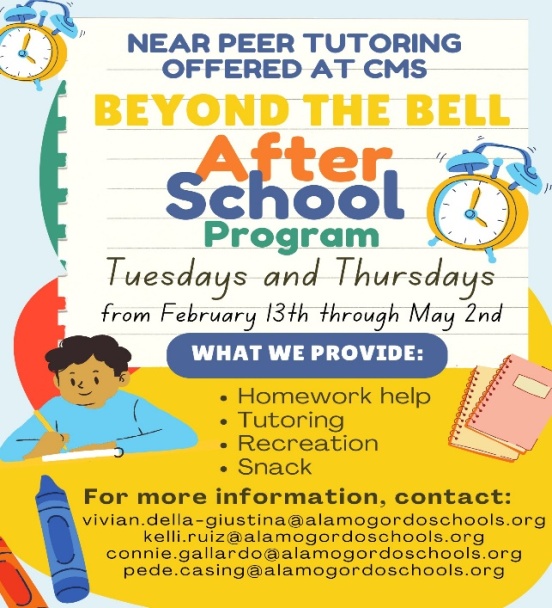
Furthermore, the teachers who conducted the after-school program must be licensed for the grade level of students attending the program. Two hours per week was scheduled per after-school intervention teacher. This was done on Tuesdays and Thursdays. APS requires that each school be provided maintenance of equity in supporting students. Maintenance of equity is based on economically disadvantaged percentiles. It requires schools to prioritize intervention services for economically disadvantaged, minority, homeless, migrant, SpEd, and ESL students. Schools should send a special invitation to parents of these students encouraging their participation in the school’s programs through flyers during the parent-teacher conferences (see Figure 1). However, students not meeting the criteria may also attend. Teachers must document programs or materials used that match the list of evidence-based resources in the 21st century in Table 1 such as ALEKS, Khan Academy, Math Prodigy, Maneuvering the Middle, Peer-Assisted Learning Strategies, Illustrative Math, Youcubed, and the like.
Teachers must maintain a daily session attendance record in the shared folder which includes the attending student's PowerSchool Student Number. School rosters will be shared with each school for this purpose. Teachers must clock in and out of Frontline Time & Attendance each day of sessions. The after-school program provides homework help, tutoring, recreation, and snacks. The results of the standardized test were used for analyzing the data, specifically on ALEKS scheduled knowledge for Pre-Test and Post-Test.
The ALEKS (Assessment and LEarning in Knowledge Spaces) educational software system is an instantiation of knowledge space theory (KST) that has been used by millions of students in mathematics, chemistry, statistics, and accounting. The software employs a probabilistic assessment based on KST for placement into an appropriate course or curriculum, a learning mode in which students are guided through course material according to a knowledge structure, and regularly spaced re-assessments which are also based on KST. In each of these aspects, the interactions of the student with the system are guided by the theory and by insights learned from student data 17. By adapting to individual students’ knowledge states and personalizing interactive practice and feedback, ALEKS may potentially support learning in mathematics, which is foundational for success in science, technology, engineering, and mathematics (STEM) fields 18.
Table 2 shows the mean and standard deviation of the pre-test and post-test of students’ mathematics achievement. In the pretest, the group shows 18.17 which indicates that the participants got low scores in the pre-test. This means that students were at a D level; that is, the participants had a poor background or little knowledge about the lessons. The results further reveal that the student’s achievement was not yet manifested at this time due to unfamiliarity with the selected topics. It can be observed further from the table that after the treatment, the group displays a mean score of 25.08. This means that there is an increase when it comes to their achievement scores. However, the group shows a huge increase which is from the D level to the B level. This indicates that the students in the after-school program had a better understanding of the lessons.
With regards to the pretest of students’ standard deviation in the Achievement Test, the group registers 2.406. Moreover, the standard deviation in the post-test of the group is 3.118. This means that the group test scores became more scattered. The effect of the treatment varied from learner to learner because of their heterogeneous ability. This means that some students got a high score while others scored very low. In other words, some students assimilated the concepts very well for they took the subject seriously and they studied more on the lessons, while others scored extremely low which might be due to the limited time frame that would allow them to fully understand the concept of each topic. The findings are consistent with the report of Masitoh et al., (2019) that the scientific approach is effective in terms of learning achievement, creative thinking abilities, interests, and mathematical self-efficacy 14. It can be concluded that exposure to after-school program might have helped them to enhance students' mathematics achievement.
Moreover, Table 3 shows the t-test summary of students’ mathematics achievement. The analysis yields a computed t-value of 7.889 and a probability value of 0.000 which is less than 0.05 level of significance. This led to the non-acceptance of the null hypothesis. This means that there is a significant difference in the students’ mathematics achievement levels among the after-school program students. This implies that the significant difference in their scores could be due to the students’ exposure to the mathematics evidence-based 21st-century resources from which the students were actively engaged. This situation happened probably because the students were involved in activities that develop critical thinking that facilitates the learning of important mathematical concepts and processes. This is also supported by Aljraiwi (2019) that mathematics resources like websites and math applications allow students to participate in the content and educational activities as they become active participants in learning, positively influencing their performance. Building positive communication and cooperative relationships among the participants resulted in experience exchange, problem-solving skills, independence, and competitiveness.
The overall aim of education is to train proactive, motivated, and independent citizens to face and overcome continuous challenges. Critical thinking—finding solutions to problems—is of primary importance in the 21st century to handle challenging situations and deal with obstacles in careers 19. Thus, after-school programs in the 21st century developed a more positive attitude towards Mathematics, allowed students to construct ideas in Mathematics that promote thinking, and illustrated an awareness of mathematical connections.
In the 21st century, after-school programs play a crucial role in fostering students' mathematics achievement. These programs offer opportunities for additional practice, reinforcement, and exploration beyond the confines of the regular school day. Through a combination of structured activities, individualized support, and engaging resources such as ALEKS, Khan Academy, Math Prodigy, Maneuvering the Middle, Peer-Assisted Learning Strategies, Illustrative Math, Youcubed, and the like, after-school programs can effectively enhance students' mathematical skills, confidence, and interest in the subject.
Research indicates that after-school programs focusing on mathematics can lead to significant improvements in students' performance and attitudes toward math. By providing a supportive environment where students can receive personalized attention, collaborate with peers, and access diverse learning resources, these programs address the unique needs of learners and cater to various learning styles.
Moreover, after-school programs offer flexibility in curriculum design, allowing educators to incorporate innovative teaching methods, real-world applications, and interdisciplinary approaches that enrich students' mathematical experiences. By integrating technology, project-based learning, and hands-on activities, these programs can make mathematics more accessible, relevant, and enjoyable for students.
To effectively foster students' mathematics achievement through after-school programs in the 21st century, it is recommended to:
1. Emphasize Individualized Support. Tailor instruction to meet the diverse needs and abilities of students, providing targeted interventions and enrichment opportunities as needed.
2. Foster Collaborative Learning. Promote peer interaction and collaboration to enhance problem-solving skills, communication, and teamwork among students.
3. Integrate Technology. Utilize digital tools, online resources, and educational software to supplement traditional instruction, facilitate interactive learning experiences, and enhance students' technological literacy.
4. Incorporate Real-World Applications. Connect mathematical concepts to real-life situations, professions, and everyday experiences to demonstrate the relevance and utility of mathematics in the modern world.
5. Engage Parents and Guardians. Involve parents and guardians in their children's learning by providing regular updates, resources, and opportunities for involvement in after-school activities.
6. Evaluate and Adjust Programming. Continuously assess the effectiveness of after-school programs through ongoing evaluation, feedback collection, and data analysis, making adjustments to curriculum, instruction, and resources as needed to optimize student outcomes.
By implementing these recommendations, after-school programs can serve as invaluable complements to traditional classroom instruction, empowering students to excel in mathematics and thrive academically in the 21st century.
The authors would like to express their sincere gratitude to Chaparral Middle School mentors, colleagues, parents, students, staff, and admin, especially to the Principal, Mr. Miguel RJ Baca, Assistant Principals, Mrs. Katelynn Stone and Dr. Ernestine Baca, to Mr. Jason Cole, the Dean of the students, Alamogordo Public Schools District headed by the Superintendent, Michael Crabtree, the Instructional Coaches and staffs of the district, for their tireless support, professional guidance, countless supervision, encouraging comments and patience in assisting with special care and attention. Finally, the authors would like to thank the New Mexico Public Education Department for their professional support.
| [1] | Guinocor, M., Almerino, P., Mamites, I., Lumayag, C., Villaganas, M., & Capuyan, M. (2020). Mathematics Performance of Students in a Philippine State University. International Electronic Journal of Mathematics Education. e-ISSN: 1306-3030., 15(3). | ||
| In article | View Article | ||
| [2] | Fauzi, K. M. A., Dirgeyase, I. W., & Priyatno, A. (2019). Building Learning Path of Mathematical Creative Thinking of Junior Students on Geometry Topics by Implementing Metacognitive Approach. International Education Studies., 12(2), 57. | ||
| In article | View Article | ||
| [3] | Mallillin, L. L. D., Ph, D., Laurel, R. D., Ph, D., Mallillin, J. B., Carag, E. A., & Ph, D. (2021). Competency Based-Learning and Quality Education in the New Normal Modality of Teaching. East African Scholars Journal of Education, Humanities and Literature., 4(4), 156–166. | ||
| In article | View Article | ||
| [4] | Marquez, L. P., Verone, M., Olivar, V., Eco, C., Ombao, R. P., Cerio, W. C., & Deogracias, F. (2020). Education and COVID-19 : Experiences and insights from a developing country. Access: Contemporary Issues in Education, 40(1), 84–90. | ||
| In article | View Article | ||
| [5] | Akman, O., Eaton, C. D., Hrozencik, D., Jenkins, K. P., & Thompson, K. V. (2020). Building Community-Based Approaches to Systemic Reform in Mathematical Biology Education. Bulletin of Mathematical Biology, 82(8). | ||
| In article | View Article PubMed | ||
| [6] | Mills, M., Rickard, B., & Guest, B. (2022). Survey of mathematics tutoring centers in the USA. International Journal of Mathematical Education in Science and Technology, 53(4), 948–968. | ||
| In article | View Article | ||
| [7] | Vandell, D. L., Simpkins, S. D., Pierce, K. M., Brown, B. B., Bolt, D., & Reisner, E. (2022). Afterschool programs, extracurricular activities, and unsupervised time: Are patterns of participation linked to children’s academic and social well-being? Applied Developmental Science, 26(3), 426–442. | ||
| In article | View Article | ||
| [8] | Yu, M. V. B., Liu, Y., Hsieh, T. Yang, Lee, G., Simpkins, S. D., & Pantano, A. (2022). "Working together as a team really gets them fired up": Afterschool program mentoring strategies to promote collaborative learning among adolescent participants. Applied Developmental Science, 26(2), 347–361. | ||
| In article | View Article | ||
| [9] | White, A. M., Akiva, T., Colvin, S., & Li, J. (2022). Integrating Social and Emotional Learning: Creating Space for Afterschool Educator Expertise. AERA Open, 8(1). | ||
| In article | View Article | ||
| [10] | Atit, K., Power, J. R., Pigott, T., Lee, J., Geer, E. A., Uttal, D. H., Ganley, C. M., & Sorby, S. A. (2022). Examining the relations between spatial skills and mathematical performance: A meta-analysis. Psychonomic Bulletin and Review, 29(3), 699–720. | ||
| In article | View Article PubMed | ||
| [11] | Liang, Q., Niu, W., Cheng, L., & Qin, K. (2022). Creativity Outside School: The Influence of Family Background, Perceived Parenting, and After-school Activity on Creativity. Journal of Creative Behavior, 56(1), 138–157. | ||
| In article | View Article | ||
| [12] | Han, S., & Suh, H. (2023). The effects of shadow education on high school students’ creative thinking and academic achievement in mathematics: the case of the Republic of Korea. Educational Studies, 49(2), 314–333. | ||
| In article | View Article | ||
| [13] | Casing, P., & B. Roble, D. (2021). Students’ Mathematical Creative Thinking Ability with Posing-Exploring-Doing-Evaluating (PEDE) Productive Failure Model in New Normal. American Journal of Educational Research, 9(7), 443–448. | ||
| In article | View Article | ||
| [14] | Masitoh, L. F., Prasetyawan, E., & Tangerang, S. (2019). The Effectiveness Of Scientific Approach With Open-Ended Problem-Based Learning Worksheet Viewed From Learning Achievement, Creative Thinking Ability, Interest, And Mathematics Self-Efficacy. DAYA MATEMATIS : Jurnal Inovasi Pendidikan Matematika, 7(3), 292–308. | ||
| In article | View Article | ||
| [15] | Aljraiwi, S. (2019). Effectiveness of Gamification of Web-Based Learning in Improving Academic Achievement and Creative Thinking among Primary School. International Journal of Education and Practice, 7(3), 242–257. | ||
| In article | View Article | ||
| [16] | Burhanuddin, N. A. N., Ahmad, N. A., Said, R. R., & Asimiran, S. (2021). Learning Theories: Views from Behaviourism Theory and Constructivism Theory. International Journal of Academic Research in Progressive Education and Development, 10(1), 85–98. | ||
| In article | View Article | ||
| [17] | Cosyn, E., Uzun, H., Doble, C., & Matayoshi, J. (2021). A practical perspective on knowledge space theory: ALEKS and its data. Journal of Mathematical Psychology, 101, 102512. | ||
| In article | View Article | ||
| [18] | Sun, S., Else-Quest, N. M., Hodges, L. C., French, A. M., & Dowling, R. (2021). The Effects of ALEKS on Mathematics Learning in K-12 and Higher Education: A Meta-Analysis. Investigations in Mathematics Learning, 13(3), 182–196. | ||
| In article | View Article | ||
| [19] | Szabo, Z. K., Körtesi, P., Guncaga, J., Szabo, D., & Neag, R. (2020). Examples of problem-solving strategies in mathematics education support the sustainability of 21st-century skills. Sustainability (Switzerland), 12(23), 1–28. | ||
| In article | View Article | ||
Published with license by Science and Education Publishing, Copyright © 2024 Pede I. Casing and Leah Mae R. Casing
 This work is licensed under a Creative Commons Attribution 4.0 International License. To view a copy of this license, visit
http://creativecommons.org/licenses/by/4.0/
This work is licensed under a Creative Commons Attribution 4.0 International License. To view a copy of this license, visit
http://creativecommons.org/licenses/by/4.0/
| [1] | Guinocor, M., Almerino, P., Mamites, I., Lumayag, C., Villaganas, M., & Capuyan, M. (2020). Mathematics Performance of Students in a Philippine State University. International Electronic Journal of Mathematics Education. e-ISSN: 1306-3030., 15(3). | ||
| In article | View Article | ||
| [2] | Fauzi, K. M. A., Dirgeyase, I. W., & Priyatno, A. (2019). Building Learning Path of Mathematical Creative Thinking of Junior Students on Geometry Topics by Implementing Metacognitive Approach. International Education Studies., 12(2), 57. | ||
| In article | View Article | ||
| [3] | Mallillin, L. L. D., Ph, D., Laurel, R. D., Ph, D., Mallillin, J. B., Carag, E. A., & Ph, D. (2021). Competency Based-Learning and Quality Education in the New Normal Modality of Teaching. East African Scholars Journal of Education, Humanities and Literature., 4(4), 156–166. | ||
| In article | View Article | ||
| [4] | Marquez, L. P., Verone, M., Olivar, V., Eco, C., Ombao, R. P., Cerio, W. C., & Deogracias, F. (2020). Education and COVID-19 : Experiences and insights from a developing country. Access: Contemporary Issues in Education, 40(1), 84–90. | ||
| In article | View Article | ||
| [5] | Akman, O., Eaton, C. D., Hrozencik, D., Jenkins, K. P., & Thompson, K. V. (2020). Building Community-Based Approaches to Systemic Reform in Mathematical Biology Education. Bulletin of Mathematical Biology, 82(8). | ||
| In article | View Article PubMed | ||
| [6] | Mills, M., Rickard, B., & Guest, B. (2022). Survey of mathematics tutoring centers in the USA. International Journal of Mathematical Education in Science and Technology, 53(4), 948–968. | ||
| In article | View Article | ||
| [7] | Vandell, D. L., Simpkins, S. D., Pierce, K. M., Brown, B. B., Bolt, D., & Reisner, E. (2022). Afterschool programs, extracurricular activities, and unsupervised time: Are patterns of participation linked to children’s academic and social well-being? Applied Developmental Science, 26(3), 426–442. | ||
| In article | View Article | ||
| [8] | Yu, M. V. B., Liu, Y., Hsieh, T. Yang, Lee, G., Simpkins, S. D., & Pantano, A. (2022). "Working together as a team really gets them fired up": Afterschool program mentoring strategies to promote collaborative learning among adolescent participants. Applied Developmental Science, 26(2), 347–361. | ||
| In article | View Article | ||
| [9] | White, A. M., Akiva, T., Colvin, S., & Li, J. (2022). Integrating Social and Emotional Learning: Creating Space for Afterschool Educator Expertise. AERA Open, 8(1). | ||
| In article | View Article | ||
| [10] | Atit, K., Power, J. R., Pigott, T., Lee, J., Geer, E. A., Uttal, D. H., Ganley, C. M., & Sorby, S. A. (2022). Examining the relations between spatial skills and mathematical performance: A meta-analysis. Psychonomic Bulletin and Review, 29(3), 699–720. | ||
| In article | View Article PubMed | ||
| [11] | Liang, Q., Niu, W., Cheng, L., & Qin, K. (2022). Creativity Outside School: The Influence of Family Background, Perceived Parenting, and After-school Activity on Creativity. Journal of Creative Behavior, 56(1), 138–157. | ||
| In article | View Article | ||
| [12] | Han, S., & Suh, H. (2023). The effects of shadow education on high school students’ creative thinking and academic achievement in mathematics: the case of the Republic of Korea. Educational Studies, 49(2), 314–333. | ||
| In article | View Article | ||
| [13] | Casing, P., & B. Roble, D. (2021). Students’ Mathematical Creative Thinking Ability with Posing-Exploring-Doing-Evaluating (PEDE) Productive Failure Model in New Normal. American Journal of Educational Research, 9(7), 443–448. | ||
| In article | View Article | ||
| [14] | Masitoh, L. F., Prasetyawan, E., & Tangerang, S. (2019). The Effectiveness Of Scientific Approach With Open-Ended Problem-Based Learning Worksheet Viewed From Learning Achievement, Creative Thinking Ability, Interest, And Mathematics Self-Efficacy. DAYA MATEMATIS : Jurnal Inovasi Pendidikan Matematika, 7(3), 292–308. | ||
| In article | View Article | ||
| [15] | Aljraiwi, S. (2019). Effectiveness of Gamification of Web-Based Learning in Improving Academic Achievement and Creative Thinking among Primary School. International Journal of Education and Practice, 7(3), 242–257. | ||
| In article | View Article | ||
| [16] | Burhanuddin, N. A. N., Ahmad, N. A., Said, R. R., & Asimiran, S. (2021). Learning Theories: Views from Behaviourism Theory and Constructivism Theory. International Journal of Academic Research in Progressive Education and Development, 10(1), 85–98. | ||
| In article | View Article | ||
| [17] | Cosyn, E., Uzun, H., Doble, C., & Matayoshi, J. (2021). A practical perspective on knowledge space theory: ALEKS and its data. Journal of Mathematical Psychology, 101, 102512. | ||
| In article | View Article | ||
| [18] | Sun, S., Else-Quest, N. M., Hodges, L. C., French, A. M., & Dowling, R. (2021). The Effects of ALEKS on Mathematics Learning in K-12 and Higher Education: A Meta-Analysis. Investigations in Mathematics Learning, 13(3), 182–196. | ||
| In article | View Article | ||
| [19] | Szabo, Z. K., Körtesi, P., Guncaga, J., Szabo, D., & Neag, R. (2020). Examples of problem-solving strategies in mathematics education support the sustainability of 21st-century skills. Sustainability (Switzerland), 12(23), 1–28. | ||
| In article | View Article | ||