The aim of this study was to assess dental students’ attitudes and knowledge regarding Evidence-based dentistry (EBD), to investigate their perception of EBD, and to identify barriers that compromise its use. A cross-sectional study was conducted by means of a questionnaire among graduate (GS) and postgraduate students (PGS) at the Faculty of Dentistry, in Casablanca, Morocco (FMDC). The questionnaire included questions on demographics data, attitudes, awareness and current practice, resources to guide clinical practice, understanding of terms, clinical situations to assess awareness of EBD, barriers and suggestions for improving the use of EBD. Data was analyzed using IBM SPSS statistics version 20. The “Chi-square test” was used to show differences in academic level between GS and PGS. A P-value less than 0.05 was considered significant. Out of the 289 questionnaires distributed, we were able to use only 262 questionnaires, resulting in a response rate of 90.65%. The sample consisted of 46.2% 5th year students, 29.8% students in the process of defending their thesis, 16% residents and 8% interns. There was a set of positive indicators towards EBD, but a relatively a fair understanding of evidence-based practice. 59.9% of students indicated they had never heard of EBD. There were no significant differences between GS and PGS. The most reported means of discovering EBD was through internet (57.3% %) or continuing education (26.3%). ambiguity and contradiction found in literature, poor language skills, lack of access to complete published articles, and difficult in assessing the level of evidence were the major barriers identified in this study. To enhance the use of evidence-based dentistry, it is recommended to implement an evidence-based curriculum that motivates students to embrace evidence-based practices in their dental profession.
In the 1990s, a revolutionary approach to reviewing scientific evidence emerged in medicine and various health fields. This systematic method aimed to distill the vast amount of literature that healthcare providers needed to absorb into their practices. Recognizing the impracticality of reading the multitude of articles published annually, evidence-based medicine (EBM) employed a systematic approach to review and disseminate evidence relevant to specific clinical situations. The goal of this process was to assist practitioners in delivering optimal care to their patients. 1 The term "evidence-based" has gone through many iterations over the years. It was first used in 1992 by the clinical epidemiology group at McMaster University in Canada, known as the Evidence Based Medicine (EBM) working group. The concept of EBM was well established in medicine and has begun to be a key component of high-quality health care. 2
Applying EBM principles to dentistry, the American Dental Association (ADA) formulated the definition of "evidence-based dentistry" (EBD): an approach to oral health care that requires the judicious integration of systematic assessments of clinically relevant scientific evidence, relating to the patient’s oral and medical condition and history, with the dentist’s clinical expertise and the patient’s treatment needs and preferences. 3 In the contemporary context, EBD is aptly perceived as a patient-centered approach to dental treatment decisions. It prioritizes dental care effectiveness to maximize patient benefits while minimizing costs and risks. This approach relies on the best available evidence base. The best evidence is determined by the highest level of research, considering the type of study conducted (clinical trial, observational study, etc.), and the highest standards of research quality in sampling, measurement, and other aspects. 4 Nowadays, EBD has become an essential decision-making tool in clinical dental practice. This approach indicates not only improved patient care, but also significant changes in health care management at an economic and professional level. 2 Nevertheless, EBD still in its infancy but it is rapidly making progress and gaining momentum. ADA has made a concerted effort to integrate EBD into the dental field in the United States, and has even included an entire section on its website devoted to EBD. Despite the well-reported needs and demands, implementation of EBD has been a challenge for more than 20 years. Numerous studies have assessed attitudes, knowledge, and barriers to EBD use among the health professions. They have reported varied results showing limited success in developing a strong strategy for EBD implementation at the national and international levels. From an educational perspective, EBD requires multiple high-level skills such as critical and logical thinking and analysis of data. It also requires clinical expertise to make clinical judgments and decisions. 2
According to our knowledge, studies on this issue in our country are very limited, even non-existent among dental students. Thus, the objective of this study was to assess the attitudes, knowledge and barriers towards EBD among graduate students (GS) (students in the 5th year and students pending thesis defense) and postgraduate students (PGS) (interns and residents) at FMDC during the academic year 2015/2016.
A cross-sectional study was conducted involving 219 GS, comprising all students in the process of defending their thesis (86) and all students in the 5th year (133), as well as 69 PGS, encompassing all residents (46) and all interns (23), at FMDC during the academic year 2015/2016. In total, 289 participants took part in the study.
A questionnaire related to evidence-based practice in orthodontics 5 was employed, with adjustments made to align it with our objectives based on existing studies on the same subject. The developed questionnaire comprised 24 questions and 7 parts as follows: 1) Identity and generalities, 2) Attitudes, awareness and current practice, 3) Resources to guide clinical practice, 4) Understanding of terms, 5) Clinical situations to assess awareness of EBD, 6) Barriers to EBD, and 7) Suggestions and proposals for improving the use of EBD.
The survey was conducted in January 2016 at FMDC, with 289 questionnaires distributed to residents, interns, and 5th year students during their clinical shifts. For students in the process of defending their thesis, a web version of the questionnaire was created using Google Docs and sent via email.
Responses were aggregated and anonymously saved on the Google Docs server. The information was then entered and analyzed using IBM SPSS statistics version 20. The ‘’Chi-square test’’ was used to demonstrate differences in academic level between GS and PGS. A P-value less than 0.05 was considered significant.
Approval for conducting the study was obtained from the Research Ethics Committee of Casablanca College of Dentistry. All study participants were briefed about the study, and informed verbal consent was obtained before the study. The questionnaires were completed anonymously to ensure the confidentiality of the provided information.
Out of the 289 questionnaires distributed, we were able to use only 262 questionnaires, resulting in a response rate of 90.65%.
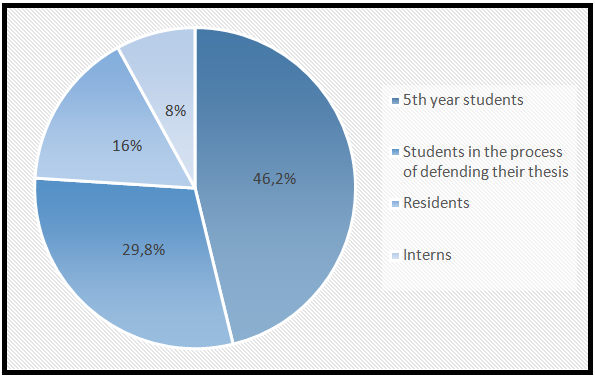
The average age of the participants was 23.89 ± 2.05 years, with extremes of 21 and 31 years. Women represented 78.2%. The sample consisted of 46.2% 5th year students, 29.8% students in the process of defending their thesis, 16% residents, and 8% interns. (Figure 1)

Regarding awareness of EBD (Table1), 59.9% of students had never heard of EBD. 84% reported having no instruction in EBD during their studies, with no significant difference between GS and PGS (p=0,124). To find more information about EBD, 57.3% of students preferred using the Internet, while 26.3% opted for continuing education. When in doubt about a clinical situation, 87.4% always looked for the answer. Concerning the use of the PICO model, 87.9% of GS did not know what PICO means, compared to 74.6% of PGS (p=0,10). Regarding the frequency of reading scientific articles, 54.3% of GS read articles less than once a month or not at all, while 79.4% of PGS reported reading once a month or once a week (p<0,001).
To search for information, there was no significant difference between GS and PGS in using reference books and practical guides, but a significant difference existed for using systematic reviews (<0,001) or original studies (<0,001). (Table 2)
To guide clinical practice and when in doubt, PGS consulted a teacher or a senior (88.1%), a colleague (59.5%) or an electronic database (50%). For GS, the preferred sources were a teacher or a senior (75.9%), a colleague (36.9%), or an electronic database (19.9%). (Table 3)
Regarding understanding of terms: (Table 4)
- EBD: 13% of students understood the term and could explain it, 30% had some understanding, while 47.7% did not understand the term but expressed a desire to.
- Medline: 34.7% of students understood the term and could explain it, 32.1% had some understanding, while 25.6% did not understand but expressed a desire to.
- Systematic review: 35.1% of students understood the term and can explain it, 33.6% had some understanding, while 24.4% did not understand but expressed a desire to.
- Meta-analysis: 21.8% of students understood the term and can explain it, 25.2% had some understanding, while 42.4% did not understand but expressed a desire to.
- Randomized Controlled Trial (RCT): 21% of students understood the term and can explain it, 29% had some understanding, while 37.4% did not understand but expressed a desire to.
- Strength of evidence: 46.6% of students did not understand the term but expressed a desire to, 28.6% had some understanding, while 13% did not understand and did not express a desire.
- Cochrane Collaboration: 61.8% of students did not understand the term but expressed a desire to, 14.1% had some understanding, while 17.2% did not understand and did not express a desire.
- Definition of EBD: 46% of PGS knew the correct definition of EBD, compared to only 22,6% of GS (p=0,032). (Table 5)
Concerning clinical situations assessing EBD awareness, the following results were noted (Table 6):
- 1st situation: <<Doing extractions after irradiation of the cervicofacial region is safe>>: 79.8% of students disagreed.
- 2nd situation: <<Evidence is limited regarding the effectiveness of techniques reducing changes in ridge height and width after 6 months of an extraction>>: 13.4% of students agreed, and 75.6% were neutral.
- 3rd situation: <<Fissure and pit sealing gives better results than topical application of fluoride for the prevention of caries of occlusal surfaces>>: this was confirmed by 67.9% of participants.
- 4th situation: <<Oral health education/ oral health promotion can effectively improve people's knowledge>>: 82.4% of students agreed.
Regarding barriers to EBD (Table 7), the majority of participants (59.5%) perceived literature as sometimes ambiguous and contradictory. 59.5% felt they had the language skills to undertake a literature review. Lack of access to complete published research articles was a barrier for 56.1%, and lack of knowledge of criteria for evaluating scientific information quality for 46.2%. Lack of knowledge and current practices were reported by 50% of students. 40.8% recognized a lack of time as a barrier. 31.5% of GS and 50.8% of PGS confirmed difficulty evaluating the level of evidence. Thus, 25.2% thought that EBD requires knowledge of communication and information techniques they did not have. For 11.5%, EBD did not require financial constraints, while 61.5% were neutral. 32,8 % did not see EBD as a threat to autonomy and clinical experience, while 54,2 % were neutral.
For the improvement of the use of EBD, 52.1% of GS and 69.4% of PGS suggested adopting an evidence-based curriculum that would help stimulate students to adopt EBD into their practice. Additionally, 40.02% of GS recommended providing easily understandable protocol summaries.
The present study aimed to evaluate the knowledge and attitudes of GS and PGS regarding the fundamental principles of EBD. Most participants had rudimentary knowledge of basic EBD concepts and critical appraisal skills, regardless of their academic level. Nevertheless, there was a set of positive indicators towards EBD and the majority of participants showed great interest in taking part in training programs for the adoption of this concept.
According to our knowledge, this study is the first of its kind conducted on a dental student population in our country. The response rate was 90.65%. In Saudi Arabia, a study 2 involving senior dental and medical students, reported a response rate of 74%. Similarly, Sabounchi et al.'s investigation 6 among dental instructors in Iran, yielded a response rate of 74.65%. Fedorowicz et al. 7 found that the response rate was 76% among final year students and interns at King Saud University. In the United States, a study 8 among orthodontists showed a response rate of 32%. This low response rate was attributed to the fact that their study was the first of its kind involving orthodontists, as well as to the length of the questionnaire. Anonymity and support from the American Association of Orthodontists (AAO) were used to maximize responses. In the present study, anonymity, availability of students during their clinical placement, and their cooperation increased the response rate.
Regarding students' attitudes toward evidence-based scientific research, our study revealed a great interest among students in having more information about EBD. Consequently, the majority held the view that scientific research influenced daily practice and affirmed its usefulness. These findings align with the results of other studies. MADHAVJI et al. 8 reported positive attitudes among orthodontists towards incorporating scientific evidence into their practice, with the majority believing that research influences their daily work. Positive attitudes toward scientific research were also expressed by students in the Gulf States, Iran, the United States, and India. They believed that the use of scientific methods formed the basis for medical progress, and that EBD improved skills, facilitated clinical decision making, and enhanced the quality of oral health care. As a result, there was a significant increase in attendance at the training courses focused on defining EBD. 2, 6[9-11] 9
To search for information, our study’ results indicated that systematic reviews and practice guidelines were the most commonly utilized sources. In Malaysia, practitioners reported that consulting colleagues and reading textbooks were preferable and quicker sources for finding evidence. 12 Students in India reported that colleagues' opinions served as the most reliable source of information, favoring them over journals and textbooks due to their quick, easy, and cost-effective nature. 13 However, standard textbooks are not considered strong evidence as they were not regularly updated and generally lack a description of inclusion and exclusion criteria or a search strategy. 6
Addressing a clinical problem through evidence-based practice involves formulating a searchable and answerable question. However, the effectiveness of our research depends on the ability to articulate this question correctly. To guide the formulation process, Sackett et al. recommended structuring the question using four main criteria, encapsulated in the acronym PICO 14. In our study, the majority (84.7%) of respondents were unfamiliar with the meaning of PICO. Similarly, Nieminen et al. 14 assessed awareness of EBD among dental students from Malaysia and Finland. The results revealed that only 6.2% of students could correctly identify the meaning of the abbreviation PICO. In a study among U.S. dental Students, Straub-Morarend et al. 15 reported that 52.9% of the respondents did not select the statement best defining a PICO model.
Regarding the frequency of reading articles, the present study showed that the majority of PGS reported reading articles either once a month or once a week. In contrast, a significant proportion of GS either did not read scientific articles or read them at a frequency of once a month or less. It is conceivable that students face challenges in comprehending scientific papers, possibly due to unfamiliar terminology or research techniques, and difficulty in evaluating the quality of scientific information. This observation aligns with findings of Bahammam et al. 2 who noted very low attitudes towards reading journals among senior dental and medical students, with no significant difference between the two groups. Additionally, the study by Nieminen et al. 14 suggested that dental students did not actively search and read scientific papers, a crucial aspect of practicing EBD. Bourzgui et al. 16 found that reading scientific articles was not a daily routine for most Moroccan dentists participating in their study, possibly due to limited time practitioners allocate to this activity. Hadley et al 12, reported that 19.9% of their sample read medical articles more than once a week, 38.2% read regularly each week to stay up-to-date, a quarter read once every 1-2 weeks, and the rest read less frequently or not at all. In this context, Davidoff et al. recommended daily reading of scientific articles to stay current with medical literature, suggesting an average of 17 articles to be read regularly. 17
Regarding the resources used to guide clinical practice, the results showed that the majority of students preferred to consult a teacher or senior, a colleague or an electronic database when in doubt about a clinical problem. In a study by Rajshekar et al. 18 among Postgraduate dental Students, the majority considered experts and colleagues as the best sources of information when confronted with clinical uncertainties. In the United States, the majority of orthodontists preferred consulting colleagues when faced with clinical doubts. 8 Bourzgui et al. 16 observed that Moroccan dental professionals consulted fellow practitioners when faced with clinical uncertainties. This source of information was the most frequently chosen because it was fast, did not involve any financial means, and provided support and guidance as well as other psychological benefits that computerized sources could not provide. The three most common actions taken by practitioners in Malaysia when faced with clinical uncertainty were to consult colleagues and textbooks or to refer the patient. In addition, about 45% of practitioners indicated that they continue to provide treatment based on their own judgment and experience despite being uncertain. 12. Nevertheless, colleagues' responses are quick, inexpensive and opinionated, potentially leading to biases, contradictions or discrepancies for those interested. 8, 19, 20 Moreover, colleagues' opinions may reflect their own clinical experience rather than good practice. 6, 8 12, 21 Similarly, experts have a great deal of clinical experience, therefore their opinions may create biased and erroneous information. 8 The problem with using textbooks as a source of evidence is that the information, they contain may not be up-to-date, and thus, it may be inaccurate. 12, 22 Dentists, as health professionals, must always act in the best interest of their patients by avoiding unsafe practices. Practice based on intuition is unethical and violates the trust placed in dentists by society. Such practice compromises the integrity of the profession and should be avoided at all times. 12 Ideally, clinicians should consult electronic databases such as PubMed and Cochrane and search for evidence in systematic reviews and meta-analyses of randomized controlled trials whenever possible to identify the best evidence to guide decision-making. 8, 12
With respect to understanding of terms, the majority of responses showed some or no understanding of all the proposed EBD terms. When asked to choose the correct definition of EBD from three proposed options, the majority of GS and PGS demonstrated a lack of awareness of the correct definition. These results were consistent with a study 8 among orthodontists, which found partial or no understanding of six of the 10 terms used in the evidence-based approach. Similarly, a study by Bourzgui et al. 16 among dental professionals in Morocco, indicated that a majority had limited or no understanding of seven out of nine EBD-related terms. Studies in Saudi Arabia and Iran showed that a minority of students had chosen the correct definition of EBD. 2, 6, 7 without a clear understanding of basic EBD terminology, incorporating the concepts of the evidence-based approach into clinical practice may prove challenging. 8
To assess awareness of EBD, clinical situations relevant to dental practice were designed. The results indicated overall correct responses, aligning with the best available scientific evidence. This can be explained by the fact that the majority of these situations were discussed in courses or tutorials at FMDC. In the United States, orthodontists responded well to the clinical situations presented to them, and their responses were consistent with the best evidence. This was attributed to the fact that these situations were discussed at conferences and meetings of orthodontic societies such as the AAO. 8 For Moroccan dental professionals, Bourzgui et al. 16 noted that a substantial proportion of participant responses aligned with the best current evidence for four out of six clinical situations.
The identification of barriers is an important element that will facilitate the introduction of evidence-based practice. Our survey revealed that lack of time, inconsistencies in the literature, inaccessibility of full-text articles, and lack of knowledge of criteria for evaluating the quality of scientific information through critical analysis were barriers to the adoption of evidence-based practice. For American orthodontists, barriers included ambiguity and contradictions in the literature, the constraints of the profession, and inadequate guidelines. 8 In Malaysia, Zamros et al. found that lack of time and financial constraints were the main barriers for practitioners to using EBD. 12 Other studies among students have shown that lack of time, inaccessibility of information resources, inadequate research and information skills, financial constraints, and lack of interest and motivation were the most cited barriers. 2, 7 9, 10 23, 24 Ambiguity and contradictions in the literature create difficulties for practitioners to identify specific answers to clinical questions. 8 Systematic reviews have the potential to clarify uncertainties about conflicting results and are therefore an important tool in the evidence-based approach to practice. 8, 12, 25 To address time constraints as well as the difficulties of assessing the quality of scientific information through critical analysis, evidence-based research needs to be presented in forms that are easy to evaluate and understand. 8, 12 This need was expressed by a significant percentage of GS (40.05%) who suggested providing easily understandable summaries and protocols. Despite the current levels of internet connectivity, it was surprising to find the inaccessibility of EBD resources among the barriers cited. An interested student is, in fact, able to obtain access at home or in the library to the various sources of information. This would reflect lower levels of interest in EBD rather than the unavailability of a computer or easy access to the Internet. 7
In conclusion, the current study revealed that students' knowledge and attitudes toward research did not exhibit significant improvement with an increase in their years of education, as there was virtually no difference in knowledge regarding EBD between GS and PGS. These findings highlighted the importance of implementing curriculum reforms in dental schools. Accordingly, a restructuring of academic curricula was initiated with the 2015/2016 academic year. The aim was to cultivate a lifelong learning and problem-solving approach, instruct students in critical reading of literature, empower them to confidently make clinical decisions, and enhance the quality of care provided to patients. Therefore, the announcement of a dynamic cross-sectional study, involving further surveys, with the objective of evaluating the effects of the implementation of the new reform is recommended.
Evidence-based care is a global movement in all health disciplines. This movement represents a philosophical shift in approach to practice, one that values facts over opinions and at the same time values judgment over blind obedience to regulations. This approach connects research to daily patient care
Through the assessment of: Attitudes, awareness and barriers, we find that students' attitudes toward evidence-based research are generally positive. This reflects their great interest in this new approach and their high motivation to learn and adopt it in their daily practice. However, students have fairly rudimentary clinical assessment skills. In addition, students prefer direct and simple responses. Critical appraisal exercises involve extra effort and time, as well as articles defining direct solutions to problems are very rare and may be perceived as ineffective and far from the students' real goals of providing better care to their patients.
The main objective of this work was to make students aware of the importance of this new approach, which has been gradually introduced, to encourage future dentists to self-educate themselves by searching for the available facts and to be inspired by them in order to enrich their knowledge and use it to solve everyday problems.
Finally, by overcoming the barriers to the introduction of EBD, harnessing the possibilities of information technology and applying scientific evidence in their daily practice, practitioners will be able to meet the greatest challenge of all: effective, quality oral health care delivery.
| [1] | A. I. Ismail et J. D. Bader, «Evidence-based dentistry in clinical practice», The Journal of the American Dental Association, vol. 135, no 1, p. 78‑83, janv. 2004. | ||
| In article | View Article PubMed | ||
| [2] | M. A. Bahammam et A. I. Linjawi, «Knowledge, attitude, and barriers towards the use of evidence based practice among senior dental and medical students in western Saudi Arabia», Saudi Med J, vol. 35, no 10, p. 1250‑1256, 2014. | ||
| In article | |||
| [3] | A. D. Association, «ADA Policy Statement on Evidence-Based Dentistry», http://www. ada. org/1754. aspx, 2008, Consulté le: 22 novembre 2023. [En ligne]. Disponible sur: https://cir.nii.ac.jp/crid/1573668925978210560. | ||
| In article | |||
| [4] | F. Chiappelli, «Evidence-Based Dentistry: Two Decades and Beyond», Journal of Evidence Based Dental Practice, vol. 19, no 1, p. 7‑16, mars 2019. | ||
| In article | View Article PubMed | ||
| [5] | A. Madhavji, E. A. Araujo, K. B. Kim, et P. H. Buschang, «Attitudes, awareness, and barriers toward evidence-based practice in orthodontics», American Journal of Orthodontics and Dentofacial Orthopedics, vol. 140, no 3, p. 309‑316, 2011. | ||
| In article | View Article PubMed | ||
| [6] | S. S. Sabounchi, M. Nouri, N. Erfani, B. Houshmand, et M. H. Khoshnevisan, «Knowledge and attitude of dental faculty members towards evidence-based dentistry in Iran», European Journal of Dental Education, vol. 17, no 3, p. 127‑137, 2013. | ||
| In article | View Article PubMed | ||
| [7] | Z. Fedorowicz, K. Almas, et J. V. Keenan, «Perceptions and attitudes towards the use of Evidence-based Dentistry (EBD) among Final year students and Interns at King Saud University, College of Dentistry in Riyadh Saudi Arabia.». | ||
| In article | |||
| [8] | A. Madhavji, E. A. Araujo, K. B. Kim, et P. H. Buschang, «Attitudes, awareness, and barriers toward evidence-based practice in orthodontics», American Journal of Orthodontics and Dentofacial Orthopedics, vol. 140, no 3, p. 309-316.e2, sept. 2011. | ||
| In article | View Article PubMed | ||
| [9] | T. Amin et al., « Knowledge, attitudes and barriers related to participation of medical students in research in three Arab Universities », Education in Medicine, vol. 4, mai 2012. | ||
| In article | View Article | ||
| [10] | C. Chakraborti, D. J. B. Iii, E. Gleeson, et W. Gunderson, «Identifying barriers to successful research during medical school», Medical Education Development, vol. 2, no 1, Art. no 1, mars 2012. | ||
| In article | View Article | ||
| [11] | Siva Kalyan Venumbaka, Tm. Padma, K. Pratap, Mp. Sandhya, A. Anitha, et A. Bhargava, « Knowledge and attitude toward evidence-based dentistry among postgraduate students of a dental college in South India », Indian Journal of Health Sciences, vol. 7, p. 88, janv. 2014. | ||
| In article | View Article | ||
| [12] | Z. Y. M. Yusof, L. J. Han, P. P. San, et A. S. Ramli, «Evidence-Based Practice Among a Group of Malaysian Dental Practitioners», Journal of Dental Education, vol. 72, no 11, p. 1333‑1342, 2008. | ||
| In article | View Article PubMed | ||
| [13] | A. Singh, S. Saxena, V. Tiwari, et U. Tiwari, « Knowledge of evidence-based dentistry among academic dental practitioners of Bhopal, India: a preliminary survey », J Educ Eval Health Prof, vol. 12, juin 2015. | ||
| In article | View Article PubMed | ||
| [14] | P. Nieminen, E. Uma, S. Pal, M.-L. Laitala, O.-P. Lappalainen, et E. Varghese, «Information Retrieval and Awareness about Evidence-Based Dentistry among Dental Undergraduate Students—A Comparative Study between Students from Malaysia and Finland», Dentistry Journal, vol. 8, no 3, Art. no 3, sept. 2020. | ||
| In article | View Article PubMed | ||
| [15] | C. L. Straub-Morarend et al., «Evidence-Based Practice Knowledge, Perceptions, and Behavior: A Multi-Institutional, Cross-Sectional Study of a Population of U.S. Dental Students», Journal of Dental Education, vol. 80, no 4, p. 430‑438, 2016. | ||
| In article | View Article PubMed | ||
| [16] | Bourzgui Farid, Bouchghel Lamia, Rouijel Soukaina, Diouny Samir, Serhier Zineb, and Bennani Othmani Mohamed, “Knowledge, Attitudes, and Barriers toward Evidence-based Dentistry among Moroccan Dental Professionals.” American Journal of Educational Research, vol. 9, no 11 (2021): 678-685. doi: 10.12691/education-9-11-4. | ||
| In article | View Article | ||
| [17] | F. Davidoff, B. Haynes, D. Sackett, et R. Smith, « Evidence based medicine », Bmj, vol. 310, no 6987. British Medical Journal Publishing Group, p. 1085‑1086, 1995. Consulté le: 23 novembre 2023. [En ligne]. Disponible sur: https://www.bmj.com/content/310/6987/1085.full-text. | ||
| In article | View Article PubMed | ||
| [18] | S. A. Rajshekar, K. S. Kote, et L. Nagesh, «Knowledge and attitudes towards evidence based dentistry among postgraduate students of two dental Colleges in Davangere City», Journal of Indian Association of Public Health Dentistry, vol. 9, no Suppl 4, p. S761, nov. 2011. | ||
| In article | View Article | ||
| [19] | A. Iqbal et A.-M. Glenny, « General dental practitioners’ knowledge of and attitudes towards evidence based practice », Br Dent J, vol. 193, no 10, Art. no 10, nov. 2002. | ||
| In article | View Article PubMed | ||
| [20] | D. C. Slawson et A. F. Shaughnessy, «Obtaining useful information from expert based sources», BMJ, vol. 314, no 7085, p. 947, mars 1997. | ||
| In article | View Article PubMed | ||
| [21] | L. L. Weed, «New connections between medical knowledge and patient care», BMJ, vol. 315, no 7102, p. 231‑235, juill. 1997. | ||
| In article | View Article PubMed | ||
| [22] | D. J. Weatherall et Ledingham J.g.g., «On dinosaurs and medical textbooks.», The Lancet, vol. 346, no 8966, 1995, Consulté le: 7 juin 2023. [En ligne]. Disponible sur: https://www.elibrary.ru/item.asp?id=2474495. | ||
| In article | View Article PubMed | ||
| [23] | M. Memarpour, A. P. Fard, et R. Ghasemi, « Evaluation of attitude to, knowledge of and barriers toward research among medical science students », Asia Pacific Family Medicine, vol. 14, no 1, p. 1, févr. 2015. | ||
| In article | View Article PubMed | ||
| [24] | «Can Teaching Research Methodology Influence Students’ Attitude toward Science? Cohort Study and Nonrandomized Trial in a Single Medical School - Ana Vujaklija, Darko Hren, Dario Sambunjak, Ivana Vodopivec, Ana Ivaniš, Ana Marušić, Matko Marušić, 2010». Consulté le: 7 juin 2023. [En ligne]. | ||
| In article | |||
| [25] | H. P. McKenna, S. Ashton, et S. Keeney, « Barriers to evidence-based practice in primary care », Journal of Advanced Nursing, vol. 45, no 2, p. 178‑189, 2004. | ||
| In article | View Article PubMed | ||
Published with license by Science and Education Publishing, Copyright © 2023 El Machrouhi Marouane, Bourzgui Farid, Bousboula Ayoub, Kissa Jamila, Serhier Zineb and Khlil Nadia
 This work is licensed under a Creative Commons Attribution 4.0 International License. To view a copy of this license, visit
https://creativecommons.org/licenses/by/4.0/
This work is licensed under a Creative Commons Attribution 4.0 International License. To view a copy of this license, visit
https://creativecommons.org/licenses/by/4.0/
| [1] | A. I. Ismail et J. D. Bader, «Evidence-based dentistry in clinical practice», The Journal of the American Dental Association, vol. 135, no 1, p. 78‑83, janv. 2004. | ||
| In article | View Article PubMed | ||
| [2] | M. A. Bahammam et A. I. Linjawi, «Knowledge, attitude, and barriers towards the use of evidence based practice among senior dental and medical students in western Saudi Arabia», Saudi Med J, vol. 35, no 10, p. 1250‑1256, 2014. | ||
| In article | |||
| [3] | A. D. Association, «ADA Policy Statement on Evidence-Based Dentistry», http://www. ada. org/1754. aspx, 2008, Consulté le: 22 novembre 2023. [En ligne]. Disponible sur: https://cir.nii.ac.jp/crid/1573668925978210560. | ||
| In article | |||
| [4] | F. Chiappelli, «Evidence-Based Dentistry: Two Decades and Beyond», Journal of Evidence Based Dental Practice, vol. 19, no 1, p. 7‑16, mars 2019. | ||
| In article | View Article PubMed | ||
| [5] | A. Madhavji, E. A. Araujo, K. B. Kim, et P. H. Buschang, «Attitudes, awareness, and barriers toward evidence-based practice in orthodontics», American Journal of Orthodontics and Dentofacial Orthopedics, vol. 140, no 3, p. 309‑316, 2011. | ||
| In article | View Article PubMed | ||
| [6] | S. S. Sabounchi, M. Nouri, N. Erfani, B. Houshmand, et M. H. Khoshnevisan, «Knowledge and attitude of dental faculty members towards evidence-based dentistry in Iran», European Journal of Dental Education, vol. 17, no 3, p. 127‑137, 2013. | ||
| In article | View Article PubMed | ||
| [7] | Z. Fedorowicz, K. Almas, et J. V. Keenan, «Perceptions and attitudes towards the use of Evidence-based Dentistry (EBD) among Final year students and Interns at King Saud University, College of Dentistry in Riyadh Saudi Arabia.». | ||
| In article | |||
| [8] | A. Madhavji, E. A. Araujo, K. B. Kim, et P. H. Buschang, «Attitudes, awareness, and barriers toward evidence-based practice in orthodontics», American Journal of Orthodontics and Dentofacial Orthopedics, vol. 140, no 3, p. 309-316.e2, sept. 2011. | ||
| In article | View Article PubMed | ||
| [9] | T. Amin et al., « Knowledge, attitudes and barriers related to participation of medical students in research in three Arab Universities », Education in Medicine, vol. 4, mai 2012. | ||
| In article | View Article | ||
| [10] | C. Chakraborti, D. J. B. Iii, E. Gleeson, et W. Gunderson, «Identifying barriers to successful research during medical school», Medical Education Development, vol. 2, no 1, Art. no 1, mars 2012. | ||
| In article | View Article | ||
| [11] | Siva Kalyan Venumbaka, Tm. Padma, K. Pratap, Mp. Sandhya, A. Anitha, et A. Bhargava, « Knowledge and attitude toward evidence-based dentistry among postgraduate students of a dental college in South India », Indian Journal of Health Sciences, vol. 7, p. 88, janv. 2014. | ||
| In article | View Article | ||
| [12] | Z. Y. M. Yusof, L. J. Han, P. P. San, et A. S. Ramli, «Evidence-Based Practice Among a Group of Malaysian Dental Practitioners», Journal of Dental Education, vol. 72, no 11, p. 1333‑1342, 2008. | ||
| In article | View Article PubMed | ||
| [13] | A. Singh, S. Saxena, V. Tiwari, et U. Tiwari, « Knowledge of evidence-based dentistry among academic dental practitioners of Bhopal, India: a preliminary survey », J Educ Eval Health Prof, vol. 12, juin 2015. | ||
| In article | View Article PubMed | ||
| [14] | P. Nieminen, E. Uma, S. Pal, M.-L. Laitala, O.-P. Lappalainen, et E. Varghese, «Information Retrieval and Awareness about Evidence-Based Dentistry among Dental Undergraduate Students—A Comparative Study between Students from Malaysia and Finland», Dentistry Journal, vol. 8, no 3, Art. no 3, sept. 2020. | ||
| In article | View Article PubMed | ||
| [15] | C. L. Straub-Morarend et al., «Evidence-Based Practice Knowledge, Perceptions, and Behavior: A Multi-Institutional, Cross-Sectional Study of a Population of U.S. Dental Students», Journal of Dental Education, vol. 80, no 4, p. 430‑438, 2016. | ||
| In article | View Article PubMed | ||
| [16] | Bourzgui Farid, Bouchghel Lamia, Rouijel Soukaina, Diouny Samir, Serhier Zineb, and Bennani Othmani Mohamed, “Knowledge, Attitudes, and Barriers toward Evidence-based Dentistry among Moroccan Dental Professionals.” American Journal of Educational Research, vol. 9, no 11 (2021): 678-685. doi: 10.12691/education-9-11-4. | ||
| In article | View Article | ||
| [17] | F. Davidoff, B. Haynes, D. Sackett, et R. Smith, « Evidence based medicine », Bmj, vol. 310, no 6987. British Medical Journal Publishing Group, p. 1085‑1086, 1995. Consulté le: 23 novembre 2023. [En ligne]. Disponible sur: https://www.bmj.com/content/310/6987/1085.full-text. | ||
| In article | View Article PubMed | ||
| [18] | S. A. Rajshekar, K. S. Kote, et L. Nagesh, «Knowledge and attitudes towards evidence based dentistry among postgraduate students of two dental Colleges in Davangere City», Journal of Indian Association of Public Health Dentistry, vol. 9, no Suppl 4, p. S761, nov. 2011. | ||
| In article | View Article | ||
| [19] | A. Iqbal et A.-M. Glenny, « General dental practitioners’ knowledge of and attitudes towards evidence based practice », Br Dent J, vol. 193, no 10, Art. no 10, nov. 2002. | ||
| In article | View Article PubMed | ||
| [20] | D. C. Slawson et A. F. Shaughnessy, «Obtaining useful information from expert based sources», BMJ, vol. 314, no 7085, p. 947, mars 1997. | ||
| In article | View Article PubMed | ||
| [21] | L. L. Weed, «New connections between medical knowledge and patient care», BMJ, vol. 315, no 7102, p. 231‑235, juill. 1997. | ||
| In article | View Article PubMed | ||
| [22] | D. J. Weatherall et Ledingham J.g.g., «On dinosaurs and medical textbooks.», The Lancet, vol. 346, no 8966, 1995, Consulté le: 7 juin 2023. [En ligne]. Disponible sur: https://www.elibrary.ru/item.asp?id=2474495. | ||
| In article | View Article PubMed | ||
| [23] | M. Memarpour, A. P. Fard, et R. Ghasemi, « Evaluation of attitude to, knowledge of and barriers toward research among medical science students », Asia Pacific Family Medicine, vol. 14, no 1, p. 1, févr. 2015. | ||
| In article | View Article PubMed | ||
| [24] | «Can Teaching Research Methodology Influence Students’ Attitude toward Science? Cohort Study and Nonrandomized Trial in a Single Medical School - Ana Vujaklija, Darko Hren, Dario Sambunjak, Ivana Vodopivec, Ana Ivaniš, Ana Marušić, Matko Marušić, 2010». Consulté le: 7 juin 2023. [En ligne]. | ||
| In article | |||
| [25] | H. P. McKenna, S. Ashton, et S. Keeney, « Barriers to evidence-based practice in primary care », Journal of Advanced Nursing, vol. 45, no 2, p. 178‑189, 2004. | ||
| In article | View Article PubMed | ||