This study explored the influence of in-service Economics teachers’ metacognitive professional skills on their teaching self-efficacy. The study utilised a descriptive cross-sectional survey design, involving a total number of 120 Senior High School Economics teachers. The Metacognitive Awareness Inventory for Teachers and Teacher Sense of Efficacy Scale were adapted as the data collection instruments for the study. Descriptive statistics (frequencies, percentages, mean and standard deviation) and Partial Least Square Structural Equation Modelling (PLS-SEM) were used to analyse the data. The study revealed that in-service Economics teachers had high level of metacognitive professional skills. Also, it was found out that in-service Economics teachers’ declarative knowledge, conditional knowledge, planning, monitoring and evaluating had statistically significant positive influence on their teaching self-efficacy. However, the study revealed that procedural knowledge had a significant negative influence on Economics teachers’ self-efficacy. As a result, it was recommended that the Ghana Education Service, the Ministry of Education, and Non-Governmental Organisations continue to offer professional development workshops for teachers in order to ensure that Economics instructors' metacognitive professional skills are continuously improved. The current study adds to empirical research by investigating the links between Economics teachers’ metacognitive professional skills and teaching self-efficacy. The findings' implications for practical application are thoroughly studied and addressed
In the dynamic landscape of education, metacognitive awareness has emerged as a vital aspect of effective teaching and learning [1-2] 1. The ability to comprehend, reflect upon, and regulate one's cognitive processes plays a pivotal role in promoting meaningful educational experiences [3-4] 3. Metacognitive awareness, as defined by Schraw and Dennison (1994), encompasses the capacity to think critically, comprehend one's own thought processes, and engage in self-regulation. By possessing metacognitive professional skills, Economics teachers demonstrate a deep awareness of their cognitive faculties, enabling them to adaptively monitor, plan, and assess their instructional strategies in the pursuit of optimising student learning outcomes [5-6] 5.
In the specific context of Economics education, the importance of metacognitive awareness for teachers cannot be overstated. Economics, being a complex and multifaceted discipline, requires teachers to possess not only a solid understanding of economic theories and concepts but also the ability to guide students through the nuances of economic reasoning and problem-solving 7. It is within the framework of metacognition that Economics teachers can navigate the intricacies of their pedagogical practices, understand the impact of their teaching decisions, and effectively adapt their strategies to cater for diverse learning needs.
Drawing from the theoretical foundations established by scholars such as Schraw 8 and Flavell 9, metacognition can be deconstructed into two interrelated components: metacognitive knowledge and metacognitive regulation. Metacognitive knowledge encompasses declarative, procedural, and conditional knowledge. Declarative knowledge refers to teachers' understanding of their cognitive strategies, skills, and abilities, including their beliefs and notions about the subject matter [10-11] 10. Procedural knowledge, on the other hand, entails the teachers' knowledge of how to effectively employ strategies and techniques to enhance student learning outcomes 8, 12. Again, conditional knowledge involves teachers' understanding of when and why specific strategies should be employed to foster optimal learning experiences [13-15] 13.
Metacognitive regulation, the second component, involves active management of cognitive processes. It encompasses planning, monitoring, organising (information management), and evaluating dimensions 8, 16. Planning pertains to the capability of educators to choose suitable techniques, establish goals, and distribute resources to enhance student learning 8. Monitoring entails teachers' ongoing evaluation of their own cognitive processes and the effectiveness of their instructional strategies. Organising and information management involve the use of cognitive strategies and techniques to handle and process information effectively 17. Pucheu 17 defines evaluation as the retrospective analysis of performance and strategy effectiveness. The diverse range of problems teachers encounter in terms of complexity and duration highlights the importance of metacognition for improved regulation of cognition [18-19] 18 and knowledge of cognition 8, 20.
Metacognition plays a pivotal role in shaping instructional practices and fostering teaching self-efficacy. Teachers’ self-efficacy is defined as “teacher’s judgment of his or her capabilities to bring about desired outcome of student engagement and learning, even among those students who may be difficult or unmotivated” 21. Isiksal 22 defines teachers’ self-efficacy as their view about the ability to exact positive student outcomes. According to Yidana et al. 7, the complex nature of Economics demands that teachers are highly efficacious in engaging students and managing the classroom. Several empirical studies [e.g., 23-27] have examined teachers’ self-efficacy level. For instance, Yidana and Arthur revealed that Economics teachers were more efficacious in instructional strategies compared to classroom management and student engagement. However, these studies have not focused on the relationship between metacognitive professional skills and teaching self-efficacy. Previous studies have established a connection between a teacher's metacognitive abilities and their self-efficacy 18 [28-29] 28. Educators who lack awareness of their cognitive abilities may encounter challenges in adapting to the ever-changing educational landscape 19, 30. On the other hand, teachers with higher levels of metacognitive professional skills experience enhanced learning capabilities and can effectively apply what they learn from professional development in their classrooms 17 [31-32] 31.
Several research have looked into instructors' metacognitive awareness [e.g., 33-39]. Baltaci 33, for example, discovered that teachers displayed intermediate cognitive awareness. Other research 34, 39 found that teachers had a high level of metacognitive awareness. Hughes 36 also discovered that teachers had varying levels of metacognitive awareness. Hughes did not specify the extent of metacognitive awareness of teachers. Furthermore, because these studies were done in different contexts and subject areas, the results cannot be extended to the Ghanaian environment. There are few empirical studies on the impact of in-service teachers' metacognitive awareness on their self-efficacy. Yildiz and Akdag 40 and Alkan 41 discovered a substantial beneficial association between pre-service teachers' metacognitive awareness and self-efficacy. Similarly, Schumann and Sibthrop 42 discovered that monitoring had a substantial impact on instructors' perceptions about teaching self-efficacy. It appears that these studies did not use a robust statistical method to investigate the causal association between teachers' metacognitive professional skills and their level of self-efficacy. Furthermore, it appears that these studies did not focus on the impact of each component of metacognitive professional abilities to teachers' self-efficacy. As a result, the current study uses partial least square structural equation modelling (PLS-SEM) to investigate the influence of in-service Economics instructors' metacognitive professional skills on their self-efficacy.
The purpose of the study is to explore the influence of in-service Economics teachers’ metacognitive professional skills on their self-efficacy using Partial Least Square Structural Equation Modelling (PLS-SEM). Specifically, the study seeks to:
1. examine the level of in-service Economics teachers’ metacognitive professional skills.
2. determine the influence of in-service Economics teachers’ metacognitive professional skills on their teaching self-efficacy.
The social cognitive theory by Bandura 43 underpins the current study. This theory suggests that individuals' self-efficacy beliefs are influenced by their personal experiences, observation of others, and verbal persuasion. In the context of this study, the metacognitive professional skills of Economics teachers have the potential to bolster their self-efficacy beliefs by equipping them with essential knowledge and competencies crucial for success in their teaching profession. The relationship between metacognitive professional skills and self-efficacy beliefs is explained by social cognitive theory. Teachers with excellent metacognitive awareness are more likely to have successful experiences in the classroom, which might boost their self-efficacy beliefs. Furthermore, teachers who monitor and reflect on their own thought processes are more likely to feel capable and confident in their teaching abilities. Furthermore, metacognitive awareness can assist teachers in developing realistic goals and effective techniques for achieving them. One example would be when a teacher is aware of their own personal talents and flaws. In such circumstances, they might set ambitious but feasible goals and design ways to address problem areas. This can boost their self-efficacy beliefs even more by giving them a sense of control and authority over their task.

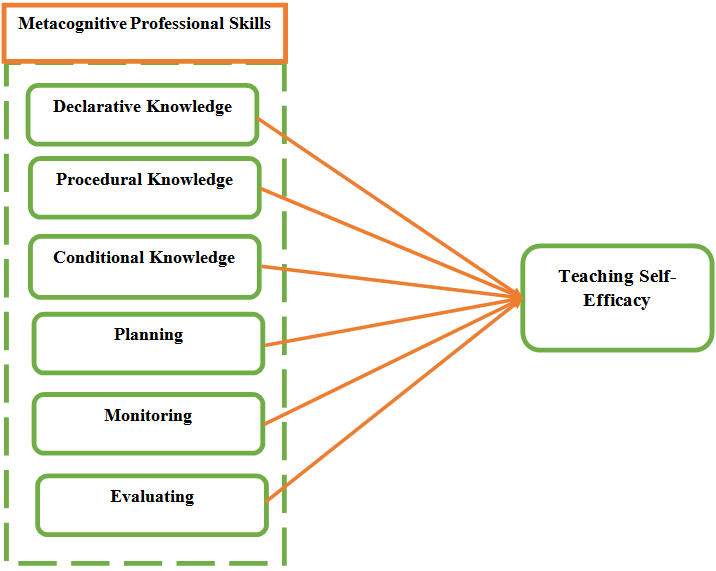
Based on the research objectives, the following conceptual framework was constructed. The conceptual framework in Figure 1 illustrates how the metacognitive professional skills of in-service Economics teachers can influence their teaching self-efficacy.
Research design, population and sampling
The study employed a descriptive cross-sectional survey design to examine the influence of in-service Economics teachers’ metacognitive professional skills on their teaching self-efficacy. This particular design was selected due to Dilman, Smyth, and Christian's 44 suggestion that cross-sectional survey design is a useful method for collecting information on respondents' attitudes and perceptions of a specific phenomenon. Also, Economics teachers willingly responded to the survey without manipulations 7, 27, 45. Furthermore, Leedy and Ormrod 46 recommend this design as it enables researchers to gather opinions and attitudes from a sample of the population being studied.
The study's target population was made up of all Economics teachers in Senior High Schools (SHS) located in the Kumasi Metropolis. According to Ghana Education Service (GES) 47, the Metropolis had a total number of 67 SHSs, with a cumulative count of 335 Economics teachers. To obtain a sample for the study, 20 out of the 67 SHSs in the Metropolis were selected using the simple random sampling technique.
The researchers employed the census method to include all 125 Economics teachers from the twenty schools in the study. This approach was deemed necessary as each school had a limited number of Economics teachers, making it unnecessary to use a sampling technique. The decision to use the census method was influenced by Farooq's 48 suggestion that if the number of elements in a population is relatively small, it is preferable to use all elements rather than to sample them. Gall, Gall and Borg 49 also proposed that larger samples provide better judgment than smaller ones, as long as they are readily available and accessible.
Data collection instrument
For data collection, the Metacognitive Awareness Inventory for Teachers (MAIT) and Teacher Sense of Efficacy Scale (TSES) designed by Balcikanli 10 and Tschannen-Moran and Woolfolk Hoy 21 were used respectively. Declarative Knowledge, Procedural Knowledge, Conditional Knowledge, Planning, Monitoring, and Evaluating are the dimensions of metacognitive awareness (metacognitive professional skills) inventory. In addition, the MAIT and TSES each had 24 items that were scored on a seven-point Likert scale: Strongly Disagree (1), Disagree (2), Somewhat Disagree (3), Neither Agree nor Disagree (4), Somewhat Agree (5), Agree (6), and Strongly Agree (7).
Procedure for data collection
Four research assistants were allocated to four separate schools and were extensively educated on the instrument and research ethics. The assistants distributed the questionnaire to all of the sampled schools' Economics teachers, giving them 30-40 minutes to complete it. The filled questionnaires were swiftly evaluated for accuracy. The assistants collected 120 out of the 125 surveys sent to the twenty Senior High Schools with a return rate of 96.0%.
Data processing and analysis
After screening the data for incomplete and invalid questionnaires, the information was coded and inputted into the Statistical Product for Service Solution (SPSS) version 28 for analysis. The mean and standard deviations were then calculated to assess Economics teachers’ level of metacognitive professional skills. The scale mean score was interpreted as follows:
1.00-2.49 = Low
2.50-4.49 = Moderate
4.50-7.00 = High
In terms of the research hypothesis, Partial Least Square Structural Equation Modelling (PLS-SEM) was used to analyse the influence of in-service Economics teachers’ declarative knowledge, procedural knowledge, conditional knowledge, planning, monitoring and evaluating on their teaching self-efficacy.
In this segment, the study's results pertaining to the research objectives formulated to guide the study are presented.
Preliminary Analysis
This section presents a preliminary analysis of the variables based on Skewness and kurtosis. Table 1 presents the normality analysis of the variables.
In Table 1, the Skewness values range from -1.629 to -.546 and also the kurtosis values range from -.183 to 3.562. These values meet the criteria for data normality (-7 ~ +7 for Kurtosis and -3 ~ +3 for Skewness) suggested by Byrne (2010).
In-service Economics Teachers’ Metacognitive Professional Skills Level
This research objective was meant to examine Economics teachers’ metacognitive professional skills level. Table 2 shows the results of Economics teachers’ metacognitive professional skills level.
From Table 2, the results showed that the metacognitive professional skills dimensions of Economics teachers had values ranging from M = 6.21 (SD = .59) to M = 6.08 (SD = .72), representing a high level of metacognitive professional skill. Ultimately, the overall score indicated that Economics teachers had a high level of metacognitive professional skill (M = 6.13, SD = .71).
Also, the researcher was interested in finding the levels of metacognitive professional skills among Economics teachers; hence, a further analysis was done. The questionnaire was 7-point; therefore, Strongly Disagree = 1, Disagree = 2, Somewhat Disagree = 3, Neither Agree nor Disagree = 4, Somewhat Agree = 5, Agree = 6 and Strongly Agree = 7. The items were transformed, and after that, low, moderate, and high levels were computed using frequencies and percentages against score ranges of 24-72, 73-120, and 121-168. Table 3 shows the results on the levels of cognitive engagement among Economics students.
Table 3 reveals that more than half of the Economics teachers possessed high level of metacognitive professional skills (n = 77, 64.2%; range = 121-168), while more than one-quarter of them possessed a moderate level of metacognitive professional skills (n = 38, 31.7%; range = 73-120). On the contrary, less than five (5) per cent of the Economics teachers had a low level of metacognitive professional skills (n = 5, 4.2%; range = 24-72). This result shows that the majority of the Economics teachers had a high level of metacognitive professional skills.
Influence of In-service Economics Teachers’ Metacognitive Professional Skills on their Teaching Self-Efficacy
The research hypothesis sought to determine the influence of in-service Economics teachers’ metacognitive professional skills on their teaching self-efficacy. Prior to the presentation of the structural model, the measurement model was assessed.
Assessment of Measurement Model
The study used the PLS-SEM technique for data analysis. The measurement model was examined to assess the factor loading, Cronbach alpha, composite reliability, convergent validity and discriminant validity of individual items. The factor loadings of each item under the constructs were assessed to examine individual item’s reliability [51-52] 51. The structural model was employed to determine the significance of the path coefficients. Table 4 presents the factor loadings, Cronbach's alpha, composite reliability, and average variance extracted.
The achievement of an average variance extracted (AVE) value of 0.5 or higher indicates the establishment of convergent validity for the constructs. The results in Table 4 demonstrated that all constructs surpassed the minimum requirement of 0.50 for AVE values 53.
Discriminant Validity
The study employed both the Fornell-Larcker and Heterotrait-Monotrait Ratio (HTMT) criteria to evaluate the discriminant validity. The discriminant validity of the measurement model is displayed in Table 5, based on the Fornell-Larcker criterion.
The results presented in Table 5 demonstrate the attainment of discriminant validity through the Fornell-Larcker criterion, as the square roots of the AVEs are greater than the corresponding correlations. However, in line with the recommendation by Henseler et al. 54 for a robust assessment of discriminant validity, the study employed the HTMT criterion, the results of which are displayed in Table 6.
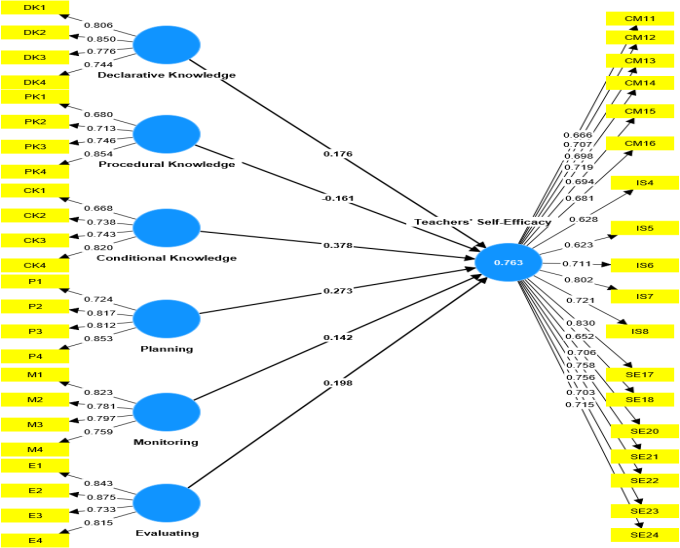
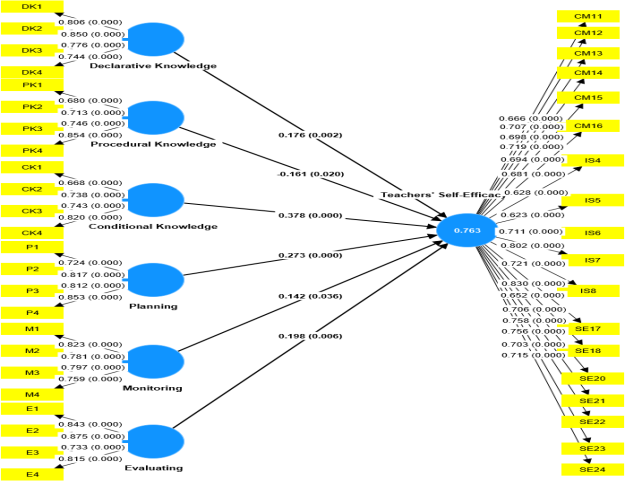
In Table 6, the HTMT values (ranging from .467 to .896) are less than the liberal discriminant validity threshold 54. Figure 2 and 3 show the structural model after PLS-SEM Algorithm and bootstrapping respectively.
Figure 2 shows the path coefficients and factor loadings after the PLS-SEM Algorithm.
Assessment of Structural Model
To evaluate the structural model, the researcher adopted the method of Hair et al. 55, which includes examining collinearity concerns using the variance inflation factor (VIF), assessing the significance and relevance of the path coefficients in the model, and analysing the model's explanatory capability 56. The result for the multicollinearity test is presented in Table 7.


The result in Table 7 indicates that the lowest and highest VIF values are 1.272 and 4.915 respectively, which suggests that collinearity is not a significant problem 57. In the current study, the VIF for all the items are less than 5 55. Afterwards, the structural model was examined and the result for the influence of in-service Economics teachers’ metacognitive professional skills on their teaching self-efficacy is presented in Table 8.
Table 8 displays a positive and statistically significant path coefficient between conditional knowledge and teaching self-efficacy (β = 0.378, t = 5.443, p <.001). This result reveals that conditional knowledge positively influences in-service Economics teachers’ teaching self-efficacy. In addition, the magnitude of the effect was moderate  . According to Hair et al. 58, effect sizes of 0.02, 0.15 and 0.35 are small, medium and large, respectively. The positive path coefficient (β = 0.378) implies that a unit increase in Economics teachers’ conditional knowledge would increase their teaching self-efficacy by 0.378. Also, the results show that declarative knowledge positively influences in-service Economics teachers’ teaching self-efficacy (β = 0.176, t = 2.844, p = .002). The magnitude of the effect was small
  . The positive path coefficient suggests that a unit increase in Economics teachers’ declarative knowledge will lead to 0.198 increase in their teaching self-efficacy.
Again, the study’s result revealed that evaluation had a significant positive influence on in-service Economics teachers’ teaching self-efficacy (β = 0.198, t = 2.510, p = .006). The magnitude of the effect was small  . The positive path coefficient (β = 0.198) implies that a unit increase in Economics teachers’ evaluation will lead to 0.198 increase in their teaching self-efficacy. Additionally, in Table 8, the results showed that monitoring had a significant positive influence on in-service Economics teachers’ teaching self-efficacy (β = 0.142, t = 1.806, p = .036). The magnitude of the effect was small
  . The positive path coefficient (β = 0.142) implies that a unit increase in monitoring will lead to 0.142 increase in Economics teachers’ teaching self-efficacy.
Moreover, the results showed that planning had a significant positive influence on in-service Economics teachers’ teaching self-efficacy (β = 0.273, t = 4.443, p <.001). The magnitude of the effect was small  . The positive path coefficient (β = 0.273) implies that a unit increase in planning will lead to 0.273 increase in Economics teachers’ teaching self-efficacy. Furthermore, the results revealed that procedural knowledge had a significant negative influence on in-service Economics teachers’ teaching self-efficacy (β = -0.161, t = 2.061, p = .020). The magnitude of the effect was small
  . The negative path coefficient (β = -0.161) implies that a unit increase in procedural knowledge will lead to 0.161 decrease in Economics teachers’ teaching self-efficacy.
Lastly, the coefficient of determination  shows how conditional knowledge, declarative knowledge, evaluating, monitoring, planning and procedural knowledge explain the variance in teachers’ teaching self-efficacy. The results indicate that 76.3% of the variation in Economics teachers' teaching self-efficacy is accounted for by the independent variables. The model exhibits a substantial explanatory capacity 58. However, it is important to note that 23.7% of the variation in Economics teachers' teaching self-efficacy remains unexplained by the variables included in the structural model. In addition, the predictive relevance of the model is indicated by Q-square
  = 0.301) and it demonstrates that the model exhibits a moderate level of predictive relevance 58.
Revised Conceptual Model

The study examined the influence of in-service Economics teachers’ metacognitive professional skills on their teaching self-efficacy. The study revealed that in-service Economics teachers possessed high level of metacognitive professional skills. The finding suggests that in-service Economics teachers have a strong understanding of their own thought processes, strategies, and learning preferences, and are able to use this knowledge to improve their teaching practices. Metacognitive professional skills can include planning, goal-setting, self-reflection, and self-evaluation, and can help teachers to be more effective in their roles. Overall, this result suggests that the Economics teachers in the study are well-equipped to support their students' learning of and success in the subject. The study's findings align with previous research conducted by Bulut 34 and Memnun and Akkaya 37, which also found that teachers possessed a high level of metacognitive awareness. The finding of the current study contradicts that of Baltaci 33 who revealed that teachers had moderate level of cognitive awareness. The disparities in the findings could be attributed to the diverse contexts and samples utilised in these studies.
The research hypothesis determined the influence of in-service Economics teachers’ metacognitive professional skills on their teaching self-efficacy. In all, in-service Economics teachers’ metacognitive professional skills had a significant influence on their teaching self-efficacy and this supports that of Alkan 41. Alkan found that teachers’ metacognitive awareness had a significant influence on their teaching self-efficacy. Specifically, the current study showed that declarative knowledge, conditional knowledge, evaluation, monitoring and planning had a significant positive influence on in-service Economics teachers’ teaching self-efficacy. Interestingly, in-service Economics teachers’ procedural knowledge had a significant negative effect on their teaching self-efficacy.
The finding that declarative knowledge, as a dimension of metacognitive awareness, had a statistically significant positive influence on Economics teachers' self-efficacy means that teachers who have a strong understanding of subject matter knowledge in Economics are more likely to be confident in their ability to teach effectively and promote student learning. This finding aligns with previous research on teacher effectiveness, which has consistently demonstrated that educators with robust subject matter knowledge tend to be more effective in fostering student learning and academic achievement 59. Moreover, teachers who are knowledgeable in their subject area are more likely to be confident in their teaching abilities, leading to higher levels of self-efficacy 60. The implications of this finding are important for teacher education and professional development programs in Economics. It suggests that in order to improve the teaching self-efficacy of Economics teachers, it is essential to prioritise the development of declarative knowledge among teachers. This can be done through training on the latest research and best practices in the teaching and learning of Economics, as well as opportunities for teachers to deepen their understanding of subject matter knowledge through ongoing professional development and collaboration with other teachers and experts in their field.
Also, the study revealed that conditional knowledge had a significant positive influence on in-service Economics teachers’ self-efficacy. This finding implies that teachers with a profound comprehension of when and how to apply their knowledge are more likely to experience confidence in their effectiveness as instructors. Possessing conditional knowledge enables teachers to apply their expertise flexibly and adaptively, potentially bolstering their confidence in teaching effectively. This finding is consistent with previous research on teacher efficacy, which has consistently shown that educators with a deep understanding of their subject matter and its application in diverse settings are more likely to feel confident in their teaching abilities 60. The implications of this finding carry significance for teacher education and professional development programs in Economics. It highlights the importance of cultivating a deep understanding of the subject matter and the capability to apply that knowledge in various contexts as key elements of effective teaching. As such, teacher education programs should prioritize these aspects to enhance the teaching self-efficacy of Economics educators. This can be done through training on problem-based learning, case studies, and other experiential learning approaches that emphasize the application of knowledge in real-world situations.
Again, planning as a domain of metacognitive professional skills had a significant positive influence on Economics teachers' self-efficacy. This implies that teachers who engage in thoughtful planning and organization of their teaching activities are more likely to feel confident in their ability to teach effectively. Teachers who engage in effective planning are better able to manage their time, resources, and instructional activities, which may increase their confidence in their ability to teach effectively. This finding is consistent with previous research on teacher efficacy, which has shown that planning and organization are important factors in predicting teacher self-efficacy 60. The implications of this finding are important for teacher education and professional development programs in Economics. It suggests that teacher education programs should focus on promoting effective planning and organization skills in teachers. This can be done through training on lesson planning, instructional design, and time management.
Furthermore, monitoring had a considerable impact on the self-efficacy of in-service Economics teachers. This finding is consistent with past educational research that has indicated that metacognitive awareness and self-efficacy are closely related phenomena [61-62] 61. The ability to monitor one's own learning process and adapt one's techniques accordingly is seen to be an important component of self-efficacy since it helps individuals to identify areas of strength and weakness and design effective strategies to attain goals. Monitoring which is a feature of metacognitive awareness may be especially significant in the context of teaching for increasing self-efficacy since it allows teachers to analyse the effectiveness of their instructional tactics and make adjustments as needed. As a result, teachers may feel more confident in their capacity to assist student learning and accomplish targeted learning outcomes. This conclusion supports the findings of Schumann and Sibthrop 42, who discovered that the monitoring dimension of metacognitive awareness favourably influences instructors' teaching self-efficacy.
Moreover, the finding that evaluating (a dimension of metacognitive awareness) had a statistically significant influence on teachers' self-efficacy suggests that teachers who are able to critically evaluate their own learning and teaching processes may exhibit higher levels of self-efficacy in their teaching. This has important implications for teacher training and development, as it suggests that metacognitive strategies could be incorporated into teacher training programs to enhance teacher self-efficacy. This suggests that helping teachers to develop self-evaluation skills, through explicit training in self-assessment strategies could lead to increased teacher self-efficacy and ultimately improved teacher effectiveness.
Lastly, the finding that procedural knowledge (a dimension of metacognitive professional skills) had a statistically significant negative influence on Economics teachers' self-efficacy means that teachers who rely too heavily on procedural or routine ways of teaching may have lower levels of confidence in their ability to teach effectively. While procedural knowledge can be helpful in some teaching contexts, it can also limit teachers' ability to adapt to new situations or to think creatively about how to approach teaching and learning 63. This may result in lower levels of confidence and self-efficacy among teachers who rely too heavily on procedural knowledge. This finding is consistent with previous research on teacher efficacy, which has shown that teachers who are overly reliant on routine ways of teaching may have lower levels of confidence in their ability to teach effectively 64. Moreover, teachers who lack flexibility in their teaching approaches may be less effective in promoting student learning and engagement 63. The implications of this finding are important for teacher education and professional development programs in Economics. It suggests that teacher education programs should emphasize the development of a range of teaching strategies and multiple intelligences approaches 7, beyond just procedural knowledge. This can be done through training on innovative pedagogies, active learning strategies, and experiential learning approaches that promote teacher creativity and flexibility.
The study explored the influence of in-service Economics teachers’ professional metacognitive skills on their teaching self-efficacy. The study revealed that in-service Economics teachers had high metacognitive professional skills. This suggests that in-service Economics teachers are able to regulate and monitor their cognition well. Also, it can be established from the findings that in-service Economics teachers’ metacognitive professional skills are influential in determining their teaching self-efficacy. The explanatory power and predictive relevance of the model show the inevitable role of metacognitive professional skills in teachers’ self-efficacy.
Based on the finding that in-service Economics teachers possess a high level of metacognitive professional skills, the following recommendations can be made to the Ghana Education Service, headmasters, and Non-Governmental Organisations (NGOs):
1. Ghana Education Service: The Ghana Education Service should consider incorporating training in metacognitive skills into teacher education and professional development programs. This would enable teachers to reflect on their own teaching practices, identify areas for improvement, and make changes to improve student learning outcomes. The service could also consider providing opportunities for in-service teachers to share their knowledge and skills with their colleagues, thereby creating a culture of continuous professional development.
2. Headmasters: Headmasters should provide opportunities for in-service teachers to develop their metacognitive skills. This could involve organising workshops, seminars, and training programs focused on metacognition and its application in the classroom. Headmasters should also encourage teachers to reflect on their own teaching practices and share their experiences with their colleagues.
3. NGOs: NGOs working in the education sector should consider supporting teacher education and professional development programs that incorporate training in metacognitive skills. NGOs could provide funding, expertise, and other resources to support the development and implementation of such programs. NGOs could also collaborate with Ghana Education Service and headmasters to ensure that these programs are aligned with national education policies and priorities.
The finding that in-service Economics teachers possess a high level of metacognitive professional skills has several implications for practice. Firstly, this suggests that teachers are able to reflect on their own teaching practices and make adjustments accordingly. This is an important skill that can improve the effectiveness of teaching and learning. Secondly, teachers who possess high levels of metacognitive professional skills are likely to be more effective in facilitating learning for their students. They are able to use a range of teaching strategies and approaches that are tailored to the needs of individual students, which can lead to better learning outcomes. Thirdly, the finding highlights the importance of professional development for teachers. Teachers need to be given opportunities to develop their metacognitive skills, as well as other teaching skills, to improve their effectiveness in the classroom.
The finding that in-service Economics teachers possess high levels of metacognitive professional skills has important implications for theory, particularly in the areas of teacher education and professional development. Firstly, the finding provides support for Bandura's 43 self-efficacy theory, which posits that individuals' beliefs about their abilities to perform a specific task influence their behavior and performance. In the teaching context, teachers with high teaching self-efficacy are more inclined to adopt effective teaching practices, ultimately leading to improved learning outcomes for their students. Therefore, this finding underscores the significance of nurturing teachers' self-efficacy beliefs as a pathway to enhancing their overall teaching effectiveness. Secondly, the finding contributes to the literature on metacognition and its role in teacher self-efficacy. The finding suggests that metacognitive professional skills can enhance teachers' teaching self-efficacy, which can in turn improve their teaching effectiveness. Thus, the finding underscores the importance of incorporating metacognitive training into teacher education and professional development programs. Thirdly, the finding contributes to the literature on teacher education and professional development. The finding suggests that teacher education and professional development programs should go beyond imparting subject-specific knowledge and pedagogical skills. They should also prioritize the development of teachers' metacognitive professional skills, as these skills have the potential to enhance their teaching self-efficacy and ultimately improve their teaching effectiveness. By fostering metacognitive awareness and professional reflection, teachers can gain a deeper understanding of their instructional practices, make informed decisions, and adapt their teaching approaches to better meet the needs of their students. Emphasising the enhancement of metacognitive professional skills can play a pivotal role in empowering teachers and positively impacting student learning outcomes.
The data that supported the findings of this study are available from the author upon reasonable request.
The author received no direct funding for this research.
The author would like to express his profound gratitude to the research assistants who helped in the data collection. A special appreciation goes to Francis Arthur, for his support in processing and refining the data.
| [1] | Haukås, Å., Bjørke, C., & Dypedahl, M. (2018). Metacognition in language learning and teaching. Taylor & Francis. | ||
| In article | View Article | ||
| [2] | Jaleel, S. (2016). A Study on the Metacognitive Awareness of Secondary School Students. Universal Journal of Educational Research, 4(1), 165-172. | ||
| In article | View Article | ||
| [3] | Özçakmak, H., Köroglu, M., Korkmaz, C., & Bolat, Y. (2021). The Effect of Metacognitive Awareness on Academic Success. African Educational Research Journal, 9(2), 434-448. | ||
| In article | View Article | ||
| [4] | Smith, A. K., Black, S., & Hooper, L. M. (2020). Metacognitive knowledge, skills, and awareness: A possible solution to enhancing academic achievement in African American adolescents. Urban Education, 55(4), 625-639. | ||
| In article | View Article | ||
| [5] | Lobczowski, N. G., Lyons, K., Greene, J. A., & McLaughlin, J. E. (2021). Socially shared metacognition in a project-based learning environment: A comparative case study. Learning, Culture and Social Interaction, 30, 100543. | ||
| In article | View Article | ||
| [6] | Wafubwa, R. N., & Csíkos, C. (2022). Impact of formative assessment instructional approach on students’ mathematics achievement and their metacognitive awareness. International Journal of Instruction, 15(2), 119-138. | ||
| In article | View Article | ||
| [7] | Yidana, M. B., Arthur, F., & Ababio, B. T. (2022). Teachers’ application of multiple intelligences approach in teaching economics. Education Research International, 2022(2875555). | ||
| In article | View Article | ||
| [8] | Schraw, G. (2001). Promoting general metacognitive awareness. Metacognition in learning and instruction: Theory, research and practice, 3-16. | ||
| In article | View Article | ||
| [9] | Flavell, J. H. (1979). Metacognition and cognitive monitoring: A new area of cognitive–developmental inquiry. American psychologist, 34(10), 906. | ||
| In article | View Article | ||
| [10] | Balcikanli, C. (2011). Metacognitive awareness inventory for teachers. Electronic Journal of Research in Educational Psychology, 9(25), 1309-1332. | ||
| In article | View Article | ||
| [11] | Desoete, A. (2007). Evaluating and improving the mathematics teaching-learning process through metacognition. | ||
| In article | |||
| [12] | Saks, K., Ilves, H., & Noppel, A. (2021). The impact of procedural knowledge on the formation of declarative knowledge: How accomplishing activities designed for developing learning skills impacts teachers’ knowledge of learning skills. Education Sciences, 11(10), 598. | ||
| In article | View Article | ||
| [13] | Riwayatiningsih, R., Setyarini, S., & Putra, R. A. A. (2021). Portraying Teacher's Metacognitive Knowledge to Promote EFL Young Learners' Critical Thinking in Indonesia. International Journal of Language Education, 5(1), 552-568. | ||
| In article | View Article | ||
| [14] | Teng, M. F., Qin, C., & Wang, C. (2022). Validation of metacognitive academic writing strategies and the predictive effects on academic writing performance in a foreign language context. Metacognition and Learning, 17(1), 167-190. | ||
| In article | View Article PubMed | ||
| [15] | Haerazi, H., & Kazemian, M. (2021). Self-Regulated Writing Strategy as a Moderator of Metacognitive Control in Improving Prospective Teachers' Writing Skills. Journal of Language and Literature Studies, 1(1), 1-14. | ||
| In article | View Article | ||
| [16] | Schraw, G., & Dennison, R. S. (1994). Assessing metacognitive awareness. Contemporary educational psychology, 19(4), 460-475. | ||
| In article | View Article | ||
| [17] | Pucheu, P. M. (2008). An investigation of the relationships between the scoring rubrics inventory and the metacognitive awareness inventory as reported by secondary school core-subject teachers (Doctoral dissertation, University of New Orleans). | ||
| In article | |||
| [18] | Hartman, H. J. (Ed.). (2001). Metacognition in learning and instruction: Theory, research and practice. Springer Science & Business Media. | ||
| In article | |||
| [19] | Kramarski, B., & Michalsky, T. (2009). Three metacognitive approaches to training pre-service teachers in different learning phases of technological pedagogical content knowledge. Educational Research and Evaluation, 15(5), 465-485. | ||
| In article | View Article | ||
| [20] | Wilson, N. S., & Bai, H. (2010). The relationships and impact of teachers’ metacognitive knowledge and pedagogical understandings of metacognition. Metacognition and learning, 5, 269-288. | ||
| In article | View Article | ||
| [21] | Tschannen-Moran, M., & Hoy, A. W. (2001). Teacher efficacy: Capturing an elusive construct. Teaching and teacher education, 17(7), 783-805. | ||
| In article | View Article | ||
| [22] | Isiksal, M. (2010). The relationship among mathematics teaching efficacy, math anxiety, and mathematical self-concept: The case of Turkish pre-service elementary teachers. Asia-Pacific Education Researcher (De La Salle University Manila), 19(3). | ||
| In article | View Article | ||
| [23] | Adhikari, K. P. (2020). Self-efficacy beliefs among school mathematics teachers of Nepal. International Journal of Research, 8(7), 192-204. | ||
| In article | View Article | ||
| [24] | Cobbold, C., & Boateng, P. (2016). How Confident Are Kindergarten Teachers in Their Ability to Keep Order in the Classroom? A Study of Teacher Efficacy in Classroom Management. Journal of Education and Practice, 7(36), 181-190. | ||
| In article | |||
| [25] | Boateng, P., & Sekyere, F. O. (2018). Exploring in-service teachers’ self-efficacy in the kindergarten classrooms in Ghana. International Journal of Instruction, 11(1), 239-254. | ||
| In article | View Article | ||
| [26] | Kaku, D. W., & Arthur, F. (2021). Pre-service economics teachers’ self-efficacy beliefs in teaching economics. International Journal of Innovative Research and Development, 10(3), 73-82. | ||
| In article | View Article | ||
| [27] | Yidana, M. B., & Arthur, F. (2023). Exploring economics teachers’ efficacy beliefs in the teaching of Economics. Cogent Education, 1-21. | ||
| In article | View Article | ||
| [28] | Georghiades, P. (2004). From the general to the situated: Three decades of metacognition. International journal of science education, 26(3), 365-383. | ||
| In article | View Article | ||
| [29] | Gourgey, A. F. (1998). Metacognition in basic skills instruction. Instructional science, 26(1-2), 81-96. | ||
| In article | View Article | ||
| [30] | Lin, X., Schwartz, D. L., & Hatano, G. (2005). Toward teachers' adaptive metacognition. Educational psychologist, 40(4), 245-255. | ||
| In article | View Article | ||
| [31] | Bransford, J. D., Brown, A. L., & Cocking, R. R. (2000). How people learn (Vol. 11). Washington, DC: National academy press. | ||
| In article | |||
| [32] | Ertmer, P. A., & Newby, T. J. (1996). The expert learner: Strategic, self-regulated, and reflective. Instructional science, 24(1), 1-24. | ||
| In article | View Article | ||
| [33] | Baltaci, A. (2019). The metacognitive awareness levels of religious education teachers. Adıyaman Üniversitesi Eğitim Bilimleri Dergisi, 9(1), 176-198. | ||
| In article | View Article | ||
| [34] | Bulut, I. (2018). The Levels of Classroom and Pre-School Teachers' Metacognitive Awareness. Universal Journal of Educational Research, 6(12), 2697-2706. | ||
| In article | View Article | ||
| [35] | Haddad, F. B., Tabieh, A. A., Alsmadi, M., Mansour, O., & Al-Shalabi, E. (2022). Metacognitive Awareness of STEAM Education among Primary Stage Teachers in Jordan. Journal of Turkish Science Education, 19(4), 1171-1191. | ||
| In article | |||
| [36] | Hughes, A. (2017). Educational complexity and professional development: Teachers' need for metacognitive awareness. Journal of Technology Education, 29(1), 25. | ||
| In article | View Article | ||
| [37] | Memnun, D. S., & Akkaya, R. (2009). The levels of metacognitive awareness of primary teacher trainees. Procedia-Social and Behavioral Sciences, 1(1), 1919-1923. | ||
| In article | View Article | ||
| [38] | Nordin, S., & Yunus, K. (2020). Exploring Metacognitive Awareness among Teachers. International Journal of Academic Research in Progressive Education and Development, 9(2). | ||
| In article | View Article | ||
| [39] | Palantis, N. J., Johan, A. M., Ibrahim, A. M., Ismail, S. H., Anuar, N. K., Ma’rof, A. M., & Buang, N. (2018). Patterns of metacognitive awareness among primary school teachers. Jurnal VARIDIKA, 29(2), 141-146. | ||
| In article | View Article | ||
| [40] | Yildiz, H., & Akdag, M. (2017). The effect of metacognitive strategies on prospective teachers' metacognitive awareness and self efficacy belief. Journal of Education and Training Studies, 5(12), 30-40. | ||
| In article | View Article | ||
| [41] | Alkan, F. (2020). Exploring the relationship between metacognitive awareness and teachers’ sense of efficacy through structural equation modelling. Social Sciences, 7(3), 169-176. | ||
| In article | View Article | ||
| [42] | Schumann, S., & Sibthorp, J. (2016). Improving the accuracy of outdoor educators’ teaching self-efficacy beliefs through metacognitive monitoring. Journal of Experiential Education, 39(2), 196-210. | ||
| In article | View Article | ||
| [43] | Bandura, A. (1977). Self-efficacy: toward a unifying theory of behavioral change. Psychological review, 84(2), 191. | ||
| In article | View Article PubMed | ||
| [44] | Dilman, D. A., Smyth, J. D., & Christian, L. M. (2014). Internet, phone, mail, and mixed-mode surveys: The tailored design method. Hoboken (Cuarta). Recuperado de http://bit. ly/2SYubdD. | ||
| In article | |||
| [45] | Yidana, M. B., Arthur, F., Kaku, D. W., & Anti Partey, P. (2023). Predictors of economics students’ behavioural intention to use tablets: A two-staged structural equation modelling-artificial neural network approach. Mobile Information Systems, 2023, 1-20. | ||
| In article | View Article | ||
| [46] | Leedy, P. D., & Ormrod, J. E. (2016). Practical research: Planning and design (11th ed.). Pearson. | ||
| In article | |||
| [47] | Ghana Education Service. (2022). Senior high school selection register. Accra, Ghana. | ||
| In article | |||
| [48] | Farooq, U. (2013). What is census method of data collection, advantages and disadvantages? . | ||
| In article | |||
| [49] | Gall, M. D., Gall, J. P., & Borg, W. R. (2007). Educational research: An introduction (8th ed.). Pearson Education. | ||
| In article | |||
| [50] | Byrne, B. M. (2010). Structural equation modeling with AMOS: Basic concepts, applications, and programming (multivariate applications series). Taylor & Francis Group. | ||
| In article | |||
| [51] | Duarte, P. A. O., & Raposo, M. L. B. (2010). A PLS model to study brand preference: An application to the mobile phone market. Handbook of partial least squares: Concepts, methods and applications, 449-485. | ||
| In article | View Article | ||
| [52] | Hair, Jr, J. F., Sarstedt, M., Matthews, L. M., & Ringle, C. M. (2016). Identifying and treating unobserved heterogeneity with FIMIX-PLS: part I–method. European business review, 28(1), 63-76. | ||
| In article | View Article | ||
| [53] | Wong, K. K. (2013). Partial least squares structural equation modelling (PLS-SEM) Techniques Using SmartPLS2. Marketing Bulletin, 24(1), 1–32. | ||
| In article | |||
| [54] | Henseler, J., Ringle, C. M., & Sarstedt, M. (2015). A new criterion for assessing discriminant validity in variance-based structural equation modeling. Journal of the academy of marketing science, 43, 115-135. | ||
| In article | View Article | ||
| [55] | Hair Jr, J. F., Hult, G. T. M., Ringle, C. M., Sarstedt, M., Danks, N. P., & Ray, S. (2021). Partial least squares structural equation modeling (PLS-SEM) using R: A workbook. | ||
| In article | View Article | ||
| [56] | Hair Jr, J. F., Howard, M. C., & Nitzl, C. (2020). Assessing measurement model quality in PLS-SEM using confirmatory composite analysis. Journal of Business Research, 109, 101-110. | ||
| In article | View Article | ||
| [57] | Ringle, C. M., Sarstedt, M., Sinkovics, N., & Sinkovics, R. R. (2023). A perspective on using partial least squares structural equation modelling in data articles. Data in Brief, 48, 109074. | ||
| In article | View Article PubMed | ||
| [58] | Hair, J. F., Ringle, C. M., & Sarstedt, M. (2013). Partial least squares structural equation modeling: Rigorous applications, better results and higher acceptance. Long range planning, 46(1-2), 1-12. | ||
| In article | View Article | ||
| [59] | Darling-Hammond, L. (2006). Constructing 21st-century teacher education. Journal of teacher education, 57(3), 300-314. | ||
| In article | View Article | ||
| [60] | Tschannen-Moran, M., & Hoy, A. W. (2007). The differential antecedents of self-efficacy beliefs of novice and experienced teachers. Teaching and teacher Education, 23(6), 944-956. | ||
| In article | View Article | ||
| [61] | Zimmerman, B. J. (1990). Self-regulated learning and academic achievement: An overview. Educational psychologist, 25(1), 3-17. Jaleel, S. (2016). A Study on the Metacognitive Awareness of Secondary School Students. Universal Journal of Educational Research, 4(1), 165-172. | ||
| In article | View Article | ||
| [62] | Schunk, D. H., & Pajares, F. (2002). The development of academic self-efficacy. In Development of achievement motivation (pp. 15-31). Academic Press. | ||
| In article | View Article | ||
| [63] | Wynants, S., & Dennis, J. (2018). Professional development in an online context: Opportunities and challenges from the voices of college faculty. Journal of Educators Online, 15(1), n1. | ||
| In article | View Article | ||
| [64] | Fives, H. (2003). What is teacher efficacy and how does it relate to teachers’ knowledge? A theoretical review. In American Educational Research Association Annual Conference, Chicago. | ||
| In article | |||
Published with license by Science and Education Publishing, Copyright © 2023 Mumuni Baba Yidana
 This work is licensed under a Creative Commons Attribution 4.0 International License. To view a copy of this license, visit
http://creativecommons.org/licenses/by/4.0/
This work is licensed under a Creative Commons Attribution 4.0 International License. To view a copy of this license, visit
http://creativecommons.org/licenses/by/4.0/
| [1] | Haukås, Å., Bjørke, C., & Dypedahl, M. (2018). Metacognition in language learning and teaching. Taylor & Francis. | ||
| In article | View Article | ||
| [2] | Jaleel, S. (2016). A Study on the Metacognitive Awareness of Secondary School Students. Universal Journal of Educational Research, 4(1), 165-172. | ||
| In article | View Article | ||
| [3] | Özçakmak, H., Köroglu, M., Korkmaz, C., & Bolat, Y. (2021). The Effect of Metacognitive Awareness on Academic Success. African Educational Research Journal, 9(2), 434-448. | ||
| In article | View Article | ||
| [4] | Smith, A. K., Black, S., & Hooper, L. M. (2020). Metacognitive knowledge, skills, and awareness: A possible solution to enhancing academic achievement in African American adolescents. Urban Education, 55(4), 625-639. | ||
| In article | View Article | ||
| [5] | Lobczowski, N. G., Lyons, K., Greene, J. A., & McLaughlin, J. E. (2021). Socially shared metacognition in a project-based learning environment: A comparative case study. Learning, Culture and Social Interaction, 30, 100543. | ||
| In article | View Article | ||
| [6] | Wafubwa, R. N., & Csíkos, C. (2022). Impact of formative assessment instructional approach on students’ mathematics achievement and their metacognitive awareness. International Journal of Instruction, 15(2), 119-138. | ||
| In article | View Article | ||
| [7] | Yidana, M. B., Arthur, F., & Ababio, B. T. (2022). Teachers’ application of multiple intelligences approach in teaching economics. Education Research International, 2022(2875555). | ||
| In article | View Article | ||
| [8] | Schraw, G. (2001). Promoting general metacognitive awareness. Metacognition in learning and instruction: Theory, research and practice, 3-16. | ||
| In article | View Article | ||
| [9] | Flavell, J. H. (1979). Metacognition and cognitive monitoring: A new area of cognitive–developmental inquiry. American psychologist, 34(10), 906. | ||
| In article | View Article | ||
| [10] | Balcikanli, C. (2011). Metacognitive awareness inventory for teachers. Electronic Journal of Research in Educational Psychology, 9(25), 1309-1332. | ||
| In article | View Article | ||
| [11] | Desoete, A. (2007). Evaluating and improving the mathematics teaching-learning process through metacognition. | ||
| In article | |||
| [12] | Saks, K., Ilves, H., & Noppel, A. (2021). The impact of procedural knowledge on the formation of declarative knowledge: How accomplishing activities designed for developing learning skills impacts teachers’ knowledge of learning skills. Education Sciences, 11(10), 598. | ||
| In article | View Article | ||
| [13] | Riwayatiningsih, R., Setyarini, S., & Putra, R. A. A. (2021). Portraying Teacher's Metacognitive Knowledge to Promote EFL Young Learners' Critical Thinking in Indonesia. International Journal of Language Education, 5(1), 552-568. | ||
| In article | View Article | ||
| [14] | Teng, M. F., Qin, C., & Wang, C. (2022). Validation of metacognitive academic writing strategies and the predictive effects on academic writing performance in a foreign language context. Metacognition and Learning, 17(1), 167-190. | ||
| In article | View Article PubMed | ||
| [15] | Haerazi, H., & Kazemian, M. (2021). Self-Regulated Writing Strategy as a Moderator of Metacognitive Control in Improving Prospective Teachers' Writing Skills. Journal of Language and Literature Studies, 1(1), 1-14. | ||
| In article | View Article | ||
| [16] | Schraw, G., & Dennison, R. S. (1994). Assessing metacognitive awareness. Contemporary educational psychology, 19(4), 460-475. | ||
| In article | View Article | ||
| [17] | Pucheu, P. M. (2008). An investigation of the relationships between the scoring rubrics inventory and the metacognitive awareness inventory as reported by secondary school core-subject teachers (Doctoral dissertation, University of New Orleans). | ||
| In article | |||
| [18] | Hartman, H. J. (Ed.). (2001). Metacognition in learning and instruction: Theory, research and practice. Springer Science & Business Media. | ||
| In article | |||
| [19] | Kramarski, B., & Michalsky, T. (2009). Three metacognitive approaches to training pre-service teachers in different learning phases of technological pedagogical content knowledge. Educational Research and Evaluation, 15(5), 465-485. | ||
| In article | View Article | ||
| [20] | Wilson, N. S., & Bai, H. (2010). The relationships and impact of teachers’ metacognitive knowledge and pedagogical understandings of metacognition. Metacognition and learning, 5, 269-288. | ||
| In article | View Article | ||
| [21] | Tschannen-Moran, M., & Hoy, A. W. (2001). Teacher efficacy: Capturing an elusive construct. Teaching and teacher education, 17(7), 783-805. | ||
| In article | View Article | ||
| [22] | Isiksal, M. (2010). The relationship among mathematics teaching efficacy, math anxiety, and mathematical self-concept: The case of Turkish pre-service elementary teachers. Asia-Pacific Education Researcher (De La Salle University Manila), 19(3). | ||
| In article | View Article | ||
| [23] | Adhikari, K. P. (2020). Self-efficacy beliefs among school mathematics teachers of Nepal. International Journal of Research, 8(7), 192-204. | ||
| In article | View Article | ||
| [24] | Cobbold, C., & Boateng, P. (2016). How Confident Are Kindergarten Teachers in Their Ability to Keep Order in the Classroom? A Study of Teacher Efficacy in Classroom Management. Journal of Education and Practice, 7(36), 181-190. | ||
| In article | |||
| [25] | Boateng, P., & Sekyere, F. O. (2018). Exploring in-service teachers’ self-efficacy in the kindergarten classrooms in Ghana. International Journal of Instruction, 11(1), 239-254. | ||
| In article | View Article | ||
| [26] | Kaku, D. W., & Arthur, F. (2021). Pre-service economics teachers’ self-efficacy beliefs in teaching economics. International Journal of Innovative Research and Development, 10(3), 73-82. | ||
| In article | View Article | ||
| [27] | Yidana, M. B., & Arthur, F. (2023). Exploring economics teachers’ efficacy beliefs in the teaching of Economics. Cogent Education, 1-21. | ||
| In article | View Article | ||
| [28] | Georghiades, P. (2004). From the general to the situated: Three decades of metacognition. International journal of science education, 26(3), 365-383. | ||
| In article | View Article | ||
| [29] | Gourgey, A. F. (1998). Metacognition in basic skills instruction. Instructional science, 26(1-2), 81-96. | ||
| In article | View Article | ||
| [30] | Lin, X., Schwartz, D. L., & Hatano, G. (2005). Toward teachers' adaptive metacognition. Educational psychologist, 40(4), 245-255. | ||
| In article | View Article | ||
| [31] | Bransford, J. D., Brown, A. L., & Cocking, R. R. (2000). How people learn (Vol. 11). Washington, DC: National academy press. | ||
| In article | |||
| [32] | Ertmer, P. A., & Newby, T. J. (1996). The expert learner: Strategic, self-regulated, and reflective. Instructional science, 24(1), 1-24. | ||
| In article | View Article | ||
| [33] | Baltaci, A. (2019). The metacognitive awareness levels of religious education teachers. Adıyaman Üniversitesi Eğitim Bilimleri Dergisi, 9(1), 176-198. | ||
| In article | View Article | ||
| [34] | Bulut, I. (2018). The Levels of Classroom and Pre-School Teachers' Metacognitive Awareness. Universal Journal of Educational Research, 6(12), 2697-2706. | ||
| In article | View Article | ||
| [35] | Haddad, F. B., Tabieh, A. A., Alsmadi, M., Mansour, O., & Al-Shalabi, E. (2022). Metacognitive Awareness of STEAM Education among Primary Stage Teachers in Jordan. Journal of Turkish Science Education, 19(4), 1171-1191. | ||
| In article | |||
| [36] | Hughes, A. (2017). Educational complexity and professional development: Teachers' need for metacognitive awareness. Journal of Technology Education, 29(1), 25. | ||
| In article | View Article | ||
| [37] | Memnun, D. S., & Akkaya, R. (2009). The levels of metacognitive awareness of primary teacher trainees. Procedia-Social and Behavioral Sciences, 1(1), 1919-1923. | ||
| In article | View Article | ||
| [38] | Nordin, S., & Yunus, K. (2020). Exploring Metacognitive Awareness among Teachers. International Journal of Academic Research in Progressive Education and Development, 9(2). | ||
| In article | View Article | ||
| [39] | Palantis, N. J., Johan, A. M., Ibrahim, A. M., Ismail, S. H., Anuar, N. K., Ma’rof, A. M., & Buang, N. (2018). Patterns of metacognitive awareness among primary school teachers. Jurnal VARIDIKA, 29(2), 141-146. | ||
| In article | View Article | ||
| [40] | Yildiz, H., & Akdag, M. (2017). The effect of metacognitive strategies on prospective teachers' metacognitive awareness and self efficacy belief. Journal of Education and Training Studies, 5(12), 30-40. | ||
| In article | View Article | ||
| [41] | Alkan, F. (2020). Exploring the relationship between metacognitive awareness and teachers’ sense of efficacy through structural equation modelling. Social Sciences, 7(3), 169-176. | ||
| In article | View Article | ||
| [42] | Schumann, S., & Sibthorp, J. (2016). Improving the accuracy of outdoor educators’ teaching self-efficacy beliefs through metacognitive monitoring. Journal of Experiential Education, 39(2), 196-210. | ||
| In article | View Article | ||
| [43] | Bandura, A. (1977). Self-efficacy: toward a unifying theory of behavioral change. Psychological review, 84(2), 191. | ||
| In article | View Article PubMed | ||
| [44] | Dilman, D. A., Smyth, J. D., & Christian, L. M. (2014). Internet, phone, mail, and mixed-mode surveys: The tailored design method. Hoboken (Cuarta). Recuperado de http://bit. ly/2SYubdD. | ||
| In article | |||
| [45] | Yidana, M. B., Arthur, F., Kaku, D. W., & Anti Partey, P. (2023). Predictors of economics students’ behavioural intention to use tablets: A two-staged structural equation modelling-artificial neural network approach. Mobile Information Systems, 2023, 1-20. | ||
| In article | View Article | ||
| [46] | Leedy, P. D., & Ormrod, J. E. (2016). Practical research: Planning and design (11th ed.). Pearson. | ||
| In article | |||
| [47] | Ghana Education Service. (2022). Senior high school selection register. Accra, Ghana. | ||
| In article | |||
| [48] | Farooq, U. (2013). What is census method of data collection, advantages and disadvantages? . | ||
| In article | |||
| [49] | Gall, M. D., Gall, J. P., & Borg, W. R. (2007). Educational research: An introduction (8th ed.). Pearson Education. | ||
| In article | |||
| [50] | Byrne, B. M. (2010). Structural equation modeling with AMOS: Basic concepts, applications, and programming (multivariate applications series). Taylor & Francis Group. | ||
| In article | |||
| [51] | Duarte, P. A. O., & Raposo, M. L. B. (2010). A PLS model to study brand preference: An application to the mobile phone market. Handbook of partial least squares: Concepts, methods and applications, 449-485. | ||
| In article | View Article | ||
| [52] | Hair, Jr, J. F., Sarstedt, M., Matthews, L. M., & Ringle, C. M. (2016). Identifying and treating unobserved heterogeneity with FIMIX-PLS: part I–method. European business review, 28(1), 63-76. | ||
| In article | View Article | ||
| [53] | Wong, K. K. (2013). Partial least squares structural equation modelling (PLS-SEM) Techniques Using SmartPLS2. Marketing Bulletin, 24(1), 1–32. | ||
| In article | |||
| [54] | Henseler, J., Ringle, C. M., & Sarstedt, M. (2015). A new criterion for assessing discriminant validity in variance-based structural equation modeling. Journal of the academy of marketing science, 43, 115-135. | ||
| In article | View Article | ||
| [55] | Hair Jr, J. F., Hult, G. T. M., Ringle, C. M., Sarstedt, M., Danks, N. P., & Ray, S. (2021). Partial least squares structural equation modeling (PLS-SEM) using R: A workbook. | ||
| In article | View Article | ||
| [56] | Hair Jr, J. F., Howard, M. C., & Nitzl, C. (2020). Assessing measurement model quality in PLS-SEM using confirmatory composite analysis. Journal of Business Research, 109, 101-110. | ||
| In article | View Article | ||
| [57] | Ringle, C. M., Sarstedt, M., Sinkovics, N., & Sinkovics, R. R. (2023). A perspective on using partial least squares structural equation modelling in data articles. Data in Brief, 48, 109074. | ||
| In article | View Article PubMed | ||
| [58] | Hair, J. F., Ringle, C. M., & Sarstedt, M. (2013). Partial least squares structural equation modeling: Rigorous applications, better results and higher acceptance. Long range planning, 46(1-2), 1-12. | ||
| In article | View Article | ||
| [59] | Darling-Hammond, L. (2006). Constructing 21st-century teacher education. Journal of teacher education, 57(3), 300-314. | ||
| In article | View Article | ||
| [60] | Tschannen-Moran, M., & Hoy, A. W. (2007). The differential antecedents of self-efficacy beliefs of novice and experienced teachers. Teaching and teacher Education, 23(6), 944-956. | ||
| In article | View Article | ||
| [61] | Zimmerman, B. J. (1990). Self-regulated learning and academic achievement: An overview. Educational psychologist, 25(1), 3-17. Jaleel, S. (2016). A Study on the Metacognitive Awareness of Secondary School Students. Universal Journal of Educational Research, 4(1), 165-172. | ||
| In article | View Article | ||
| [62] | Schunk, D. H., & Pajares, F. (2002). The development of academic self-efficacy. In Development of achievement motivation (pp. 15-31). Academic Press. | ||
| In article | View Article | ||
| [63] | Wynants, S., & Dennis, J. (2018). Professional development in an online context: Opportunities and challenges from the voices of college faculty. Journal of Educators Online, 15(1), n1. | ||
| In article | View Article | ||
| [64] | Fives, H. (2003). What is teacher efficacy and how does it relate to teachers’ knowledge? A theoretical review. In American Educational Research Association Annual Conference, Chicago. | ||
| In article | |||