Local food products are used in poultry feed in Côte d'Ivoire. The aim of the study was to assess the impact of cashew oilcake on haematological parameters in broilers. Using standard broiler feeds, experimental start-up, growth and finishing rations were formulated by substituting soybean meal for cashew meal at 0%, 25%, 50%, 75% and 100%. For 6 weeks, 5 batches (F0, F25, F50, F75 and F100) of 5-day-old Cobb 500 chicks were successively fed 03 experimental feed rations. On the 45th day of feeding, blood samples were taken from the fasting chickens, followed by haematological analyses. The results showed that the white blood cell count of broilers in batch F50 (11.38.103/µL) was lower than the normal value (12-30.103/µL). In addition, the haematocrit levels of birds in batches F50 (20.72%) and F25 (23.82%) were relatively low compared with the normal value (27-55%), which would indicate a possible microcytic anaemia in these birds. The mean corpuscular volume of the birds fed the cashew meal-based ration was lower, particularly that of batch F100 (118.5 mm3) and F75 (122.26 mm3) compared with the control batch (129.54 mm3). The mean corpuscular volume of broilers fed cashew meal rations was within the normal range (90-140 mm3), ruling out anaemia in these birds. Cashew oilcake has nutritional effects comparable to those of soybean oilcake in broilers, and could therefore be a substitute for soybean oilcake in poultry feed in Côte d'Ivoire.
As a result of population growth in West Africa, livestock production remains insufficient to meet the population's animal protein needs 1. Poultry farming currently occupies a prominent place in development and poverty reduction strategies in most developing countries 2. In less than 20 years, Côte d'Ivoire has gone from entirely traditional production to increasingly modern production 3. In addition, industrial poultry farming is highly dependent on external supplies of chicks and rearing inputs, leading to a rise in the production price of poultry for poultry farmers 4. This problem suggests the need to look for new sources of feed, particularly easily accessible protein sources that do not compete with human consumption needs 5. Among these alternative resources, cashew kernel meal from the cashew nut (Anacardium occidentale) is well placed. Cashew kernel meal is available and easily accessible in all cashew nut processing areas, and its nutritional qualities make it a good source of protein and energy 6. However, the incorporation of a new food source into poultry diets will have to maintain their health, as measured by biological parameters 7.
The study of blood constituents provides valuable information on the general condition of the animal 8, 9. The aim of the present study was to determine the impact of cashew oilcake incorporated into broiler chicken feed on haematological parameters.
Study area
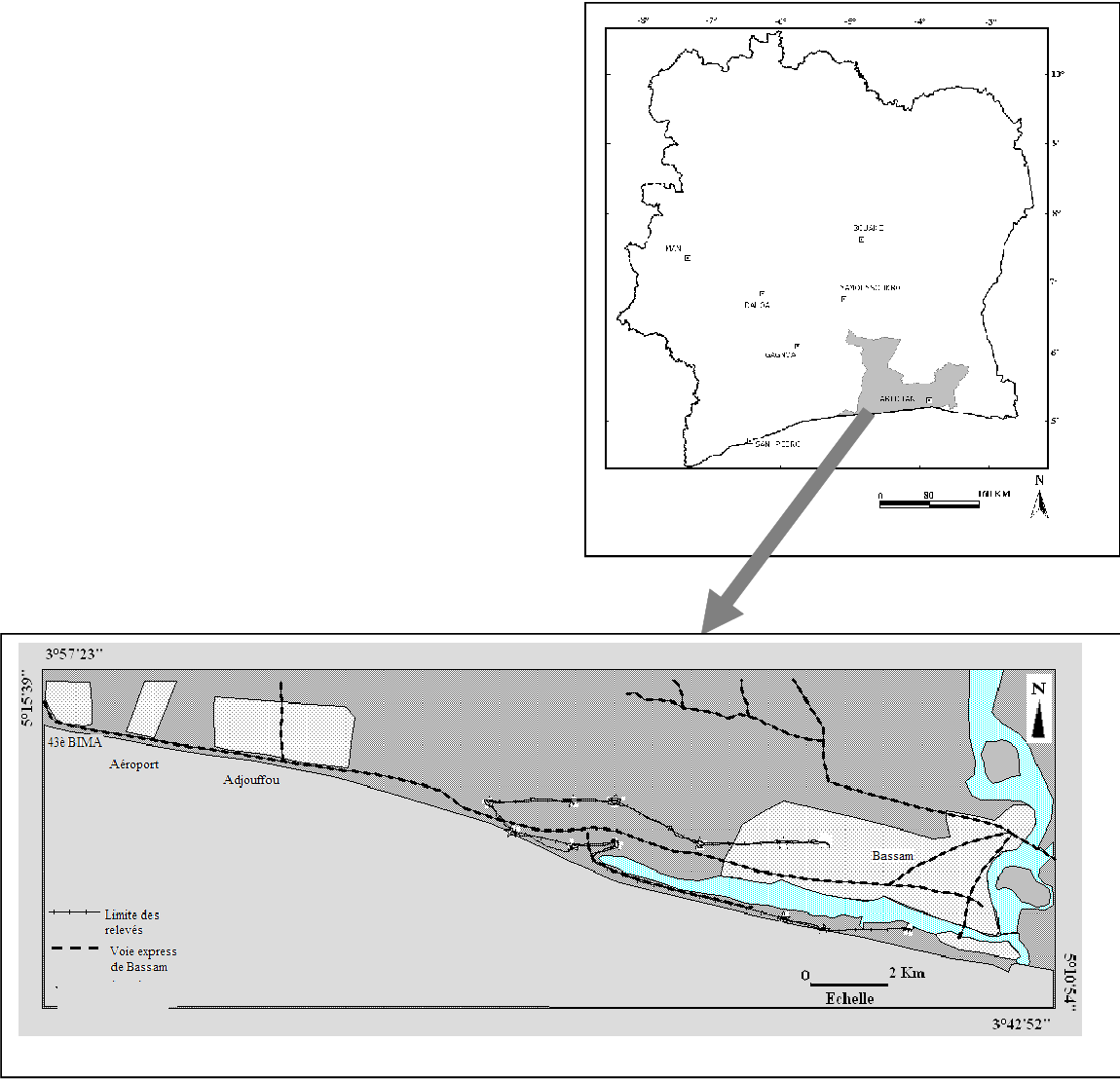
This study was carried out in a peripheral poultry area in Port-Bouët, south-east of Abidjan, Côte d'Ivoire (Figure 1).

Plant material
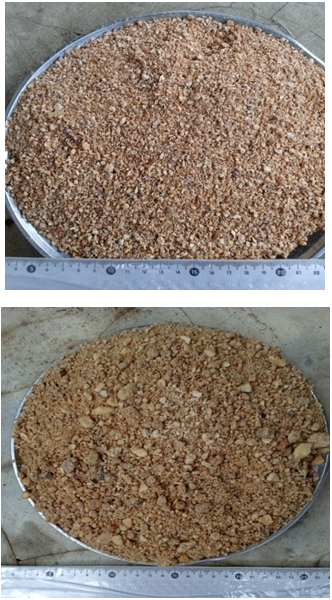
The plant material consisted of declassified cashew kernels collected from an industrial cashew nut processing unit, ‘Eburnie’, and soya cake purchased commercially from the ‘KENZ’ company in Abidjan (Figure 2).

Animal material
Chicks (Cobb 500) vaccinated against Newcastle disease were purchased from the ‘IVOGRAIN’ company in Abidjan and transported to the experimental farm located in the commune of Port-Bouët, Abidjan.
Formulation of experimental chicken feed rations
The compositions of the standard broiler starter, grower and finisher rations are presented in Table 1.
Based on the above standard rations F0, experimental rations F25, F50, F75 and F100 are formulated by substituting 25, 50, 75 and 100% soybean meal for cashew meal, respectively, as described by Fofana et al. 11.
Composition of experimental groups of broilers
After an incubation period, 5 batches of 15 unsexed 5-day-old Cobb 500 chicks were formed. For 6 weeks, these groups of chickens were successively fed starter, grower and finisher rations according to the following experimental scheme:
F0: batch of chickens fed standard feed rations
F25: batch of chickens fed experimental diets consisting of 25% substitution of soybean meal for cashew meal
F50: batch of chickens fed experimental rations consisting of 50% substitution of soybean meal for cashew meal
F75: batch of chickens fed experimental feed rations consisting of 75% substitution of soybean meal for cashew meal
F100: batch of chickens fed experimental feed rations consisting of 100% substitution of soybean meal for cashew meal.
Determination of mortality and zootechnical parameters
The number of deaths was recorded daily and the mortality rate (%) was calculated. A hierarchical classification analysis (HCA) based on the zootechnical data was used to group the experimental batches according to their evolutionary similarities. The zootechnical parameters were grouped according to their similarities in growth performance using Principal Component Analysis (PCA).
Determination of blood haematological parameters
On 45th day of the study, the chickens were fasted overnight before blood sampling. Using a syringe, the blood of 5 chickens chosen at random from each batch was drawn from their wing veins and packed in EDTA tubes at +4°C for blood cell count (CBC) on a Sysmex XN-550 at the haematology laboratory of the University Hospital of Cocody, Abidjan, Côte d'Ivoire.
Statistical analysis
The various results obtained were recorded in the Microsoft Excel spreadsheet. The means of the data were compared by analysis of variance (ANOVA) using the Turkey test with GraphPad Prism 8.4.3 (686) software. The significance threshold was p ˂0.05.
Effect of cashew oilcake on broiler mortality
Overall, mortality was low in all groups of chickens fed the different diets (Table 2). Most chickens died at the start-up stage, namely 5% (F0), 3.33% (F100 and F50) and 1.67% (F75 and F25).
Effects of cashew oilcake on zootechnical parameters of broilers
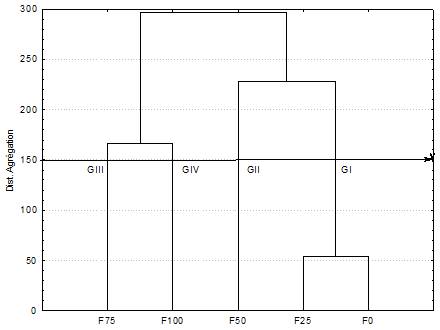
Four experimental groups of broilers were distinguished according to their evolutionary similarities (Figure 3). The GI group included all broilers fed F0 and F25 rations. Group GII included chickens fed the F50 ration. Group GIII consisted of chickens fed ration F75. Group GIV consisted of chickens fed ration F100.

GI: group of broilers fed rations F0 and F25; GII: group of broilers fed ration F50. GIII: group of broilers fed ration F75; GIV: group of broilers fed ration F100.

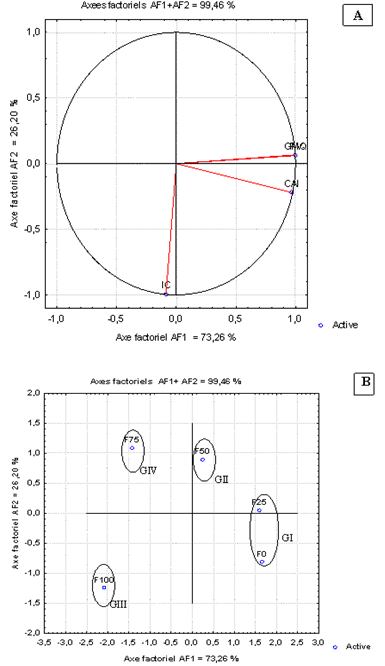
Two axes for grouping broilers, namely axis AF1 (73.26%) and axis AF2 (26.20%), were selected on the basis of the mean values of each zootechnical variable (Figure 4). These 2 grouping axes express 98.13% of the information contained in the data matrix. The correlation circle showed a strong negative correlation of the feed intake index (CI) on the AF1 factorial axis and a strong positive correlation between average daily gain (ADG) and individual feed intake (IFA) on the AF2 factorial axis (Figure 4A). The factorial map showed the distribution of the five (5) experimental batches according to growth performance characteristics. Comparative analysis of Figures 4 A and 4 B revealed that the batches in group GI (F0 and F25) were characterised by their high individual feed intake (IFA) and average daily gain (ADG), followed by group GII (F50) and group GIII (F100), which was characterised by its very high feed conversion ratio (FCR).
(A) Correlation circle of the growth parameters projected on the factorial axes; CI: consumption index; CAI: individual feed intake; GMQ: average daily gain; (B) Factorial map showing the distribution of the five experimental batches formulated according to growth characteristics; F0: 0% substitution of soybean meal;F100:100% substitution of soybean meal;F75:75% substitution of soybean meal;F50: 50% substitution of soybean meal; F25: 25% substitution of soybean meal; GI, GII, GIII and GIV: groups observed.
Effect on haematological parameters in broilers
Erythrocyte parameters
Batch F100 (43.04%) recorded the highest haematocrit (HT) level, unlike batches F75, F50 and F25, which recorded haematocrit levels of 28.12±3.31%, 20.72±1.39% and 23.82±4.7% respectively, which were significantly (p<0.05) lower than those of the F0 control (34.06%). The mean corpuscular volume (MCV) of batches F100 (118.5 g/dL) and F75 (122.26±2.32 g/dL) were significantly different (p<0.05) compared with the F0 control (129.54 g/dL). The mean corpuscular haemoglobin content (MCHC) and mean corpuscular haemoglobin concentration (MCHC) of batch F100 (25.87±4.13 pg and 21.98±3.65 g/dL respectively) were significantly (p<0.05) lower than the control (32.71±0.84 pg) (Table 3).
Trombocytes
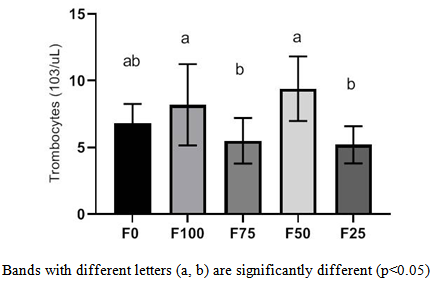
Trombocyte levels in broilers fed cashew meal were similar to those in control chickens (Figure 5).

White blood cell parameters
White blood cell (WBC) levels in chickens fed cashew-based rations in batches F50 (11.38.103/uL) and F25 (13.66.103/uL) were significantly (p<0.05) lower than in the F0 controls (20.17.103/uL). With the exception of neutrophil levels in batch F100, leukocytes in broilers fed cashew cake-based rations were statistically low (p<0.05) compared with those in the F0 control batch (Table 4).
This study analysed the zootechnical parameters and in particular the haematological profile of broilers fed standard and experimental diets. The experimental diets were obtained by substituting soybean meal from the standard diet for cashew meal.
During the 45 days the broilers were fed, mortality rates observed were ≤5%. This low mortality was noted during the start-up phase of rearing. Similar results of 3.03% mortality in broilers were found by others authors 12. Kere et al. 13 found similar mortality rates of between 1.76 and 3.46% in Burkina-Faso. On the other hand, the work of Abdellaoui 14 in Algeria observed a higher mortality of 8.33%.
In fact, the low mortality in broiler rearing can be explained by good control of rearing conditions, good nutritional qualities of the feed consumed and suitable climatic conditions 15, 16. Betene 17 found that the mortality rate for broilers rose from 8% in the cold season to 12% in the hot season. Mortality was highest in the start-up phase, when chicks are highly susceptible to pathogens and their immune systems are still underdeveloped 18.
The present study showed that the 50% experimental diet substituting soybean meal for cashew meal (F50) significantly reduced the number of white blood cells (WBC) in poultry (11.38.103/µL) compared with chickens fed standard F0 diets with a WBC level of 20.17.103/µL.
Similarly, Msaid 19 showed that heat stress reduced WBC levels to 11.06.103/µL and 11.42.103/µL respectively in local chickens and hens, Gallus gallus domesticus. However, Kiki 20 found that chilli powder (Capsicum frutescens) in the diet did not influence the haematological parameters of broilers, which had WBC values ranging from 22.78 to 25.22.103/µL; the normal WBC level in broilers being between 12.103 to 30.103/µL. The normal WBC levels observed are thought to be due to the absence of bacterial or parasitic infection, an inflammatory syndrome or an allergic drug reaction in the chickens 21.
The haematocrit (HT) levels of birds in batches F50 (20.72%) and F25 (23.82%) were significantly lower than those of control birds F0 (34.06%) and normal haematocrit values of between 27 and 55%, indicating the presence of microcytic anaemia in birds in batches F50 and F25. In contrast, the haematocrit level of birds in batch F100 was normal at 43.04%. Other studies had found normal haematocrit levels of between 26.52 and 28.00% 22 and between 37.42 and 38.30% 20 in broilers.
In general, the mean corpuscular volume (MCV) of birds fed cashew meal-based rations from batches F100 (118.5 mm3) and F75 (122.26 mm3) were in line with normal values (90 - 140 mm3) for MCV in broilers. Kiki (2013) found normal values between 127.85 and 130.30 mm3 20. Kamagaté 23 also reported normal VGM values of between 129.82 and 131.88 mm3 in broilers undergoing BIOFOR antibiotic treatment. With the exception of batch F100, whose mean corpuscular haemoglobin content (MCHC) was 25.87±4.13 pg, the MCHC values of the other batches of chickens fed cashew meal-based diets were comparable to that of the control batch (32.71±0.84 pg). However, the MCHT values of all chickens were within the standard (25-48 pg) for broilers. Most interestingly, the mean corpuscular haemoglobin concentration (MCHC) of chickens fed cashew oilcake was comparable to that of control chickens and in line with normal values (20-34 g/dL) in broilers 24.
The number of thrombocytes in chickens fed cashew kernel meal was significantly different (p<0.05). Values were lower than those of 22, which ranged from 35.74 to 47.26.109/L in Ross 308 broilers, and 25, which ranged from 21.33 to 30.33.109/L in broilers fed alkaline phosphatase supplementation. Since thrombocytes play an important role in blood coagulation, a low thrombocyte count would increase the risk of bleeding in hens 26.
Finally, the differential leucocyte count showed that, with the exception of neutrophil count, the other leucocyte parameters were comparable to those of the control. Neutrophil values were higher than those of 25, which ranged from 5.20 to 6.85.103/uL obtained in broilers after 42 days of dietary supplementation with alkaline phosphatase of microbial origin. Neutrophils are important mediators of natural resistance to bacterial infection in poultry 27, and their high levels could suggest bacterial infection 28. Lymphocyte levels were close to 1.5-2.79.103/uL, as obtained by Thema et al. 22 in Ross 308 broilers.
Monocyte and eosinophil levels were within the normal range of 0.15-2.109/L and 0-1.109/L respectively 29. Basophil levels were higher than those found by Escobar et al. 25 of between 0.8 and 0.99.109/L in broilers after 42 days of dietary supplementation with alkaline phosphatase.
This study showed that red and white blood cell levels in broilers were affected to varying degrees depending on the experimental rations consumed. The haematological parameters of the rats varied disparately from one group of chickens to another fed different cashew meal-based rations. Overall, the incorporation of cashew nut meal into poultry rations had beneficial effects on their zootechnical and haematological parameters, comparable to those of soya meal. Cashew nuts would be a genuinely inexpensive local substitute for imported soya and would reduce the production costs of poultry feed in Côte d'Ivoire. In the future, biotechnological studies aimed at adapting the granulometry of cashew oilcake will be necessary to produce better quality feed rations for poultry.
Authors' Contributions
Daouda Fofana wrote the research project. He reared the broilers and carried out the biological tests in the laboratory. Camille Koffi supervised the research work and took blood samples from the broilers. He also wrote the article and is its corresponding author. N'Goran Mathieu Kouamé and Kanga Sita N'zoué reviewed the article. Mamadou Kamagaté and Masse Diomandé are the scientific supervisors of the research project.
The present study was approved by the Scientific Committee of the “Medical Sciences Training and Research Unit (UFR SM)” of the “Alassane Ouattara University’’ and all experimental protocols were carried out in accordance with the NIH Guide for the Care and Use of Laboratory Animals.
The authors state that there were no competing interests.
All relevant data are within the paper and its supporting information files.
ADG (Average Daily Gain); CAI (Individual Feed Intake); CBC (Blood Cell Count); CCMH (Mean Corpuscular Haemoglobin Concentration); CI (Consumption Index); F0 (Batch of chickens fed standard feed rations); F100 (Batch of chickens fed experimental feed rations consisting of 100% substitution of soybean meal for cashew meal); F25 (Batch of chickens fed experimental diets consisting of 25% substitution of soybean meal for cashew meal); F50 (Batch of chickens fed experimental rations consisting of 50% substitution of soybean meal for cashew meal); F75 (Batch of chickens fed experimental feed rations consisting of 75% substitution of soybean meal for cashew meal); FCR (Feed Conversion Ratio); Fysal-MP (Free and Buffered Organic Acid Mixtures); GB (Number of White Blood Cells); GI (Group of Broilers Fed Rations F0 and F25); GII (Group of Broilers Fed Ration F50); GIII (Group of Chickens Fed Ration F75); GIV (Group of Chickens Fed Ration F100); GMQ (Average Daily Gain); GR (Number of Red Blood Cells); HB (Haemoglobin); HCA (hierarchical classification analysis); HT (Haematocrit); IFA (Individual Feed Intake); MCHC (Mean Corpuscular Haemoglobin Concentration); MCHC (Mean Corpuscular Haemoglobin Content); MCV (Mean Corpuscular Volume); PCA (Principal Component Analysis); TCMH (Mean Corpuscular Haemoglobin Content); TNH Chair (Vitamin Complex); Toxo-XL (Broad-Spectrum Mycotoxin Sensor); UFR (Teaching and Research Unit); VGM (Mean Corpuscular Volume); WBC (White Blood Cell).
| [1] | Erdaw, M.M. “Contribution, prospects and trends of livestock production in sub-Saharan Africa: a review”, Int. J. Agr. Sustain., 21 (1), 1-15, 2023. | ||
| In article | View Article | ||
| [2] | Bounds, M. and Zinyemba, O, “Poultry farming: Lessening poverty in rural areas”, S Afr. Jnl. Agric. Ext, 2018, 46 (1), 59-70, 2024. | ||
| In article | View Article | ||
| [3] | Schneider K., Gugerty M.K., Plotnick R., “Poultry Market in West Africa: Cote d’Ivoire”. EPAR, 88: 1-10, 2010. | ||
| In article | |||
| [4] | Njoroge S.C., Bett E.K., Njehia B.K., “Impact of Poultry Feed Price and Price Variability on Commercial Poultry Production in Murang'a County, Kenya”. IOSR JEF, 6(1):46-53, 2015. | ||
| In article | |||
| [5] | Wongnaa C.A., Mbroh J., Mabe F.N., Abokyi E., Debrah R., Dzaka E., Cobbinah S., Poku F.A., “Profitability and choice of commercially prepared feed and farmers’ own prepared feed among poultry producers in Ghana”, J. Agric. Food Res., 12, 1-7, 2023. | ||
| In article | View Article | ||
| [6] | Lautié E., Dornier M., De Souza F., and Reynes M., “Cashew tree products: characteristics, processing and markets”, Fruits, 56, 235-248, 2001. | ||
| In article | View Article | ||
| [7] | Mench J.A., “The welfare of poultry in modern production systems”, Poult. Sci. Rev. 4, 107-128, 1992. | ||
| In article | |||
| [8] | Martín-Barrasa J.L., Tejedor-Junco M.T., Cabrera S., Morales M., Melián A., Corbera J.A. “Haematological and biochemical blood reference values for Canary Island camels (Camelus dromedarius), an endangered dromedary species”. Saudi J Biol Sci. 30(6), 1-11, 2023. | ||
| In article | View Article | ||
| [9] | Bowes V.A., Julian R.J., Stirtzinger T. Comparison of serum biochemical profiles of male broilers with female broilers and White Leghorn chickens. Can J Vet Res, 1989, 53: 7- 11. | ||
| In article | |||
| [10] | Kouassi A.F., Adou Y.C.Y., Ipou I.J. & Kamanzi K., “Floristic diversity of grazed coastal zones in Côte d'Ivoire: the case of the Port-Bouët-Grand-Bassam barrier beach (Abidjan)”, Sciences & Nature, 7 (1), 69–86, 2010. | ||
| In article | View Article | ||
| [11] | Fofana D., Ouattara A., Diomande M., Ouattara A., Beugre G.A.M, Konate I., Bouatene D., Bohoua L.G., “Effect of cashew oilcake (Anacardium occidentale) on growth performance of Cobb 500 broiler chickens in Côte d'Ivoire”, IOSR-JAVS 16 (2), 31-46, 2023. | ||
| In article | |||
| [12] | Grilli C., Stocchi R., Loschi A.R., Conti F., Rea S., “Survey on broiler pre-slaughter mortality in a commercial abattoir of central Italy”, Ital J Food Saf., 6, 7 (3),174-180, 2018. | ||
| In article | View Article | ||
| [13] | Kere M., Traoré B., Belem A., Hien O.C., Bougouma Y. and Valérie M.C., “Assessment of the Profitability Window of Broiler Chickens Farming in Bobo-Dioulasso, Burkina Faso”, Int. J. Environ. Agric. Res., 6 (10), 24-33, 2020. | ||
| In article | |||
| [14] | Abdellaoui N., Slaughter of broiler chickens in the wilaya of Tizi-Ouzou: Study of a number of characteristics, Master's thesis, Mouloud Mammeri University, Tizi-Ouzou, Algeria, 2018, 80 p. | ||
| In article | |||
| [15] | Mramba O.P., Mwantambo P.A., “The impact of management practices on the disease and mortality rates of broilers and layers kept by small-scale farmers in Dodoma urban district, Tanzania”, Heliyon, 10 (8), 1-10, 2024. | ||
| In article | View Article | ||
| [16] | Emous R.A.V., Harn J.V., Riel J.W.V., “Effects of season, catching method, and thinning on carcass quality and production parameters in 4 different broiler production systems in the Netherlands”, Poult. Sci., 103 (6), 1-13, 2024. | ||
| In article | View Article | ||
| [17] | Betene A.D.C.L. Evaluation of zootechnical and economic performance in the post-reform period of broiler chicken rearing (cobb-500 and jupiter strains) in the Dakar region. PhD thesis, Cheikh Anta Diop University, Dakar, Senegal, 2006, 114 p. | ||
| In article | |||
| [18] | Yerpes M., Llonch P., Manteca X., “Factors Associated with Cumulative First-Week Mortality in Broiler Chicks”, Animals (Basel), 10 (2), 1-13, 2020. | ||
| In article | View Article | ||
| [19] | Msaid O, Effect of heat stress on certain blood parameters in local hens (Gallus gallus domesticus), Master's thesis, Abdelhamid Ibn Badis University, Algeria, 2017, 68 p. | ||
| In article | |||
| [20] | Kiki P.S., Effects of Chili Powder (Capsicum frutescens) on Zootechnical, Hematological, Biochemical Parameters and the Carcass of the Hubbard Broiler, Master's thesis, University of Abomey-Calavi, Cotonou, Benin, 2013, 79 p. | ||
| In article | |||
| [21] | Onunkwo D.N., Ufot U.E., Ezenyilimba B.N., Omumuabuike J.N and Ezeoke F.C., “Blood profile of starter broiler chickens fed diet containing leaf meal composite as alternative to commercial broiler premix”, Nigerian J. Anim. Sci., 24 (2), 103-110, 2022. | ||
| In article | |||
| [22] | Thema K.K., Mnisi C.M., Mlambo V., “Stocking density-induced changes in growth performance, blood parameters, meat quality traits, and welfare of broiler chickens reared under semiarid subtropical conditions”, PLoS ONE, 17 (10), 1-13, 2022. | ||
| In article | View Article | ||
| [23] | Kamagaté A., “BIOFOR: Health regulator”, Int. J. Innov. Stud., 17 (4): 1286-1293, 2016. | ||
| In article | |||
| [24] | Kanda I., “Exotic Animal Formulary, 4th edition”. Can Vet J., 56 (7), 736, 2015. | ||
| In article | |||
| [25] | Escobar J., Dobbs M., Ellenberger C., Parker A., Latorre J.D. and Gabor L., “Oral supplementation of alkaline phosphatase in poultry and swine”, Transl. anim. sci., 6: 1-10, 2022. | ||
| In article | View Article | ||
| [26] | Guérin J.L., Balloy D., Villate D., Poultry diseases. 3rd Edition, France Agricole, 557, 2011, 73-88. | ||
| In article | |||
| [27] | Powell P.C., “Immune mechanisms in infections of poultry”, Vet. Immunol. Immunopathol., 15, 87-113, 1987. | ||
| In article | View Article | ||
| [28] | Goldman L., Schafer A.I. Goldman’s Cecil Medicine, 24th edition, Elsevier/Saunders, Philadelphie, USA, 2012, 2565 p. | ||
| In article | |||
| [29] | Wakenell P.S., Hematology of Chickens and Turkeys. In: Schalm’s veterinary hematology, Weiss DJ, Wardrop KJ. 6th edition, Ed Wiley-Blackwell, Ames. Iowa, Tennessee, U.S.A, 2010, 962-963. | ||
| In article | |||
Published with license by Science and Education Publishing, Copyright © 2024 Camille Koffi, Daouda Fofana, Masse Diomandé, Kanga Sita N’Zoué, N’Goran Mathieu Kouamé and Mamadou Kamagaté
 This work is licensed under a Creative Commons Attribution 4.0 International License. To view a copy of this license, visit
https://creativecommons.org/licenses/by/4.0/
This work is licensed under a Creative Commons Attribution 4.0 International License. To view a copy of this license, visit
https://creativecommons.org/licenses/by/4.0/
| [1] | Erdaw, M.M. “Contribution, prospects and trends of livestock production in sub-Saharan Africa: a review”, Int. J. Agr. Sustain., 21 (1), 1-15, 2023. | ||
| In article | View Article | ||
| [2] | Bounds, M. and Zinyemba, O, “Poultry farming: Lessening poverty in rural areas”, S Afr. Jnl. Agric. Ext, 2018, 46 (1), 59-70, 2024. | ||
| In article | View Article | ||
| [3] | Schneider K., Gugerty M.K., Plotnick R., “Poultry Market in West Africa: Cote d’Ivoire”. EPAR, 88: 1-10, 2010. | ||
| In article | |||
| [4] | Njoroge S.C., Bett E.K., Njehia B.K., “Impact of Poultry Feed Price and Price Variability on Commercial Poultry Production in Murang'a County, Kenya”. IOSR JEF, 6(1):46-53, 2015. | ||
| In article | |||
| [5] | Wongnaa C.A., Mbroh J., Mabe F.N., Abokyi E., Debrah R., Dzaka E., Cobbinah S., Poku F.A., “Profitability and choice of commercially prepared feed and farmers’ own prepared feed among poultry producers in Ghana”, J. Agric. Food Res., 12, 1-7, 2023. | ||
| In article | View Article | ||
| [6] | Lautié E., Dornier M., De Souza F., and Reynes M., “Cashew tree products: characteristics, processing and markets”, Fruits, 56, 235-248, 2001. | ||
| In article | View Article | ||
| [7] | Mench J.A., “The welfare of poultry in modern production systems”, Poult. Sci. Rev. 4, 107-128, 1992. | ||
| In article | |||
| [8] | Martín-Barrasa J.L., Tejedor-Junco M.T., Cabrera S., Morales M., Melián A., Corbera J.A. “Haematological and biochemical blood reference values for Canary Island camels (Camelus dromedarius), an endangered dromedary species”. Saudi J Biol Sci. 30(6), 1-11, 2023. | ||
| In article | View Article | ||
| [9] | Bowes V.A., Julian R.J., Stirtzinger T. Comparison of serum biochemical profiles of male broilers with female broilers and White Leghorn chickens. Can J Vet Res, 1989, 53: 7- 11. | ||
| In article | |||
| [10] | Kouassi A.F., Adou Y.C.Y., Ipou I.J. & Kamanzi K., “Floristic diversity of grazed coastal zones in Côte d'Ivoire: the case of the Port-Bouët-Grand-Bassam barrier beach (Abidjan)”, Sciences & Nature, 7 (1), 69–86, 2010. | ||
| In article | View Article | ||
| [11] | Fofana D., Ouattara A., Diomande M., Ouattara A., Beugre G.A.M, Konate I., Bouatene D., Bohoua L.G., “Effect of cashew oilcake (Anacardium occidentale) on growth performance of Cobb 500 broiler chickens in Côte d'Ivoire”, IOSR-JAVS 16 (2), 31-46, 2023. | ||
| In article | |||
| [12] | Grilli C., Stocchi R., Loschi A.R., Conti F., Rea S., “Survey on broiler pre-slaughter mortality in a commercial abattoir of central Italy”, Ital J Food Saf., 6, 7 (3),174-180, 2018. | ||
| In article | View Article | ||
| [13] | Kere M., Traoré B., Belem A., Hien O.C., Bougouma Y. and Valérie M.C., “Assessment of the Profitability Window of Broiler Chickens Farming in Bobo-Dioulasso, Burkina Faso”, Int. J. Environ. Agric. Res., 6 (10), 24-33, 2020. | ||
| In article | |||
| [14] | Abdellaoui N., Slaughter of broiler chickens in the wilaya of Tizi-Ouzou: Study of a number of characteristics, Master's thesis, Mouloud Mammeri University, Tizi-Ouzou, Algeria, 2018, 80 p. | ||
| In article | |||
| [15] | Mramba O.P., Mwantambo P.A., “The impact of management practices on the disease and mortality rates of broilers and layers kept by small-scale farmers in Dodoma urban district, Tanzania”, Heliyon, 10 (8), 1-10, 2024. | ||
| In article | View Article | ||
| [16] | Emous R.A.V., Harn J.V., Riel J.W.V., “Effects of season, catching method, and thinning on carcass quality and production parameters in 4 different broiler production systems in the Netherlands”, Poult. Sci., 103 (6), 1-13, 2024. | ||
| In article | View Article | ||
| [17] | Betene A.D.C.L. Evaluation of zootechnical and economic performance in the post-reform period of broiler chicken rearing (cobb-500 and jupiter strains) in the Dakar region. PhD thesis, Cheikh Anta Diop University, Dakar, Senegal, 2006, 114 p. | ||
| In article | |||
| [18] | Yerpes M., Llonch P., Manteca X., “Factors Associated with Cumulative First-Week Mortality in Broiler Chicks”, Animals (Basel), 10 (2), 1-13, 2020. | ||
| In article | View Article | ||
| [19] | Msaid O, Effect of heat stress on certain blood parameters in local hens (Gallus gallus domesticus), Master's thesis, Abdelhamid Ibn Badis University, Algeria, 2017, 68 p. | ||
| In article | |||
| [20] | Kiki P.S., Effects of Chili Powder (Capsicum frutescens) on Zootechnical, Hematological, Biochemical Parameters and the Carcass of the Hubbard Broiler, Master's thesis, University of Abomey-Calavi, Cotonou, Benin, 2013, 79 p. | ||
| In article | |||
| [21] | Onunkwo D.N., Ufot U.E., Ezenyilimba B.N., Omumuabuike J.N and Ezeoke F.C., “Blood profile of starter broiler chickens fed diet containing leaf meal composite as alternative to commercial broiler premix”, Nigerian J. Anim. Sci., 24 (2), 103-110, 2022. | ||
| In article | |||
| [22] | Thema K.K., Mnisi C.M., Mlambo V., “Stocking density-induced changes in growth performance, blood parameters, meat quality traits, and welfare of broiler chickens reared under semiarid subtropical conditions”, PLoS ONE, 17 (10), 1-13, 2022. | ||
| In article | View Article | ||
| [23] | Kamagaté A., “BIOFOR: Health regulator”, Int. J. Innov. Stud., 17 (4): 1286-1293, 2016. | ||
| In article | |||
| [24] | Kanda I., “Exotic Animal Formulary, 4th edition”. Can Vet J., 56 (7), 736, 2015. | ||
| In article | |||
| [25] | Escobar J., Dobbs M., Ellenberger C., Parker A., Latorre J.D. and Gabor L., “Oral supplementation of alkaline phosphatase in poultry and swine”, Transl. anim. sci., 6: 1-10, 2022. | ||
| In article | View Article | ||
| [26] | Guérin J.L., Balloy D., Villate D., Poultry diseases. 3rd Edition, France Agricole, 557, 2011, 73-88. | ||
| In article | |||
| [27] | Powell P.C., “Immune mechanisms in infections of poultry”, Vet. Immunol. Immunopathol., 15, 87-113, 1987. | ||
| In article | View Article | ||
| [28] | Goldman L., Schafer A.I. Goldman’s Cecil Medicine, 24th edition, Elsevier/Saunders, Philadelphie, USA, 2012, 2565 p. | ||
| In article | |||
| [29] | Wakenell P.S., Hematology of Chickens and Turkeys. In: Schalm’s veterinary hematology, Weiss DJ, Wardrop KJ. 6th edition, Ed Wiley-Blackwell, Ames. Iowa, Tennessee, U.S.A, 2010, 962-963. | ||
| In article | |||