sciepub.com
 Quick Submission

Atom Bond Connectivity Index of Carbon Nanocones and An Algorithm
Ömür Kıvanç Kürkçü1, , Ersin Aslan2
1Department of Mathematics, Faculty of Science and Arts, Celal Bayar University, Manisa, Turkey
2Turgutlu Vocational Training School, Celal Bayar University, Manisa, Turkey
Abstract
Let G be a chemical graph, where V(G) and E(G) are represented set of vertices and edges respectively. Atom bond connectivity index ABC(G) is related to degree of vertices of graph G. In this paper, we calculate the index for generalized carbon nanocones. Subsequently, an useful algorithm (pseudocode) are given. The goal of this paper is to further the study of ABC(G) index for generalized carbon nanocones.
Keywords: carbon nanocones, atom bond connectivity index, generalized formula, algorithm
Received August 18, 2015; Revised September 01, 2015; Accepted September 16, 2015
Copyright © 2015 Science and Education Publishing. All Rights Reserved.Cite this article:
- Ömür Kıvanç Kürkçü, Ersin Aslan. Atom Bond Connectivity Index of Carbon Nanocones and An Algorithm. Applied Mathematics and Physics. Vol. 3, No. 1, 2015, pp 6-9. http://pubs.sciepub.com/amp/3/1/2
- Kürkçü, Ömür Kıvanç, and Ersin Aslan. "Atom Bond Connectivity Index of Carbon Nanocones and An Algorithm." Applied Mathematics and Physics 3.1 (2015): 6-9.
- Kürkçü, Ö. K. , & Aslan, E. (2015). Atom Bond Connectivity Index of Carbon Nanocones and An Algorithm. Applied Mathematics and Physics, 3(1), 6-9.
- Kürkçü, Ömür Kıvanç, and Ersin Aslan. "Atom Bond Connectivity Index of Carbon Nanocones and An Algorithm." Applied Mathematics and Physics 3, no. 1 (2015): 6-9.
| Import into BibTeX | Import into EndNote | Import into RefMan | Import into RefWorks |
At a glance: Figures
1. Introduction
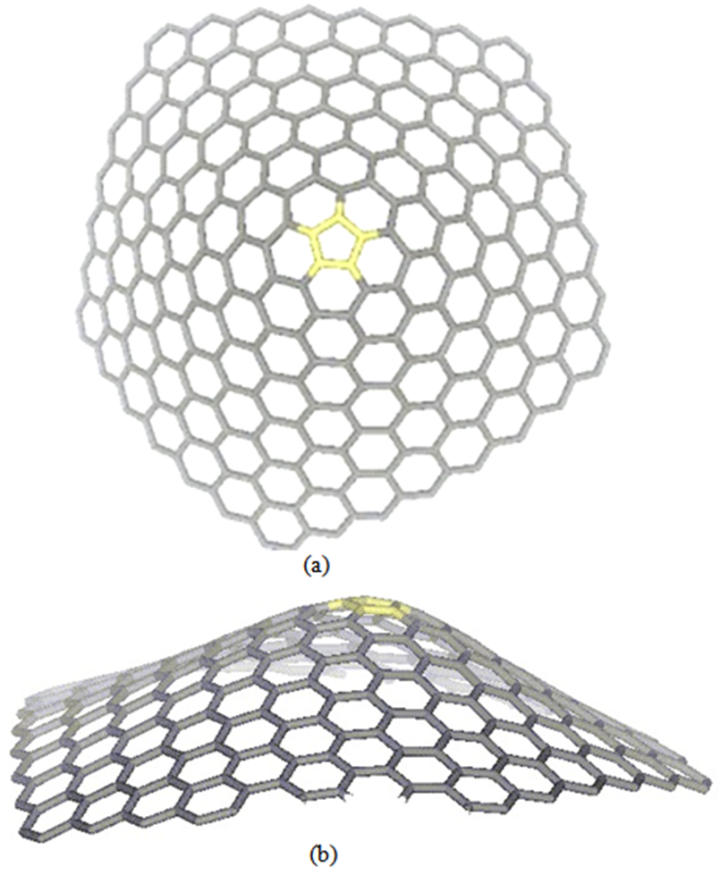
The graph theory has wide range of applied field and which is specially nanostructures of nanotechnology. Carbon nanotubes (CNT) were discovered by Sumio Iijima in 1991 [6]. Subsequently, carbon nanocones (CNC) were discovered by Ge and Sattler in 1994 [7] (See Figure 1). Recently, nanostructures involving carbon have been the focus of an intense research activity, which is driven to a large extent by the quest for new materials with miscellaneous applications.
A topological index of a chemical graph G is numeric quantity attributed to G. The topological indices are graph invariants and are used for quantitative structure-activity relationship (QSAR) and quantitative structure-property relationship (QSPR) [8, 9]. The oldest topological index is Wiener index, which was presented by the chemist Harold Wiener in 1947 [10]. It is based on distance d(u,v) between any u and v atoms in chemical graph G and defined as follows:
 |
Now, we give some definitions. Let G be a basic chemical graph, in which edge sets are represented by E(G) and degree of vertex u is represented by d(u). In chemical graphs, the vertices of the graph attributed to the atoms of the molecule and the edges represent the chemical bonds. Atom bond connectivity index [2] defined as follows:
 |
In the research paper [1], the authors evaluated GA and ABC topological index of trigonal and tetragonal carbon nanocones.
In this paper, we aimed to develop atom bond connectivity index for generalized carbon nanocones.

 Download as

2. Main Results
Let  be. Our notation is standard and mainly taken from standard book of graph theory such as [3, 4, 5]. Now we give to require theorems.
Theorem 1 [1]. Consider the graph of carbon nanocones  . Then we have:
 |
Theorem 2 [1]. Consider the graph of carbon nanocones  . Then we have:
 |
Theorem 3. Consider the graph of pentagonal carbon nanocones  . Then we have
 |
Proof. Let us consider the graph  has
has  edges and
  vertices for all
  . On the other hand, there are
  edges of type d(u)=d(v)=3, 5 edges of type d(u)=d(v)=2 and 10n edges of type d(u)=3, d(v)=2. We get
 |
Proposition 4. Consider the graph of pentagonal carbon nanocones  . Then we have
 |
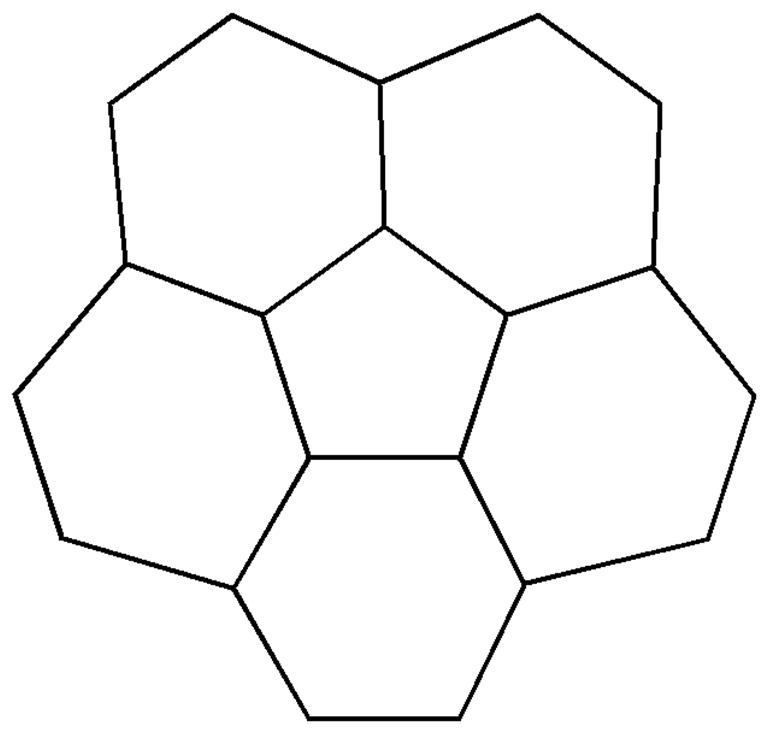
Proof. The graph of pentagonal carbon nanocones  is illustrated in Figure 2 and which has 25 edges. If u and v be endpoints on any edge then there exist,
10 edges of type  ,
,
5 edges of type  ,
,
10 edges of type  . This way,
 |
 Download as
 and it’s first layer
Proposition 5. Consider the graph of pentagonal carbon nanocones  . Then we have
 |
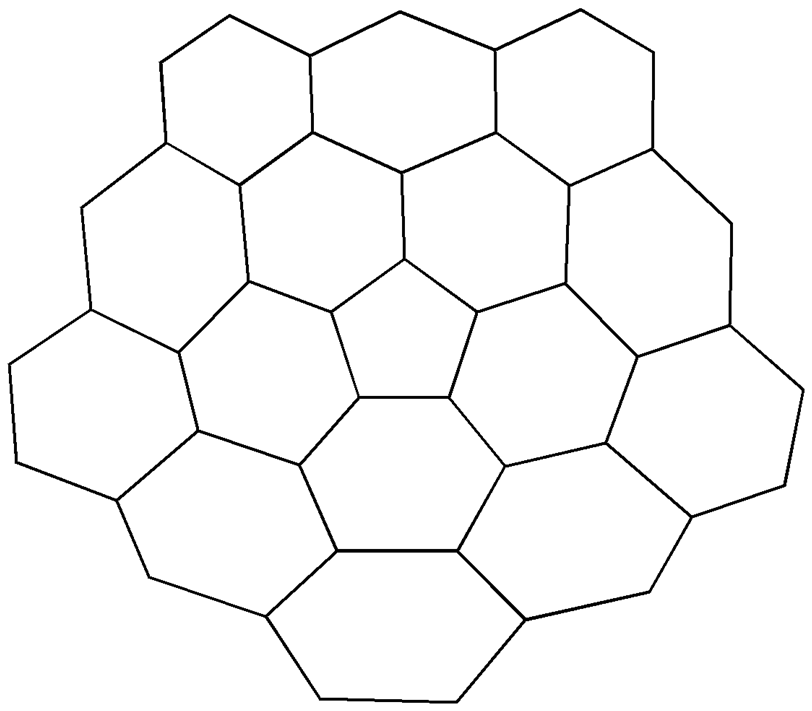
Proof. The graph of pentagonal carbon nanocones  is illustrated in Fig. 3 and which has 60 edges.
35 edges of type  ,
,
5 edges of type  ,
,
20 edges of type  . Then,
 |
 Download as
 and it’s first two layers
Theorem 6. Consider the graph of heptagonal carbon nanocones  . Then we have
 |
Proof. Let us consider the graph  has
has  edges and
  vertices for all
  . On the other hand, there are
  edges of type d(u)=d(v)=3, 7 edges of type d(u)=d(v)=2 and 14n edges of type d(u)=3, d(v)=2. Hence,
 |
Proposition 7. Consider the graph of heptagonal carbon nanocones  . Then we have
 |
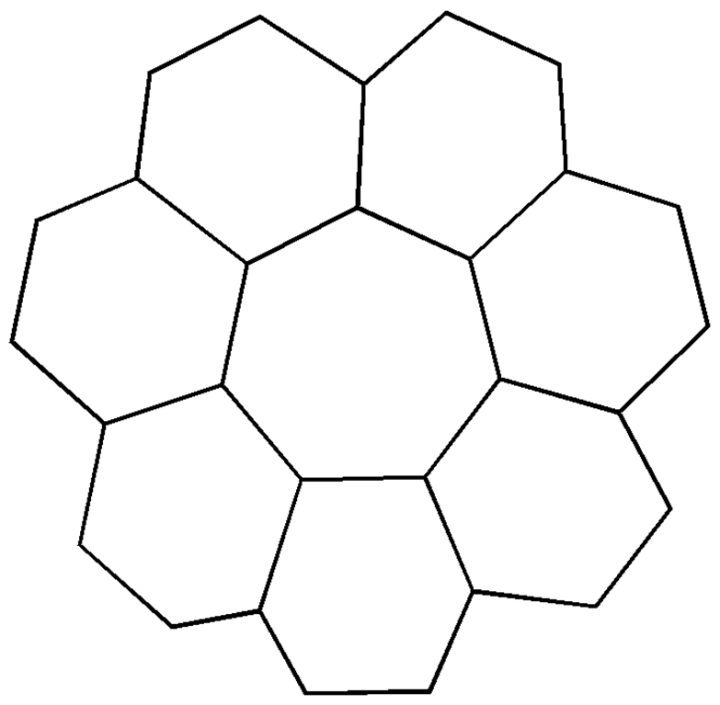
Proof. The graph of heptagonal carbon nanocones  is illustrated in Figure 4 and which has 35 edges.
14 edges of type  ,
,
7 edges of type  ,
,
14 edges of type  , then we get,
 |
 Download as
 and it’s first layer
Proposition 8. Consider the graph of heptagonal carbon nanocones  . Then we have
 |
Proof. The graph of heptagonal carbon nanocones  has 84 edges.
49 edges of type  ,
,
7 edges of type  ,
,
28 edges of type  , then we have
 |
We conclude that the following theorem.
Theorem 9. Let  and
and  be positive integers. Then, we have the generalized formula
 |
Proof. Let Ei, Ej and Ek (i, j and k are arbitrary positive integers) are subsets of  . Then,
 |
 |
 |
 |
 |
Hence,
 |
The proof is completed.
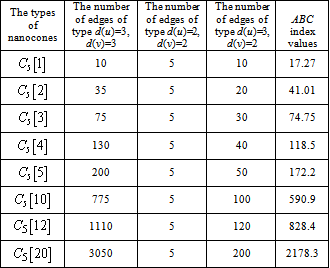
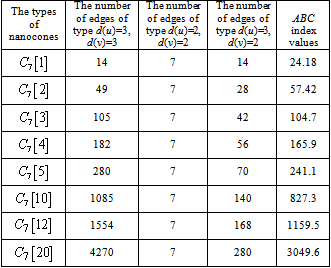
In Table 1 and Table 2, the numbers of edges of type d(u)=d(v)=3, d(u)=d(v)=2 and d(u)=3, d(v)=2 have been shown as respectively. Also, the values of ABC index have been calculated for some  and
and  .
.






3. An Algorithm for ABC Index
In this section, an algorithm (pseudocode) is proposed for the evaluation of the atom bond connectivity index. In algorithm, we use some variables which we defined below:
m is the number of edges of the chemical graph,
 (e=uv) are the edges of the chemical graph,
Sum is the sum of ABC index for each edge.
Step 0. Start.
Step 1. Take Sum=0,  .
.
Step 2.  .
.
Step 3. Determine the degrees of  and
and  for
for  .
.
Step 4. Sum=Sum + .
.
Step 5. If  then, return to Step 2.
Step 6. Else, write the Sum.
Step 7. Stop.
4. Conclusion
In this paper, atom bond connectivity index of pentagonal and heptagonal carbon nanocones has been calculated and also, the theorem has been given for the first time. It is possible to apply any families of carbon nanocones. Furthermore, the algorithm can be used other vertex based topological indices. Atom bond connectivity index is convenient for measuring (connected) nanostructures which is based on degrees of their vertices.
References
| [1] | Khaksar, A., Ghorbani, M. and Maimani, H.R., “On atom bond connectivity and GA indices of nanocones,” Optoelectron. Adv. Mater. – Rapid Commun., 4 (11). 1868-1870. 2010. | ||
 In article In article | |||
| [2] | Furtula, B., Graovac, A. and Vukicevic, D., “Atom–bond connectivity index of trees,” Disc. Appl. Math., 157. 2828-2835. 2009. | ||
| In article | View Article | ||
| [3] | Trinajstic, N. and Gutman, I., “Mathematical Chemistry,” Croat. Chem. Acta, 75. 329-356. 2002. | ||
| In article | |||
| [4] | West, D.B., Introduction to Graph theory, Prentice Hall, Upper Saddle River, 1996. | ||
| In article | |||
| [5] | Harary, F., Graph Theory, Addison-Wesley, Reading MA, 1969. | ||
| In article | |||
| [6] | Iijima, S., “Helical microtubules of graphitic carbon,” Nature, 354. 56-58. 1991. | ||
| In article | View Article | ||
| [7] | Ge, M. and Sattler, K., “Observation of fullerene cones,” Chem. Phys. Lett., 220. 192. 1994. | ||
| In article | View Article | ||
| [8] | Todeschini, R. and Consonni, V., Handbook of Molecular Descriptors, Wiley-VCH: Weinheim, 2000. | ||
| In article | View Article PubMed | ||
| [9] | Diudea, M.V. QSPR/QSAR Studies by Molecular Descriptors, Nova Science Publishers: Huntington, NY, 2000. | ||
| In article | |||
| [10] | Wiener, H., “Structural determination of paraffin boiling points,” J. Am. Chem. Soc., 69. 17-20. 1947. | ||
| In article | View Article PubMed | ||
| [11] | Alipour, M.A. and Ashrafi, A.R., “A numerical method for computing the Wiener index of one heptagonal carbon nanocone,” Journal of Computational and Theoretical Nanoscience, 6. 1-4. 2009. | ||
| In article | View Article | ||
| [12] | Ashrafi, A.R. and Gholami-Nezhaad, F., “The PI and Edge Szeged Indices of One-Heptagonal Carbon Nanocones,” Current Nanoscience, 5 (1). 51-53. 2009. | ||
| In article | View Article | ||
| [13] | Gan, L., Hou, H. and Liu, B., “Some results on atom-bond connectivity index of graphs,” MATCH Commun. Math. Comput. Chem., 69. 669-680. 2011. | ||
| In article | |||
| [14] | Ediz, S., “The Ediz eccentric connectivity index of one pentagonal carbon nanocones,” Fullerenes, Nanotubes, and Carbon Nanostructures, 21. 113-116. 2013. | ||
| In article | View Article | ||
| [15] | Nejati, A. and Alaeiyan, M., “The edge version of MEC index of one-pentagonal carbon nanocones,” Bulgarian Chemical Communications, 46 (3). 462-464. 2014. | ||
| In article | |||
| [16] | Yang, L. and Hua, H., “The harmonic index of general graphs, nanocones and triangular benzenoid graphs,” Optoelectron. Adv. Mater. – Rapid Commun., 6 (5-6). 660-663. 2012. | ||
| In article | |||
| [17] | Alaeiyan, M., Asadpour, J. and Mojarad, R., “A Study of an Infinite Family of Carbon Nanocones by the Eccentricity Connectivity Polynomial,” Fullerenes, Nanotubes, and Carbon Nanostructures, 21. 849-860. 2013. | ||
| In article | View Article | ||
| [18] | Das, K.Ch., Gutman, I. and Furtula, B., “On atom–bond connectivity index,” Filomat, 26 (4). 733-738. 2012. | ||
| In article | View Article | ||
| [19] | Farahani, M.R., “The Edge Version of Geometric–Arithmetic Index of Benzenoid Graph,” Proc. Rom. Acad., Series B, 15 (2). 83-86. 2013. | ||
| In article | |||
| [20] | Ashrafi, A.R. and Mohammad-Abadi, Z., “On Wiener Index of One-Heptagonal Nanocone,” Current Nanoscience, 8 (1). 180-185. 2012. | ||
| In article | View Article | ||
 CiteULike
 Mendeley
 StumbleUpon
 Delicious
 Facebook
 Twitter
 LinkedIn
, (b) The one-pentagonal carbon nanocone (top and side view) (color figure available online))