 OPEN ACCESS
  PEER-REVIEWED
Two Numerical Methods to Solve the Second Order Multi-pantograph Equation with Boundary Conditions
Mahdi Ahmadinia1, , Zeinab Safari1
1Department Mathematics, University of Qom, Qom, Iran
Abstract
In this article, we present two numerical methods to solve the second order multi-pantograph equation with boundary conditions. The multi-pantograph equation is converted to an integral equation then the integral equation is solved by two projective methods. Some properties of Chebyshev polynomials are employed to prove the convergence analysis of the two proposed methods. Finally, numerical examples also are given to illustrate the efficiency and validity of the two proposed methods.
At a glance: Figures
Keywords: Multi-pantograph equation, Integral equation, Chebyshev polynomials
Applied Mathematics and Physics, 2014 2 (4),
pp 124-127.
DOI: 10.12691/amp-2-4-1
Received April 21, 2014; Revised May 28, 2014; Accepted June 18, 2014
Copyright © 2013 Science and Education Publishing. All Rights Reserved.Cite this article:
- Ahmadinia, Mahdi, and Zeinab Safari. "Two Numerical Methods to Solve the Second Order Multi-pantograph Equation with Boundary Conditions." Applied Mathematics and Physics 2.4 (2014): 124-127.
- Ahmadinia, M. , & Safari, Z. (2014). Two Numerical Methods to Solve the Second Order Multi-pantograph Equation with Boundary Conditions. Applied Mathematics and Physics, 2(4), 124-127.
- Ahmadinia, Mahdi, and Zeinab Safari. "Two Numerical Methods to Solve the Second Order Multi-pantograph Equation with Boundary Conditions." Applied Mathematics and Physics 2, no. 4 (2014): 124-127.
| Import into BibTeX | Import into EndNote | Import into RefMan | Import into RefWorks |
1. Introduction
The following second order delay differential
 | (1) |
is called multi-pantograph equation with anti-periodic boundary conditions when 

 and
and  . The first order of the multi-pantograph equation has been solved by many methods such as Bessel collection method [12] by Yüzbaşi et al. the Taylor approximation method [6, 7, 8] by Sezer et al. and θ-method [4] by Liu and Li. Saadatmandi and Dehghan applied the variational iteration method in [5] and Yu in [15] as well. Homotopy method has been employed in [10] by Yusufoğlu. Brunner at al. [2] applied discontinuous Galerkin method to solve the delay differential equations of pantograph type and explained convergence analysis of the method completely. Some other cases of the neutral delay differential equation have been studied in [13, 14] by Yüzbaşi et al. The system of multi-pantograph equation of the first order has been solved by Bessel collocation method in [11]. The present paper introduces two projective methods to solve the second order of multi-pantograph equation with anti periodic boundary conditions. We convert multi-pantograph equation (1) to an integral equation and solve it by two projective methods. The rest of the paper is arranged as fallows: Section 2 introduces preliminaries of the method and describes the method which is to convert problem (1) to an integral equation also the integral equation is solved by two projective methods. Section 3 proves the convergence analysis of the two projective methods. The last section illustrates numerical examples to confirm the theory.
2. Preliminaries and the Method
Multi-pantograph equation (1) with anti-periodic boundary conditions can be converted to the following integral equation, for convenience assume that  and
and  . The value
  is fixed throughout the paper,
  . Consider
 | (2) |
when
 |
and
 |
If  is the solution of integral equation (2) then the following formula yields the solution of multi-pantograph equation(1).
 | (3) |
To obtain the solution of multi-pantograph equation (1) with anti-periodic boundary conditions, it is sufficient to solve integral equation (2) and considering (3). Therefore, we solve integral equation (2) by two projective methods and obtain the approximate solution of (1) by approximate solution (2). Integral equation (2) can be converted to the same integral equation on  by changing variable, then, without loss of generality, assume that
  . To present the two projective methods, we have to introduce Chebyshev polynomials. Let
  denotes Chebyshev polynomial of degree
  as follows:
 | (4) |
Note that  s are the zeros of
  . Let
. Let  be the polynomial space of degree
 . Consider the two projections as follows:
 |
when  s are the zeros of
  introduced in (4) and
  is Lagrange polynomial
 |
Conside as an approximation solution of (2) in the finite dimensional space
  . We will obtain the unknown coefficients
  , by two projective methods. Integral equation (2) yields
 | (5) |
Taking projection  on both sides of (5) implies
 | (6) |
Both sides of the above equation are two polynomials of degree , this equality of polynomials yields a system of
  equations with
  unknowns
  then we can obtain unknowns
  by solving a linear system. This method is called Galerkin method. We have another linear system with unknowns
  if we apply the projection
  instead of
  in (6). This projective method is called collocation method. Both projective methods solve integral equation (2) approximately and the approximate solution converges to the exact solution of (2). By considering (3) and the approximate solution of (2), we will obtain the approximate solution of (1), which converges to the exact solution (1). We will prove this fact in the next section.
3. Convergence Analysis
This section proves that the approximate solutions of two projective methods converge to the exact solution of integral equation (2). This fact will be presented by theorem 3.1 and corollary 3.2. The approximate solution of the integral equation yields an approximate solution of multi-pantograph equation with anti-periodic boundary conditions (1) which converges to the exact solution of (1), it is the result of theorem 3.3.
Theorem 3.1. Assume that  , is bounded operator
 |
and assume  is one to one and onto. Further assume
  , where
  is a projection
  and
and  is a finite dimensional space. Then for all sufficiently large
 , say
, say  , the operator
  exists as a bounded operator. Moreover, it is uniformly bounded:
 |
For the approximate solution  and
and  of
of
 | (7) |
and  respectively, we have
 |
Proof: This theorem has been presented by Atkinson and Han [1] page 479.
Corollary 3.2. Assume that  ,
,  and
and  is the polynomial space of degree
  . If
. If  is the approximate solution of (7) and
  is the exact solution of (2), then
  converges to
  in the two following cases:
i) 
ii) 
where  and
and  introduced in the previous section.
Proof: Theorem 3.1 yields
 |
it is sufficient to show that  converges zero in two cases
 and
and  Trefethen proved
  converges zero in the recent paper [9]. It is obvious that
  is interpolation projection at zeros of Chebyshev polynomials, then,
  converges to zero when the sequence
  is uniformly bounded (See Burden and Faires [3] page 524).
Theorem 3.3. Let  be the solution of integral equation (2) then the function
  in (3) is a solution of the multi-pantograph equation with anti-periodic boundary conditions (1). Moreover, if
  is an approximate solution of integral equation (2) and
  is approximate solution (1) which is obtained by substituting
  in (3), then the approximate solution
  converges to the exact solution (1), when
 |
Proof. Let  be the exact solution of integral equation (2). It is clear that the defined function
  in (3) satisfies the multi-pantograph equation with anti-periodic boundary conditions (1). If
  is an approximate solution (1), which is obtained by (3) and
  (approximate solution (2)) then the following inequality is clear by considering (3),
 |
where  is a constant independent of
  . The above inequality proves that the approximate solution
  converges to the exact solution of the multi-pantograph equation with anti-periodic boundary conditions.
Let  be the solution of the following system:
 |
where  or
or  , then corollary 3.2. and theorem 3.3. imply that
 converges to the exact solution of multi-pantograph equation (1).
4. Numerical Examples
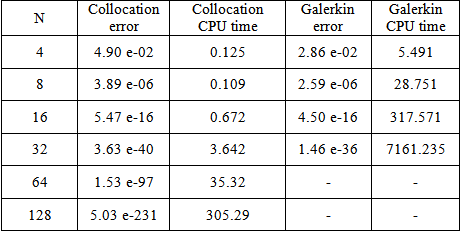
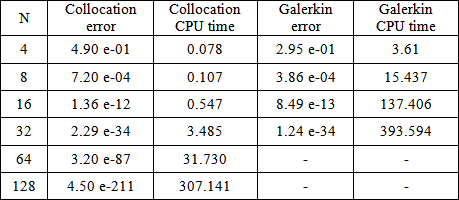
This section confirms the theory of the two proposed methods by illustrating numerical examples. The tables show the error of the methods ( ) and CPU time. All computations of the following examples have been run by Maple 15.Software.
Example 4.1. Consider the following multi-pantograph equation with anti-periodic boundary conditions,
 |
where
 |
and
 |
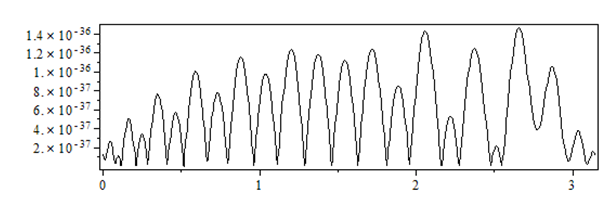
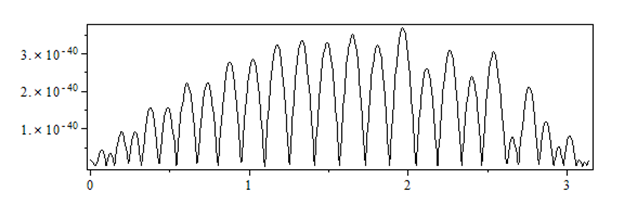
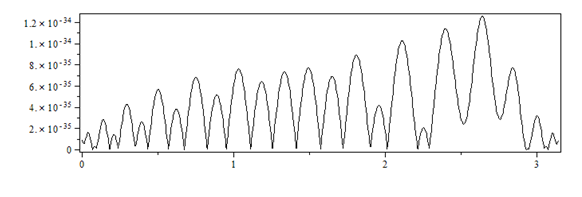
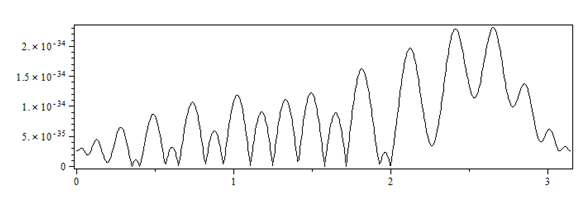
The exact solution is . Table 1 presents the error of the methods and CPU time. Figures 1. and figure 2. illustrate the error of Galerkin method and collocation method respectively.


 PowerPoint Slide
 Larger image(png format)
 View current table in a new window

 PowerPoint Slide
 Larger image(png format)

 PowerPoint Slide
 Larger image(png format)
Example 4.2. Consider the following multi-pantograph equation with anti-periodic boundary conditions,
 |
where
 |
and
 |
The exact solution of the multi-pantograph with boundary condition is  Table 2 shows the error of the methods and CPU time. Figures.3 and figures.4 show the error of Galerkin method and collocation method respectively.

 PowerPoint Slide
 Larger image(png format)
 View current table in a new window
 PowerPoint Slide
 Larger image(png format)
 PowerPoint Slide
 Larger image(png format)
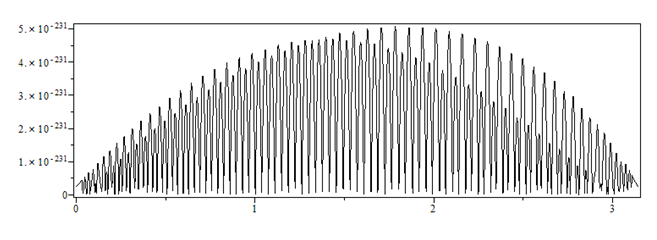
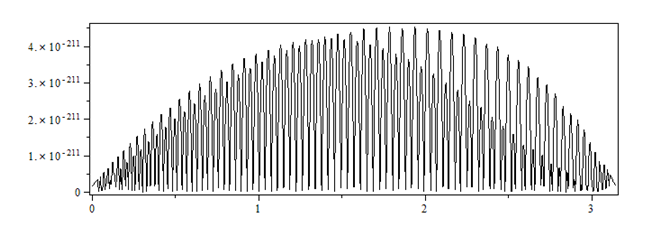
Figure 5 and Figure 6 illustrate the error of the collocation method for Example 4.1-4.2 and  .
.

 PowerPoint Slide
 Larger image(png format)
 PowerPoint Slide
 Larger image(png format)
5. Conclusion
In this study, we convert the second order multi-pantograph equation with anti-periodic boundary conditions to an integral equation then two projective methods are proposed to solve the integral equation. Some properties of interpolation and Chebyshev polynomials prove the convergence analysis of the two proposed methods. The numerical examples show that the errors of the two methods are same approximately, but the collocation method spends CPU time less than Galerkin method.
References
| [1] | K. Atkinson and W. Han, Theoretical Numerical Analysis A Functional Analysis Frame-work, , 2009. | ||
 In article In article | |||
| [2] | H. Brunner, Q. Huang and H. Xie,“Discontinuous Galerkin methods for delay differential equations of pantograph type,” SIAM J. Numer. Anal, 48. 1944-1967. 2010. | ||
| In article | CrossRef | ||
| [3] | R. L. Burden and J. D. Faires, Numerical Analysis, Brooks/Cole, Boston, 2011. | ||
| In article | |||
| [4] | M.Z. Liu and D. Li, “Properties of analytic solution and numerical solution of multi-pantograph equation,”Appl. Math. Comput., 155. 853-871. 2004. | ||
| In article | CrossRef | ||
| [5] | A. Saadatmand and M. Dehghan, “Variational iteration method for solving a generalized pantograph equation,” Comput. Math. Appl. 58(11-12). 2190-2196. 2009. | ||
| In article | CrossRef | ||
| [6] | M. Sezer and A. Akyüz-Daşcıoğlu, “A Taylor method for numerical solution of generalized pantograph equations with linear functional argument,”J. Comput. Appl. Math., 200. 217-225. 2007. | ||
| In article | CrossRef | ||
| [7] | M. Sezer, S. Yalçinbaş and M. Gülsu,“A Taylor polynomial approach for solving generalized pantograph equations with nonhomogeneous term,” Int. J. Comput. Math., 85(7), 1055-1063. 2008. | ||
| In article | CrossRef | ||
| [8] | M. Sezer, S. Yalçinbaş and N. Şahin, “Approximate solution of multi-pantograph equation with variable coefficients,” J. Comput. Appl. Math., 214. 406-416. 2008. | ||
| In article | CrossRef | ||
| [9] | L. N. Trefethen, “Is Gauss quadrature better than Clenshaw-Curtis?,” SIAM Review, 50. 67-87. 2008. | ||
| In article | CrossRef | ||
| [10] | E.Yusufoğlu, “An efficient algorithm for solving generalized pantograph equations with linear function alargument,” Appl. Math. Comput, 217(7). 3591-3595. 2010. | ||
| In article | CrossRef | ||
| [11] | Ş. Yüzbaşi, “An efficient algorithm for solving multi-pantograph equations systems,” Comput. Math. Appl, 64, 589-603, 2012. | ||
| In article | CrossRef | ||
| [12] | S.Yüzbaşi, N. Şahin, and M. Sezer. “A Bessel collocation method for numerical solution of generalized pantograph equations.” Numerical Methods for Partial Differential Equations, 28(4). 1105-1123, 2012. | ||
| In article | CrossRef | ||
| [13] | Ş.Yüzbaşi, N. Şahin and M. Sezer, “Numerical solutions of systems of linear Fredholm integro-differential equations with Bessel polynomial bases,” Comput. Math. Appl, 61(10), 3079-3096, 2011. | ||
| In article | CrossRef | ||
| [14] | Ş.Yüzbaşi, N. Şahin and M. Sezer, “A Bessel polynomial approach for solving linear neutral delay differential equations with variable coefficients,” J. Adv. Res. Differ. Equ. 3(1). 81-101, 2011. | ||
| In article | |||
| [15] | Z. H. Yu, “Variational iteration method for solving the multi-pantograph delay equation,” Phys. Lett. A, 372(43). 6475-6479. 2008. | ||
| In article | CrossRef | ||

 CiteULike
 Mendeley
 StumbleUpon
 Delicious
 Facebook
 Twitter
 LinkedIn
 Print
Print