 OPEN ACCESS
  PEER-REVIEWED
Introduction of Derivatives and Integrals of Fractional Order and Its Applications
Mehdi Delkhosh
Abstract
Fractional calculus is a branch of classical mathematics, which deals with the generalization of operations of differentiation and integration to fractional order. Such a generalization is not merely a mathematical curiosity but has found applications in various fields of physical sciences. In this paper, we review the definitions and properties of fractional derivatives and integrals, and we express the prove some of them.
At a glance: Figures
Keywords: fractional calculus, fractional derivatives, fractional integrals, derivative of fractional order, integral of fractional order
Applied Mathematics and Physics, 2013 1 (4),
pp 103-119.
DOI: 10.12691/amp-1-4-3
Received August 21, 2013; Revised October 24, 2013; Accepted October 27, 2013
Copyright © 2013 Science and Education Publishing. All Rights Reserved.Cite this article:
- Delkhosh, Mehdi. "Introduction of Derivatives and Integrals of Fractional Order and Its Applications." Applied Mathematics and Physics 1.4 (2013): 103-119.
- Delkhosh, M. (2013). Introduction of Derivatives and Integrals of Fractional Order and Its Applications. Applied Mathematics and Physics, 1(4), 103-119.
- Delkhosh, Mehdi. "Introduction of Derivatives and Integrals of Fractional Order and Its Applications." Applied Mathematics and Physics 1, no. 4 (2013): 103-119.
| Import into BibTeX | Import into EndNote | Import into RefMan | Import into RefWorks |
1. Introduction
1.1. History of CreationIn 1695, Hopital wrote a letter to Leibniz, to this content which, how can you justify  when
when ? Leibniz wrote in answer, and suggested a close relationship between derivatives and infinite series (divergent), and he continues: “
 is equal to
  .”, And stated: "This is an obvious paradox that someday something good will result." [21].
In 1819, Lacroix devoted two pages to the discussion of the derivative of arbitrary order, in his book with seven hundred pages. He showed that if  then
then  . In particular, this result obtained that
  [18].
[18].
In 1823, Abel provided the first application of the fractional calculus in physical problems, and of course he did not solve this problem. (Tautochrone: It is to determine a curve so that an object under the effect of gravity on it tumbles without friction, the time motion is independent of the starting point) [2].
In 1884, Laurent presented a theory of generalized operators  with
with  where is real, and he was confronted with the differentiation and integration of the arbitrary order [19].
In 1892, Heaviside applies derivatives of fractional order in the theory of transmission lines [12].
In 1936, Gemant continued theory of transmission lines of Heaviside and he used the fractional derivatives in elasticity [11].
In 1974, Ross held the “Proceeding of the International Conference on Fractional Calculus and Its Applications ", and report it published in a book [31].
In 1993, Kenneth Miller and Ross published the book: "an Introduction to the Fractional Calculus and Fractional Differential Equations". This book provides good methods [25].
In 1997, Kolwankar, in his doctoral thesis, paid to studies of fractal structures and processes using methods of fractional calculus [15].
In 2000, Hilfer published a book in 9 chapters: "Applications of Fractional calculus in Physics " [13].
In 2003, Falconer published a book in 18 chapters: "Fractal Geometry - Mathematical Foundations and Applications " [10].
Given clarify the importance and numerous applications of fractional derivatives and integrals, in recent years many articles and books on this subject have been published [3, 4].
1.2. Gamma FunctionLet  be factorial function. In this case, for any positive integer
  , we have:
 | (1-1) |
Gamma function for any positive  is defined as follows:
 |
For the Gamma function can be demonstrated that:
 | (1-2) |
Now, according to equations (1-1) and (1-2) we have:
 |
For example,
 |
With the change of variable  :
:
 |
So we have:
 |
Also, for negative values of x, we use the following definition:
 |
For example,
 |
It can be proved that (which is proved by Weierstrass) [1]
 |
Euler for the Gamma function provided another defined as follows:
 |


) PowerPoint Slide
PowerPoint Slide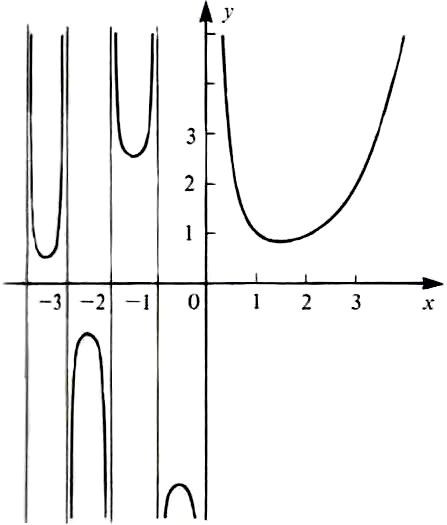 Larger image(png format)


Chart for Gamma function is plotted in Figure 1-1. So, we can accept that for  :
:
 |
Incomplete Gamma function, , is defined as follows [1]:
 |
Beta function is defined as follows [1]:
 |
And it has the following properties:
1- 
2-
3-
Incomplete beta function,  , is defined as follows [1]:
 |
2. Integral of Fractional Order (Fractional Calculus)
The derivative operator  for all those who have studied the normal calculations is introduced. And we know the derivation of
  -order of function
  , i.e.
  where
where  is a positive integer. (If
  is a positive integer, then
  is integral of
  -order of the function
  ).
).
Now the question that arises is: If we have  , where
  is an arbitrary number (rational, irrational or complex), What is the value of
  ?
?
Fractional calculus was used initially for solving the Abel integral equations. But later found many applications in different sciences. Such as: Tautochrone, calculation of Heaviside’s operator in physics, Fluid flows and the design of Weir Notch in Civil and Mechanics, Analysis diagrams earthquake in geology and et al.
There are two main methods for defining fractional calculus: One using of integrals and other using of the series. Any method has the features, applications and disadvantages of owning.
2.1. Definitions by Integrals for Integral of Fractional OrderDefinition 1. Definition of Riemann [25]
 |
Where indices in  indicate,
  : order of fractional integrals,
  : the lower limit of integration, and
 : the upper limit of the integral.
Definition 2. Definition of Liouville [25]
 |
Definition 3. Definition of Weyl [25]
 |
where is very suitable for periodic functions.
Definition 4. Definition of Riemann - Liouville [25]
Let  and
and  is a point wise continuous function on
  and is integral able on any finite interval of
  . Then for all
  , we have:
 |
The set of all functions that satisfy in this definition, we show with  , and we define
 ,
,  .
.
One of the important definitions for fractional calculus by series, as follows:
Definition 5. Definition of Grunwald [25]
Grunwald defined fractional integral of the function  at the point
  as follows:
 |
We can write it, for each  , as follows [15]:
 |
where  is Lower limit of integration and
  .
.
Now, we show that the above definitions can be obtained with different methods, which shows the importance of these definitions and ideas for a variety of definitions.
2.3. Verification Methods Definitions of Integral of Fractional Order2.3.1. Method of Iterative Integrals
We consider the ordinary integrals of n-tuple as follows [25]:
 | (2-1) |
Where  and
and  is continues function on
  .
.
If  , we have
 |
By repeating this procedure  -times, (2-1) becomes:
 | (2-2) |
It is clear that the right side (2-2) for each  where
where  is significant. Thus
 |
That is the definition of Riemann.
2.3.2. Method of Differential Equations
Let  is a linear derivative operator, where the coefficients
 are continuous functions on an interval
  . Also let
  is continues on
  and
and  .
.
We consider the differential equation:
 | (2-3) |
Unique solution of the equation (2-3) for every  is as follows:
 | (2-4) |
where  is the Green's function corresponding to
  [24].
[24].
If  is any basic set of solution of homogeneous equation
  , then Green’s function
  can be written as:
 |
Where  is Wronskian:
 |
Now, we assume that  , then (2-3) can be written as follows:
 | (2-5) |
And  is any basic set of solution of homogeneous equation
  , thus Green’s function
  is:
is:
 |
And Wronskian is:
 |
Where is independent of  .
.
We see that  can be transformed into a polynomial of degree
  with a leading coefficient:
 |
We know according to properties of the Green function that:
 |
So,  is a zero of
  order for
  . Thus
 |
Thus, from the equations (2-4) and (2-5) we have:
 |
Where for each number, where the real part is positive, it is meaningful.
Thus, we obtain the definition of Riemann.
It should be noted that the same result can be achieved by using the Laplace’s transform, i.e. if  equation (2-5) becomes
 |
Where  and
and  are Laplace’s transforms of
  and
and  . Thus
 |
And by Convolution Theorem, we have [8]:
 |
Thus, we obtain the definition of Riemann - Liouville.
2.3.3. Definition of Weyl
Let  .
.
The adjoint equation for  is as follows:
 |
Then, the solution of non-homogeneous equation
 |
is
 | (2-6) |
Where  is the Green's function corresponding to adjoint operator
  [24].
[24].
However, if  is the Green’s function of
  , then [24]:
 |
Thus, equation (2-6) can be written as:
 |
Now, we assume that  , then
  , thus:
 |
Where for each number, where the real part is positive, it is meaningful.
Thus, let  is
is  and
and  , then
 |
Thus, we obtain the definition of Weyl.
2.4. Some Examples of Integral of Fractional OrderExample 1:
1- 
Where  . In particular, if
  , integral of fractional order for constant
  is:
is:
2- 
3- 
Where is the incomplete Gamma function. Mainly, fractional integral of an exponential function to represent the following: [25]
 |
And the same method can obtain: [25]
4- 
5- 
To calculate other trigonometric functions, we can be used of relations, for example,
6- 
7- 
8- Let  where
where  is a positive number and
  . Then
 |
Where  is incomplete Beta function. In the special case, if
  then
then
 |
9- Let  is a non-negative integer number
 |
If we consider:
 |
And we put in the above equation, we have:
 |
Where it’s a special case of Leibniz’s formula, the general form is shown later.
In all the examples above, we hypothesized that the lower limit of the integral is equal to zero, the definition of Riemann - Liouville, if that were necessary case where the lower limit of the integral is nonzero, we can use the following technique:
 |
By changing the variable  , we have:
 |
Where 
10- 
11- 
12- 
13- 
In all cases, if  , the previous equations are obtained.
3. Derivative of Fractional Order (Fractional Calculus)
The derivative operator  for all those who have studied the normal calculations is introduced. And we know the derivation of
  -order of function
  , i.e.
  where
where  is a positive integer.
Now, we describe the case where  is an arbitrary number in
  .
.
There are two main methods for defining fractional calculus.
3.1. Definitions by Integrals for Derivative of Fractional Order3.1.1. Using of the Integral of Fractional Order
Definition 6. Let  ,
,  and
and  , then
  and derivative of fractional
  of order
  , for
, for  is
is
 |
Where  is integral of fractional order.
Example 2: if  and
and  then
then  , and we have
 | (3-1) |
If  and
and  then
then
 |
Since  , thus
 | (3-2) |
By comparing equations (3-1) and (3-2) to conclude that
 | (3-3) |
For  and
and  .
.
To equation (3-3) we are saying Differintegral, Namely, if  is a positive number, operation is derivative (differential) and if
  is a negative number, operation is integration.
Remark 1: if
 | (3-4) |
is definition of Riemann and  and
and  is continues function, then derivative of fractional order is exists. However, this does not guarantee the existence of fractional derivatives. For example, let
  is continues function but it’s not differentiable (Such as the Weierstrass function), and
  , then
 |
Now, if  then
then  (as
(as  ), by equation (3-1) we have
 |
But by assumption,  is not differentiable.
On the other hand, if  is
is  -time differentiable, then the equation (3-3) has existed for all
  , To prove this, By changing the variable
  in equation (3-4), where
  , we have
 |
And
 |
Or
 |
Where it exists for each  , Since
  is a continues by assumption.
Therefore, this method is useful in many cases, but in the general case, it’s not efficient for functions that are not differentiable of ordinary order.
3.1.2. Definitions of Direct
Definition 7. Definition of Riemann [25]
 |
Definition 8. Definition of Riemann - Liouville [25]
 |
Definition 9. Definition of Marchaud [25]
 |
Example 3: Let  then
then
 |
By changing the variable  , we have
 |
So after simplification, we have:
 |
Definition 10. Definition of Grunwald [25]
Grunwald defined fractional derivative of the function  at the point
  as follows:
 | (3-5) |
We can write it, for each  , as follows [6, 7, 15, 20]:
 | (3-6) |
Where  is Lower limit of derivative.
In the definition of Grunwald, We can show that if  is a positive number such as
  , then the equation (3-5) by using
 |
Convert to
 |
Now, we assume  , thus
 |
To approximate the derivative of fractional order, on the large  , we have:
 |
4. Properties Fractional Calculus
Now, we express some properties of the operators of differentiation and integration of arbitrary order. [15, 25, 27, 32].
4.1. Linear and HomogeneousFrom the definitions introduced in the previous, it is clear that the differintegral is held on the following property:
 |
When the argument is changed by a factor, Differintegral is held on the following property: [27]
 |
If  is an analytic function and
  is a sufficiently differentiable function, then the chain rule for fractional derivatives is as follows [27]:
 |
Where  can be extended on all nonnegative integer combinations of
  , such that
  and
and  .
.
This is a generalization of the chain rule for ordinary derivatives, but its nature is complex.
4.4. Differintegral by PartsFirst consider the case  . Let
. Let  is uniformly convergent on the
  , where
  . Then [27]
 |
Also, right hand side is uniformly convergent on  .
.
For  , if
, if  and
and  are uniformly convergent on the
  , then
 |
On the  .
.
Osler [28] generalized Taylor series of fractional derivatives. He has proven a very general result. We discuss a special case. This case called the – Riemann series.
 |
Where  and
and  is an analytic function.
Now, we are studying the relationship between these two operators:
 |
and
 |
When the  , we have:
 |
And Composition’s Rule is clear.
When the  , Composition’s Rule is true if
 |
And if it's not true, we have
 |
We can be shown that when  , Composition’s Rule is true for any differintegral on function
  . In fact, if
  is finite in
  , then the Composition’s Rule is valid for
  .
.
We know that if  is a continuous function on
  , we have:
 |
To show the Dirichlet formula, we assume that  is a continuous function and
  are positive numbers, then
 |
Example 4: if  and
and  , then we have
 |
In addition, if  then we have
 |
Where  is Beta function.
As a useful application of Dirichlet's formula, we express the extension’s rule for fractional integrals:
Theorem 1: Let  is a continues function on
  and
and  . Then for any
  [25]
[25]
 |
Proof: By definitions, we have
 |
Theorem 1 is established for  (or
(or  ) If
) If  is an operator identity.
Example 5: If  , Since
  is a continues function, we have
 |
And we have  and
and  . So,
. So,
We obtained the following useful recursive relation:
 |
(Assuming strong  )
)
And, in the same method, we can obtain:
 |
 |
Theorem 2: Let  is a continues function on
  and
and  . Then [25]
a) If  is in class
  , then
 |
b) If  is a continues function on
  . Then for any
 |
Proof: a) let  and
and  . Then the derivatives of
  and
and  are continuous functions on
  . Therefore, the integration by parts shows that:
 |
We take the limit when  tended to zero, and we divided into
  , then part (a) is proofed.
b) By changing the variable  , where
  , we have
 |
Then for any 
 |
Changing the variable will be returned, and then part (b) is proofed.
Example 6: If  , According to (a) in theorem 2, we have
 |
By using Example 1 part 3, we have
 |
i.e.
 |
The result is a recursive relation for  . Similarly, we can obtain:
 |
 |
Theorem 3: Let is a positive number and
  is a continues function on
  and
and  . Then [25]
a) If  is in class
  , then
 |
b) If  is a continues function on
  . Then for any
 |
Where
 |
Theorem 4: Let is a positive number and
  and
and  has a continuous derivative on
  . Then for any
  [25]
[25]
 |
Theorem 5: Let are positive integer number and
  are positive number such that
  and
and  has
has  -time continuous derivatives on
  where
where  . Then for any
 | (4-1) |
Where  and
and  is sign function. And for any
 | (4-2) |
Proof: if  it’s clear. Let
  , and
, and  therefore
  . By theorem 3, we have:
 |
Since  and
and  then the equation (4-1) is true.
For proof equation (4-2), by theorem 4, we have
 |
With -time derivative, we have:
 |
Since  and
and  then equation (4-2) is true.□
We say the function  is of
is of  exponential order, If there are positive constants such as
  such that for any
If  is in class
  and it’s of
  exponential order, then
 |
is exist, for any  such that
  . we call the Laplace transform of
  , and write:
 |
And also write:
 |
i.e.,  is the inverse Laplace transform (unique) of
  .
.
Functions and
and  are in class
  , and they are of exponential order. So
 |
 |
One of the very useful properties of the transform is in the Convolution theorem [8]. The theorem shows that the Laplace transform of the convolution of two functions is multiplication the transforms of them. i.e.
 |
Now, if  is in class
  , then fractional integral of
  of order
  :
:
 |
is a Convolution. Therefore, if  is of exponential order then
 | (4-3) |
 | (4-4) |
Equation (4-4) is true for  , but the equation (4-3) is not true, although
 | (4-5) |
Example 7:
 |
Now, we try to calculate the Laplace transform of fractional integral of the derivative and the Laplace transform of derivatives of fractional integral.
Let  is continues function on
  and
and  is in class
  and it’s of exponential order, then by equation (4-4) we have
 | (4-6) |
Since,  is continues function on
  then
then  is exist. Therefore, we obtained the Laplace transform of fractional integral of the derivative. This formula for
  is obvious.
By theorem 2 part (b), we have
 | (4-7) |
Therefore, we obtained the Laplace transform of derivatives of fractional integral.
By equation (4-6), let  , we have
  , but by the equation (4-7), we have
  . This "unconformity" occurs from this fact that:
 | (4-8) |
By comparing equations (4-5) and (4-8), we conclude that the " " and "
 " are not commutative.
Thus, we can show that:
 |
Leibniz classical formula (i.e.  ) is as follows:
 |
where  and
and  are
are  -time differentiable functions.
Now, we want to express the Leibniz formula for fractional operators.
Theorem 6: Let  is a continues function on
  and
and  is an analytic function for any
  . Then for any
  and
and  , we have [25]
 |
Osler, a general result, proved to differintegral, where its expressed as follows: [28]
 |
where  is arbitrary constant.
5. Fractional Differentiable
Now, we want to express some necessary conditions for that the fractional derivative of a function is exist [15, 30].
Definition 11:  is said to have an
  th derivative, where
  for integer
  , if
, if  (in the Weyl sense), with
  , has
, has  Peano derivatives at
  , That is, there exists a polynomial
  of degree
  s.t.
s.t.
 |
Further if
 |
 is said to have an
  th derivative in the
  sense.
It is clear that this definition of fractional differentiability is not local. Particularly the behavior of the function at  also plays a crucial role. The main results can be stated using this notion of differentiability and involve the classes
  and
and  which are given by the following definitions.
Definition 12: If there exists a polynomial  of degree
  s. t.
s. t.  as
as  then
then  is said to satisfy the condition
  , Or in simpler terms,
  is the set of all functions that satisfy in the Holder exponents of an
  order exponential.
Definition 13: If  and Further
 |
 is said to satisfy the condition
  .
.
Definition 14:  is said to satisfy the condition
  if for some
 |
Now, we express the main results in four theorems (without proof) [15, 30].
Theorem 7: Suppose that  satisfies the condition
  at every point of a set
  of positive measure. Then
  exists almost everywhere in
  if and only if
  satisfied condition
  almost everywhere in
  .□
.□
Theorem 8: The necessary and sufficient condition that  satisfies the condition
  almost everywhere in a set
  is that
  satisfies the condition
  and
and  exists in the
  sense, almost everywhere in this set.□
Theorem 9: Let  ,
,  and suppose that
  . Then
  if
if  . □
. □
Theorem 10: Let  Then
Then  if
if  .□
.□
Despite their merits, these results are not really suitable and adequate to obtain information regarding irregular behavior of functions and Holder exponents. We observe that the Weyl definition involves highly nonlocal information and hence is somewhat unsuitable for the treatment of local scaling behavior.
6. Local Fractional Derivatives (LFD)
The definition of the fractional derivative was discussed in the last chapter. These derivatives differ in some aspects from integer order derivatives. In order to see this, one may note, from definition 6, that except when  is a positive integer, the
  th derivative is nonlocal as it depends on the lower limit ‘
 ’. The same feature is also shown by other definitions. However, we wish to study local scaling properties and hence we need to modify this definition accordingly. Secondly from example 1 part 2, it is clear that the fractional derivative of a constant function is not zero. Therefore adding a constant to a function alters the value of the fractional derivative. This is an undesirable property of the fractional derivatives to study fractional differentiability. While constructing local fractional derivative operator, we have to correct for these two features. This forces one to choose the lower limit as well as the additive constant before hand.
The most natural choices are as follows.
1) We subtract, from the function, the value of the function at the point where we want to study the local scaling property. This makes the value of the function zero at that point, canceling the effect of any constant term.
2) The natural choice of a lower limit will again be that point itself, where we intend to examine the local scaling.
Definition 15: If, for a function  , the limit
 |
is exists and finite, then we say that the local fractional derivative ( ) of the order
  (denoted by
  ), at
), at  , exists. [15]
This defines the  for
for  . We generalized to include all positive values of
  as follows. [10]
Definition 16: If, for a function  , the limit
 |
exists and is finite, where  is the largest integer for which
  the derivative of
  at
at  exists and is finite, then we say that the local fractional derivative (
 ) of the order
  (
( ), at
), at  , exists.
Definition 17: The critical order  , at
, at  , of a function
  is
is
 |
Sometimes it is essential to distinguish between limits, and hence the critical order, taken from above and below. In that case we define
 |
We will assume  unless mentioned otherwise.
The local fractional derivative that we have defined above reduces to the usual derivatives of integer order when  is a positive integer, where this study is simple.
It is clear that in our construction local fractional derivatives generalize the usual derivatives in fractional order keeping the local nature of the derivative operator intact, in contrast to other definitions of fractional derivatives. The local nature of the operation of derivation is crucial at many places, for instance, in studying the differentiable structure of complicated manifolds, studying evolution of physical systems locally, etc. The virtue of such a local quantity will be evident in the following section where we show that the local fractional derivative appears naturally in the fractional Taylor expansion. This will imply that the LFDs are not introduced in an ad hoc manner merely to satisfy the two conditions mentioned in the beginning, but they have their own importance.
6.1. Local Fractional Taylor ExpansionIn order to derive local fractional Taylor expansion, let [9, 15]
 |
It is clear that
 |
Now, for 
 |
provided the last term exists. Thus
 | (6-1) |
i.e.
 | (6-2) |
where  is a remainder given by
 |
Equation (6-2) is a fractional expansion of  involving only the lowest and the second leading terms. Using the general definition of
  and following similar steps one arrives at the fractional expansion for
  (provided
  exists), given by,
 | (6-3) |
Where
 |
We note that the local fractional derivative (not just fractional derivative) as defined above provides the coefficient  in the approximation of
  by the function
  , for
, for  , in the vicinity of
  . We further note that the terms on the RHS of equation (6-1) are nontrivial and finite only in the case
  .
.
Let us consider the function  , where
  , Then
  and using equation (6-3) at
  we get
  since the remainder term turns out to be zero.
Clearly, integrals and derivatives of the integer order having simple geometrical and physical interpretation, which can be used to solve application problems in various sciences. But, in integrals and derivatives of the fractional order, it is not easy [15, 25]. The idea of integrals and derivatives of arbitrary order (not necessarily an integer), specific geometric and physical interpretation for these operators, to more than 300 years was not expressed. The lack of this interpretation, in the First International Conference for Fractional Calculus in the New Haven U.S. in 1974 led to that this question be considered as an open problem [32], and the future conferences, such as the University of British Astrakly in 1984 [23] and Nihon University in Japan in 1990 [26], this question is not answered. Although, there were various discussions on this issue, the problem was not solved until 1996. However, later that year, fairly satisfactory answers were given to this question [14, 22, 29].
Whereas, the local fractional Taylor expansion of section 6.1 suggests a possibility of such an interpretation for  s. In order to see this note that when
  is set equal to unity in the equation (6-2) one gets the equation of the tangent. It may be recalled that all the curves passing through a point
  and having the same tangent form an equivalence class (which is modeled by a linear behavior). Analogously all the functions (curves) with the same critical order
  and the same
  will form an equivalence class modeled by
  (If f differs from
  by a logarithmic correction then terms on the RHS of equation (6-1) do not make sense like in the ordinary calculus). This is how one may generalize the geometric interpretation of derivatives in terms of ‘tangents’. This observation is useful when one wants to approximate an irregular function by a piecewise smooth (scaling) function.
The definition of the Local fractional derivative can be generalized for higher dimensional functions in the following manner [15, 16, 17].
Definition 18: Let  , We define
 |
Then the directional- of
of  at
at  of order
  ,
,  , in the direction
  is given (provided it exists) by
 |
where the RHS involves the usual fractional derivative of equation (3-6). The directional  s along the unit vector
  will be called
  th partial-
 .
.
7. Applications of Fractional Calculus
7.1. Abel's Integral Equation and the Tautochrone ProblemAbel was the first to solve an integral equation by means of the fractional calculus. Perhaps even more important, our derivation below will furnish an example of how the Riemann-Liouville fractional integral arises in the formulation of physical [25].

 PowerPoint Slide
 Larger image(png format)
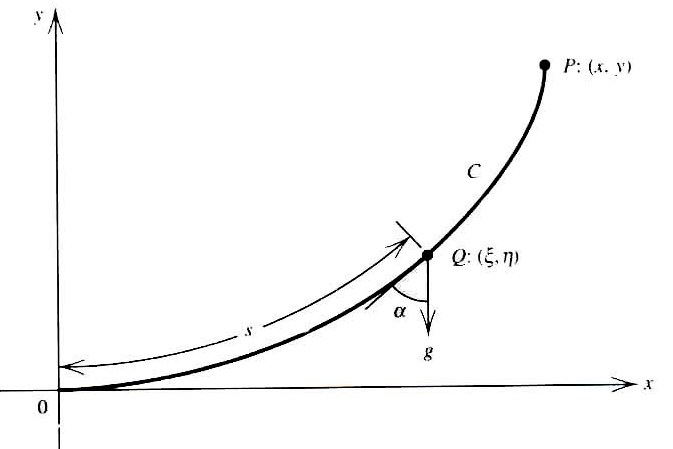
Suppose, then, that a thin wire  is placed in the first quadrant of a vertical plane and that a frictionless bead slides along the wire under the action of gravity (see Figure 7-1). Let the initial velocity of the bead be zero. Abel set himself the problem of finding the shape of the curve
  for which the time of descent
  from
from  to the origin is independent of the starting point. Such a curve is called a tautochrone.
Abel's tautochrone problem should not be confused with the brachistochrone problem in the calculus of variations. That problem was to find the shape of the curve C such that the time of descent of the bead from  to
to  would be a minimum. This question was discussed as early as 1630 by Galileo; but it was not until 1696 that Johann Bernoulli formulated and solved the problem of finding "the curve of quickest descent." In this case the brachistochrone is a cycloid.
We now proceed to formulate Abel's problem. Let  be the arc length measured along
  from
from  to an arbitrary point
  on
on  , and let a be the angle of inclination (see Figure 7-1). Then
  is the acceleration
  of the bead, where
  is the gravitational constant, and
 |
Hence we have the differential equation
 |
With the aid of the integrating factor  , we see immediately that
 | (7-1) |
where  is a constant of integration. Since the bead started from rest,
  is zero when
  , and thus
  . We therefore may write (7-1) as
 |
The negative square root is chosen since as  increases,
  decreases. Thus the time of descent
  from
from  to
to  is
is
 |
Now the arc length  is a function of
  , say
, say  , where
  depends on the shape of the curve
  . Therefore,
 |
Or
 | (7-2) |
where
 | (7-3) |
If we let
 | (7-4) |
then the integral equation of (7-2) may be written in the notation of the fractional calculus as
 | (7-5) |
But the right-hand side of (7-5) is the Riemann-Liouville fractional integral of  of order
  . This is our desired formulation. It remains then to solve (7-5) and then find the equation of
  .
.
Abel attacked the first problem by applying the fractional operator  to both sides of (7-5) and writing
 | (7-6) |
Now we know from Theorem 1, that this is legitimate if  and
and  are of class
  . But a constant is certainly of class
  , and since
  , we see that
  also is of class
  . Thus (7-6) becomes
 | (7-7) |
which is the solution of (7-5) [or (7-2)].
Now, to solve the second part of the problem, that is, to find the equation of  , we begin by using (7-3) and (7-4) to write
 |
Thus
 |
Or
 | (7-8) |
But  since at the origin
  .
.
If we let  , then the change of variable of integration
  reduces (7-8) to
 |
where
 |
These last two equations then imply that
 |
and if we make the trivial change of variable  , the parametric equations of
  become
 | (7-9) |
The solution of our problem is now complete. We see from (7-9) that  is a cycloid.
G. W. Hill had the daring to publish in 1877 a paper on the problem of the moon's perigee in which he used determinants of infinite order. Hill's novel method was open to serious questions from the standpoint of rigorous analysis until H. Poincare in 1886 proved the convergence of infinite determinants [25].
A somewhat similar history followed Oliver Heaviside's publication in 1893 of certain methods for solving linear differential equations (known today as the Heaviside operational calculus) except that in this case, a much longer period elapsed before his procedures were put on a firm foundation by T. J. Bromwich in 1919 and J. R. Carson in 1922.
We illustrate Heaviside's methods by applying them to a particular partial differential equation. The partial differential equation we consider is
 | (7-10) |
If  is interpreted as temperature, then (7-10) is the heat equation in one dimension. If
  is interpreted as voltage or current, (7-10) is called the submarine cable equation (Depending on intended equation,
  constant will change).
Let us assume that (7-10) is the heat equation. Let
 | (7-11a) |
be the initial condition and
 | (7-11b) |
(where  is a given constant) be the boundary condition.
We shall solve (7-10) together with (7-11) using Heaviside's arguments. He introduced the letter  to represent
  ,i.e.
,i.e.  .
.
In this notation we may write (7-10) as
 | (7-12) |
Now he assumed that  was a constant and treated (7-12) as an ordinary differential equation in
  . The solution is therefore
 | (7-13) |
where  and
and  are independent of
  . On physical grounds he was led to choose
  as zero. If we do so, the boundary condition of (7-11b) implies that
  . Thus
 |
Expanding the exponential in a power series, we obtain
 |
Now Heaviside ignored positive integral powers of  and wrote
  as
as
 | (7-14) |
Since
 | (7-15) |
Although formula (7-15) is certainly the correct expression for the fractional derivative of a constant of order  , Heaviside did not record how he arrived at (7-15). One may speculate on how he deduced this result; however, we choose not to second-guess a genius.
Substituting (7-15) into (7-14) immediately yields
 |
Or
 | (7-16) |
If we note that
 |
then (7-16) reduces to
 | (7-17) |
which is the solution to our problem. ( is Error function)
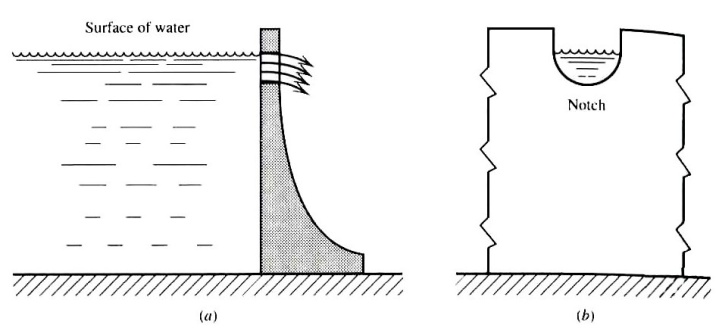
A weir notch is an opening in a dam (weir) that allows water to spill over the dam, see Figure 7-2, where we have indicated a cross section of the dam and a partial front view. (The sketch is not to scale.) [5, 25, 33].
Our problem is to design the shape of the opening such that the rate of flow of water through the notch (say, in cubic feet per second) is a specified function of the height of the opening. Starting from physical principles we derive the equation for determining the shape of the notch. It turns out to be an integral equation of the Riemann-Liouville type. After formulating the problem, we shall, of course, solve it.

 PowerPoint Slide
 Larger image(png format)
Let the  -axis denote the direction of flow, the
  -axis the vertical direction, and the
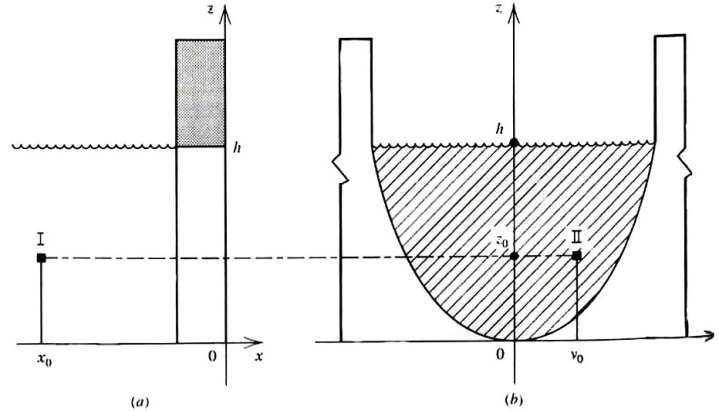
  -axis the transverse direction along the face of the dam. See Figure 7-3, where we have drawn an enlarged view of a portion of Figure 7-2. The axes are oriented as indicated, and
  is the height of the notch.
The solid square at point I and the solid square at point II are supposed to indicate the same element of fluid as it moves from point I [with coordinates  ] to point II [with coordinates
  ] along the same "tube of flow." Then by Bernoulli's theorem from hydrodynamics
 | (7-18) |

 PowerPoint Slide
 Larger image(png format)
where  is the density of water,
  the acceleration of gravity, and
  and
and  are the pressure and velocity at point I while
  and
and  are the corresponding quantities at point II.
If we assume that point I is far enough upstream,  is negligible and we may write (7-18) as
 | (7-19) |
Now
 |
and since point II is in the plane of the notch (the shaded area of Figure 7-3b)
 |
Thus  is a constant (namely,
 ) times
  and (7-19) implies that
 | (7-20) |
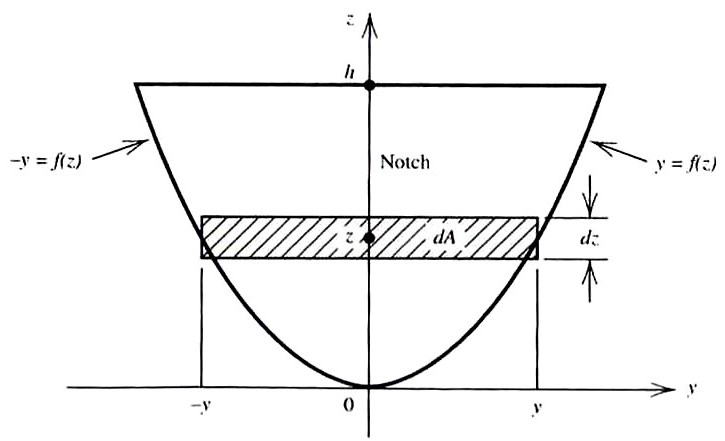
Referring to Figure 7-4, we see that the element of area  (the shaded region in Figure 7-4) is
 | (7-21) |

 PowerPoint Slide
 Larger image(png format)
where we have assumed that the shape of the notch is symmetrical about the  -axis. Now
  is some function of
  , say
, say
 | (7-22) |
and we may write (7-21) as  . Thus the incremental rate of flow of water through the area
  is
is  , where
  is the velocity of flow at height
  , and from (7-20)
 |
The total flow of water through the notch is thus
 | (7-23) |
Equation (7-23) is the desired integral equation for the determination of  when
when  is given. In the notation of the fractional calculus we may write it as
 | (7-24) |
To solve (7-24) we first observe that if  , then certainly
  also is of class
  . Hence
 |
and by Theorem 1
 | (7-25) |
which is the desired solution.
For example, suppose that  , (where
  ; is a constant). Then certainly
  if
if  and
and
 |
Thus, by equation (7-25), we have
 |
Where  and
and  or
or  .
.
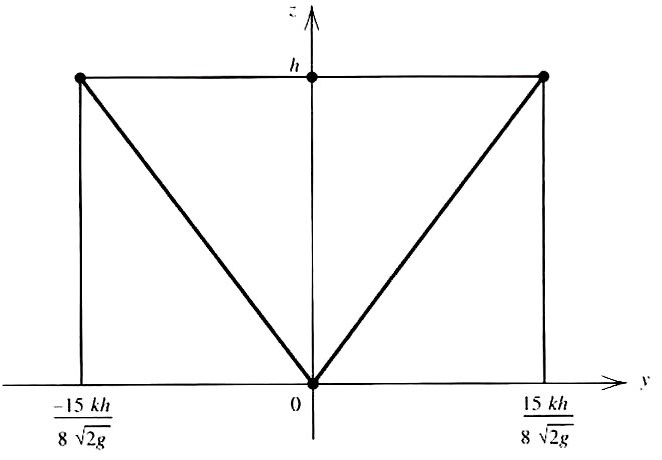
In particular, if  , that is,
  then
then
 |
and the notch is V-shaped (Figure 7-5).

 PowerPoint Slide
 Larger image(png format)
References
| [1] | Parsian H., Special Functions and its Applications, Bu-Ali Sina University, Iran, 1379. | ||
 In article In article | |||
| [2] | Abel N.H.; Solution de quelques a l’aide d’integrales defines; Ocuvers Completes; Vol. 1; Grondahl, Christiania; Norway; 1881. | ||
| In article | |||
| [3] | Arvet P., Enn T., Numerical solution of nonlinear fractional differential equations by spline collocation methods, Journal of Computational and Applied Mathematics, 255, p.216-230, 2014. | ||
| In article | CrossRef | ||
| [4] | Leung, A.Y.T., Zhongjin G., Yang, H.X., Fractional derivative and time delay damper characteristics in Duffing–van der Pol oscillators, Communications in Nonlinear Science and Numerical Simulation, 18(10),p.2900-2915, 2013. | ||
| In article | CrossRef | ||
| [5] | Brenke W.C.; An Application of Able’s Integral equation; Amer. Math. Monthly; Vol. 29; PP. 58-60; 1992. | ||
| In article | |||
| [6] | Camko S.; The Multimensional Fractional Integrodifferentiation and The Grunwald-Letnikov approach to Fractional Calculus;proceedings of the International Conference on ractional Calculus and Its Applications; College of Engineering; Nihon university; Tokyo; pp. 221-225; May-june 1989. | ||
| In article | |||
| [7] | Camko S., Marichev O., and Kilbos A.; Fractional Integrals and Drivatives and Some of their Applications; Science and Technica; Minsk; 1987 (in Russian). | ||
| In article | |||
| [8] | Churchill R.V.; Modern Operational Mathematics in Engineering; Mc-Graw-Hill; New York; 1994. | ||
| In article | |||
| [9] | Courant R. and John F.; Introduction to Calculus and Analysis; John Wiley; New York; Vol. 1; 1965. | ||
| In article | |||
| [10] | Falconer K.; Fractal Geometry - Mathematical Foundations and Applications; John Wiley; New York; Second Edition, 2003. | ||
| In article | CrossRef | ||
| [11] | Gemant A.; A method of analyzing experimental result obtained from elastoviscous bodies; Physics 7; PP. 311-317; 1936. | ||
| In article | |||
| [12] | Heaviside O.; Electrical Papers; Macmillan; London; 1892. | ||
| In article | |||
| [13] | Hilfer R.; Applications of Fractional calculus in Physics; World Scientific; Singapore; 2000. | ||
| In article | PubMed | ||
| [14] | Kiryakova V.; A long standing conjecture failed? In: P. Rusev, I. Dimovski, V. Kiryakova; Transform Method and Special Functions; Varna’96 (Proc. 3rd International Workshop); Institute of Mathematics and Informatics; Bulgarian Academy of Sciences; Sofia; PP. 579-588;1998. | ||
| In article | |||
| [15] | Kolwankar K.M.; Studies of Fractal Structures and Processes Using Methods of Fractional Calculus; http://arxiv.org/abs/chao-dyn/9811008. | ||
| In article | |||
| [16] | Kolwankar K.M., and Gangal A.D.; In the proceeding of the Conference “Fractals in Enginering”; Archanon; 1997. | ||
| In article | |||
| [17] | Kolwankar K.M., and Gangal A.D.; Local Fractional Derivatives and Fractal functions of several variables; http://arxiv.org/pdf/physics/9801010. | ||
| In article | |||
| [18] | Lacroix S.F.; Traite du calcul differential et du calcul integral. 2nd ed.; Courcier; Paris; pp. 409-410; 1819. | ||
| In article | |||
| [19] | Laurent H.; Sur le calcul des derives a indices quelconques; Nouv. Ann. Math.; Vol. 3; PP. 240-252; 1884. | ||
| In article | |||
| [20] | Lavoie J.L., Osler T.J., and Tremblay R.; Fractional Derivatives and Special functions; SIAM Rev.; Vol. 18; PP. 240-268; 1976. | ||
| In article | |||
| [21] | Leibniz G.W.; Letter from Hanover; Germany; to G.F.A. L’Hopital, September 30; 1695; in Mathematische Schriften, 1849; reprinted 1962, Olms verlag; Hidesheim; Germany; Vol. 2, PP. 301-302; 1965. | ||
| In article | |||
| [22] | Mainardi F.; Considerations on fractional calculus: Interpretations and Applications, In: P. Rusev, I. Dimovski, V. Kiryakova; Transform Method and Special Functions; Varna’96 (Proc. 3rd International Workshop); Institute of Mathematics and Informatics; Bulgarian Academy of Sci.; Sofia; PP. 579-588;1998. | ||
| In article | |||
| [23] | Mc Bride A. and Roach G.; Fractional Calculus Research Notes in mathematics; Vol. 138; Pitman; Boston-London-Melbourne; 1985. | ||
| In article | |||
| [24] | Miller K.S.; Linear Differential Equation in Engineering Problem; Prentice Hall; New York; 1953. | ||
| In article | |||
| [25] | Miller K.S. and Ross B.; an Introduction to the Fractional Calculus and Fractional Differential Equations; John Wiley & Sons, Inc.; New York; 1993. | ||
| In article | |||
| [26] | Nishimoto K.; Fractional Calculus and Its Applications; Nihon university; Koriyama; 1990. | ||
| In article | |||
| [27] | Oldham K.B., and Spanier J.; The Fractional calculus; Academic Press; New York; 1974. | ||
| In article | |||
| [28] | Osler T.J.; SIAM Journal; Math. Anal.; Vol.2; P. 37; 1971. | ||
| In article | CrossRef | ||
| [29] | Poldlubny I.; Geometric and Physical Inteerpretation of Fractional Integration and Fractional Differentiation; Fractional Calculus and Applied Analysis Journal; Vol. 5; PP. 367-386; 2002 | ||
| In article | |||
| [30] | Welland G.V.; Proc. Amer. Math. Soc.; Vol. 19; P. 135; 1968. | ||
| In article | CrossRef | ||
| [31] | Ross B.; editor, proceeding of the International Conference on Fractionl Calculus and Its Applications; University of New Haven; West Haven; Conn., June 1974; Springer-verlag; New York; 1975. | ||
| In article | |||
| [32] | Ross B.; In Fractional Calculus and Its Applications: Lecture Notes in Mathematics; Springer-Verlag; New York; Vol. 457; P. 1; 1975. | ||
| In article | CrossRef | ||
| [33] | Ross B.; Brief Note: The Reimann-liouville Transformation; J. Math. Modeling; Vol. 2; PP. 233-236; 1981. | ||
| In article | |||

 CiteULike
 Mendeley
 StumbleUpon
 Delicious
 Facebook
 Twitter
 LinkedIn
 Print
Print