Comparative studies of water-related diseases and the quality of borehole drinking water sources in Okada town were conducted. This is to ascertain the level of water-related disease outbreaks associated with the quality of drinking borehole water sources in Okada residents to prevent an epidemic of waterborne diseases. Primary data on water-related diseases treated at the Teaching Hospital of Igbinedion University (IUTH) and the Parent Consultative Forum (PCF) clinics, both in Okada Town, Edo State, Nigeria, were obtained for a period of four years from 2019 to 2022. Secondary data of 25 borehole drinking water quality variables in Okada were obtained from published journals. A statistical data package in Excel was used to collate the obtained results. Results of thirty-one (31) borehole water quality variables from published journals were also collated. Twenty–seven (27) of the water quality parameters are within the threshold value recommended for drinking purposes, while 4 of the variables exceeded the recommended value for drinking purposes. The related water diseases treated in the clinics include malaria, gastro-enteritis, diarrhea, dysentery, typhoid, scabies, hypertension, poliomyelitis, hepatitis, and meningitis. Malaria recorded the highest frequency of cases, about 1629. Annual related water disease cases within the study area are estimated at 600, with an average annual population of 174197. Statistical analysis of the population for the cases of water-related diseases showed that 0.34% of the population was affected. This revealed that the level of water-related diseases may not be associated with groundwater drinking sources. Related water diseases were higher during the rainy season than in the dry season because of the increase in breeding spaces for mosquitoes. Awareness and enlightenment programs should be organised within the community on how to combat malaria. Environmental hygiene and sanitation of the community should be upheld to reduce exposure to these diseases. Ingestion of contaminated food and water should also be avoided.
Water is an odorless, transparent, tasteless, and colorless chemical substance found abundantly on the earth’s surface. It is vital for the lives of all plants and animals. Water is an exceptional solvent that readily causes the dissolution of substances when in contact. It occurs as a result of the accumulation of moisture into perceptible droplets, leading to condensation and saturation of the atmosphere. It reaches the earth’s surface through precipitation. The earth’s surface is always recharged and refreshed through the water cycle. Water in its natural state is pure, but its transmission through the earth’s surface results in contamination of the water bodies. The use of water cannot be avoided for all living things, but the most exigent is human use. Reference 1 revealed that microorganisms and chemical substances in drinking water undermine the use of that water for consumption purposes. The use of contaminated water for humans results in serious health risks and hazards, which in some cases may lead to death.
The prevalence of water-related diseases or outbreaks, especially in developing countries like Africa, is alarming. Poor sanitation and contaminated water can be attributed to manifestations of these preventable diseases, such as typhoid, dysentery, diarrhea, etc. Water-related diseases occur as a result of consuming contaminated or dirty water or exposure to inadequate clean water for drinking and all other domestic purposes. The presence of contaminated substances or impurities in the water can greatly affect its use. Therefore, it is extremely important to study water with the intent of understanding its quality and effects on human health and the environment. These impurities found in water may be in the form of suspended solids or dissolved solids. Dissolved materials, which are molecules or ions contained in the water's molecular structure, may only be determined through laboratory investigation. Therefore, the water quality of drinking water sources is a worldwide concern and very important for public health 2. This project aims to study the relationship between waterborne diseases associated with the quality of drinking water sources among Okada residents. The objectives are to obtain information on cases of treated water-related diseases in Igbinedion University Teaching Hospital (IUTH) and Parent Consultative Forum (PCF) clinics located in Okada Town; collate secondary data on the published articles on the quality of drinking water sources in Okada, compare the results of water quality parameters associated with water diseases; and determine the degree of the affected percentage population.
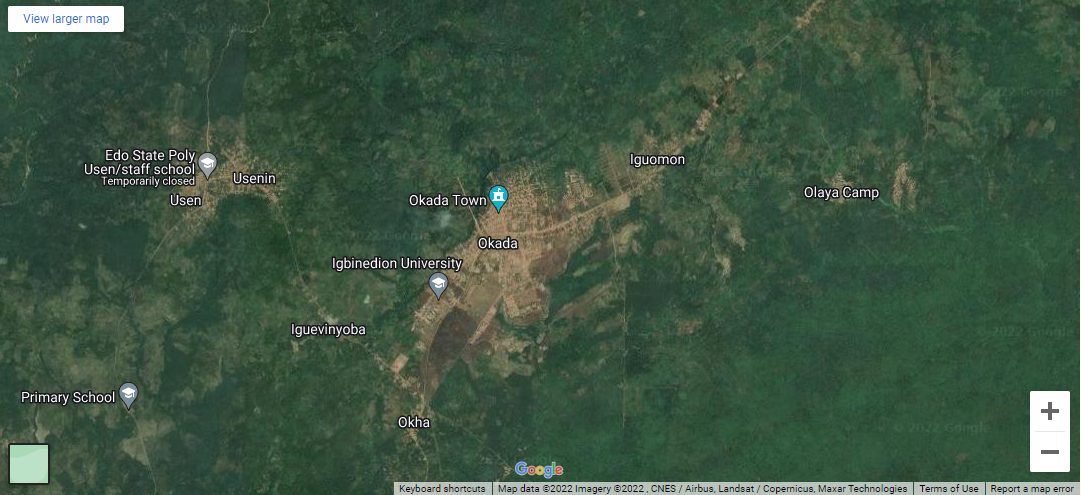
The study area is Okada town, located in Ovia North East Local Government Area. The administrative headquarters of the local government is located in Okada Town. Ovia North-East Local Government Area is one of the eighteen local government areas serving Edo State and is included in the southern senatorial district of Edo State, also known as Edo South District, along with Ovia South-West, Egor, Oredo, Orihionmwon, lkpoba, Okha, and Uhumwode. The Ovia North-East Local Government and Ovia-South-West Local Government make up the federal constituency. Some commercial activities and business adventures mobilise individuals to seek greener pastures in the area. Over ten primary and secondary schools, including public and private, are located within the study area. The first private premier university, Igbinedion University, is also located in the area. Four institutional banks: - Access, Zenith, Sterling Banks, and ABC Microfinance Bank are operational in the study area. Ovia North East Police Station office is also located within the study area. Figure 1 shows the geographical map of the study area with geographical coordinates of 6.7331°N and 5.3913°E.
Primary data were obtained from Igbinedion University Teaching Hospital (IUTH), Okada, and Parents Consultative Forum (PCF) Clinic, Crown Estate, Okada. They include all the registered water-related diseases treated in the mentioned hospital and clinic. Secondary data were obtained from published articles on borehole drinking water quality in Okada. Results of water quality parameters of drinking groundwater sources in Okada Town from published journals were collated and compared with recommended water quality standards for drinking purposes set by the World Health Organisation (WHO) and Nigeria Standard for Drinking Water Quality (NSDWQ). Statistical analysis of water-related disease cases and the population of Okada residents were evaluated to determine the percentage of the population affected by cases of water diseases.
3.1. Estimation of Population Forecasting of the Okada CommunityAccording to the National population census in 2006, the estimated population of Okada residents is 153, 849 4. Population forecasting for the years under study was calculated using the empirical formula in equation 1 to obtain the estimated present population of the study area. According to the World Bank, 0.86 % was reported as the annual percentage growth rate of rural areas in Nigeria 5
 | (1) |
Where, Po = population count in the initial year (2006)
Pt = population estimate for the year (2019, 2020, 2021, and 2022)
to = initial population census year (2006)
tf = present year of study using the obtained data (2019, 2020, 2021, and 2022)
r = assumed growth rate for rural areas within the 1st ten years =0.86% (0.0086)
3.2. Calculation of Percentage Analysis of Population Affected by Water-Related DiseasesA percentage analysis of the population affected by water-related disease was calculated using Equation 2. This would help to ascertain the degree and level of water-related disease cases within the study area.
 | (2) |
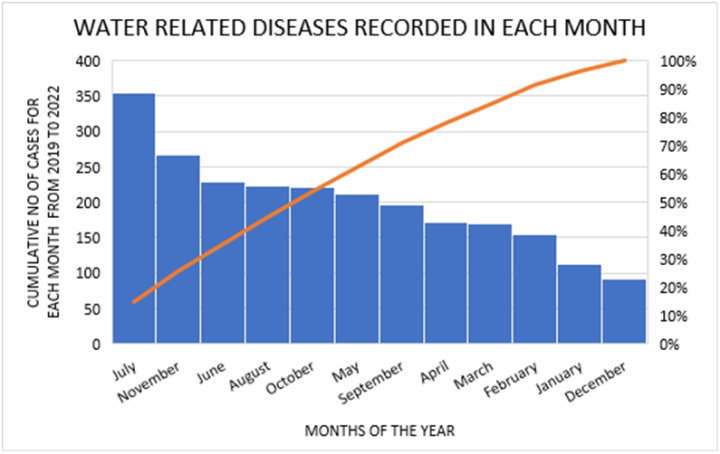
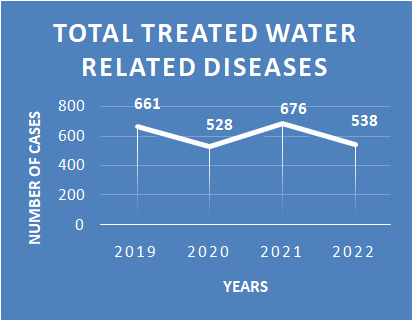
Registered cases of water-related disease outbreaks in Okada were obtained from Igbinedion University Teaching Hospital, Okada and the Parent Consultative Forum clinic for a period of 4 years, starting from 2019 to 2022. The cumulative cases of water diseases obtained from clinics for each month and the recorded cases of water-related diseases in each year from 2019 to 2022 are summarised in Table 1 and Table 2 Table, respectively. Figure 2 and Figure 3 revealed the number of water-related diseases treated in the clinics for the period under study.
From Table 1, the number of malaria-related cases recorded was 1629, the number of hypertension cases recorded was 347, and the number of gastroenteritis cases recorded was 160. The month of July was observed as the month with the highest registered cases of water-related diseases. From Table 2, related water diseases recorded in the years from 2019 to 2022 are 661, 528, 676, and 538, respectively.

Figure 2 is a Pareto chart showing the distribution of recorded treated water-related diseases in descending order of frequency, with a cumulative line on the secondary axis as a percentage of the total cases. Related water-treated diseases were higher during the rainy season (April to October) than during the dry season (November to March). The month of July recorded the highest cases. November, being part of the months that recorded the highest cases of waterborne diseases, can be attributed to the characteristics of the study area. Igbinedion University reopens academic sessions in October, thus causing an influx of students that contributes to the population of the area.

The plotted graph in Figure 3 exhibits almost the same trends over the years studied. Therefore, it can be inferred that the annual water-related disease cases expected are about 600.
4.2. Estimated Population of Okada Community ResidentsUsing a geometrical population with an annual growth rate of 0.86% as described above, the estimated population of Okada residents for 2019, 2020, 2021, and 2022 are 171966, 173445, 174936, and 176441, respectively. The average annual population of the study area for the period is 174197.
4.3. Statistical Description of Drinking Water Qualities in Okada.Secondary data were obtained from published articles on the quality of borehole drinking water in Okada Towns. Table 3 is a statistical description of 25 boreholes’ water quality from four published journals in two different years, 2019 and 2020. The range depicts the minimum and maximum values of water quality parameters adapted from the journals compared with the adapted maximum recommended limit set by the Nigerian Standard for Drinking Water Quality 6 and the World Health Organisation 7. A total of thirty (31) water quality parameters of borehole results were published and obtained from the journals. They are pH, Colour (col), Turbidity (Turb), Salinity, Electrical conductivity (EC), Total Dissolve Solids (TDS), and Dissolved Oxygen (DO). Chemical Oxygen Demand (COD), Biochemical Oxygen Demand (BOD), Bicarbonate (HCO3), Phosphate (PO4), Chloride (Cl-), Nitrite (NO2), Nitrate (NO3), Sulphate (SO4), Sodium (Na), Magnesium (Mg), Calcium (Ca), Zinc (Zn), Ammonium(NH4), Manganese (Mn), Iron (Fe), Copper (Cu), Potassium(K), Vanadium (V). Cadmium (Cd), Nickel (Ni), Chromium (Cr), Lead (Pb), Total coliform and E. coli.
From Table 3, Dissolved Oxygen (Do), Magnesium (Mg), Manganese (Mn), and Iron (Fe) exceeded the recommended limit established by WHO and NSDWQ.
The secondary data obtained from published articles on borehole drinking water qualities, as revealed in Table 3, showed that DO, Mn, Mg, and Fe exceeded the recommended value established by WHO and NSDWQ. The health implications of the exceeded parameters are summarily discussed in Table 4.
The water-related diseases registered and treated at IUTH teaching hospital include malaria, gastro-enteritis, diarrhea, dysentery, typhoid, scabies, hypertension, poliomyelitis, hepatitis, and meningitis. The obtained results of borehole water quality parameters from published journals also revealed that 27 water quality parameters are within the threshold recommended for drinking purposes. Four parameters exceeded the threshold limit established for consumption.
The only parameter which exceeded the recommended threshold and is directly associated with diarrhea (water-related disease) is magnesium. According to the literature, excess consumption of magnesium causes osmotic diarrhea, which poses a health threat 12. Table 5 shows water quality parameters that can cause the recorded water-related diseases obtained from the clinics.
From Table 5, magnesium and iron are causative water quality parameters directly associated with diarrhea and hepatitis. This indicates that the registered cases of water-related diseases obtained from IUTH may not be holistically linked with the borehole drinking water sources in Okada town. The recorded water-related diseases may also be contracted through other means such as food, skin contact, poor environmental and personal hygiene.
Malaria is a water-borne vector-borne disease disseminated by mosquitoes. They thrive as part of their life cycle in water. Gastroenteritis, dysentery, diarrhea, and typhoid are water-borne diseases that can only be contracted through oral transmission by ingesting contaminated food or water 15, 16. Scabies is a water-washed disease, mainly caused by mites thriving in a poor hygienic environment and water. Poliomyelitis, Hepatitis, and meningitis are virus-infected diseases that can also be caused by ingestion of contaminated food or water 17.
In 2019, 2020, 2021, and 2022, the estimated population of Okada residents was 171966, 173445, 174936, and 176441, respectively. The collated registered cases of water-related diseases in Okada in the mentioned years are 661, 528, 676, and 538, respectively.
 |
The annual estimation of the population for the four years under study is 174197. The percentage distribution ranges from 0.3% to 0.38% with an average value of 0.34%, which is very insignificant compared to the population weighted on a 100% scale. The study area may not be associated with an epidemic of water-related diseases.
Water-related diseases predominant in the Okada community include Malaria, gastro-enteritis, diarrhea, dysentery, typhoid, scabies, hypertension, poliomyelitis, hepatitis, and meningitis. Malaria recorded the highest number of cases treated in the hospital, with about 480 and 407 cases recorded in 2019 and 2020, while 371 cases were recorded in both 2021 and 2022. This was followed by hypertension, gastroenteritis, diarrhea, and scabies. The total registered cases of water-related diseases in 2019, 2020, 2021, and 2022 are 661, 528, 676, and 538, respectively. The highest registered cases of water-related diseases were in November. This may be due to an influx of students during the period as many students resume academic studies in October, which is just a month after resumption. with
Twenty-seven (27) water quality parameters obtained from published journals are within the recommended threshold value set by WHO and NSDWQ. Four (4) water quality parameters exceeded the recommended limits set by the standards. They include dissolved oxygen, iron, magnesium, and manganese. Statistical analysis of water-related diseases and the population of residents showed that the registered cases cannot be holistically linked to borehole water consumption by the residents. The percentage of the population affected is insignificant when compared to the total population estimated for each year. In 2019, 2020, 2021, and 2022, the affected population percentage is 0.3%, 0.38%, 0.3%, and 0.38%, respectively, weighted at 100% annual population of the study area for four years. Therefore, public health workers and officials must create an awareness and enlightenment program for the residents on personal and environmental hygiene for their well-being.
The following are the recommendations from the research findings:
1. Awareness and enlightenment programs should be initiated by all stakeholders and health officers within the community on how to combat mosquitoes that transmit malaria parasites into human bodies.
2. Environmental hygiene and sanitation should be encouraged and improved within the community.
3. Ingestion of contaminated food and water should be avoided by the residents.
We wish to acknowledge the IUTH and PCF clinic Record unit for allowing us to assess their record for research purposes.
| [1] | Ezugwu, M. O., & Akhimien, F. O. “Review of the Effects of Water Characteristics and Quality on Human Health,” International Journal of Current Science Research and Review. 05 (03) 673 – 685, March 2022. | ||
| In article | View Article | ||
| [2] | Levallois , P., & Villanueva, C. M. “Drinking Water Quality and Human Health: An Editorial”, International Journal of Environment Research and Public Health. 16,( 8) 2019. | ||
| In article | View Article PubMed | ||
| [3] | Maplandia.Okada Map — Satellite Images of Okada.MapLandia.com: Accessed on June 2022. | ||
| In article | |||
| [4] | NPC “National Population Commission” www. nationalpopulation.gov.ng. 2006. | ||
| In article | |||
| [5] | www. tradingeconomics.com. “Nigeria –Rural Population Growth (annual %). Accessed on 29th July, 2022. | ||
| In article | |||
| [6] | NIS “Nigerian Standard for Drinking Water Quality”ICS 13.060.20. 2007. | ||
| In article | |||
| [7] | WHO: “Guidelines for drinking water quality” Fourth edition. www. Unicef.org. (2011). | ||
| In article | |||
| [8] | Wuraola A. Raji, Christaiana Anih, Perpetual Oby Obeta. Assessment of Physicochemical Properties and Heavy Metals in Borehol Water used for Drinking in Okada Town, Edo State, Nigeria. Journal of Applied Sciences and EnvironmentalManagement. | ||
| In article | |||
| [9] | Ngubi, F. W., Azike , R. U., Yerima , Y., Azuokwu, A. A., Wurola, & A., R. (2021). Physical and Chemical Quality Assessment of Water Used for Drinking and other Domestic Purposes in Okada Town, Edo State. Proceedings of Igbinedion University First Annual Research Day and Conference (5th August, 2019). Greening Academia/Industry Research Synergy: To Promote Sustainable Development Goals in Nigeria. Nigeria Journal of Engineering Science Research (NIJESR)., 01-09. | ||
| In article | |||
| [10] | Ezugwu, M.O. and Eze, A.B.M, Quality Assessment of Drinking Water Sources in Igbinedion University Okada and its Environs Nigerian Journal of Engineering Science Research (NIJESR), 2(1): 49-59, 2019. | ||
| In article | |||
| [11] | Ogieriakhi, O., & Ilevbare, M. “Physicochemical and Hydrogeological Characteristics of Water Obtained From Borehole and Rivers in Okada and Environs”. Journal of Applied Science, Environment and Management, 24(8), 1475-1481 August 2020. Retrieved July 29, 2022, from https:// www.ajol.info/ index.pho/jasem. | ||
| In article | View Article | ||
| [12] | www.freedrinkingwater.com. “How exactly does dissolved oxygen affect water quality. Accessed 31st July, 2022. | ||
| In article | |||
| [13] | USEPA “Groundwater and Drinking water”2009 www. Epa.gov. Accessed February, 2022. | ||
| In article | |||
| [14] | SIC “Fact Sheet: Iron for Private Water and Health Regulated Public Water Supplies” Government of Saskatchewan, 2007. Water Information website, . Accessed November, 2021. | ||
| In article | |||
| [15] | Dalton, J.“Groundwater News”, 2013 Dales water services. www. Dales.water. co.uk. Accessed February 2017. | ||
| In article | |||
| [16] | WORLD HEALTH ORGANIZATION. Vector-Borne Diseases. March, 2020 Retrieved from Newsroom: https:// www.who.int/news-room/fact-sheets/detail/vector-borne-diseases. | ||
| In article | |||
| [17] | Agunwamba, J.Water Engineering System. Immaculate publication Limited.Enugu, Nigeria, 2000. 15-45. | ||
| In article | |||
Published with license by Science and Education Publishing, Copyright © 2026 Maryann Ogoamaka Ezugwu, Joshua Ebong Eyibio and Fredrick W. Ngubi
 This work is licensed under a Creative Commons Attribution 4.0 International License. To view a copy of this license, visit
http://creativecommons.org/licenses/by/4.0/
This work is licensed under a Creative Commons Attribution 4.0 International License. To view a copy of this license, visit
http://creativecommons.org/licenses/by/4.0/
| [1] | Ezugwu, M. O., & Akhimien, F. O. “Review of the Effects of Water Characteristics and Quality on Human Health,” International Journal of Current Science Research and Review. 05 (03) 673 – 685, March 2022. | ||
| In article | View Article | ||
| [2] | Levallois , P., & Villanueva, C. M. “Drinking Water Quality and Human Health: An Editorial”, International Journal of Environment Research and Public Health. 16,( 8) 2019. | ||
| In article | View Article PubMed | ||
| [3] | Maplandia.Okada Map — Satellite Images of Okada.MapLandia.com: Accessed on June 2022. | ||
| In article | |||
| [4] | NPC “National Population Commission” www. nationalpopulation.gov.ng. 2006. | ||
| In article | |||
| [5] | www. tradingeconomics.com. “Nigeria –Rural Population Growth (annual %). Accessed on 29th July, 2022. | ||
| In article | |||
| [6] | NIS “Nigerian Standard for Drinking Water Quality”ICS 13.060.20. 2007. | ||
| In article | |||
| [7] | WHO: “Guidelines for drinking water quality” Fourth edition. www. Unicef.org. (2011). | ||
| In article | |||
| [8] | Wuraola A. Raji, Christaiana Anih, Perpetual Oby Obeta. Assessment of Physicochemical Properties and Heavy Metals in Borehol Water used for Drinking in Okada Town, Edo State, Nigeria. Journal of Applied Sciences and EnvironmentalManagement. | ||
| In article | |||
| [9] | Ngubi, F. W., Azike , R. U., Yerima , Y., Azuokwu, A. A., Wurola, & A., R. (2021). Physical and Chemical Quality Assessment of Water Used for Drinking and other Domestic Purposes in Okada Town, Edo State. Proceedings of Igbinedion University First Annual Research Day and Conference (5th August, 2019). Greening Academia/Industry Research Synergy: To Promote Sustainable Development Goals in Nigeria. Nigeria Journal of Engineering Science Research (NIJESR)., 01-09. | ||
| In article | |||
| [10] | Ezugwu, M.O. and Eze, A.B.M, Quality Assessment of Drinking Water Sources in Igbinedion University Okada and its Environs Nigerian Journal of Engineering Science Research (NIJESR), 2(1): 49-59, 2019. | ||
| In article | |||
| [11] | Ogieriakhi, O., & Ilevbare, M. “Physicochemical and Hydrogeological Characteristics of Water Obtained From Borehole and Rivers in Okada and Environs”. Journal of Applied Science, Environment and Management, 24(8), 1475-1481 August 2020. Retrieved July 29, 2022, from https:// www.ajol.info/ index.pho/jasem. | ||
| In article | View Article | ||
| [12] | www.freedrinkingwater.com. “How exactly does dissolved oxygen affect water quality. Accessed 31st July, 2022. | ||
| In article | |||
| [13] | USEPA “Groundwater and Drinking water”2009 www. Epa.gov. Accessed February, 2022. | ||
| In article | |||
| [14] | SIC “Fact Sheet: Iron for Private Water and Health Regulated Public Water Supplies” Government of Saskatchewan, 2007. Water Information website, . Accessed November, 2021. | ||
| In article | |||
| [15] | Dalton, J.“Groundwater News”, 2013 Dales water services. www. Dales.water. co.uk. Accessed February 2017. | ||
| In article | |||
| [16] | WORLD HEALTH ORGANIZATION. Vector-Borne Diseases. March, 2020 Retrieved from Newsroom: https:// www.who.int/news-room/fact-sheets/detail/vector-borne-diseases. | ||
| In article | |||
| [17] | Agunwamba, J.Water Engineering System. Immaculate publication Limited.Enugu, Nigeria, 2000. 15-45. | ||
| In article | |||