Industrial effluent discharged into surface water bodies significantly contributes to contamination in the Bo water, swamp and well systems. In developing countries like Sierra Leone, poor wastewater management by small industries poses increasing threats to environmental and public health. This study investigates the physicochemical properties of effluent produced by Kabakudu soap factories and its impact on the surrounding water systems in Bo City. The objective was to assess the contamination levels in wells and swamp waters near soap factories and to evaluate the findings against the World Health Organization (WHO) drinking water quality standards. Soap effluent and water samples were collected monthly over five months (July to November) from four sampling sites, including two wells, one swamp and one control site. On each sampling occasion, physicochemical parameters such as water temperature, pH, total dissolved solids (TDS), turbidity, conductivity, salinity and hydrogen peroxide were analyzed using standard field and laboratory methods. The pH of the soap effluent varied between 7.1 and 8.7. The physicochemical characteristics of the water samples showed that pH (7.1 – 7.3), temperature (27.20 – 29.40°C), salinity (0.1 – 2.79 PSU), and some turbidity and TDS values remained within WHO limits. However, certain well and swamp samples recorded turbidity levels up to 359 NTU and TDS values up to 3378.0mg/l, conductivity ranging from 18.0 to 519.8 µS/cm, and hydrogen peroxide concentrations between 0- 2.5ppm some of which exceeded WHO permissible thresholds. Higher pollution levels were generally observed during the rainy season, suggesting increased runoff and effluent transport from production sites into neighboring water sources. The analysis revealed that although some measured values conformed to WHO standards, others exceeded the limits, particularly for conductivity, hydrogen peroxide, turbidity and TDS. The results indicate that the contamination level of soap effluents is already impacting water quality and the surrounding ecosystem. While certain indicators remain within acceptable limits, continuous discharge without proper treatment will likely lead to widespread environmental degradation. It is established that industries like Kabakudu pollute streams and significantly impair water quality in various parts of Bo City. Immediate regulatory intervention is recommended to prevent contamination from surpassing safe levels and posing further risks to human health and the environment.
Toxic wastewater discharge is prevalent in metropolitan areas of developing nations, adversely affecting the quality of water bodies in these regions 1. The economic advancement of any nation is contingent upon industrial growth in the 21st century. Regrettably, numerous enterprises fail to properly manage their waste and thus discharge it into nearby aquatic environments, including swamps and rivers. Toxic chemicals are frequently present in industrial waste, contaminating the water, air, or land into which they are discharged. The rate of industrial effluent discharge into adjacent water bodies and marshes in Sierra Leone is increasingly concerning and requires immediate regulatory intervention. Discharge wastewater in metropolitan areas of developing nations predominantly comprises inorganic and organic harmful substances. These toxic substances contaminate water bodies and, consequently, the environment owing to the continual dumping or discharge of wastewater from manufacturers. In Sierra Leone, for example, wastewater discharge from local companies often contains harmful compounds, including chemicals and heavy metals, and has an impact on watershed ecosystems. Sierra Leone has encountered several issues related to wastewater discharge from diverse small and major companies throughout the years. The proliferation of affluent discharges is concerning due to population growth, the extensive installation of small companies, and inadequate adherence to environmental protection agency laws 2. The discharge effluent constitutes the primary cause of natural water contamination and, consequently, environmental pollution in emerging nations. The incapacity of tiny urban settlements such as Bo City to manage wastewater sustainably has led to these effluent discharges becoming a point source. In Sierra Leone, minor enterprises such as the Kabakudu soap factory significantly contribute to water pollution, impacting the ecosystem both directly and indirectly 3. Effluent discharges from factories and industrial enterprises significantly impact human health and environmental integrity 4. The release of effluents has resulted in significant environmental degradation, thereby degrading water quality for the increasing population in metropolitan areas of developing nations 1.
The indiscriminate discharge of untreated effluent has both direct and indirect detrimental effects on water bodies, human health, soil and aquatic biodiversity 5. Sierra Leone, like other developing nations, relies heavily on industrial activity for economic and sustainable growth. Nevertheless, industrial firms such as the Kabaka soap factory are unable to effectively manage their effluent waste and therefore release these pollutants into adjacent water bodies, including streams and wetlands. Many of these effluent wastes contain hazardous substances that contaminate the environment and water bodies into which they are discharged. However, the quality and quantity of groundwater are predominantly influenced by diverse human activities in the metropolitan areas of emerging nations such as Sierra Leone 6. In Sierra Leone and other developing nations, the availability of quality water is essential for the health of industrial facilities and adjacent people who rely on both groundwater and surface water for drinking and residential uses 7.
In recent years, wastewater discharge from minor companies, such as the Kabakudu soap factory, has generated several environmental issues for the water systems in the Bo neighborhood. The untreated wastewater released from these enterprises comprises hazardous substances such as surfactants, alkalis, oils, greases, detergents, plasticisers and medicines, among others 8. The release of untreated effluent water can modify water quality, hence impacting the chemical, biological, and physical marine ecosystems. Untreated wastewater significantly adds to water contamination, leading to a deterioration in water quality. Contaminated water bodies resulting from industrial waste provide significant health risks to populations next to industrial areas and are a major societal issue due to the potential lethality of waterborne diseases 7. Freshwater bodies receiving untreated industrial effluent are deemed essential sources of life-sustaining water for civilization. Nevertheless, the disposal or release of effluent waste jeopardized these ecosystems and their biodiversity 9. The polluted ecosystems and water bodies of industrial fringe settlements are essential for human life and the preservation of aquatic biodiversity 10, 11, 12, 13.
A study by 9, 14 indicated that untreated industrial effluent has contaminated river bodies in Ethiopia. The release of this untreated wastewater has caused ecological degradation and a decline in aquatic biodiversity 15.
Research by 7 examined the physico-chemical parameters of effluents from the soap plant in Wardha, India. Research by 16 indicated that water from the Onukpawahe Creek in Ghana was contaminated due to the discharge of untreated trash. The discharge of garbage has rendered the stream's drinking water inaccessible owing to the excessive release of untreated wastewater from the adjacent industry. Research by 17 indicated that hazardous chemicals, including organic and inorganic pollutants, are discharged from industrial effluents. Consequently, a comprehensive understanding of the impact of effluent waste disposal is essential to grasp the environmental ramifications of this waste and to provide an efficient solution for the discharge of wastewater from small companies. In this study, we analyse the impact of effluent waste on aquatic ecosystems resulting from a soap factory in the Bo district of southern Sierra Leone. Consequently, conducting a study to comprehend the impact of effluent waste on the water system in Bo, particularly focusing on the Kabakudu soap factories, is both relevant and valuable for understanding the consequences of effluent discharge. The primary aim of this study is to assess the toxicity levels of effluents released by the Kabakudu soap business on the adjacent water bodies within the study region. The investigation will identify the primary pollutants from the kabakudu soap factories and their associated health hazards. This study will elucidate the impact of effluent wastewater from the Kabakudu soap factories on water quality.
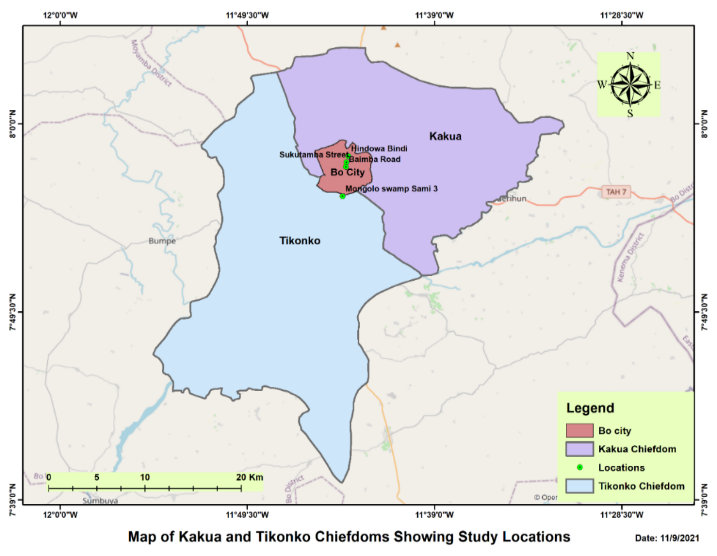
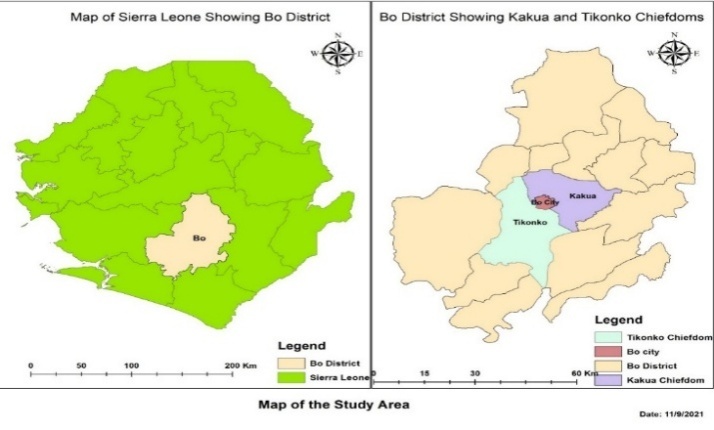
This study was conducted in Bo town, which is the second-largest city in the southern region of Sierra Leone, located 180 kilometres from Freetown, the capital of Sierra Leone, characterized by a low elevation landscape and dispersed marshes. Bo City undergoes two distinct seasons: the dry season and the wet season. The dry season occurs from November to April, and the wet season spans from May to October 18. It has an annual precipitation of up to 3200mm and is subjected to arid Sahara winds from December to February. The climate is tropical and humid, characterised by intense heat in March and April.


Before the commencement of the sampling collection, a comprehensive list of all sampling sources from the four (4) locations inside Bo City was produced. Following the preliminary assessment of the four selected locations in Bo City, the sample points were cross-sectional, employing a random sampling approach. Following a preliminary survey of eighteen (18) Kabakudu soap factory sites in Bo city, four (4) sampling sources were selected: two (2) water wells, one (1) swamp located in Kakua chiefdom, and one (1) reference site in Tinkonko chiefdom, Bo district, where no Kabakudu soap production has occurred.
2.3. Sample Collection and PreservationSamples of Kabakudu soap wastewater effluent were randomly collected during five distinct months. The initial sample was acquired on 26 July 2021, 27 August 2021, 28 September 2021, and 29 October 2021 in the morning, whilst the subsequent sample was gathered on 1 November 2021 during the early hours from the four Kabakudu soap producing locations. Sample bottles were directly filled from the boreholes and marshes between 9:14 am and 10:55 am. To prevent interaction with the materials, the samples were gathered in a plastic bucket secured to a rope. The water samples were gathered in four 800 mL polythene bottles. The bottles were thoroughly cleaned inside and out using chlorinated foam soap and a sponge. The bottles were cleaned twice with clean hot tap water and distilled water, followed by multiple rinses with the water sample to be taken before filling. The sample vials were thereafter secured tightly.
The AQUAREAD water-monitoring device was employed to assess the following physical parameters: pH, temperature, electrical conductivity (EC), dissolved oxygen (DO), total dissolved solids (TDS), turbidity, salinity, seawater specific gravity (S.S.G), and altitude. The Plain test kit chemicals and the Photometer were utilized to assess Hydrogen peroxide levels. The AquaRead AP 2000 was conducted immediately and extended to a depth of 30 to 50 cm from the surface of the contaminated wastewater. Eight samples were obtained. Six (6) samples were evaluated for physical factors, and two (2) for chemical parameters. The samples were subsequently dispatched to the Vimetco Mining Company Laboratory for examination. Upon filling the treated sampling containers with water samples, a 10% void was maintained to accommodate for expansion during storage in a refrigerator maintained at 4°C, pending further chemical analysis.
The pH was determined via the AquaRead AP 2000 apparatus. The AquaRead AP 2000 probe was cleaned with distilled water, after which the sample water was plunged to a depth of 3cm to 5cm in an 800ml container. The AquaRead AP 2000 automatically reads and analyses the water sample within 5 minutes. The same device was designated to measure total dissolved solids (TDS) and assess Conductivity. Furthermore, the read AP 2000 set was employed to assess temperature, turbidity and salinity. A newly prepared hydrogen peroxide standard solution with a concentration of 2.00 mg/l H2O2 was utilized to evaluate the photometric measurement system, including test reagents, measurement apparatus, and operational procedures.
The result disclosed the effluent condition of seven (7) physicochemical variables examined. The Findings indicate that the effluent temperature and pH levels fall below the standards recommended by the WHO. Although the WHO standard is 40°C, every wastewater collected from the research region was below 30°C. Nevertheless, the temperature in November was elevated relative to that in July, August, September and October, suggesting more intense sunshine in November than in July, August, September and October. This outcome aligns with the research undertaken 19
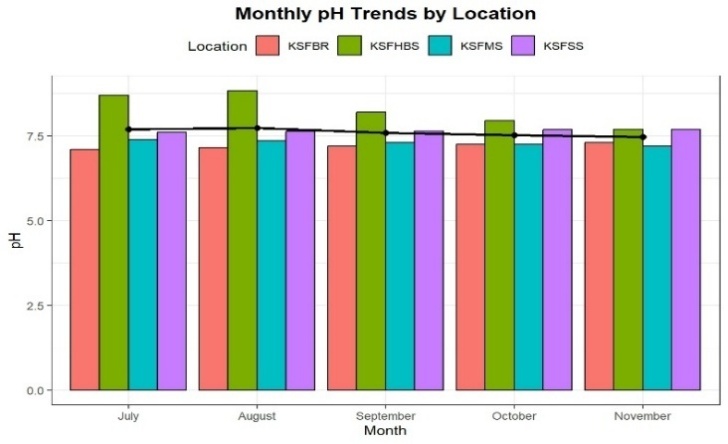
The pH of the collected effluent samples varied from neutral to alkaline. In July, the minimum pH value recorded was 7.1 at KSFBR, whereas the maximum pH value of 8.7 was observed at KSFHBS. This indicates that both sites significantly affected the pH of the water samples.
The mean pH at the KSFBR sampling point was 7.20 ± 0.08, showing very little variation over the five months. KSFMS recorded a mean pH of 7.30 ± 0.08, also indicating stable conditions. The pH at KSFSS had a mean of 7.65 ± 0.40, while KSFHBS showed the highest mean pH of 8.28 ± 0.49, suggesting greater fluctuation, likely due to effluent discharge.
The pH levels of samples from KSFBR, KSFMS, and KSFSS Street were not statistically different from each other, yet they were significantly lower than the pH observed at KSFHBS. The timing of sample collection significantly influenced the pH of the water sample, as indicated in Table 3. In July, the average pH across the sampling sites ranged between 7.1 and 8.7. Nonetheless, statistical analysis indicated that November values were significantly lower than those of July, except at KSFHBS, which exhibited a higher value in August.
The recorded pH values were analyzed against the recommended WHO standard to assess the pH level in the collected effluent sample (Figure 3). Except for KSFBR, KSFHBS, and KSFMS wetlands in July, August, September and November, most collected samples did not meet the specified value. The majority of the samples fell within the acceptable pH range of 6.5 to 8.5. The pH of the sampled effluent varies from 6.5 to 8.5, aligning with the WHO-accepted standard of 8.5 20. Except for KSHBS, the pH of the effluent in the study area was above 7. The pH value of 7 may result from effluent discharge during the production preparation stage, while the materials utilized in production could have contributed to the alkaline values. Acidic water is typically not commonly observed, except in instances of significant pollution 21. The findings are consistent with those of 22. The elevated pH may result from groundwater recharge and the dissolution of substances from soils and bedrock, among other sources 23.

Electrical Conductivity (EC) of the Water Sample Collected
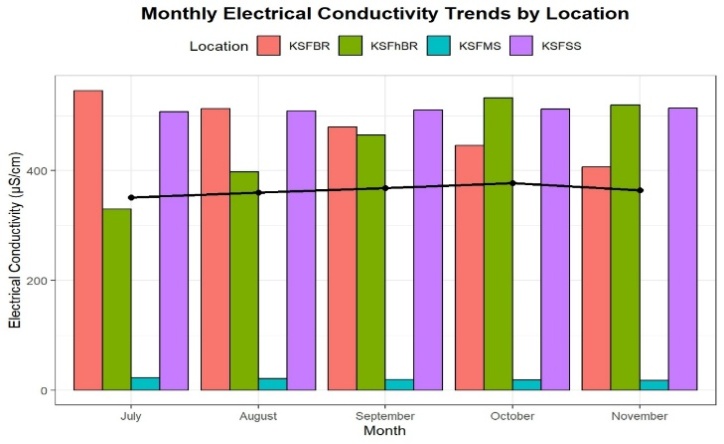
Table 4 displays the average monthly electrical conductivity (EC) values from four sample sites. The recorded EC values ranged from 23.0 µS/cm to 21.5 µS/cm at KSFMS, 330.50 µS/cm to 532.30 µS/cm at KSFHBS, 407.00 µS/cm to 2512.80 µS/cm at KSFBR, and 507.00 µS/cm to 514.00 µS/cm at KSFSS, respectively. The mean EC at KSFBR was 878.0 µS/cm ± 915 µS/cm, indicating substantial variation, with the highest recorded in August at 2512.80 µS/cm. KSFMS exhibited a mean EC of 20.0 µS/cm ± 2.1 µS/cm, showing minimal variation. KSFSS had a mean EC value of 511.0 µS/cm ± 2.8 µS/cm, while KSFHBS recorded a higher mean of 449.0 µS/cm ± 85 µS/cm, reflecting greater fluctuations.
Although KSFHBS and KSFSS exhibited notably high conductivity readings in November, these values were not significantly higher than those observed in other months. The EC values varied statistically across the months, with the highest value of 2512.80 µS/cm recorded in August. Nevertheless, the levels in July were significantly lower than those recorded in August and November.
Figure 4 illustrates that the EC readings obtained from the four locations over the two months deviate from the WHO-accepted EC standard. All sites, except KSFMS, recorded EC levels that surpassed the recommended thresholds set by WHO. This suggests low calcium and magnesium content in the collected effluent water samples. Electrical conductivity, while having minimal implications for human or aquatic health, functions similarly to other physicochemical parameters. The rise in conductivity observed in November may be linked to the heightened evapotranspiration process, which has resulted in elevated concentrations within the water body.

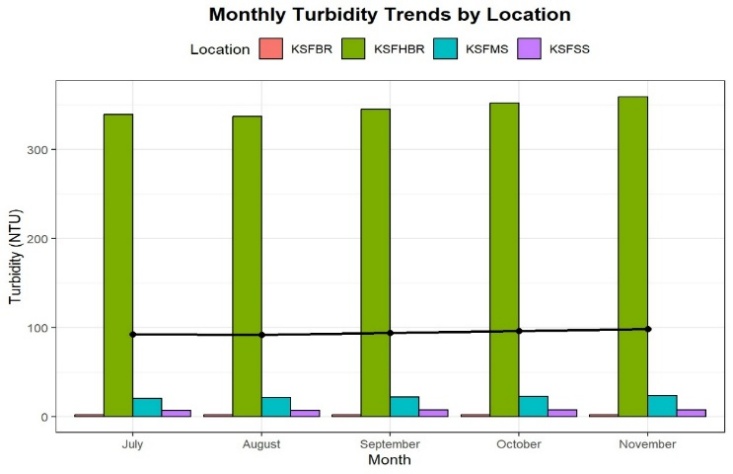
Table 5 presents the turbidity levels at the four sample sites across five months. The recorded turbidity values ranged from a minimum of 2.01 NTU at KSFBR in July to a maximum of 359 NTU at KSFHBS in November. The mean turbidity value at KSFBR was 2.10 ± 0.10 NTU, indicating stable conditions. KSFMS recorded a mean turbidity of 22.92 ± 1.19 NTU, with slight fluctuations across the months. KSFHBS exhibited the highest mean turbidity at 344.47 ± 11.57 NTU, reflecting significant variation, particularly in November when the turbidity reached its highest value of 359 NTU. KSFSS had a mean turbidity of 7.65 ± 0.29 NTU, showing relatively low variability in comparison to the other sites. The turbidity levels varied significantly across the sampling sites, suggesting that the location of sampling greatly influences turbidity levels. The sample collected in November had a significantly higher turbidity than that collected in July and the other months, particularly at KSFHBS.
Figure 5 presents a comparison of the turbidity levels of the water samples against the standards recommended by the WHO. The study indicated that certain samples did not meet the anticipated WHO standards and limits. The KSFHBS reading of more than 300 significantly exceeded the accepted threshold of <5.0 NTU across the months.


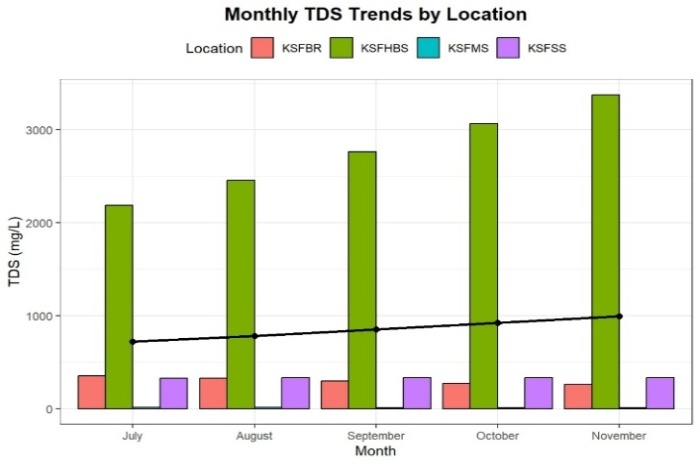
Table 6 presents the total dissolved solids (TDS) measurements at each sampling location across five months. The recorded TDS values ranged from 11.0 mg/l at KSFMS in November to a maximum of 3378 mg/l at KSFHBS in November. The mean TDS at KSFBR was 884.0 ± 1310 mg/l, indicating significant variation across the months. KSFMS exhibited a mean TDS of 12.0 ± 1.2 mg/l, showing minimal fluctuation, while KSFHBS recorded a mean of 2338.0 ± 1340 mg/l, reflecting considerable variation, especially during November when the maximum value of 3378 mg/l was observed. KSFSS had a mean TDS of 336.0 ± 2.4 mg/l, with relatively stable readings
The TDS readings showed a significant increase in November compared to the other months, particularly at KSFHBS. The elevated TDS values at KSFHBS can likely be attributed to rising water levels, which lead to greater dissolution of solids over time. Additionally, the relatively low TDS values observed at KSFMS and other locations may be explained by the low turbidity at these sites. As turbidity is linked to the presence of particles in water, it can result in higher TDS levels when suspended particles dissolve. Therefore, an increase in turbidity is often associated with elevated TDS values.
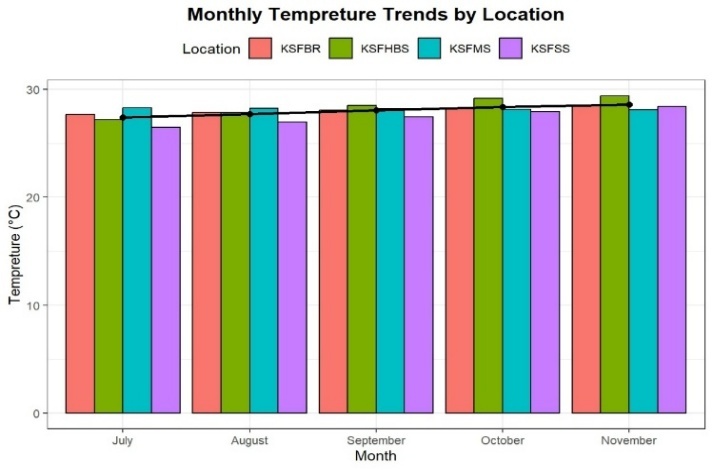
Table 7 presents the temperature readings for water samples collected at four different locations across five months. The recorded temperatures ranged from a minimum of 26.50°C at KSFSS in July to a maximum of 29.40°C at KSFHBS in November. The mean temperature at KSFBR was 28.07°C ± 0.34°C, showing relatively stable conditions across the months. KSFMS exhibited a mean temperature of 28.20°C ± 0.07°C, with little variation, while KSFHBS recorded a mean of 28.42°C ± 0.91°C, reflecting slightly higher fluctuations, particularly in November when the maximum temperature of 29.40°C was recorded. KSFSS had a mean temperature of 27.45°C ± 0.75°C, showing moderate variation.
The temperature readings varied significantly across the sampling sites, with KSFHBS recording the highest temperatures, particularly in November. The temperature of the water samples during the sampling period ranged from 26.50°C to 29.40°C, indicating that the sampling location had a significant impact on the water sample temperatures. November exhibited the highest temperature values, reflecting a noticeable increase compared to the preceding months. Increased water temperature typically reduces oxygen solubility and enhances odors, potentially affecting water quality 24
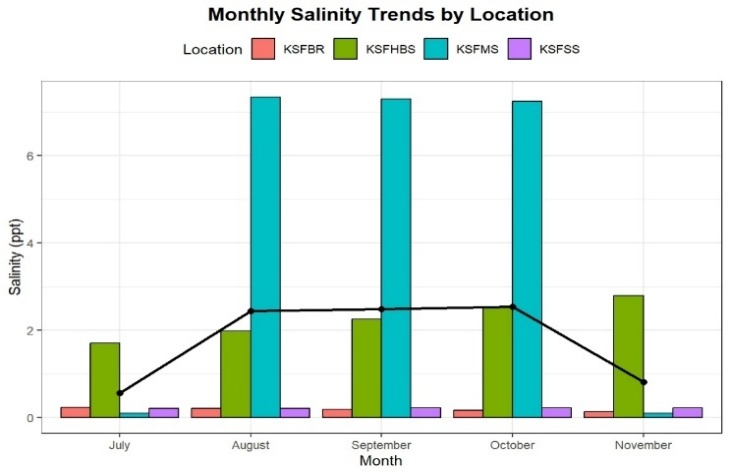
Table 8 presents the average monthly salinity of samples collected over five months from four different water sources in Bo City. The recorded salinity ranged from a minimum of 0.14 PSU at KSFBR in November to a maximum of 2.79 PSU at KSFHBS in November. The mean salinity at KSFBR was 0.19 PSU ± 0.04 PSU, showing minimal variation across the months. KSFMS exhibited a mean salinity of 7.29 PSU ± 0.09 PSU, with slight fluctuations. The mean salinity at KSFHBS was 2.25 PSU ± 0.43 PSU, reflecting greater variation, particularly in November when the maximum salinity of 2.79 PSU was recorded. KSFSS had a mean salinity of 0.22 PSU ± 0.01 PSU, indicating relatively low and stable readings. The analysis results indicate that both the sampling location and the month significantly influenced the salinity of the water samples. The salinity levels at KSFBR, KSFMS, and KSFSS were statistically similar, but these were significantly lower than the salinity observed at KSFHBS. Sampling month also played a significant role in determining the salinity values, with the salinity recorded in November being significantly higher than that recorded in July.


Figure 8 compares the salinity readings of water samples collected from four different sites over 5 months to the WHO-recommended standard. The salinity of the water samples ranges between 0.14 PSU and 2.79 PSU. The KSFMS had the lowest salinity value (0.14 PSU), whereas KSFHBS had the highest (2.79 PSU). However, two sample times in three locations, KSFHBS, KSFBR and KSFSS, were less than the WHO standard. The majority of the samples showed salinity levels that were lower than the prescribed limit.
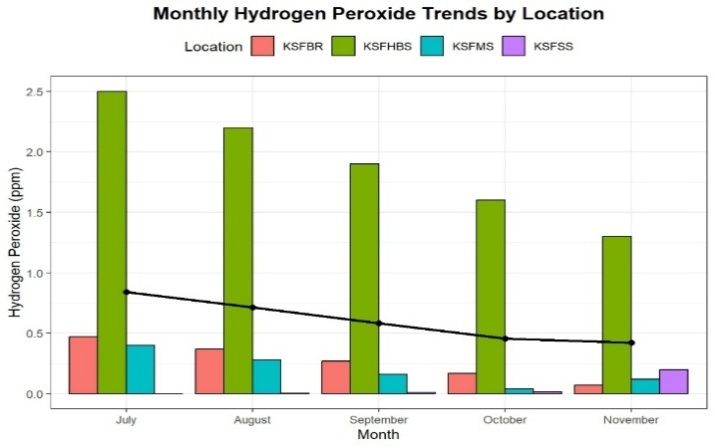
Table 9 presents the hydrogen peroxide concentrations measured at four sample locations across five months. The recorded concentrations ranged from a minimum of 0 ppm at KSFSS in July to a maximum of 2.5 ppm at KSFHBS in July. The mean concentration at KSFBR was 0.27 ppm ± 0.16 ppm, showing minimal variation over the months. KSFMS exhibited a mean concentration of 0.20 ppm ± 0.14 ppm, with low fluctuation. KSFHBS recorded a mean concentration of 1.90 ppm ± 0.47 ppm, reflecting more significant variation, especially in July, when the maximum value of 2.5 ppm was observed. KSFSS had a very low mean concentration of 0.01 ppm ± 0.01 ppm, indicating minimal hydrogen peroxide presence throughout the months. The readings at KSFMS and KSFHBS in July ranged from 0 ppm to 2.5 ppm, with KSFHBS exhibiting significantly higher levels compared to other sites. The majority of readings across the locations showed nearly identical observations, except for KSFHBS, which demonstrated higher hydrogen peroxide concentrations. These findings suggest that hydrogen peroxide levels were notably elevated in July, with KSFHBS exhibiting the highest concentration. The data indicate that sampling location and month played significant roles in determining hydrogen peroxide concentrations in the study area.
Figure 9 presents a bar chart that compares the Hydrogen Peroxide levels of samples collected from four locations against the WHO recommended standard. The hydrogen peroxide concentrations in the water samples vary from 0 to 2.5 ppm. KSFSS recorded the minimum value of 0 ppm, while KSFHBS exhibited the maximum value of 2.5 ppm. Nonetheless, two sample times across three locations (KSFMS, KSFBR, and KSFSS) fell below the WHO limit. The hydrogen peroxide concentrations in most samples were below the recommended threshold.

Temperature, pH, Electrical Conductivity (EC), Turbidity, Total Dissolved Solids, Salinity, and Hydrogen Peroxide were measured according to established protocols. The physical-chemical parameters predominantly did not meet the safe limit standards established by 20, with only a limited number approaching the maximum permissible levels across the four study sites. The pH levels of the water samples varied from slightly acidic to slightly alkaline. The sampling site and the month of sampling significantly influenced the pH levels. Several analyzed samples exceeded the WHO recommended limits for EC values. Turbidity samples failed to comply with the proposed limit, as they were found to be outside the range established by WHO drinking water standards. Some TDS samples were below the permissible levels for drinking water as per the WHO standards. The temperature aligns with the standards set by the WHO. Most samples exhibited salinity levels below the recommended limit set by the WHO. A portion of the samples exhibited hydrogen peroxide levels below the WHO standard, whereas the majority of the samples were below the recommended limit. The physicochemical parameters of water samples collected in July, August, September, October and November indicate that the values for July (wet season) were higher than those for November (dry season). This is due to the significant release of production effluent in the rainy season. The discharge effluent released during the rainy season (July) introduces significant pollutants into the nearby water sources of the factory, thereby elevating the concentration of physicochemical parameters during this period.
This study underscores the importance of evaluating the extent of pollution resulting from industrial wastewater in Bo City. The results indicate that the discharge of effluent from the soap industry has a detrimental impact on water bodies, leading to the pollution of groundwater in the vicinity of these facilities. It indicates that it is essential to treat wastewater effluent before discharge to prevent contamination of nearby groundwater. The investigation revealed that, despite the existence of standard protocols for effluent discharge, many soap industries, such as Kabakudu, do not comply with these regulations. The findings show that the majority of the Physico-chemical parameters exhibit concentrations that are marginally below and above the recommended WHO standard. It indicates that the wastewater effluent is non-biodegradable and contains various substances resulting from the use of diverse raw materials in the soap formulation process.
Funding and Support: This work was funded by Integrated Research into the Utilities and the Urban Environment (InRUE) and supported by the Environmental Protection Agency Southern Regional Office, Bo, Sierra Leone.
Conflicts of Interest: The authors declare no conflict of interest.
Data Availability Statement: Data will be made available upon request.
Acknowledgements: We are grateful to Joseph S.M. Gbassa for helping with fieldwork assistance and Joseph S. Momoh for transportation of samples.
| [1] | Di Prinzio C.Y, Alan Sebastián Andrade-Muñoz A, Yanina Andrea Assef A B, Walter Mauricio Dromaz A, Pamela Quinteros A, María Laura Miserendino A (2024). Impact of Treated Effluent Discharges on Fish Communities: Evaluating the Effects of Pollution on Fish Distribution, Abundance and Environmental Integrity. Science of the Total Environment, 917, 170237. | ||
| In article | View Article PubMed | ||
| [2] | Mansaray, A., Aamodt, J. and Koroma, B. (2018) Water Pollution Laws in Sierra Leone: A Review with Examples from the UK And USA. Natural Resources, 9, 361-388. | ||
| In article | View Article | ||
| [3] | Fenda A. Akiwumi (2015). Analyzing Sierra Leone's Water Reform Efforts: Law, Environment, and Sociocultural Justice Issues, Politics, Groups, and Identities, 3: 4, 655-659. | ||
| In article | View Article | ||
| [4] | Awaleh MO, Soubaneh YD (2014) Waste Water Treatment in Chemical Industries: The Concept and Current Technologies. Hydrol Current Res 5: 164. | ||
| In article | |||
| [5] | Ayotunde L.M. and Aderonke, O.A. (2014). Effect of Effluent from Soap Industry on the Physico-Chemical Parameters of Nearby Well Water. International Water Resources Association. (Accessed November 2024) Available At: . Sunbula. Archived from on March 21, 2008. Retrieved 2008-04-18. | ||
| In article | |||
| [6] | Adeola Fashae, O., Abiola Ayorinde, H., Oludapo Olusola, A. Et Al. Land Use and Surface Water Quality in an Emerging Urban City. Appl Water Sci 9, 25 (2019). | ||
| In article | View Article | ||
| [7] | Tekade, P.V., Mohabansi, N.P. And Patil, V.B. (2011). Study Of Physico-Chemical Properties of Effluents from Soap Industry in Wardha. Rasayan Journal of Chemistry 4, (2), 461-465. | ||
| In article | |||
| [8] | Muralikrishna, I. V., & Manickam, V. (2017). Wastewater Treatment Technologies. Environmental Management, 249–293. | ||
| In article | View Article | ||
| [9] | Lemessa, F., Simane, B., Seyoum, A., & Gebresenbet, G. (2023). Assessment of the Impact of Industrial Wastewater on the Water Quality of Rivers around the Bole Lemi Industrial Park (BLIP), Ethiopia. Sustainability, 15(5), 4290. | ||
| In article | View Article | ||
| [10] | Salem, T.A. Changes in the Physicochemical and Biological Characteristics in the Lentic and Lotic Waters of the Nile River. Egypt. J. Aquat. Res. 2021, 47, 21–27. | ||
| In article | View Article | ||
| [11] | Reid, A.J.; Carlson, A.K.; Creed, I.F.; Eliason, E.J.; Gell, P.A.; Johnson, P.T.J.; Kidd, K.A.; Maccormack, T.J.; Olden, J.D.; Ormerod, S.J.; Et Al. Emerging Threats and Persistent Conservation Challenges for Freshwater Biodiversity. Biol. Rev... 2019, 94, 849–873. | ||
| In article | View Article PubMed | ||
| [12] | Geda, K.; Douglas, M.; Rita, B.L.; Olyad, D.; Aschalew, L.; Daniel, S.H.; Andreas, H.F.; Wolfram, G. Macroinvertebrate Indices Versus Microbial Fecal Pollution Characteristics for Water Quality Monitoring Reveals Contrasting Results for an Ethiopian River. Ecol. Indic. 2020, 108, 105733. | ||
| In article | View Article | ||
| [13] | Şener, Ş.; Şener, E.; Davraz, A. Evaluation of Water Quality Using Water Quality Index (WQI) Method and GIS in Aksu River (SW-Turkey). Sci. Total Environ. 2017, 584–585, 131–144. | ||
| In article | View Article PubMed | ||
| [14] | Worku, Y.; Giweta, M. Can we imagine pollution-free rivers Around Addis Ababa City, Ethiopia? What were the wrongdoings? What action should be taken to correct them? J. Pollut. Eff. Cont. 2018, 6, 228. | ||
| In article | |||
| [15] | Legaspi, K.; Lau, A.Y.A.; Jordan, P.; Mackay, A.; Mcgowan, S.; Mcglynn, G.; Baldia, S.; Papa, R.D.; Taylor, D. Establishing the Impacts of Freshwater Aquaculture in Tropical Asia: The Potential Role of Palaeolimnology. Geogr. Environ. 2015, 2, 148–163. | ||
| In article | View Article | ||
| [16] | Abdalla Abubakari, Anyemedu Fredrick Oppong-Kyekyeku, Donkor Emmanuel and Jackson Adiyiah Nyantakyi (2016). The Effect of Industrial Effluents on the Quality of Onukpawahe Stream, Tema-Ghana. Journal of Environmental Science and Engineering B 5 (2016) 457-475. | ||
| In article | View Article | ||
| [17] | Bartram, J., & Balance, R. (1996). Water quality monitoring. A practical guide to the design and implementation of fresh water quality studies and monitoring programs (Pollution Research 383). UNEP/WHO, Chapman and Hall. | ||
| In article | View Article | ||
| [18] | Sheriff, S. (2021). Evaluating Management Support to the Internal Audit System in Bo District Council, Sierra Leone. Open Journal of Business and Management, 9, 1603-1618. | ||
| In article | View Article | ||
| [19] | Omonijo, A. G., & Matzarakis, A. (2011). Climate And Bioclimate Analysis of Ondo State, Nigeria. Meteorologische Zeitschrift, 20(5), 531–539. | ||
| In article | View Article PubMed | ||
| [20] | WHO 5th Edition - WHO Chronicle, 2011 -Apps.Who.Int. | ||
| In article | |||
| [21] | Dutta, N., & Narayanan, K. (2011). Impact of Environmental Regulation on Technical Efficiency. Science, Technology and Society. | ||
| In article | View Article | ||
| [22] | Ayotunde and Aderonke, (2012). Effect of Effluent from Soap Industry on the Physico-Chemical Parameters of Nearby Well Water.Available Online: Https:// Iwra.Org/ Proceedings/ Congress/ Resource/ absid243 _effect_ of_ effluent _from_ soap_industry_on_the_physicochemical_parameters_of_nearby_well_water_paper.pdf. | ||
| In article | |||
| [23] | Brown, A. And Caldwell (2004). Watershed Protection Plan Development Guidebook, Northeast Georgia Regional Development Centre. | ||
| In article | |||
| [24] | Ademoroti CMA (1996). Standard methods for water and waste effluent analysis. Foludex Press Ltd., Ibadan. Ist Edition. 32-36. | ||
| In article | |||
Published with license by Science and Education Publishing, Copyright © 2025 Mohamed Koiva Kallon, Moses Fayiah, Sule-Otu Hadi Ateiza and Sam-Mbomah E
 This work is licensed under a Creative Commons Attribution 4.0 International License. To view a copy of this license, visit
http://creativecommons.org/licenses/by/4.0/
This work is licensed under a Creative Commons Attribution 4.0 International License. To view a copy of this license, visit
http://creativecommons.org/licenses/by/4.0/
| [1] | Di Prinzio C.Y, Alan Sebastián Andrade-Muñoz A, Yanina Andrea Assef A B, Walter Mauricio Dromaz A, Pamela Quinteros A, María Laura Miserendino A (2024). Impact of Treated Effluent Discharges on Fish Communities: Evaluating the Effects of Pollution on Fish Distribution, Abundance and Environmental Integrity. Science of the Total Environment, 917, 170237. | ||
| In article | View Article PubMed | ||
| [2] | Mansaray, A., Aamodt, J. and Koroma, B. (2018) Water Pollution Laws in Sierra Leone: A Review with Examples from the UK And USA. Natural Resources, 9, 361-388. | ||
| In article | View Article | ||
| [3] | Fenda A. Akiwumi (2015). Analyzing Sierra Leone's Water Reform Efforts: Law, Environment, and Sociocultural Justice Issues, Politics, Groups, and Identities, 3: 4, 655-659. | ||
| In article | View Article | ||
| [4] | Awaleh MO, Soubaneh YD (2014) Waste Water Treatment in Chemical Industries: The Concept and Current Technologies. Hydrol Current Res 5: 164. | ||
| In article | |||
| [5] | Ayotunde L.M. and Aderonke, O.A. (2014). Effect of Effluent from Soap Industry on the Physico-Chemical Parameters of Nearby Well Water. International Water Resources Association. (Accessed November 2024) Available At: . Sunbula. Archived from on March 21, 2008. Retrieved 2008-04-18. | ||
| In article | |||
| [6] | Adeola Fashae, O., Abiola Ayorinde, H., Oludapo Olusola, A. Et Al. Land Use and Surface Water Quality in an Emerging Urban City. Appl Water Sci 9, 25 (2019). | ||
| In article | View Article | ||
| [7] | Tekade, P.V., Mohabansi, N.P. And Patil, V.B. (2011). Study Of Physico-Chemical Properties of Effluents from Soap Industry in Wardha. Rasayan Journal of Chemistry 4, (2), 461-465. | ||
| In article | |||
| [8] | Muralikrishna, I. V., & Manickam, V. (2017). Wastewater Treatment Technologies. Environmental Management, 249–293. | ||
| In article | View Article | ||
| [9] | Lemessa, F., Simane, B., Seyoum, A., & Gebresenbet, G. (2023). Assessment of the Impact of Industrial Wastewater on the Water Quality of Rivers around the Bole Lemi Industrial Park (BLIP), Ethiopia. Sustainability, 15(5), 4290. | ||
| In article | View Article | ||
| [10] | Salem, T.A. Changes in the Physicochemical and Biological Characteristics in the Lentic and Lotic Waters of the Nile River. Egypt. J. Aquat. Res. 2021, 47, 21–27. | ||
| In article | View Article | ||
| [11] | Reid, A.J.; Carlson, A.K.; Creed, I.F.; Eliason, E.J.; Gell, P.A.; Johnson, P.T.J.; Kidd, K.A.; Maccormack, T.J.; Olden, J.D.; Ormerod, S.J.; Et Al. Emerging Threats and Persistent Conservation Challenges for Freshwater Biodiversity. Biol. Rev... 2019, 94, 849–873. | ||
| In article | View Article PubMed | ||
| [12] | Geda, K.; Douglas, M.; Rita, B.L.; Olyad, D.; Aschalew, L.; Daniel, S.H.; Andreas, H.F.; Wolfram, G. Macroinvertebrate Indices Versus Microbial Fecal Pollution Characteristics for Water Quality Monitoring Reveals Contrasting Results for an Ethiopian River. Ecol. Indic. 2020, 108, 105733. | ||
| In article | View Article | ||
| [13] | Şener, Ş.; Şener, E.; Davraz, A. Evaluation of Water Quality Using Water Quality Index (WQI) Method and GIS in Aksu River (SW-Turkey). Sci. Total Environ. 2017, 584–585, 131–144. | ||
| In article | View Article PubMed | ||
| [14] | Worku, Y.; Giweta, M. Can we imagine pollution-free rivers Around Addis Ababa City, Ethiopia? What were the wrongdoings? What action should be taken to correct them? J. Pollut. Eff. Cont. 2018, 6, 228. | ||
| In article | |||
| [15] | Legaspi, K.; Lau, A.Y.A.; Jordan, P.; Mackay, A.; Mcgowan, S.; Mcglynn, G.; Baldia, S.; Papa, R.D.; Taylor, D. Establishing the Impacts of Freshwater Aquaculture in Tropical Asia: The Potential Role of Palaeolimnology. Geogr. Environ. 2015, 2, 148–163. | ||
| In article | View Article | ||
| [16] | Abdalla Abubakari, Anyemedu Fredrick Oppong-Kyekyeku, Donkor Emmanuel and Jackson Adiyiah Nyantakyi (2016). The Effect of Industrial Effluents on the Quality of Onukpawahe Stream, Tema-Ghana. Journal of Environmental Science and Engineering B 5 (2016) 457-475. | ||
| In article | View Article | ||
| [17] | Bartram, J., & Balance, R. (1996). Water quality monitoring. A practical guide to the design and implementation of fresh water quality studies and monitoring programs (Pollution Research 383). UNEP/WHO, Chapman and Hall. | ||
| In article | View Article | ||
| [18] | Sheriff, S. (2021). Evaluating Management Support to the Internal Audit System in Bo District Council, Sierra Leone. Open Journal of Business and Management, 9, 1603-1618. | ||
| In article | View Article | ||
| [19] | Omonijo, A. G., & Matzarakis, A. (2011). Climate And Bioclimate Analysis of Ondo State, Nigeria. Meteorologische Zeitschrift, 20(5), 531–539. | ||
| In article | View Article PubMed | ||
| [20] | WHO 5th Edition - WHO Chronicle, 2011 -Apps.Who.Int. | ||
| In article | |||
| [21] | Dutta, N., & Narayanan, K. (2011). Impact of Environmental Regulation on Technical Efficiency. Science, Technology and Society. | ||
| In article | View Article | ||
| [22] | Ayotunde and Aderonke, (2012). Effect of Effluent from Soap Industry on the Physico-Chemical Parameters of Nearby Well Water.Available Online: Https:// Iwra.Org/ Proceedings/ Congress/ Resource/ absid243 _effect_ of_ effluent _from_ soap_industry_on_the_physicochemical_parameters_of_nearby_well_water_paper.pdf. | ||
| In article | |||
| [23] | Brown, A. And Caldwell (2004). Watershed Protection Plan Development Guidebook, Northeast Georgia Regional Development Centre. | ||
| In article | |||
| [24] | Ademoroti CMA (1996). Standard methods for water and waste effluent analysis. Foludex Press Ltd., Ibadan. Ist Edition. 32-36. | ||
| In article | |||