This study investigated the growth, mortality and exploitation parameters of Senilia senilis in the Senegal River delta, Senegal. Samples were collected monthly from July 2017 to Jun 2018. The parameters were estimated based on size-frequency data processed by FISAT II software. The measured length of 9939 specimens ranged from 5 to 65.48 mm. The growth parameter (K) was estimated as 1.30 yr-1 with asymptotic length (L∞ = 68.25 mm). The growth performance index and the theoretical age at birth (t0) were estimated as 3.78 and -0.097 yr-1 respectively. Total mortality, natural mortality and fishing mortality rates were estimated as 3.29 yr-1, 1.64 yr-1 and 1.65 yr-1 respectively. The current exploitation rate (E) was calculated as 0.5 which showed an optimal exploitation of Senilia senilis in the Senegal River delta. However, urgent management actions should be taken for a sustainable exploitation of this species.
Senilia senilis (also known as Anadara senilis) is a taxodont lamellibranch mollusc found in lagoon or estuarine biotopes along the West African coast, from Western Sahara to Angola 1. It is a species well known to West African coastal populations, and is the most extensively studied of the bivalve molluscs 2.
In Senegal, S. senilis is one of the most widely exploited bivalve molluscs. The existence of shellfish beds where S. senilis is the dominant species, or even often the only species present, attests to the long history of exploitation of this species in Senegal. Recently, the opening of the Langue de Barbarie breach in Gandiol, to prevent flooding of the city of Saint-Louis, has disrupted a number of socio-economic activities, including fishing, tourism, flood recession farming and market gardening 3, 4.
The ecological disruption caused by the development of the breach has had the positive effect of encouraging the appearance of certain species of bivalve mollusc, such as S. senilis. Exploitation of this mollusc has become an income-generating activity in Gandiolais 5. However, the harvesting of this species in the Gandiolais area escapes government control and remains an informal activity 5.
This is the reason why the present study attempts to study the parameters of growth, mortality and exploitation of this species with a view to its sustainable management in the Senegal River delta.
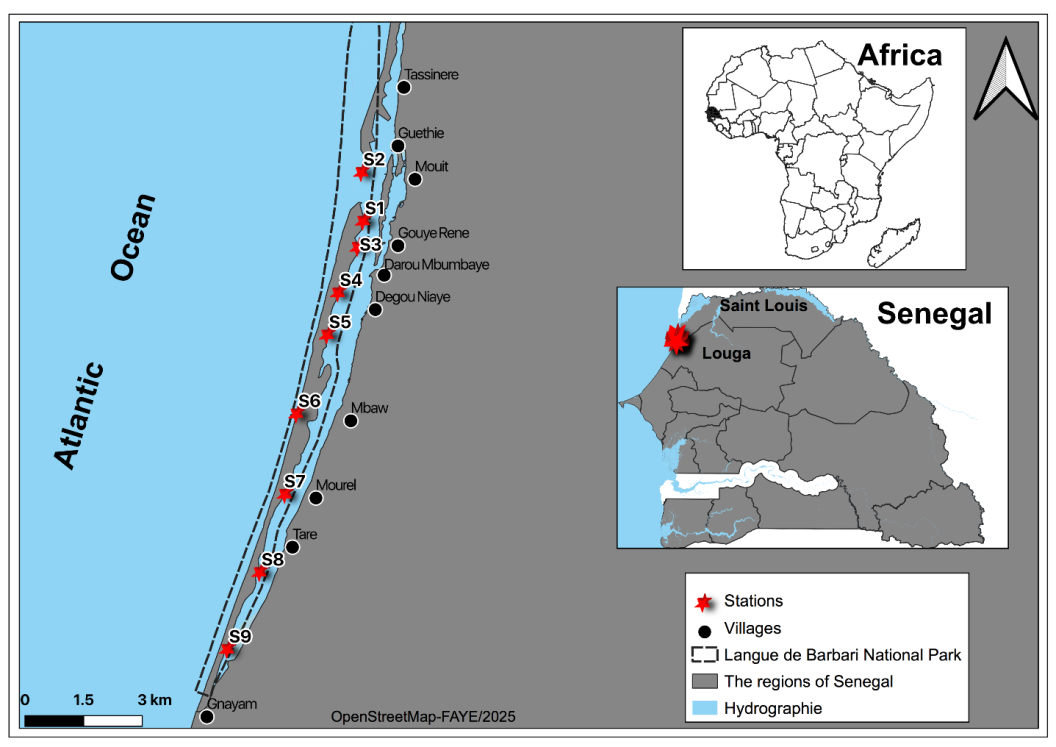
The study was carried out in Gandiol, which straddles the Niayes of Senegal’s northern coastline and the Senegal River delta 6. The area lies downstream of the Diama dam, south of the city of Saint-Louis. Located at 16°15' north latitude and 16°25' west longitude, Gandiol borders the commune of Saint-Louis to the east, the commune of Fass Ngom, National Road 2 and the Toubé area, and to the south, the rural commune of Léona in the department of Louga (Figure 1). It lies between the Senegal River and the Atlantic Ocean to the west, covering an area of around 360 km2 5.

Sampling was carried out monthly from July 2017 to June 2018. A total of 09 collection stations were chosen (Figure 1). Data were collected using two sampling techniques: the quadrat technique along a transect and the dredge technique. For the first technique, quadrats of 25 cm on each side, spaced 5 m apart, were laid out perpendicular to the bank to a depth of around 70 cm. The number of quadrats varied between 2 and 5, depending on the width of the bank. For the second technique, a cylindrical-conical dredger was used in the deep areas (middle of the bed). This dredge, with an opening diameter of 50 cm and equipped with a metal bar, is wrapped in a net with a mesh size of 1 cm. Once at the bottom, the dredge was pulled by a strong rope attached to a pirogue to collect the fauna and accumulate it at the bottom of the net. The dredge was raised every 5 minutes to recover the S. senilis individuals collected. The individuals from each surface unit explored by both the dredge and the quadrats are collected and placed in numbered bags. In the laboratory, S. senilis individuals were measured and weighed using a caliper and a 0.01 g precision electronic balance, respectively. For each individual, length, height and bulge were measured and the animal weight with shell was weighed.
2.3. Growth ParametersThe FAO-ICLARM Stock Assessment Tool (FiSAT II, version 1.2.2) software was used to analyze the monthly length frequency data 7, 8. The parameters of the von Bertalanffy Growth function (VBGF), asymptotic length (L∞) and growth coefficient (K) were estimated using the ELEFAN-1 method 9. According to VBGF as expressed below, individual fishes grew on average towards the asymptotic length at an instantaneous growth rate (K) with length at time (t) following the expression: Lt = L∞ [1 - e-k (t - t0)], where Lt = the length at age t, L∞ = the asymptotic length that was the mean length of fish would reach if they were to grow indefinitely, K = the growth coefficient and t0 was the age of the fish at zero length. 10’s empirical equation for the theoretical age at length zero (t0) was used to obtain this parameter as: Log (-t0) = -0.392-0.275×Log L∞ - 1.038×LogK. The growth performance index (Φ’) was computed from the equation 11: (Φ’) =2×logL∞+LogK and the longevity (tmax) was estimated as 12: tmax = 3/K + t0
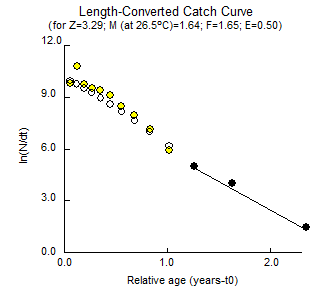
2.4. Mortality ParametersTotal annual instantaneous mortality rate (Z) was estimated using the Length converted catch curve 13. The natural mortality (M) was estimated by Pauly’s empirical equation 14, where the mean habitat temperature was 26.6°C. LogM = - 0.0066 – 0.279×logL∞ + 0.6543×logK + 0.4634×logT, where M = natural mortality, L∞ = asymptotic length, K = growth curvature of VBGF, T = mean surface temperature °C. The fishing mortality expresses the quantity of fish taken by the fishing activity in a year. After having calculated the coefficients Z and M, the determination of the fishing mortality (F) was made from the following relation 15: F=Z-M, where F = fishing mortality, Z = total mortality and M = natural mortality. The exploitation rate (E) was given by FiSAT from linearized length converted catch curve of each species: E = F/Z, where E = exploitation rate, F = fishing mortality and Z = total mortality. The exploitation rate (E) was compared to the optimum criterion of 0.5 11.
2.5. Recruitment PatternsThe recruitment pattern was determined by backward projection on the length axis of the set of available length-frequency data 16. Length at first recruitment (Lr) was taken as the mid-length of the smallest length interval 17 while age at first recruitment followed 18.
2.6. Virtual Population Analysis (VPA)VPA (Length structured) was undertaken by applying the values of growth and mortality parameters as well as growth pattern from the length-weight relationship. The length-weight relationship was done using the expression 19: W = a×Lb, where W = body weight and L = length.
2.7. Relative Yield Per Recruit (Y/R) and Relative Biomass Per Recruit (B/R)Relative yield per recruit (Y/R) and relative biomass per recruit (B/R) were calculated as a function of exploitation. Further to this, exploitation rate at the maximum (Emax), exploitation rate at 0.1 of the virgin biomass (E0.1) and E0.5 tallying to the exploitation rate at 0.5 of the virgin biomass were worked out through the application of Knife-edge option.
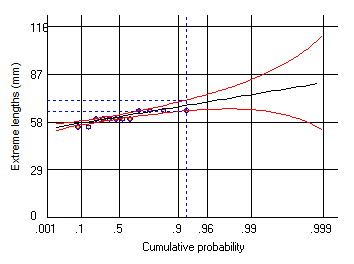
A total of 9929 specimens of S. senilis were collected for the study. Results of length-weight measurements gave the following ranges, length 5 - 65.48 mm. The mean length of samples was 20.98±9.46 mm. The observed and the predicted extreme length (Lmax) were found to be 65 and 67.90 mm respectively (Figure 2). The range at 95% confidence interval for extreme length was calculated as 64.73 - 71.07 mm.
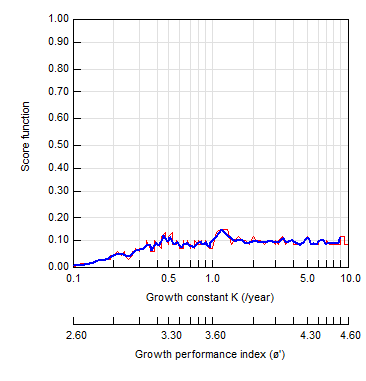
The best value of VGBF growth constant (K) was estimated to be 1.30 yr-1 by ELEFAN-I with an asymptotic length (L∞) of 68.25 mm and a growth performance index (Φ’) calculated as 3.78 (Figure 3).
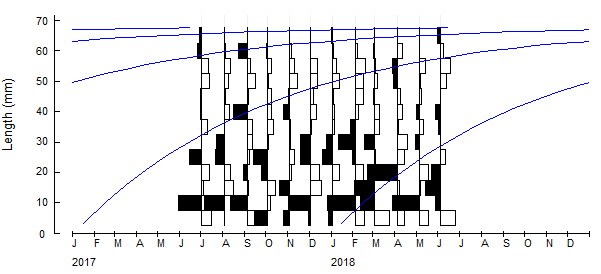
The restructured length frequency distribution diagram and growth curves produced by ELEFAN I method and displayed in Figure 4. The theoretical age t0 and longevity (tmax) of S. senilis values were calculated as -0.097 yr and 2.21 respectively.


The mortality rates for S. senilis were showed in Figure 5. The total mortality rate (Z) was calculated as 3.29 year-1. The natural (M) and fishing (F) mortality rates were estimated to be 1.64 year-1 and 1.65 year-1, respectively. The current exploitation rate (E) was found to be 0.50.
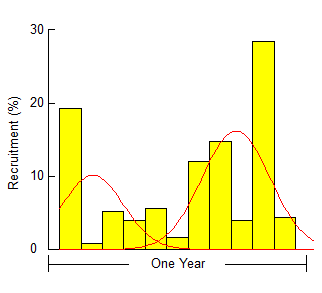
3.3. Recruitment PatternsThe recruitment pattern of S. senilis was continuous throughout the year with two peaks (January-February and August-September) indicating two distinct spawning events (Figure 6). The major peak recorded 28.53% recruitment while the minor peak recorded 19.34 %.

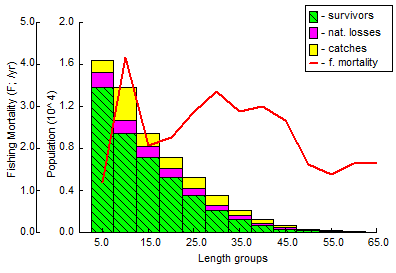
The virtual population analysis of S. senilia was shown in Figure 6. Individuals within the range of 10 - 15 mm experienced the highest level of exploitation. S. senilia observed natural loss due to natural mortality at 5 mm to 10 mm. The minimum and maximum fishing mortality rates were recorded as 1.19 yr-1 and 4.16 yr-1, respectively. The fishing mortality (F) reached a maximum of 4.16 yr-1 at 10 mm. Surviving individuals in the stock exhibited a declining trend with increased rate of fishing pressure (Figure 7).

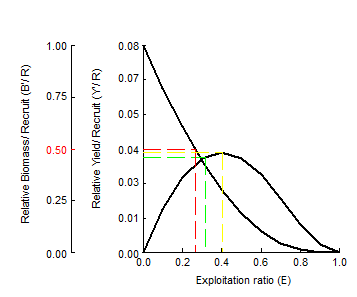
As fishing exploitation increased relative yield per recruit (Y’/R) decreased (Figure 8). The Beverton and Holt relative yield per recruit model showed that the optimum sustainable yield (E0.5), the maximum sustainable yield (Emax) and the economic yield target (E0.1) indices were 0.26; 0.40 and 0.32, respectively.

The conventional von Bertalanffy growth model has been found to be a good description of molluscan growth 20, 21. In addition, reliable estimates of growth parameters in bivalves are likely to be associated with similar (Φ’) values as long as the species in the comparison group have a similar shape 21. Thus, the values of (Φ’) were used in the present study to evaluate the reliability of the growth parameters obtained for S. senilis by comparing the values of (Φ’) with those calculated for other species of the Senilia genus (Table 1) 22. The growth performance index, (Φ’) = 3.78, of this study was higher than the estimated values for other Senilia species (Table 1). These disparities may be attributed environmental peculiarities at the different locations. Indeed, growth performance of bivalves could be as a result of influences of environmental factors, and thus, bivalves found at different geographical locations may have different growth performance indices which could be as a result of the prevailing environmental conditions 23. Indeed, 24 and 25 suggested that linear growth may vary from one water body to another, because environmental factors such as the productivity of the areas, the availability of food may vary. Growth in bivalves is influenced by many factors, including temperature, food intake, current action, salinity, food availability, water flow, and reproductive state 26.
The coefficients of total mortality, natural mortality and fishing mortality estimated during the present study were Z = 3.29 yr-1, M = 1.64 yr-1 and F = 1.65 yr-1, respectively (Table 2). It appears that natural mortality was roughly equal to fishing mortality. However, fishing mortality is slightly higher, which suggested that mortality based on exploitation was relatively higher than that based on natural causes. The causes of natural mortality can be environmental or biological in origin 34. Because, bivalves serve as food for a wide range of other organisms from groups such as fish, birds, mammals, crustaceans, echinoderms, flatworms, and even other molluscs 23.
The continuous recruitment pattern found for S. senilis with two major peaks (January-February and August-September) was the result of the spawning events that took place in December and July. The presence of recruits during January-February and August-September might indicate that the larval phase lasted at least 1 month 36. These results were relatively similar to those of 37 who suggested that the major spawning period of S. senilis was in October-November.
Length-based VPA provides a medium for estimating fishing pressure on various length groups 38. In the present study, Virtual analysis populations of S. senilis indicates that natural mortality was higher at small sizes (5-10 mm) and decreased gradually. This phenomenon could be explained by the fact that young individuals are more vulnerable to natural predation 39.
From the results of Beverton & Holt’s relative yield per recruit, the exploitation rate 0.5 yr-1 was close to the maximum sustainable yield (0.40), but it was higher than the optimum sustainable yield (0.26) and economic yield (0.32) indices. Then, this showed an optimal exploitation of S. senilis in the Senegal River delta. The estimated exploitation rate in the present study for S. senilis was smaller than those obtained by 27 for A. senilis (E = 0.51), by 22 for A. tuberculosa (E = 0.71) and by 35 for A. antiquate (E = 0.75). The low exploitation rate estimated in the present study could be due to the fact that the exploitation of S. senilis in the Senegal River delta does not date back long. Indeed, the exploitation began after the installation of the breach in 2003, the ecological disturbances of which caused the appearance of certain species such as the bivalve molluscs S. senilis and Carasostrea gasar.
This study was a first attempt to assess the growth and exploitation parameters of S. senilis in the Senegal River delta in North of Senegal. The current exploitation rates (E) of S. senilis was estimated as 0.5. This might be supported that the species had not over exploitation but they reached the optimal fishing level in this study area. To ensure the availability and sustainability of S. senilis, it is in the stakeholders’ interest not to increase fishing effort since this could lead to a situation of overexploitation of this species. Especially since, there are still no official planning and management measures for the sustainable exploitation of this resource. In this sense, the present study provides important information that would help in developing efficient management and conservation strategies.
The authors would like to thank all those who helped collect data in the field
The authors have no conflict of interest.
| [1] | Descamps, M, Collecting ark shells (Anadara Senilis L) in the lower Saloum region (Senegal): an ethnoarchaeological approach to shell middens, Work of the Laboratory of Anthropology and Prehistory of the Western Mediterranean Countries, France, 1989, 131-149. | ||
| In article | |||
| [2] | Hanzen, C, Socio-economic and bioecological aspects of the exploitation of arks (Arca senilis L) in the Saloum Delta, Senegal, Master’s thesis, University of Liège, Belgium, 2012, 56p. | ||
| In article | |||
| [3] | Camara, M.M.B, Impacts of developments on coastal areas: the example of the opening of the breach on the Langue de Barbarie, in “proceedings of the international multidisciplinary conference “The coastline: undergo, speak, act”, Lille, France, 2008, 12p. | ||
| In article | |||
| [4] | Ndiaye, F, Impacts of the breach on the Langue de Barbarie National Park. In Cormier-Salem, M.C., Descroix, L., Diakhate, M.M. Habert, E. Sy, B.A. Touré, L., The Senegal River Delta, 2022, 176p. | ||
| In article | |||
| [5] | Sow, E.H., Coly, O., Ndiaye, P.A. and Niang, C, "Exploitation of the Anadara Senilis (Arches) species in the Langue de Barbarie National Park", Gandiol (Senegal). European Scientific Journal, 17(39). 117-134. November 2021. | ||
| In article | View Article | ||
| [6] | Gueye, I, Geomorphological evolution of the northern Senegalese coast (Gandiolais sector), analysis of resource degradation and conservation prospects, Master's thesis, Gaston Berger University, Senegal, 2010, 147p. | ||
| In article | |||
| [7] | Gayanilo, F.C. and Pauly, D. FAO-ICLARM Stock Assessment Tools (FiSAT), FAO Computerised Information Series (Fisheries), Rome, FAO, 8, 1997, 262p. | ||
| In article | |||
| [8] | Gayanilo, F., Sparre, P. and Pauly, D, FAO-ICLARM Stock Assessment Tools II (FiSAT II), Revised, User's guide. Computerized Information Series (Fisheries), Revised version, Rome, FAO, 8, 2005, 168p. | ||
| In article | |||
| [9] | Pauly, D. and David, N, "ELEFAN-I BASIC program for the objective extraction of growth parameters from Length frequency data", Meeresforsch, 28(4). 205-211. 1981. | ||
| In article | |||
| [10] | Pauly, D, Theory and Management of Tropical Multi-Species Stocks: A Review, with Emphasis on the Southeast Asian Demersal Fisheries, Studies and Review No. 1, International Center for Living Aquatic Resources Management, Manila, Philippines, 1979, 35p. | ||
| In article | |||
| [11] | Pauly, D. and Munro, J, "Once more on the comparison of growth in fish and invertebrates", Fishbyte, 2(1). 1-21. 1984. | ||
| In article | |||
| [12] | Pauly, D, "Length converted catch curves. A powerful tool for fisheries research in tropics", Fishbyte, 1(2). 9-13. (1983). | ||
| In article | |||
| [13] | Sparre, P. and Venema, S.C, Introduction to tropical fish stock Assessment-Part 1: Manual: FAO Fisheries Technical Paper, Nº 306(1), Rev. 8, Rome, FAO, 1998, 407p. | ||
| In article | |||
| [14] | Pauly, D, "On the interrelationships between natural mortality, growth parameters and mean environmental temperature in 175 fish stocks", Journal of Conservation and International Exploration of Maritime, 39(3). 175-192. 1980. | ||
| In article | View Article | ||
| [15] | Bousseba, M., Ferraj, L., Ouahb, S., Droussi, M. and Hasnaoui, M, "Study of the mortality and exploitation parameters of Sander lucioperca (Linnaeus, 1758) in the Al Massira Reservoir", E3S Web of Conferences, 314, 03003. 1-7. October 2021. | ||
| In article | View Article | ||
| [16] | Nurual-Amin, S., Arshad, A., Siraj, S. and Japar-Sidik, B, "Population structure, growth, mortality and yield per recruit of sergestid shrimp, Acetes japonicus (Decapoda: Sergestidae) from the coastal waters of Malacca, Peninsular Malaysia", Indian Journal of Marine Sciences, 38(1). 57-68. March 2009. | ||
| In article | |||
| [17] | Gheshlaghi, P., Vahabnezhad, A. and Taghavi Motlagh, S.A, "Growth parameters, mortality rates, yield per recruit, biomass, and MSY of Rutilus frisii kutum, using length frequency analysis in the Southern parts of the Caspian Sea", Iranian Journal of Fisheries Sciences, 11(1). 48-62. July 2012. | ||
| In article | |||
| [18] | Beverton, R.J.H. and Holt, S.J. On the dynamics of exploited fish populations, H.M. Stationery Office, UK, 1957, 533p. | ||
| In article | |||
| [19] | Pauly, D, "Length-converted catch curves: a powerful tool for fisheries research in the tropics (Part II)", Fishbyte, 2(1). 17-19. 1984. | ||
| In article | |||
| [20] | Caddy, J.F, "A perspective on the population dynamics and assessment of scallop fisheries, with special reference to sea scallop, Placopecten magellanicus (Gmelin)". In: J. F. Caddy, editor. Marine invertebrate fisheries: their assessment and management. New York: Wiley-Interscience, 559-589. 1989. | ||
| In article | |||
| [21] | Vakily, J.M, "Determination and comparison of bivalve growth, with emphasis on Thailand and other tropical areas", ICLARM Technical Reports, 36. 1-125. 1992. | ||
| In article | |||
| [22] | Stern-Pirlot, A. and Wolff, M, "Population dynamics and fisheries potential of Anadara tuberculosa (Bivalvia: Arcidae) along the Pacific coast of Costa Rica", Revista de Biología Tropical, 54(1). 87-99. September 2006. | ||
| In article | |||
| [23] | Krampah, E.A., Yankson, K. and Blay, J, "Aspects of the reproduction of the brown mussel Perna perna (Linnaeus, 1758) at the Iturerocky beach near Cape Coast, Ghana", African Journal of Marine Science, 38(4). 503-512. January 2016. | ||
| In article | View Article | ||
| [24] | Gulland, J.A. and Rosenberg, A.A. (1992). A review of length-based approaches to assessing fish stocks, FAO Fisheries Technical Paper, Nº 323, Rome, FAO, 1992, 100p. | ||
| In article | |||
| [25] | Faye, A., Diouf, M., Sarr, A., Ndiaye, W., Mbodj, A. and Sow, D, "Growth and exploitation parameters of Ilisha africana, by-catch of the experimental fishing for the study on selectivity of gill nets for Ethmalosa fimbriata, in the Saloum estuary and Joal (Senegal)", Journal of Oceanography and Marine Science, 8(2). 14-22. May 2017. | ||
| In article | View Article | ||
| [26] | Acarlı, S, Lok, A. and Yigitkurt, S, "Growth and Survival of Anadaraina equivalvis (Bruguiere, 1789) in Sufa Lagoon, Izmir, Turkey", Israeli Journal of Aquaculture- Bamidgeh, 64. January 2012. | ||
| In article | View Article | ||
| [27] | Ansa, E.J. and Sikoki, F.D, "Growth studies on the populations of benthic bivalves in the Andoni flats, Niger Delta, Nigeria" Proceedings of the 20th Annual Conference of the Fisheries Society of Nigeria (FISON), Port Harcourt, 14th-18th November 2005. 204-206. | ||
| In article | |||
| [28] | Wolff, W.J., Gueye, A, Meijboom, A., Piersma, T. and Sall, M.A, "Distribution, Biomass, Recruitment and Productivity of Anadara senilis (L) (Mollusca: Bivalvia) on the Banc d’arguin Mauritania", Netherlands Journal of Sea Research, 21(3). 243-253. 1987. | ||
| In article | View Article | ||
| [29] | Villalobos, C.R. and Báez, A.L, "Tasa de crecimiento y mortalidad en Anadara tuberculosa (Bivalvia: Arcidae) bajo dos sistemas de cultivo en el Pacifico de Costa Rica", Rev. Lat. Acuic. Lima-Peru, 1-54. 1983. | ||
| In article | |||
| [30] | Madrigal, E.A. Algunos aspectos biológicos de Anadara tuberculosa (“piangua”). Ministerio de Agricultura y Ganadería, Departamento de Pesca y Caza Maritimas, San José, Costa Rica, 1980, 22p. | ||
| In article | |||
| [31] | Mcgraw, K.A., Castagna, M. and Conquest, L.L, "A study of the arkshell clams, Noetia ponderosa (Say 1822) and Anadara ovalis (Bruguiere 1789), in the oceanside lagoons and tidal creeks of Virginia", Journal of Shellfish Research, 20(1). 185-195. June 2001. | ||
| In article | |||
| [32] | Sahin, C., Düzgünes, E., Mutlu, C., Aydin, M. and Emiral, H, "Determination of the Growth Parameters of the Anadara cornea R. 1844 Population by the Bhattacharya Method in the Eastern Black Sea", Turkish Journal of Zoology, 23(1). 99-105. 1999. | ||
| In article | |||
| [33] | Broom, M.J, "The Biology and Culture of Marine Bivalve Molluscs of the Genus Anadara", ICLARM Studies and Reviews, 12(1). 1-37. 1985. | ||
| In article | |||
| [34] | Helm, M.M., Bourne, N. and Lovatelli, A, Hatchery culture of bi-valves. A practical manual. FAO Fisheries Technical Paper. Nº 471.Rome, FAO, 2004, 177p. | ||
| In article | |||
| [35] | Azmi, F., Mawardi, A.L., Sinaga, S., Nurdin, M.S, Febri, S.P. and Haser, T.F, "Population dynamics of Anadara antiquata of East Coast of Aceh, Indonesia", Biodiversitas, 23(1). 436-442. January 2022. | ||
| In article | View Article | ||
| [36] | Zeinalipour, M., Kiabi, B.H, Shokri, M.R. and Ardalan, A.A, "Population dynamic and distribution of Barbatia decussate (Bivalvia: Arcidae) on rocky intertidal shores in the northernPersian Gulf (Iran)", Tropical Zoology, 27(3). 73-87. August 2014. | ||
| In article | View Article | ||
| [37] | Yoloye, V, "The sexual phases of the West African bloody cockle Anadara senilis (L.)", The Malacological Society of London, 41. 25-27. 1974b. | ||
| In article | View Article | ||
| [38] | Neethiselvan, N., Venkataramani, V.K, "Population dynamics of siboga squid Doryteuthis sibogae (Cephalopoda/Teuthoidea) in Thoothukkudi (Tuticorin) coast, southeast coast of India", Indian Journal of Marine Sciences, 31(3). 147-213. 2002. | ||
| In article | |||
| [39] | Koné, T, Diet and reproduction of a lagoon tilapia (Sarotherodon melanotheron melanotheron Rüppel, 1852) in the Bia River and the Ayamé dam lake, Ivory Coast), Doctoral thesis, Katholieke Universiteit, Leuven, 2000, 253p. | ||
| In article | View Article | ||
Published with license by Science and Education Publishing, Copyright © 2025 Mamadou Lamine DIOP, Alioune FAYE and Malick DIOUF
 This work is licensed under a Creative Commons Attribution 4.0 International License. To view a copy of this license, visit
http://creativecommons.org/licenses/by/4.0/
This work is licensed under a Creative Commons Attribution 4.0 International License. To view a copy of this license, visit
http://creativecommons.org/licenses/by/4.0/
| [1] | Descamps, M, Collecting ark shells (Anadara Senilis L) in the lower Saloum region (Senegal): an ethnoarchaeological approach to shell middens, Work of the Laboratory of Anthropology and Prehistory of the Western Mediterranean Countries, France, 1989, 131-149. | ||
| In article | |||
| [2] | Hanzen, C, Socio-economic and bioecological aspects of the exploitation of arks (Arca senilis L) in the Saloum Delta, Senegal, Master’s thesis, University of Liège, Belgium, 2012, 56p. | ||
| In article | |||
| [3] | Camara, M.M.B, Impacts of developments on coastal areas: the example of the opening of the breach on the Langue de Barbarie, in “proceedings of the international multidisciplinary conference “The coastline: undergo, speak, act”, Lille, France, 2008, 12p. | ||
| In article | |||
| [4] | Ndiaye, F, Impacts of the breach on the Langue de Barbarie National Park. In Cormier-Salem, M.C., Descroix, L., Diakhate, M.M. Habert, E. Sy, B.A. Touré, L., The Senegal River Delta, 2022, 176p. | ||
| In article | |||
| [5] | Sow, E.H., Coly, O., Ndiaye, P.A. and Niang, C, "Exploitation of the Anadara Senilis (Arches) species in the Langue de Barbarie National Park", Gandiol (Senegal). European Scientific Journal, 17(39). 117-134. November 2021. | ||
| In article | View Article | ||
| [6] | Gueye, I, Geomorphological evolution of the northern Senegalese coast (Gandiolais sector), analysis of resource degradation and conservation prospects, Master's thesis, Gaston Berger University, Senegal, 2010, 147p. | ||
| In article | |||
| [7] | Gayanilo, F.C. and Pauly, D. FAO-ICLARM Stock Assessment Tools (FiSAT), FAO Computerised Information Series (Fisheries), Rome, FAO, 8, 1997, 262p. | ||
| In article | |||
| [8] | Gayanilo, F., Sparre, P. and Pauly, D, FAO-ICLARM Stock Assessment Tools II (FiSAT II), Revised, User's guide. Computerized Information Series (Fisheries), Revised version, Rome, FAO, 8, 2005, 168p. | ||
| In article | |||
| [9] | Pauly, D. and David, N, "ELEFAN-I BASIC program for the objective extraction of growth parameters from Length frequency data", Meeresforsch, 28(4). 205-211. 1981. | ||
| In article | |||
| [10] | Pauly, D, Theory and Management of Tropical Multi-Species Stocks: A Review, with Emphasis on the Southeast Asian Demersal Fisheries, Studies and Review No. 1, International Center for Living Aquatic Resources Management, Manila, Philippines, 1979, 35p. | ||
| In article | |||
| [11] | Pauly, D. and Munro, J, "Once more on the comparison of growth in fish and invertebrates", Fishbyte, 2(1). 1-21. 1984. | ||
| In article | |||
| [12] | Pauly, D, "Length converted catch curves. A powerful tool for fisheries research in tropics", Fishbyte, 1(2). 9-13. (1983). | ||
| In article | |||
| [13] | Sparre, P. and Venema, S.C, Introduction to tropical fish stock Assessment-Part 1: Manual: FAO Fisheries Technical Paper, Nº 306(1), Rev. 8, Rome, FAO, 1998, 407p. | ||
| In article | |||
| [14] | Pauly, D, "On the interrelationships between natural mortality, growth parameters and mean environmental temperature in 175 fish stocks", Journal of Conservation and International Exploration of Maritime, 39(3). 175-192. 1980. | ||
| In article | View Article | ||
| [15] | Bousseba, M., Ferraj, L., Ouahb, S., Droussi, M. and Hasnaoui, M, "Study of the mortality and exploitation parameters of Sander lucioperca (Linnaeus, 1758) in the Al Massira Reservoir", E3S Web of Conferences, 314, 03003. 1-7. October 2021. | ||
| In article | View Article | ||
| [16] | Nurual-Amin, S., Arshad, A., Siraj, S. and Japar-Sidik, B, "Population structure, growth, mortality and yield per recruit of sergestid shrimp, Acetes japonicus (Decapoda: Sergestidae) from the coastal waters of Malacca, Peninsular Malaysia", Indian Journal of Marine Sciences, 38(1). 57-68. March 2009. | ||
| In article | |||
| [17] | Gheshlaghi, P., Vahabnezhad, A. and Taghavi Motlagh, S.A, "Growth parameters, mortality rates, yield per recruit, biomass, and MSY of Rutilus frisii kutum, using length frequency analysis in the Southern parts of the Caspian Sea", Iranian Journal of Fisheries Sciences, 11(1). 48-62. July 2012. | ||
| In article | |||
| [18] | Beverton, R.J.H. and Holt, S.J. On the dynamics of exploited fish populations, H.M. Stationery Office, UK, 1957, 533p. | ||
| In article | |||
| [19] | Pauly, D, "Length-converted catch curves: a powerful tool for fisheries research in the tropics (Part II)", Fishbyte, 2(1). 17-19. 1984. | ||
| In article | |||
| [20] | Caddy, J.F, "A perspective on the population dynamics and assessment of scallop fisheries, with special reference to sea scallop, Placopecten magellanicus (Gmelin)". In: J. F. Caddy, editor. Marine invertebrate fisheries: their assessment and management. New York: Wiley-Interscience, 559-589. 1989. | ||
| In article | |||
| [21] | Vakily, J.M, "Determination and comparison of bivalve growth, with emphasis on Thailand and other tropical areas", ICLARM Technical Reports, 36. 1-125. 1992. | ||
| In article | |||
| [22] | Stern-Pirlot, A. and Wolff, M, "Population dynamics and fisheries potential of Anadara tuberculosa (Bivalvia: Arcidae) along the Pacific coast of Costa Rica", Revista de Biología Tropical, 54(1). 87-99. September 2006. | ||
| In article | |||
| [23] | Krampah, E.A., Yankson, K. and Blay, J, "Aspects of the reproduction of the brown mussel Perna perna (Linnaeus, 1758) at the Iturerocky beach near Cape Coast, Ghana", African Journal of Marine Science, 38(4). 503-512. January 2016. | ||
| In article | View Article | ||
| [24] | Gulland, J.A. and Rosenberg, A.A. (1992). A review of length-based approaches to assessing fish stocks, FAO Fisheries Technical Paper, Nº 323, Rome, FAO, 1992, 100p. | ||
| In article | |||
| [25] | Faye, A., Diouf, M., Sarr, A., Ndiaye, W., Mbodj, A. and Sow, D, "Growth and exploitation parameters of Ilisha africana, by-catch of the experimental fishing for the study on selectivity of gill nets for Ethmalosa fimbriata, in the Saloum estuary and Joal (Senegal)", Journal of Oceanography and Marine Science, 8(2). 14-22. May 2017. | ||
| In article | View Article | ||
| [26] | Acarlı, S, Lok, A. and Yigitkurt, S, "Growth and Survival of Anadaraina equivalvis (Bruguiere, 1789) in Sufa Lagoon, Izmir, Turkey", Israeli Journal of Aquaculture- Bamidgeh, 64. January 2012. | ||
| In article | View Article | ||
| [27] | Ansa, E.J. and Sikoki, F.D, "Growth studies on the populations of benthic bivalves in the Andoni flats, Niger Delta, Nigeria" Proceedings of the 20th Annual Conference of the Fisheries Society of Nigeria (FISON), Port Harcourt, 14th-18th November 2005. 204-206. | ||
| In article | |||
| [28] | Wolff, W.J., Gueye, A, Meijboom, A., Piersma, T. and Sall, M.A, "Distribution, Biomass, Recruitment and Productivity of Anadara senilis (L) (Mollusca: Bivalvia) on the Banc d’arguin Mauritania", Netherlands Journal of Sea Research, 21(3). 243-253. 1987. | ||
| In article | View Article | ||
| [29] | Villalobos, C.R. and Báez, A.L, "Tasa de crecimiento y mortalidad en Anadara tuberculosa (Bivalvia: Arcidae) bajo dos sistemas de cultivo en el Pacifico de Costa Rica", Rev. Lat. Acuic. Lima-Peru, 1-54. 1983. | ||
| In article | |||
| [30] | Madrigal, E.A. Algunos aspectos biológicos de Anadara tuberculosa (“piangua”). Ministerio de Agricultura y Ganadería, Departamento de Pesca y Caza Maritimas, San José, Costa Rica, 1980, 22p. | ||
| In article | |||
| [31] | Mcgraw, K.A., Castagna, M. and Conquest, L.L, "A study of the arkshell clams, Noetia ponderosa (Say 1822) and Anadara ovalis (Bruguiere 1789), in the oceanside lagoons and tidal creeks of Virginia", Journal of Shellfish Research, 20(1). 185-195. June 2001. | ||
| In article | |||
| [32] | Sahin, C., Düzgünes, E., Mutlu, C., Aydin, M. and Emiral, H, "Determination of the Growth Parameters of the Anadara cornea R. 1844 Population by the Bhattacharya Method in the Eastern Black Sea", Turkish Journal of Zoology, 23(1). 99-105. 1999. | ||
| In article | |||
| [33] | Broom, M.J, "The Biology and Culture of Marine Bivalve Molluscs of the Genus Anadara", ICLARM Studies and Reviews, 12(1). 1-37. 1985. | ||
| In article | |||
| [34] | Helm, M.M., Bourne, N. and Lovatelli, A, Hatchery culture of bi-valves. A practical manual. FAO Fisheries Technical Paper. Nº 471.Rome, FAO, 2004, 177p. | ||
| In article | |||
| [35] | Azmi, F., Mawardi, A.L., Sinaga, S., Nurdin, M.S, Febri, S.P. and Haser, T.F, "Population dynamics of Anadara antiquata of East Coast of Aceh, Indonesia", Biodiversitas, 23(1). 436-442. January 2022. | ||
| In article | View Article | ||
| [36] | Zeinalipour, M., Kiabi, B.H, Shokri, M.R. and Ardalan, A.A, "Population dynamic and distribution of Barbatia decussate (Bivalvia: Arcidae) on rocky intertidal shores in the northernPersian Gulf (Iran)", Tropical Zoology, 27(3). 73-87. August 2014. | ||
| In article | View Article | ||
| [37] | Yoloye, V, "The sexual phases of the West African bloody cockle Anadara senilis (L.)", The Malacological Society of London, 41. 25-27. 1974b. | ||
| In article | View Article | ||
| [38] | Neethiselvan, N., Venkataramani, V.K, "Population dynamics of siboga squid Doryteuthis sibogae (Cephalopoda/Teuthoidea) in Thoothukkudi (Tuticorin) coast, southeast coast of India", Indian Journal of Marine Sciences, 31(3). 147-213. 2002. | ||
| In article | |||
| [39] | Koné, T, Diet and reproduction of a lagoon tilapia (Sarotherodon melanotheron melanotheron Rüppel, 1852) in the Bia River and the Ayamé dam lake, Ivory Coast), Doctoral thesis, Katholieke Universiteit, Leuven, 2000, 253p. | ||
| In article | View Article | ||