Water resources in the upper Lake Chad basin in the north and north-east of the Central African Republic are poorly monitored, and their hydrochemical characteristics are poorly understood. The present study was carried out with the aim of characterizing the water sampled and gaining a better understanding of the origin of groundwater mineralization, using a combination of hydrochemical and isotopic methods. The results show that the water presents bicarbonate-calcium, bicarbonate-calcium-magnesium, bicarbonate-sodium and bicarbonate-potassium facies, with an evolution towards chloride and nitrate types, reflecting superficial inputs and a probably very short residence time in a relatively humid region of the basin. Ionic strength values ranged from 3.10-4 to 132.8.10-4 atm, with a mean value of 62.8.10-4 ± 60.910-4 atm, which is overall higher than the atmospheric value (3.16.10-4 atm). These results suggest that the system is open to soil CO2. Water stable isotope analyses revealed that tritium contents varied from 0 to 3.9 TU in the wet season and from 0 to 4.7 TU in the dry season. The joint analysis of hydroclimatic, hydrochemical and isotopic approaches enabled us to establish a diagnosis of the vulnerability of aquifers in the Lake Chad basin. Thus, recourse to non-conventional resources, such as the use of purified wastewater for agriculture, must be considered a priority in order to avoid a situation of severe water shortage.
Groundwater resilience to climate change is a major scientific topic throughout the Nord-RCA region. It would appear that shallow aquifers show some form of resilience to climate change in the region, but studies affirming this are still few and far between, and this issue still needs to be further investigated and confirmed. The Central African Republic, with its vast territory spanning several contrasting climatic zones, is an ideal setting for this type of study. However, this type of approach requires credible measurement networks to be set up throughout the country. This study represents an investigation in the region that should be deepened and perpetuated. The overall objective is to enable rational and sustainable management of shared groundwater resources in the Lake Chad Basin region, in order to support sustainable socio-economic development, in particular by strengthening regional capacities in the management of shared aquifers and the protection of biodiversity and terrestrial resources. However, the development of a rational exploitation strategy would make it possible to enhance the value of these waters while preserving their long-term potential. Thus, the use of non-conventional resources, such as treated wastewater for agriculture, must be considered a priority in order to avoid serious water shortages. Borehole water from underground sources is a precious resource, much in demand by communities. Anthropogenic and domestic activities linked to housing expose water quality to various sources of contamination.
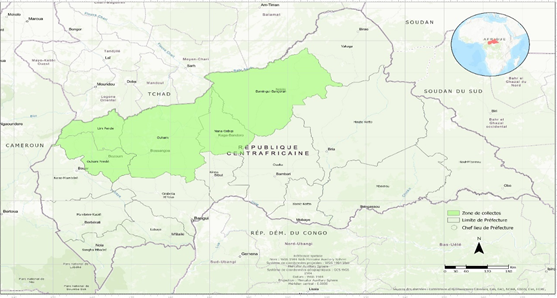
1.1. LocationThe Central African watershed of Lake Chad is divided between two river basins: the Chari and the Logone Oriental (Pendé). It extends over four countries: Sudan, Chad, Central African Republic and Cameroon. The basin stretches from latitude 5°35'N at the source of the FAFA to latitude 10°56'N at the TIZI pond. In longitude, the basin originates in the Adamaoua massif at 15°10'E to 22°53'E. Cameroon and the Central African Republic only occupy around 2% and 9% of the Chad basin's surface area, but three-quarters of the lake's water supply comes from the wetlands of these two countries. The Chad Basin is a vast endoreic basin whose surface waters are directed towards Lake Chad (see Figure 1 below).

The Central African watershed of Lake Chad is characterized by low rainfall. It extends from the Yadé massif in the west to the Dar Challa massif in the northeast, via the Bongos Escarpment in the east and northeast. The region is made up of dry tropical forests and wooded savannahs, which do not contribute effectively to the recycling of atmospheric humidity. This climate affects the regions at the origin of the many rivers.
Here, the rhythm of life depends entirely on the regular alternation between a rainy season, a period of intense agricultural activity, and a dry season, a time for harvesting, trade and travel. It is therefore the climate that must be given pride of place in the study of the physical environment. The Chadian basin has a succession of tropical climates with dry nuances, i.e. where a dry season and a wet season predominate successively and without division. The duration of each of these seasons is strictly related to latitude. The quantity and duration of rainfall depend directly on the position of the air masses, which clash and move according to the sun's zenithal position. The dry, Saharan continental air mass, which extends over Libya and the Sahara, sends a northeasterly trade wind that blows throughout the dry season, reaching the southern part of the basin in January-February. The humid maritime air mass coming from the Gulf of Guinea provides a south-westerly monsoon flow (in fact, this is an austral trade wind deviated from south-east to south-west as it crosses the geographic equator). Its advance is greatest in August north of Lake Chad. This maritime air mass slides in a wedge shape beneath the continental air mass.
1.3. HydrogeologyThe study area comprises the prefectures of Ouham, Ouham-Pendé, Lim-Pendé, Vakaga, Bamingui-Bangoran and Nana-Gribizi. Two hydrogeological formations characterize the project area: the non-carbonate Precambrian formation, which occupies over 75% of CAR's surface and is the most geologically varied; and the sandy and clayey Tertiary and Quaternary formations. It includes all the basic complex with highly recrystallized rocks (granites, gneisses, granulites, amphibolites, schists, quartzites), as well as the slightly metamorphic rocks of the Upper Paleoproterozoic (shales, sandstones, quartzites).
1.4. GeologyThe study area lies to the north and north-west of the Central African Republic, between 15° and 17° east longitude, and between 5° and 7° north latitude. The geology of the Ouham (North) region was highlighted during the mapping of Central Africa. In general terms, the Ouham geology consists of a bedrock composed of Precambrian basement on which rest eruptive and metamorphic formations (migmatics, frank quartzites, schists and micaschists, etc.) and continental terminal surface formations (fine sandstones degraded to sand, lateralized sandstones, etc.). During the course of this study, more specifically in the town of Bossangoa, a few outcrops of the superficial formations were observed; the other outcrops, although existing, were not observed directly due to the dense vegetation cover during the rainy season. The geology of the Ouham Péndé and Lim Péndé is predominantly magmatic (granitic) and metamorphic. From the Bossemptélé axis to Bocaranga, there are old or recent syntectonic granites in batholiths, as well as quartzite quarries to the south-west and north-east of Bozoum. These outcrops are also found to the southeast of Bocaranga.
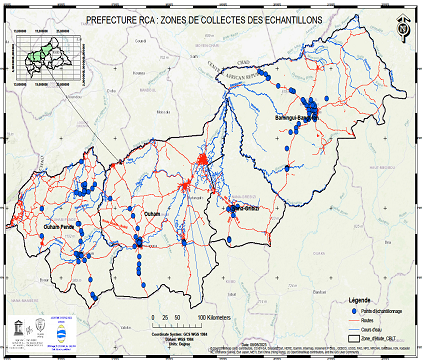
After the initial phase of reconnaissance of the structures to be sampled in the field by the laboratory team. Two field campaigns were organized: the first from September 20 to 29, 2022, and the second from January 19 to 26, 2023. The missions mainly covered the North and North-West regions, including the towns of Bossangoa, Bozoum, Bocaranga and Paoua. A total of 62 water points (boreholes, springs, wells, streams, ponds, etc.) were sampled in this area, which forms the headwaters of CAR's Lake Chad basin. At the same time, a second team carried out sampling in the Kaga-Bandoro, Ndélé and Birao (Aouk) region, during which an additional 33 samples were taken, bringing the total number of samples per campaign to 95. The sampling points were carefully selected to cover the entire study area, and are mainly located in the clayey-schistose and sandstone formations of northern CAR. These points are listed in Figure 2 below.
The following in situ analyses were carried out on each water sampling point:
- pH (WTW 340i pH meter) ;
- electrical conductivity and temperature (WTW 340i conductivity meter).
- Alkalinity (HACH alkalinity test kit);
A series of samples were taken for various chemical and isotopic analyses:
- 2 x 30 ml pillboxes for deuterium and oxygen-18 analysis.
- 1 x 0.5 l bottle for tritium analysis at 16 points;
- 3 x 30 ml bottles filtered at 0.45 μm for cations (then acidified with pure nitric acid), anions and trace elements (then acidified with ultra-pure nitric acid). At each borehole and well, measurements and samples were taken after sufficient renewal of the water in the column, where equipment permitted. Stable isotope analyses of the water molecule were carried out at the Laboratoire du Centre National de l'Energie, des Sciences et des Techniques Nucléaires (CNESTEN) in Morocco.
- Cations were detected by a Varian AA55 atomic absorption spectrometer, either by absorption or emission, while anions were analyzed by JENWAY 6850 dual-beam UV-visible spectrometry.
The pH of the samples analyzed was around 4.00 and tending towards 7. This range reflects the acidic and alkaline nature of the water in this region. The waters in this region are more acidic, as they are hydraulically connected to crystalline subsoil aquifers and are clearly influenced by mixing with poorly mineralized hard rock groundwater. The temperature of the groundwater varies in most cases between 26 and 31.5 degrees, reflecting the region's average atmospheric temperatures.
Electrical conductivity values ranged from 13.7 µS/cm to 555 µS/cm in the Bamingui-Bangoran-Birao and Aouk regions, and from 2.13 to 1058 µS/cm in the Ouham and Lim-Pendé regions. Variations in electrical conductivity indicate a diversity of groundwater chemistry between regions. Relatively low values in some areas (13.7 μS/cm) suggest low mineralization, while high values (up to 1058 μS/cm) reflect higher mineralization, linked to geological interactions or anthropogenic inputs 1, 2.
3.2. Water ChemistryMajor elements enable us to refine our field approach and identify the main interaction processes between water and rocks.
In the wet season, calcium levels vary between 4.4 and 42.4 mg/l for all drilling points. Magnesium values ranged from 0.29 to 23.5 mg/l. Sodium levels range from 3.5 to 88 mg/l, while potassium levels are low, varying from 1.8 to 4.8 mg/l.
These chemical characteristics reflect moderate to low mineralization of groundwater in the basin, influenced by water-rock interactions, hydrodynamic conditions and recent recharge due to seasonal precipitation 3.
Bicarbonate (HCO₃-) contents are high, ranging from 29.3 to 373.5 mg/l.
Bicarbonate (HCO₃-) levels are high at all drilling points, with values ranging from 29.3 to 373.5 mg/l. Chlorides range from 0.3 to 25.1 mg/l. Nitrates and sulfates are within acceptable levels for the aquatic environment.
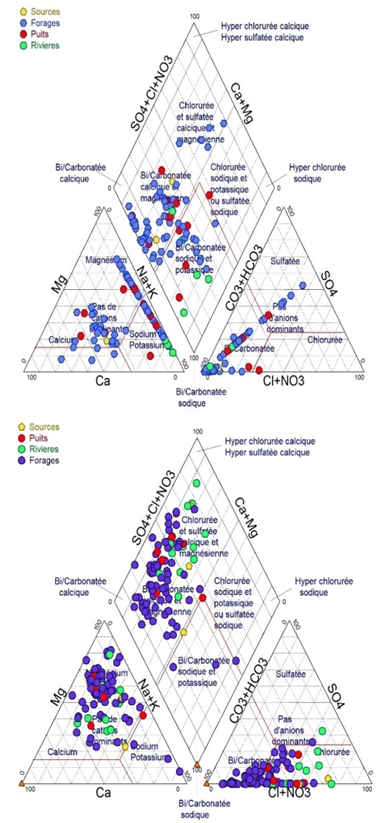
Overall, these results suggest that groundwater is of good chemical quality, influenced mainly by natural weathering processes and moderate recharge, with little anthropogenic impact in the areas studied. The Piper diagram was used to classify the waters according to facies.
The diagram shows that the dominant anion is the HCO₃- ion for almost all the waters analyzed; these waters are therefore all bicarbonated. As far as cations are concerned, there is no dominant ion in all cases (mixed facies). We note that some waters from the fissure/fracture nappe are close to the calcic pole, while others stand out clearly towards the zone with no dominant cation.
In summary, the waters present bicarbonate, calcium-magnesium, sodium-bicarbonate and potassium-bicarbonate facies, as well as a convergence type evolving towards chloride and nitrate types, testifying to superficial contributions. Due to interactions with the Precambrian rock matrix, and in the northeast with Tertiary and Quaternary deposits of the Chadian basin, as well as mixing with the surface waters of swamps and major rivers such as the Ouham, Fafa, Nana Baria, Nana Bakassa, Bamingui, Vassako, Ngarba, Sharie, Gribingui, Bangoran, etc., which flow from the northern part of the region to the northwest, which flow from the southern regions of the Lake Chad basin. In this context, interactions between groundwater and the aquifer rock matrix are brief (as clearly shown by the undersaturation of calcite in the samples). This bicarbonate, calcic, magnesian and sodic or potassic facies reflects the specificity of their origin (the head of the watershed) and the probably very short residence time in a relatively humid region of the Lake Chad basin 4, 5, 6. The distribution of the main ions depends on both the intensity of evaporation processes and the intensity of water-rock interaction processes, which are linked to groundwater residence time.


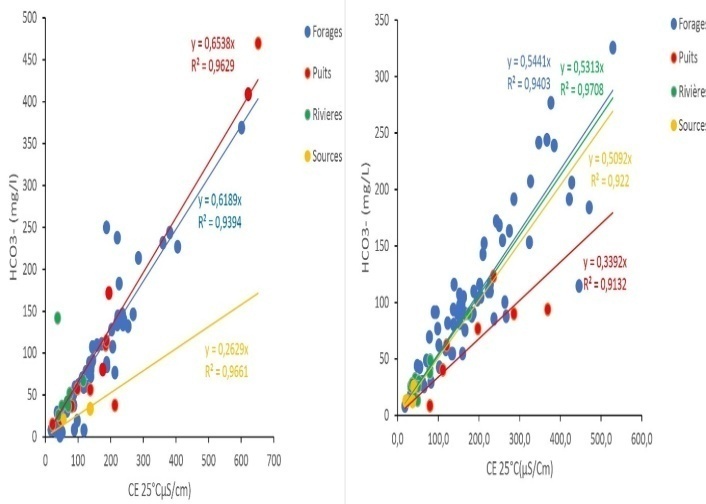
HCO3- levels are generally moderate in the crystalline environment, with a concentration of around 100 to 150 mg/l. Above 200 mg/l, this suggests that CO₂ is produced in the aquifer from the mineralization of organic matter 7, 8, 9. There is a fairly good correlation between conductivity and alkalinity (Figure), especially for water from river and spring well boreholes (inset). This confirms that bicarbonates make up the bulk of mineralization. However, samples that deviate significantly from this trend are mainly those from wells, springs and rivers, probably affected by significant pollution by elements of anthropogenic origin 10, 11, 7. The use of chemical pollutants such as mercury in the Bozoum region to exploit gold deposits has been reported. Previous studies have shown that mining companies use this toxic metal to improve production yields. .
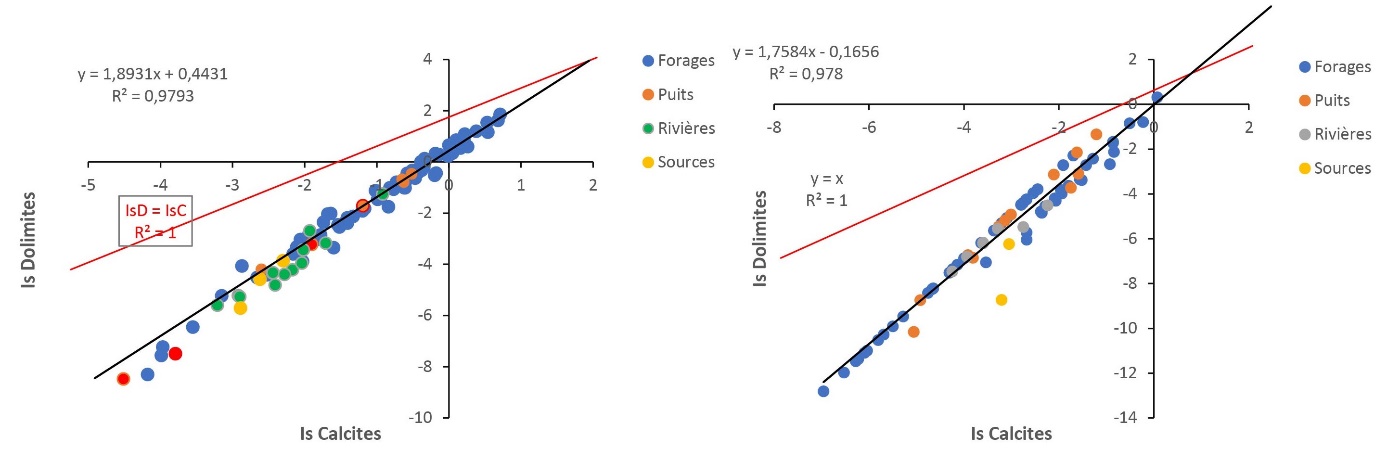
3.4. Saturation IndexA simple model from the PREEQC geochemical program is used to determine the saturation indices of the minerals responsible for the mineralization of the region's groundwater, in relation to the surrounding terrain. An SI value greater than zero indicates that the groundwater is supersaturated with respect to the mineral material concerned, and therefore unable to dissolve many minerals. Such an index value reflects groundwater originating from an aquifer containing a sufficient quantity of the mineral concerned, with a sufficiently long residence time to reach equilibrium. Nevertheless, supersaturation can also be produced by other factors, such as incongruent dissolution, common ion effect, evaporation, rapid rise in temperature and dissolved CO₂ concentration 10, 12, 13. Saturation Index (SI) results for the two campaigns are plotted in Figure 188 below. Two categories of resources are distinguished: saturated water (deep aquifers) and undersaturated water (superficial aquifers) with respect to calcite, dolomite, anhydrite, gypsum and aragonite. Ionic strength values range from a minimum of 3.10-4 atm to a maximum of 132.8 atm, with an average value of 62.8 ± 60.91 atm. Most waters are very rich in dissolved CO2, with values obtained overall higher than that of the atmosphere (3.16.10-4 atm). These results suggest that the system is open to soil CO2 14, 12, 8.


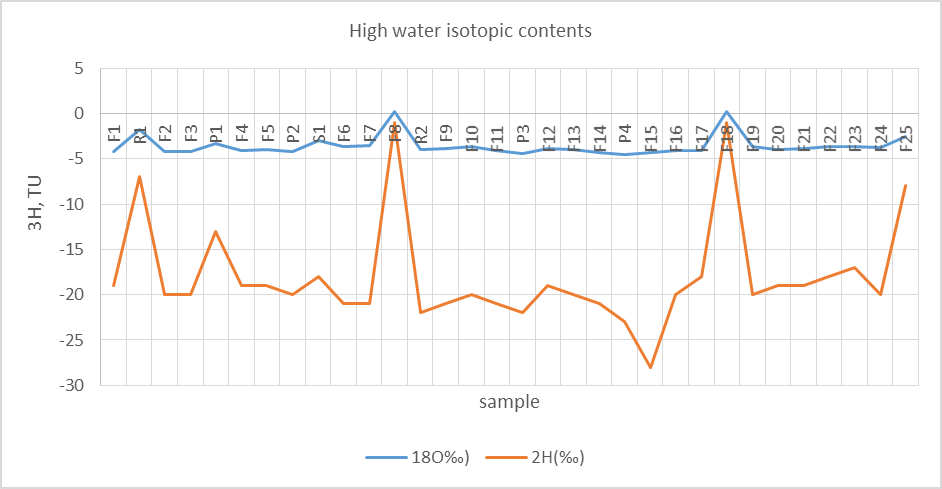
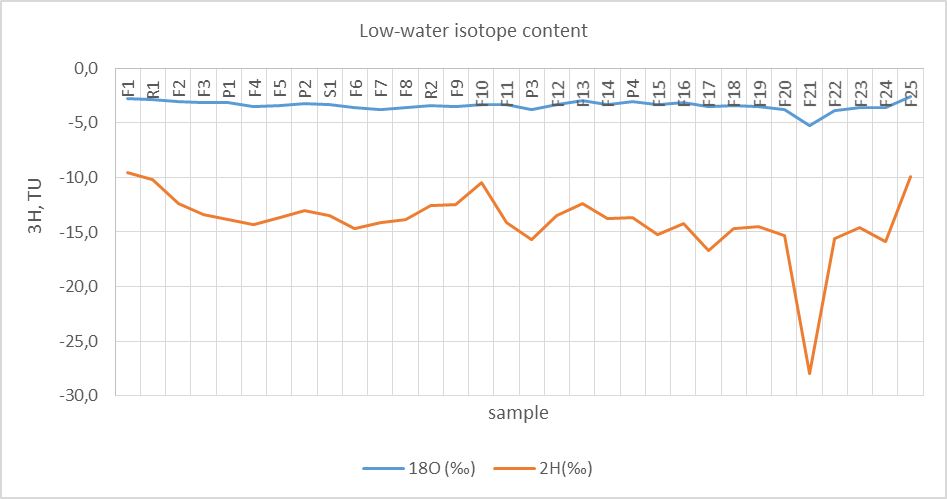
Isotope contents vary as follows: 2H between -2 ‰ and -1 ‰, 18 O from -4.5 ‰ to 0.2 ‰ during the wet season and 2H between -27.9 ‰ and -1 ‰, 18 O from -5.3 ‰ to 0.2 ‰ during the dry season. These results show isotope depletion during high water and enrichment during low water. Surface and groundwater isotope data collected across the region clearly indicate that tritium is ubiquitous, indicative of active groundwater recharge and a dynamic interconnection between surface and groundwater bodies 15, 16, 17 .
Isotope data collected at new Global Network for Isotopes in Precipitation (GNIP) and Global Network for Isotopes in Rivers (GNIR) stations, notably in N'Djamena and Bangui, showed higher values than expected, meaning that this tracer can be used more widely to date the age of groundwater 18, 19, 20. Transboundary and shared aquifers in Quaternary formations show active and high recharge rates, linked to episodes of heavy rainfall.
We also analyzed the tritium present in the sampled waters. Tritium is a radioactive element that enters the water cycle through precipitation. Its presence in groundwater in concentrations greater than one tritium unit (TU) indicates current recharge. On the other hand, water with a concentration of less than 1 TU is considered ancient, dating back to pre-1952, the date of the first nuclear tests.
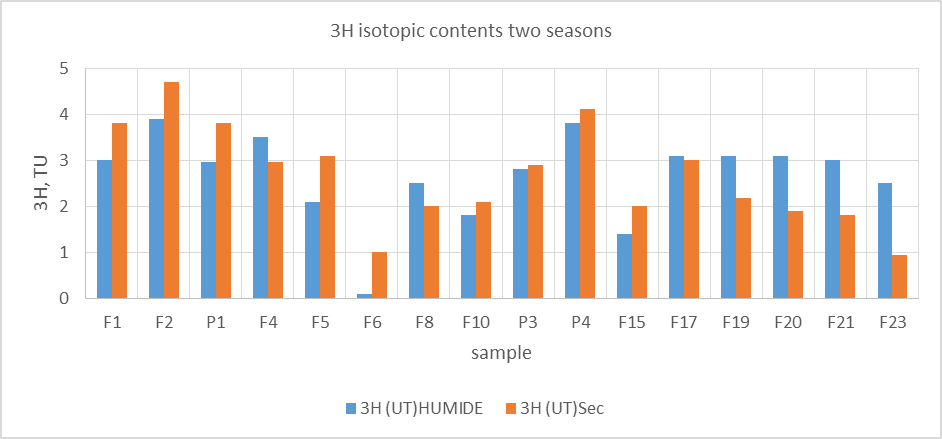
In groundwater in the northern part of CAR, results vary from 0 to 3.9 TU in the wet season and from 0 to 4.7 TU in the dry season for tritium (3H). These values indicate:
- Pre-nuclear recharge for waters with a 3H concentration of less than 1 TU;
- Post-nuclear recharge for waters with 3H concentrations above 1 TU.
- Post-nuclear recharge for waters with 3H concentrations above 1 TU.
Groundwater samples from the Central African Republic can be seen as an illustration of the modern isotopic signature of groundwater at the head of the southern watershed, even though these waters are not connected to the rest of the shallow hydrogeological structures, with 18O values varying between -4 and -5.3% and tritium activities between 2 and 4 TU 15, 21, 20. In addition, two different recharge processes can be distinguished for aquifers: Boreholes have a distant, homogeneous recharge, while wells have a local recharge 15, 16, 22.
The issue of groundwater resilience to climate change is a major scientific topic throughout the Nord-RCA region. It would appear that surface aquifers in the region are somewhat resilient to climate change, but studies confirming this are still few and far between, and the issue still requires further investigation and confirmation. From a chemical point of view, only a few wells and springs show a highly anthropized facies, reflecting mixtures between groundwater and various pollutant sources, such as sanitation water (latrines) and washing water. With regard to nitrate levels, only a few sectors showed local contamination of anthropogenic origin, with nitrate concentrations generally low (< 50 mg/l). HCO3- levels are generally moderate in the crystalline environment (100 to 150 mg/l) and account for most of the mineralization. However, two other phenomena also contribute to the mineralization of water in the study area: soil rainfall and pollution of surface water by human activities. The use of mercury in mining activities increases the risk of contamination for human beings living in the vicinity of the pollution. The results of stable isotope analyses of water have shown that tritium (3H) levels vary from 0 to 3.9 TU in groundwater in the northern part of CAR during the wet season, and from 0 to 4.7 TU in dry-season samples.
These levels indicate:
- post-nuclear recharge for waters with 3H levels above 1 TU;
- pre-nuclear recharge for waters with 3H levels below 1 TU.
- post-nuclear recharge for waters with 3H contents above 1 TU.
In general, shallow waters (< 40 m) are characterized by high tritium levels, as are the wells sampled. The combined analysis of hydroclimatic, hydrodynamic, hydrochemical and isotopic approaches has enabled us to establish a diagnosis of the vulnerability of aquifers in the Lake Chad basin north of the Central African Republic to climate change. However, the development of a rational exploitation strategy would make it possible to develop these waters while preserving their long-term potential.
Acknowledgre: The authors would like to thank the staff of the Laboratoire Hydrosciences at the University of Bangui for the sampling campaigns, the Agence Nationale de l'Energie Atomique (AIEA) and the Lake Chad Basin Commission (LCBC), which funded this study.
The authors declare that they have no competing interest.
| [1] | Adelana S.M.A., Olasehinde P.I., and Vrbka P., 2003, Isotope and geochemical characterization of surface and subsurface waters in the semi-arid sokoto basin, nigeria African Journal of Science and Technology (AJST), Science and Engineering Series Vol. 4, No. 2, pp. 80-89. | ||
| In article | View Article | ||
| [2] | Agodzo S.K., Obuobie E., Braimah C.A., 2014, the effects of irrigation dams on water supply in Ghana, International organization of Scientific Research Journal of Engineering, Vol. 4(5): 48-53. | ||
| In article | View Article | ||
| [3] | ABN (2007): Etude sur l’élaboration du plan d’action de développement durable du bassin du Niger: Rapport de bilan diagnostic. 405pp. | ||
| In article | |||
| [4] | BGR (2009): A review of the groundwater situation in the Lake Chad Basin. Report, 18 pages. | ||
| In article | |||
| [5] | BGR (2012): Groundwater needs assessment in the Lake Chad Basin. Report, 14 pages. | ||
| In article | |||
| [6] | BGR (2013a): Discharge Measurements at Chari, Logone and Koulambou River, Chad (July 2013). Report, 18 pages. | ||
| In article | |||
| [7] | BOUCHEZ C. (2015): Bilan et dynamique des interactions rivières-lac(s)-aquifères dans le bassin hydrologique du lac Tchad. Approche couplée géochimie et modélisation des transferts. Thèse Doct. Univ. Aix-Marseille. | ||
| In article | |||
| [8] | BOULVERT Y. (1987): Importance réduite du Continental Terminal en Centrafrique. Doc. ORSTOM. BRG (2010): Investigation on water quality in the southeastern part of the Lake Chad Basin. Report, 35 pages. | ||
| In article | |||
| [9] | Leduc C., Favreau G., Schroeter P. (2001): Long-term rise in a Sahelian water-table: the Continental Terminal in South-West Niger. Journal of Hydrology, 243, 43-54. | ||
| In article | View Article | ||
| [10] | Ako, A.A., Eyong, G.E.T. & Nkeng, G.E. Water Resources Management and Integrated Water Resources Management (IWRM) in Cameroon. Water Resour Manage 24, 871–888 (2010). | ||
| In article | View Article | ||
| [11] | BUCREP (2011): Rapport national sur l’état de la population au Cameroun. Bureau central des recensements et des études de population, 96p. | ||
| In article | |||
| [12] | BGR (2016): Groundwater-Surface Water interaction in the Lower Logone floodplain. Report, 49 pages. BORONINA A., RAMILLIEN G. (2008): Application of AVHRR imagery and GRACE measurements for calculation of actual evapotranspiration over the Quaternary aquifer (Lake Chad Basin) and validation of groundwater models. Journal of Hydrology, vol. 348, p. 98 à 109. | ||
| In article | View Article | ||
| [13] | KPEGLI K.A.R., ALASSANE A., TRABELSI R., ZOUARI K., BOUKARI M., MAMA D., DOVONON F.L., and YOXI Y.V., TORO-ESPITIA L.E. (2015): Geochemical processes in Kandi Basin, Benin, West Africa: A combined hydrochemistry and stable isotopes approach. Quaternary International, 369, 99-109. | ||
| In article | View Article | ||
| [14] | Akujieze C.N., Coker S.J.L., Oteze G.E., 2003, Groundwater in Nigeria – a millennium experience –distribution, practice, problems and solutions, Hydrogeology Journal, 11: 259–274. | ||
| In article | View Article | ||
| [15] | KETCHEMEN B. (1992): Etude hydrogéologique du Grand Yaéré (Extrême Nord du Cameroun), synthèse hydrogéologique et étude de la recharge par les isotopes de l’environnement. Thèse Doctorat, Université Cheikh Anta Diop, Dakar, 172p. | ||
| In article | |||
| [16] | Kuicha D., Takounjou A.L.F, Ndjama J., 2013, l’hydrochimie et l’isotope de l’environnement à la connaissance des ressources en eaux souterraines de Yaoundé, Cameroun, Journal of Applied Biosciences 67: 5194– 5208. | ||
| In article | View Article | ||
| [17] | LE BARBE L., ALE G., MILLET B., TEXIER H., BOREL Y., GUALDE R. (1993): Les ressources en eaux superficielles de la République du Bénin. Editions de l’ORSTOM, Collection Monographies Hydrologiques N°11, Paris. | ||
| In article | |||
| [18] | KPEGLI K.A.R., ALASSANE A., VAN DER ZEE S.E.A.T.M, BOUKARI M., MAMA D. (2018): Development of a conceptual groundwater flow model using a combined hydrogeological, hydrochemical and isotopic approach: A case study from southern Benin. Journal of Hydrology: Regional Studies, 18, 50-67. | ||
| In article | View Article | ||
| [19] | Lierscha S., Fournet S., Koch H., Gado Djibo A., Reinhardt J., Kortlandt J., Van Weert F., Seidou O., Klop E., Baker C., Hatterman F.F., 2019, Water resources planning in the Upper Niger River basin: Are there gaps between water demand and supply?, Journal of Hydrology: Regional Studies, vol.21: 176-194. | ||
| In article | View Article | ||
| [20] | Diamond, Roger E., 2022, Stable Isotope Hydrologyk. The Groundwater Project, Guelph, Ontario, Canada. | ||
| In article | |||
| [21] | Loehnert E. P., 1988, Major chemical and isotope variations in surface and subsurface waters of West Africa Journal of African Earth Sciences, Vol. 7, No. 3, pp. 579-588. | ||
| In article | View Article | ||
| [22] | Leduc C., Sabljak S., Taupin J.D, Marlin C., Favreau G., 2000, Estimation de la recharge de la nappe quaternaire dans le Nord-Ouest du bassin du lac Tchad (Niger oriental) à partir de mesures isotopiques, CRAS 330: 355–361. | ||
| In article | View Article | ||
Published with license by Science and Education Publishing, Copyright © 2025 B. Nguerekossi, V. Namndouta Ngaïsssona, E. Foto and O. Allahdin
 This work is licensed under a Creative Commons Attribution 4.0 International License. To view a copy of this license, visit
http://creativecommons.org/licenses/by/4.0/
This work is licensed under a Creative Commons Attribution 4.0 International License. To view a copy of this license, visit
http://creativecommons.org/licenses/by/4.0/
| [1] | Adelana S.M.A., Olasehinde P.I., and Vrbka P., 2003, Isotope and geochemical characterization of surface and subsurface waters in the semi-arid sokoto basin, nigeria African Journal of Science and Technology (AJST), Science and Engineering Series Vol. 4, No. 2, pp. 80-89. | ||
| In article | View Article | ||
| [2] | Agodzo S.K., Obuobie E., Braimah C.A., 2014, the effects of irrigation dams on water supply in Ghana, International organization of Scientific Research Journal of Engineering, Vol. 4(5): 48-53. | ||
| In article | View Article | ||
| [3] | ABN (2007): Etude sur l’élaboration du plan d’action de développement durable du bassin du Niger: Rapport de bilan diagnostic. 405pp. | ||
| In article | |||
| [4] | BGR (2009): A review of the groundwater situation in the Lake Chad Basin. Report, 18 pages. | ||
| In article | |||
| [5] | BGR (2012): Groundwater needs assessment in the Lake Chad Basin. Report, 14 pages. | ||
| In article | |||
| [6] | BGR (2013a): Discharge Measurements at Chari, Logone and Koulambou River, Chad (July 2013). Report, 18 pages. | ||
| In article | |||
| [7] | BOUCHEZ C. (2015): Bilan et dynamique des interactions rivières-lac(s)-aquifères dans le bassin hydrologique du lac Tchad. Approche couplée géochimie et modélisation des transferts. Thèse Doct. Univ. Aix-Marseille. | ||
| In article | |||
| [8] | BOULVERT Y. (1987): Importance réduite du Continental Terminal en Centrafrique. Doc. ORSTOM. BRG (2010): Investigation on water quality in the southeastern part of the Lake Chad Basin. Report, 35 pages. | ||
| In article | |||
| [9] | Leduc C., Favreau G., Schroeter P. (2001): Long-term rise in a Sahelian water-table: the Continental Terminal in South-West Niger. Journal of Hydrology, 243, 43-54. | ||
| In article | View Article | ||
| [10] | Ako, A.A., Eyong, G.E.T. & Nkeng, G.E. Water Resources Management and Integrated Water Resources Management (IWRM) in Cameroon. Water Resour Manage 24, 871–888 (2010). | ||
| In article | View Article | ||
| [11] | BUCREP (2011): Rapport national sur l’état de la population au Cameroun. Bureau central des recensements et des études de population, 96p. | ||
| In article | |||
| [12] | BGR (2016): Groundwater-Surface Water interaction in the Lower Logone floodplain. Report, 49 pages. BORONINA A., RAMILLIEN G. (2008): Application of AVHRR imagery and GRACE measurements for calculation of actual evapotranspiration over the Quaternary aquifer (Lake Chad Basin) and validation of groundwater models. Journal of Hydrology, vol. 348, p. 98 à 109. | ||
| In article | View Article | ||
| [13] | KPEGLI K.A.R., ALASSANE A., TRABELSI R., ZOUARI K., BOUKARI M., MAMA D., DOVONON F.L., and YOXI Y.V., TORO-ESPITIA L.E. (2015): Geochemical processes in Kandi Basin, Benin, West Africa: A combined hydrochemistry and stable isotopes approach. Quaternary International, 369, 99-109. | ||
| In article | View Article | ||
| [14] | Akujieze C.N., Coker S.J.L., Oteze G.E., 2003, Groundwater in Nigeria – a millennium experience –distribution, practice, problems and solutions, Hydrogeology Journal, 11: 259–274. | ||
| In article | View Article | ||
| [15] | KETCHEMEN B. (1992): Etude hydrogéologique du Grand Yaéré (Extrême Nord du Cameroun), synthèse hydrogéologique et étude de la recharge par les isotopes de l’environnement. Thèse Doctorat, Université Cheikh Anta Diop, Dakar, 172p. | ||
| In article | |||
| [16] | Kuicha D., Takounjou A.L.F, Ndjama J., 2013, l’hydrochimie et l’isotope de l’environnement à la connaissance des ressources en eaux souterraines de Yaoundé, Cameroun, Journal of Applied Biosciences 67: 5194– 5208. | ||
| In article | View Article | ||
| [17] | LE BARBE L., ALE G., MILLET B., TEXIER H., BOREL Y., GUALDE R. (1993): Les ressources en eaux superficielles de la République du Bénin. Editions de l’ORSTOM, Collection Monographies Hydrologiques N°11, Paris. | ||
| In article | |||
| [18] | KPEGLI K.A.R., ALASSANE A., VAN DER ZEE S.E.A.T.M, BOUKARI M., MAMA D. (2018): Development of a conceptual groundwater flow model using a combined hydrogeological, hydrochemical and isotopic approach: A case study from southern Benin. Journal of Hydrology: Regional Studies, 18, 50-67. | ||
| In article | View Article | ||
| [19] | Lierscha S., Fournet S., Koch H., Gado Djibo A., Reinhardt J., Kortlandt J., Van Weert F., Seidou O., Klop E., Baker C., Hatterman F.F., 2019, Water resources planning in the Upper Niger River basin: Are there gaps between water demand and supply?, Journal of Hydrology: Regional Studies, vol.21: 176-194. | ||
| In article | View Article | ||
| [20] | Diamond, Roger E., 2022, Stable Isotope Hydrologyk. The Groundwater Project, Guelph, Ontario, Canada. | ||
| In article | |||
| [21] | Loehnert E. P., 1988, Major chemical and isotope variations in surface and subsurface waters of West Africa Journal of African Earth Sciences, Vol. 7, No. 3, pp. 579-588. | ||
| In article | View Article | ||
| [22] | Leduc C., Sabljak S., Taupin J.D, Marlin C., Favreau G., 2000, Estimation de la recharge de la nappe quaternaire dans le Nord-Ouest du bassin du lac Tchad (Niger oriental) à partir de mesures isotopiques, CRAS 330: 355–361. | ||
| In article | View Article | ||