OPEN ACCESS
 PEER-REVIEWED
Assessment of Motor Fitness, Physical Fitness and Body Composition of Women Football Players at Different Levels of their Participation
Rajkumar Sharma
Abstract
Objective :Many of scientific investigations on women’s football specific to the topics of player characteristics has considerably increased in recent years due to the increased popularity of the women’s game in India and world. Therefore, the present investigation aim was to assess the different motor levels of women football players from various competitive levels i.e. motor fitness, physical fitness and body composition. Participants: Fifty women football players of three different competitive levels volunteered to participate in this study, were selected as the subjects from the state of Chhattisgarh. The age, height, weight, Body Mass Index, Explosive power of arms and shoulder, Explosive power of legs, speed., Agility and Cardiovascular endurance (PFI) were taken as a criterion measure for the present study. This investigation included National level (N= 17, age =21.29 ± 1.21 years, height=162 ± 0.06 cm, weight= 49.76 ± 3.21 kg ), Interuniversity level (N=17, age =20.53 ± 1.33 years, height=161 ± 0.03 cm, weight= 49.12 ± 2.57 kg), and state level N= 16, age =21.19 ± 1.38 years, height=161 ± 0.03 cm, weight= 48.38 ± 5.21 kg) women football player’s physical fitness, motor fitness and body composition were measured. Methods: All the subjects were asked to execute the physical performance tests Haward Step Test measure cardiovascular endurance), (Medicine Ball Throw measure explosive power of arms and shoulder), (Standing Broad Jump measure explosive power of legs ), ( Zig-Zag Run measure agility & speed) and (Shuttle Run measure agility). Age (years) of the participants was recorded from the academic record of the schools, were weights were measures by using a digital scale (Harpenden Balance Scale), Standing heights were measured with Harpenden portable stadiometer and. Body mass Index (BMI) was calculated as weight (kg) divided by the square of the height (m). To assess the motor fitness, physical fitness, and body composition of three different level women football players, means, standard deviations and F-ratios were computed. The level of significance was set at a p<0.05. The statistical package for social science (SPSS 16.0 version) software package was used to analyze the data. Results: Descriptive statistics resulted similarity in anthropometric characteristics of national level, inter- university level and state levels female Football players. One way analysis of variance (ANOVA) with physical fitness, motor fitness and BMI of women Football players of National, Inter-university and state level and motor fitness resulted in insignificant F-ratio for zigzag run (1.24), shuttle run (1.07), medicine ball throw(1.42) and standing broad jump(0.52). P.F.I.(1.73) and B.M.I.(0.93). Conclusion: Similarity was expressed by women Football players of national, inter-university and state levels in their selected anthropometric characteristic, Physical fitness and motor fitness components.
Keywords: motor fitness, physical fitness, anthropometric characteristics, competitive levels
Copyright © 2015 Science and Education Publishing. All Rights Reserved.Cite this article:
- Rajkumar Sharma. Assessment of Motor Fitness, Physical Fitness and Body Composition of Women Football Players at Different Levels of their Participation. American Journal of Sports Science and Medicine. Vol. 3, No. 2, 2015, pp 47-54. http://pubs.sciepub.com/ajssm/3/2/4
- Sharma, Rajkumar. "Assessment of Motor Fitness, Physical Fitness and Body Composition of Women Football Players at Different Levels of their Participation." American Journal of Sports Science and Medicine 3.2 (2015): 47-54.
- Sharma, R. (2015). Assessment of Motor Fitness, Physical Fitness and Body Composition of Women Football Players at Different Levels of their Participation. American Journal of Sports Science and Medicine, 3(2), 47-54.
- Sharma, Rajkumar. "Assessment of Motor Fitness, Physical Fitness and Body Composition of Women Football Players at Different Levels of their Participation." American Journal of Sports Science and Medicine 3, no. 2 (2015): 47-54.
| Import into BibTeX | Import into EndNote | Import into RefMan | Import into RefWorks |
At a glance: Figures
1. Introduction
Football is a unique sport, with matches involving intermittent high intensity sprints between periods of jogging and walking and repeated physical contact. Endurance, speed, strength, power and agility are essential physical characteristics [1]. In football training special and multifaceted motor abilities have direct impact on the special fitness of the football players. Depending on the needs, they can be helpful as a selection criterion and useful for the evaluation of the progress in the player abilities.
Women in team sports may consume diets with a low energy intake, due to the desire to lose or maintain body weight [2]. Age positively and BMI negatively correlated with energy intake /BMR. Age and BMI may influence the relative accuracy of energy intake among adults [3]. Artistic gymnasts reported higher intake of carbohydrates than rhythmic gymnasts. relative to body weight [4]. Players of a higher skill level are taller, somewhat heavier, and have higher vertical jump values than players of a lower level [5]. Body composition of subjects were significantly higher in regular basketball players than in non-regular players [6]. Cardio-respiratory fitness tasks is affected to a certain extent by lower extremity muscular strength. The latter also demonstrates a positive relationship with laboratory-based performance [7]. The sports disciplines strongly affected the nutrition knowledge, attitudes and practices of sportsmen. The overall scores indicate that most sportsmen had good knowledge of nutrition and supplements [8].
Physical fitness is the state of body in which a person can do work for a longer duration effectively and efficiently, without undue fatigue. Good health provides sound and solid foundation on which fitness rests and at the same time fitness provides one of the most important key to health and living one’s life to fullest. The importance of certain physical fitness abilities for success in a wrestling bout varies in wrestlers of various wrestling styles and age. The aim of this research was to identify the differences between the classical style (Greco-Roman) and the free style wrestlers in the variables assessing physical fitness [9]. Fitness had always been a concern of man from pre-historic times. People were not agreed as to what constitute physical fitness though it is important to everyone. The expression "Physically fit" is very much common [10].
The measurement of regular exercise was most favored as a test of physical fitness. These results, taken together with evidence of the physical and psychological health benefits of regular exercise, imply that the most appropriate measure of physical fitness for the average person is an assessment of the habitual physical activity level [11]. A minimum of muscular strength and flexibility and a minimum of cardiovascular reserve are necessary to prevent disease. Although exercise performance can be affected by body weight and composition, these physical measures should not be a criterion for sports performance and daily weigh-ins are discouraged. Adequate food and fluid should be consumed before, during, and after exercise to help maintain blood glucose concentration during exercise, maximize exercise performance, and improve recovery time [12].
Coaches or sport scientists monitoring or modifying fitness of team game players should recognize there is generally little overall change in mean fitness within and between seasons. They should also take into account the small to moderate changes in individuals [13].
Soccer is the most popular worldwide sport which is characterized by high intensity, short-term actions and pauses of vary- ing length [14]. To succeed in a team sport, soccer players need the optimal combination of technical, tactical, physical characteristics (like somatotype) and mental motivation [15]. Indeed, many experts in the field, such as soccer coaches, managers and scientists believe that the success of this sport can be associated with anthropometric characteristics of players.
Indian women football performance has been improved from last decade but still we are lacking in various ways if we compare our women football players with the international arena of women football players like USA, Australia, China, and Brazil and so on we can easily say that we need to concentrate more on physical fitness, Anthropometric and physiological variables so that we can able to give effective results in the map of world women football [16].
Participation in sports is one of the common traits of human character and it starts to develop from the very beginning of childhood. The characteristics of an athlete mainly depend upon physical fitness, having components like muscular strength and endurance, cardio- respiratory endurance, flexibility, speed, power, agility, balance etc. But, these components, may very in sportspersons involving different sports activities. The purpose of the present investigation was to assess the motor fitness, physical fitness and body composition of women football players at different levels of their participation.
2. Methodology
2.1. Selection of SubjectsFifty Indian women football players were selected from Chhattisgarh State were selected to serve as the subjects for this investigation. The sample consisted of 17 National level, 17 Inter-university level and 16 state level women football players. The mean age of National, Inter-university and state level in years were 21.29±1.21, 20.29 ±1.33 and 21.19 ±1.38 respectively. The mean height of National, Inter-university and state level women football players in Centimeters were 162 ±0.06, 161 ±0.03 and 161 ±0.03 respectively. The mean weight of National, Inter-university and state level women football players in kgs. were 49.76 ±3.21, 49.12 ±2.57 and 48.38 ±5.21 respectively. The respondents selected amongst the women football players were those, who had represented state, university and district teams in national, inter-university and state football competitions held in state of Chhattisgarh. The training age of women football players ranged from 03 to 10 years. The playing experience of three levels women football players was 5 years trained six hours per week for 90 to 120 minutes per training session in the morning and evening.
Prior to the investigation, coaches and their players had been informed about the aim of the experimental study and its procedure. Approval and consent were taken together from the coaches and all respondents of the investigation.
2.2. Criterion MeasureThe age, height, weight, Body Mass Index, Explosive power of arms and shoulder, Explosive power of legs, speed., Agility and Cardiovascular endurance (PFI) were taken as a criterion measure for the present study.
2.3. Test ProtocolThe following test were administered on all the subjects, when they were not busy and ready to give their response to conduct the tests by the investigator. These test are given below:
 |
Before the physical tests, age (years), body height (cm), body weight (kg) of the subjects were measured. Age (years) of the women football players was recorded from the academic record of the schools. Subjects were weighed in minimal clothing using a digital scale (Harpenden Balance Scale) to the nearest 0.1 kg. Standing heights were measured with an appropriate stadiometer (Harpenden portable stadiometer) to the nearest 0.1cm. Body mass Index (BMI) was calculated sa weight (kg) divided by the square of the height (m).
2.5. Physical Tests2.5.1. Haward Step Test
Purpose: To measure cardiovascular endurance of the women football players. Equipments: A stopwatch, 20-inch high bench, metronome (optional), stethoscope (optional). Test Administration: The tester gives a demonstration of the stepping up style to be followed by the subjects during the test. If the metronome is available, it should be set to a speed of 120 beats per minute a group of 1 to 4 subjects were asked to start the stepping up and down exercise in consonance with the sounds of metronome and by starting the stopwatch at the signal 'go'. If the metronome is not available, then the tester should do enough rehearsal of counting the pace up-up-down-down, 30 times a minute. The subject was given instructions that on the common 'up' or the first sound of the metronome, she placed one foot on the bench, on the second command up or the second sound of the metronome, she placed both feet fully on bench with the body erect straightening the legs and back. Immediately after reaching the erect posture, she step down one foot at time as the tester gives command 'down-down' (third and fourth sounds of the metronome). The subjects were instructed to repeat the stepping up and down exercise in the above manner for three minutes at the pace of 30 steps per minute. The subject was also asked to take off and step-down with the same foot each time. The tester started the Stopwatch simultaneously with the first take off by the subject and stops the watch after exactly three minutes by giving the 'stop' signal to the subjects who immediately sit down on the bench. In case, any subject stops the exercise or slows down the pace of the exercise due to fatigue and exhaustion, her duration of exercise performed at the correct pace was noted (in seconds) and was asked to stop and sit down. Exactly one minute after the exercise/ the tester starts, counting the pulse rate and records the same for the duration from 1 to 1.5, 2 to 2.5 and 3 to 3.5 minutes. Scoring: The pulse of all the 3 half minute counts recorded are added together and a fitness index was calculated by the following formula.
Fitness Index = Duration of Exercise Period in Seconds x 100 / Sum of three pulse counts after exercise.
2.5.2. Medicine Ball Throw
Purpose: To measure the power of arms and shoulder of the women football players. Equipments: A 6-pound medicine ball, a chair, a small rope, a measuring tape, and marking material (chalk or tape or wooden peg).Test Administration: The subject was asked to take a straight sitting chair and to hold the medicine ball in both hands in such a way that the ball was in front of chest below the chin. A rope was placed around the performer's chest and held tight to the rear by a helper. The performer was asked to push the ball forwards and upwards for a distance using maximum efforts primarily with the arms. Each subject was given three trials. The farthest point where the ball touches first was marked with the help of a wooden peg or tape or chalk as per the feasibility of the marking material depending upon the type of the surface. Scoring: The longest distance measured provides the score of the test out of the three trials.
2.5.3. Standing Broad Jump
Purpose: To measures the power of legs in jumping horizontal distance of the women football players. Equipments: Floor, mat or long jump pit may be used, measuring tape, marking-tape/chalk. Test Administration: A demonstration of the standing broad jump was given to a group of subjects to be tested. The subject was then asked to stand behind the starting line with the feet parallel to each other. She was instructed to jump" as farthest as possible by bending knees and swinging arms to take off for the broad jump in the forward direction. The subject was given three trials. Scoring: The distance between the starting line and the nearest point of landing provides the score of the test. The best (maximum distance) trials was used as the final score of the test. Comments: This is quite simple, practical, reliable and objective test of measuring athletic power of legs in jumping forward.
2.5.4. Zig-Zag Run
Purpose: To Measure agility & speed of the women football players. Equipments: Stop watch, Five sticks if these are not available five chairs can he solve the purpose. Administration: It should be administer, on a floor. The subject has to complete three rounds. Scoring : The time taken by the individual in three rounds will be the score of individual. The score will be taken up to the 1/10 of the second.
2.5.5. Shuttle Run
Purpose: To measure the agility of the women football players. Equipment: Two blocks of wood (2" x 2" x 4"), a stopwatch and marking powder. The subject should wear spikes or run bare foot. Test Administration: Two parallel liens were marked on the floor 10 yards apart used for the test. The two wooden blocks were placed behind one of the lines. The subject was asked to start from behind the other line, on the signal ready go, the timer starts the watch and the subject run towards the blocks, picks-up one block, runs back to the starting line, places the block behind the starting line, runs back and picks-up the second block to be carried back across the starting line. As soon as the second block-was placed on the ground the timer stopped the watch and records the time.
2.6. Statistical AnalysesTo assess the cardiovascular fitness and motor fitness of three different level women football players, means and standard deviations were computed. To assess the significance of differences among three different levels women football players, F-ratios were computed. To check the obtained F-ratio, significance was set at 5%.
3. Results
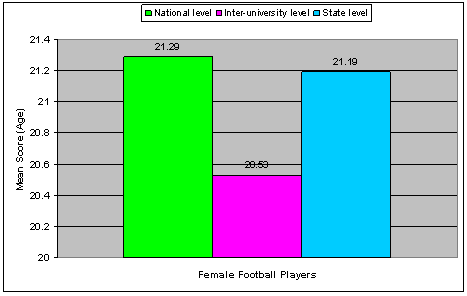
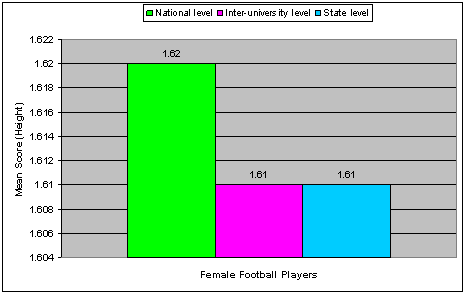
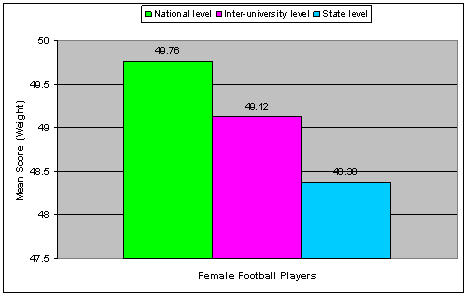
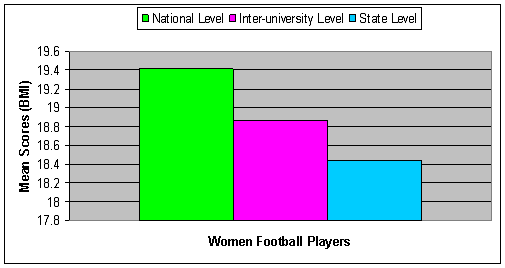
3.1. Anthropometric CharacteristicsFifty women football players of three different competitive levels were included in the present investigation. M±SD of physical characteristics and body composition are presented in Table 1. The mean age, height, weight and BMI of the National level women football players were 21.29 years, 162 cm, 49.76 kg and 19.41 Kg·m-2 respectively, In case of Inter-university level women football players, mean age, height, weight and BMI were 20.53 years, 161 cm, 49.12 kg and 18.86 Kg·m-2 respectively, Whereas the state level women football players were found to have mean age, height, weight and BMI were 21.19 years, 161 cm, 48.38 kg and 18.44 Kg·m-2. respectively, Difference was not expressed by the three competitive level women football players in their age, height and weight. From Table 2, ANOVA revealed the insignificant difference among women Football players of National, Inter-university and state level in their body mass index (F-= 2,47=3.18, p<0.05).
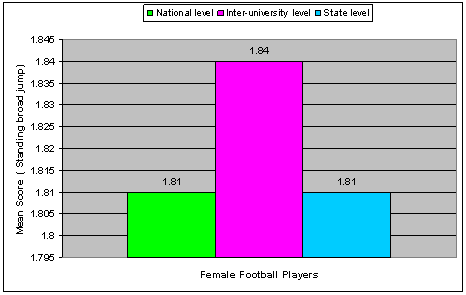
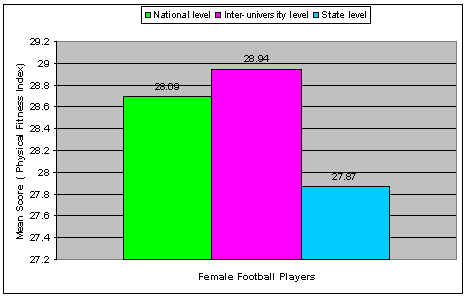
The mean scores of physical characteristics, motor fitness, physical fitness and body mass Index of national, inter- university and state levels of women Football players have been depicted in Figure 1 to Figure 4.
Table 1. Descriptive Statistics of Anthropometric characteristics of Women Football Players at Different Competitive levels

 Download as
Table 2. Analysis of Variance of Body Mass Index among Women Football Players of Three Different Levels

 Download as
 Download as
 Download as
 Download as
This test measured the cardiovascular endurance of the participants. Means and standard deviations of cardiovascular endurance of the women football players of National (28.69±2.06), Inter-university (28.94±1.75) and state (27.87±1.81) levels are presented in Table 3 (Figure 9). ANOVA revealed that women Football players of National, Inter-university and state levels did not differ significantly in their cardiovascular endurance (F 2,47= 3.18, p<0.05) which is presented in Table 4.
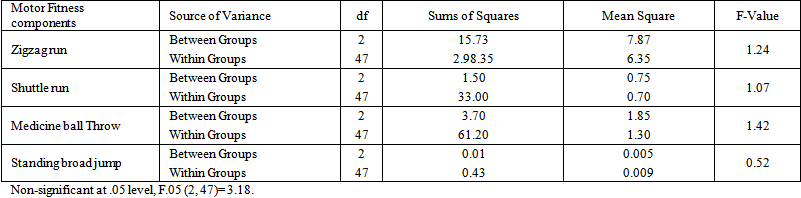
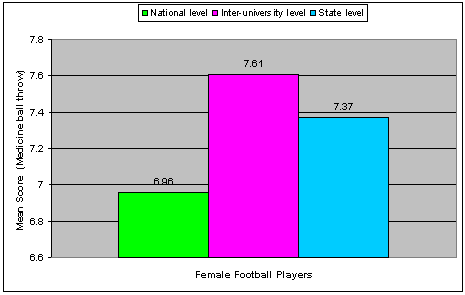
3.3. Medicine Ball Throw TestThis test measured the explosive strength of arm and shoulder of the participants. Means and standard deviations of cardiovascular endurance of the women football players of National (6.96±1.69), Inter-university (7.61±0.76) and state (7.37±0.63) levels are presented in Table 3 (Figure 7). From Table 4, ANOVA resulted insignificant difference among women Football players of National, Inter-university and state levels in their explosive strength of arm and shoulder (F-= 2,47=3.18, p<0.05).
Table 3. Descriptive Statistics of Physical Fitness and Motor Fitness of Women Football Players at Different Competitive Levels

Table 4. Analysis of Variance of Motor levels among Women Football Players of Three Different Levels

This test measured the explosive strength of leg of the participants. Means and standard deviations of cardiovascular endurance of the women football players of National (1.81±0.09), Inter-university (1.84±0.09) and state (1.81±0.09) levels are presented in Table 3 (Figure 8). Table 4, revealed the insignificant difference among women Football players of National, Inter-university and state levels in their explosive strength of leg (F-= 2,47=3.18, p<0.05).
 Download as
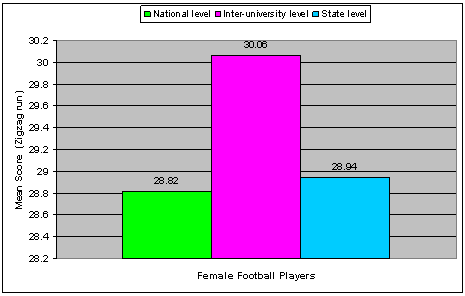
This test measured the agility of women football players of three different competitive levels. Means and standard deviations of agility of the women football players of National (28.82±2.38), Inter-university (30.06±2.51) and state (28.94±2.67) levels are presented in Table 3 (Figure 5). Significant difference was not existed among among women Football players of National, Inter-university and state levels in their agility (F= 2,47=3.18, p<0.05) as mentioned in Table 4.
 Download as
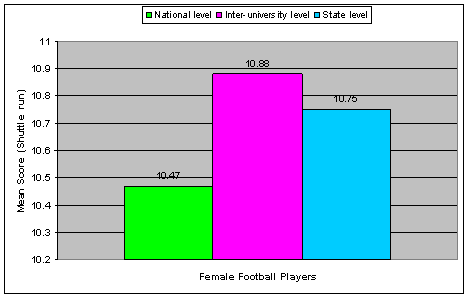
Shuttle run test measured the speed of women football players of three different competitive levels. Means and standard deviations of speed ability of the women football players of National (10.47±0.72), Inter-university (10.88±0.99) and state (10.75±0.77) levels are presented in Table 3 (Figure 6). Significant difference was not observed among women Football players of National, Inter-university and state levels in their speed ability (F= 2,47=3.18, p<0.05) as mentioned in Table 4.
Table 5. Analysis of Variance of Cardiovascular endurance among Women Football Players of Three Different Levels
 Download as
 Download as
 Download as
 Download as
The mean scores of physical characteristics, motor fitness, physical fitness and body mass Index of national, inter- university and state levels of women Football players have been depicted in Figure 4 to Figure 8.
4. Discussion
The aim of the present study was to investigate the specific anthropometric characteristics physical fitness and motor fitness of women football players of three different competitive levels. Data related to anthropometric and physical fitness characteristics of women football players of three different competitive levels were analysed and compared each other. The development of anthropometric characteristics and body composition in our sample was found in similar pattern, while the minor mean differences were found among anthropometric characteristics, and motor levels of women football players at three different competitive levels. Football is a game where a standard physical characteristics with height and weight are required for good performance. Due to concept of total football in modern soccer, most of the players except the goal keeper possessed very similar height and weight irrespective of positions like forward, defense etc. Finding data of descriptive data of three different levels women football players on age, height, weight and BMI indicated that all football players of state, inter-university and national levels were found under weight (18.5- 24.9), as the BMI was obtained 18.44, 18.86, and 19.41 respectively. BMI is associated with physical fitness. Normal BMI perform better in physical fitness tests than higher BMI. Weight of the Indian women was also according to their height [17]. Indian council of medical research also indicated that the reference Indian adult women is between 18-29 years of age and weighs 55 kg with a height of 1.61 m and BMI of 21.2 is free from disease and physically fit for active work [18]. The minute difference was observed in age, weight and height among national, inter-university and state levels women football players.
Finding data of descriptive data of national, inter-university and state levels women football players on agility, speed, power of arm & shoulder, power of leg, and PFI indicated that inter-university level women football players (30.06±2.51) were found more agile than state levels women football players (28.94±2.61), where as state level women football players (28.94±2.38) were found less agile than national level women football players(28.82±2.38). Speed of the inter-university level women football players (10.88±0.99) was more and national level women football players (10.47±0.72) have less speed ability than state level women football players (10.75±0.77). In case of arm and shoulder power of the inter-university level women football players(7.61±0.76), they were also have more power ability in comparison of state level women football players (7.37±0.63). and national level women football players (6.96±1.69). Inter-university level women football players (1.84±0.09) were have more power ability in comparison of state level (1.81±0.09) and national level (1.81±0.09) women football players. where as national level and state level women football players were found to have similar power ability. Physical fitness index of inter-university level football players (28.94±1.75) was better than national level (28.69±2.06) and state level (27.87±1.81) women football players. But state level women football players were have better PFI than national level football players. Earlier many studies by different sport scientists about the anthropometric characteristic, Physical and motor characteristics of female soccer players were examined. These researchers indicated the importance of height, weight, body composition, physical and motor parameters to improve the performance of female soccer players [19, 20, 21, 22].
Relationships between anthropometric and physical fitness characteristics in the whole group of soccer players suggest that those with higher sprint running or vertical jump height performances tend to have lower endurance running capacities [23]. Physical characteristics were similar in club level and country level with the exception of indices of speed and agility, fitness levels are similar in club level and country level The 20 shuttle run test is a modest predictor of V02max in club level and country level [24]. Football player who enjoys a high height is better in the activities of strength and power than in the activities of endurance. Soccer coaches can select young players based on their anthropometry characteristics other than technical and tactical performance in short term [25]. Indian players are not meeting physical and physiological standards expected for professional international footballers [26]. Major fitness differences expressed by gender for a given competitive level in football players. It is suggested that training and talent identification should focus on football-specific endurance and agility as fitness traits in post-adolescent players of both sexes [27]. Anthropometric characteristics and performances in physical fitness tests differed among players of different sports. In addition, for each variable assessed, adolescents who practised team court sports showed similar or improved results compared to their counterparts in the general population [28]. Weight status is closely related with body composition, somatotype and leg muscle power. Therefore, achieving an optimal BMI might result in improvements with regard to physique and anaerobic power, and consequently in performance enhancement [29]. Anthropometric profile of soccer players in the United Arab Emirates is similar to others around the world. However, regarding the physical fitness, results are still inconclusive, since findings from other studies suggest that the anaerobic power of our sample is alike or lower than other elite players throughout the world [30]. Anthropometric and physical fitness characteristics of outdoor sports players have found that elite outdoor sports players must posses superior strength, power and endurance characteristics [31, 32, 33].
Results of ANOVA expressed the insignificant differences among women Football players of national, inter-university and state levels in their physical fitness and motor components i.e. agility, speed, power of arm and shoulder and explosive power of leg. Insignificant differences were also observed among women Football players of National, Inter-university and state level in their cardiovascular fitness and Body Mass Index, This may be due to similarity in training and instruction, feedback, behaviour and social support by their coaches and trainers. The obtained results clearly revealed the similarity among women football players of three different achievement levels, which may be due to similarity in physical fitness program, training program and diet schedule of the all participants of the present study.
5. Conclusions
1. Women football players of state, inter-university and national levels were found under weight.
2. Weight of the women football players was observed according to their height. as mentioned by Indian council of medical research.
3. National level women football players were found have less agility, speed, arm and shoulder power and power of the leg and inter-university level women football players more agility, speed, arm and shoulder power and power of the leg than state level women football players.
4. Cardiovascular endurance of inter-university level football players was better than national and state levels women football players. But state level women football players were have better Cardiovascular endurance than national level football players.
5. Similarity was observed among women Football players of national, inter-university and state levels in their agility, speed, power of arm and shoulder, explosive power of leg, cardiovascular endurance and Body Mass Index.
6. Practical Application
Agility, speed, explosive power of leg, arm and shoulder, normal BMI are the main determinants of sport performance for male and female football players which can be used for the higher levels of performance in game of football. Football coaches should test these parameters in regular training session. Football coaches should assess these performance determinants regularly in order to identify their strengths and weaknesses of male and female football players. These performance determining parameters should be taken into consideration for Talent identification and talent development in the game of football for female and male players.
7. Recommendations
Football is a game of agility, speed, endurance and power of arm, shoulder and leg might also play an important role in the physical fitness of the women football players. So, It will be better to suggests that women football players should emphasized the aerobic endurance training. A similar study may be replicated on male player at different levels of their participation in other state of India. A study may be conducted on more population of Indian sportsmen of individual, team and combat games. A similar study may be conducted on school level male and female players of different sports and games in various age groups.
Acknowledgment
The authors would like to thank the coaches and women football players of chhattisgarh for immense help in data collection. The author was also highly indebt to the parents of football players. There was no financial assistance with this research project.
References
| [1] | Cicirko, Leszek. et.al. General and Special Physical Fitness Levels in Young Football Players. Journal of Sports Science and Medicine, 10, 187. 2007. | ||
 In article In article | |||
| [2] | Brewer, J. Nutritional Aspects of Women's Soccer. Journal of Sports Sciences. 12, S-35-38. 1994. | ||
| In article | |||
| [3] | Okubo, Hitomi. et.al. The Influence of Age and Body Mass Index on Relative Accuracy of Energy Intake among Japanese Adults. Public Health Nutrition. 9, 651-657. 2006. | ||
| In article | CrossRef PubMed | ||
| [4] | Soric, M., Misigoj-Durakovic, M. & Pedisic, Z. Dietary intake and body composition of prepubescent women aesthetic athletes. International Journal of Sport Nutrition and Exercise Metabolism. 18 ( 3), 343-54. June, 2008. | ||
| In article | PubMed | ||
| [5] | Lidor, R. and Ziv, G. Physical and physiological attributes of women volleyball players-a review. Journal of Strength & Conditioning Research. 24 (7), 1963-1973. July, 2010. | ||
| In article | CrossRef PubMed | ||
| [6] | Young, H. A study of physical fitness and body composition of players of the women's Japan basketball league. Tokyo Jikeikai Medical Journal, 120 ( 2), 91-97. 2005. | ||
| In article | |||
| [7] | Flouris, A. D., Metsios, G. S., and Koutedakis, Y. Contribution of muscular strength in cardio-respiratory fitness tests. Journal of Sports Medicine and Physical Fitness. 46 (2). 197-201. June, 2006. | ||
| In article | PubMed | ||
| [8] | Nazni, Peerkhan and Vimala, Srinivasan. Nutrition knowledge, attitude and practice of college sportsmen. Asian Journal of Sports Medicine, 1 (2), 93-100. June, 2010 | ||
| In article | PubMed | ||
| [9] | Baic, Mario., Sertic, Hrvoje and Starosta, Wlodzimier. Differences in physical fitness levels between the classical and the free style wrestlers. Kinesiology. 39 (2), 142-149. 2007. | ||
| In article | |||
| [10] | Harry, J. et. al. Evaluation of AAHPER youth fitness test. Journal of. Sports Medicine & Physical Fitness, 5, 5-6. 1965. | ||
| In article | |||
| [11] | Hopkins, William G. and Walker, Nicholas P. The meaning of physical fitness. Preventive Medicine, 17 (6), 764-773. November, 1988. | ||
| In article | CrossRef | ||
| [12] | Kraus, Hans. Evaluation of muscular and cardiovascular fitness, Preventive Medicine. 1 (1-2), 178-184. March, 1972. | ||
| In article | CrossRef | ||
| [13] | Drinkwater E. J., Lawton T. W., Lindsell R. P., Pyne D. B., Hunt P. H., McKenna M. J. Training Leading to Repetition Failure Enhances Bench Press Strength gains in Elite Junior Athletes. Journal of Strength and Conditioning Research, 19(2), 382-8. May, 2005. | ||
| In article | PubMed | ||
| [14] | Stroyer, J., Hansen, L., & Klausen, K. Physiological profile and activity pattern of young soccerplayers during match play. Medicine Sciences Sports Exercises. (36), 168-174. 2004. | ||
| In article | |||
| [15] | Bangsbo, J. & Michalsik, L. Assessment and physiological capacity of elite soccer players. In T. Reilly, & A. Murphy (Eds.), Science and football IV (pp. 53-62). Cambridge, UK: Routledge, 2002. | ||
| In article | |||
| [16] | Pawar, Vinay & Hazarika, Denish Brahma. Indian National Women Soccer Team – A Profile Study. Variorum, Multi- Disciplinary e-Research Journal. 2 (3), 1-5. February, 2012. | ||
| In article | |||
| [17] | Indian Council of Medical Research ( ICMR )-3. 6 &3.7, 2010. | ||
| In article | |||
| [18] | Indian Council of Medical Research (ICMR), 24. 2010. | ||
| In article | |||
| [19] | Rupf, R., Brown, T., and Marques, D. M. C. “Physical performance characteristics of high-level female soccer players 12-21 years of age. Scand J Med Sci Sports.John Wiley & Sons, 2010. | ||
| In article | |||
| [20] | Janboone., Roelvaeyens., Adelheidsteyaert., Lucvandenbossche., Andjanbourgois. Physical fitness of elite belgian soccer players by player position. 26 (8 ), 2051-2057. August, 2012. | ||
| In article | |||
| [21] | Anup Adhikari, Jady Nugent. Anthropometric characteristic, body composition and somatotype of canadian female soccer players. American Journal of Sports Science. 2 (6-1), 14-18. 2014. | ||
| In article | |||
| [22] | Nikolaidis, Pantelis T. Physical Fitness in Female Soccer Players by Player Position: A Focus on Anaerobic Power. Human Movement. 15 (2), 74-79. August 2014. | ||
| In article | CrossRef | ||
| [23] | Gorostiaga, Esteban M., Llodio, Iñaki., Ibanez, Javier., Granados, Cristina., Navarro, Ion., Ruesta, Maite., Bonnabau, Henry and Izquierdo Mikel. Differences in physical fitness among indoor and outdoor elite male soccer players. European Journal of Appiedl Physiology. 26, 1040-1047. March, 2009. | ||
| In article | |||
| [24] | 24. Stephens, Patrick. “Fitness Evaluation of Gaelic Football Players”. Unpublished Master’s Thesis, Dublin City University, 2004 | ||
| In article | |||
| [25] | Brahim, Mehdi Ben, Bougatfa, Rym and Mohamed, Amri. Anthropometric and Physical Characteristics of Tunisians Young Soccer Players. Advances in Physical Education. 3(3), 125-130. August, 2013. | ||
| In article | CrossRef | ||
| [26] | Singh, Amrinder, Kartik, Kulkarni and Singh. Sandhu Jaspal. Physical and physiological characteristics of elite indian national football players. International Journal of Physical Education, Fitness and Sports. 2(3 ), 12-21. September, 2013. | ||
| In article | |||
| [27] | Mujika I, Santisteban J, Impellizzeri FM, Castagna C. Fitness determinants of success in men's and women's football. Journal of Sports Science. 27(2), 107-114. January, 2009. | ||
| In article | CrossRef PubMed | ||
| [28] | Diego Augusto Santos Silva, Edio Luiz Petroski, Adroaldo Cesar Araujo Gaya, Anthropometric and physical fitness differences among brazilian adolescents who practise different team court. Sports Journal of Human Kinetics. 36, 77-86. 2013. | ||
| In article | |||
| [29] | Nikolaidis, P. Weight status and physical fitness in female soccer players: is there an optimal BMI? Sport Sciences for Health. 10 (1), 41. April, 2014. | ||
| In article | CrossRef | ||
| [30] | Sales, M. M., Browne, R. A., Asano, R. Y., dos Reis Vieira Olher R., and Novad, J. F. Vila., Moraes Simões, H. G. Physical fitness and anthropometric characteristics in professional soccer players of the United Arab Emirates. Revista Andaluza de Medicina del Deporte. 7 (3), 106. September, 2014. | ||
| In article | CrossRef | ||
| [31] | Arnason A., Sigurdsson S.B., Gudmundsson A., Holme I., Engebretsen L., and Bahr R. Physical fitness, injuries, and team performance in soccer. Medicine Science and Sports Exercise. 36, 278-285. 2004. | ||
| In article | CrossRef PubMed | ||
| [32] | Casajus J. A. Seasonal variation in fitness variables in professional soccer players. Journal of Sports Medicine and Physical Fitness. 41, 463-469. 2001. | ||
| In article | PubMed | ||
| [33] | Stolen T., Chamari K., Castagna C., and Wislo VU. Physiology of soccer: an update. Sports Medicine. 35, 501-536. 2005. | ||
| In article | CrossRef PubMed | ||
 CiteULike
 Mendeley
 StumbleUpon
 Delicious
 Facebook
 Twitter
 LinkedIn