Malaria continues to be a profoundly impactful infectious disease responsible for a significant number of fatalities annually, primarily attributed to Plasmodium falciparum. The onset of antifolate drug resistance, notably characterized by mutations in Plasmodium falciparum dihydrofolate reductase (pfDHFR) and Plasmodium falciparum dihydropteroate synthase (PfDHPS), has significantly undermined the effectiveness of current therapeutic interventions, highlighting the urgent need for the development of new inhibitory agents. This research delineates a thorough in silico methodology that employs structure-based virtual screening, ADMET profiling, and molecular docking analyses to discern promising lead compounds targeting pfDHFR. A collection of 400 synthetic compounds was evaluated against the quadruple-mutant (N51I+C59R+S108N+I164L) pfDHFR and triple mutant PfDHPS crystal structures (PDB: 1J3K and 6JWZ). Drug-likeness criteria grounded in Lipinski's Rule of Five and ADMET assessments were utilized to refine the selection of candidates. Molecular docking analyses were conducted employing AutoDock Vina, and binding affinities were compared with those of the reference antifolate compounds pyrimethamine, cycloguanil, and sulfadoxine. Five lead compounds — ZINC000019331645, ZINC000426406087, ZINC000001154555, ZINC000001160009, and ZINC000013283483 — exhibited exceptional binding energies between −8.0 and −8.5 kcal/mol, indicating stronger predicted binding than the three reference drugs. (sulfadoxine, pyrimethamine, cycloguanil). The findings indicate that the identified scaffolds are promising candidates for additional experimental validation as novel antimalarial drugs, relevant for addressing drug-resistant malaria.
Malaria continues to represent one of the most significant global public health challenges of the 21st century with the World Health Organization (WHO) reporting an estimated 282 million malaria cases and 610, 000 deaths recorded in 2024, with the overwhelming burden concentrated in sub-Saharan Africa and Southeast Asia 1. Of the five Plasmodium species known to infect humans, Plasmodium falciparum is responsible for the most severe and lethal form of the disease, accounting for over 95% of malaria-related mortalities worldwide 2.
The antifolate class of antimalarials, particularly pyrimethamine and its combination with sulfadoxine (SP), has historically served as a cornerstone of malaria treatment 3, 4. These compounds exert their therapeutic effect by inhibiting dihydrofolate reductase (DHFR), an enzyme critical for folate biosynthesis 5. Specifically, pfDHFR catalyzes the NADPH-dependent reduction of dihydrofolate (DHF) to tetrahydrofolate (THF), which is an indispensable cofactor in the de novo synthesis of thymidylate and purine nucleotides required for DNA replication and cell proliferation 6. Given that P. falciparum depends exclusively on de novo folate biosynthesis, unlike humans who obtain folate from dietary sources, pfDHFR represents a highly selective and validated drug target 7.
Unfortunately, the widespread deployment of antifolate drugs has been undermined by the rapid emergence and dissemination of resistant Plasmodium falciparum strains harboring mutations in the pfDHFR and pfDHPS gene 8, 9.
The pressing necessity to engineer next-generation pfDHFR and pfDHPS inhibitors proficient in surmounting resistance has driven significant interest within the realm of computational drug discovery methodologies 10, 11. Structure-based virtual screening and molecular docking constitute robust and economically viable methodologies that utilize the three-dimensional structural data of target proteins to discern and prioritize potential ligands predicated on anticipated binding affinity and interaction compatibility 12. These methods enable rapid interrogation of large chemical libraries at a fraction of the time and cost of high-throughput experimental screening 13, 14.
The structural diversity of natural products and their semi-synthetic analogues have drawn significant interest as potential scaffolds with reported antimalarial activity 15. Despite the progress made in discovering such compounds, the ability to identify compounds that meet the requirements of high binding affinity to both WT and QM pfDHFR, good pharmacokinetics, and low toxicity presents great difficulties 16.
This study aims to address this challenge through a systematic in silico pipeline integrating: (i) homology-validated target preparation of QM pfDHFR and pfDHPS structures; (ii) compound library curation and drug-likeness filtering; (iii) ADMET profiling; and (iv) comparative molecular docking analysis 17. The outcomes of this study provide a prioritized set of lead compounds with the structural and energetic attributes required to advance toward experimental hit validation against drug-resistant malaria 18.
The three-dimensional crystal structures of the Quadruple mutant (N51I+C59R+S108N+I164L) Plasmodium falciparum dihydrofolate reductase-thymidylate synthase (PfDHFR-TS) complexed with WR99210, NADPH, and Dump and pfDHPS were retrieved from the RCSB Protein Data Bank (PDB) using accession codes 1J3K and 6JWZ (QM, resolution: 2.21 Å). 19 Both structures were co-crystallized with the inhibitor WR99210, providing well-defined active site coordinates 20. Protein preparation was performed using Chimera. The preparation workflow encompassed: (i) removal of water molecules and co-crystallized ligands; (ii) addition of missing hydrogen atoms and Gasteiger partial charges; (iii) merging of non-polar hydrogen atoms; (iv) assignment of atom types according to the AutoDock force field. The active site was identified based on the co-crystallized ligand binding pose. 21
A virtual compound library was assembled by querying the SwissSimilarity web server () using three reference antimalarial drugs—sulfadoxine, pyrimethamine, and cycloguanil—as separate templates. 22 For each reference drug, the top 400 structurally analogous compounds were retrieved using commercial database and drug-like filter. Structural data for all 1,200 compounds (3 references × 400 compounds) were processed for format standardization, duplicate removal, and energy minimization 23. Molecular similarity to each respective reference drug was calculated, and compounds were ranked based on their Tanimoto similarity coefficients 24. The top 60 highest-scoring compounds for each reference drug (sulfadoxine, pyrimethamine, and cycloguanil) were selected for further analysis, yielding a total of 180 prioritized compounds.
Drug-likeness evaluation was implemented on the 180 selected compounds using multi-parametric filtering based on Lipinski's Rule of Five (MW ≤ 500 Da, cLogP ≤ 5, HBD ≤5, HBA≤10) using SWISSADME software (https://www.swissadme.ch/) 25, 26. PAINS filters were applied to eliminate promiscuous chemical scaffolds prone to assay interference. 27
The Pharmacokinetics (ADME) and toxicity parameters were predicted using SwissADME and pkCSM (https://biosig.lab.uq.edu.au/pkcsm/) respectively 25, 28. The evaluated parameters included gastrointestinal absorption, blood-brain barrier (BBB) permeability, P-glycoprotein (P-gp) substrate/inhibitor potential, cytochrome P450 (CYP) enzyme inhibition profiles (CYP1A2, CYP2C9, CYP2C19, CYP2D6, CYP3A4), aqueous solubility, plasma protein binding, and predictions for hepatotoxicity and cardiotoxicity (hERG channel inhibition). The CYP3A4 received the highest attention during analysis due to it being the most abundant hepatic isoform being responsible for the biotransformation of over 50% of drugs 29. Only compounds that matched both favorable ADMET profiles and satisfactory drug-likeness criteria were chosen for molecular docking. 30
Compounds with satisfying ADMET properties were selected and drawn on PubChem Sketcher tool. 31 The molfile was downloaded and converted to their respective 3-D structures by Avogadro software. 32 By using the Avogadro software, the 3-D structures were optimised to the most stable conformation by using MMFF94s as the force field. With the help of Chimera software, hydrogen atoms and charge were added to the stable conformations of the selected compounds.
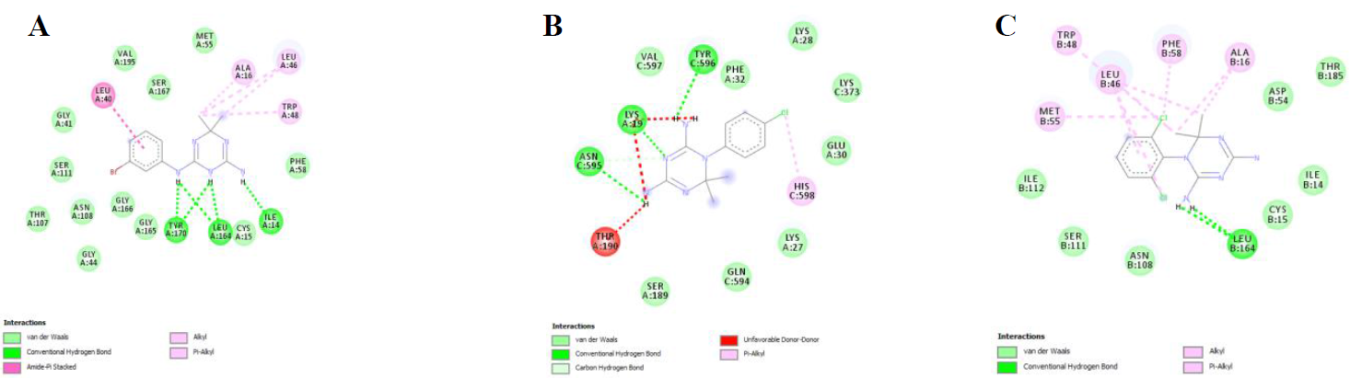
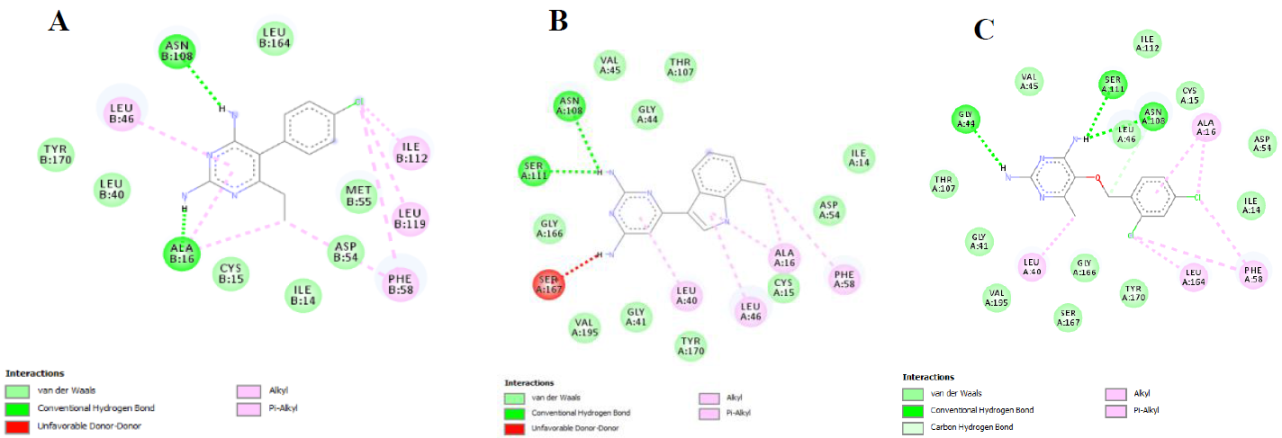
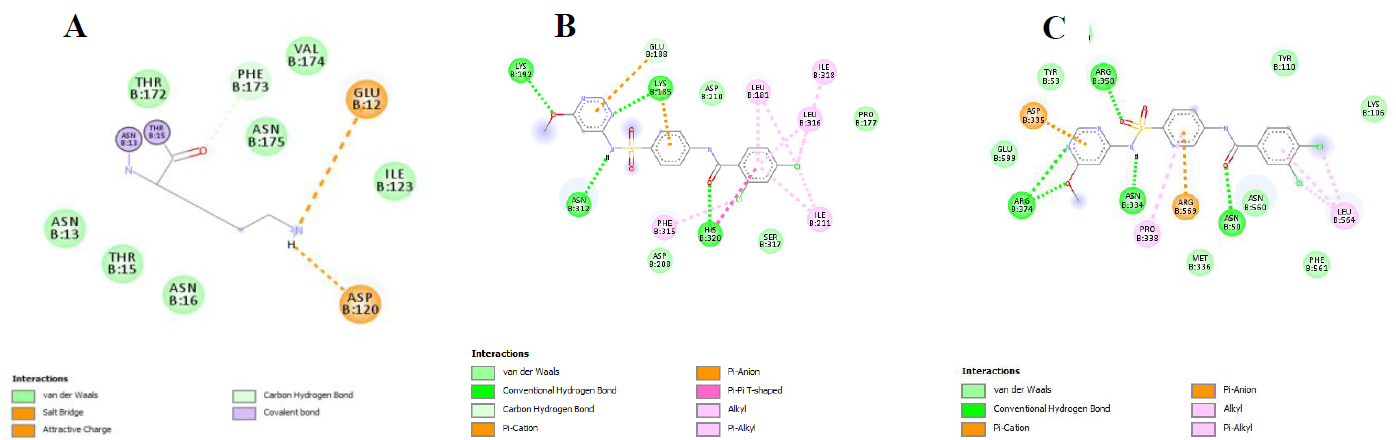
Molecular docking studies were carried out using AutoDock Vina in UCSF Chimera, which involves docking of the ligand and the target protein as Mol.2 files. It applies an iterated local search algorithm together with a hybrid scoring function to predict ligand–protein interactions. 33 An exhaustiveness value of 32 was selected to ensure extensive conformational sampling, thereby improving docking reliability. 34 For each compound, the ten best binding poses were generated and ranked based on their predicted binding free energies (ΔG, kcal/mol). 35 The ligand-protein interaction was then visualized using Biovia Studio software in 2D dimension to analyze the critical amino acid interaction. 36
Of the 400 structurally analogous compounds retrieved for each reference drug (cycloguanil, pyrimethamine, and sulfadoxine), percentage similarity cutoffs were applied as follows based on the distribution of similarity scores: 0.9 for sulfadoxine, 0.78 for cycloguanil, and 0.85 for pyrimethamine. This filtering process yielded 60 compounds per reference drug, which were subsequently subjected to ADMET analysis.
To determine drug-likeness and safety, the overall ADMET profiles of the reference medications (pyrimethamine, sulfadoxine, and cycloguanil) and their corresponding ZINC counterparts were examined. Cycloguanil showed high GI absorption, was not a Pgp substrate, and had no predicted hepatotoxicity or Herg inhibition. However, it lacked BBB permeability and tested positive for Ames toxicity. It is encouraging to note that all of the Cycloguanil analogues maintained the favorable characteristics of the parent drug (high GI absorption, no Pgp efflux, zero Lipinski violations, and no cardiotoxicity) while significantly improving safety by reducing Ames toxicity from "Yes" to "No". Sulfadoxine showed a low LD50, positive hepatotoxicity, strong GI absorption, and no Pgp efflux. With a few notable exceptions, such as ZINC000001160009 and ZINC000001154555, which produced improved docking scores but introduced several CYP interactions and hERG2 inhibition, raising safety concerns. However, most other sulfadoxine analogues shared the parent drug's overall profile.
Pyrimethamine was notable because it showed no hepatotoxicity, no Ames toxicity, high GI absorption, and BBB permeability. All pyrimethamine analogues, however, lost BBB permeability, suggesting reduced potential for central nervous system (CNS) penetration. This could be advantageous if CNS-related side effects are a concern for the parent drug. Sadly, several analogues added hepatotoxicity and hERG1 inhibition, which were not present in the parent drug. Docking scores (kcal/mol) served as a proxyfor binding affinity. All of the analogues surpassed cycloguanil (reference: -6.7), with ZINC000019331645 having the highest affinity at -8.5, followed by ZINC000000071371 (-7.6) and ZINC000000063598 (-7.4), showing steadily improved binding across the series. Sulfadoxine (reference: -6.6) demonstrated even greater improvements; ZINC000001154555 (-8.4) and ZINC000001160009 (-8.0) showed the strongest binding, while ZINC000000002100 (-7.8) and ZINC000000852704 (-7.6) also significantly outperformed the parent. Several analogues outperformed pyrimethamine (reference: -7.0), including ZINC000426406087 (-8.1) and ZINC000085388629 (-7.9), while ZINC000013283483 and ZINC000075273399 both scored -7.7. All three series' projected binding affinities were generally increased by structural changes, with the sulfadoxine analogues exhibiting the biggest absolute improvements. Based on the docking scores and 2D diagrams, analysis of important amino acid interactions identifies likely structural factors of increased affinity. The parent compound in the cycloguanil series mostly forms hydrogen bonds and hydrophobic interactions with conserved DHFR residues like Ile14, Leu46, and Phe58. Extended aromatic character probably facilitates more π-π stacking or halogen bonding with Phe58 or Tyr170, which accounts for ZINC000019331645's higher affinity (-8.5). The top-scoring analogues (e.g., ZINC000001154555) of sulfadoxine, a sulfonamide that interacts with the DHPS pterin-binding site via hydrogen bonds with Asn115, Gln217, and Lys221, likely form additional electrostatic contacts or hydrophobic packing due to substituted aromatic rings; but these modifications also introduced potential metabolic soft spots, such as interactions with CYP2C9 and 3A4.


The parent in the pyrimethamine series binds DHFR by stacking with Phe58 and forming hydrogen bonds with Asp54 and Ile164. Although the in silico Pgp substrate prediction is still negative, the universal loss of BBB permeability across all analogues suggests that modifications increased polarity or introduced unrecognized Pgp recognition motifs. The strong affinity of ZINC000426406087 (-8.1) may be due to additional interactions with the hydrophobic subpocket (Leu46, Pro113). In this study, we have discovered several ZINC analogues with better binding affinities and advantageous or improved ADMET profiles. Analogues of cycloguanil, such as ZINC000019331645 (best docking: -8.5) and ZINC000000071371 (-7.6), effectively eliminated Ames toxicity while maintaining high GI absorption and low overall toxicity, making them viable options for additional enzymatic and cellular tests. While ZINC000001154555 and ZINC000001160009 had better docking scores (-8.4 and -8.0, respectively) for sulfadoxine, their broad CYP inhibition and hERG2 risk are concerning; ZINC000000002100 (-7.8) and ZINC0000000852704 (-7.6) offer a better balance between affinity and safety (no hERG, no Ames, minimal CYP), though hepatotoxicity is still a class-wide concern. ZINC000426406087 (-8.1) and ZINC000085388629 (-7.9) are strong binders for pyrimethamine, but they also added hepatotoxicity, even though analogues often lost the desired BBB permeability. Therefore, while these analogues may be suitable for peripheral indications, pyrimethamine might retain an advantage if CNS penetration is desired.
Lastly, we suggest that ZINC000019331645 (Cycloguanil series) and ZINC000000002100 (Sulfadoxine series) be given priority for experimental validation because they combine improved binding with better or comparable safety profiles in comparison to their respective reference drugs, whereas pyrimethamine analogues need to be further optimized to restore BBB permeability without sacrificing potency.
Here we present a systematic in silico pipeline to identify novel antifolate inhibitors against quadruple-mutant (N51I+C59R+S108N+I164L) Plasmodium falciparum dihydrofolate reductase (pfDHFR), a clinically validated target against which resistance to the first line antimalarials pyrimethamine, cycloguanil and sulfadoxine has developed. An integrated workflow of structure-based virtual screening, Lipinski drug-likeness filtering, extensive ADMET profiling and AutoDock Vina molecular docking prioritized five lead compounds, ZINC000019331645, ZINC000426406087, ZINC000001154555, ZINC000001160009 and ZINC000013283483 as the most promising candidates.These compounds showed improved binding free energies of -8.0 to -8.5 kcal/mol against the QM pfDHFR crystal structure (PDB: 1J3K) compared to the three reference antifolate drugs. Interaction analysis revealed that the increased binding affinities of the lead compounds are attributed to favorable hydrophobic packing, extended π–π stacking interactions with conserved active site residues (Phe58, Leu46), and additional hydrogen bond contacts with Asp54, Ile164, and associated catalytic residues. ADMET profiling confirmed that ZINC000019331645 (cycloguanil series) and ZINC000000002100 (sulfadoxine series) had particularly attractive safety margins, with improved or comparable toxicity profiles to their parent drugs, including removal of Ames mutagenicity and absence of hERG-mediated cardiotoxicity. However, some potent binding analogs, such as ZINC000001154555 and ZINC000001160009, presented broad CYP inhibition and hERG2 liability that require further structural optimization before moving forward.
In sum, the present results validate the utility of the employed computational framework for the fast and inexpensive discovery of structurally diverse scaffolds with the ability to bind the resistant pfDHFR active site with high affinity. The compounds identified provide a promising chemical foundation for the development of next-generation antifolates against drug-resistant malaria.
In light of the findings of the current investigation, the following recommendations are proposed to advance the identified lead compounds: 1. Molecular Dynamics (MD) Simulation: The static docking poses produced in this study depict a singular energetic snapshot of ligand–protein interaction, neglecting the conformational flexibility of the pfDHFR active site under physiological settings. We highly advocate for the comprehensive molecular dynamics simulations of all five lead compounds, utilizing known MD platforms such as GROMACS, AMBER, or NAMD, with a minimum trajectory duration of 100 ns. MD analysis will facilitate the evaluation of binding stability, conformational flexibility of the protein-ligand complex, and the longevity of dynamic interactions across time. Additional free-energy perturbation (FEP) or MM-PBSA/GBSA computations are required to get more precise and thermodynamically robust binding affinity predictions and a more refined lead ranking compared to static docking. 2. Experimental Hit Validation: The prioritizing of lead drugs driven by molecular dynamics should be substantiated using in vitro enzymatic inhibition experiments utilizing recombinant QM pfDHFR, followed by parasite growth inhibition studies against drug-resistant P. falciparum strains. This will validate the anticipated binding affinities and assist in identifying the most physiologically active scaffolds. 3. Structure Optimization of Flagged Compounds: Compounds exhibiting robust binding yet deficient ADMET properties, particularly those with extensive CYP enzyme inhibition (e.g., CYP2C9, CYP3A4) and hERG2 channel inhibition, necessitate optimization through medicinal chemistry to mitigate metabolic liabilities while maintaining potency. Two-dimensional interaction diagrams can be utilized to inform structure-activity relationship (SAR) investigations and to pinpoint locations amenable to substitution modifications.
| [1] | “World malaria report 2025: Addressing the threat of antimalarial drug resistance”. | ||
| In article | |||
| [2] | A. Mohanty, L. Carlos I, E. G. Barbosa, A. K. Jordão, and C. R. S. Garcia, “Targeting Plasmodium Falciparum Asexual and Sexual Stages with Melatonin-Based Indole Compounds,” ChemistrySelect, vol. 10, no. 41, p. e04720, 2025. | ||
| In article | View Article | ||
| [3] | T. Masserey, L. Braunack-Mayer, R. S. Miller, J. J. Möhrle, and M. A. Penny, “A roadmap for understanding sulfadoxine-pyrimethamine in malaria chemoprevention,” Parasitology, vol. 152, no. 2, pp. 133–142, Feb. 2025. | ||
| In article | View Article PubMed | ||
| [4] | “WHO guidelines for malaria, 13 August 2025,” 2025. | ||
| In article | |||
| [5] | K. Verma et al., “Repurposing FDA‐approved drugs to target malaria through inhibition of dihydrofolate reductase in the folate biosynthesis pathway: A prospective approach,” J of Cellular Biochemistry, vol. 125, no. 3, p. e30533, Mar. 2024. | ||
| In article | View Article PubMed | ||
| [6] | S. K. Halder et al., “Identification of potential inhibitors of dihydrofolate reductase (DHFR) through blocking the folate biosynthetic pathway of Mycobacterium tuberculosis utilizing structure-based virtual screening,” RSC Adv., vol. 15, no. 43, pp. 36331–36343, 2025. | ||
| In article | View Article PubMed | ||
| [7] | R. T. Delfino, O. A. Santos-Filho, and J. D. Figueroa-Villar, “Molecular modeling of wild-type and antifolate resistant mutant Plasmodium falciparum DHFR,” Biophysical Chemistry, vol. 98, no. 3, pp. 287–300, Aug. 2002. | ||
| In article | View Article PubMed | ||
| [8] | S. Ghosh, D. Joshi, C. S. Ponnusamy, B. Sridharan, and M. Velusamy, “Computational investigation of mutations in PfCRT and PfDHFR proteins for emerging resistance of Plasmodium falciparum to antimalarial drugs,” Molecular and Biochemical Parasitology, vol. 264, p. 111700, Dec. 2025. | ||
| In article | View Article PubMed | ||
| [9] | C. Putaporntip, J. Somkuna, R. Rojrung, T. Tia, N. Kuamsab, and S. Jongwutiwes, “Contrasting evolutionary trajectories of pyrimethamine resistance in human and zoonotic malaria parasites,” Malar J, vol. 25, no. 1, p. 161, Mar. 2026. | ||
| In article | View Article PubMed | ||
| [10] | A. Kaushik et al., “Antiprotozoal agents – Integration of drug discovery, medicinal chemistry, and advanced computational approaches: An in-depth review,” The Microbe, vol. 7, p. 100395, Jun. 2025. | ||
| In article | View Article | ||
| [11] | W. Xu, “Current Status of Computational Approaches for Small Molecule Drug Discovery,” J. Med. Chem., vol. 67, no. 21, pp. 18633–18636, Nov. 2024. | ||
| In article | View Article PubMed | ||
| [12] | L. P. Hastuti, F. Hermawan, M. R. Iresha, T. Ernawati, and Firdayani, “In-silico studies of hydroxyxanthone derivatives as potential pfDHFR and pfDHODH inhibitor by molecular docking, molecular dynamics simulation, MM-PBSA calculation and pharmacokinetics prediction,” Informatics in Medicine Unlocked, vol. 47, p. 101485, 2024. | ||
| In article | View Article | ||
| [13] | J. Sim, D. Kim, B. Kim, J. Choi, and J. Lee, “Recent advances in AI-driven protein-ligand interaction predictions,” Current Opinion in Structural Biology, vol. 92, p. 103020, Jun. 2025. | ||
| In article | View Article PubMed | ||
| [14] | S. S. Duay, R. C. Y. Yap, A. L. Gaitano, J. A. A. Santos, and S. J. Y. Macalino, “Roles of Virtual Screening and Molecular Dynamics Simulations in Discovering and Understanding Antimalarial Drugs,” International Journal of Molecular Sciences, vol. 24, no. 11, p. 9289, Jan. 2023. | ||
| In article | View Article PubMed | ||
| [15] | P. V. T. Fokou et al., “Natural products as transmission-blocking agents against malaria: a comprehensive review of bioactive compounds and their therapeutic potential,” Malar J, vol. 24, no. 1, p. 164, May 2025. | ||
| In article | View Article PubMed | ||
| [16] | E. Chikwaro, S. Nyoni, J. Ndlovu, and R. Shoko, “Natural products in antimalarial drug discovery: progress, emerging technologies, and future directions,” All Life, vol. 19, no. 1, p. 2634576, Feb. 2026. | ||
| In article | View Article | ||
| [17] | P. J. P. Tjitda, F. O. Nitbani, T. D. Wahyuningsih, R. I. Lerrick, and Y. M. Abanit, “In Silico Study Revealing the Inhibitory Potential of Flavonoids From Azadirachta Indica against PfDHFR and PfDHODH as Antimalarial Agents,” ChemistrySelect, vol. 10, no. 19, p. e202404851, 2025. | ||
| In article | View Article | ||
| [18] | “An Open Drug Discovery Competition: Experimental Validation of Predictive Models in a Series of Novel Antimalarials,” Journal of Medicinal Chemistry, vol. 64, no. 22, pp. 16450–16463, Nov. 2021. | ||
| In article | |||
| [19] | J. Yuvaniyama et al., “Insights into antifolate resistance from malarial DHFR-TS structures,” Nat Struct Mol Biol, vol. 10, no. 5, pp. 357–365, May 2003. | ||
| In article | View Article PubMed | ||
| [20] | I. V. Singh and S. Mishra, “Molecular Docking Analysis of Pyrimethamine Derivatives with Plasmodium falciparum Dihydrofolate Reductase,” Bioinformation, vol. 14, no. 5, pp. 232–235, 31 2018. | ||
| In article | View Article PubMed | ||
| [21] | A. Ogunbowale and E. R. Georgieva, “Engineered Chimera Protein Constructs to Facilitate the Production of Heterologous Transmembrane Proteins in E. coli,” IJMS, vol. 25, no. 4, p. 2354, Feb. 2024. | ||
| In article | View Article PubMed | ||
| [22] | M. E. Bragina, A. Daina, M. A. S. Perez, O. Michielin, and V. Zoete, “The SwissSimilarity 2021 Web Tool: Novel Chemical Libraries and Additional Methods for an Enhanced Ligand-Based Virtual Screening Experience,” International Journal of Molecular Sciences, vol. 23, no. 2, p. 811, Jan. 2022. | ||
| In article | View Article PubMed | ||
| [23] | J. J. Naveja, M. Vogt, D. Stumpfe, J. L. Medina-Franco, and J. Bajorath, “Systematic Extraction of Analogue Series from Large Compound Collections Using a New Computational Compound–Core Relationship Method,” ACS Omega, vol. 4, no. 1, pp. 1027–1032, Jan. 2019. | ||
| In article | View Article PubMed | ||
| [24] | N. Andayani and E. Mulatsari, “Molecular structure similarity analysis using Tanimoto coefficient and its correlation analysis with Maltase-glucoamylase inhibitory activity of Nigella sativa’s compounds,” JNPDD, vol. 2, no. 1, pp. 48–57, Sep. 2024. | ||
| In article | View Article | ||
| [25] | A. Daina, O. Michielin, and V. Zoete, “SwissADME: a free web tool to evaluate pharmacokinetics, drug-likeness and medicinal chemistry friendliness of small molecules,” Sci Rep, vol. 7, no. 1, p. 42717, Mar. 2017. | ||
| In article | View Article PubMed | ||
| [26] | N. Lohit et al., “Description and In silico ADME Studies of US-FDA Approved Drugs orDrugs under Clinical Trial which Violate the Lipinski’s Rule of 5,” LDDD, vol. 21, no. 8, pp. 1334–1358, Jun. 2024. | ||
| In article | View Article | ||
| [27] | J. B. Baell and J. W. M. Nissink, “Seven Year Itch: Pan-Assay Interference Compounds (PAINS) in 2017—Utility and Limitations,” ACS Chem. Biol., vol. 13, no. 1, pp. 36–44, Jan. 2018. | ||
| In article | View Article PubMed | ||
| [28] | D. E. V. Pires, T. L. Blundell, and D. B. Ascher, “pkCSM: Predicting Small-Molecule Pharmacokinetic and Toxicity Properties Using Graph-Based Signatures,” J. Med. Chem., vol. 58, no. 9, pp. 4066–4072, May 2015. | ||
| In article | View Article PubMed | ||
| [29] | M. Zhao et al., “Cytochrome P450 Enzymes and Drug Metabolism in Humans,” IJMS, vol. 22, no. 23, p. 12808, Nov. 2021. | ||
| In article | View Article PubMed | ||
| [30] | D. Gheidari, M. Mehrdad, and Z. Karimelahi, “Virtual screening, ADMET prediction, molecular docking, and dynamic simulation studies of natural products as BACE1 inhibitors for the management of Alzheimer’s disease,” Sci Rep, vol. 14, no. 1, p. 26431, Nov. 2024. | ||
| In article | View Article PubMed | ||
| [31] | S. Kim et al., “PubChem 2025 update,” Nucleic Acids Research, vol. 53, no. D1, pp. D1516–D1525, Jan. 2025. | ||
| In article | View Article PubMed | ||
| [32] | M. D. Hanwell, D. E. Curtis, D. C. Lonie, T. Vandermeersch, E. Zurek, and G. R. Hutchison, “Avogadro: an advanced semantic chemical editor, visualization, and analysis platform,” J Cheminform, vol. 4, no. 1, p. 17, Dec. 2012. | ||
| In article | View Article PubMed | ||
| [33] | S. S. Butt, Y. Badshah, M. Shabbir, and M. Rafiq, “Molecular Docking Using Chimera and Autodock Vina Software for Nonbioinformaticians,” JMIR Bioinformatics Biotechnol, vol. 1, no. 1, p. e14232, Jun. 2020. | ||
| In article | View Article PubMed | ||
| [34] | R. Agarwal and J. C. Smith, “Speed vs Accuracy: Effect on Ligand Pose Accuracy of Varying Box Size and Exhaustiveness in AutoDock Vina,” Molecular Informatics, vol. 42, no. 2, p. 2200188, Feb. 2023. | ||
| In article | View Article PubMed | ||
| [35] | M. Feng, G. Heinzelmann, and M. K. Gilson, “Absolute binding free energy calculations improve enrichment of actives in virtual compound screening,” Sci Rep, vol. 12, no. 1, p. 13640, Aug. 2022. | ||
| In article | View Article PubMed | ||
| [36] | U. Baroroh, S.Si., M.Biotek., Z. S. Muscifa, W. Destiarani, F. G. Rohmatullah, and M. Yusuf, “Molecular interaction analysis and visualization of protein-ligand docking using Biovia Discovery Studio Visualizer,” IJCB, vol. 2, no. 1, p. 22, Jul. 2023. | ||
| In article | View Article | ||
Published with license by Science and Education Publishing, Copyright © 2026 Ian Oduori and Brian Nguti
 This work is licensed under a Creative Commons Attribution 4.0 International License. To view a copy of this license, visit
http://creativecommons.org/licenses/by/4.0/
This work is licensed under a Creative Commons Attribution 4.0 International License. To view a copy of this license, visit
http://creativecommons.org/licenses/by/4.0/
| [1] | “World malaria report 2025: Addressing the threat of antimalarial drug resistance”. | ||
| In article | |||
| [2] | A. Mohanty, L. Carlos I, E. G. Barbosa, A. K. Jordão, and C. R. S. Garcia, “Targeting Plasmodium Falciparum Asexual and Sexual Stages with Melatonin-Based Indole Compounds,” ChemistrySelect, vol. 10, no. 41, p. e04720, 2025. | ||
| In article | View Article | ||
| [3] | T. Masserey, L. Braunack-Mayer, R. S. Miller, J. J. Möhrle, and M. A. Penny, “A roadmap for understanding sulfadoxine-pyrimethamine in malaria chemoprevention,” Parasitology, vol. 152, no. 2, pp. 133–142, Feb. 2025. | ||
| In article | View Article PubMed | ||
| [4] | “WHO guidelines for malaria, 13 August 2025,” 2025. | ||
| In article | |||
| [5] | K. Verma et al., “Repurposing FDA‐approved drugs to target malaria through inhibition of dihydrofolate reductase in the folate biosynthesis pathway: A prospective approach,” J of Cellular Biochemistry, vol. 125, no. 3, p. e30533, Mar. 2024. | ||
| In article | View Article PubMed | ||
| [6] | S. K. Halder et al., “Identification of potential inhibitors of dihydrofolate reductase (DHFR) through blocking the folate biosynthetic pathway of Mycobacterium tuberculosis utilizing structure-based virtual screening,” RSC Adv., vol. 15, no. 43, pp. 36331–36343, 2025. | ||
| In article | View Article PubMed | ||
| [7] | R. T. Delfino, O. A. Santos-Filho, and J. D. Figueroa-Villar, “Molecular modeling of wild-type and antifolate resistant mutant Plasmodium falciparum DHFR,” Biophysical Chemistry, vol. 98, no. 3, pp. 287–300, Aug. 2002. | ||
| In article | View Article PubMed | ||
| [8] | S. Ghosh, D. Joshi, C. S. Ponnusamy, B. Sridharan, and M. Velusamy, “Computational investigation of mutations in PfCRT and PfDHFR proteins for emerging resistance of Plasmodium falciparum to antimalarial drugs,” Molecular and Biochemical Parasitology, vol. 264, p. 111700, Dec. 2025. | ||
| In article | View Article PubMed | ||
| [9] | C. Putaporntip, J. Somkuna, R. Rojrung, T. Tia, N. Kuamsab, and S. Jongwutiwes, “Contrasting evolutionary trajectories of pyrimethamine resistance in human and zoonotic malaria parasites,” Malar J, vol. 25, no. 1, p. 161, Mar. 2026. | ||
| In article | View Article PubMed | ||
| [10] | A. Kaushik et al., “Antiprotozoal agents – Integration of drug discovery, medicinal chemistry, and advanced computational approaches: An in-depth review,” The Microbe, vol. 7, p. 100395, Jun. 2025. | ||
| In article | View Article | ||
| [11] | W. Xu, “Current Status of Computational Approaches for Small Molecule Drug Discovery,” J. Med. Chem., vol. 67, no. 21, pp. 18633–18636, Nov. 2024. | ||
| In article | View Article PubMed | ||
| [12] | L. P. Hastuti, F. Hermawan, M. R. Iresha, T. Ernawati, and Firdayani, “In-silico studies of hydroxyxanthone derivatives as potential pfDHFR and pfDHODH inhibitor by molecular docking, molecular dynamics simulation, MM-PBSA calculation and pharmacokinetics prediction,” Informatics in Medicine Unlocked, vol. 47, p. 101485, 2024. | ||
| In article | View Article | ||
| [13] | J. Sim, D. Kim, B. Kim, J. Choi, and J. Lee, “Recent advances in AI-driven protein-ligand interaction predictions,” Current Opinion in Structural Biology, vol. 92, p. 103020, Jun. 2025. | ||
| In article | View Article PubMed | ||
| [14] | S. S. Duay, R. C. Y. Yap, A. L. Gaitano, J. A. A. Santos, and S. J. Y. Macalino, “Roles of Virtual Screening and Molecular Dynamics Simulations in Discovering and Understanding Antimalarial Drugs,” International Journal of Molecular Sciences, vol. 24, no. 11, p. 9289, Jan. 2023. | ||
| In article | View Article PubMed | ||
| [15] | P. V. T. Fokou et al., “Natural products as transmission-blocking agents against malaria: a comprehensive review of bioactive compounds and their therapeutic potential,” Malar J, vol. 24, no. 1, p. 164, May 2025. | ||
| In article | View Article PubMed | ||
| [16] | E. Chikwaro, S. Nyoni, J. Ndlovu, and R. Shoko, “Natural products in antimalarial drug discovery: progress, emerging technologies, and future directions,” All Life, vol. 19, no. 1, p. 2634576, Feb. 2026. | ||
| In article | View Article | ||
| [17] | P. J. P. Tjitda, F. O. Nitbani, T. D. Wahyuningsih, R. I. Lerrick, and Y. M. Abanit, “In Silico Study Revealing the Inhibitory Potential of Flavonoids From Azadirachta Indica against PfDHFR and PfDHODH as Antimalarial Agents,” ChemistrySelect, vol. 10, no. 19, p. e202404851, 2025. | ||
| In article | View Article | ||
| [18] | “An Open Drug Discovery Competition: Experimental Validation of Predictive Models in a Series of Novel Antimalarials,” Journal of Medicinal Chemistry, vol. 64, no. 22, pp. 16450–16463, Nov. 2021. | ||
| In article | |||
| [19] | J. Yuvaniyama et al., “Insights into antifolate resistance from malarial DHFR-TS structures,” Nat Struct Mol Biol, vol. 10, no. 5, pp. 357–365, May 2003. | ||
| In article | View Article PubMed | ||
| [20] | I. V. Singh and S. Mishra, “Molecular Docking Analysis of Pyrimethamine Derivatives with Plasmodium falciparum Dihydrofolate Reductase,” Bioinformation, vol. 14, no. 5, pp. 232–235, 31 2018. | ||
| In article | View Article PubMed | ||
| [21] | A. Ogunbowale and E. R. Georgieva, “Engineered Chimera Protein Constructs to Facilitate the Production of Heterologous Transmembrane Proteins in E. coli,” IJMS, vol. 25, no. 4, p. 2354, Feb. 2024. | ||
| In article | View Article PubMed | ||
| [22] | M. E. Bragina, A. Daina, M. A. S. Perez, O. Michielin, and V. Zoete, “The SwissSimilarity 2021 Web Tool: Novel Chemical Libraries and Additional Methods for an Enhanced Ligand-Based Virtual Screening Experience,” International Journal of Molecular Sciences, vol. 23, no. 2, p. 811, Jan. 2022. | ||
| In article | View Article PubMed | ||
| [23] | J. J. Naveja, M. Vogt, D. Stumpfe, J. L. Medina-Franco, and J. Bajorath, “Systematic Extraction of Analogue Series from Large Compound Collections Using a New Computational Compound–Core Relationship Method,” ACS Omega, vol. 4, no. 1, pp. 1027–1032, Jan. 2019. | ||
| In article | View Article PubMed | ||
| [24] | N. Andayani and E. Mulatsari, “Molecular structure similarity analysis using Tanimoto coefficient and its correlation analysis with Maltase-glucoamylase inhibitory activity of Nigella sativa’s compounds,” JNPDD, vol. 2, no. 1, pp. 48–57, Sep. 2024. | ||
| In article | View Article | ||
| [25] | A. Daina, O. Michielin, and V. Zoete, “SwissADME: a free web tool to evaluate pharmacokinetics, drug-likeness and medicinal chemistry friendliness of small molecules,” Sci Rep, vol. 7, no. 1, p. 42717, Mar. 2017. | ||
| In article | View Article PubMed | ||
| [26] | N. Lohit et al., “Description and In silico ADME Studies of US-FDA Approved Drugs orDrugs under Clinical Trial which Violate the Lipinski’s Rule of 5,” LDDD, vol. 21, no. 8, pp. 1334–1358, Jun. 2024. | ||
| In article | View Article | ||
| [27] | J. B. Baell and J. W. M. Nissink, “Seven Year Itch: Pan-Assay Interference Compounds (PAINS) in 2017—Utility and Limitations,” ACS Chem. Biol., vol. 13, no. 1, pp. 36–44, Jan. 2018. | ||
| In article | View Article PubMed | ||
| [28] | D. E. V. Pires, T. L. Blundell, and D. B. Ascher, “pkCSM: Predicting Small-Molecule Pharmacokinetic and Toxicity Properties Using Graph-Based Signatures,” J. Med. Chem., vol. 58, no. 9, pp. 4066–4072, May 2015. | ||
| In article | View Article PubMed | ||
| [29] | M. Zhao et al., “Cytochrome P450 Enzymes and Drug Metabolism in Humans,” IJMS, vol. 22, no. 23, p. 12808, Nov. 2021. | ||
| In article | View Article PubMed | ||
| [30] | D. Gheidari, M. Mehrdad, and Z. Karimelahi, “Virtual screening, ADMET prediction, molecular docking, and dynamic simulation studies of natural products as BACE1 inhibitors for the management of Alzheimer’s disease,” Sci Rep, vol. 14, no. 1, p. 26431, Nov. 2024. | ||
| In article | View Article PubMed | ||
| [31] | S. Kim et al., “PubChem 2025 update,” Nucleic Acids Research, vol. 53, no. D1, pp. D1516–D1525, Jan. 2025. | ||
| In article | View Article PubMed | ||
| [32] | M. D. Hanwell, D. E. Curtis, D. C. Lonie, T. Vandermeersch, E. Zurek, and G. R. Hutchison, “Avogadro: an advanced semantic chemical editor, visualization, and analysis platform,” J Cheminform, vol. 4, no. 1, p. 17, Dec. 2012. | ||
| In article | View Article PubMed | ||
| [33] | S. S. Butt, Y. Badshah, M. Shabbir, and M. Rafiq, “Molecular Docking Using Chimera and Autodock Vina Software for Nonbioinformaticians,” JMIR Bioinformatics Biotechnol, vol. 1, no. 1, p. e14232, Jun. 2020. | ||
| In article | View Article PubMed | ||
| [34] | R. Agarwal and J. C. Smith, “Speed vs Accuracy: Effect on Ligand Pose Accuracy of Varying Box Size and Exhaustiveness in AutoDock Vina,” Molecular Informatics, vol. 42, no. 2, p. 2200188, Feb. 2023. | ||
| In article | View Article PubMed | ||
| [35] | M. Feng, G. Heinzelmann, and M. K. Gilson, “Absolute binding free energy calculations improve enrichment of actives in virtual compound screening,” Sci Rep, vol. 12, no. 1, p. 13640, Aug. 2022. | ||
| In article | View Article PubMed | ||
| [36] | U. Baroroh, S.Si., M.Biotek., Z. S. Muscifa, W. Destiarani, F. G. Rohmatullah, and M. Yusuf, “Molecular interaction analysis and visualization of protein-ligand docking using Biovia Discovery Studio Visualizer,” IJCB, vol. 2, no. 1, p. 22, Jul. 2023. | ||
| In article | View Article | ||