Ionizing irradiations doses were delivered to paediatric and adults patients during CT scans examinations are caused various effects on tissues organs exposed. This can be induced various risks consequences including cancers if overdosed. Administered doses are regulated compared to international standards worldwide. The aim of this study was to evaluate dose delivered to patients during CT scans in four hospitals in the republic Congo. A total of 350 adult and 76 paediatric patients were surveyed especially cerebral chest, Pelvis-abdominal and thoracic abdomino-pelvis. We were obtained adult DPL mean values in adults ranging from 1896.04 ± 57.08 mGy.cm to 3018.45 ± 1917.13 mGy.cm with contrast product. Whereas, without a contrast product, value is varied from 1244.01 ± 694.18 mGy.cm when the highest in the skull is 1943.86 ± 72.05 mGy.cm. We were accessed high effective doses compared to ICPR 60 (4.08 ± 1.62 - 42.88 ± 25.53) and ICPR 103 (03.69 ± 1.47 - 40.02 ± 23.83). Paediatric patients were received doses ranging between 193.00 to 347.55mG.cm in the skull in hospital A. In the age-group of < 1- 15 years, all centers were received from 6.46 to 19.84 mGy.cm. The highest is meant for adults in the cerebral were 133.35 mSv whereas others organs were received between 39.58 to 73.81 mSv with contrast. The paediatric patients are reached 347.55 mSv in the cerebral with contrast product and other organs were received up to 19.84 mSv. Our studies were revealed that doses were delivered to patients during CT scans in the republic of the Congo are all higher than the standard. This is due to be unregulated, administered to patients, the vestuosity of the equipment used, and the lack of technical training for technician’s radiologists’ on dose reduction. These results were raised an alarm to establish a dose level reduction and national regulatory body to be convened international standards on doses reduction countrywide.
The use of ionizing radiation in medicine has long been established and is subjected to principles of radiation protection established at the International Atomic Energy Agency Basic Safety Standards 1. Ionizing radiation has been many beneficial applications 2, from generating electricity to its use in medicine. The recommendations were seted by the International Commission on Radiological Protection have been established to be followed in hospitals 3. Medical exposure is remained the largest man-made source of ionizing radiation exposure and this exercise is remained the largest man-made source of ionizing radiation exposure, at 98% 4 versus 43% for CT, constituting the total collective effective dose from medical radiology diagnostics 5. This constitutes 14% of annual exposures worldwide from all other radiation sources 6. The radiological is risked to patients that may be resulted from medical radiology exposures, particularly CT scan, must be assessed and, if necessary, was controlled 7. In order to be assessing the collective risk, the effective dose per capita should be evaluated and patients ages distribution should be therefore being considered 8. Diagnostic examinations are in high demand nowadays in health facilities due to the increasing demand of clinical imaging services. This therefore is implied the use of new generation medical imaging equipment. Although innovative technology advances have been emancipated tools and were standarded in the field of dosimetry, the technology of new scanning systems has been resulted in a tendency to increase this dose more significantly 9. Regulations of the amount of dose absorbed by tissue or organ are based on incident factors, namely relative body weight, in order to reflect the significant biological effect of ionizing radiation to avoid be risked of stochastic or even random effects. These effects may be lead to cancer in organs that are not sensitive and all has been framed by the International Commission on Radiological Protection 10, 11. Despite efforts by some African governments to be regulated the doses used in medical imaging techniques, some countries still remain in the shadow of empirical techniques, such as Congo Brazzaville. In Germany, and in most European countries, despite the frequent is used of alternative examination techniques such as CT, NMR and is endoscopied, the frequency of radiological and nuclear medical examinations remains a common problem 8. However, CT scans is provided necessary information which quickly is facilitated diagnosis and avoided the use of more invasive procedures 4. The equipment was used in this case in several African countries are of very old brands and therefore, regular assessment of patient exposure before and after any medical treatment or diagnosis is necessary 7.
Furthermore, it is important to be analysed its evolution over time for a better follow-up in order to be mitigated related public health problems. Medical diagnosis using X-rays remains largely beneficial to health, although there is used to carry some risk of cancer development 6. New technologies were related to digitization are also a factor in increasing the doses of contrast agents were injected to patients, were associated with repeated examinations in order to be obtained quality images Sari- 9, 12. However, due to the lack of a specific regulatory framework for the regulation of products were administered during medical exposure at the national level, patient dosimetry and the administration of drug doses by injection are become very important 13. In paediatric patients the inappropriate is used of unregulated dose may be leaded to unavoidable risks was associated with ionizing radiation 14. This intend was reduced the consequences of optimizing radiation protection of patients 12. All these measures are not implemented in the medical structures in Congo. There is no integrated practice of dose optimization and no procedures guide in the medical diagnostic system is framed at local level. Similarly, all departments were used to ionizing radiation for medical diagnostic procedures have been never integrated patient radiation protection into their daily clinical practices for adults and children in Congo 7. The purpose of our study is to access ionizing irradiation doses were delivered to patient during CT scan examinations in order to be established a diagnostic reference levels to be enable effectived patient management in the four major hospitals. This will be helped in eliminating the risks were associated with pathologies due to long term exposure and were related diseases and implement dose reduction policy.
Study sites
This study was conducted in four hospital settings in the Republic of Congo namely in Brazzaville and Pointe-Noire cities, among which, the Hospital Central des Armées Pierre MOBENGO (A), Hopital d'Amitié Chino-Congolais MFILOU (B), the Clinique Net-care in pointe noire city (C) and Hospital of Reference de Talangai (D).
Sampling
The samples and medical records was used in our study were approved by the ethics committee of the Ministry of Hospitals of Congo Brazzaville (n° 0011/MSP/ CAB/DGSSa/DH/SH-22) and the University of Congo Brazzaville (No. 398/MESRSIT/IRSSA-CERSSA). This descriptive and cross-sectional study was concerned four hospitals and was carried out in four CT departments whose equipment characteristics such as model, serial number, year of manufacture, year of installation, and other relevant information, are presented in Table1.
The study was conducted between July 2021 and November 2021, and a total of 426 adults and paediatric patients’ scanographic examination data were collected in the four canters. The patients age are ranged between 0 to 78 years. The study was carried out in four selected hospitals. The facilities were chosen based on the frequency of examinations performed and on the possibility that ionizing radiation dose were collected directly from the patients. The relevant CT technical parameters are obtained and are displayed, and are recorded on the console of the CT scan machines. The study was involved four CT centers, all equipped with 16-bar scanners of the brands Neusoft,, Siemens Somatom (Table 1).
Hospital centres are referred as centres A; B; C and D
At this stage, we have been collected CT scan data from 426 subjects were aged 0 to 78 years. This study was aimed to be evaluated / estimated the doses were received by patients in these four health facilities in Congo. The four types of examinations were performed on the skull, Chest, abdomen-pelvis, and Chest-abdomen-pelvis; the CT scan index volume and the CT dose-length product were considered for the study. The mean, minimum, maximum, and median of CTDIvol and dose-length product were also used in this study. The effective dose was used in this study was calculated using the following formula:
 |
With DLP: the dose-length is producted (mGy.cm) and k the DLP-effective dose conversion factor. The effective dose values were obtained then were compared with those were obtained after other studies.
Demographic results
A quantitative study was performed for data collection and results of the CT scans were performed, were reported (Table 2) showing patients demographic. Age is a very important characteristic to be taken into account regarding the types of examinations were performed. Skull examinations are in the majority and those of the other organs are between 32 and 63 years old. Men (55.3%) had been more CT scans than women (44.7%), with a mean of 41.6 and a standard deviation of 22.3. Cranial scans were performed more frequently (37.2%).
The Mfilou hospital performed more scans (51.7%) followed by HCA (27.5%), Netcare and talangai was received 17.2% and 3.6% of CT scans respectively.
Adults effective Dose comparison against ICPR 60 and ICPR 103:
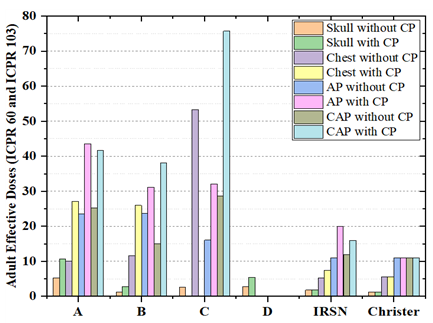
Our results were obtained compared with those of other reference (ICPR 60 and ICPR 103) studies in adult patients. Dosimetric analysis of CT scan was performed with or without injection of contrast product according to the technical parameters of exposure are showned (Figure 1). It is showned that in the centres C was received injection of the most effective dose in the TAP with contrast is producted, was followed by the Chest (53.35 mSv), the cerebral on the other hand was received doses between 1.29 to 10.74 mSv (Figure 1). The PA was received up to 43.57 mSv.
Center D was received moderate doses, and only in the skull (2.72 to 5.44 mSv) was compared to the adult doses (ICRP 60) with the literature. The center D has not been received many patients compared to the rest.

Evaluation of dose Length product.
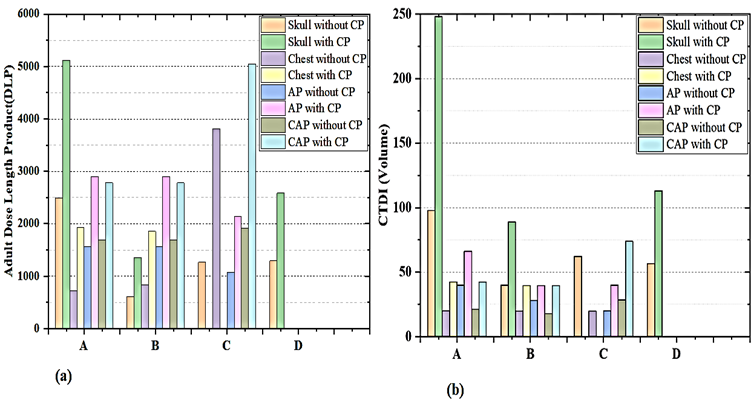
The Dose Length Product values (Figure 2) in adult patients are showed the values of injected doses corresponding to the time of exposure of organs to be ionized radiation.

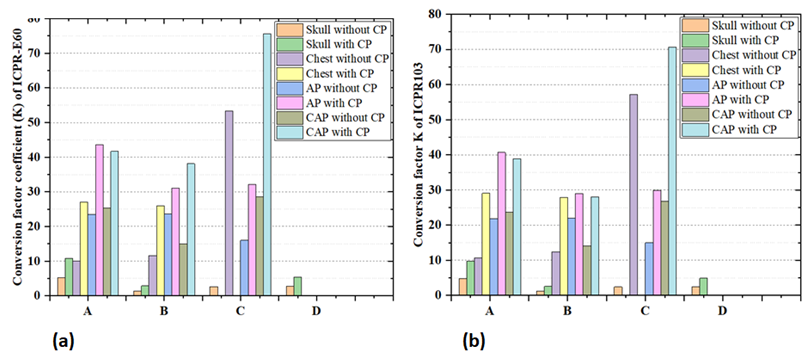
In centers A and C, the examination of the Cerebral, TAP with contrast is producted and the chest, the length time of the examination is showed very high values of 5114.05mGy.cm, 5045.47 mGy.cm and 3810.65 mGy.cm respectively. The remaining DLP values are belowed 3000 mGy.cm in all centers. The maximum LDP doses are estimated at 6070 mGy.cm and the relative median is 4260 mGy.cm. In the abdomen-pelvis, the mean LDP values are 1403.13 mGy.cm and 2372.86 mGy.cm, without and with contrast is producted, respectively. On the other hand, the medians are 1133.03 mGy.cm and 2233.14 mGy.cm, and the Chest-abdomen-pelvis, the values are 1532.61 mGy.cm and of 3515.44 mGy.cm with medians of 1590.09 mGy.cm and 3423.17mGy.cm. In centers B, the cerebral was received 2.57 mGy; 27.84 mGy in the Chest and 29.03 mGy in the AP and up to 38.92 mGy in TAP with contrast is producted. Center C, the cerebral was received the optimal moderate, without contrast is producted dose of 2.41 mGy versus 57.16 mGy in the Chest. In contrast, the AP was received the dose of 29.96 mGy with contrast is producted while the TAP was received up to 70.64 mGy. Center D was received only 4.92 mGy in the cerebral and was not made undergo further testing to be evaluated the actual doses were calculated on the basis of the ICRP103 conversion factor k with or without is contrasted producted in centers B, C, and D.
Assessment of the CTDIvol
The average dose in the Cerebral is ranged between 2.98 to 6.79 mSv without and with contrast injection. Meanwhile, the Chest was received up to 26.55 mSv while the abdomen-pelvis was received 35.60mGy.cm and the Chest-abdominal pelvis 51.82 mSv. The CTDIvol is showed the average of the pre-calculated real volumes were received by patients in the skull without contrast product are 64.14 mSv and 149.10 mSv with contrast is producted (Figure 3).The values are belowed the diagnostic reference level in CT scan was compared to the European Commission. The CTDIvol is relatively lowed in the other organs, with maximums of 66.25m.sv to 73.81msv.
Effective Doses
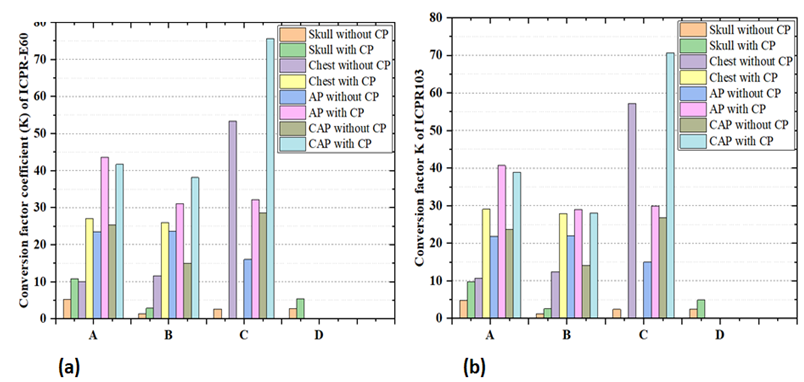
The effective doses was calculated based on the ICRP-60 conversion factor k, expressing the actual doses was received by the patients (Figure 4). The results are showed that the Cerebral was received an average doses ranging from 2.66 mGy to 15.98 mGy among the four centres, with center A having the highest dose and the lowest in C. In the AP, doses ranging from 67.07 mGy for center A; 57.72 mGy for center B; 48.15 mGy for center C. However, the TAP is showed mean values oscillating between 67.01 mGy; 53.13 mGy; 104.31 mGy for centers A, B and C. Whereas the effective dose (Figure.4) was calculated using ICRP103 conversion factor, for the skulls in center A, the ICPR 103 k-conversion coefficient values in adult patients are showed a similar trend to these of ICPR 60 with doses with 9.72 mGy in the skull against 29.05 mGy in the Chest and 40.66 mGy in the AP and 38.92 mGy in the TAP with contrast is producted, while the doses are almost half without contrast producted in all other organs.
Results on pediatric patients
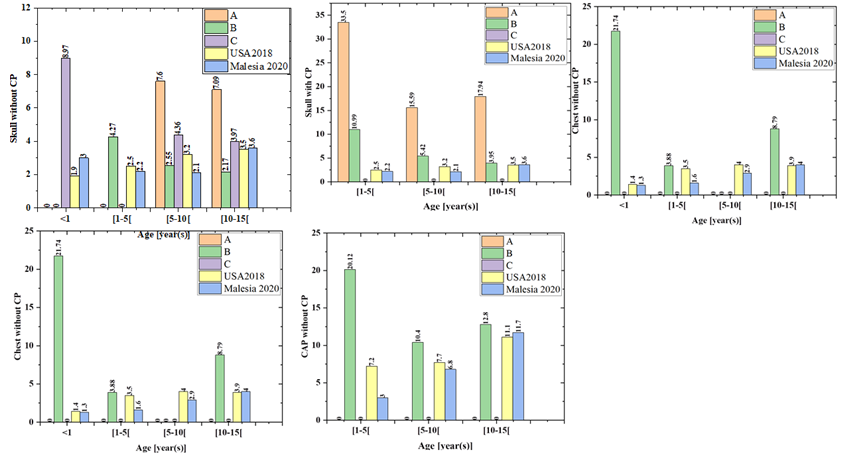
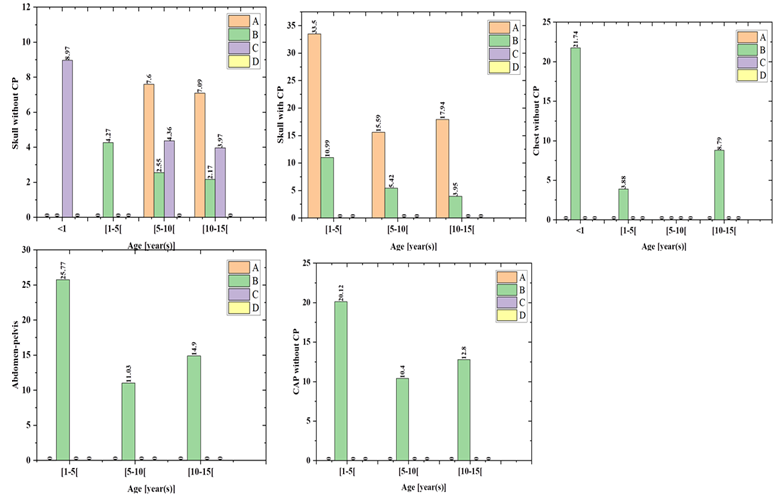
The comparison of paediatric effective doses in the four centers were compared with ICPR 60 from the literature 15, 16 from. The cerebral in paediatric patients within the age- group years and years were received the most effective doses (7.6 to 33.50mGy) in the center A (Figure 5). In the Chest; Abdomen-pelvis and TAP examination without contrast is producted, only the center B in these services were more effectived for the injection of doses ranging from 21.74mGy and up to 25, 77mGy and 20.12mGy respectively. In contrast, centers A and C were not delivered injections on paediatric patients, including those from year-old in the cerebral without contrast, but also the Chest, AP, and TAP with and without contrast. At center C, the cerebral examination was performed only in the cerebral and in all was cased the paediatric doses are aboved the standard. Doses in the cerebral can be tolerated because range from 2.17mGy to 2.55mGy. center D was not received the paediatric patients for the corresponding examinations and was not compared.


Pediatric CTDI
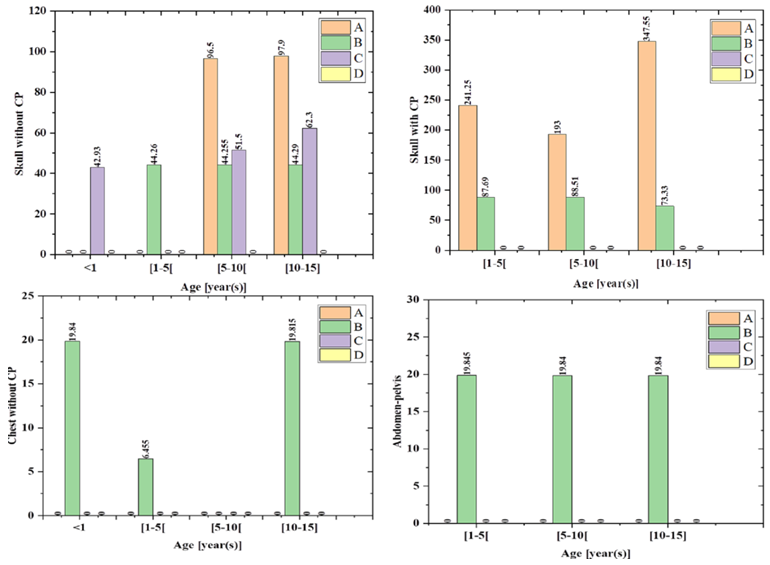
The age group of 1 to 15 years centers A, B, and C were received the highest effective volumes in the cerebral scan, including children younger than 1 year (Figure 6).
At center A, patients were received the highest doses up to 97.9mSv (5 to 15 years) in the cerebral. All paediatric age groups in center B was received the highest CTDIvol doses in the Chest and abdomen-pelvis only, with doses up to 19.84 mSv (Table 6). On the other hand, center D, was not undergone any examination to be demonstrated the effectiveness of the CTDIvol dose injection. Therefore, volumes that would be allowed evaluation of effective doses in paediatric patients were not evaluated. In paediatric patients at all centers, LDP values (Figure 7) in the cerebral without contrast is producted in the under-5 age group was received doses up to 44 mGy.cm versus 241.25 mGy.cm with contrast is producted. The mean LDP values in the 5- 10-year-old age group were 64.09 mGy.cm without contrast is producted and 140.76 mGy.cm with contrast is producted. In the 10-15 years age group without contrast is producted, 68.16 mGy.cm and with contrast is producted, with an average of 210.44 mGy.cm. In the Chest and in the abdomen and pelvis without contrast is producted, all values were less than 20 mGy.cm, while children under 5 years of age was received 6.46 mGy.cm in the chest.
The doses of contrast media were administered during CT examinations performed in four hospitals in Congo Brazzaville in adult and paediatric patients are given an idea of the management and care of patients before CT examinations in Congo. In adult patients, the frequency of hospital visits is not negligible and leaded us to consider our results. Men who were participated in CT examinations represent 55.3% compared to 44.7% of adult women. These values are represented a percentage. A very notable fact is the high rate of cranial CT scans performed, 37.2% in both adults and children. The time between is purchased and installation of the machines must be taken into account, but maintenance is also a key factor for good dosimetry. In the cerebral level, the effective doses were obtained moderate,were compared to the standard (Figure 1). At centers B, C and D, doses are relatively high (5.24 mSv to 10.74 mSv) compared to the ICRP 60 and ICRP 103 standard in the literature 2, 18. These values are 2 to 5 times higher than those of the International Convention on Reference Materials at Dose 60, in the centers C, A, and B respectively. The center D, on the other hand, was not received patients and data are not available, made it is impossible to be assessed effective doses in the cerebral.


These high doses were administered to patients, present risk and exposure to be ionized radiation related diseases with time. These effects have been showned to be had an impact on the modification of haematological factors and consequently lead to malignant diseases, direct consequences of cancers 17. In Europe, for instance, studies are showed that the dose of contrast products were administered during x-ray irradiation have been showned the risk of exposing patients to cancers. According to the dose-length product of the patients' exposure to be ionized radiation during the examination (Figure2), the doses were administered showing an average of 1417.12mGy.cm for the cerebral examination without contrast is producted and 3018.45mGy.cm with contrast is producted. These mean values are much higher (3018.45mGy.cm) than those already observed 18 and even was compared to that of European DLR (1050mGy.cm) 19 .The median values in the cerebral, without and without contrast is producted and in the Chest also has been a higher meant (1896.04mGy.cm) with contrast is producted compared to those in the literature 20. In the abdomen-pelvis, the mean LDP values without and with contrast is producted and the medians in one hand and in the Chest-abdomen-pelvis, in the other hand, all values are also higher than those of the examinations have already been reported 21. In adults patients, the median dose of the highest CTDIvol in the cerebral (112.94 mSv-198.6 mSv) and are quit lowed in other organs (50.00 mSv-73.8 mSv), with the maximum (79.50 mSv-100.80 mSv)(Fig. S2). In center A, the effective doses with or without contrast is producted even 3 to 5 times than the standard. This is the case in the chest, Abdomen-Pelvis, and Chest-Abdomen-Pelvis, with the exception of center D, where the maximum effective dose reach 53.35 mSv in the chest, 43.57 mSv in the AP, and 75.68 mSv in the TAP, with contrast is producted. In contrast, the CTDIvol (Figure 7) in paediatric patients are showed very high effective dose in both paediatric age groups <1-5 years in the chest. In the PA, the age group of10 to 15 years were received 97.9mSv, but also was received slight doses of more or less 2 times than the international standard (11.03-14.94 mSv).It has been showed that CTDIvol underestimate dose on the larger organs for 30%-48% CT coverage depending on the conversion factor, are different from published data 22. The Abdominal-pelvic examinations with contrast is producted at center B are four times (25.77 mSv) higher than that of us regulatory dose for paediatric patients of 1-5 years. In contrast, the doses were received without contrast to be producted showed moderate to tree times (10.48 to 20.12 mSv) above normal data for the entire age group.
It has been showed that paediatric subjects were exposed in medical settings were suggested that the risk of cancer could be increased even at lower doses. Using the conversion factors (k) of ICRP 60 (Figure 4 ) and ICRP 103 (Figure 4)., in the cerebral the effective dose in all centers are in the order of 15.98 mGy(A), 4.13 mGy(B), 2.66 mGy(C) and in the center C and 15.98 mGy (D), similar facts are also observed. Whereas in the chest, doses up to 53.35 mGy.cm are recorded, in the PA, the doses are higher than those recommended in Europe reaching 67.07 mGy in A, 53.13 mGy in B and more (48.15 mGy) in C. While at TAP, the doses are higher than normal in all hospitals; in A (67.01 mGy) versus 53, 13 mGy in B and 104.31 mGy in C 23. These CT scans cumulative dose of about 50 mGy was delivered in children have been proved to have been with time , might be almost triple the risk of leukaemia while dose of about 60 mGy might triple the risk of brain cancer 24. In paediatric patients (Figure 5), our study reveals an alarming DLP dose was administered, especially in the cerebral without contrast compound in center C are 5 times higher than reference doses for children were aged 1 to 15 years and 3 times (Table S7) higher than conventional doses were recommended in Malaysia. The cerebral with contrast has been moderated (B) and very high doses were compared with conventional dose from the USA versus 15 times of Malaysia for patients were aged between 1 to 15 years at center A. At center B, the paediatric data for thoracic examinations, without contrast is producted showed for the highest values (21.71 mSv), 16 times more than the norm for the age group (<1 year) and more or less moderate for patients with ages between 5 and 10 years. Centers A and C was not received any patients for thoracic and abdomen-pelvic examinations during our study period. Considering excessive is used of dose their radiosensitivity in children, were associated risks may be implied various pathologies 25. Comparison of paediatric effective dose with the literature is showed quite significant doses were compared to the international standards, for chest; Abdomen-pelvis and TAP without contrast is producted ( Figure 6). Only in center B, these services were effectived and the doses were administered (20.12mGy 21.74mGy to 25, 77mGy). In contrast, centers A and C were not delivered injections on paediatric patients, this as a result of low attency in these health care facilities, including the year-old cerebral without contrast, but also the chest, AP, and TAP with and without contrast. At center C, only the cerebral scan was performed, and in all cases, doses are aboved the standard. Center D was not received the paediatric patients for the corresponding examinations and was not compared.
Similarly, the evaluation of the volume of the actual doses were delivered to patients, CTDIvol is showed the actual dose was delivered to adult patients in the cerebral (97.9 mGy-39.865 mGy), without contrast product in the four hospitals selected in this study , are all below the diagnostic reference level (DLR) in CT to be compared to the European Commission and the American College of Radiology. With the contrast is producted, values (112.94 mSv-248.25 mSv) in the Cerebral and centers A and D, respectively, represent the highest CTDIvol values, across all four centers, with the mean (149.10-133.35 mSv) with the contrast median. This is represents higher values was compared to European standards 26. However, thoracic, AP and TAP examinations, with or without contrast producted, was showed very high values, which necessitates training of agents in radiation protection, especially on dose reduction techniques as well as on the follow-up and evaluation, in paediatric and adult patients. These weighted CT dose indices were represented the actual dose per patient and are all belowed the standard for protecting patients from the harmful effects of radiation without reducing diagnostic effectiveness 27. In paediatric patients, the values of the dose-length product are higher in neonates (< 1 year) with 2.1 and 0.7 in adolescents, in the cerebral we are reached the value of LDP up to 347.55 mGy.cm in teenagers of 10-15 years, showing the risks 28. To be considering, the very high dose was administered, the adult patients age range and also their vulnerability on one hand and the fragility of paediatric patients on the other hand, demonstrate that the optimization procedure and parameters may be played an essential role in dose delivery, which are not necessarily correlated to the intrinsic factors of the device used. It is not only the obsolescence nor the poor practice of the equipment used, but also the quality of the execution that should be considered. The reason for overdoses in some cases, could testify the quality of the personnel involved in the use of laboratory equipment; risks of cancerous disease associated has been discussed 29. By comparing effective dose between hospital settings, it is perceived that values were obtained, may be influenced by the quality of the equipment 30 and the quality of the technical staff, as already questioned in Congo 31, are not neglected. The administration of such high doses to adult and paediatric patients in all CT examinations clearly were showed potential danger associated to multiple risks in terms of cancer. Furthermore, according to the basic principles of radiation protection, in all cases, each party with responsibilities, particularly in terms of safety, must be ensured that the relevant requirements are applied, and to be ensured that specific dose limits are not exceeded 32.
These alarming doses should be called upon local authority to be taken necessary action in order to avoid patients exposition to overdoses of (i) contrast products and consequently to (ii) ionizing radiation. The regulatory framework of the Congo, need to be established, in order to monitor the harmful effects of ionizing radiation and to be established a national legal framework. It will also be necessary to be limited, regulate the operationalization of facilities and the performance of activities that is given rise to radiological risks, in order to be ensured the protection of people. Furthermore, three key factors, namely the equipment quality was used the level of qualification of the technicians, and the regulation and standardization of the doses to be administered. Also the need is advocated the policy in dose reduction, the number CT scans examinations in paediatric patients is necessary 25.
The analysis of the data was collected allowed us to be observed that the doses were delivered to patients during CT examinations without or with injection of the contrast is producted higher than the standard doses. Consequently, we are noted that the doses were submitted to patients during CT examinations more exposed to be ionized radiation. Therefore, urgent measures must be taken to avoid long-term medical exposure in order to be allowed adequate patient management. Training of radiology technologists in the use of dose reduction technique is essential for decision makers in Congo. This is to harmonize the technical parameters of dose reduction was applied. Radiation protectionists and medical physicists must be involved in the equipment supply chain.
Sincerely thank all the traditional doctors who accept to share their knowledge with us to reach the objective of this work. We also thank Minister of National Defense of Republic of Congo for their technical assistances.
| [1] | J. Aldrich A, Bilawich MJR: “Radiation doses to patients receiving computed tomography examinations in British Columbia,” Can. Assoc. Radiol. J., vol. 57, no. 2, pp. 79–85, 2006. | ||
| In article | |||
| [2] | IRSN: “IMAGERIE PÉDIATRIQUE Informations pour faciliter le dialogue sur les bénéfices et les risques entre professionnels et patients,” 2022. | ||
| In article | |||
| [3] | CIPR 105: Protection radiologique en médecine. 2004. | ||
| In article | |||
| [4] | WHO: “Ionizing Radiation: Health Effects and Protective Measures,” 2016. [Online]. Available:https:// www.who.int/ fr/news-room/fact-sheets/detail/ionizing-radiation-health-effects-and-protective-measures | ||
| In article | |||
| [5] | Beauvais-March M, Valero A, Biau N, Hocine JL, Rehel M: Bourguignon:“L’exposition des patients en radiodiagnostic : Bilan de l’étude dosimétrique réalisée en 2001–2003 dans 24 services français de radiologie,” Radioprotection, vol. 39, no. 4, pp. 493–511, 2004. | ||
| In article | View Article | ||
| [6] | De González, Darby S: “Risk of cancer from diagnostic X-rays : estimates for the UK and 14 other countries,” vol. 363, pp. 345–351, 2004. | ||
| In article | View Article PubMed | ||
| [7] | IRSN: “IMAGERIE PÉDIATRIQUE Informations pour faciliter le dialogue sur les bénéfices et les risques entre professionnels et patients,” pp. 1–94, 2022. | ||
| In article | |||
| [8] | A. Kaul B, Bauer J, Bernhardt D: Nosske, and R. Veit, “Original article Effective doses to members of the public from the diagnostic application of ionizing radiation in Germany ,” vol. 1132, pp. 1127–1132, 1997. | ||
| In article | View Article PubMed | ||
| [9] | Sari-Minodier D, Paul F, Coletti T, Orsière A, Botta: “Évaluation dosimétrique et biogénotoxicologique de l ’ exposition aux rayonnements ionisants,” vol. 41, no. 5, pp. 209–226, 2007. | ||
| In article | View Article | ||
| [10] | ICRP: “Managing Patient Dose in Digital Radiology,” ICRP Ann. ICRP, vol. 34, no. 1, pp. 1–73, 2004. | ||
| In article | View Article PubMed | ||
| [11] | ICPR 60: “New Quantities and Units As Given in Icrp Publication 60,” p. 8, 1990, [Online]. Available: http:// www.iaea.org/ inis/collection/NCLCollectionStore/_Public/26/071/26071238.pdf | ||
| In article | |||
| [12] | ICPR 103: “ICPR 103: The 2007 Recommendations of the International Commission on Radiological Protection,” Ann. ICRP, vol. 37, no. 2–4, p. 39, 1967. | ||
| In article | |||
| [13] | Benabdallah N: “Optimisation de la dosimétrie en alphathérapie par approche multi-échelle : application au traitement des métastases osseuses par le 223 Ra,” 2017. | ||
| In article | |||
| [14] | Doudenkova V: “Enjeux éthiques en radiologie diagnostique : comment la bioéthique peut-elle contribuer à une meilleure radioprotection du patient?,” 2015. | ||
| In article | |||
| [15] | Cristy M, Eckerman KF: “Specific absorbed fractions of energy at various ages from internal photon sources: 5, Fifteen-year-old male and adult female,” United States, 1987. | ||
| In article | View Article | ||
| [16] | Muhammad NA, Khalis Abdul Karim M, Hassan HA, Kamarudin MA, Ding Wong J H, Hoong K: “Diagnostic Reference Level of Radiation Dose and Image Quality among Paediatric CT Examinations in A Tertiary Hospital in Malaysia,” Diagnostics, vol. 10, no. 591, pp. 1–14, 2020. | ||
| In article | View Article PubMed | ||
| [17] | Shao YH, Tsai K, Kim S, Wu YJ, Demissie K: “Exposure to tomographic scans and cancer risks,” Oxford Univ. Press, vol. 4, no. 1, pp. 1–7, 2020. | ||
| In article | View Article PubMed | ||
| [18] | Torp C, Olerud H, Einarsson G, Gron P, Leitz W, Servomaa A: “Use of the EC quality criteria as a common method of inspecting CT laboratories- a pilot project by the Nordic Radiation protection Authorities,” Vienna, Austria, 2001. | ||
| In article | |||
| [19] | European Commission, Radiation Protection Raport N°185 :European Guidelines on Diagnostic Reference Levels for Peadiatric Imaging. Luxembourg: Publications Office of the European Union, 2018. | ||
| In article | |||
| [20] | Aiea RADEL:“Rapport annuel de l’aiea 2019,” 2019. | ||
| In article | |||
| [21] | Tsapaki V, Kottou S, Papadimitriou D: “Application of European Commission reference dose levels in CT examinations in Crete , Greece,” vol. 74, no. September, pp. 836–840, 2001. | ||
| In article | View Article PubMed | ||
| [22] | Li X: “Patient-specific radiation dose and cancer risk estimation in CT: Part II. Application to patients,” Med. Phys., vol. 38, no. 1, pp. 408–419, 2011. | ||
| In article | View Article PubMed | ||
| [23] | Shrimpton PC, Hillier MC, Lewis MA, Dunn M: “National survey of doses from CT in the UK : 2003,” vol. 79, no. December, pp. 968–980, 2006. | ||
| In article | View Article PubMed | ||
| [24] | Pearce MS: “Radiation exposure from CT scans in childhood and subsequent risk of leukaemia and brain tumours : a retrospective cohort study,” Lancet, vol. 380, no. 9840, pp. 499–505, 1985. | ||
| In article | View Article PubMed | ||
| [25] | Baysson H: “Suivi d’enfants exposés aux rayonnements ionisants dans le cadre de procédures radiologiques à visée diagnostique,” Radioprotection, vol. 48, no. 1, pp. 97–113, 2013. | ||
| In article | View Article | ||
| [26] | European Commission:“RADIATION PROTECTION 150,” in A Critical Review of the Draft 2005 ICRP Recommendations, 2008, no. 150, pp. 1–59. | ||
| In article | |||
| [27] | Osei EK, Darko J: “A Survey of Organ Equivalent and Effective Doses from Diagnostic Radiology Procedures,” vol. 2013, 2013. | ||
| In article | View Article PubMed | ||
| [28] | Mokubangele CM, Moifo B, Fotsin JG: “Évaluation de la dose patient en scanographie pédiatrique dans deux hôpitaux universitaires à Yaoundé Cameroun,” vol. 47, pp. 533–542, 2012. | ||
| In article | View Article | ||
| [29] | Matsubara K: “Assessment of an organ-based tube current modulation in thoracic computed tomography,” J. Appl. Clin. Med. Phys., vol. 13, no. 2, pp. 148–158, 2012. | ||
| In article | View Article PubMed | ||
| [30] | De la Santé M: “Radioprotection en radiologie-Grands établissements Procédures de sécurité pour l’installation , l’utilisation et le contrôle des appareils à rayons X dans les grands établissements radiologiques médicaux Code de sécurité 35,” 2008, pp. 1–94. [Online]. Available:https:// www.canada.ca/fr/sante-canada/services/ sante-environnement-milieu-travail/ rapports-publications/ radiation/code-securite-35-procedures-securite-installation-utilisation-appareils. html. | ||
| In article | |||
| [31] | Bazoma J, Dallou GB, Ondo Meye P, Bouka Biona C, Saïdou GH: Ben-Bolie, “Assessment of Organ and Effective Doses Received by Paediatric Patients Undergoing Computed Tomography Examinations in Three Hospitals in Brazzaville, Congo Republic: An Urgent Necessity for Regulatory Control,” Int. J. Sci. Res. Sci. Technol., vol. 8, no. 5, pp. 527–550, 2021. | ||
| In article | View Article | ||
| [32] | IAEA: “Normes de sûreté de l’AIEA pour la protection des personnes et de l’environnement,” Vienne, 2017. | ||
| In article | |||
Published with license by Science and Education Publishing, Copyright © 2024 Francis Akiana, Olivia Firmine Galiba Atipo Tsiba, Joel Bazoma, Abraham Mayoke, Régis Moyikoua, Guy Apollinaire Mensah and Daton Medenou
 This work is licensed under a Creative Commons Attribution 4.0 International License. To view a copy of this license, visit
http://creativecommons.org/licenses/by/4.0/
This work is licensed under a Creative Commons Attribution 4.0 International License. To view a copy of this license, visit
http://creativecommons.org/licenses/by/4.0/
| [1] | J. Aldrich A, Bilawich MJR: “Radiation doses to patients receiving computed tomography examinations in British Columbia,” Can. Assoc. Radiol. J., vol. 57, no. 2, pp. 79–85, 2006. | ||
| In article | |||
| [2] | IRSN: “IMAGERIE PÉDIATRIQUE Informations pour faciliter le dialogue sur les bénéfices et les risques entre professionnels et patients,” 2022. | ||
| In article | |||
| [3] | CIPR 105: Protection radiologique en médecine. 2004. | ||
| In article | |||
| [4] | WHO: “Ionizing Radiation: Health Effects and Protective Measures,” 2016. [Online]. Available:https:// www.who.int/ fr/news-room/fact-sheets/detail/ionizing-radiation-health-effects-and-protective-measures | ||
| In article | |||
| [5] | Beauvais-March M, Valero A, Biau N, Hocine JL, Rehel M: Bourguignon:“L’exposition des patients en radiodiagnostic : Bilan de l’étude dosimétrique réalisée en 2001–2003 dans 24 services français de radiologie,” Radioprotection, vol. 39, no. 4, pp. 493–511, 2004. | ||
| In article | View Article | ||
| [6] | De González, Darby S: “Risk of cancer from diagnostic X-rays : estimates for the UK and 14 other countries,” vol. 363, pp. 345–351, 2004. | ||
| In article | View Article PubMed | ||
| [7] | IRSN: “IMAGERIE PÉDIATRIQUE Informations pour faciliter le dialogue sur les bénéfices et les risques entre professionnels et patients,” pp. 1–94, 2022. | ||
| In article | |||
| [8] | A. Kaul B, Bauer J, Bernhardt D: Nosske, and R. Veit, “Original article Effective doses to members of the public from the diagnostic application of ionizing radiation in Germany ,” vol. 1132, pp. 1127–1132, 1997. | ||
| In article | View Article PubMed | ||
| [9] | Sari-Minodier D, Paul F, Coletti T, Orsière A, Botta: “Évaluation dosimétrique et biogénotoxicologique de l ’ exposition aux rayonnements ionisants,” vol. 41, no. 5, pp. 209–226, 2007. | ||
| In article | View Article | ||
| [10] | ICRP: “Managing Patient Dose in Digital Radiology,” ICRP Ann. ICRP, vol. 34, no. 1, pp. 1–73, 2004. | ||
| In article | View Article PubMed | ||
| [11] | ICPR 60: “New Quantities and Units As Given in Icrp Publication 60,” p. 8, 1990, [Online]. Available: http:// www.iaea.org/ inis/collection/NCLCollectionStore/_Public/26/071/26071238.pdf | ||
| In article | |||
| [12] | ICPR 103: “ICPR 103: The 2007 Recommendations of the International Commission on Radiological Protection,” Ann. ICRP, vol. 37, no. 2–4, p. 39, 1967. | ||
| In article | |||
| [13] | Benabdallah N: “Optimisation de la dosimétrie en alphathérapie par approche multi-échelle : application au traitement des métastases osseuses par le 223 Ra,” 2017. | ||
| In article | |||
| [14] | Doudenkova V: “Enjeux éthiques en radiologie diagnostique : comment la bioéthique peut-elle contribuer à une meilleure radioprotection du patient?,” 2015. | ||
| In article | |||
| [15] | Cristy M, Eckerman KF: “Specific absorbed fractions of energy at various ages from internal photon sources: 5, Fifteen-year-old male and adult female,” United States, 1987. | ||
| In article | View Article | ||
| [16] | Muhammad NA, Khalis Abdul Karim M, Hassan HA, Kamarudin MA, Ding Wong J H, Hoong K: “Diagnostic Reference Level of Radiation Dose and Image Quality among Paediatric CT Examinations in A Tertiary Hospital in Malaysia,” Diagnostics, vol. 10, no. 591, pp. 1–14, 2020. | ||
| In article | View Article PubMed | ||
| [17] | Shao YH, Tsai K, Kim S, Wu YJ, Demissie K: “Exposure to tomographic scans and cancer risks,” Oxford Univ. Press, vol. 4, no. 1, pp. 1–7, 2020. | ||
| In article | View Article PubMed | ||
| [18] | Torp C, Olerud H, Einarsson G, Gron P, Leitz W, Servomaa A: “Use of the EC quality criteria as a common method of inspecting CT laboratories- a pilot project by the Nordic Radiation protection Authorities,” Vienna, Austria, 2001. | ||
| In article | |||
| [19] | European Commission, Radiation Protection Raport N°185 :European Guidelines on Diagnostic Reference Levels for Peadiatric Imaging. Luxembourg: Publications Office of the European Union, 2018. | ||
| In article | |||
| [20] | Aiea RADEL:“Rapport annuel de l’aiea 2019,” 2019. | ||
| In article | |||
| [21] | Tsapaki V, Kottou S, Papadimitriou D: “Application of European Commission reference dose levels in CT examinations in Crete , Greece,” vol. 74, no. September, pp. 836–840, 2001. | ||
| In article | View Article PubMed | ||
| [22] | Li X: “Patient-specific radiation dose and cancer risk estimation in CT: Part II. Application to patients,” Med. Phys., vol. 38, no. 1, pp. 408–419, 2011. | ||
| In article | View Article PubMed | ||
| [23] | Shrimpton PC, Hillier MC, Lewis MA, Dunn M: “National survey of doses from CT in the UK : 2003,” vol. 79, no. December, pp. 968–980, 2006. | ||
| In article | View Article PubMed | ||
| [24] | Pearce MS: “Radiation exposure from CT scans in childhood and subsequent risk of leukaemia and brain tumours : a retrospective cohort study,” Lancet, vol. 380, no. 9840, pp. 499–505, 1985. | ||
| In article | View Article PubMed | ||
| [25] | Baysson H: “Suivi d’enfants exposés aux rayonnements ionisants dans le cadre de procédures radiologiques à visée diagnostique,” Radioprotection, vol. 48, no. 1, pp. 97–113, 2013. | ||
| In article | View Article | ||
| [26] | European Commission:“RADIATION PROTECTION 150,” in A Critical Review of the Draft 2005 ICRP Recommendations, 2008, no. 150, pp. 1–59. | ||
| In article | |||
| [27] | Osei EK, Darko J: “A Survey of Organ Equivalent and Effective Doses from Diagnostic Radiology Procedures,” vol. 2013, 2013. | ||
| In article | View Article PubMed | ||
| [28] | Mokubangele CM, Moifo B, Fotsin JG: “Évaluation de la dose patient en scanographie pédiatrique dans deux hôpitaux universitaires à Yaoundé Cameroun,” vol. 47, pp. 533–542, 2012. | ||
| In article | View Article | ||
| [29] | Matsubara K: “Assessment of an organ-based tube current modulation in thoracic computed tomography,” J. Appl. Clin. Med. Phys., vol. 13, no. 2, pp. 148–158, 2012. | ||
| In article | View Article PubMed | ||
| [30] | De la Santé M: “Radioprotection en radiologie-Grands établissements Procédures de sécurité pour l’installation , l’utilisation et le contrôle des appareils à rayons X dans les grands établissements radiologiques médicaux Code de sécurité 35,” 2008, pp. 1–94. [Online]. Available:https:// www.canada.ca/fr/sante-canada/services/ sante-environnement-milieu-travail/ rapports-publications/ radiation/code-securite-35-procedures-securite-installation-utilisation-appareils. html. | ||
| In article | |||
| [31] | Bazoma J, Dallou GB, Ondo Meye P, Bouka Biona C, Saïdou GH: Ben-Bolie, “Assessment of Organ and Effective Doses Received by Paediatric Patients Undergoing Computed Tomography Examinations in Three Hospitals in Brazzaville, Congo Republic: An Urgent Necessity for Regulatory Control,” Int. J. Sci. Res. Sci. Technol., vol. 8, no. 5, pp. 527–550, 2021. | ||
| In article | View Article | ||
| [32] | IAEA: “Normes de sûreté de l’AIEA pour la protection des personnes et de l’environnement,” Vienne, 2017. | ||
| In article | |||