Understanding the determinants of COVID-19 vaccine hesitancy is critical for public health strategy. This study aimed to compare the socio-demographic and perceptual factors influencing vaccine hesitancy between urban and rural populations in Bangladesh. Methods: A comparative study was conducted at Ashiyan Medical College, Dhaka, Bangladesh, from January to December 2021. A purposive sample of 58 individuals (16 urban, 42 rural) was recruited. Data on socio-demographics, vaccination status, trusted information sources, and perceptions were collected. Analysis was performed using SPSS version 23.0, employing descriptive statistics, chi-square, and t-tests. Results: Analysis revealed high overall vaccination uptake (Urban: 100%, Rural: 88.1%, p=0.184) but a significant rural-urban disparity in booster dose coverage (81.3% vs 33.3%, p=0.001). Rural residents had lower education and income (p<0.05). Trusted information sources differed markedly: urban respondents relied on government (81.3%), while rural respondents used community leaders (35.7%) and social media (33.3%) (p<0.001). All unvaccinated individuals (n=5) were rural, citing fear or disbelief. Conclusion: Significant rural-urban disparities in booster coverage persist in Bangladesh, driven by socioeconomic factors and reliance on informal information sources. Targeted, community-led interventions are essential to build vaccine confidence and improve uptake in rural populations.
The COVID-19 pandemic, caused by the novel coronavirus SARS-CoV-2, represents one of the most profound global public health crises in modern history 1. With millions of deaths worldwide and severe disruptions to health systems and economies, the rapid development and deployment of effective vaccines offered a pivotal pathway out of the pandemic 2. Vaccines have proven to be the most critical tool in reducing severe disease, hospitalization, and mortality, thereby alleviating the burden on healthcare infrastructure 3, 4. However, the success of vaccination programs is contingent not only on the availability and efficacy of the vaccines but also on their widespread public acceptance. Vaccine hesitancy, defined by the World Health Organization (WHO) as a "delay in acceptance or refusal of vaccines despite availability of vaccination services," has emerged as a significant threat to global health security 5. This complex issue is influenced by a confluence of factors, including complacency, convenience, and confidence, and varies considerably across different geographic, cultural, and socio-demographic contexts 6, 7. In low- and middle-income countries (LMICs) like Bangladesh, which launched one of the world's largest vaccination drives, addressing hesitancy is paramount to achieving herd immunity and controlling the virus's spread 8, 9. The discourse surrounding COVID-19 vaccines has been inundated with misinformation and conspiracy theories, often propagated rapidly through social media and other informal channels 10. This infodemic has eroded public trust in health authorities and scientific institutions, fostering fear and uncertainty 11. Studies conducted in various countries have identified key determinants of hesitancy, such as fear of side effects, concerns about the rapid development process, and low perceived risk of the disease itself 12, 13. In Bangladesh, a country with a pronounced socio-economic divide between urban and rural populations, these challenges are particularly acute. Rural communities, which constitute a significant majority of the population, often face barriers such as lower health literacy, limited access to credible information, and stronger reliance on traditional and communal sources of advice compared to their urban counterparts 14, 15. Understanding the nuanced differences in attitudes and perceptions between these two populations is therefore essential. While previous studies have examined vaccine acceptance in Bangladesh broadly, there is a scarcity of research that directly compares the socio-demographic and perceptual drivers of hesitancy between urban and rural dwellers within the same methodological framework. This gap limits the ability to design precisely targeted and effective intervention strategies. This study aims to fill this gap by conducting a comparative analysis of vaccine hesitancy in urban and rural settings in Bangladesh. Specifically, it seeks to profile and compare the socio-demographic characteristics, trusted sources of information, exposure to misinformation, and key motivators for vaccination between these two groups. The findings are intended to inform policymakers and health communicators in developing localized, context-specific strategies to enhance vaccine confidence and uptake across the entire nation.
Study population: This comparative study was conducted at the outpatient department of Ashiyan Medical College, Dhaka, Bangladesh. The study population consisted of adult individuals attending the facility during the data collection period from January to December 2021.
Inclusion criteria: Participants were eligible for inclusion if they were aged 18 years or older and were able to provide verbal consent to participate in the study. There were no restrictions based on gender, vaccination status, or medical history.
Exclusion criteria: Individuals who were critically ill, had significant cognitive impairments that prevented them from understanding the study questions, or who declined to participate were excluded from the study.
Study procedure: A purposive sampling technique was employed to recruit participants. A structured questionnaire was administered through face-to-face interviews by trained research assistants. The questionnaire collected data on socio-demographics, vaccination status, sources of health information, and perceptions related to COVID-19 vaccines.
Data analysis: Data were analyzed using the Statistical Package for the Social Sciences (SPSS) version 23. 0. Descriptive statistics were presented as frequencies, percentages, means, and standard deviations. Chi-square and Fisher’s exact tests were used for categorical variables, while an independent samples t-test was used for continuous variables. A p-value of <0. 05 was considered statistically significant.
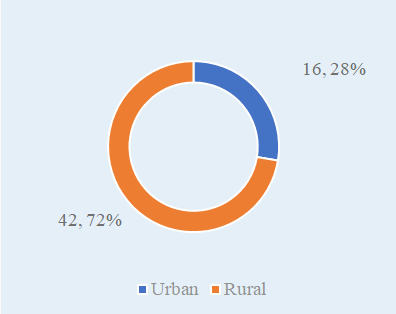
A total of 58 individuals participated in this study, comprising 16 (27.6%) urban and 42 (72. 4%) rural residents. The socio-demographic analysis revealed significant disparities between the groups. The urban cohort was significantly more educated, with 87.5% having an HSC or higher level of education, compared to 52. 4% of the rural cohort (p = 0.016). Income distribution also differed markedly; all urban respondents (100%) reported an income greater than 10,000 BDT, whereas only 59. 5% of rural respondents fell into this category, with 23. 8% earning 5,000-10,000 BDT and 16. 7% earning less than 5,000 BDT (p = 0.001). Occupational profiles were distinct, with urban areas dominated by service holders (56.3%) and rural areas by housewives (35.7%) and businessmen (23.8%) (p<0.001). No significant differences were found in mean age, gender distribution, or average household size. Vaccination uptake was high overall, with no significant difference in the proportion vaccinated between urban (100%) and rural (88.1%) areas (p=0.184). However, a significant gap existed in the completion of the full vaccination regimen. A markedly higher proportion of urban respondents (81.3%) had received a booster dose compared to just 33. 3% of rural respondents (p=0.001). Critical perceptual differences were observed. Trusted sources of vaccine information varied dramatically. Urban respondents placed paramount trust in government sources (81.3%), while rural respondents relied more on community leaders (35.7%) and social media (33.3%) (p<0.001). The primary motivator for vaccination also differed; a workplace requirement was the key factor for 50.0% of urban respondents, whereas rural respondents were primarily motivated by community examples (31.0%) and family encouragement (26.2%). All unvaccinated individuals (n=5) were from rural areas, citing "fear of side effects" or "don’t believe in vaccine" as their reason.
This study provides a comparative analysis of the socio-demographic and perceptual factors driving COVID-19 vaccine hesitancy between urban and rural populations in Bangladesh. The findings reveal a critical divergence: while overall vaccination uptake was high and comparable, a significant rural-urban disparity existed in booster dose coverage and the underlying drivers of acceptance and hesitancy. The high overall vaccination rate (88. 1% rural, 100% urban) is encouraging and aligns with the successful initial rollout of Bangladesh's national vaccination campaign, which achieved high coverage targets 16. However, the stark contrast in booster dose administration (33. 3% in rural vs. 81. 3% in urban areas) unveils a more nuanced picture of hesitancy. This suggests that while initial barriers may have been overcome, a "compliance gap" emerges for subsequent doses, a phenomenon observed in other LMICs where follow-up vaccination rates lag behind initial uptake 17. This finding is alarming, as booster doses are crucial for maintaining immunity against emerging variants and preventing severe disease 18. The socio-demographic profile of our sample underscores deep-seated structural inequities. The rural population had significantly lower educational attainment and income levels, factors consistently identified as key social determinants of health and predictors of lower health literacy and vaccine uptake 19, 20. This economic and educational disadvantage creates a fertile ground for hesitancy, as individuals with lower health literacy may find it more challenging to navigate complex and evolving scientific information 21. Perhaps the most salient finding of this study is the dramatic difference in trusted information sources. The urban cohort's strong reliance on government sources (81. 3%) indicates a higher level of institutional trust, which is a well-established facilitator of vaccine acceptance 22. In contrast, the rural population's primary reliance on community leaders and social media (35. 7% and 33. 3%, respectively) highlights a trust deficit in official channels and a heightened vulnerability to misinformation. This aligns with global studies showing that misinformation spread through social media and close social networks is a primary driver of vaccine hesitancy 23. The fact that all unvaccinated individuals were from rural areas and cited fear or disbelief reinforces that misinformation, often propagated through these trusted informal channels, has tangible, negative consequences on health behavior 24. Consequently, the motivators for vaccination also differed. The urban population was primarily driven by workplace requirements, an external mandate. The rural population was more influenced by internal social factors: community examples and family encouragement. This indicates that strategies effective in urban settings, like mandates, may be less impactful in rural communities. Instead, interventions leveraging community leaders and existing social networks for peer-to-peer advocacy could be far more effective 25.
The study findings are limited by the purposive sampling method and small sample size from a single center, which affects generalizability. The cross-sectional design also prevents the establishment of causal relationships between the examined variables.
This study confirms a significant rural-urban disparity in COVID-19 booster dose coverage in Bangladesh, despite high initial uptake. Vaccine confidence in rural areas is hindered by lower socio-economic status and greater reliance on informal information sources compared to official channels. Public health strategies must move beyond one-size-fits-all campaigns and instead implement targeted interventions that leverage trusted community leaders to effectively combat misinformation and improve vaccine acceptance in underserved rural populations.
Future vaccination campaigns should prioritize decentralized, community-led strategies in rural Bangladesh. These initiatives must actively engage local leaders and healthcare workers to disseminate trustworthy information and directly address misinformation, thereby bridging the confidence gap and improving booster dose uptake.
| [1] | Chandraker, Dilendra. "REVIEW OF WORLDWIDE PANDEMIC SITUATION OF COVID-19 ACTIVITIES FROM BEGINNING 2019 TO CURRENT SCENARIO–2022." European Journal of Biomedical 9. 12 (2022): 547-553. | ||
| In article | |||
| [2] | Lurie, Nicole, et al. "Developing Covid-19 vaccines at pandemic speed." New England journal of medicine 382. 21 (2020): 1969-1973. | ||
| In article | View Article PubMed | ||
| [3] | Polack, Fernando P., et al. "Safety and efficacy of the BNT162b2 mRNA Covid-19 vaccine." New England journal of medicine 383. 27 (2020): 2603-2615. | ||
| In article | |||
| [4] | Baden, Lindsey R., et al. "Efficacy and safety of the mRNA-1273 SARS-CoV-2 vaccine. " New England journal of medicine 384. 5 (2021): 403-416. | ||
| In article | |||
| [5] | MacDonald, Noni E. "Vaccine hesitancy: Definition, scope and determinants." Vaccine 33. 34 (2015): 4161-4164. | ||
| In article | View Article PubMed | ||
| [6] | Lazarus, Jeffrey V., et al. "A global survey of potential acceptance of a COVID-19 vaccine." Nature medicine 27. 2 (2021): 225-228. | ||
| In article | View Article PubMed | ||
| [7] | Sallam, Malik. "COVID-19 vaccine hesitancy worldwide: a concise systematic review of vaccine acceptance rates." Vaccines 9. 2 (2021): 160. | ||
| In article | View Article PubMed | ||
| [8] | Joarder, Taufique, Muhammad NB Khaled, and Mohammad AI Joarder. "Urban educated group's perceptions of the COVID-19 pandemic management in Bangladesh: a qualitative exploration." F1000Research 10 (2021): 170. | ||
| In article | View Article PubMed | ||
| [9] | Abedin, Minhazul, et al. "Willingness to vaccinate against COVID-19 among Bangladeshi adults: Understanding the strategies to optimize vaccination coverage." PloS one 16. 4 (2021): e0250495. | ||
| In article | View Article PubMed | ||
| [10] | Islam, Md Saiful, et al. "COVID-19–related infodemic and its impact on public health: A global social media analysis." The American journal of tropical medicine and hygiene 103. 4 (2020): 1621. | ||
| In article | View Article PubMed | ||
| [11] | Zarocostas, John. "How to fight an infodemic." The lancet 395. 10225 (2020): 676. | ||
| In article | View Article PubMed | ||
| [12] | Neumann-Böhme, Sebastian, et al. "Once we have it, will we use it? A European survey on willingness to be vaccinated against COVID-19." The European Journal of Health Economics 21. 7 (2020): 977. | ||
| In article | View Article PubMed | ||
| [13] | Lin, Cheryl, PikueiTu, and Leslie M. Beitsch. "Confidence and receptivity for COVID-19 vaccines: a rapid systematic review." Vaccines 9. 1 (2020): 16. | ||
| In article | View Article PubMed | ||
| [14] | Hossain, Mohammad Bellal, et al. "Health belief model, theory of planned behavior, or psychological antecedents: what predicts COVID-19 vaccine hesitancy better among the Bangladeshi adults?." Frontiers in public health 9 (2021): 711066. | ||
| In article | View Article PubMed | ||
| [15] | Kabir, Russell, et al. "COVID-19 vaccination intent and willingness to pay in Bangladesh: a cross-sectional study." Vaccines 9. 5 (2021): 416. | ||
| In article | View Article PubMed | ||
| [16] | Tagoe, Eunice Twumwaa, et al. "COVID-19 vaccination in lower-middle income countries: national stakeholder views on challenges, barriers, and potential solutions." Frontiers in Public Health 9 (2021): 709127. | ||
| In article | View Article PubMed | ||
| [17] | Khairi, Md. "LNH; Fahrni, ML; Lazzarino, AI The Race for Global Equitable Access to COVID-19 Vaccines. Vaccines 2022, 10, 1306. " 2022, | ||
| In article | View Article PubMed | ||
| [18] | Bar-On, Yinon M., et al. "Protection of BNT162b2 vaccine booster against Covid-19 in Israel." New england journal of medicine 385. 15 (2021): 1393-1400. | ||
| In article | View Article PubMed | ||
| [19] | Patwary, Muhammad Mainuddin, et al. "COVID-19 vaccine acceptance among low-and lower-middle-income countries: a rapid systematic review and meta-analysis." Vaccines 10. 3 (2022): 427. | ||
| In article | View Article PubMed | ||
| [20] | Jefsen, Oskar Hougaard, et al. "COVID-19 vaccine willingness amongst patients with mental illness compared with the general population." ActaNeuropsychiatrica 33. 5 (2021): 273-276. | ||
| In article | View Article PubMed | ||
| [21] | Roozenbeek, Jon, et al. "Susceptibility to misinformation about COVID-19 around the world." Royal Society open science 7. 10 (2020): 201199. | ||
| In article | View Article PubMed | ||
| [22] | Karlsson, Linda. "Psychological factors associated with vaccine attitudes and vaccination behaviors." (2021). | ||
| In article | |||
| [23] | Loomba, Sahil, et al. "Measuring the impact of COVID-19 vaccine misinformation on vaccination intent in the UK and USA." Nature human behaviour 5. 3 (2021): 337-348. | ||
| In article | View Article PubMed | ||
| [24] | Islam, Md Saiful, et al. "COVID-19 vaccine rumors and conspiracy theories: The need for cognitive inoculation against misinformation to improve vaccine adherence." PloS one 16. 5 (2021): e0251605. | ||
| In article | View Article PubMed | ||
| [25] | Moola, Sandeep, et al. "A rapid review of evidence on the determinants of and strategies for COVID-19 vaccine acceptance in low-and middle-income countries." Journal of global health 11 (2021): 05027. | ||
| In article | View Article PubMed | ||
Published with license by Science and Education Publishing, Copyright © 2026 Shahara Sarmin, Enamul Islam Saad and Laxmi Rani Das
 This work is licensed under a Creative Commons Attribution 4.0 International License. To view a copy of this license, visit
http://creativecommons.org/licenses/by/4.0/
This work is licensed under a Creative Commons Attribution 4.0 International License. To view a copy of this license, visit
http://creativecommons.org/licenses/by/4.0/
| [1] | Chandraker, Dilendra. "REVIEW OF WORLDWIDE PANDEMIC SITUATION OF COVID-19 ACTIVITIES FROM BEGINNING 2019 TO CURRENT SCENARIO–2022." European Journal of Biomedical 9. 12 (2022): 547-553. | ||
| In article | |||
| [2] | Lurie, Nicole, et al. "Developing Covid-19 vaccines at pandemic speed." New England journal of medicine 382. 21 (2020): 1969-1973. | ||
| In article | View Article PubMed | ||
| [3] | Polack, Fernando P., et al. "Safety and efficacy of the BNT162b2 mRNA Covid-19 vaccine." New England journal of medicine 383. 27 (2020): 2603-2615. | ||
| In article | |||
| [4] | Baden, Lindsey R., et al. "Efficacy and safety of the mRNA-1273 SARS-CoV-2 vaccine. " New England journal of medicine 384. 5 (2021): 403-416. | ||
| In article | |||
| [5] | MacDonald, Noni E. "Vaccine hesitancy: Definition, scope and determinants." Vaccine 33. 34 (2015): 4161-4164. | ||
| In article | View Article PubMed | ||
| [6] | Lazarus, Jeffrey V., et al. "A global survey of potential acceptance of a COVID-19 vaccine." Nature medicine 27. 2 (2021): 225-228. | ||
| In article | View Article PubMed | ||
| [7] | Sallam, Malik. "COVID-19 vaccine hesitancy worldwide: a concise systematic review of vaccine acceptance rates." Vaccines 9. 2 (2021): 160. | ||
| In article | View Article PubMed | ||
| [8] | Joarder, Taufique, Muhammad NB Khaled, and Mohammad AI Joarder. "Urban educated group's perceptions of the COVID-19 pandemic management in Bangladesh: a qualitative exploration." F1000Research 10 (2021): 170. | ||
| In article | View Article PubMed | ||
| [9] | Abedin, Minhazul, et al. "Willingness to vaccinate against COVID-19 among Bangladeshi adults: Understanding the strategies to optimize vaccination coverage." PloS one 16. 4 (2021): e0250495. | ||
| In article | View Article PubMed | ||
| [10] | Islam, Md Saiful, et al. "COVID-19–related infodemic and its impact on public health: A global social media analysis." The American journal of tropical medicine and hygiene 103. 4 (2020): 1621. | ||
| In article | View Article PubMed | ||
| [11] | Zarocostas, John. "How to fight an infodemic." The lancet 395. 10225 (2020): 676. | ||
| In article | View Article PubMed | ||
| [12] | Neumann-Böhme, Sebastian, et al. "Once we have it, will we use it? A European survey on willingness to be vaccinated against COVID-19." The European Journal of Health Economics 21. 7 (2020): 977. | ||
| In article | View Article PubMed | ||
| [13] | Lin, Cheryl, PikueiTu, and Leslie M. Beitsch. "Confidence and receptivity for COVID-19 vaccines: a rapid systematic review." Vaccines 9. 1 (2020): 16. | ||
| In article | View Article PubMed | ||
| [14] | Hossain, Mohammad Bellal, et al. "Health belief model, theory of planned behavior, or psychological antecedents: what predicts COVID-19 vaccine hesitancy better among the Bangladeshi adults?." Frontiers in public health 9 (2021): 711066. | ||
| In article | View Article PubMed | ||
| [15] | Kabir, Russell, et al. "COVID-19 vaccination intent and willingness to pay in Bangladesh: a cross-sectional study." Vaccines 9. 5 (2021): 416. | ||
| In article | View Article PubMed | ||
| [16] | Tagoe, Eunice Twumwaa, et al. "COVID-19 vaccination in lower-middle income countries: national stakeholder views on challenges, barriers, and potential solutions." Frontiers in Public Health 9 (2021): 709127. | ||
| In article | View Article PubMed | ||
| [17] | Khairi, Md. "LNH; Fahrni, ML; Lazzarino, AI The Race for Global Equitable Access to COVID-19 Vaccines. Vaccines 2022, 10, 1306. " 2022, | ||
| In article | View Article PubMed | ||
| [18] | Bar-On, Yinon M., et al. "Protection of BNT162b2 vaccine booster against Covid-19 in Israel." New england journal of medicine 385. 15 (2021): 1393-1400. | ||
| In article | View Article PubMed | ||
| [19] | Patwary, Muhammad Mainuddin, et al. "COVID-19 vaccine acceptance among low-and lower-middle-income countries: a rapid systematic review and meta-analysis." Vaccines 10. 3 (2022): 427. | ||
| In article | View Article PubMed | ||
| [20] | Jefsen, Oskar Hougaard, et al. "COVID-19 vaccine willingness amongst patients with mental illness compared with the general population." ActaNeuropsychiatrica 33. 5 (2021): 273-276. | ||
| In article | View Article PubMed | ||
| [21] | Roozenbeek, Jon, et al. "Susceptibility to misinformation about COVID-19 around the world." Royal Society open science 7. 10 (2020): 201199. | ||
| In article | View Article PubMed | ||
| [22] | Karlsson, Linda. "Psychological factors associated with vaccine attitudes and vaccination behaviors." (2021). | ||
| In article | |||
| [23] | Loomba, Sahil, et al. "Measuring the impact of COVID-19 vaccine misinformation on vaccination intent in the UK and USA." Nature human behaviour 5. 3 (2021): 337-348. | ||
| In article | View Article PubMed | ||
| [24] | Islam, Md Saiful, et al. "COVID-19 vaccine rumors and conspiracy theories: The need for cognitive inoculation against misinformation to improve vaccine adherence." PloS one 16. 5 (2021): e0251605. | ||
| In article | View Article PubMed | ||
| [25] | Moola, Sandeep, et al. "A rapid review of evidence on the determinants of and strategies for COVID-19 vaccine acceptance in low-and middle-income countries." Journal of global health 11 (2021): 05027. | ||
| In article | View Article PubMed | ||