Background: African populations continue to grapple with the cumulative impacts of the slave trade, colonialism, and ongoing neocolonialism. This violence—encompassing epistemic, physical, psychological, and economic dimensions—is both intergenerational and interconnected, manifesting in complex systems of ongoing harm. Objectives: To identify the root causes of violence in Africa by examining the racist knowledge system and to highlight Indigenous African knowledge systems, specifically Oromummaa, as vital counter-epistemes. Methods: Utilizing a systems thinking framework, this paper investigates the structural drivers and social determinants of contemporary violence in Africa. The analysis maps the root causes and examines the interplay between positive and negative feedback loops that sustain cycles of conflict. Findings: Through a public health lens, violence is conceptualized as a contagious, predictable, and preventable phenomenon with a distinct incubation period. This study identifies a racist episteme as the foundational driver of systemic violence. This framework underpinned the colonial and neocolonial exploitation of African human and natural resources, directly resulting in societal fragmentation, poverty, and climate vulnerability. These stressors—specifically food and water insecurity—act as catalysts that intensify competition and trigger further violence. Conclusions: Breaking the cycle of violence requires delegitimizing the racist episteme and advancing Afrocentric knowledge systems, such as Oromummaa, which emphasize social justice, gender equity, and ecological harmony. True progress demands transformative education for healing and policy frameworks that are intersectional: just, environmentally sustainable, and culturally grounded.
Africa is often regarded as a global hotspot for conflict and violence. The continent has endured severe forms of violence, including slavery, colonialism, genocide, and neocolonialism, all of which have left both visible and invisible scars. For example, during the formation of the Ethiopian state, European empire builders supplied military hardware, advisors, and racist ideological justifications to Abyssinian King Menelik II, enabling the conquest of neighboring groups such as the Oromos, Sidamas, Wolaitas, and others 1, 2. This conquest involved a prolonged and violent conflict, with pacification achieved through extreme violence. As a result of warfare and subsequent public health crises, the Oromo population was reduced by half 3. Many Oromo children were sold into slavery, while others became serfs, required to surrender between one-quarter and three-quarters of their harvest to the conquerors. All Oromo institutions, including Gada, Sinqee, and Qaalu, as well as the Oromo language, were banned. Following significant sacrifices, the Oromo people regained the right to use their language in schools and workplaces after 1992 4. To this day, the Oromo people are struggling to guarantee their right to freely determine their social, economic, political, cultural, and environmental rights 5. Although Menelik II harbored colonial ambitions, his success in conquering neighboring peoples depended on the military support of European empire builders 1, 2.
Socially ingrained ideas shape collective meaning-making and guide society's direction. The Ethiopian government's attacks on Oromo institutions such as Gada, Sinqee, and Qaalu serve to strengthen its capacity to control and exploit the human and natural resources of the Oromo people. Institutions establish shared meanings and expectations, thereby enabling the regulation of social agents and facilitating exploitation with minimal resistance. The Oromo institutions—Gada, which promotes democratic governance; Sinqee, which fosters gender equality; and Qaalu, which supports spiritual connections between society and the natural world—were supplanted by institutions that reinforced structural inequality 6, 7. As Ethiopian colonial policies delegitimised Oromo indigenous institutions, they also intensified evictions, extrajudicial killings, exploitation of human and natural resources, impoverishment, and impeded public health development 5, 7.
Despite its abundant natural resources, a significant portion of the African population continues to face persistent barriers to accessing necessities such as food, clean water, shelter, and clothing. Africa also has the lowest life expectancy worldwide and experiences substantial annual emigration 8. Understanding the root causes of these challenges and the mechanisms by which the system operates is essential for developing effective interventions. According to public health literature, violence is predictable, preventable, contagious, and characterized by an incubation period 9. Epistemic injustice, defined as the systematic denial of opportunities for people to produce knowledge about themselves and derive meaning from their experiences 10, has excluded African people from knowledge production and meaning-making processes, hindering their ability to connect current social problems to colonial policies. The exclusion of African people from knowledge production victimised the victim and freed the criminals from taking accountability. Consequently, African public health researchers must address questions such as why violence is more prevalent in Africa and what roles the transatlantic slave trade, colonialism, and neocolonial policies, and the imposed colonial knowledge system play in contemporary social problems and violence on the continent.
A knowledge system constitutes an integral component of the broader social system 11. Knowledge is generated as our brain organizes information, interprets lived experiences, and constructs meaning within their environments 12. The process of meaning-making is shaped by cultural context. Cultural diversity, therefore, reflects the epistemic pluralism inherent in a society's knowledge system. For instance, Africa is home to approximately 2,500 to 3,000 languages, compared to 200 in Europe and 2,300 in Asia. Historically, the greater linguistic diversity in Africa was associated with reduced tendencies toward colonization and assimilation. This suggests that, during the precolonial period, cultural and linguistic diversity in Africa was more widely accepted. The onset of European imperial expansion, including the transatlantic slave trade and colonial invasions, introduced new systems of structural inequality. These systems established knowledge frameworks that facilitated the assimilation and exploitation of certain groups by others. The creation of structural inequality, assimilation, and exploitation constitute acts of violence.
Public health focuses on disease prevention and the promotion of overall well-being. It serves as a catalyst for social change. Key initiatives include identifying social determinants of health, systematically eliminating risk factors, and strengthening protective factors. The concept of social determinants addresses the fundamental causes of health outcomes 13. This paper investigates not only the incidence of violence and related casualties, but also the social environments and circumstances that facilitate such violence. Consequently, understanding the social determinants of violence, formulating intervention policies, and proposing practical solutions require a systemic approach. To implement transformative and innovative strategies, policymakers and leaders must adopt system thinking and comprehend the relevant system inputs.
The primary objective of this paper is to identify the root causes of violence in Africa by examining racist knowledge systems that contributed to the transatlantic slave trade and colonialism. These systems introduced and expanded structural inequality, enabling the exploitation of both human and natural resources and intensifying competition for resources. The secondary objective is to reintroduce and revitalize Indigenous African knowledge systems, such as Oromummaa, as essential counter-epistemes to advance social and environmental justice.
Understanding the origins of violence, rather than merely responding to its symptoms, creates opportunities for healthier and more resilient societies. This approach reveals structural issues such as inequality, exclusion, and historical trauma, which can inform the development of more just and effective social systems 14. Early identification of these problems enables communities to intervene proactively, reducing harm before it occurs. Root-cause analysis also fosters empathy, dialogue, and shared responsibility. Addressing underlying causes can disrupt cycles of intergenerational trauma and promote community well-being. From a public health perspective, this reduces physical harm, stress, and mental health burdens. Safer communities also experience lower financial costs related to violence, attract investment, and support sustainable livelihoods 15, 14. Furthermore, when root causes are understood, individuals and groups gain agency to develop culturally relevant, locally led solutions. Focusing on root causes shifts the emphasis from punishment to accountability, healing, and transformation. By identifying drivers such as poverty, historical trauma, marginalization, inequality, and environmental stress, communities can design more effective interventions 16 .Analysis must consider external factors, such as the impact of racism and proxy wars initiated by European colonizers, alongside internal factors, including the lasting effects of slavery, colonialism, neocolonialism, and their associated knowledge systems on African societies, as well as the influence of internal conditions such as the indigenous worldviews on social relations. Furthermore, climate change intensifies resource competition and contributes to ongoing violence. The multifaceted nature of these causes requires a systems-thinking approach to identify feedback mechanisms and guide strategies for systemic transformation.
The African intellectual tradition is not immune to manifestations of violence. In Ethiopia, for instance, certain Abyssinian names assigned to children may convey messages that promote violence and aggressive behaviour toward others. For example, one of King Haile Selassie's children was named Asfa-Wesen, meaning 'widen the border,' suggesting expansion at the expense of neighboring groups and effectively implying colonization. Other commonly used names in this cultural context include Ashebir ('terrorize'), Ascheniki ('make them suffer'), Assegid ('make them bow for you'), Gizachew ('rule over them'), Kitachew ('punish them'), Damtew ('crush him'), Demmissew ('dismantle him'), Danyachew ('judge them'), Getachew ('their master'), Belayneh (you are superior), and Atalay ('cheater'). The significance of these names lies in the fact that, when children and adults are addressed by their name, they are continually reminded of how they are expected to behave and the attitudes expected of them.
Culture is dynamic 12, and an exclusive focus on external agents to explain African challenges or to identify comprehensive solutions is insufficient. The term Abyssinia, for instance, denotes a population of mixed ancestry resulting from the intermingling of groups from southern Yemen and the Horn of Africa 17. Cultural frameworks influence morality, ethics, and attitudes toward both social and natural environments. These frameworks guide individuals in their interactions with those outside their cultural group and prescribe appropriate behaviours in ambiguous social contexts. The origins of Abyssinian naming conventions and attitudes toward others remain uncertain; it is unclear whether these were adopted from southern Arabia or developed post-migration, potentially reflecting an immigrant mindset. Immigrant groups may display prejudiced attitudes toward indigenous populations and establish mechanisms to assert dominance. Dominance is a central concept in systems thinking, and feedback loops of dominance significantly influence behaviour 18. Naming conventions operate as a dominant system, shaping group members' behaviour. Consistent with these conventions, the Abyssinian tendency against other Africans is chauvinistic. Their attitude against non-Abyssinians and non-Orthodox Christians has persisted as a significant social issue.
Climate change, driven by unregulated human intervention in natural systems, is exacerbating a range of social problems. It not only intensifies existing challenges, such as food insecurity and water scarcity, but also generates new, less understood issues that are difficult to predict and manage. Although African populations contribute little to climate change, they disproportionately bear its consequences 19. Climate change causes extreme weather events, including severe and prolonged droughts or floods, which increasingly restrict access to necessities. For instance, such events disrupt social infrastructure related to food production, transportation, storage, and access to clean water. These disruptions also extend to essential public services, including health care and education. Limited access to these necessities heightens competition for resources within and between families and communities, which in turn can contribute to increased violence 9, 20.
In the Horn of Africa, competition for water and grazing land among pastoralist communities intensifies during droughts. Underground water sources and grazing areas are frequently guarded by armed militias. These conditions often lead to internal displacement, as individuals move from severely affected, impoverished regions to areas that are only marginally better off. The struggle to secure necessities often leads to conflict. These dynamics demonstrate that climate change contributes to conflict and violence in the region 9.
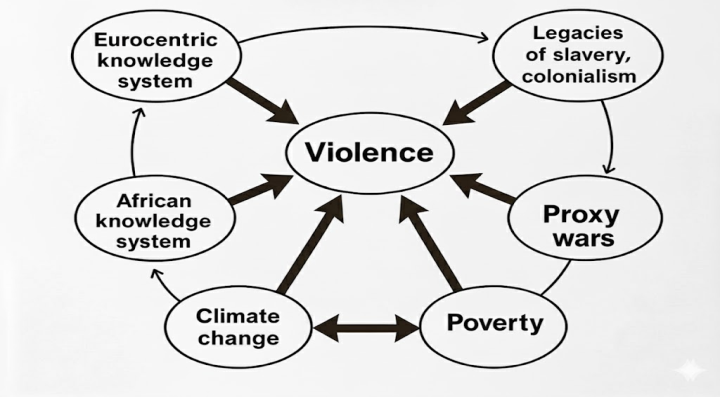
In short, the causes of conflict and violence in the Horn of Africa are complex and it include: a) the legacies of violence resulting from slavery, colonialism; b) proxy wars and poverty generated by colonial and neo-colonial policies; c) climate change driven by unregulated exploitation of natural resources; d) the Eurocentric knowledge system that perpetuates structural inequality; and e) the African knowledge system, which emphasizes community-centered approaches. These social factors interact both directly and indirectly within a complex system. Therefore, understanding the causes of violence in Africa and developing effective public health policy responses requires a systemic thinking approach.
The European Industrial Revolution was characterized by reductionist, linear, and logical thinking. Modern social and natural sciences continue to employ reductionist principles, often attributing the causes of social problems to external rather than internal factors. Although reductionist methods have addressed specific issues, they have also produced numerous unforeseen and complex challenges. The consequences of these challenges are multidirectional, contradicting earlier assumptions of unidirectionality. In many cases, the problems resulting from attempted solutions exceed the complexity and scale of the original issues. As Meadows 18 noted, a system is more than the sum of its parts. It is interactive, adaptive, dynamic, goal-seeking, self-preserving, and evolutionary. Systems possess the capacity to adapt, respond to events, self-organize, and self-repair when necessary. The classic Borneo malaria epidemic and the public health interventions that followed are the primary examples of a system 21.
The historical event in Borneo, now part of Malaysia, is widely regarded as a foundational case study for systems thinking in public health. This example illustrates that interventions which do not consider system complexity may produce unintended consequences. In the 1950s, the Dayak people of Borneo faced a severe malaria outbreak and sought assistance from the World Health Organization (WHO) 21. The WHO responded by spraying DDT to eliminate malaria-carrying mosquitoes. Initially, this intervention reduced mosquito populations and lowered malaria rates. However, several unintended consequences soon emerged. First, DDT eradicated a species of parasitic wasp that had previously controlled thatch-eating caterpillars, resulting in a caterpillar population surge that damaged villagers' thatched roofs. Second, the chemical accumulated in insects consumed by local geckos, which tolerated the toxin but stored it in their bodies. Third, village cats, which preyed on the geckos, ingested concentrated DDT and subsequently died. Finally, the absence of cats allowed the rat population to increase rapidly, leading to the destruction of grain stores and elevating the risk of Sylvatic Plague and Typhus outbreaks. In response to this complex situation, the WHO implemented "Operation Cat Drop," parachuting live cats into the area to control the rat population 21.
|
The WHO initially adopted a linear approach, focusing solely on malaria by targeting mosquito populations. This approach addressed only the immediate symptom and inadvertently generated more complex problems. In contrast, systems thinking requires attention to the broader ecosystem, facilitating an understanding of the interrelationships among mosquitoes, cats, roofs, and rats. Systems thinking enables anticipating feedback loops and unintended side effects. It emphasizes the interconnectedness within systems and prepares practitioners to recognize how changes in one component can influence others. The interactions among mosquitoes, geckos, cats, and rats constitute a balancing loop; disrupting this equilibrium can destabilize the entire system. Delays within these loops, such as the lag between DDT application and the subsequent increase in rat populations, further complicate decision-makers' comprehension. Systems thinking thus enhances the ability to anticipate and respond to such complexities.
The historical event in Borneo, which revealed the complex interactions between social and natural systems, offers a valuable framework for analyzing public health challenges through systems thinking. The principal drivers of violence in Africa include: a) the Eurocentric knowledge system that sustains structural inequality; b) the persistent legacies of violence from slavery and colonialism; c) proxy wars arising from colonial and neo-colonial policies; d) climate change resulting from unregulated exploitation of natural resources; e) poverty caused by the exploitation of human and natural resources; and f) the African knowledge system, which emphasizes community-centered approaches. Understanding the social system necessitates examining the interactions among these factors. Within this context, it is essential to determine which elements correspond to DDT, mosquitoes, parasitic wasps, geckos, cats, and rats.
Violence is a persistent social problem that affects all cultures, though its prevalence and severity vary across and within countries. Poor and marginalized communities are disproportionately affected, which exacerbates existing health disparities. The consequences of violence include injuries, disabilities, fatalities, long-term psychological trauma, chronic stress, and intergenerational effects. Violence has been linked to an increased risk of substance abuse, mental health issues, and chronic infectious diseases. In addition, violence imposes significant economic burdens by increasing healthcare costs, reducing productivity, and straining legal and social service systems. Like other public health challenges, violence is both predictable and preventable through evidence-based interventions 22, 14. While social determinants shape patterns of violence, biological factors also play a significant role. Violence exhibits characteristics of contagion, including an incubation period, and exposure to violence is a major risk factor for subsequent violent behavior 16.
Public health is widely defined as “the science and art of preventing disease, prolonging life, and promoting health through the organized efforts of society,” which prominently includes the prevention of violence within its scope. The field systematically employs scientific tools from various disciplines, such as medicine, epidemiology, sociology, psychology, criminology, education, and economics. This interdisciplinary approach enables public health to address diverse conditions globally, facilitates the identification of root causes underlying many social problems, including violence, and provides a robust framework for “social medicine” 23. Thoroughly understanding the root causes of violence and developing effective, evidence-based prevention strategies are essential. Conceptualizing violence as a contagious disease that can be transmitted, tracked, and prevented shifts the focus from reactive legal responses to proactive public health interventions 14, 16. Violence in Africa and other regions undeniably constitutes a significant public health problem, and prevention efforts should commence well before violent social conditions are created and behaviours manifest 15.
The public health approach to violence utilizes a systemic framework to analyze and address risk factors 15, 22. The Social-Ecological Model, for instance, is employed to identify the underlying causes of violence. According to this model, violence arises from the interaction of four primary factors. The first factor pertains to individual biological and personal history characteristics, such as age, education, and substance use. The second factor involves close social networks, including peers and family, which can either elevate risk or offer protection. The third factor concerns community environments, such as schools, workplaces, and neighborhoods, where social relationships form. The fourth factor encompasses broader societal influences, including economic inequality, cultural norms, and the availability of social safety nets 15.
Colonialism constitutes a form of collective violence for several reasons 22, 5. First, it is underpinned by a racist epistemology that asserts the biological and cultural superiority of the colonising group over the colonised. This belief system legitimises the establishment of control and the use of brutality against those who resist, rendering such actions both legally and morally acceptable within colonial policy. Second, colonialism is fundamentally oriented toward enriching the colonisers at the expense of the colonised. To facilitate economic gain, colonisers systematically exploit the natural and human resources of the colonised populations. Third, colonialism, informed by theories of cultural superiority, operates on the premise that the culture of the colonisers is inherently superior to that of the colonised. This cultural imposition is often framed as a civilising mission. Punishment and discrimination against individuals who resist these ideologies and policies frequently manifest in violent forms.
Collective violence encompasses not only physical harm but also actions targeting the social, economic, political, cultural, and environmental dimensions of a population 5, 22. When colonisers exert control over these domains, they impede the development of social, economic, political, cultural, and environmental capacities. For instance, violations of political rights may manifest as the denial of opportunities for leadership development, while violations of economic rights include the exploitation of human and natural resources and the widening poverty level and food insecurity. Violations of cultural rights can result in educational underachievement. These forms of violence, both independently and in combination, contribute to the underdevelopment of public health 24. In turn, food insecurity and scarcity of clean water fosters competition on resources and lead to violence 9.
In the African context, the Social-Ecological Model indicates that colonial experiences are significant contributors to violence on the continent. The mechanisms by which colonial policies contribute to violence in Africa can be categorized into twelve major groups. These include divide-and-rule strategies, the imposition of artificial borders, institutionalization of ethnic or national identities, land dispossession and displacement, intergenerational trauma, disruption of indigenous institutions essential for dispute resolution, enforcement of racial, ethnic, national, or gender binaries, economic marginalization and increased poverty, proxy wars, suppression of indigenous knowledge and promotion of structural inequality, legitimation of state violence, and increased resource scarcity and competition 25, 26. For example, colonial divide-and-rule policies were informed by racist ideologies and the promotion of racial hierarchies, which fostered structural inequality in Africa. These policies often favored one ethnic or national group over others, particularly in access to education and employment. In Rwanda and Burundi, such favoritism exacerbated tensions between Tutsi and Hutu populations, ultimately contributing to the Rwandan genocide 27. In Ethiopia, colonial powers supported Abyssinian expansion by providing military and political assistance to subjugate the Oromo and other groups, resulting in instability, poverty, famine, and widespread human rights violations 1, 2.
Oromummaa, or the essence of "being Oromo," is an ethical framework rooted in the centuries-old institutions of Gadaa, Siiqqee, and Qallu. At its core is Gadaa, a sophisticated system of democratic governance characterized by peaceful power transfers every eight years and consensus-based decision-making designed to prevent marginalization. This political structure is balanced by Siiqqee, a women-led institution dedicated to gender equity, and Qallu, a spiritual authority that fosters harmony between society, the divine, and the natural world 28.
These institutions function through a system of checks and balances; Gadaa leaders cannot assume authority without the formal blessing of Siiqqee and Qallu representatives. This interdependence cultivates a culture of Nagaa (peace) and Fayyaa (health), which the Oromo view as inseparable. Ethical conduct is further reinforced through the power of language; for instance, Qallu leaders avoid "profane" words associated with violence—such as "kill" or "burn"—believing that speech possesses the power to inform and theorise. Ultimately, Oromummaa transcends simple identity to become a comprehensive episteme: one that mandates democratic rule, the protection of human rights, and a profound stewardship of the environment 29.
Oromummaa thus guides daily life through a framework of morality and ethics. Traditional teachings, often shared around the fireplace, reinforce these values. The dominant societal objectives are to bring peace and health to individuals, families, communities, the natural world, and live in harmony with divine power 28, 29. As Baise Biqile, a respected elder, advises: “Do not transgress against others and never allow others to transgress against you.” Consequently, the episteme of Oromummaa embodies democratic governance, the rule of law, gender equity, and harmony within both the social and natural worlds, which counters the racist episteme 28, 30.
Orommuma is constructed and cemented in the Oromo episteme. Jalata 30 identifies Orommuma as the most significant aspect of Oromo cultural tradition. He argues that abandoning Orommuma compels individuals to seek ideological, religious, and institutional refuge in unfamiliar social contexts. Societies that adopt the epistemic perspectives of colonisers face significant challenges in constructing their institutions and revitalizing their identities. The inability to define both historical and contemporary identity increases vulnerability to cultural assimilation and external influence. Reclaiming and revitalizing Orommuma requires reconstructing Oromo social institutions and leadership, which are foundational to collective identity. Orommuma promotes epistemic rigor that supports democracy, equity, diversity, sustainability, and harmony within society and with the natural world. The principles of democracy, equity, and diversity encourage full participation in decision-making processes, which is essential for fostering harmony among people and countering colonial divide-and-rule policies. Therefore, Orommuma offers theoretical resources for marginalized populations lacking strong state protection and subjected to exploitative and dehumanizing epistemologies 28, 30.
The commodification of human beings and the implementation of colonial policies, motivated by racism and economic interests, normalized violence and facilitated the exploitation of both human and natural resources in Africa. The violence perpetrated by human traffickers and colonizers has produced intergenerational effects. The slave trade and colonialism have contributed to persistent social inequality and have established social determinants that perpetuate violence. This inequality has restricted access to essential resources such as food, clean water, and affordable housing. Food insecurity is implicated to complex public health problems 31. Resulting insecurity over necessities has intensified competition for resources. Consequently, the legacy of the slave trade and colonialism manifests as intergenerational collective trauma 5, 17.
A close examination of the factors contributing to violence begins with the Eurocentric knowledge system. Scholarly evidence demonstrates a reciprocal relationship between theory and practice 11. The Eurocentric knowledge system constitutes a worldview that positions European history, culture, values, and methods as the universal standard for humanity 32. By claiming universality, it treats Western epistemologies as the only valid or objective truth and dismisses African knowledge systems as “superstitious,” which inferiorizes the culture and the people. Consequently, Eurocentric knowledge perpetuates epistemic violence. Epistemic violence is the invisible processes through which the empire builders invalidate and suppress the knowledge systems of African peoples. By delegitimizing African history, morality, ethics, social structures, and indigenous ecological practices, this framework creates a knowledge ecology in which colonialism and slavery are morally justified and presented as "civilizing missions” 33, 34. The Eurocentric knowledge system also justifies and propagates structural inequality and proxy wars in Africa. It frequently frames conflicts in Africa through the lens of "neoliberal theory,” thereby obscuring the economic or resource-based motivations underlying proxy wars. This legitimizes the exploitation of human and natural resources, contributing to poverty and climate change. Thus, Eurocentric knowledge functions as the intellectual and cultural apparatus that justifies and sustains other forms of violence discussed below 35. If I use computer terminology, it serves as the "software" that legitimizes the "hardware" of physical violence, including slavery, colonialism, neo-colonialism, proxy wars, poverty, and climate change, as illustrated in the accompanying graph. If I use the 1950s Borneo malaria metaphor discussed above, Eurocentric knowledge can be seen as analogous to DDT.

At the time of drafting, two major wars were ongoing: the conflict between Ukraine and Russia in Europe and the confrontation involving Israel, the United States, and Iran in the Middle East. Although these wars are geographically distant from Africa and might be expected to have minimal impact on the continent, the actual consequences are significant. Due to the legacy of colonial policies, many African nations operate within constrained economies and rely heavily on external countries for economic development. Their business dependency makes them more vulnerable. For instance, the Ukraine-Russia war disrupted fertilizer exports from Ukraine and Russia to Africa, leading to reduced availability, lower agricultural productivity, and higher prices. Similarly, the conflict in the Middle East has disrupted the flow of essential raw materials, such as methane and phosphorus, critical to fertilizer production 36. As a result, African farmers have faced mounting challenges in maintaining crop yields and ensuring food security. These external pressures often exacerbate pre-existing economic hardships, highlighting the interconnectedness of global events. These developments demonstrate that violence transcends national borders and that African populations are adversely affected by such conflicts.
In Africa, the legacies of slavery and colonialism continue to drive contemporary violence, functioning as persistent rather than solely historical influences. These legacies established enduring frameworks for conflict, including the imposition of artificial borders, the adoption of exploitative economic systems, and the perpetuation of institutionalized mistrust. One significant consequence is the lasting resentment between groups that were compelled to participate in the slave trade or collaborate with colonizers and those who suffered as a result. Transatlantic slave traders provided financial incentives and firearms to local agents in Africa, thereby facilitating the slave trade. In many cases, the slave trade contributed to the creation of structural inequality. For instance, in Ethiopia, transatlantic slave traders and empire builders advanced racist theoretical justifications, asserting that non-Christians should be subjected to slavery and colonialism, and shaped the social structure during state formation 7. As a result, those who actively participated in the slave trade and collaborated in indirect colonialism became the dominant group 37. Resistance to social inequality is often undermined by efforts to preserve the privileges conferred by such inequality, which remains a major source of conflict in Ethiopia.
The transatlantic slave trade incentivized local leaders to betray their own communities and neighboring ethnic or national groups for personal gain and survival. These actions contributed to the breakdown of institutional structures, eroded communal trust, and undermined ethical and moral systems within the judiciary. Ethnic and national groups frequently targeted by the slave trade developed defensive mechanisms to protect themselves. Consequently, regions heavily affected by slave raids established fragmented political structures and localized knowledge systems 37. Many of these areas continue to experience weak state authority, which has facilitated the emergence of militias and vigilante groups as populations perceive the official state as incapable of providing adequate protection.
The racist worldview influenced European powers to colonize and divide Africa. During the Berlin Conference of 1884–1885, European powers partitioned the continent without considering the settlement of its more than 3,000 distinct ethnic and national groups 38. The resulting borders, drawn arbitrarily, created over 50 countries and frequently split single ethnic or national groups. For example, the Somali people were divided into British Somaliland, Italian Somaliland, French Somaliland, and territories within Ethiopia. After independence, parts of British and Italian Somaliland merged to form Somalia, while another portion of British Somaliland became part of Kenya. French Somaliland became Djibouti, and a significant area inhabited by Somalis was incorporated into Ethiopia. These divisions have contributed to irredentist violence, including wars aimed at reuniting separated populations, as well as ongoing social challenges in Somalia. Oromo territories were divided between Abyssinian (now Ethiopia) and British colonial authorities, with some areas becoming part of Kenya. In the Oromo case, the imposed artificial border contributed to institutional breakdown, and for that reason, until recently, the Oromo people refused to recognize it.
The imposition of national borders compelled diverse populations to be incorporated into newly formed countries, often forcing groups with historical rivalries to coexist within the same state. Colonial borders and "Divide and Rule" policies frequently provided ideological justification and military support, elevating minority groups to positions of power to maintain control over others. These practices directly contributed to events such as the Rwandan Genocide and the Sudanese Civil Wars. Similar dynamics have also played a significant role in the colonisation and marginalization of the Oromo people in Ethiopia.
Violence is a contagious disease 39. Certain forms of violence function as proxies for colonial and neo-colonial social policies and their agents 40. When social mechanisms that benefit colonisers are impeded, alternative or expanded mechanisms are frequently developed to eliminate obstacles to their objectives, resulting in the sponsorship of violence within and between communities. The colonial system established an economic model that legitimised the exploitation of both human and natural resources. The primary objective was the extraction of raw materials, including gold, diamonds, oil, and rubber, from colonised territories for the benefit of the colonisers. Colonial powers invested in infrastructure specifically designed for resource extraction, such as railways linking extraction sites to ports. To maintain control over mineral resources in Africa, colonial authorities often supported and organised opposing factions, leading to proxy conflicts. For example, in the Congo, Belgian and American forces removed Patrice Lumumba, the legitimate leader, and installed Mobutu as a puppet leader. In response, local populations organised rebel groups to contest control over these extraction points, resulting in conflict that persisted for over five decades.
The proxy war between the United States and the USSR in the Horn of Africa during the late 1970s exemplifies the era's realpolitik. This conflict is often referred to as the "Great Swap" because the two superpowers exchanged allies during the war. Prior to 1974, under Emperor Haile Selassie, the United States maintained a strong alliance with Ethiopia, while the USSR supported Somalia. In 1974, the Marxist military junta overthrew the emperor and declared Ethiopia a socialist state. The declaration ended the previous alliance. Ethiopia subsequently sought support from the USSR. When Somalia recognised the USSR's support for Ethiopia, it turned to the United States for assistance. Thus, the alliances shifted to the opposite of their original configuration 40.
When Somalia invaded Ethiopia to reclaim territory considered part of Somali Somali-speaking region, the USSR faced a "socialist dilemma" because both countries identified as Marxist states. Initially, the USSR attempted to mediate and sought to halt the invasion. However, after Somalia received support from the United States and refused to cease hostilities, the USSR withdrew its backing from Somalia and fully supported Ethiopia. This decision was influenced by three factors: historical ties through the Orthodox Church, Ethiopia's larger population, and its strategic geographic position. The involvement of external powers escalated a regional border dispute into a significant international conflict. To counteract the military equipment previously supplied to Somalia, the USSR organized a large-scale airlift to Ethiopia. Additionally, 15,000 Cuban troops were deployed to support the Ethiopian army. Substantial shipments of tanks, fighter jets, and small arms entered the region, providing weaponry that would perpetuate violence for decades after the Cold War 40. The proxy conflict's violence did not cease with the end of the Ethiopia-Somalia war in 1978. Instead, it established conditions for ongoing instability 26. The conflict contributed to Eritrea's eventual secession from Ethiopia and precipitated Somalia's collapse. The defeat in the Ogaden War undermined the Somali government, fostering internal dissent, the rise of clan-based rebel movements, and ultimately the complete disintegration of the Somali state in 1991 26. The Ethiopian military government openly brags about the disintegration Somali state.
In Ethiopia, the conflict was a significant factor in the onset of famine. The military government prioritized defense expenditures and implemented "villagization" policies, which played a major role in the catastrophic famine of 1983–1985 that resulted in over a million deaths. The villagisation policies were developed in response to the war, as the government feared that the Oromo population might use the conflict to advance their liberation movement. Consequently, the Ethiopian government adopted collective farming strategies modeled after those introduced by the USSR in the 1920s. The Ogaden region remained a focal point of tension, and the ethnic and political divisions intensified by superpower involvement continue to drive conflicts in Ethiopia today 5, 17.
During this proxy War, the Oromo people experienced significant casualties, and many were forced to flee as refugees, and a few of them got settlement in the USA and Canada. The Somali government demanded complete support from the Oromo population, and any attempt at neutrality or opposition resulted in the deaths of entire villages. Simultaneously, the Ethiopian government also required unconditional support from the Oromo. When the Somali military attacked Ethiopian positions, the Oromo were accused by Ethiopian forces of insufficient support and information sharing. Conversely, when the Ethiopian military targeted Somali positions, Somali forces accused the Oromo of failing to provide adequate assistance. Consequently, both armies perpetrated mass killings of the Oromo, destroyed villages, looted cattle and grain, and burned immovable property. Facing violence from both sides, many Oromo joined the newly established Oromo Liberation Front (OLF), a national movement advocating for self-determination. In response, the Ethiopian government implemented the villagization program to suppress the OLF's political activities 5, 17.
The relationship between colonialism and poverty reflects a deliberate structural design. Colonial agendas systematically enriched the colonizing powers by exploiting both human and natural resources in the colonies. This process was predicated on the depletion of the colonies and the corresponding enrichment of the colonisers. A close examination of colonial policies reveals five principal mechanisms by which the colonised populations were impoverished.
The first mechanism involved resource extraction and the draining of wealth. Rather than utilizing local resources such as gold, minerals, or timber to develop domestic industries, these materials were exported to Europe. During this extraction process, colonisers exploited both human and natural resources, leaving the colonies with depleted reserves and without an industrial base. Consequently, the colonisers accumulated wealth while the colonised populations experienced increasing impoverishment 39, 41.
Second, colonisers imposed agricultural practices that prioritized their own markets, including forced monoculture and the cultivation of cash crops. Local farmers were compelled to abandon the cultivation of diverse food staples, such as millet and tubers, in favor of single cash crops like cotton, rubber, tea, cocoa, and coffee to meet European demand. This imposition led to food insecurity and rendered local economies dependent on the volatile prices of European markets, granting colonial authorities’ significant control over the pricing of African products. When the market prices of these crops declined, entire colonies faced famine or severe poverty. Such dependency further entrenched the impoverishment of African populations 41.
Third, colonial policies led to the destruction of indigenous industries. To maintain colonies as captive markets for European goods, colonisers produced manufactured items in Europe and exported them to the colonies, frequently undermining local industries through high taxes, import bans, or direct destruction. These deindustrialization policies transformed previously self-sufficient populations into consumers reliant on costly imports.
Fourth, colonial land seizure policies deprived colonised populations of their means of production. Colonisers replaced traditional communal land-ownership systems with private property regimes, favoring European settlers and loyal local elites. This shift resulted in the displacement of large populations from fertile lands to less productive areas, compelling many to accept low-wage labor on plantations and in other industries. These social policies were intended to concentrate wealth among European settlers and a small group of local collaborators, thereby widening the poverty gap and perpetuating structural inequality, which often led to conflict and instability 41, 39.
Fifth, colonial policies promoted the development of infrastructure such as railroads, ports, and roads, but these structures were designed primarily to facilitate the extraction and export of resources rather than to connect local communities or encourage internal trade. Colonisers showed little interest in developing human capital, including education and healthcare, for the indigenous population. Most individuals received only minimal training for basic labor, resulting in a significant skills gap and a fragmented economy that further contributed to persistent poverty. In sum, the exploitation of human and natural resources has intensified poverty, which in turn exacerbates competition, homelessness 42 and violence 9.
The relationship between colonialism and climate change is well documented. Colonialism has contributed to climate change and heightened vulnerability to its impacts such as famine and violence. Although the mechanisms underlying this relationship are complex, this paper focuses on four primary areas. The first area concerns the historical origins of large-scale greenhouse gas emissions. The Industrial Revolution, which initiated significant greenhouse gas release, was financed and driven by colonial expansion. Colonial powers extracted resources locally to support their colonial expansion. Later, the raw materials from the colonies, such as coal, cotton, and timber, were intensively sourced to fuel European factories. This process created a "carbon debt," in which industrialized nations advanced at the expense of colonized populations' resources and labor.
The second mechanism involves ecological transformation of colonized lands. Colonial policies not only extracted resources but also imposed new land use practices. Indigenous systems of sustainable land management were frequently dismissed as outdated and replaced with monoculture agriculture, which prioritized the cultivation of single crops such as sugar, coffee, or rubber for export. Monoculture practices reduced local biodiversity, degraded soil health, and diminished ecosystem resilience to climate shocks, thereby increasing the vulnerability of both environments and communities to climate-related events such as droughts and floods.
Third, colonialism exacerbated structural vulnerabilities, increasing the susceptibility of colonized populations to climate change. The prevalence of famine and drought in African regions is closely linked to colonial legacies. Colonial and neocolonial policies have resulted in fragile economies, dependence on raw material exports, infrastructure designed primarily for resource extraction, weakened institutions, and high levels of debt. These factors have left many countries with limited financial capacity to invest in climate adaptation.
Fourth, contemporary responses to climate change frequently replicate colonial policies. For instance, carbon offsetting initiatives enable wealthy corporations to purchase inexpensive land in the Global South for tree planting, often resulting in the displacement of Indigenous communities from their ancestral territories. Additionally, efforts to reduce emissions have increased demand for minerals such as cobalt and lithium, which are often extracted under exploitative conditions that harm both workers and the environment in former colonies.
Colonial social policies designed to control and exploit resources have resulted in unregulated extraction, contributing to greenhouse gas emissions and climate change. Climate change, characterized by extreme weather events such as prolonged or frequent drought and flooding, restricts access to essential resources and intensifies competition and violence 9.
African knowledge systems are dynamic and influenced by both internal and external forms of violence. These systems are shaped by social factors within communities as well as external pressures. Initially, African knowledge systems were designed to protect individual communities from one another and to safeguard members against environmental threats. The implementation of divide-and-rule strategies by slave traders and colonizers, who favored certain ethnic groups, transformed inter-community relationships from resource competition to persistent enmity, rendering these conflicts intergenerational and pervasive. Religious beliefs became a central area of contestation. In Ethiopia, for example, political rivalry between the Agaw and the Amhara took on a religious dimension. Amhara elites, without substantiating evidence, claimed descent from King Solomon to legitimize their authority, compelling the Agaw to relinquish power; those who resisted were labeled as “sinful” and forced to beg for generations 33. In Sudan, Arab groups similarly claimed descent from Prophet Mohamed to justify their dominance over the people of Darfur 43. As a result, knowledge systems that were originally intended to defend communities from external threats or to counter Eurocentric paradigms, and that prioritized community-centered approaches, evolved to facilitate aggression against other groups. The protection provided by African knowledge systems is not universally extended, and social exclusion has frequently led to conflict and violence.
Understanding the relationship between African knowledge systems and violence requires an examination beyond physical conflict, focusing instead on epistemic violence, which refers to the systematic destruction or marginalization of a people’s way of knowing. A primary objective of colonizers was to destroy and delegitimize indigenous knowledge, a process described as epistemicide, or the deliberate attempt to "kill" indigenous knowledge 33, 35. By undermining these systems, colonizers sought to replace them with Western frameworks that prioritized commercial profit over ecological balance. For instance, colonial education systems that banned African languages not only restricted communication but also severed connections to the complex vocabularies used to describe local ecosystems, seasons, and medicinal plants. As a result, vital intergenerational knowledge about surviving droughts or managing forests was lost or "frozen" due to the suppression of the languages used to transmit it.
The enduring legacies of slavery and colonialism continue to manifest in various contemporary theories and practices. In response, the concept of resistance through epistemic disobedience is gaining momentum. Reclaiming African knowledge is increasingly regarded as an act of resistance. Scholars and activists advocate for "epistemic disobedience," which involves prioritizing African ecological traditions over Western solutions.
Violence, particularly in Africa, arises from complex and interconnected causes. A comprehensive understanding of the relationships among social structures, systems, and behaviours is essential to discern how systems function, what influences behaviour, and where interventions can effectively shift behavioural patterns toward improved outcomes. While most of the gun manufacturers are motivated by profit, buyers may be driven by considerations of profit and security. Key questions include whether gun manufacturers actively seek to create markets in Africa and thereby foster conflict, how transatlantic and colonial violence has shaped contemporary violence in Africa, and whether those who purchase firearms for profit derive these practices from local contexts or external influences.
If a factory is torn down but the rationality which produced it is left standing, then that rationality will simply produce another factory. If a revolution destroys a government, but systemic patterns of thought that produced that government are left intact, then those patterns will repeat themselves. Robert Pirsing cited in Meadows 18.
The quote above strongly connects to my own experiences. I grew up in the Oromo community in Ethiopia, where I witnessed state violence from a young age. The Haile Selassie government executed Oromos who resisted Amhara rule. My family and neighbors had to give a quarter of their harvest to Amhara landlords. Some people hoped for change, some prayed for a fair government, and others took action to make change happen 5. In 1974, King Haile Selassie was overthrown, and a military government came to power. The new leaders listened to people’s complaints, ended land dispossession, gave land back to farmers, and declared socialism as the new state policy. At first, it looked like the revolution had ended the old oppression. But when the Oromo people demanded greater rights—social, economic, political, and cultural—the military government introduced policies even harsher than before. The Oromo were forced to defend the empire that had oppressed them, and they also had to feed city residents and the military, selling their grain at low prices. The villagization and collective farm policies adopted from the U.S.S.R uprooted millions of farmers from their homes and collectively impoverished them. Even though the revolution removed the monarchy, state violence did not stop 5.
Again, millions of individuals demonstrated their desire for change through both silent prayers and active efforts to alter the military government. Oromo farmers, who were forced to dismantle their homes, serve in the military, and supply food at reduced prices to urban populations, intensified both passive and active forms of resistance. Many conscripted soldiers refused to fight and instead surrendered to liberation movements such as the Eritrean People's Liberation Front (EPLF), the Tigray People's Liberation Front (TPLF), and the Oromo Liberation Front (OLF). These developments contributed to the collapse of the military government in 1991 and the subsequent rise of the Ethiopian People's Revolutionary Democratic Front (EPRDF), which was dominated by the TPLF. As you can see next, although the revolution ended the military government, it did not achieve broader social transformation or social justice 5.
The EPRDF utilized Oromos who had refused military service and surrendered to the TPLF and EPLF to act against the Oromo population. The TPLF developed a political program, presented it to prisoners of war, established the Oromo People's Democratic Organisation (OPDO), and incorporated it into the EPRDF coalition. In response to national concerns, the EPRDF government nominally introduced self-rule and autonomy for various ethnic and national groups. In practice, however, the TPLF-led policies used the concept of self-rule to divide the Ethiopian population along ethnic lines, consolidate its authority, and facilitate the exploitation of human and natural resources 44. The OPDO was employed as a political instrument to perpetuate violence against the Oromo people. The EPRDF systematically sought to undermine the political and economic influence of the Oromo population, including by installing the OPDO as political leaders and denying the Oromo people independent leadership. The EPRDF also established chartered cities and actively excluded the Oromo people from urban political participation. In several instances, the government deliberately redrew regional boundaries to include Oromo-speaking communities in other regions, thereby generating conflict. Additionally, under the pretext of urban expansion and land leasing to international corporations, the EPRDF legalized the eviction of Oromo communities. The EPRDF further exacerbated internal divisions among the Oromo along clan and religious lines. Although the revolution ended the military regime and Amhara dominance, it ultimately led to Tigray's dominance under the EPRDF and failed to secure peace or social justice 5.
The grievances of the Oromo people, resulting from killings, imprisonment, and eviction 45, led to mass protests that compelled the EPRDF to recognize its inability to govern effectively. Consequently, the EPRDF opted to change its leadership and selected a member of the OPDO), Abiy Ahmed, to assume leadership. Abiy Ahmed, who joined the OPDO at the age of 14, was socialized within the party and internalized the EPRDF's ideological framework. From the outset, he promoted and idealized Ethiopian monarchs associated with the slave trade, genocide, and serfdom. This idealization provided ideological justification for Fano extremist Amhara nationalists to target Oromos, non-Oromos, and liberal Amharas. The Abiy administration adopted policies and strategies inherited from the EPRDF to suppress the aspirations of the Oromo people. Furthermore, the administration has been accused of perpetuating violence, arming Fano, and supporting perpetrators of violence. The revolution that ended the dominance of the Tigray People's Liberation Front (TPLF) did not result in peace or social justice. Over the past 60 years, Ethiopia has undergone four major social experiments, none of which have secured peace or social justice. The replacement of the head of state has not produced the desired social outcomes, indicating that substantive change requires systemic transformation rather than mere leadership change 5.
Dowden (2009) 57, through a comprehensive analysis of Africa, examined the influence of colonial education and policies on early post-colonial leaders. As a school teacher, he observed that “Africa is fleeing from itself as fast as it can go” (p. 32). Dowden further argued that, instead of strengthening indigenous institutions and systems, these leaders pursued Western wealth and status and adopted colonial governance structures. This approach alienated local knowledge systems and perpetuated epistemic violence, a process in which colonial epistemologies are legitimized while indigenous perspectives are marginalized or erased. As a result, post-independence leaders strove to maintain the absolute power inherited from colonial rulers and employed colonial mechanisms to control and exploit populations that had previously been self-governing. For instance, Idi Amin of Uganda, influenced by British military discipline, admired and sought to implement British hierarchical structures. Jomo Kenyatta of Kenya, after witnessing British colonization and land dispossession, inherited land following the British departure and subsequently exploited the people he had once sought to liberate. Similarly, Mobutu of Zaire, who ascended to power with Western support, prioritized Western interests over those of his own citizens. The colonial education system further legitimized the violent colonial social structure. These early African leaders, shaped by the colonial framework, contributed to the continued suppression of African epistemologies and reinforced the legacy of colonial violence, i.e. domination and exploitation.
The subsequent questions to consider are: why does the system persist, and how can systemic change be achieved? What should an improved system entail? To address these questions, I employ the public health metaphor of “upstream, midstream, and downstream” in conjunction with Oromummaa, as discussed in my previous work. This metaphor facilitates the identification of root causes and the transmission of problems across different levels. It also clarifies the epistemic origins of the issue and the cultural context that has contributed to violence. By understanding these foundational causes, I utilize Oromummaa to promote social and environmental justice, gender equality, and cultural diversity and equity.
A comprehensive understanding of the underlying issues is essential for effective problem-solving. Racist epistemologies have historically informed and guided the policies that underpinned the slave trade, colonialism, and neo-colonialism. Colonial policies legitimized land dispossession and erased the history, identity, and experiences of affected populations. These policies constitute the root causes of the exploitation of human and natural resources, persistent poverty, and environmental degradation. The boundaries of African states, established during the 1884/85 Berlin Conference, resulted in the fragmentation of communities. Racist epistemologies created and perpetuated structural inequality and normalized power imbalances. These frameworks have also been used to discredit the experiences of African people and undermine recognition of their social challenges. Additionally, such frameworks pathologized African cultures, identities, and experiences. Imperial ideologies interpret social problems through a narrow lens, which obscures the health impacts of colonialism. In summary, racist epistemologies perpetuate epistemic violence and contribute to other forms of violence. Therefore, applying the concept of "Upstream Thinking" requires the delegitimization of racist knowledge systems.
Colonialism generates trauma that is intergenerational, historical, and collective. Addressing epistemic racism is crucial for healing such trauma, advancing social justice, and informing effective social policy. Social justice is necessary to guarantee equitable access to healthy food, clean water, and comprehensive health care. According to social constructionist theory, members of different societies interpret their social worlds in distinct ways, constructing and shaping realities based on unique cultures and interests 46, 47, in his genealogy of incarceration, demonstrated that incarceration originated as a form of punishment rather than correction. Individuals were often incarcerated not for criminal acts, but for behaviors deemed deviant. Authorities define the boundaries of acceptable behavior, enforce these standards, and thereby establish cultural norms. Challenging these norms frequently results in punitive responses. Across societies, moral codes are established and maintained by individuals, groups, and states. Consequently, epistemology, culture, and violence are often deeply interconnected.
From a public health perspective, violence is considered contagious, predictable, and preventable 15, 16, 22. Violent attitudes and motives are acquired through learning and are epistemically reproduced. Therefore, effective violence prevention requires an understanding of the epistemic and cultural contexts in which violence develops and is sustained, as well as tracing its origins. Evidence indicates that cultural norms, beliefs, and practices influence both the acceptance and perpetuation of violence and shape societal responses. In certain contexts, violence is glorified, aggressive behaviors are rewarded, or victims are silenced, which creates environments where harm is legitimized and contributes to elevated rates of violence. Examining this relationship necessitates analysis of how power dynamics, media, political ideologies, and social structures can normalize aggression, making violence appear natural, justified, or essential for maintaining reputation or identity.
Social injustice fundamentally obstructs the cultivation of positive social relations by imposing a "racist episteme" that privileges Eurocentric knowledge systems 10 over African and other marginalized perspectives. Since the synthesis of knowledge is inextricably linked to an individual’s identity and social location 46, this systemic bias often results in the delegitimating of knowledge produced by marginalized groups. However, collective organization—particularly through civic engagement—can serve as a critical intervention to mitigate this credibility gap and restore epistemic curiosity 48.
When these systemic inequities are left unaddressed, they contribute to cycles of violence governed by distinct feedback mechanisms: whereas negative feedback serves to stabilize and correct behavior, positive feedback amplifies and reinforces aggressive patterns. The risk of such amplification is heightened by acculturation stress—the psychological burden of navigating divergent cultural frameworks—and by cultural homogeneity in honor-oriented contexts, where a refusal to engage in violence may be perceived as a catastrophic loss of social status. Conversely, the development of a robust ethnic identity and bicultural self-efficacy serve as vital protective factors. Ultimately, social systems that satisfy fundamental psychological needs and institutionalize prosocial values are more likely to bypass aggressive feedback loops in favor of sustainable peace 18.
Jalata 49 insightfully examines the phases of terrorism, emphasizing that terrorism can originate from state actors as well as from organized groups and individuals. He persuasively argues that the persistent denial of social injustice serves as the root cause of violence, while pervasive fear perpetuates ongoing acts or threats of terrorism. For instance, the transatlantic slave trade and colonialism were facilitated through sustained warfare and violence. The colonizers' assertion that the scramble for African lands was a sacred duty reflects a deeply entrenched racist ideology that presumes cultural, religious, and racial superiority. This imperialistic worldview justified the exploitation of both human and natural resources in Africa and contributed to the systemic impoverishment of its people. The establishment of enduring political and economic domination also led to the emergence of collaborators and activists seeking transformative social change. The resulting contestation between these groups further contributed to recurring cycles of violence. From the experiences of African people, traumas from the slave trade and colonialism have not healed because neocolonial policies persist. For them, violence is intergenerational.
This paper argues that violence and instability in Africa are intrinsically connected to transatlantic human trafficking, colonialism and neocolonialism. The intergenerational consequences of violence inflicted by traffickers, colonizers and neo-colonisers have perpetuated epistemic violence, undermining the lived experiences of Africans and imposing Eurocentric perspectives and reasoning. These dynamics have fostered structural inequality and facilitated the exploitation of both human and natural resources, thereby contributing to persistent conflict and instability across the continent. As violence consume resources it has been exacerbating social inequality and intensified competition for resources. Despite these complex challenges, there has been limited application of systems thinking to analyze the root causes of violence or to inform effective preventive strategies. The cycle of violence may be disrupted if policymakers adopt a systemic approach, address foundational causes, and promote societal healing.
Social justice is fundamental to public health, comparable to the necessity of food and clean water for physical health and love for mental health 50, 51. Despite the formal withdrawal of colonial powers from Africa, the enduring effects of colonization continue to influence daily life. Historically, slave traders and colonizers implemented divide-and-rule strategies, favoring specific ethnic groups and providing them with arms to advance colonial interests and facilitate criminal activities. These practices have resulted in lasting collective memories within affected societies. Following their departure, colonial authorities frequently transferred political power to preferred groups. Many post-independence African leaders, educated within Eurocentric epistemological frameworks, made limited efforts to address these historical injustices. Often, these leaders perpetuated social inequalities and the exploitation of both human and natural resources. Notable examples include the conflict between the Tutsi and Hutu in Rwanda and Burundi, where colonizers employed racist theories to divide the population 27. Another example is the state formation in Ethiopia, where Amhara elites were armed and supported to dominate the Oromos, the largest ethnic group in the country, as well as other groups 1, 2.
Scholars contend that theory informs practice and, conversely, practice shapes theory, indicating that knowledge is derived from lived experiences. The capitalist political economy, driven by profit and control, systematically exploits both human and natural resources, legitimizes injustice, and constructs theoretical rationalizations for violence 51. This approach often overlooks the diverse histories, values, and social structures present within African societies 52. Ignoring these complexities can result in policy failures and deepen societal inequalities. Adopting this system without accounting for the unique African context is inadvisable. African indigenous knowledge provides a robust framework for understanding local realities 53. Therefore, it is essential that African policymakers prioritize indigenous knowledge and reasoning as foundational frameworks in policy development.
The 1986 Ottawa Charter, the first international conference on the promotion of health, strongly emphasized the critical role of lasting peace in achieving sustainable health outcomes 54. Despite this, certain states that actively facilitated violence through destructive proxy wars were not subjected to legal accountability. Upholding individual rights significantly enhances communities' collective ability to address shared needs 55; however, persistent violations of these fundamental rights by states often go unpunished. Given the recognition that violence can rapidly spread within societies 56, African countries need to actively collaborate to prevent its escalation and foster harmonious, resilient social relations.
| [1] | Holcomb, Bonnie & Ibssa, Sisay (1990) The Invention of Ethiopia, The Making of a Dependent Colonial State in North Africa, The Red Sea Press, Trenton. | ||
| In article | |||
| [2] | Jalata, Asafa (2005) Oromia and Ethiopia. State Formation and Ethnonational Conflict 1868-2004.The Red Sea Press, Inc, Trenton, NJ. | ||
| In article | |||
| [3] | De Salviac, Martial (1901/2005) An Ancient People, Great African Nation, The Oromo, Translation from the Original French Edition by Kenno, Ayalew,Father Martial de Salviac Missionary. | ||
| In article | |||
| [4] | Lata, Leencho (1999) The Ethiopian State at the Crossroads: Decolonization and Democratization or Disintegration?, Red Sea Press, Laurelville, New Jersy. | ||
| In article | |||
| [5] | Dugassa, Begna (2025) Colonial Pathology: The Experience of the Oromo People, Cambridge Scholars Publishing, UK. | ||
| In article | |||
| [6] | Dugassa, Begna (2019) Where is the Global South in the Health Discourse? Attempt Forthcoming from the Oromo People’s Perspective, American Journal of Public Health Research, 2018, Vol. 6, No. 6, 243-252. | ||
| In article | |||
| [7] | Dugassa Begna. (2021B). Structural Inequality (SI) and Underdevelopment of Public Health Conditions: the Experiences of Oromo people in Ethiopia. HPHR.; 30. | ||
| In article | |||
| [8] | Our World in Data https://ourworldindata.org/data-insights/life-expectancy-in-africa-is-lower-than-on-other-continents. | ||
| In article | |||
| [9] | Dugassa, Begna (2024) “Climate Change and Violence in the Horn of Africa.” American Journal of Public Health Research, vol. 12, no. x (2024): 8-21. doi: 10.12691/ajphr-12-2-1. | ||
| In article | View Article | ||
| [10] | Fricker, Miranda. (2007). Epistemic Injustice: Power and the Ethics of Knowing. Oxford: University Press. | ||
| In article | View Article | ||
| [11] | Audi, Robrt (1998) Epistemology, A Contemporary Introduction to the Theory of Knowledge, Second Edition, Routledge, New York. | ||
| In article | |||
| [12] | Seale, Clive (2006) Researching Society and Culture, Secondary Edition, Sage Publications, London. | ||
| In article | |||
| [13] | WHO (2008) Closing the gap in a generation Health equity through action on the social determinants of health, https://iris.who.int/server/api/core/bitstreams/cb08095c-55c8-484e-bff6-0e9c78fd38dd/content. | ||
| In article | |||
| [14] | APHA (2018) Violence is a Public Health Issue: Public Health is Essential to Understanding and Treating Violence in the U.S., Policy number 20185. | ||
| In article | |||
| [15] | CDC (2025) About Violence Prevention, https:// www.cdc.gov/ violence-prevention/about/index.html. | ||
| In article | |||
| [16] | Slutkin, Gary; Ransford, Charles and Zvetina Daria (2018). How the Health Sector Can Reduce Violence by Treating it as a Contagion, AMA Journal of Ethics, Volume 20, Number 1: 47-55. | ||
| In article | View Article PubMed | ||
| [17] | Dugassa, Begna. (2008). Indigenous Knowledge, Colonialism and Epistemological Violence. The Experience of the Oromo People Under Abyssinian Colonial Rule, A thesis submitted in conformity with the requirement for the degree of Doctor of Philosophy, Department of Theory and Policy Studies in Education, Ontario Institute for Studies in Education of the University of Toronto. | ||
| In article | |||
| [18] | Meadows, Donella (2008) Thinking in Systems. A Primer, Chelsee Green Publishing, White River Junction, Vermont. | ||
| In article | |||
| [19] | Dugassa, Begna; Bachie Oli and Diba, Fantahun (2026) Climate Change and Public Health in the Horn of Africa: Mitigation Strategies and Resilience Building, The Journal of Oromo Studies 30 (2) Accepted for publication. | ||
| In article | |||
| [20] | Dugassa Begna (2023) The Nexus Between Violence Against Children and Public Health: The Experiences of Oromo People in Ethiopia. American Journal of Public Health Research. 2023; 11(1):25-37. | ||
| In article | View Article | ||
| [21] | O'Shaughnessy PT (2008). Parachuting cats and crushed eggs the controversy over the use of DDT to control malaria. Am J Public Health. Nov;98(11):1940-8. | ||
| In article | View Article PubMed | ||
| [22] | WHO (2002), World Report on Violence and Health, Geneva, Switzerland. | ||
| In article | |||
| [23] | Taylor, R. and Rieger, A. (1985). ‘Medicine as Social Science: Rudolph Virchow on the Typhus Epidemic in Upper Silesia’. International Journal of Health Services, 15(4): 547-559. | ||
| In article | View Article PubMed | ||
| [24] | Dugassa, Begna (2017). Collective Violence and Public Health: The Experience of the Oromo People in Ethiopia. Sociology Mind, 7, 102-127. | ||
| In article | View Article | ||
| [25] | Dugassa, Begna. (2004). Human Rights Violations and Famine in Ethiopia. The Journal of Oromo Studies, Vol.11, Number 1 and 2, page 47-68. | ||
| In article | |||
| [26] | Ford, Richard; Adam Hussein and Ismail, Edna (2000) War Destroys, Peace Nurtures. Somali Reconciliation and Development, The Red Sea Press, Lawrenceville, NJ. | ||
| In article | |||
| [27] | Mamdani, Mahmood (2002) When Victims Become Killers, Colonialism, Nativism,, and the Genocide in Rwanda, Princeton University Press, New Jersey. | ||
| In article | View Article | ||
| [28] | Dugassa, Begna (2022) Fostering Healthy Social Policies and Sustainable Development: Employing Oromummaaa as a Framework of Thinking, The Journal of Oromo Studies, Vol. 28, No.1, pp65-90. | ||
| In article | |||
| [29] | Dugassa, Begna (2021) The Public Health Significance of Religious Imposition: The Experience of Oromo People in Ethiopia. J Relig Health 60, 974–998. | ||
| In article | View Article PubMed | ||
| [30] | Jalata, Asafa (2007) Oromummaaa: Oromo Culture, Identity & Nationalism, Oromia Publishing Company, P.O.Box 467472, Atlanta, Georgia, 31146. | ||
| In article | |||
| [31] | Dugassa, Begna. (2019). Public Health Impacts of Famine in the Horn of Africa American Journal of Public Health Research, 2019, Vol. 7, No. 5, 171-181 | ||
| In article | |||
| [32] | Smith, Linda (2002) Decolonizing Methodologies. Research and Indigenous Peoples, Zed Books Ltd, London. | ||
| In article | |||
| [33] | Dugassa, Begna (2015) Epistemic Freedom and Development of Better Public Health Conditions: The case of Oromia Regional State in Ethiopia, Journal of Oromo Studies, Vol. 22, No. 1& 2, p199-238. | ||
| In article | |||
| [34] | Dugassa, Begna (2011) Colonialism of Mind: The Experience of Oromo People in Ethiopia, Journal of Sociology of Mind, Vol. 1, No. 2, pp55-64. | ||
| In article | View Article | ||
| [35] | Dugassa, Begna (2026) “The Ethiopian Discriminatory Educational Policies and Public Health Underdevelopment in Oromia.” The Journal of Oromo Studies 30 (1): 87–124. | ||
| In article | |||
| [36] | FAO (2026) FAO Chief Economist warns of severe global food security risks from disruption to Strait of Hormuz trade corridor, https://www.fao.org/newsroom/detail/fao-chief-economist-warns-of-severe-global-food-security-risks-from-disruption-to-strait-of-hormuz-trade-corridor/ en#: ~: text=Rising% 20input% 20costs% 20and% 20risks, baseline% 20usage%20is%20already%20low. (Retrieved on May 2, 2026). | ||
| In article | |||
| [37] | Bulcha, Mekuria (2002) The Making of Oromo Diaspora: A Historical Sociology of Forced Migration, Minneapolis: Kirk House Publishers. | ||
| In article | |||
| [38] | Hochschild, Adam (1998) King Leopold's Ghost: A Story of Greed, Terror, and Heroism in Colonial Africa, Houghton Mifflin. | ||
| In article | |||
| [39] | Slutkin, G. (2013). “Violence Is a Contagious Disease.” The Contagion of Violence. Institute of Medicine. Available at: www.cureviolence.org/wp-content/ uploads/2014/01/iom.pdf. | ||
| In article | |||
| [40] | Stone, Gregory (2010) Proxy War: A Critical Examination of Superpower Indirect Conflict in Africa. A Thesis Submitted to the Faculty of Graduate Studies In Partial Fulfillment of the Requirements for the Degree of Master of Arts Department of Political Studies, Faculty of Arts University of Manitoba. | ||
| In article | |||
| [41] | Elkins, Caroline (2014) Britain's Gulag: Brutal Ends of Empire in Kenya, The Bodley Head, London. | ||
| In article | |||
| [42] | Gathenya, Wambui (2003) Alternative education provisions for "street children" in Kenya, Ph.D thesis at University of Toronto, Canada. | ||
| In article | |||
| [43] | Jalata, A. (2005a). State Terrorism and Globalization: The Cases of Ethiopia and Sudan: The Cases of Ethiopia and Sudan. International Journal of Comparative Sociology, 46(1-2), 79-102. | ||
| In article | View Article | ||
| [44] | Dugassa, Begna (2012) Denial of Leadership Development and the Underdevelopment of Public Health: The Experience of the Oromo People in Ethiopia. Journal of Oromo Studies, Vol. 19, No. 1 &2, p139-174. | ||
| In article | |||
| [45] | Human Rights Watch (2005) Suppressing Dissent. Human Rights Abuses and Political Repression in Ethiopia’s Oromia Region. Volume 17, No. 7 (A). | ||
| In article | |||
| [46] | Berger, Peter and Luckman, Thomas (1967) The Social Construction of Reality, A Treatise in the Sociology of Knowledge, Anchor Books, A Division of Random House, New York. | ||
| In article | |||
| [47] | Foucault, Michael (1977) Discipline and punish: The birth of the prison (A. Sheridan, Trans.). Pantheon Books. | ||
| In article | |||
| [48] | Dugassa, Begna (2024) What are the Roles of Civic Organizations in Public Health Development? Attempting to Make Politics A Social Medicine in the Horn of Africa, American Journal of Public Health Research. 2024, 12(4), 87-99. | ||
| In article | View Article | ||
| [49] | Jalata, Asafa (2016) Phases of Terrorism in the age of Hlobalisation. From Chrstopher Columbus to Osama bin Laden, Palgrave, Macmillan. | ||
| In article | |||
| [50] | Wallack, Lawrence (2019) Building a Social Justice Narrative for Public Health, Health Education and Behavior, Vol. 46 (6) pps901-904.51. | ||
| In article | View Article PubMed | ||
| [51] | Crichlow, W. (2002). Western colonization as disease: Native adoption & cultural genocide. Critical Social Work, 2(2), 104-126. | ||
| In article | |||
| [52] | Dugassa, Begna. (2014). Reclaiming Oromo Indigenous Organizational Structures and Fostering Supportive Environments for Health, Archives of Business Research – Vol.2, No.1, p2-24. | ||
| In article | View Article | ||
| [53] | Dugassa, Begna. (2012). Knowledge Construction: Untapped Perspective in Pursuit for Health Equity. Sociology Mind, 2, 362- 372. | ||
| In article | View Article | ||
| [54] | Ottawa Charter for Health Promotion (1986) First International Conference on Health Promotion Ottawa, 21 November 1986 - WHO/HPR/HEP/95.1 http:// www.who.int/ hpr/ NPH/docs/ ottawa_charter_hp.pdf (Retrieved on March 18, 2012). | ||
| In article | |||
| [55] | Dugassa, Begna. (2018). The Significance of Collective Rights to Public Health Development: The Case of Oromia Regional State in Ethiopia, American Journal of Public Health Research. 6(5), 203-214. | ||
| In article | |||
| [56] | Glover, Chris & Makooie, Bobbak. (2018). Exposure to Community Violence as a Social Determinant of Health, Report to Toronto Board of Health. | ||
| In article | |||
| [57] | Dowden, Richard (2009) Africa, Altered States, Ordinary Miracles, Public Affairs, New York. | ||
| In article | |||
Published with license by Science and Education Publishing, Copyright © 2026 Begna Fufa Dugassa
 This work is licensed under a Creative Commons Attribution 4.0 International License. To view a copy of this license, visit
http://creativecommons.org/licenses/by/4.0/
This work is licensed under a Creative Commons Attribution 4.0 International License. To view a copy of this license, visit
http://creativecommons.org/licenses/by/4.0/
| [1] | Holcomb, Bonnie & Ibssa, Sisay (1990) The Invention of Ethiopia, The Making of a Dependent Colonial State in North Africa, The Red Sea Press, Trenton. | ||
| In article | |||
| [2] | Jalata, Asafa (2005) Oromia and Ethiopia. State Formation and Ethnonational Conflict 1868-2004.The Red Sea Press, Inc, Trenton, NJ. | ||
| In article | |||
| [3] | De Salviac, Martial (1901/2005) An Ancient People, Great African Nation, The Oromo, Translation from the Original French Edition by Kenno, Ayalew,Father Martial de Salviac Missionary. | ||
| In article | |||
| [4] | Lata, Leencho (1999) The Ethiopian State at the Crossroads: Decolonization and Democratization or Disintegration?, Red Sea Press, Laurelville, New Jersy. | ||
| In article | |||
| [5] | Dugassa, Begna (2025) Colonial Pathology: The Experience of the Oromo People, Cambridge Scholars Publishing, UK. | ||
| In article | |||
| [6] | Dugassa, Begna (2019) Where is the Global South in the Health Discourse? Attempt Forthcoming from the Oromo People’s Perspective, American Journal of Public Health Research, 2018, Vol. 6, No. 6, 243-252. | ||
| In article | |||
| [7] | Dugassa Begna. (2021B). Structural Inequality (SI) and Underdevelopment of Public Health Conditions: the Experiences of Oromo people in Ethiopia. HPHR.; 30. | ||
| In article | |||
| [8] | Our World in Data https://ourworldindata.org/data-insights/life-expectancy-in-africa-is-lower-than-on-other-continents. | ||
| In article | |||
| [9] | Dugassa, Begna (2024) “Climate Change and Violence in the Horn of Africa.” American Journal of Public Health Research, vol. 12, no. x (2024): 8-21. doi: 10.12691/ajphr-12-2-1. | ||
| In article | View Article | ||
| [10] | Fricker, Miranda. (2007). Epistemic Injustice: Power and the Ethics of Knowing. Oxford: University Press. | ||
| In article | View Article | ||
| [11] | Audi, Robrt (1998) Epistemology, A Contemporary Introduction to the Theory of Knowledge, Second Edition, Routledge, New York. | ||
| In article | |||
| [12] | Seale, Clive (2006) Researching Society and Culture, Secondary Edition, Sage Publications, London. | ||
| In article | |||
| [13] | WHO (2008) Closing the gap in a generation Health equity through action on the social determinants of health, https://iris.who.int/server/api/core/bitstreams/cb08095c-55c8-484e-bff6-0e9c78fd38dd/content. | ||
| In article | |||
| [14] | APHA (2018) Violence is a Public Health Issue: Public Health is Essential to Understanding and Treating Violence in the U.S., Policy number 20185. | ||
| In article | |||
| [15] | CDC (2025) About Violence Prevention, https:// www.cdc.gov/ violence-prevention/about/index.html. | ||
| In article | |||
| [16] | Slutkin, Gary; Ransford, Charles and Zvetina Daria (2018). How the Health Sector Can Reduce Violence by Treating it as a Contagion, AMA Journal of Ethics, Volume 20, Number 1: 47-55. | ||
| In article | View Article PubMed | ||
| [17] | Dugassa, Begna. (2008). Indigenous Knowledge, Colonialism and Epistemological Violence. The Experience of the Oromo People Under Abyssinian Colonial Rule, A thesis submitted in conformity with the requirement for the degree of Doctor of Philosophy, Department of Theory and Policy Studies in Education, Ontario Institute for Studies in Education of the University of Toronto. | ||
| In article | |||
| [18] | Meadows, Donella (2008) Thinking in Systems. A Primer, Chelsee Green Publishing, White River Junction, Vermont. | ||
| In article | |||
| [19] | Dugassa, Begna; Bachie Oli and Diba, Fantahun (2026) Climate Change and Public Health in the Horn of Africa: Mitigation Strategies and Resilience Building, The Journal of Oromo Studies 30 (2) Accepted for publication. | ||
| In article | |||
| [20] | Dugassa Begna (2023) The Nexus Between Violence Against Children and Public Health: The Experiences of Oromo People in Ethiopia. American Journal of Public Health Research. 2023; 11(1):25-37. | ||
| In article | View Article | ||
| [21] | O'Shaughnessy PT (2008). Parachuting cats and crushed eggs the controversy over the use of DDT to control malaria. Am J Public Health. Nov;98(11):1940-8. | ||
| In article | View Article PubMed | ||
| [22] | WHO (2002), World Report on Violence and Health, Geneva, Switzerland. | ||
| In article | |||
| [23] | Taylor, R. and Rieger, A. (1985). ‘Medicine as Social Science: Rudolph Virchow on the Typhus Epidemic in Upper Silesia’. International Journal of Health Services, 15(4): 547-559. | ||
| In article | View Article PubMed | ||
| [24] | Dugassa, Begna (2017). Collective Violence and Public Health: The Experience of the Oromo People in Ethiopia. Sociology Mind, 7, 102-127. | ||
| In article | View Article | ||
| [25] | Dugassa, Begna. (2004). Human Rights Violations and Famine in Ethiopia. The Journal of Oromo Studies, Vol.11, Number 1 and 2, page 47-68. | ||
| In article | |||
| [26] | Ford, Richard; Adam Hussein and Ismail, Edna (2000) War Destroys, Peace Nurtures. Somali Reconciliation and Development, The Red Sea Press, Lawrenceville, NJ. | ||
| In article | |||
| [27] | Mamdani, Mahmood (2002) When Victims Become Killers, Colonialism, Nativism,, and the Genocide in Rwanda, Princeton University Press, New Jersey. | ||
| In article | View Article | ||
| [28] | Dugassa, Begna (2022) Fostering Healthy Social Policies and Sustainable Development: Employing Oromummaaa as a Framework of Thinking, The Journal of Oromo Studies, Vol. 28, No.1, pp65-90. | ||
| In article | |||
| [29] | Dugassa, Begna (2021) The Public Health Significance of Religious Imposition: The Experience of Oromo People in Ethiopia. J Relig Health 60, 974–998. | ||
| In article | View Article PubMed | ||
| [30] | Jalata, Asafa (2007) Oromummaaa: Oromo Culture, Identity & Nationalism, Oromia Publishing Company, P.O.Box 467472, Atlanta, Georgia, 31146. | ||
| In article | |||
| [31] | Dugassa, Begna. (2019). Public Health Impacts of Famine in the Horn of Africa American Journal of Public Health Research, 2019, Vol. 7, No. 5, 171-181 | ||
| In article | |||
| [32] | Smith, Linda (2002) Decolonizing Methodologies. Research and Indigenous Peoples, Zed Books Ltd, London. | ||
| In article | |||
| [33] | Dugassa, Begna (2015) Epistemic Freedom and Development of Better Public Health Conditions: The case of Oromia Regional State in Ethiopia, Journal of Oromo Studies, Vol. 22, No. 1& 2, p199-238. | ||
| In article | |||
| [34] | Dugassa, Begna (2011) Colonialism of Mind: The Experience of Oromo People in Ethiopia, Journal of Sociology of Mind, Vol. 1, No. 2, pp55-64. | ||
| In article | View Article | ||
| [35] | Dugassa, Begna (2026) “The Ethiopian Discriminatory Educational Policies and Public Health Underdevelopment in Oromia.” The Journal of Oromo Studies 30 (1): 87–124. | ||
| In article | |||
| [36] | FAO (2026) FAO Chief Economist warns of severe global food security risks from disruption to Strait of Hormuz trade corridor, https://www.fao.org/newsroom/detail/fao-chief-economist-warns-of-severe-global-food-security-risks-from-disruption-to-strait-of-hormuz-trade-corridor/ en#: ~: text=Rising% 20input% 20costs% 20and% 20risks, baseline% 20usage%20is%20already%20low. (Retrieved on May 2, 2026). | ||
| In article | |||
| [37] | Bulcha, Mekuria (2002) The Making of Oromo Diaspora: A Historical Sociology of Forced Migration, Minneapolis: Kirk House Publishers. | ||
| In article | |||
| [38] | Hochschild, Adam (1998) King Leopold's Ghost: A Story of Greed, Terror, and Heroism in Colonial Africa, Houghton Mifflin. | ||
| In article | |||
| [39] | Slutkin, G. (2013). “Violence Is a Contagious Disease.” The Contagion of Violence. Institute of Medicine. Available at: www.cureviolence.org/wp-content/ uploads/2014/01/iom.pdf. | ||
| In article | |||
| [40] | Stone, Gregory (2010) Proxy War: A Critical Examination of Superpower Indirect Conflict in Africa. A Thesis Submitted to the Faculty of Graduate Studies In Partial Fulfillment of the Requirements for the Degree of Master of Arts Department of Political Studies, Faculty of Arts University of Manitoba. | ||
| In article | |||
| [41] | Elkins, Caroline (2014) Britain's Gulag: Brutal Ends of Empire in Kenya, The Bodley Head, London. | ||
| In article | |||
| [42] | Gathenya, Wambui (2003) Alternative education provisions for "street children" in Kenya, Ph.D thesis at University of Toronto, Canada. | ||
| In article | |||
| [43] | Jalata, A. (2005a). State Terrorism and Globalization: The Cases of Ethiopia and Sudan: The Cases of Ethiopia and Sudan. International Journal of Comparative Sociology, 46(1-2), 79-102. | ||
| In article | View Article | ||
| [44] | Dugassa, Begna (2012) Denial of Leadership Development and the Underdevelopment of Public Health: The Experience of the Oromo People in Ethiopia. Journal of Oromo Studies, Vol. 19, No. 1 &2, p139-174. | ||
| In article | |||
| [45] | Human Rights Watch (2005) Suppressing Dissent. Human Rights Abuses and Political Repression in Ethiopia’s Oromia Region. Volume 17, No. 7 (A). | ||
| In article | |||
| [46] | Berger, Peter and Luckman, Thomas (1967) The Social Construction of Reality, A Treatise in the Sociology of Knowledge, Anchor Books, A Division of Random House, New York. | ||
| In article | |||
| [47] | Foucault, Michael (1977) Discipline and punish: The birth of the prison (A. Sheridan, Trans.). Pantheon Books. | ||
| In article | |||
| [48] | Dugassa, Begna (2024) What are the Roles of Civic Organizations in Public Health Development? Attempting to Make Politics A Social Medicine in the Horn of Africa, American Journal of Public Health Research. 2024, 12(4), 87-99. | ||
| In article | View Article | ||
| [49] | Jalata, Asafa (2016) Phases of Terrorism in the age of Hlobalisation. From Chrstopher Columbus to Osama bin Laden, Palgrave, Macmillan. | ||
| In article | |||
| [50] | Wallack, Lawrence (2019) Building a Social Justice Narrative for Public Health, Health Education and Behavior, Vol. 46 (6) pps901-904.51. | ||
| In article | View Article PubMed | ||
| [51] | Crichlow, W. (2002). Western colonization as disease: Native adoption & cultural genocide. Critical Social Work, 2(2), 104-126. | ||
| In article | |||
| [52] | Dugassa, Begna. (2014). Reclaiming Oromo Indigenous Organizational Structures and Fostering Supportive Environments for Health, Archives of Business Research – Vol.2, No.1, p2-24. | ||
| In article | View Article | ||
| [53] | Dugassa, Begna. (2012). Knowledge Construction: Untapped Perspective in Pursuit for Health Equity. Sociology Mind, 2, 362- 372. | ||
| In article | View Article | ||
| [54] | Ottawa Charter for Health Promotion (1986) First International Conference on Health Promotion Ottawa, 21 November 1986 - WHO/HPR/HEP/95.1 http:// www.who.int/ hpr/ NPH/docs/ ottawa_charter_hp.pdf (Retrieved on March 18, 2012). | ||
| In article | |||
| [55] | Dugassa, Begna. (2018). The Significance of Collective Rights to Public Health Development: The Case of Oromia Regional State in Ethiopia, American Journal of Public Health Research. 6(5), 203-214. | ||
| In article | |||
| [56] | Glover, Chris & Makooie, Bobbak. (2018). Exposure to Community Violence as a Social Determinant of Health, Report to Toronto Board of Health. | ||
| In article | |||
| [57] | Dowden, Richard (2009) Africa, Altered States, Ordinary Miracles, Public Affairs, New York. | ||
| In article | |||