Background: Digital dentistry has emerged as a transformative force, reshaping diagnosis, treatment planning, and clinical outcomes. Understanding the knowledge, attitude, and practice (KAP) of dental professionals toward digital dentistry is essential for its successful integration into routine care. Objective: To evaluate the KAP of digital dentistry among dental professionals from India, Pakistan, and Ecuador. Methods: A cross-sectional, self-reported questionnaire-based survey was conducted among 109 dental professionals. Data on demographics, awareness, attitudes, and practice patterns were analyzed to assess the integration of digital technologies into dentistry. Results: Of the 109 respondents, most were aged 25–30 years (39.8%), with nearly equal gender distribution. The majority were from India (55%), followed by Ecuador (26%) and Pakistan (19%). Awareness of digital technologies was high (93.5%), with intraoral scanners (86.9%), CBCT (83.2%), and CAD/CAM (72%) being most familiar. Prosthodontics (73.6%), diagnosis (70.8%), and implantology (70.8%) were the main application areas. Most participants (90.8%) agreed that digital technologies enhance clinical efficiency, and 93.5% viewed them as the future of dentistry. Although nearly all supported incorporating digital dentistry into undergraduate curricula, only 36.2% of respondents felt their undergraduate training had adequately prepared them for digital dentistry. Conclusion: Dental professionals across India, Pakistan, and Ecuador exhibit high awareness and positive attitudes toward digital dentistry, particularly in prosthodontics and implantology. However, limited undergraduate exposure underscores the need for curriculum integration. As a cross-sectional, self-reported study, findings reflect perceptions at a single time point and may be influenced by response bias.
Digital technologies have brought a paradigm shift in modern dentistry, reshaping the way diagnosis, treatment planning, and clinical procedures are performed. The integration of computer-aided design and manufacturing (CAD/CAM), intraoral scanners, cone-beam computed tomography (CBCT), and three-dimensional (3D) printing has enhanced precision, efficiency, and patient satisfaction across dental specialties 1, 2. From prosthodontics and implantology to orthodontics and maxillofacial surgery, digital workflows are increasingly recognized for improving clinical outcomes, reducing chairside time, and facilitating minimally invasive approaches 3. These innovations have positioned digital dentistry as a cornerstone of contemporary dental care.
Despite its potential, the adoption of digital dentistry is uneven worldwide. High-income countries have rapidly embraced advanced digital workflows, supported by greater availability of resources, training, and infrastructure 4. In contrast, many low- and middle-income countries face barriers that limit implementation, including high costs, inadequate access to equipment, lack of standardized training, and resistance to change due to limited familiarity 5. Consequently, the extent to which dental professionals are prepared to adopt digital dentistry depends not only on technological access but also on their knowledge, attitudes, and practices (KAP) regarding these tools.
Several studies in developed countries have reported favorable perceptions of digital dentistry, with practitioners acknowledging its role in improving efficiency and treatment quality 6, 7. However, evidence from South Asia and Latin America remains scarce, where contextual challenges, such as disparities in resources, patient affordability, and gaps in dental education, may significantly influence uptake. Most existing studies have focused on single-country evaluations, offering limited understanding of how perspectives vary across regions with differing healthcare and educational infrastructures 8. Comparative multi-country investigations are particularly valuable because they can uncover cross-cultural differences and common challenges that shape the global trajectory of digital dentistry.
India, Pakistan, and Ecuador provide a unique platform for such evaluation. India, with one of the world’s largest networks of dental schools, is rapidly expanding exposure to digital technologies, yet adoption in clinical practice remains inconsistent due to financial and infrastructural constraints 9. Pakistan, similarly, has seen growing interest in digital
workflows, though accessibility and training opportunities are limited to select institutions 10. Ecuador, representing the Latin American region, is also navigating the transition toward digital dentistry, but faces challenges in standardizing technology integration across diverse practice settings. Together, these three countries represent diverse educational, economic, and professional contexts, offering an opportunity to examine the global disparities and commonalities in digital dentistry adoption.
Understanding dental professionals’ KAP in these regions can provide actionable insights for policymakers, educators, and healthcare planners. Positive attitudes toward digital dentistry may indicate willingness to adopt innovations, while gaps in knowledge or limited clinical practice highlight areas for targeted training and curriculum development. Moreover, evaluating the perspectives of professionals at different stages of their careers, ranging from recent graduates to experienced practitioners, can shed light on generational differences in readiness to embrace digital transformation.
Therefore, this study was designed to evaluate the knowledge, attitudes, and practices of dental professionals toward digital dentistry in India, Pakistan, and Ecuador. By exploring these aspects in a cross-country context, the study aims to identify gaps in awareness and training, highlight regional trends, and provide recommendations for integrating digital dentistry more effectively into education and clinical practice.
A cross-sectional, self-reported questionnaire-based survey was conducted from January to August 2025 to evaluate the knowledge, attitudes, and practices (KAP) of digital dentistry among dental professionals from India, Pakistan, and Ecuador. The study targeted licensed practicing dentists, including general practitioners and specialists, who voluntarily agreed to participate and provided electronic informed consent. Dental students, retired dentists, and incomplete responses were excluded.
2.1. Questionnaire Development and ValidationThe questionnaire was developed based on previously validated instruments used in similar studies assessing digital dentistry awareness and adoption. Content validity was established through review by three academic experts in prosthodontics and digital dentistry. The survey was pre-tested among 10 dental professionals who were not part of the final sample to assess clarity and feasibility, and minor modifications were made accordingly. Internal consistency reliability was calculated using Cronbach’s alpha (α = 0.82), indicating good internal reliability.
2.2. Study Design and ReportingThis study adhered to the STROBE (Strengthening the Reporting of Observational Studies in Epidemiology) guidelines for cross-sectional research. Participants were recruited via professional dental networks and email invitations using convenience sampling. Only fully completed electronic responses were included in the final dataset; incomplete or duplicate responses were automatically excluded by the survey system. Confidentiality and voluntary participation were ensured throughout.
A structured questionnaire comprised four sections: demographics (age, gender, country, years of clinical experience, type of dentist); knowledge and awareness of digital dental technologies (intraoral scanners, CAD/CAM, CBCT, 3D printing); attitudes toward digital dentistry (perceived efficiency, relevance, and educational integration); and practice patterns were evaluated across the following specialty categories: General Dentistry, Prosthodontics, Orthodontics, Endodontics, Oral Surgery, Periodontics, and Other.
Data were collected electronically via email and professional social media networks over a predefined recruitment period from January to August 2025. Recruitment remained open throughout this period, and a total of 109 complete responses were obtained by the end of data collection. Descriptive statistics, including frequencies and percentages, were calculated to identify trends and assess patterns in knowledge, attitudes, and practices across demographic variables. The study protocol adhered to the Declaration of Helsinki, with confidentiality maintained throughout.
A total of 109 dental professionals completed the survey. Most respondents were aged 25-30 years (n = 43, 39.8%), followed by 31-35 years (n = 30, 27.5%). The remaining 36 participants (32.7%) were aged over 35 years. The gender distribution was nearly equal, with 52.3% female (n = 57) and 47.7% male (n = 52). The majority of participants were from India (n = 60, 55%), followed by Ecuador (n = 28, 26%) and Pakistan (n = 21, 19%). General dentists comprised 67% of respondents (n = 73), while specialists represented 33% (n = 36). Most participants had less than 5 years of clinical experience (n = 76, 69.7%), followed by 5-10 years (n = 25, 22.9%) and more than 10 years (n = 8, 7.3%).
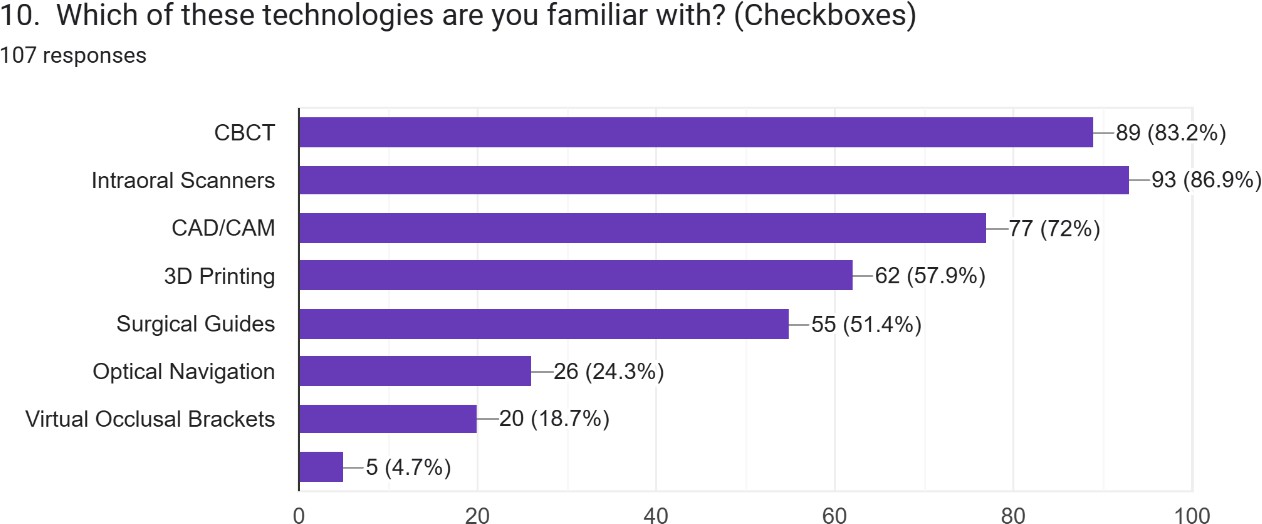
3.2. Knowledge and Awareness of Digital DentistryAwareness of digital technologies was high, with 93.5% of participants reporting familiarity with at least one digital tool. The most commonly known technologies were intraoral scanners (n = 95, 86.9%), CBCT (n = 91, 83.5%), and CAD/CAM systems (n = 79, 72%). Self-reported awareness of 3D printing was indicated by 68 participants (62.4%).


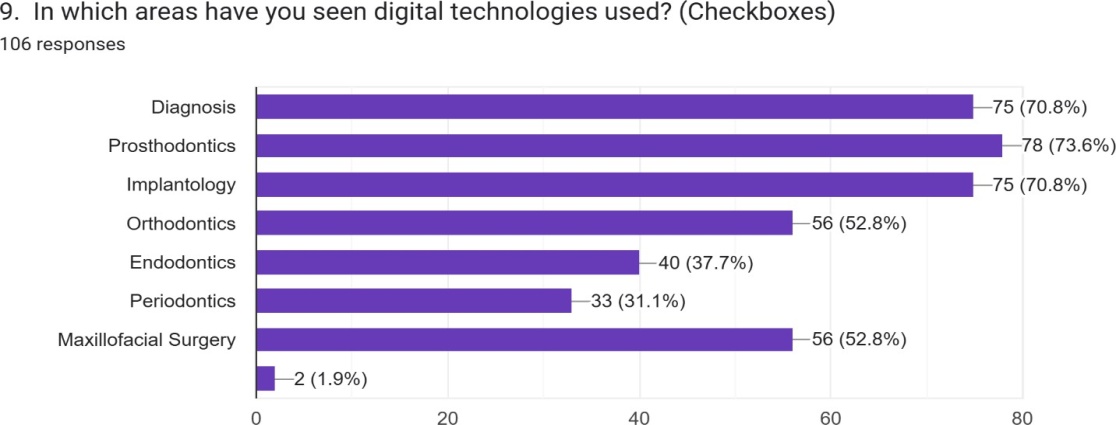
Digital dentistry was most frequently applied in prosthodontics (n = 80, 73.6%), diagnosis (n = 77, 70.8%), and implantology (n = 77, 70.8%). Applications in orthodontics and maxillofacial surgery were each reported by 52.8% of participants (n = 58), while endodontics and periodontics were less common (n = 41, 37.7%; n = 34, 31.1%, respectively).
3.4. Attitude toward Digital DentistryMost respondents expressed positive attitudes toward digital dentistry. A total of 99 participants (90.8%) agreed that digital technologies improve clinical efficiency, and 102 (93.5%) recognized digital dentistry as the future of dental practice. Similarly, 102 participants (93.5%) supported incorporating digital dentistry into undergraduate curricula. However, only 36.2% of respondents (n = 39) felt adequately trained in digital dentistry during their undergraduate studies.
The present study evaluated the knowledge, attitudes, and practices of dental professionals toward digital dentistry across three countries: India, Pakistan, and Ecuador. Overall, the results revealed a high level of awareness and a positive attitude toward digital technologies, especially regarding their role in improving clinical efficiency and future relevance. However, gaps in formal training and limited undergraduate exposure indicate that educational reforms and structured hands-on programs remain essential for effective adoption.
The high awareness of digital tools such as intraoral scanners, CBCT, and CAD/CAM systems aligns with findings from similar studies in Asia and Europe, where these technologies are increasingly integrated into daily clinical workflows 11. Intraoral scanners, in particular, have transformed prosthodontic and implant workflows by enhancing accuracy, reducing patient discomfort, and minimizing errors associated with conventional impressions 12. The recognition of prosthodontics, implantology, and diagnostic imaging as the most common applications in this study mirrors global trends, as these disciplines benefit most from digital precision and automation 13, 14.
Despite widespread awareness, fewer respondents reported formal training in digital workflows during undergraduate education. Similar educational deficiencies have been reported by Al Hamad et al. (2022), who noted that insufficient exposure during dental schoolleads to reduced confidence in using digital systems clinically 15. Incorporating structured modules, simulation-based training, and access to CAD/CAM laboratories can bridge this gap and prepare graduates for technology-driven practice environment 16. Faculty development programs are equally critical, as educators’ digital competence directly influences student learning outcomes 17.
Attitudinally, most participants acknowledged that digital systems enhance accuracy, efficiency, and treatment outcomes. These perceptions are supported by clinical studies showing superior marginal fit, shorter chairside time, and improved patient satisfaction with digitally fabricated restorations 18, 19. However, concerns about cost, maintenance, and steep learning curves persist. These issues are particularly pronounced in low and middle-income countries (LMICs), where infrastructure and affordability challenges limit widespread implementation 20. Such barriers highlight the need for institutional and governmental support to subsidize equipment and provide continuing education opportunities.
Cross-country comparison in this study highlights global disparities in digital adoption. A majority of respondents were from India (55%), followed by Ecuador (26%) and Pakistan (19%), which may partly reflect differences in access to training and integration of digital technologies at the postgraduate level. While India and Pakistan have made significant strides in incorporating CBCT and intraoral scanning into training programs, Ecuador and similar Latin American countries are still transitioning toward standardized implementation. These disparities mirror broader socioeconomic differences affecting access to advanced dental technologies 21. Nevertheless, consistently positive attitudes toward digital dentistry across all regions suggest that professionals are ready to adopt digital workflows if provided with adequate resources and training.
The strong agreement among participants that digital dentistry should be integrated into undergraduate curricula is noteworthy. Several studies advocate for curriculum reforms that introduce digital modules early in training to ensure familiarity with evolving tools 22, 23. As the profession transitions toward fully digital ecosystems, including 3D printing, guided implant surgery, and artificial intelligence-based diagnostics, comprehensive digital literacy will be indispensable for maintaining clinical competence and competitiveness 24, 25.
This study’s limitations include its cross-sectional design, modest sample size, and reliance on self-reported data, which may introduce response bias. Additionally, unequal representation from participating countries (India 55%, Ecuador 26%, and Pakistan 19%) may limit the generalizability of the findings both within these countries and to other LMICs. Nevertheless, the results provide important preliminary insights into digital dentistry adoption and underscore the need for larger-scale, national studies to more comprehensively evaluate trends, barriers, and opportunities across diverse settings.
The findings highlight high awareness and positive perceptions of digital dentistry among dental professionals in India, Pakistan, and Ecuador, yet emphasize insufficient hands-on exposure during training. Strengthening curriculum integration, promoting continuing education, and improving access to digital infrastructure are essential to foster equitable global adoption of digital dentistry.
Conflicts of Interest: All authors declare no conflicts of interest.
| [1] | Khurshid Z. Digital dentistry: Transformation of oral health and dental education with technology. Eur. J. Dent. 2023; 17(4): 943–944. | ||
| In article | View Article PubMed | ||
| [2] | Kothapalle J, Vangapalli V, Ajayi A, et al. Artificial intelligence and digital dentistry: Bridging innovation and clinical outcomes. EAS J Dent Oral Med. 2025; 7(5): 192–198. | ||
| In article | View Article | ||
| [3] | Tian Y, Chen C, Xu X, et al. A review of 3D printing in dentistry: Technologies, affecting factors, and applications. Scanning. 2021; 2021: 9950131. | ||
| In article | View Article PubMed | ||
| [4] | Elbanna L, Rahimi H, Mohammadi M, et al. Integration of digital technologies in implant dentistry: Workflow, challenges, and opportunities. Eur. J. Dent. Oral Health. 2026; 7(1): 22–28. | ||
| In article | |||
| [5] | Alyami DA, Alrasheedi AN, Alrashidy NN, Alrashidy AN. Dentists’ knowledge, usage and barriers to computer assisted technologies in oral and maxillofacial surgery: A cross sectional study in Saudi Arabia. J Pioneering Med Sci. 2025; 14(4): 98–105. | ||
| In article | View Article | ||
| [6] | Tariq K, Tahir H, Malik U, et al. Attitudes and readiness to adopt artificial intelligence among healthcare practitioners in Pakistan’s resource limited settings. BMC Health Serv Res. 2025; 25(1): 1031. | ||
| In article | View Article PubMed | ||
| [7] | Borges do Nascimento IJ, Abdulazeem H, Vasanthan LT, et al. Barriers and facilitators to utilizing digital health technologies by healthcare professionals. npj Digit. Med. 2023; 6(1): 161. | ||
| In article | View Article PubMed | ||
| [8] | Annamma LM, Varma SR, Abuttayem H, et al. Current challenges in dental education: A scoping review. BMC Med Educ. 2024; 24(1): 1523. | ||
| In article | View Article PubMed | ||
| [9] | Falah TM, Alshatrat SM, Sabarini JM, et al. Teledentistry in Jordan: Assessing knowledge and attitudes among dentists. Front. Oral Health. 2025; 6: 1619119. | ||
| In article | View Article PubMed | ||
| [10] | Subhan R, Ismail WA, Musharraf S, et al. Teledentistry as a supportive tool for dentists in Pakistan. Biomed Res Int. 2021; 2021: 8757859. | ||
| In article | View Article PubMed | ||
| [11] | Umer MF, Faheemuddin M, Alshehri YA, et al. Assessment of digital dentistry knowledge and practices among dental students at King Faisal University, Saudi Arabia. Med Sci Monit. 2024; 30: e944692. | ||
| In article | View Article PubMed | ||
| [12] | Elbanna L, Singh S, Kalakota S, et al. Intraoral scanners in dentistry: Principles, workflow, and clinical applications – A comprehensive review. Indian J Conserv. Endod. 2025; 10(3): 146-154. | ||
| In article | View Article | ||
| [13] | Zitzmann NU, Hagmann E, Weiger R. What is the prevalence of various types of prosthetic dental restorations in Europe? Clin. Oral Implants Res. 2007; 18(Suppl 3): 20-33. | ||
| In article | View Article PubMed | ||
| [14] | Schlenz MA, Michel K, Wegner K, et al. Undergraduate dental students’ perspective on the implementation of digital dentistry in the preclinical curriculum: A questionnaire survey. BMC Oral Health. 2020; 20(1): 78. | ||
| In article | View Article PubMed | ||
| [15] | Hall MA, Mahmoud AZ, Mohamed OS, Karawia I. Knowledge, awareness, and perception of dental students regarding digital dentistry in Egypt: A cross sectional study. Cureus. 2024; 16(10): e71061. | ||
| In article | View Article | ||
| [16] | Anas M, Ullah I, Sultan MU. Embracing the future: Integrating digital dentistry into undergraduate dental curriculum. J Calif Dent Assoc. 2024; 52(1). | ||
| In article | View Article | ||
| [17] | Zitzmann NU, Matthisson L, Ohla H, Joda T. Digital undergraduate education in dentistry: A systematic review. Int. J. Environ. Res. Public Health. 2020; 17(9): 3269. | ||
| In article | View Article PubMed | ||
| [18] | Alghazzawi TF. Advancements in CAD/CAM technology: Options for practical implementation. J Prosthodont Res. 2016; 60(2): 72–84. | ||
| In article | View Article PubMed | ||
| [19] | Zimmermann M, Mehl A, Mörmann WH, Reich S. Intraoral scanning systems: A current overview. Int. J. Comput. Dent. 2015; 18(2): 101–129. | ||
| In article | |||
| [20] | Alotaibi N, Wilson CB, Traynor M. Enhancing digital readiness and capability in healthcare: A systematic review of interventions, barriers, and facilitators. BMC Health Serv Res. 2025; 25(1): 500. | ||
| In article | View Article PubMed | ||
| [21] | Schnitzler C, Bohnet Joschko S. Technology readiness drives digital adoption in dentistry: Insights from a cross sectional study. Healthcare (Basel). 2025; 13(10): 1155. | ||
| In article | View Article PubMed | ||
| [22] | Elbanna L, et al. Fundamentals of dental implantology: A comprehensive review. Saudi J Oral Dent Res. 2025; 10(8): 308–315. | ||
| In article | View Article | ||
| [23] | Schlenz MA, Schmidt A, Wöstmann B, et al. Students’ and lecturers’ perspective on the implementation of online learning in dental education due to SARS CoV 2 (COVID 19): A cross sectional study. BMC Med Educ. 2020; 20(1): 354. | ||
| In article | View Article PubMed | ||
| [24] | Dashti M, Londono J, Ghasemi S, et al. Attitudes, knowledge, and perceptions of dentists and dental students toward artificial intelligence: A systematic review. J Taibah Univ Med Sci. 2024; 19(2): 327–337. | ||
| In article | View Article PubMed | ||
| [25] | Schwendicke F, Samek W, Krois J. Artificial intelligence in dentistry: Chances and challenges. J Dent Res. 2020; 99(7): 769–774. | ||
| In article | View Article PubMed | ||
Published with license by Science and Education Publishing, Copyright © 2026 Dr. Gul Afshan Syed, Dr. Sandeep Singh, Dr. Karen Ojeda Carrillo, Dr. Yug Jitendra Mistry, Dr. Latifa Elbanna, Dr. Alasifa Arshad and Dr. Ridhi Bhola
 This work is licensed under a Creative Commons Attribution 4.0 International License. To view a copy of this license, visit
http://creativecommons.org/licenses/by/4.0/
This work is licensed under a Creative Commons Attribution 4.0 International License. To view a copy of this license, visit
http://creativecommons.org/licenses/by/4.0/
| [1] | Khurshid Z. Digital dentistry: Transformation of oral health and dental education with technology. Eur. J. Dent. 2023; 17(4): 943–944. | ||
| In article | View Article PubMed | ||
| [2] | Kothapalle J, Vangapalli V, Ajayi A, et al. Artificial intelligence and digital dentistry: Bridging innovation and clinical outcomes. EAS J Dent Oral Med. 2025; 7(5): 192–198. | ||
| In article | View Article | ||
| [3] | Tian Y, Chen C, Xu X, et al. A review of 3D printing in dentistry: Technologies, affecting factors, and applications. Scanning. 2021; 2021: 9950131. | ||
| In article | View Article PubMed | ||
| [4] | Elbanna L, Rahimi H, Mohammadi M, et al. Integration of digital technologies in implant dentistry: Workflow, challenges, and opportunities. Eur. J. Dent. Oral Health. 2026; 7(1): 22–28. | ||
| In article | |||
| [5] | Alyami DA, Alrasheedi AN, Alrashidy NN, Alrashidy AN. Dentists’ knowledge, usage and barriers to computer assisted technologies in oral and maxillofacial surgery: A cross sectional study in Saudi Arabia. J Pioneering Med Sci. 2025; 14(4): 98–105. | ||
| In article | View Article | ||
| [6] | Tariq K, Tahir H, Malik U, et al. Attitudes and readiness to adopt artificial intelligence among healthcare practitioners in Pakistan’s resource limited settings. BMC Health Serv Res. 2025; 25(1): 1031. | ||
| In article | View Article PubMed | ||
| [7] | Borges do Nascimento IJ, Abdulazeem H, Vasanthan LT, et al. Barriers and facilitators to utilizing digital health technologies by healthcare professionals. npj Digit. Med. 2023; 6(1): 161. | ||
| In article | View Article PubMed | ||
| [8] | Annamma LM, Varma SR, Abuttayem H, et al. Current challenges in dental education: A scoping review. BMC Med Educ. 2024; 24(1): 1523. | ||
| In article | View Article PubMed | ||
| [9] | Falah TM, Alshatrat SM, Sabarini JM, et al. Teledentistry in Jordan: Assessing knowledge and attitudes among dentists. Front. Oral Health. 2025; 6: 1619119. | ||
| In article | View Article PubMed | ||
| [10] | Subhan R, Ismail WA, Musharraf S, et al. Teledentistry as a supportive tool for dentists in Pakistan. Biomed Res Int. 2021; 2021: 8757859. | ||
| In article | View Article PubMed | ||
| [11] | Umer MF, Faheemuddin M, Alshehri YA, et al. Assessment of digital dentistry knowledge and practices among dental students at King Faisal University, Saudi Arabia. Med Sci Monit. 2024; 30: e944692. | ||
| In article | View Article PubMed | ||
| [12] | Elbanna L, Singh S, Kalakota S, et al. Intraoral scanners in dentistry: Principles, workflow, and clinical applications – A comprehensive review. Indian J Conserv. Endod. 2025; 10(3): 146-154. | ||
| In article | View Article | ||
| [13] | Zitzmann NU, Hagmann E, Weiger R. What is the prevalence of various types of prosthetic dental restorations in Europe? Clin. Oral Implants Res. 2007; 18(Suppl 3): 20-33. | ||
| In article | View Article PubMed | ||
| [14] | Schlenz MA, Michel K, Wegner K, et al. Undergraduate dental students’ perspective on the implementation of digital dentistry in the preclinical curriculum: A questionnaire survey. BMC Oral Health. 2020; 20(1): 78. | ||
| In article | View Article PubMed | ||
| [15] | Hall MA, Mahmoud AZ, Mohamed OS, Karawia I. Knowledge, awareness, and perception of dental students regarding digital dentistry in Egypt: A cross sectional study. Cureus. 2024; 16(10): e71061. | ||
| In article | View Article | ||
| [16] | Anas M, Ullah I, Sultan MU. Embracing the future: Integrating digital dentistry into undergraduate dental curriculum. J Calif Dent Assoc. 2024; 52(1). | ||
| In article | View Article | ||
| [17] | Zitzmann NU, Matthisson L, Ohla H, Joda T. Digital undergraduate education in dentistry: A systematic review. Int. J. Environ. Res. Public Health. 2020; 17(9): 3269. | ||
| In article | View Article PubMed | ||
| [18] | Alghazzawi TF. Advancements in CAD/CAM technology: Options for practical implementation. J Prosthodont Res. 2016; 60(2): 72–84. | ||
| In article | View Article PubMed | ||
| [19] | Zimmermann M, Mehl A, Mörmann WH, Reich S. Intraoral scanning systems: A current overview. Int. J. Comput. Dent. 2015; 18(2): 101–129. | ||
| In article | |||
| [20] | Alotaibi N, Wilson CB, Traynor M. Enhancing digital readiness and capability in healthcare: A systematic review of interventions, barriers, and facilitators. BMC Health Serv Res. 2025; 25(1): 500. | ||
| In article | View Article PubMed | ||
| [21] | Schnitzler C, Bohnet Joschko S. Technology readiness drives digital adoption in dentistry: Insights from a cross sectional study. Healthcare (Basel). 2025; 13(10): 1155. | ||
| In article | View Article PubMed | ||
| [22] | Elbanna L, et al. Fundamentals of dental implantology: A comprehensive review. Saudi J Oral Dent Res. 2025; 10(8): 308–315. | ||
| In article | View Article | ||
| [23] | Schlenz MA, Schmidt A, Wöstmann B, et al. Students’ and lecturers’ perspective on the implementation of online learning in dental education due to SARS CoV 2 (COVID 19): A cross sectional study. BMC Med Educ. 2020; 20(1): 354. | ||
| In article | View Article PubMed | ||
| [24] | Dashti M, Londono J, Ghasemi S, et al. Attitudes, knowledge, and perceptions of dentists and dental students toward artificial intelligence: A systematic review. J Taibah Univ Med Sci. 2024; 19(2): 327–337. | ||
| In article | View Article PubMed | ||
| [25] | Schwendicke F, Samek W, Krois J. Artificial intelligence in dentistry: Chances and challenges. J Dent Res. 2020; 99(7): 769–774. | ||
| In article | View Article PubMed | ||