Background: Breast cancer affects women at any age, with increasing rates in later life. Age, height, family history, and racial disparities contribute to the disease's risk. Advanced screening methods, such as smart bras and positron emission mammography, help detect the disease. Aim: The current study was conducted to assess female workers’ knowledge about breast cancer at Beni-Suef University and evaluate the impact effect socio-demographic characteristics on their knowledge. Subjects and Methods: Design: A descriptive design was utilized. Sample and Settings: 323 working women at Beni-Suef University. Tools: Tool I: A Structured Interviewing Questionnaire Sheet; It was concerned with the personal and socio-demographic details of the studied females (6 questions). Tool II: women's knowledge about breast cancer, breast self-examination, and breast cancer preventive measures sheet; to assess women's knowledge about breast cancer, self-examination, and preventive measures, focusing on 55 questions across three domains: general information, early detection screening, and preventive measures. Results: illustrated that 50.8% of the female in the study were between the ages of 30 and under 40, 75.9% of the female were married, and 45.8% of them held a university degree, 72.1%, 76.8%, and 72.4%, respectively, had poor level of general knowledge compared to only 10.2%, 7.4%, and 7.1% that had good knowledge. Conclusion There a relation between the socio-demographic characteristics of the studied female workers and their total knowledge about breast cancer, breast self-examination, and breast cancer preventive measures. There was a statistically significant relation between the studied female workers total knowledge score with their educational level, place of residence, and marital status. Recommendations: Provide breast self-examination techniques to Beni-Suef University employee ladies in order to develop their practices and facilitate the early diagnosis of any abnormalities.
In 2022, there were 2.3 million women diagnosed with breast cancer and 670,000 deaths globally. Breast cancer occurs in every country of the world in women at any age after puberty but with increasing rates in later life 1. More advanced in breast cancer screening are smart bras, breast lights, elastography, molecular breast imaging, positron emission mammography, and electrical impedance tomography 2, 3, 4, 5, 6.
At now, about 40% of patients with breast cancer are older than 65, and over 80% of patients are over 50. There is a progressive increase in the chance of breast cancer with age: 1.5% at age 40, 3% at age 50, and almost 4% at age 70 7. Interestingly, a correlation between a patient's age and a certain molecular subtype of cancer was found: the aggressive resistant triple-negative breast cancer subtype is most frequently identified in people under 40, whereas the luminal breast cancer subtype is more common in patients over 70 8, 9, 10, 11, 12, 13, 14, 15.
Taller women are more likely than shorter women to develop breast cancer, according to numerous studies. Although the exact causes are unknown, they could be related to early life nutrition, hormones, genetics, or other variables that impact early growth. The frequency of breast cancer rose from 5.1% in women who were 160 cm or less to 6.8% in those who were 175 cm or more in the 51–60 age group, and from 9.2% in those who were 160 cm or less to 12.2% in those who were 171–175 cm in the 60+ age group 16.
One main factor that is significantly linked to an elevated risk of breast cancer is a family history of the disease. Thirteen to nineteen percent of those with breast cancer report having a first-degree relative with the disease 17, 18, 19, 20, 21, 22, 23, 24.
Furthermore, the risk of breast cancer rises dramatically as the number of first-degree relatives affected rises; this risk may even increase if the affected relatives are younger than 50. Regardless of age, all patients with a family history have a noticeably greater incidence of breast cancer. Epigenetic modifications and maybe trigger-producing environmental variables are the driving forces behind this connection 25, 26, 27, 28, 29, 30, 31.
Genetic Mutations: It has been shown that many genetic variants are strongly linked to an elevated risk of breast cancer. Breast cancer genes A1 (found on chromosome 17) and BRCA2 (found on chromosome 13) are two important genes with a high penetrance. Their principal association is with an elevated risk of breast carcinogenesis 32.
Racial and racial disparities are still frequently seen among breast cancer patients; the causes underlying this occurrence are yet unknown. In general, white non-Hispanic women continue to have the highest prevalence of breast cancer. On the other hand, Black women experience a far greater death rate from this cancer; also, they have the lowest survival rates 33.
The current study was conducted to assess female workers’ knowledge about breast cancer at Beni-Suef University and evaluate the impact effect socio-demographic characteristics on their knowledge.
Research design:
To accomplish its goals, the study used a descriptive research design.
Subjects and Settings:
It consists of 323 working women at Beni-Suef University.
Tools of data collection:
Tool I: A Structured Interviewing Questionnaire Sheet
It was developed by the researcher based on the review of relevant literature. It aimed to gather information related to women. It was concerned with the personal and socio-demographic details of the studied females, including their age, age of marriage, level of education, marital status, place of residence, and family income (6 `Questions).
Tool II: women's knowledge about breast cancer, breast self-examination, and breast cancer preventive measures sheet.
The study aimed to assess women's knowledge about breast cancer, self-examination, and preventive measures, focusing on 55 questions across three domains: general information, early detection screening, and preventive measures. System of scoring: A total score of 55 degrees was awarded for all questions, with one point awarded for a correct response and zero points for an incorrect one for each question. The following categories apply to the distribution of the total knowledge scores: Good scores are ≥75%; ≥ 40 degrees; average scores are between 50% and 74% to 27%; 40 degrees; and poor scores are less than 50%.
Tools Validity:
A Beni-Suef University jury committee assessed the research instruments' content validity, making sure they were thorough, accurate, and understandable, and made the required adjustments.
Tools Reliability
The Cronbach's Alpha test was used to evaluate the study tools' reliability, and the results showed that the Breast Cancer Preventive Measures and total knowledge scores were 0.886 and 0.897, respectively.
Administrative Design:
Approval to carry out this study was obtained from the dean of the faculty of nursing at Beni-Suef University.
Ethical Consideration:
The study received ethical approval from Beni-Suef University's Faculty of Medicine's Research Ethics Committee.
Pilot study:
A pilot study was conducted on 10% of 32 women.
Statistical Design:
The updated, coded, and computer-entered data were statistically analyzed using the Statistical Package for Social Science (SPSS) version 20. Data were displayed in tables utilizing mean, standard deviation, number, and percentage distribution to compare women's understanding and use of preventive behaviors.
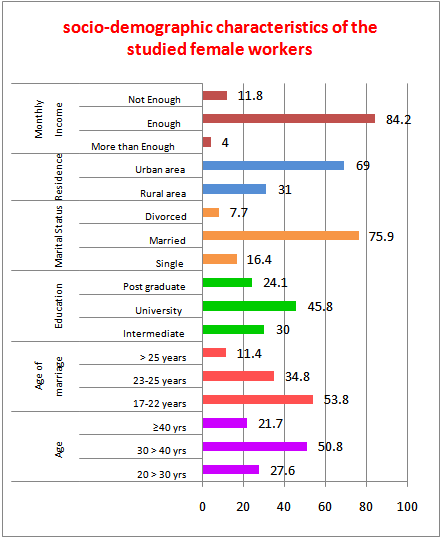
The percentage distribution of the female employees under study with respect to their socio-demographic information is displayed in Figure 1. According to the data, 50.8% of the female in the study were between the ages of 30 and under 40. According to the report, 75.9% of the female were married, and 45.8% of them held a university degree. According to their perspective, 84.2% of them had a sufficient monthly income, and 69.0% of them lived in an urban area.
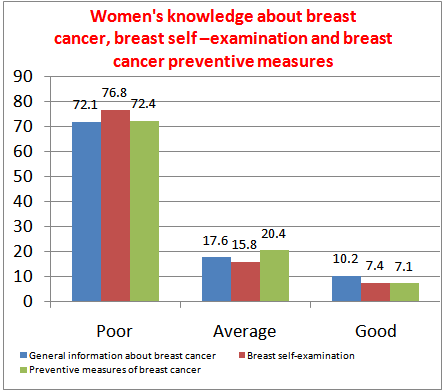
Figure 2 shows female workers’ regarding their general knowledge level about breast cancer, breast self-examination, and breast cancer preventive measures; It reveals that 72.1%, 76.8%, and 72.4%, respectively, had poor level of knowledge compared to only 10.2%, 7.4%, and 7.1% that had good knowledge.
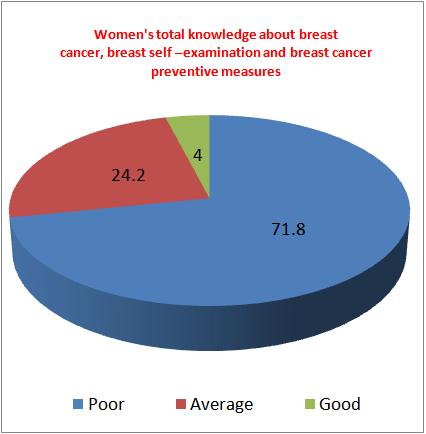
Figure 3 illustrates that female workers’ regarding their total knowledge level about breast cancer, breast self-examination, and breast cancer preventive measures were 71.80%, 24.2%, 4 with the following levels: poor, average, & good, respectively.
Table 1 reveals the relation between the socio-demographic characteristics of the studied female workers and their total knowledge about breast cancer, breast self-examination, and breast cancer preventive measures. It clarifies that 2.8% &1.5% of females aged 30 to less than 40 years & their age of marriage was 17-22 years, respectively, had good knowledge compared to 35% & 36.6% that had poor knowledge. Also, 3.7% & 1.5% of married females who had university education, respectively, had good knowledge compared to 53.6% & 35.6% that had poor knowledge. Moreover, 4.0% & 4.0% of females, who live in urban areas and have enough family income respectively, had good knowledge compared to 43.9% & 57.8% that had poor knowledge. There was a highly statistically significant relation between the studied female workers total knowledge score with their educational level and place of residence, as P-value = 0.000. There was a statistically significant relation with their marital status, as P-value = 0.040.


The aim of the study was assess female workers’ knowledge about breast cancer at Beni-Suef University and evaluate the impact effect socio-demographic characteristics on their knowledge. The study found that most female workers have poor knowledge about breast cancer, including information about self-examination and preventive measures, compared to those with good knowledge, contradicting previous studies by Ram (2020) and Ibitoye et al. (2021) 34, 35.
In terms of the correlation between the demographic features of the female participants and their overall knowledge score, the current study found that all subgroups had poor information regardless their age, education, marital status, homes, and family income. The study found no significant relationship between age and age of marriage and total knowledge score for females, but poor knowledge was more prevalent among those aged 30-40. This may be due to increased age, and women are overburdened with their work and domestic responsibilities. This finding is supported by Ahmed et al. (2019), but contradicting Kumarasamy et al.'s (2017) findings 36, 37.
The study found a significant relationship between the total knowledge score of female workers and their educational level, indicating the program's impact on women's education. This is in line with findings of El-kest et al. (2021) 38. The majority of intermediate-educated females had good knowledge, indicating the program's success in providing necessary information.
The study found a significant relationship between female workers' total knowledge score pretest and their place of residence, with less than a tenth of urban females having good knowledge. This aligns with Al-Mousa et al.'s (2020) research on breast cancer knowledge among Jordanian women 39.
The study found a significant relationship between the total knowledge score of female workers and their marital status, with a minority of married women having good knowledge, contradicting previous research. This finding is supported Al-Qazaz et al. (2020) findings and other researchers 40, 41, 42, 43, 44.
The study found no significant correlation between monthly family income and total knowledge score, with less than one-tenth of female workers having good knowledge. The study contradicts previous research, indicating no significant relationship between knowledge and social characteristics, and contradicts previous studies, such as Heena et al. (2019) and Isara & Ojedokun (2011), which found no significant association between socio-demographic characteristics and breast cancer knowledge. The researcher suggests that women with sufficient monthly family income prioritize their health and avoid unnecessary expenses 45, 46.
Based on the findings of the present study, it can be concluded that there a relation between the socio-demographic characteristics of the studied female workers and their total knowledge about breast cancer, breast self-examination, and breast cancer preventive measures. There was a statistically significant relation between the studied female workers total knowledge score with their educational level, place of residence, and marital status.
Establish an educational initiative to increase women's awareness of breast cancer and ways to prevent it.
Provide breast self-examination techniques to Beni-Suef University employee ladies in order to develop their practices and facilitate the early diagnosis of any abnormalities.
| [1] | Giaquinto, A. N., Sung, H., Miller, K. D., Kramer, J. L., Newman, L. A., Minihan, A., & Siegel, R. L. Breast cancer statistics, 2022. CA: a cancer journal for clinicians, 2022; 72(6): 524-541. | ||
| In article | View Article PubMed | ||
| [2] | Mohamed S., Fatma Saber Nady F., Hassan H. Breast Cancer Preventive Measures among Female Workers at Beni-Suef University: Educational Program Based on Health Belief Model. Egyptian Journal of Health Care, 2025; 16 (1): 117-142. | ||
| In article | View Article | ||
| [3] | Mohammed F., Shahin M., Youness E., Hassan H. Survivorship in Women Undergoing Gynecological and Breast Cancer Treatment in Upper Egypt: The Impact of Quality of Life Improvement Educational Program”. American Research Journal of Gynaecology. 2018; 2(1): 1-28. | ||
| In article | |||
| [4] | Rashid, S., Saxena, A., & Rashid, S. Latest Advances in Diagnosis and Treatment of Women-Associated Cancers, 2022. | ||
| In article | View Article | ||
| [5] | Hassan, H., Bayoumi, M., & Atwa, A. Emotional Distress Associated with Gynecologic and Breast Cancer in Beni-Suef City. International Journal of Science and Research, 2016; 5(2): 1118-1129. | ||
| In article | View Article | ||
| [6] | Nady F., Said M., Youness E., Hassan H. Impact of Tailored Educational Program of Quality of Life Improvement on Women Undergoing Breast Cancer Treatment at El-Minia Region, Egypt. American Research Journal of Gynaecology. 2017; 1(1): 1-17. | ||
| In article | |||
| [7] | Kashyap, D., Pal, D., Sharma, R., Garg, V. K., Goel, N., Koundal, D., & Belay, A. Global increase in breast cancer incidence: risk factors and preventive measures. BioMed research international, 2022; 23(5): 1-17 | ||
| In article | View Article PubMed | ||
| [8] | Cathcart-Rake, E. J., Ruddy, K. J., Bleyer, A., & Johnson, R. H. Breast cancer in adolescent and young adult women under the age of 40 years. JCO oncology practice, 2021; 17(6): 305-313. | ||
| In article | View Article PubMed | ||
| [9] | Nady F., El-Sherbiny M., Youness E., Hassan H. Effectiveness of Quality of Life Planned Teaching Program on Women Undergoing Gynecologic Cancer Treatment. American Research Journal of Oncology. 2018; 1(1): 1-17. | ||
| In article | |||
| [10] | Nady F., Said M., Youness E., Hassan H. Effect of Nursing Intervention Program on Quality of Life Improvement for Women Undergoing Gynecological and Breast Cancer Treatment. Assuit Scientific Nursing Journal, 2018; 6(15): 62-77. | ||
| In article | View Article | ||
| [11] | Abd El Salam S., Hassan H., Kamal K., Ali R. Sexual Dysfunction of Women’s Associated with Cervical Cancer. , 2021; 1(2): 12-27. | ||
| In article | |||
| [12] | Hassan H., Masaud H., Mohammed R., Ramadan S. Self-Knowledge and Body Image among Cervical Cancer Survivors' Women in Northern Upper Egypt. , 2021; 1(1): 1-12 | ||
| In article | |||
| [13] | Ali R., Abd El Salam S., Kamal H., Hassan H. Women with Cervical Cancer: Impact of an Educational Program their Knowledge. Journal of Obstetrics Gynecology and Reproductive Sciences, 2021; 5(2): 1-8. | ||
| In article | View Article | ||
| [14] | Hassan H., Mohammed R., Ramadan S., Masaud H. Impact of an Educational Program on Sexual Issues among Cervical Cancer Survivors' Women in Northern Upper Egypt. Journal of Obstetrics Gynecology and Reproductive Sciences, 2021; 5(1): 1-16. | ||
| In article | View Article | ||
| [15] | Ali R., Kamal H., Hassan H., Abd El Salam S. Impact of an Educational Program on Sexual Distress Associated With Cervical Cancer. , 2021; 1(1): 30-42. | ||
| In article | |||
| [16] | Gremke, N., Griewing, S., Kalder, M., & Kostev, K. Positive association between body height and breast cancer prevalence: a retrospective study with 135,741 women in Germany. Breast Cancer Research and Treatment, 2022; 196(2): 349-354. | ||
| In article | View Article PubMed | ||
| [17] | Thorat, M. A., & Balasubramanian, R. Breast cancer prevention in high-risk women. Best Practice & Research Clinical Obstetrics & Gynaecology, 2020: 18-31. | ||
| In article | View Article PubMed | ||
| [18] | Qalawa, Sh., Eldeeb, A., & Hassan, H. Young Adult Women’s intention regarding breast and cervical cancer screening in Beni-Suef. Scientific Research Journal, 2015; 3(3): 11-24. | ||
| In article | |||
| [19] | Elzeblawy H., Kamal H., Abd El Salam S., Ali R. Survivors from Cervical Cancer: Impact of an Educational Program on Self-Knowledge and body-Image. Public Health Open Access, 2021; 5(2): 1-9. | ||
| In article | View Article | ||
| [20] | Masaud H., Hassan H., Mohammed R., Ramadan S. Women's Sexual Distress Associated with Cervical Cancer. Sumerianz Journal of Medical and Healthcare, 2021; 4(1): 28-34. | ||
| In article | View Article | ||
| [21] | Ramadan S., Hassan H., Masaud H., Mohammed R. Women's Body Image Distress Associated with Cervical Cancer. Journal of Obstetrics Gynecology and Reproductive Sciences, 2021; 5(3): 1-6. | ||
| In article | View Article | ||
| [22] | Kamal H., Ali R., Abd El Salam S., Hassan H. Self-Knowledge among Women with Cervical Cancer. Journal of Cancer Research and Treatment, 2021; 9(1): 12-21. | ||
| In article | |||
| [23] | Hassan H., Mohammed R., Ramadan S., Masaud H. Call for Alleviating Sexual Issues among Cervical Cancer Survivors' Women in Northern Upper Egypt. Journal of Obstetrics Gynecology and Reproductive Sciences, 2021; 5(3): 1-11. | ||
| In article | View Article | ||
| [24] | Hassan H., Ali R., Abd El Salam S., Kamal H. Impact of an Educational Program on Sexual Dysfunction Associated With Cervical Cancer. Journal of Cancer Research and Treatment, 2021; 9(2): 22-31. | ||
| In article | |||
| [25] | Behravan, H., Hartikainen, J. M., Tengström, M., Kosma, V. M., & Mannermaa, A. Predicting breast cancer risk using interacting genetic and demographic factors and machine learning. Scientific reports, 2020; 10(1): 11044. | ||
| In article | View Article PubMed | ||
| [26] | Said S., H., A. . American Journal of Nursing Research. 2018; 6(2): 59-66. | ||
| In article | |||
| [27] | Atwa A., Hassan H., Ahmed S. The impact of a hospital-based awareness program on the knowledge of patients about breast cancer and cancer cervix. International Journal of Studies in Nursing. 2019; 4(1): 20-29. | ||
| In article | View Article | ||
| [28] | Hassan H., Ramadan S., Ali R., Kamal H. Sexual Issues among Cervical Cancer Survivors' Women in Northern Upper Egypt. Journal of Advanced Trends in Basic and Applied Science, 2021; 1(1): 1-11. | ||
| In article | |||
| [29] | Abd El Salam., Ali R., Hassan H., Kamal H. Outcome of an Educational Program on Body Image Distress Associated with Cervical Cancer. Journal of Advanced Trends in Basic and Applied Science, 2021; 1(1): 12-20 | ||
| In article | |||
| [30] | Masaud H., Abd Rabo R., Ramadan S. Hassan H. Impact of Protocol of Nursing Intervention on Sexual Dysfunction among Women with Cervical Cancer. Journal of Nursing Science Benha University, 2021; 2(2): 203-224 | ||
| In article | View Article | ||
| [31] | Farag D., Mohamed S., Malk R., Hassan H. Effectiveness of Educational Intervention Program about Cervical Cancer on Working Women's Knowledge, Attitude, and Practice at Beni-Suef University. Egyptian Journal of Health Care, 2024; 15 (1): 1-16. | ||
| In article | View Article | ||
| [32] | Breast Cancer Association Consortium. Breast cancer risk genes—association analysis in more than 113,000 women. New England Journal of Medicine, 2021; 384(5): 428-439. | ||
| In article | View Article PubMed | ||
| [33] | Hirko, K. A., Rocque, G., Reasor, E., Taye, A., Daly, A., Cutress, R. I., & Park, Y. H. The impact of race and ethnicity in breast cancer—disparities and implications for precision oncology. BMC medicine, 2022; 20(1): 1-12. | ||
| In article | View Article PubMed | ||
| [34] | Ram,G. Impact of an Educational Programme on Knowledge on Breast Cancer and Practice of Breast Self Examination among Women: Indian Journal of Continuing Nursing Education, 2020; 21(2): 155-158. | ||
| In article | View Article | ||
| [35] | Ibitoye, O. F., & Thupayegale-Tshwenegae, G. The impact of education on knowledge attitude and practice of breast self-examination among adolescents girls at the Fiwasaye girls grammar school Akure, Nigeria. Journal of Cancer Education, 2021; 36(1): 39-46. | ||
| In article | View Article PubMed | ||
| [36] | Ahmed, S. A. E. M., & Shrief, S. E. The effect of health promotion program on female breast self-examination knowledge and practice. Egyptian Nursing Journal, 2019; 16(1): 25-35. | ||
| In article | View Article | ||
| [37] | Kumarasamy, H., Veerakumar, A. M., Subhathra, S., Suga, Y., & Murugaraj, R. Determinants of awareness and practice of breast self examination among rural women in Trichy, Tamil Nadu. Journal of mid-life health, 2017; 8(2): 84-88. | ||
| In article | View Article PubMed | ||
| [38] | El-kest, H. R. A., Elagemy, M. A. E., & El-Gamal, S. M. A. The Effect of A Health Education Program on Prevention of Breast and Cervical Cancer Based on the Health Belief Model among Female Employees at MedicalCampus. the breast, 2021; 5(8): 2314-5595. | ||
| In article | |||
| [39] | Al-Mousa, D. S., Alakhras, M., Hossain, S. Z., Al-Sa’di, A. G., Al Hasan, M., Al-Hayek, Y., & Brennan, P. C. Knowledge, attitude and practice around breast cancer and mammography screening among Jordanian women. Breast Cancer: Targets and Therapy, 2020; 21(5): 231-242. | ||
| In article | View Article PubMed | ||
| [40] | Al-Qazaz, H. K., Yahya, N. A., & Ibrahim, D. K. Knowledge, awareness, and practice of breast self-examination among females in Mosul city, Iraq. Journal of cancer research and therapeutics, 2020; 16(6): 1376-1381. | ||
| In article | View Article PubMed | ||
| [41] | Nady F, Zaki S, Hassan H. Female workers’ knowledge about breast cancer preventive measures at Beni-Suef University. Nursing & Care Open Access Journal. 2025; 11(1): 16‒20. | ||
| In article | View Article | ||
| [42] | Hassan H., Zaki S., Nady F. Effect of an Educational Program on Female Workers’ Knowledge about Breast Cancer Preventive Measures at Beni-Suef University. American Journal of Nursing Research. 2025; 13(1): 1-10. | ||
| In article | View Article | ||
| [43] | Hassan H., Zaki S., Nady F. Female Workers’ Socio-demographic characteristics and Their Total Knowledge about Breast Cancer: Effect of an Educational program at Beni-Suef University, International Journal of Nursing Science, 2025; 15(1): 1-8. | ||
| In article | View Article | ||
| [44] | Hassan H., Nady F. , Zaki S. Northern Upper Egyptian Female Workers’ Beliefs Regarding Breast Cancer according to Health Belief Model: Effect of an Educational Program, Public Health Open Access, 2025; 9(1). | ||
| In article | View Article | ||
| [45] | Heena, H., Durrani, S., AlFayyad, I., Riaz, M., Tabasim, R., Parvez, G., & Abu-Shaheen, A. Knowledge, attitudes, and practices towards cervical cancer and screening amongst female healthcare professionals: a cross-sectional study. Journal of oncology, 2019. | ||
| In article | View Article PubMed | ||
| [46] | Isara, A. R., & Ojedokun, C. I. Knowledge of breast cancer and practice of breast self examination among female senior secondary school students in Abuja, Nigeria. J prev med hyg, 2011; 52(4): 186-90. | ||
| In article | |||
Published with license by Science and Education Publishing, Copyright © 2025 Sahar Gamal Zaki, Hanan Elzeblawy Hassan and Fatma Saber Nady
 This work is licensed under a Creative Commons Attribution 4.0 International License. To view a copy of this license, visit
http://creativecommons.org/licenses/by/4.0/
This work is licensed under a Creative Commons Attribution 4.0 International License. To view a copy of this license, visit
http://creativecommons.org/licenses/by/4.0/
| [1] | Giaquinto, A. N., Sung, H., Miller, K. D., Kramer, J. L., Newman, L. A., Minihan, A., & Siegel, R. L. Breast cancer statistics, 2022. CA: a cancer journal for clinicians, 2022; 72(6): 524-541. | ||
| In article | View Article PubMed | ||
| [2] | Mohamed S., Fatma Saber Nady F., Hassan H. Breast Cancer Preventive Measures among Female Workers at Beni-Suef University: Educational Program Based on Health Belief Model. Egyptian Journal of Health Care, 2025; 16 (1): 117-142. | ||
| In article | View Article | ||
| [3] | Mohammed F., Shahin M., Youness E., Hassan H. Survivorship in Women Undergoing Gynecological and Breast Cancer Treatment in Upper Egypt: The Impact of Quality of Life Improvement Educational Program”. American Research Journal of Gynaecology. 2018; 2(1): 1-28. | ||
| In article | |||
| [4] | Rashid, S., Saxena, A., & Rashid, S. Latest Advances in Diagnosis and Treatment of Women-Associated Cancers, 2022. | ||
| In article | View Article | ||
| [5] | Hassan, H., Bayoumi, M., & Atwa, A. Emotional Distress Associated with Gynecologic and Breast Cancer in Beni-Suef City. International Journal of Science and Research, 2016; 5(2): 1118-1129. | ||
| In article | View Article | ||
| [6] | Nady F., Said M., Youness E., Hassan H. Impact of Tailored Educational Program of Quality of Life Improvement on Women Undergoing Breast Cancer Treatment at El-Minia Region, Egypt. American Research Journal of Gynaecology. 2017; 1(1): 1-17. | ||
| In article | |||
| [7] | Kashyap, D., Pal, D., Sharma, R., Garg, V. K., Goel, N., Koundal, D., & Belay, A. Global increase in breast cancer incidence: risk factors and preventive measures. BioMed research international, 2022; 23(5): 1-17 | ||
| In article | View Article PubMed | ||
| [8] | Cathcart-Rake, E. J., Ruddy, K. J., Bleyer, A., & Johnson, R. H. Breast cancer in adolescent and young adult women under the age of 40 years. JCO oncology practice, 2021; 17(6): 305-313. | ||
| In article | View Article PubMed | ||
| [9] | Nady F., El-Sherbiny M., Youness E., Hassan H. Effectiveness of Quality of Life Planned Teaching Program on Women Undergoing Gynecologic Cancer Treatment. American Research Journal of Oncology. 2018; 1(1): 1-17. | ||
| In article | |||
| [10] | Nady F., Said M., Youness E., Hassan H. Effect of Nursing Intervention Program on Quality of Life Improvement for Women Undergoing Gynecological and Breast Cancer Treatment. Assuit Scientific Nursing Journal, 2018; 6(15): 62-77. | ||
| In article | View Article | ||
| [11] | Abd El Salam S., Hassan H., Kamal K., Ali R. Sexual Dysfunction of Women’s Associated with Cervical Cancer. , 2021; 1(2): 12-27. | ||
| In article | |||
| [12] | Hassan H., Masaud H., Mohammed R., Ramadan S. Self-Knowledge and Body Image among Cervical Cancer Survivors' Women in Northern Upper Egypt. , 2021; 1(1): 1-12 | ||
| In article | |||
| [13] | Ali R., Abd El Salam S., Kamal H., Hassan H. Women with Cervical Cancer: Impact of an Educational Program their Knowledge. Journal of Obstetrics Gynecology and Reproductive Sciences, 2021; 5(2): 1-8. | ||
| In article | View Article | ||
| [14] | Hassan H., Mohammed R., Ramadan S., Masaud H. Impact of an Educational Program on Sexual Issues among Cervical Cancer Survivors' Women in Northern Upper Egypt. Journal of Obstetrics Gynecology and Reproductive Sciences, 2021; 5(1): 1-16. | ||
| In article | View Article | ||
| [15] | Ali R., Kamal H., Hassan H., Abd El Salam S. Impact of an Educational Program on Sexual Distress Associated With Cervical Cancer. , 2021; 1(1): 30-42. | ||
| In article | |||
| [16] | Gremke, N., Griewing, S., Kalder, M., & Kostev, K. Positive association between body height and breast cancer prevalence: a retrospective study with 135,741 women in Germany. Breast Cancer Research and Treatment, 2022; 196(2): 349-354. | ||
| In article | View Article PubMed | ||
| [17] | Thorat, M. A., & Balasubramanian, R. Breast cancer prevention in high-risk women. Best Practice & Research Clinical Obstetrics & Gynaecology, 2020: 18-31. | ||
| In article | View Article PubMed | ||
| [18] | Qalawa, Sh., Eldeeb, A., & Hassan, H. Young Adult Women’s intention regarding breast and cervical cancer screening in Beni-Suef. Scientific Research Journal, 2015; 3(3): 11-24. | ||
| In article | |||
| [19] | Elzeblawy H., Kamal H., Abd El Salam S., Ali R. Survivors from Cervical Cancer: Impact of an Educational Program on Self-Knowledge and body-Image. Public Health Open Access, 2021; 5(2): 1-9. | ||
| In article | View Article | ||
| [20] | Masaud H., Hassan H., Mohammed R., Ramadan S. Women's Sexual Distress Associated with Cervical Cancer. Sumerianz Journal of Medical and Healthcare, 2021; 4(1): 28-34. | ||
| In article | View Article | ||
| [21] | Ramadan S., Hassan H., Masaud H., Mohammed R. Women's Body Image Distress Associated with Cervical Cancer. Journal of Obstetrics Gynecology and Reproductive Sciences, 2021; 5(3): 1-6. | ||
| In article | View Article | ||
| [22] | Kamal H., Ali R., Abd El Salam S., Hassan H. Self-Knowledge among Women with Cervical Cancer. Journal of Cancer Research and Treatment, 2021; 9(1): 12-21. | ||
| In article | |||
| [23] | Hassan H., Mohammed R., Ramadan S., Masaud H. Call for Alleviating Sexual Issues among Cervical Cancer Survivors' Women in Northern Upper Egypt. Journal of Obstetrics Gynecology and Reproductive Sciences, 2021; 5(3): 1-11. | ||
| In article | View Article | ||
| [24] | Hassan H., Ali R., Abd El Salam S., Kamal H. Impact of an Educational Program on Sexual Dysfunction Associated With Cervical Cancer. Journal of Cancer Research and Treatment, 2021; 9(2): 22-31. | ||
| In article | |||
| [25] | Behravan, H., Hartikainen, J. M., Tengström, M., Kosma, V. M., & Mannermaa, A. Predicting breast cancer risk using interacting genetic and demographic factors and machine learning. Scientific reports, 2020; 10(1): 11044. | ||
| In article | View Article PubMed | ||
| [26] | Said S., H., A. . American Journal of Nursing Research. 2018; 6(2): 59-66. | ||
| In article | |||
| [27] | Atwa A., Hassan H., Ahmed S. The impact of a hospital-based awareness program on the knowledge of patients about breast cancer and cancer cervix. International Journal of Studies in Nursing. 2019; 4(1): 20-29. | ||
| In article | View Article | ||
| [28] | Hassan H., Ramadan S., Ali R., Kamal H. Sexual Issues among Cervical Cancer Survivors' Women in Northern Upper Egypt. Journal of Advanced Trends in Basic and Applied Science, 2021; 1(1): 1-11. | ||
| In article | |||
| [29] | Abd El Salam., Ali R., Hassan H., Kamal H. Outcome of an Educational Program on Body Image Distress Associated with Cervical Cancer. Journal of Advanced Trends in Basic and Applied Science, 2021; 1(1): 12-20 | ||
| In article | |||
| [30] | Masaud H., Abd Rabo R., Ramadan S. Hassan H. Impact of Protocol of Nursing Intervention on Sexual Dysfunction among Women with Cervical Cancer. Journal of Nursing Science Benha University, 2021; 2(2): 203-224 | ||
| In article | View Article | ||
| [31] | Farag D., Mohamed S., Malk R., Hassan H. Effectiveness of Educational Intervention Program about Cervical Cancer on Working Women's Knowledge, Attitude, and Practice at Beni-Suef University. Egyptian Journal of Health Care, 2024; 15 (1): 1-16. | ||
| In article | View Article | ||
| [32] | Breast Cancer Association Consortium. Breast cancer risk genes—association analysis in more than 113,000 women. New England Journal of Medicine, 2021; 384(5): 428-439. | ||
| In article | View Article PubMed | ||
| [33] | Hirko, K. A., Rocque, G., Reasor, E., Taye, A., Daly, A., Cutress, R. I., & Park, Y. H. The impact of race and ethnicity in breast cancer—disparities and implications for precision oncology. BMC medicine, 2022; 20(1): 1-12. | ||
| In article | View Article PubMed | ||
| [34] | Ram,G. Impact of an Educational Programme on Knowledge on Breast Cancer and Practice of Breast Self Examination among Women: Indian Journal of Continuing Nursing Education, 2020; 21(2): 155-158. | ||
| In article | View Article | ||
| [35] | Ibitoye, O. F., & Thupayegale-Tshwenegae, G. The impact of education on knowledge attitude and practice of breast self-examination among adolescents girls at the Fiwasaye girls grammar school Akure, Nigeria. Journal of Cancer Education, 2021; 36(1): 39-46. | ||
| In article | View Article PubMed | ||
| [36] | Ahmed, S. A. E. M., & Shrief, S. E. The effect of health promotion program on female breast self-examination knowledge and practice. Egyptian Nursing Journal, 2019; 16(1): 25-35. | ||
| In article | View Article | ||
| [37] | Kumarasamy, H., Veerakumar, A. M., Subhathra, S., Suga, Y., & Murugaraj, R. Determinants of awareness and practice of breast self examination among rural women in Trichy, Tamil Nadu. Journal of mid-life health, 2017; 8(2): 84-88. | ||
| In article | View Article PubMed | ||
| [38] | El-kest, H. R. A., Elagemy, M. A. E., & El-Gamal, S. M. A. The Effect of A Health Education Program on Prevention of Breast and Cervical Cancer Based on the Health Belief Model among Female Employees at MedicalCampus. the breast, 2021; 5(8): 2314-5595. | ||
| In article | |||
| [39] | Al-Mousa, D. S., Alakhras, M., Hossain, S. Z., Al-Sa’di, A. G., Al Hasan, M., Al-Hayek, Y., & Brennan, P. C. Knowledge, attitude and practice around breast cancer and mammography screening among Jordanian women. Breast Cancer: Targets and Therapy, 2020; 21(5): 231-242. | ||
| In article | View Article PubMed | ||
| [40] | Al-Qazaz, H. K., Yahya, N. A., & Ibrahim, D. K. Knowledge, awareness, and practice of breast self-examination among females in Mosul city, Iraq. Journal of cancer research and therapeutics, 2020; 16(6): 1376-1381. | ||
| In article | View Article PubMed | ||
| [41] | Nady F, Zaki S, Hassan H. Female workers’ knowledge about breast cancer preventive measures at Beni-Suef University. Nursing & Care Open Access Journal. 2025; 11(1): 16‒20. | ||
| In article | View Article | ||
| [42] | Hassan H., Zaki S., Nady F. Effect of an Educational Program on Female Workers’ Knowledge about Breast Cancer Preventive Measures at Beni-Suef University. American Journal of Nursing Research. 2025; 13(1): 1-10. | ||
| In article | View Article | ||
| [43] | Hassan H., Zaki S., Nady F. Female Workers’ Socio-demographic characteristics and Their Total Knowledge about Breast Cancer: Effect of an Educational program at Beni-Suef University, International Journal of Nursing Science, 2025; 15(1): 1-8. | ||
| In article | View Article | ||
| [44] | Hassan H., Nady F. , Zaki S. Northern Upper Egyptian Female Workers’ Beliefs Regarding Breast Cancer according to Health Belief Model: Effect of an Educational Program, Public Health Open Access, 2025; 9(1). | ||
| In article | View Article | ||
| [45] | Heena, H., Durrani, S., AlFayyad, I., Riaz, M., Tabasim, R., Parvez, G., & Abu-Shaheen, A. Knowledge, attitudes, and practices towards cervical cancer and screening amongst female healthcare professionals: a cross-sectional study. Journal of oncology, 2019. | ||
| In article | View Article PubMed | ||
| [46] | Isara, A. R., & Ojedokun, C. I. Knowledge of breast cancer and practice of breast self examination among female senior secondary school students in Abuja, Nigeria. J prev med hyg, 2011; 52(4): 186-90. | ||
| In article | |||