The aging of the American population is likely to lead to an increase in the incidence of cognitive decline and dementia. This health burden will not be evenly distributed, with Black and Hispanic individuals suffering disproportionately. Studies across diverse populations of aging adults are required to better understand the multitude of factors which influence risk for cognitive decline and dementia, including quality diet and food security. To this end, the current study sought to describe the population within New York City as it relates to socioeconomic factors, as well as dietary quality and food security. Thus, individuals from around the five boroughs of New York City were recruited to complete online questionnaires about their dietary habits, food security, as well as several demographic and socioeconomic factors. Comparisons were made among the city boroughs, as well as among ethnic groups, income levels, and educational achievement. Unsurprisingly, non-White individuals were more likely to report food insecurity. In addition, those with less educational achievement and those living in less economically advantaged boroughs reported lower quality diet compared to those with higher education and those living in more affluent boroughs. These findings suggest that non-White individuals, those with less educational achievement, and those residing in economically disadvantaged areas may have increased risk of not only cognitive decline but any other chronic diseases which relate to food security or diet quality. Further studies, which include cognitive assessments are needed to determine the impact of these or other risk factors on cognitive decline.
Due to the aging population in the United States, the total number of individuals with dementia is expected to increase for several decades into the future 1 2 3. Between 2000 and 2009, 13.9% of the population attributable fraction of deaths among Americans 70 through 100 years of age was from dementia, and in 2021 Alzheimer’s disease, the most common form of dementia, was the fifth leading cause of death of Americans over 65 4 5. It is likely that Black and Hispanic individuals will bear a disproportionate health burden of increased cognitive decline and dementia as they have historically 1 3 6 7 8. This discrepancy in disease burden is multifaceted, relating to various environmental and lifestyle risk factors and associated comorbidities 9 10. These factors must be disentangled if better public health approaches are to be developed to meet the needs of these communities.
Unfortunately, there are no reliable treatments for dementia 11 12. However, the risk of cognitive impairment or dementia may be modified through lifestyle factors such as diet, exercise, adequate sleep, and stress management 13 14 15 16 17. It seems that risk reduction, prevention, and/or delay of onset, are currently the most effective approaches to curb the projected increasing incidence of dementia 11 12. These lifestyle factors, along with differences in socioeconomic status and education, may influence the observed inequity in the disease burden of dementia and Alzheimer’s disease 3 13 14 15. Hence, these factors require increased study among those with the highest risk of developing cognitive decline and dementia.
Nationally, the county with the third highest rate of Alzheimer’s disease is Bronx County, within New York City (NYC) 5. This is unsurprising based on the demographics and socioeconomic status of this city borough. The Bronx has almost 30% greater minority population compared to NYC and greater than 40% more than the state average 18. In addition, the median household income is less than half that of NYC as a whole; with lower overall educational attainment, higher poverty, and higher unemployment compared to NYC or New York State as a whole 18. The Bronx also reports less physical activity and lower food environment index (a measure of healthy diet as well as food security) than the rest of New York state 19.
Food security is another factor associated with cognitive deficits 20 22 23. Those with lower food security have shown reduced cognitive function 22 23. Food insecurity also influences the rate at which age-related cognitive decline occurs, with food insecure individuals having higher rates of cognitive decline over time 20 21. While food security is associated with various socioeconomic factors, the influence of food insecurity on cognitive decline is significant even when these factors are considered 22. Thus, the influence of food security on cognitive decline goes beyond its potential effects on nutritional quality or the overarching socioeconomic conditions.
Therefore, the purpose of the current study was to examine the nutritional status and food security of older adults in NYC. It was hypothesized that there would be demographic differences in nutrition quality and food security based on ethnic background, education, and other factors associated with socioeconomic status. Further, it was hypothesized that more affluent boroughs would have better diet quality and food security.
The current study approach was a cross-sectional quantitative analysis of individuals living in NYC. Participants were sampled from the five boroughs of New York City. All participants were contacted, consented, and completed surveys online. Qualtrics Marketing (Provo, UT, USA) research firm was used to administer this online survey. The survey included demographic questions, a Dietary Screening Tool (DST), and the U.S. Household Food Security Survey 24 25. These tools were used to assess the overall quality of dietary intake as well as the level of food security among the sample.
The DST consisted of 26 questions relating to the average intake of various foods over an average week. The DST’s first 25 items were used to calculate seven sub-scales relating to the overall intake of: fruit and juice, vegetables, whole grains, lean proteins, added fats and sugars, dairy, and processed meats. An additional question about multivitamins/minerals was also asked. All sub-scales were summed together for a score between 0 and 100. If dietary supplements were reported, the score was increased by 5 points. The higher the DST score, the better the overall composition and health of the individual’s diet.
The U.S. Household Food Security Survey consisted of six questions regarding how frequently the individual’s household had trouble purchasing or consuming enough food in the last 12 months 26. The number of affirmative responses were summed to determine food security status. Scores greater than 2 affirmative responses were considered “food insecure” while scores 0-2 were considered “food secure”.
Data Analysis: Data were collected and coded to allow for statistical analysis. IBM SPSS (v26) was used to run all statistical measurements. Descriptive statistics including frequencies were performed to better understand the sample. The DST score and food security status were the dependent variables with demographic and socioeconomic factors being used as independent variables. A MANOVA was used to assess the sub-scales of the DST. For socioeconomic variables across the five boroughs sampled, Kruskal-Wallis Tests were performed for ordinal data and Chi-square (χ2) test were performed on nominal variables to better understand the distribution of these factors among the study sample. ANCOVA and MANCOVA were used to compare boroughs for DST scores and adjusted for differences given socioeconomic factors. In all cases, post-hoc tests with a Bonferroni correction were used to examine any significant main effects.
A total of 378 individuals responded to the survey, however, 20 individuals were omitted due to their age being younger than 60. Only one individual from outside of the NYC area participated, and was thus omitted from the analysis, leaving a total of 357 surveyed participants. The descriptive data for the participants can be seen in Table 1. Due to the low number of respondents who reported “Technical school” for education and the inability to interpret “prefer not to answer” for household income, these responses were not included in any analysis of education or income.
Overall ethnic distribution was unequal across the five boroughs. Small numbers of those identifying as Asian or “Other” as well as lower response rate from Staten Island made it necessary to recode ethnicity to White and Non-White for the χ2 test. This test showed a significant difference in White versus Non-White New Yorkers across the 5 boroughs (χ2=17.08, p<0.01), with the largest differences in expected counts and actual counts occurring in the Bronx. No differences were observed among the boroughs for sex, (χ2=3.24, p=0.52), nor were there differences among the boroughs for education level (H(5)=8.41, p=0.08), nor income level (H(5)=7.16, p=0.13).
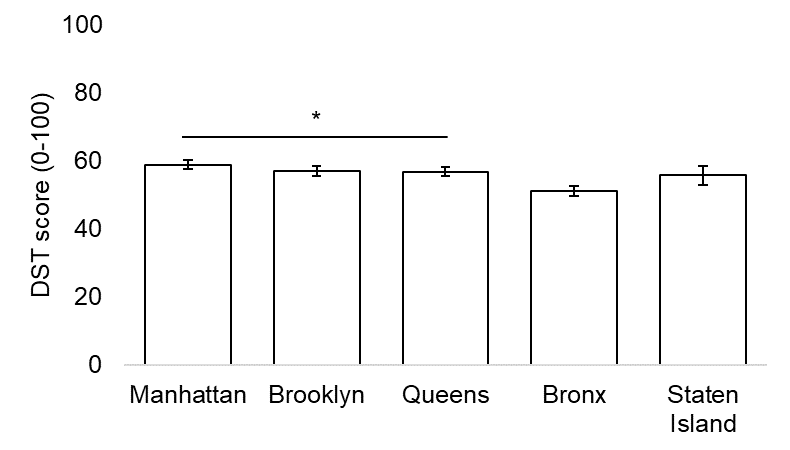
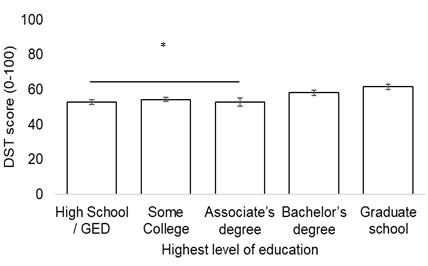
When DST score was compared across the five boroughs, shown in Figure 1, there were significant differences among the boroughs (F=3.91, p<0.01). Post-hoc tests showed the Bronx to have a lower DST score compared to all boroughs except Staten Island (all p<0.05). The DST scores were significantly different when comparing across education levels (F=6.14, p<0.01) and income levels (F=2.65, p=0.01). Educational differences in DST scores were between those with graduate degrees and those with either a high school diploma (p<0.01), an associate’s degree (p=0.02), or some college (p<0.01), as seen in Figure 2. Despite a significant effect of income on DST score, no post-hoc differences were directly observed between any individual income levels.
Because a one-way ANOVA for ethnicity would violate Levene’s test, a Kruskal-Wallis test was performed. This showed significant differences in DST scores among the different ethnic groups (H(5)=17.04, p<0.01). Post-hoc comparisons showed differences in DST scores between White and Hispanic individuals (p=0.03), and approached significance between Black and White individuals (p=0.054).


To account for socioeconomic factors, a principal component reflecting education and income was added to the model as a covariate. The principal component was calculated using: age, sex, ethnicity, education, and income. Three principal components were extracted with Eigenvalues greater than 1.0, however, based on the scree plot, only the first component was retained. This component, using Varimax rotation, captured variability from level of education (0.87) and income (0.75). The difference in DST scores remained significant among city boroughs (F=2.68, p=0.03) with a significant covariate from the principal component (F=16.12, p<0.01). Accounting for variability in education and income, the post-hoc analysis of DST scores only showed significant differences between Manhattan and the Bronx.
A MANOVA to examine differences in the seven DST sub-scales across all five boroughs showed significant differences (Λ=0.88, F=1.61, p=0.02). Follow-up univariate tests showed significant differences among the five boroughs for vegetable score (F=4.41, p<0.01), lean protein score (F=2.49, p=0.04), and processed meat score (F=3.26, p=0.01). The main differences occurred between the Bronx and Manhattan (p<0.01) for vegetable intake score and between the Bronx and Queens for processed meat intake score (p=0.03). The post-hoc analysis did not show a significant difference directly between two boroughs for lean protein intake score, with the largest difference occurring between Staten Island and Manhattan (p=0.06).
If the principal component accounting for education and income level were added to the MANOVA as a covariate, it has greater explanatory value than the city borough (Λ=0.94, F=2.97, p<0.01; vs. Λ=0.89, F=1.34, p=0.11). While city borough univariate tests would still show significant differences for vegetable score (F=3.04, p=0.02), lean protein (F=2.52, p=0.04), and processed meat (F=2.59, p=0.04), the socioeconomic covariate showed greater differences. The principal component showed significant associations with fruit (F=15.22, p<0.01), vegetables (F=8.34, p<0.01), and lean proteins (F=7.22, p<0.01).
3.3. Food SecurityThe majority of respondents (78.2%) reported being food secure as shown in Table 2. However, the highest proportion of respondents reporting food insecurity relative to total borough respondents came from the Bronx (28.36%).
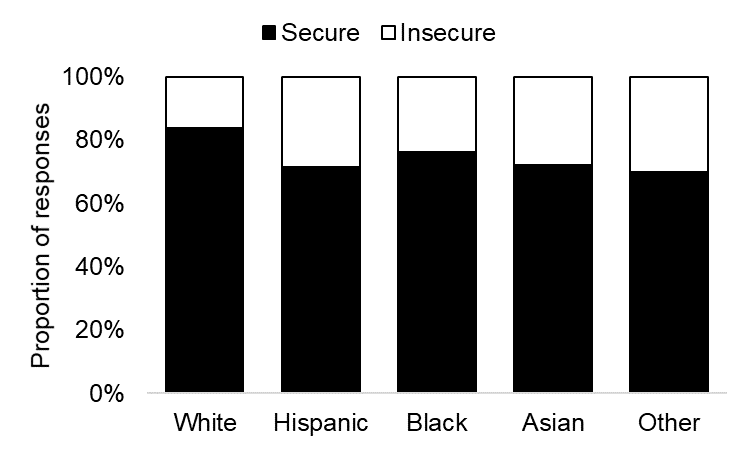
Across ethnic groups, those who selected “other” had the highest proportion of responses indicating food insecurity (30.00%), just ahead of those who identified as Hispanic (28.43%). However, the small number of Asian (18 individuals) and “other” (10 individuals) respondents make it difficult to interpret these data as seen in Figure 3. Thus, a χ2 test between White and Non-White respondents showed a significant difference in food security (χ2=6.20, p=0.01) with White New Yorkers being less likely to be food insecure. Food security was shown to be lowest amongst those with lower incomes and lower education. Although those with high school or GED showed higher food security than those with some college or an associate’s degree.

The current study showed discrepancies in both food security and healthy eating among aging individuals in NYC’s separate boroughs. Manhattan generally seemed to have the healthiest and most food secure nutrition, while the Bronx was the least food secure and had the worst DST. These findings are not surprising and align with our hypothesis that boroughs with higher average incomes (based on census data) will have higher diet quality 27. While the current study’s income responses by borough do not match census data, both results had the Bronx as the borough with the lowest average income 27. This implies that the residents in the Bronx may have less purchasing power to buy nutritious and healthy foods. The Bronx also has the least food pantries per capita compared to other boroughs likely driven by the majority of older NYC residents, in or near poverty, residing in the Bronx rather than a low total number of food pantries 28 29. This likely contributes to the fact that individuals in the Bronx have more chronic disease burden than other boroughs, as those with the least food security showed high rates of chronic diseases 30 31. Worse, those who are food insecure are likely to delay or forgo medical care or prescription medication and are more likely to have cognitive decline 20 21 22 31.
Beyond food security, diet quality is linked to many chronic diseases as well as cognitive decline 16 32 33 34 35 36. Despite this, recent research has not shown significant differences in cognitive difficulty across the five boroughs of NYC 37. While there were differences in certain ethnic groups, they only appeared within boroughs, and not across the entire city 37. It may be that the effects of diet quality or food security do not impact cognitive decline as much as other socioeconomic factors. Although, there is also a possibility that these effects were not observed previously because the study did not focus on aging adults who are most likely to experience cognitive decline 37.
Further studies are required to verify levels of food security and diet quality among marginalized populations. In addition, cognitive assessments among aging adults should be conducted to better understand any differences in cognitive decline due to socioeconomic factors, and target other potential risk factors. The issue of cognitive decline and its unequal distribution is multifaceted, relating to racial, educational, and income inequities. It may require a more focused analyses of older adults across underrepresented communities to truly determine the impact of nutrition quality, food security, and other lifestyle related factors and their implications for cognitive decline.
There were limitations to the current study, most notably that the plurality of respondents were younger (60-64 years of age), White, and higher income earners. More targeted sampling approaches will be required to obtain information from older Black and Hispanic residents of the five boroughs. When performing survey research, there is always a risk of recall bias, particularly when relying on questions that ask participants to estimate information from some time ago. Finally, NYC has diverse demographics, allowing a wide variety of sampled individuals. However, it also limits the generalizability of the data to other cities and communities.
5. ConclusionThe current study shows differences in nutritional quality and food security across the five boroughs of NYC, with the Bronx lagging behind the other boroughs 38 39. Whether this discrepancy is due to differences in socioeconomic factors, ethnic background, or something else is uncertain. Our research is unable to provide causal explanations. However, the current study has shown that nutritional quality and food security differed based on all of these parameters. Policies need to be implemented to improve access to healthy foods among those living in the most vulnerable communities, particularly among older adults at risk of dementia and Alzheimers Disease. This will become more important over time where a lack of access to a healthy diet will likely exacerbate already existing health disparities among populations least capable of enduring the financial stress of healthcare costs.
The study was funded through the City University of New York, Lehman College Tax Levy, Dean's budget.
Authors have no competing interests.
| [1] | Matthews, K.A., et al., "Racial and ethnic estimates of Alzheimer's disease and related dementias in the United States (2015–2060) in adults aged ≥65 years". Alzheimer's & Dementia. 15(1): p. 17-24, 2019. | ||
| In article | View Article PubMed | ||
| [2] | Farina, M.P., et al., "Trends in Dementia Prevalence, Incidence, and Mortality in the United States (2000–2016)". Journal of Aging and Health. 34(1): p. 100-108, 2022. | ||
| In article | View Article PubMed | ||
| [3] | Chen, C. and J.M. Zissimopoulos, "Racial and ethnic differences in trends in dementia prevalence and risk factors in the United States". Alzheimer's & Dementia: Translational Research & Clinical Interventions. 4: p. 510-520, 2018. | ||
| In article | View Article PubMed | ||
| [4] | Stokes, A.C., et al., "Estimates of the Association of Dementia With US Mortality Levels Using Linked Survey and Mortality Records". JAMA Neurology. 77(12): p. 1543-1550, 2020. | ||
| In article | View Article PubMed | ||
| [5] | Alzheimer's Association, Mapping a better future for dementia care navigation, 2024, | ||
| In article | |||
| [6] | Hudomiet, P., M.D. Hurd, and S. Rohwedder, "Trends in inequalities in the prevalence of dementia in the United States". Proceedings of the National Academy of Sciences. 119(46): p. e2212205119, 2022. | ||
| In article | View Article PubMed | ||
| [7] | Mehta, K.M. and G.W. Yeo, "Systematic review of dementia prevalence and incidence in United States race/ethnic populations". Alzheimer's & Dementia. 13(1): p. 72-83, 2017. | ||
| In article | View Article PubMed | ||
| [8] | Mayeda, E.R., et al., "Inequalities in dementia incidence between six racial and ethnic groups over 14 years". Alzheimer's & Dementia. 12(3): p. 216-224, 2016. | ||
| In article | View Article PubMed | ||
| [9] | Lin, P.-J., et al., "Dementia Diagnosis Disparities by Race and Ethnicity". Medical Care. 59(8) 2021. | ||
| In article | View Article PubMed | ||
| [10] | Moon, H., et al., "Dementia Prevalence in Older Adults: Variation by Race/Ethnicity and Immigrant Status". The American Journal of Geriatric Psychiatry. 27(3): p. 241-250, 2019. | ||
| In article | View Article PubMed | ||
| [11] | Tisher, A. and A. Salardini. A comprehensive update on treatment of dementia. in Seminars in neurology. 2019. Thieme Medical Publishers. | ||
| In article | View Article PubMed | ||
| [12] | Ismail, Z., et al., "Recommendations of the 5th Canadian Consensus Conference on the diagnosis and treatment of dementia". Alzheimer's & Dementia. 16(8): p. 1182-1195, 2020. | ||
| In article | View Article PubMed | ||
| [13] | Livingston, G., et al., "Dementia prevention, intervention, and care". The Lancet. 390(10113): p. 2673-2734, 2017. | ||
| In article | View Article PubMed | ||
| [14] | Livingston, G., et al., "Dementia prevention, intervention, and care: 2020 report of the Lancet Commission". Lancet. 396(10248): p. 413-446, 2020. | ||
| In article | View Article PubMed | ||
| [15] | Eubank, J.M., et al., "Effects of Lifestyle Factors on Cognition in Minority Population of Older Adults: A Review". Frontiers in Nutrition. 9 2022. | ||
| In article | View Article PubMed | ||
| [16] | Dominguez, L.J., et al., "Nutrition, Physical Activity, and Other Lifestyle Factors in the Prevention of Cognitive Decline and Dementia". Nutrients. 13(11): p. 4080, 2021. | ||
| In article | View Article PubMed | ||
| [17] | Wei, X., et al., "Leisure time physical activity and dementia risk: a dose-response meta-analysis of prospective studies". BMJ Open. 7(10): p. e014706, 2017. | ||
| In article | View Article PubMed | ||
| [18] | New York State Department of Health, Bronx Borough Health Equity Report, 2021, | ||
| In article | |||
| [19] | Elizabeth Blomberg, P.K.G., PhD; Kim Gilhuly, MPH; Marjory Givens, PhD, MSPH; Sheri Johnson, PhD; Christine Muganda, PhD; Bethany Rogerson, MS; Michael Stevenson, MPH., University of Wisconsin Population Health Institute, County Health Rankings & Roadmaps. National Findings Report 2024, 2024. | ||
| In article | |||
| [20] | Lu, P., et al., "Associations of Food Insecurity and Memory Function Among Middle to Older-Aged Adults in the Health and Retirement Study". JAMA Netw Open. 6(7): p. e2321474, 2023. | ||
| In article | View Article PubMed | ||
| [21] | Qian, H., et al., "Food Insecurity, Memory, and Dementia Among US Adults Aged 50 Years and Older". JAMA Network Open. 6(11): p. e2344186-e2344186, 2023. | ||
| In article | View Article PubMed | ||
| [22] | Roy, A., "Food insecurity and cognitive function in older adults: findings from the longitudinal aging study in India". BMC Psychiatry. 23(1): p. 640, 2023. | ||
| In article | View Article PubMed | ||
| [23] | Portela-Parra, E.T. and C.W. Leung, "Food Insecurity Is Associated with Lower Cognitive Functioning in a National Sample of Older Adults". The Journal of Nutrition. 149(10): p. 1812-1817, 2019. | ||
| In article | View Article PubMed | ||
| [24] | Bailey, R.L., et al., "A dietary screening questionnaire identifies dietary patterns in older adults". The Journal of nutrition. 137(2): p. 421-426, 2007. | ||
| In article | View Article PubMed | ||
| [25] | Bailey, R.L., et al., "Dietary screening tool identifies nutritional risk in older adults". The American journal of clinical nutrition. 90(1): p. 177-183, 2009. | ||
| In article | View Article PubMed | ||
| [26] | Blumberg, S.J., et al., "The effectiveness of a short form of the Household Food Security Scale". American Journal of Public Health. 89(8): p. 1231-1234, 1999. | ||
| In article | View Article PubMed | ||
| [27] | U. S. Census Bureau, ACS 5-Year Estimates Subject Tables. Mean Income in the Past 12 Months (in 2022 Inflation-Adjusted Dollars), American Community Survey. 2022. | ||
| In article | |||
| [28] | Leung MM, T.D., Eilender E, Li C, Aguilera Y, Butz L, Gallanter M, Harrison L, Platkin C., Capturing the State of Food Access in NYC During COVID-19 Recovery: Insights on Preparing for the Next Crisis, 2022, | ||
| In article | |||
| [29] | Poverty Data: Data Tool. 2005-2019 2024]; Available from: https: //www.nyc.gov/site/opportunity/poverty-in-nyc/data-tool.page. | ||
| In article | |||
| [30] | Newman, D., E. Levine, and S.P. Kishore, "Prevalence of multiple chronic conditions in New York State, 2011-2016". PLoS One. 14(2): p. e0211965, 2019. | ||
| In article | View Article PubMed | ||
| [31] | New York Health Foundation, NYHealth Survey of Food and Health, 2022. | ||
| In article | |||
| [32] | Yuan, C., et al., "Long-term diet quality and its change in relation to late-life subjective cognitive decline". The American Journal of Clinical Nutrition. 115(1): p. 232-243, 2022. | ||
| In article | View Article PubMed | ||
| [33] | Tangney, C.C., et al., "Adherence to a Mediterranean-type dietary pattern and cognitive decline in a community population". Am J Clin Nutr. 93: p. 601-7, 2011. | ||
| In article | View Article PubMed | ||
| [34] | Morris, M.C., et al., "MIND diet slows cognitive decline with aging". Alzheimer's & Dementia. 11(9): p. 1015-1022, 2015. | ||
| In article | View Article PubMed | ||
| [35] | Liu, X., et al., "A healthy plant-based diet was associated with slower cognitive decline in African American older adults: a biracial community-based cohort". Am J Clin Nutr. 116(4): p. 875-886, 2022. | ||
| In article | View Article PubMed | ||
| [36] | McCullough, M.L., et al., "Diet quality and major chronic disease risk in men and women: moving toward improved dietary guidance123". The American Journal of Clinical Nutrition. 76(6): p. 1261-1271, 2002. | ||
| In article | View Article PubMed | ||
| [37] | Henriquez-Castillo, M., "Cognitive Difficulty in the Five Boroughs of New York City, 2000-2019". 2022. | ||
| In article | |||
| [38] | Food Security, New York State Adults 2021, Albany, NY,2023, | ||
| In article | |||
| [39] | Aldo Crossa, D.P., Tanzia Shaheen, Gabriella Garcia, John Jasek, Food Security among New York City Adults Living in Poverty, 2022, 2024. | ||
| In article | |||
Published with license by Science and Education Publishing, Copyright © 2024 DJ Oberlin, Jacob M. Eubank, Hyangmi Kim, Kathleen Woolf, Lillie Monroe-Lord, Elgloria A Harrison and Collette Brown
 This work is licensed under a Creative Commons Attribution 4.0 International License. To view a copy of this license, visit
https://creativecommons.org/licenses/by/4.0/
This work is licensed under a Creative Commons Attribution 4.0 International License. To view a copy of this license, visit
https://creativecommons.org/licenses/by/4.0/
| [1] | Matthews, K.A., et al., "Racial and ethnic estimates of Alzheimer's disease and related dementias in the United States (2015–2060) in adults aged ≥65 years". Alzheimer's & Dementia. 15(1): p. 17-24, 2019. | ||
| In article | View Article PubMed | ||
| [2] | Farina, M.P., et al., "Trends in Dementia Prevalence, Incidence, and Mortality in the United States (2000–2016)". Journal of Aging and Health. 34(1): p. 100-108, 2022. | ||
| In article | View Article PubMed | ||
| [3] | Chen, C. and J.M. Zissimopoulos, "Racial and ethnic differences in trends in dementia prevalence and risk factors in the United States". Alzheimer's & Dementia: Translational Research & Clinical Interventions. 4: p. 510-520, 2018. | ||
| In article | View Article PubMed | ||
| [4] | Stokes, A.C., et al., "Estimates of the Association of Dementia With US Mortality Levels Using Linked Survey and Mortality Records". JAMA Neurology. 77(12): p. 1543-1550, 2020. | ||
| In article | View Article PubMed | ||
| [5] | Alzheimer's Association, Mapping a better future for dementia care navigation, 2024, | ||
| In article | |||
| [6] | Hudomiet, P., M.D. Hurd, and S. Rohwedder, "Trends in inequalities in the prevalence of dementia in the United States". Proceedings of the National Academy of Sciences. 119(46): p. e2212205119, 2022. | ||
| In article | View Article PubMed | ||
| [7] | Mehta, K.M. and G.W. Yeo, "Systematic review of dementia prevalence and incidence in United States race/ethnic populations". Alzheimer's & Dementia. 13(1): p. 72-83, 2017. | ||
| In article | View Article PubMed | ||
| [8] | Mayeda, E.R., et al., "Inequalities in dementia incidence between six racial and ethnic groups over 14 years". Alzheimer's & Dementia. 12(3): p. 216-224, 2016. | ||
| In article | View Article PubMed | ||
| [9] | Lin, P.-J., et al., "Dementia Diagnosis Disparities by Race and Ethnicity". Medical Care. 59(8) 2021. | ||
| In article | View Article PubMed | ||
| [10] | Moon, H., et al., "Dementia Prevalence in Older Adults: Variation by Race/Ethnicity and Immigrant Status". The American Journal of Geriatric Psychiatry. 27(3): p. 241-250, 2019. | ||
| In article | View Article PubMed | ||
| [11] | Tisher, A. and A. Salardini. A comprehensive update on treatment of dementia. in Seminars in neurology. 2019. Thieme Medical Publishers. | ||
| In article | View Article PubMed | ||
| [12] | Ismail, Z., et al., "Recommendations of the 5th Canadian Consensus Conference on the diagnosis and treatment of dementia". Alzheimer's & Dementia. 16(8): p. 1182-1195, 2020. | ||
| In article | View Article PubMed | ||
| [13] | Livingston, G., et al., "Dementia prevention, intervention, and care". The Lancet. 390(10113): p. 2673-2734, 2017. | ||
| In article | View Article PubMed | ||
| [14] | Livingston, G., et al., "Dementia prevention, intervention, and care: 2020 report of the Lancet Commission". Lancet. 396(10248): p. 413-446, 2020. | ||
| In article | View Article PubMed | ||
| [15] | Eubank, J.M., et al., "Effects of Lifestyle Factors on Cognition in Minority Population of Older Adults: A Review". Frontiers in Nutrition. 9 2022. | ||
| In article | View Article PubMed | ||
| [16] | Dominguez, L.J., et al., "Nutrition, Physical Activity, and Other Lifestyle Factors in the Prevention of Cognitive Decline and Dementia". Nutrients. 13(11): p. 4080, 2021. | ||
| In article | View Article PubMed | ||
| [17] | Wei, X., et al., "Leisure time physical activity and dementia risk: a dose-response meta-analysis of prospective studies". BMJ Open. 7(10): p. e014706, 2017. | ||
| In article | View Article PubMed | ||
| [18] | New York State Department of Health, Bronx Borough Health Equity Report, 2021, | ||
| In article | |||
| [19] | Elizabeth Blomberg, P.K.G., PhD; Kim Gilhuly, MPH; Marjory Givens, PhD, MSPH; Sheri Johnson, PhD; Christine Muganda, PhD; Bethany Rogerson, MS; Michael Stevenson, MPH., University of Wisconsin Population Health Institute, County Health Rankings & Roadmaps. National Findings Report 2024, 2024. | ||
| In article | |||
| [20] | Lu, P., et al., "Associations of Food Insecurity and Memory Function Among Middle to Older-Aged Adults in the Health and Retirement Study". JAMA Netw Open. 6(7): p. e2321474, 2023. | ||
| In article | View Article PubMed | ||
| [21] | Qian, H., et al., "Food Insecurity, Memory, and Dementia Among US Adults Aged 50 Years and Older". JAMA Network Open. 6(11): p. e2344186-e2344186, 2023. | ||
| In article | View Article PubMed | ||
| [22] | Roy, A., "Food insecurity and cognitive function in older adults: findings from the longitudinal aging study in India". BMC Psychiatry. 23(1): p. 640, 2023. | ||
| In article | View Article PubMed | ||
| [23] | Portela-Parra, E.T. and C.W. Leung, "Food Insecurity Is Associated with Lower Cognitive Functioning in a National Sample of Older Adults". The Journal of Nutrition. 149(10): p. 1812-1817, 2019. | ||
| In article | View Article PubMed | ||
| [24] | Bailey, R.L., et al., "A dietary screening questionnaire identifies dietary patterns in older adults". The Journal of nutrition. 137(2): p. 421-426, 2007. | ||
| In article | View Article PubMed | ||
| [25] | Bailey, R.L., et al., "Dietary screening tool identifies nutritional risk in older adults". The American journal of clinical nutrition. 90(1): p. 177-183, 2009. | ||
| In article | View Article PubMed | ||
| [26] | Blumberg, S.J., et al., "The effectiveness of a short form of the Household Food Security Scale". American Journal of Public Health. 89(8): p. 1231-1234, 1999. | ||
| In article | View Article PubMed | ||
| [27] | U. S. Census Bureau, ACS 5-Year Estimates Subject Tables. Mean Income in the Past 12 Months (in 2022 Inflation-Adjusted Dollars), American Community Survey. 2022. | ||
| In article | |||
| [28] | Leung MM, T.D., Eilender E, Li C, Aguilera Y, Butz L, Gallanter M, Harrison L, Platkin C., Capturing the State of Food Access in NYC During COVID-19 Recovery: Insights on Preparing for the Next Crisis, 2022, | ||
| In article | |||
| [29] | Poverty Data: Data Tool. 2005-2019 2024]; Available from: https: //www.nyc.gov/site/opportunity/poverty-in-nyc/data-tool.page. | ||
| In article | |||
| [30] | Newman, D., E. Levine, and S.P. Kishore, "Prevalence of multiple chronic conditions in New York State, 2011-2016". PLoS One. 14(2): p. e0211965, 2019. | ||
| In article | View Article PubMed | ||
| [31] | New York Health Foundation, NYHealth Survey of Food and Health, 2022. | ||
| In article | |||
| [32] | Yuan, C., et al., "Long-term diet quality and its change in relation to late-life subjective cognitive decline". The American Journal of Clinical Nutrition. 115(1): p. 232-243, 2022. | ||
| In article | View Article PubMed | ||
| [33] | Tangney, C.C., et al., "Adherence to a Mediterranean-type dietary pattern and cognitive decline in a community population". Am J Clin Nutr. 93: p. 601-7, 2011. | ||
| In article | View Article PubMed | ||
| [34] | Morris, M.C., et al., "MIND diet slows cognitive decline with aging". Alzheimer's & Dementia. 11(9): p. 1015-1022, 2015. | ||
| In article | View Article PubMed | ||
| [35] | Liu, X., et al., "A healthy plant-based diet was associated with slower cognitive decline in African American older adults: a biracial community-based cohort". Am J Clin Nutr. 116(4): p. 875-886, 2022. | ||
| In article | View Article PubMed | ||
| [36] | McCullough, M.L., et al., "Diet quality and major chronic disease risk in men and women: moving toward improved dietary guidance123". The American Journal of Clinical Nutrition. 76(6): p. 1261-1271, 2002. | ||
| In article | View Article PubMed | ||
| [37] | Henriquez-Castillo, M., "Cognitive Difficulty in the Five Boroughs of New York City, 2000-2019". 2022. | ||
| In article | |||
| [38] | Food Security, New York State Adults 2021, Albany, NY,2023, | ||
| In article | |||
| [39] | Aldo Crossa, D.P., Tanzia Shaheen, Gabriella Garcia, John Jasek, Food Security among New York City Adults Living in Poverty, 2022, 2024. | ||
| In article | |||