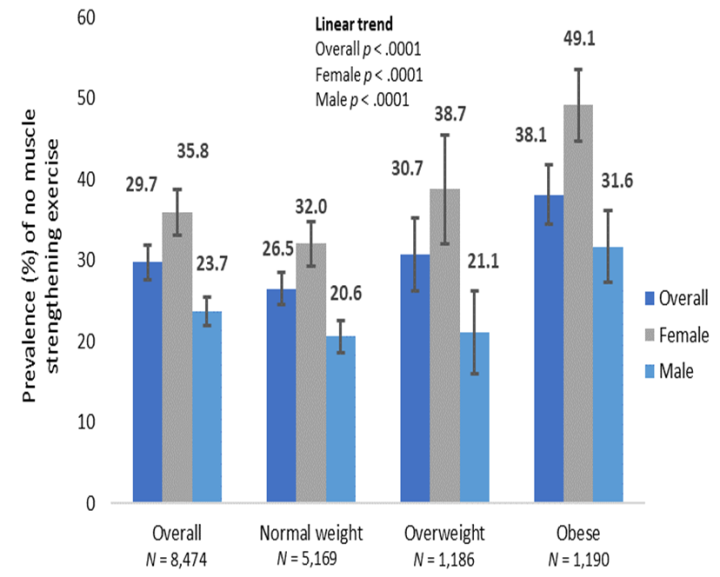
This BriefTrends examines the prevalence (%) of no muscle strengthening exercise in U.S. high school students in 2019 both overall and across different weight status categories.
Briefly present the prevalence of no muscle strengthening exercise reported by U.S. high school students by weight status and by sex for 2019.
The 2019 High School Youth Risk Behavior Survey (YRBS).
All U.S. public and private high school students grades 9 thru 12.
1) Muscle strengthening exercise status (Status of ‘No’ for those reporting 0 days to the question: During the past 7 days, on how many days did you do exercises to strengthen or tone your muscles, such as pushups, sit-ups, or weight lifting?, otherwise ‘Yes’.), 2) Weight status (‘Normal weight’: < 85th BMI percentile for age and sex, ‘Overweight’: ≥ 85th BMI percentile for age and sex and < 95th BMI percentile for age and sex, ‘Obese’: ≥ 95th BMI percentile for age and sex), and 3) sex.
Prevalence (%) estimates of no muscle strengthening exercise, overall and by weight status and by sex, 95% confidence intervals (CIs) for prevalence estimates, and linear contrasts for trend in log odds across weight status groups. SAS Survey Procedures were used for estimates, CIs, and tests, version 9.4.

The prevalence of no muscle strengthening activity reported by high school students in 2019 overall was 29.7% (95% CI: 27.6-31.9). Significant sex differences were seen overall with female (35.8% 95% CI: 32.9-38.8) prevalence of no muscle strengthening exercise greater than the male prevalence (23.7% 95% CI: 21.9-25.5).
Sex differences remained within each weight status group. Finally, significant linear trend tests (ps < .0001) indicate greater prevalence of no muscle strengthening exercise for overweight and obese students, overall and within each sex group.
| [1] | Underwood JM, Brener N, Thornton J, et al. Overview and methods for the Youth Risk Behavior Surveillance System—United States, 2019. In: Youth Risk Behavior Surveillance—United States, 2019. MMWR Suppl 2020; 69(No. Suppl 1). | ||
| In article | View Article PubMed | ||
| [2] | Centers for Disease Control and Prevention. Youth Risk Behavior Surveillance System (YRBSS): 2019 YRBS Data User’s Guide 2019. August, 2020. | ||
| In article | |||
| [3] | SAS Institute Inc. 2015. SAS/STAT® 14.1 User’s Guide. Cary, NC: SAS Institute Inc. | ||
| In article | |||
Published with license by Science and Education Publishing, Copyright © 2022 Peter D. Hart
 This work is licensed under a Creative Commons Attribution 4.0 International License. To view a copy of this license, visit
http://creativecommons.org/licenses/by/4.0/
This work is licensed under a Creative Commons Attribution 4.0 International License. To view a copy of this license, visit
http://creativecommons.org/licenses/by/4.0/
| [1] | Underwood JM, Brener N, Thornton J, et al. Overview and methods for the Youth Risk Behavior Surveillance System—United States, 2019. In: Youth Risk Behavior Surveillance—United States, 2019. MMWR Suppl 2020; 69(No. Suppl 1). | ||
| In article | View Article PubMed | ||
| [2] | Centers for Disease Control and Prevention. Youth Risk Behavior Surveillance System (YRBSS): 2019 YRBS Data User’s Guide 2019. August, 2020. | ||
| In article | |||
| [3] | SAS Institute Inc. 2015. SAS/STAT® 14.1 User’s Guide. Cary, NC: SAS Institute Inc. | ||
| In article | |||