sciepub.com
 Quick Submission

Serum Vitamin D Level in Behcet’s Disease: Single Center Study from Iraq
Nizar A Jassim1, Noor Hassan A. Alrasool2, Faiq I Gorial1,
1Department of Medicine, College of Medicine, University of Baghdad, Baghdad, Iraq
2Baghdad Teaching Hospital, Rheumatology Unit, Baghdad, Iraq
Abstract
Background: Behcet’s disease (BD) is a multisystemic vasculitis. Low serum vitamin D status is closely associated with disease risk of BD. Objective: To evaluate serum vitamin D level in Iraqi patients with BD. Patients and methods: In this case control study, A 43 patients with BD were diagnosed according to International Study Group Criteria and 24 healthy persons recruited as a control group were enrolled in the study. Total serum 25-hydroxyvitamin D (vitamin D) was assessed in both groups and levels ≥22 ng/ml were considered sufficient, while levels of <22 ng/ml were considered low. Results: The mean age for BD patients was 34.2±9.6 years compared to 31.8±6.5 years in control group. Male represented 69% in BD and 70% of healthy controls. Mean disease duration for BD was 5.9±6.7 years. The mean BMI of BD patients was 27.1±4.5 Kg/m2 compared to 27.4±3.5 Kg/m2 in controls. The demographic and clinical characteristics of study sample showed no significant clinical difference between patients and controls apart from current smoking which was significantly associated with BD (P < 0.05). Serum vitamin D levels were significantly lower in patients with BD than controls (P<0.001). Serum vitamin D levels were significantly inversely correlated with BD duration. Conclusion: serum vitamin D levels were significantly lower in BD patients compared to controls.
Keywords: Behcet’s disease, serum vitamin D, vasculitis, Vitamin D and Behcet’s disease
Copyright © 2016 Science and Education Publishing. All Rights Reserved.Cite this article:
- Nizar A Jassim, Noor Hassan A. Alrasool, Faiq I Gorial. Serum Vitamin D Level in Behcet’s Disease: Single Center Study from Iraq. American Journal of Medical Sciences and Medicine. Vol. 4, No. 1, 2016, pp 8-10. http://pubs.sciepub.com/ajmsm/4/1/2
- Jassim, Nizar A, Noor Hassan A. Alrasool, and Faiq I Gorial. "Serum Vitamin D Level in Behcet’s Disease: Single Center Study from Iraq." American Journal of Medical Sciences and Medicine 4.1 (2016): 8-10.
- Jassim, N. A. , Alrasool, N. H. A. , & Gorial, F. I. (2016). Serum Vitamin D Level in Behcet’s Disease: Single Center Study from Iraq. American Journal of Medical Sciences and Medicine, 4(1), 8-10.
- Jassim, Nizar A, Noor Hassan A. Alrasool, and Faiq I Gorial. "Serum Vitamin D Level in Behcet’s Disease: Single Center Study from Iraq." American Journal of Medical Sciences and Medicine 4, no. 1 (2016): 8-10.
| Import into BibTeX | Import into EndNote | Import into RefMan | Import into RefWorks |
At a glance: Figures
1. Introduction
Behcet’s disease (BD) is a multisystemic vasculitis characterized by recurrent orogenital aphthous ulcers, uveitis, and skin lesions with chronic relapsing course [1]. The geographical distribution of BD is distinctive and considered a major cause of morbidity [2]. Vitamin D has major biologic activities including cellular proliferation and differentiation, immune system modulation and muscle strengthening [3, 4]. It is regarded as an environmental factor essential in the etiology of T-cell-mediated autoimmune diseases [5]. Poor vitamin D status is important in the initiation and propagation of a range of autoimmune diseases [6] like multiple sclerosis, type 1 diabetes, systemic lupus erythematosus, and rheumatoid arthritis and is associated with an increased risk of several diseases such as hypertension, infectious diseases, diabetes, cardiovascular disease, musculoskeletal disorders, asthma, as well as several psychiatric conditions such as schizophrenia, depression, and dementia and solid tumors [7, 8]. Some patients with autoimmune diseases have anti-vitamin D antibodies while several autoimmune pathways are suppressed by vitamin D including the T helper (Th)1, B cells, Th-17,dendritic cell ,and co-stimulatory molecule systems [9]. Vitamin D metabolites have direct targets to the adaptive immune system cells [10]. This study aimed to evaluate serum vitamin D in Iraqi patients with BD.
2. Patients and Methods
2.1. Study DesignThis case control study was performed in Baghdad Teaching Hospital from July 2013 to July 2014. Patients with BD and controls were taken consecutively. A signed consent was taken from the individuals in both groups for admission in the study. Ethical approval was taken from medical department, collage of medicine, Baghdad.
2.2. Clinical and Laboratory EvaluationForty two patients with BD were diagnosed according to International Study Group criteria [11] and 24 healthy controls recruited from the general population as a control group were enrolled in the study. Patients with history of chronic disease affecting bone metabolism were excluded from the study. All BD patients were subjected to detailed history taking and thorough clinical examination. Weight and height of all subjects were recorded, and body mass index (BMI) was calculated as weight (kg)/height (m2).
Laboratory investigations were obtained from all patients and controls. Including: Complete blood count, Erythrocyte sedimentation rate (ESR) recorded in mm/1st h., C-reactive protein (CRP), Total serum calcium (N= 8.4–10.2 mg/dl), total serum phosphorus (N =2.3–4.7 mg/dl) and total serum alkaline phosphatase (N= 40–150 IU/L). Total serum 25-hydroxyvitamin D (vitamin D) was assessed by ELIZA. The kit was derived from Euroimmun Medizinische Labordiagnostika AG. Serum vitamin D levels ≥22 ng/ml were considered sufficient, while levels of <22 ng/ml were considered low.
2.3. Statistical AnalysisStatistical package for social sciences version 20 (SPSS 20) was used for data input and analysis. Continuous variables were presented as means± standard deviations and discrete variables presented as numbers and percentages. T test for two independent samples was used to test the significant of difference in mean scores. Chi-square test for independence was used to test the significance of association between discrete variables. Pearson's correlation coefficient was used to test the significance of linear correlation between continuous variables. P value less than 0.05 was considered significant.
3. Results
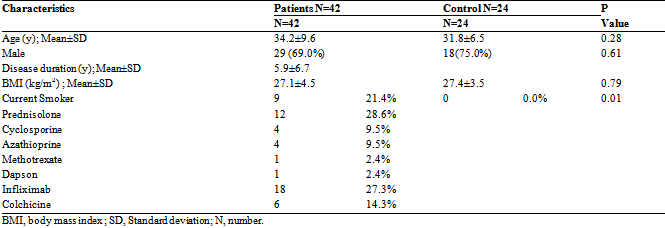
A total number of 42 BD patients and 24 healthy controls were studied in this case control study. BD subgroup comprised 29 males with mean age of 34.2 ± 9.6 years . Controls comprised of 24 healthy individuals 18 males with mean age of 31.8±6.5 years. The mean disease duration was 5.9±6.7 years. The mean BMI values for patients & controls are 27.1±4.5 and 27.4±3.5 respectively. In patient group, 9 (21.4%) patients were current smokers, 18 (27.3%) were on infliximab treatment,12 (21.4%) were on prednisolone, 4(9.5%)were on cyclosporine and azathioprine, 1 (2.4%) on methotrexate and dapson and 6 (14.3%) on colchicine. There was no significant difference between BD patients and controls in age, sex, and BMI (P> 0.05). Smoking significantly associated with BD (P < 0.05). Table 1.




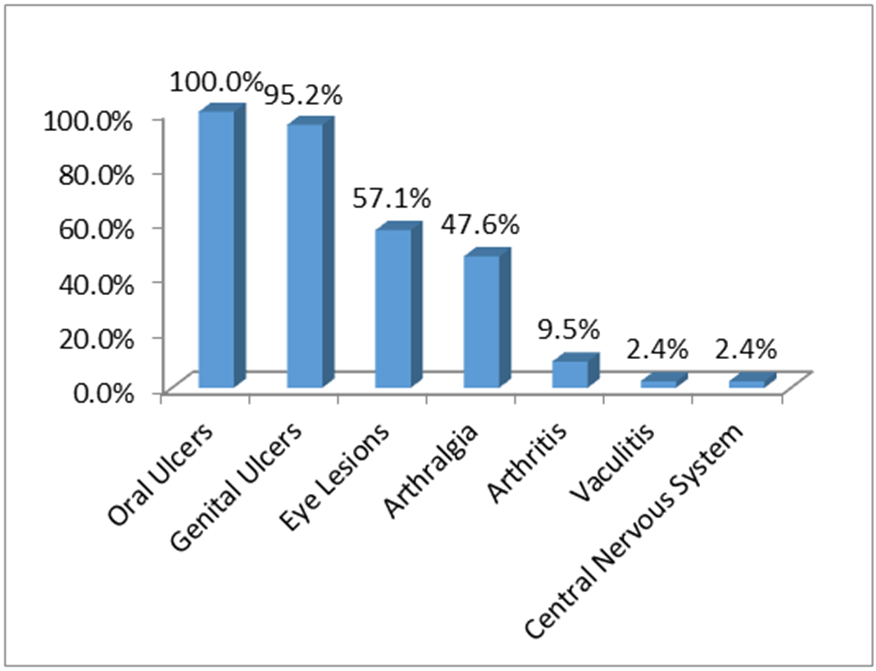
Forty two patients with BD presented with oral ulceration (100%) and 40 of them have history of genital ulceration (95.2%). Eye lesions (uveitis) presented in 24 patients (57.1%), arthralgia in 20 patients (47.6%), arthritis in 4 patients (9.5%), vasculitis and central nervous system involvement was reported in 1 patient (2.4%) each. Figure 1.
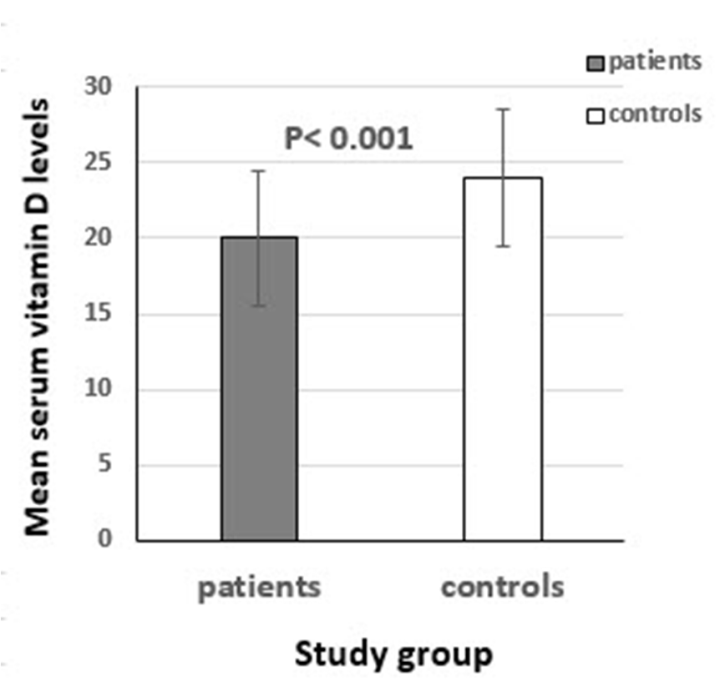
Serum vitamin D mean levels were significantly lower in BD patients compared to controls ((20±4.5ng/ml) versus (24.9±4.5 ng/ml), P < 0.05) as in Figure 2.

 Download as

 Download as
Serum vitamin D levels were significantly inversely correlated with BD duration (r = -0.312, P < 0.05). Other correlations with age, sex, and BMI were not significant (P > 0.05). There was positive correlation between current smoking and loss of vitamin D however this correlation was statistically not significant (Spearman's rho= 0.190, p=0.23(. Also there was no significant variation of serum vitamin D level according to the presence and absence of different clinical manifestations (p>0.05).
4. Discussion
As far as we know this is the first case control study that assessed serum vitamin D level in sample of Iraqi patients with Behcet’s disease.
In this study serum vitamin D level was significantly decreased in BD patients compared to healthy control. This may be due to diminished regulator T-cells and shifts of Th1/Th2 ratio toward Th1 [12]. In addition low vitamin D level may result from lack of calcium and vitamin D intake, malnutrition, inadequate sunlight exposure and impaired physical activity. This finding was supported by Ganeb et al who reported that serum levels of vitamin D were significantly lower in BD patients compared to controls [13], Karatay et al showed that serum 25-hydroxyvitamin D levels are decreased in patients with Behcet’s Disease [14] and Ibrahim et al observed that vitamin D deficiency occurs at a higher rate in patients with RA, SLE, Behcet’s disease and A.S [15] .
In this study serum vitamin D level found to be inversely correlated with BD duration (P value<0.05). Ganeb et al [13] showed no significant correlation between disease duration of BD and S. vitamin D level. This is probably because of difference in number of patients included in each study.
The current showed positive correlation between current smoking and loss of vitamin D however this correlation was statistically not significant. Similarly other studies [16, 17] have reported independent positive correlates of smoking with vitamin D deficiency but this correlation was statistically significant. The non-statistical significance in the present study may be explained by the small study sample.
There was no significant correlation between deficient vitamin D serum level and the presence of various clinical manifestations. Ganeb et al [13] observed statistically significant decrease of vitamin D serum levels in BD patients with vascular lesions only, this difference may be due to small sample size of our study.
In summary, Serum vitamin D mean level in BD patients was lower than healthy controls and it was significantly inversely correlated with BD duration. As Behcet’s disease has low serum vitamin D level, so follow up of patients with serum vitamin D level testing is recommended. A large longer-term follow up studies are needed to confirm the findings of the current study.
References
| [1] | Kirnap M, Calis M, Kaya N, Muhtaroglu S. Is the Behcet's disease a risk factor for osteoporosis and is relation to cytokines?.Bratisl Lek Listy. 2010; 111(6):340-4. | ||
 In article In article | |||
| [2] | Idil A, Gurler A, Boyvat A, et al. The prevalence of Behcet’s disease above the age of 10 years. The results of a pilot study conducted at the Park Primary Health Care Center in Ankara, Turkey. Ophthalmic Epidemiology 2002; 9: 325-31. | ||
| In article | View Article PubMed | ||
| [3] | Haroon M, Bond U, Quillinan N, et al. The prevalence of vitamin D deficiency in consecutive new patients seen over a 6-month period in general rheumatology clinics. Clin Rheumatol 2011; 30(6):789-94. | ||
| In article | View Article PubMed | ||
| [4] | Bischoff-Ferrari HA, Giovannucci E, Willett WC, et al. Estimation of optimal serum concentrations of 25-hydroxyvitamin D for multiple health outcomes. Am J Clin Nutr 2006; 84:18-28. | ||
| In article | PubMed | ||
| [5] | Cutolo M, Otsa K. Review: vitamin D, immunity and lupus. Lupus 2008; 17:6-10. | ||
| In article | View Article PubMed | ||
| [6] | Ben-Zvi I, Aranow C, Mackay M, Stanevsky A, Kamen DL, Marinescu LM, et al. The impact of vitamin D on dendritic cell function in patients with systemic lupus erythematosus. PLoS One 2010; 5(2):e 9193. | ||
| In article | |||
| [7] | Shoenfeld N, Amital H, Shoenfeld Y. The effect of melanism and vitamin D synthesis on the incidence of autoimmune disease. Nat Clin Pract Rheumatol 2009; 5:99-105. | ||
| In article | View Article PubMed | ||
| [8] | Ganeb S, Sabry H, El-Assal MM, et al. Vitamin D levels in patients with Behcet’s disease: Significance and impact on disease measures The Egyptian Rheumatologist (2013) 35, 151-7. | ||
| In article | |||
| [9] | Lerner A, Shapira Y, Agmon-Levin N, Pacht A, Ben-Ami Shor D, Lo´ pez HM, et al. The clinical significance of 25OH-vitamin D status in celiac disease. Clin Rev Allergy Immunol 2012; 42: 322-30. | ||
| In article | View Article PubMed | ||
| [10] | Peelen E, Knippenberg S, Muris AH, et al. Effects of vitamin D on the peripheral adaptive immune system: a review. Autoimmun Rev 2011; 10(12):733-43. | ||
| In article | View Article PubMed | ||
| [11] | International Study Group for Behcet's Disease Criteria for diagnosis of Behcet's disease. Lancet 1990, 335:1078-80. | ||
| In article | PubMed | ||
| [12] | Hamzaoui K, Hamzaoui A. Vitamin D level and potential impact on immune cells in Behçet’s disease. OA Inflammation .2013; 1(1): 6. | ||
| In article | View Article | ||
| [13] | Ganeb S, Sabry H, El-Assal MM, et al. Vitamin D levels in patients with Behcet’s disease: Significance and impact on disease measures The Egyptian Rheumatologist (2013) 35, 151-7. | ||
| In article | |||
| [14] | Karatay S, Yildirim K, Karakuzu A,et al . Vitamin D status in patients with Behcet’s Disease. CLINICS 2011; 66(5):721-3. | ||
| In article | PubMed | ||
| [15] | Ibrahim M H, Bakheet MS, Abdel Sater KA and Abdel Shakoor M. Wyno. Relationship between vitamin D and disease activity in some rheumatic disease. Academic Journal of Medical Sciences. 2013; 2 (7): 52-6. | ||
| In article | |||
| [16] | Alkerwi A, Sauvageot N, Gilson G, Stranges S. Prevalence and Correlates of Vitamin D Deficiency and Insufficiency in Luxembourg Adults: Evidence from the Observation of Cardiovascular Risk Factors (ORISCAV-LUX) Study.. Nutrients. 2015 Aug 13;7(8):6780-96. | ||
| In article | View Article PubMed | ||
| [17] | .Cutillas-Marco E1, Fuertes-Prosper A, Grant WB, Morales-Suárez-Varela M.Vitamin D deficiency in South Europe: effect of smoking and aging. Photodermatol Photoimmunol Photomed. 2012 Jun; 28(3):159-61. | ||
| In article | View Article PubMed | ||
 CiteULike
 Mendeley
 StumbleUpon
 Delicious
 Facebook
 Twitter
 LinkedIn
 encountered during recruitment)