Background: Various body measures have been found predictive of morbidity and mortality in population-based studies. Similarly, links between a healthy lifestyle and health outcomes are well established. However, the extent to which body shape and healthy lifestyle can independently predict death in elderly populations is less clear. Purpose: The aim of this study was to determine if measures of body shape and healthy lifestyle can independently predict all-cause mortality in older adults. Methods: A baseline sample of 9,610 adults 65+ years of age were included from ten cycles (1999-2018) of NHANES. A body shape index (BSI) was computed using objectively assessed anthropometric measures. A healthy lifestyle index (HLI, 0-to-8) was constructed using four rating scale measures that included physical activity (0-to-2), alcohol consumption (0-to-2), smoking (0-to-2), and BMI groups (0-to-2). To account for confounding health status, chronic conditions and activities of daily living (ADL) were considered. Survival analysis was employed to examine the independent associations between the predictors and risk of all-cause mortality. Linear regression was used to characterize the mortality risk trend across HLI scores by different BSI quartile groups. Results: A total of 4,059 all-cause deaths were observed during a mean (median) follow-up of 10.9 (10.8) years. BSI was an independent predictor of mortality with risk decreasing linearly (p<0.0001) from 4th (reference), 3rd (HR=0.85, 0.75-0.95), 2nd (HR=0.77, 0.67-0.88), and 1st (HR=0.72, 0.63-0.82) BSI quartiles. Similarly, HLI was an independent predictor with risk increasing linearly (p<0.0077) from HLI 7+ (reference), HLI 6 (HR=1.25, 1.01-1.56), HLI 5 (HR=1.27, 1.03-1.57), HLI 4 (HR=1.45, 1.18-1.78), HLI 3 (HR=1.52, 1.22-1.88), HLI 2 (HR=1.85, 1.48-2.30), HLI 1 (HR=2.00, 1.50-2.68), and HLI 0 (HR=2.03, 1.05-3.93). Additionally, predicted hazard means decreased linearly across HLI scores for each BSI quartile group with lower means observed in lower BSI quartile groups. However, a significant quadratic trend was seen in the 1st and 4th BSI quartile groups, indicating a rapid decline in mortality risk beginning at approximately HLI 4 for those BSI groups. Conclusion: These findings indicate that body shape and healthy lifestyle each influence mortality risk in older adults. Adopting healthy behaviors and improving abdominal fat metrics should be promoted among adult populations regardless of disease, functioning, and age.
Several different body measure variables are known predictors of morbidity and mortality in population-based studies of older adults. For instance, body mass index (BMI) is known to correlate with mortality risk in non-frail older populations 1. Additionally, older adults considered underweight or obese using a measure of BMI have been shown to have higher risk of all-cause mortality 2. A related but different measure, waist circumference (WC), is a measure of abdominal obesity and is also known to be positively associated with mortality risk in older populations 3. Often used in clinical settings, percent body fat (PBF) is the amount of body fat as a percentage of body weight. PBF is purported to be a better predictor of health and is also associated with risk of all-cause mortality 4. A relatively newer body measure, body shape index (BSI), is a measure of abdominal obesity that removes BMI from WC and is correlated with PBF 5. As such, BSI may be a better predictor of mortality in older populations than either BMI or WC 6, 7.
In like manner, connections have been established between a healthy lifestyle and health outcomes. Many studies have used collective measures or indexes, formed by combining several health behaviors, as predictors of mortality 8. By combining health variables such as BMI, smoking status, alcohol use, physical activity (PA), and diet, researchers are able to garner the power of a single predictor in an analysis without the nuisance of several potentially correlated variables 9. Studies have used these combined healthy lifestyle variables to predict mortality in many different populations including older adults 9, 10.
To date, no studies have examined the contribution of both a measure of body shape and a combined measure of healthy lifestyle on mortality in older adults. Thus, the extent to which body shape and healthy lifestyle can independently predict death in older populations is unknown. The aim of this study was to determine if measures of body shape and healthy lifestyle can independently predict all-cause mortality in a representative sample of older U.S. adults.
Study design
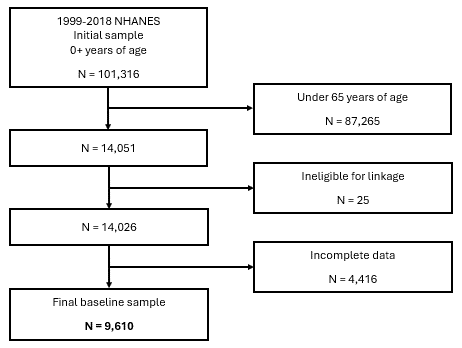
This study used ten cycles (1999-2018) of National Health and Nutrition Examination Survey (NHANES) data along with National Center for Health Statistics (NCHS) 2019 public-use linked mortality files 11, 12. The initial dataset consisted of 101,316 adults 0+ years of age and, after exclusions, resulted in a final baseline sample of 9,610 older adults (Figure 1).

Healthy lifestyle index (HLI)
The HLI for this study was created using four health metrics that included alcohol use, smoking, PA, and BMI status 13. Each health metric was converted to a 3-point rating scale with category values of 0, 1, and 2. Alcohol use was assessed using a series of questions asking participants about their alcohol consumption history and average alcohol consumption. From these responses, an alcohol use metric variable was created that assigned participants to one of three score categories: non-drinker (2), light drinker (1), or moderate-to-heavy drinker (0). Smoking status was assessed using a series of questions asking participants about their lifetime and current smoking habits. From these responses, a smoking metric variable was created that assigned participants to one of three score categories: non smoker (2), former smoker (1), or current smoker (0). PA was assessed by first computing variables indicating if the participant reported typically engaging in any weekly moderate PA (MPA) or vigorous PA (VPA) for at least 10 minutes continuously. From these indicator variables, a PA metric variable was created that assigned participants to one of three score categories of physically active in both MPA and VPA (2), physically active in MPA or VPA only (1), or physically inactive (0). BMI (kg/m2) status was assessed by first forming the following BMI categories: 1) underweight (BMI < 18.5), 2) normal weight (18.5 ≤ BMI < 25.0), 3) overweight (25.0 ≥ BMI < 30.0), and 4) obese (BMI ≥ 30.0). From these groups, a BMI metric variable was created that assigned participants to one of three score categories: normal weight (2), overweight (1), or underweight/obese (0). Finally, the HLI was created by summing across the four health metric variables, yielding a total score from 0 to 8, with larger values indicating better health.
Body shape index (BSI)
A measure of body shape, body shape index (BSI), was used in this study as a predictor of central obesity as well as for its association with chronic disease and sleep quality 14. BSI was computed from objectively measured height, weight, and waist circumference (WC) using the following formula: BSI (m11/6/kg2/3)= WC / (BMI2/3×height1/2) 15. BSI is considered a measure of WC with a participant’s BMI removed with larger values indicative of poor health outcomes. For descriptive purposes, BSI values were converted to T-scores with a mean of 50 and standard deviation (SD) of 10. For modeling purposes, BSI values were categorized into quartiles, where larger quartiles contained higher BSI values.
Activities of daily living (ADL)
A measure of functional limitations was assessed using a 4-itemactivities of daily living (ADL) scale. Each ADL item asked participants how much difficulty they experience completing certain tasks. For this study, the ADL scale considered the tasks of 1) dressing themselves, 2) walking between rooms, 3) getting in and out of bed, and 4) eating with a knife, fork, and cup. A common response scale was used ranging from no difficulty to unable to do the activity. A final two-group ADL status variable was created with participants considered to either have no difficulty on all tasks or at least some difficulty on any task.
Chronic conditions
A chronic conditions variable was created from nine different disease conditions that included 1) coronary heart disease, 2) congestive heart failure, 3) coronary heart disease, 4) angina pectoris, 5) heart attack, 6) stroke, 7) emphysema, 8) chronic bronchitis, and 9) arthritis. If a participant indicated they were told by a doctor or other health professional that they had the condition, they were assigned a ‘1’, otherwise a ‘0’. A final two-group chronic conditions status variable was created with participants considered to either have no chronic conditions or at least one chronic condition.
Assessment of covariates
For descriptive and statistical adjustment purposes, age, sex, race, and income variables were created. Age was used as a continuous variable, ranging from 18 years to 80+ years, as well as a grouping variable for descriptive purposes. Sex included males and female and dummy coded when appropriate (1=male and 0=female). Race/ethnicity was used as a categorical variable and included White, Black, Hispanic, and Other groupings. Lastly, income was used as a continuous variable and computed as a ratio of the family income to poverty, ranging from 0 to 5, as well as a grouping variable (quartiles) for descriptive purposes.
Statistical analyses
The sample was described using weighted percentages across HLI groups with 95% confidence intervals (CIs). The Rao-Scott chi-square (X²) statistic was used to test for differences in HLI group percentages across demographic and health status characteristics. Additionally, linear regression was used to test for difference in BSI across HLI groups for each demographic and health status characteristic. Cox regression survival analysis was employed to examine the independent associations between the predictors and risk of all-cause mortality. Linear regression was used to characterize the trend in mortality risk across HLI scores by different BSI quartile groups. SAS version 9.4 survey procedures were used for all analyses 16, 17.
A total of 4,059 all-cause deaths were observed during a mean (median) follow-up of 10.9 (10.8) years. A larger percentage of female (44.6%), 80+ years (46.2%), other race (53.6%), high income (39.5%), disease free (43.4%), and functionally healthy (39.1%) adults were categorized in the high HLI (HLI 5-8) group, as compared to their respective counterparts (Table 1). Additionally, BSI values were greater among adults in the low HLI (HLI 0-2) group for males (p=0.0004) but not females (Table 2). Similar trends in BSI were observed in the 65-69 and 70-79 year age groups, White and Black groups, and the top three income quartile groups. Additionally, significantly greater BSI was observed in the low HLI (HLI 0-2) group in both ADL status groups, although, those with functional limitation had significantly (HLI int p=0.0347) greater BSI than their healthy counterparts.
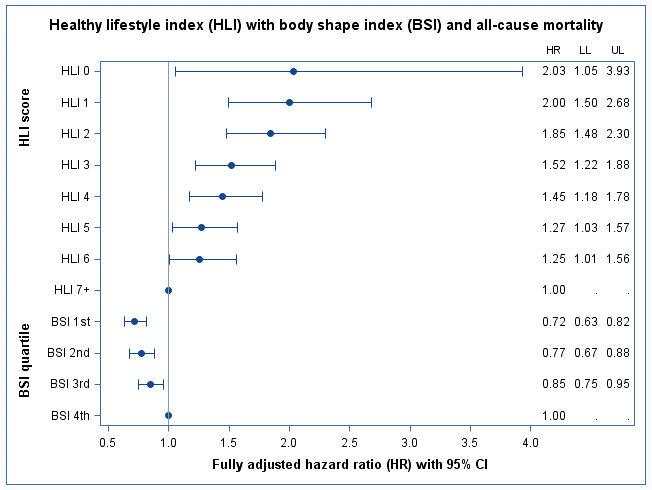
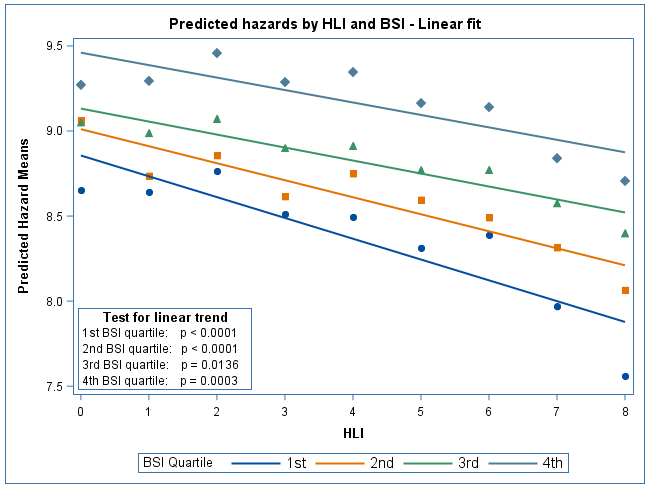
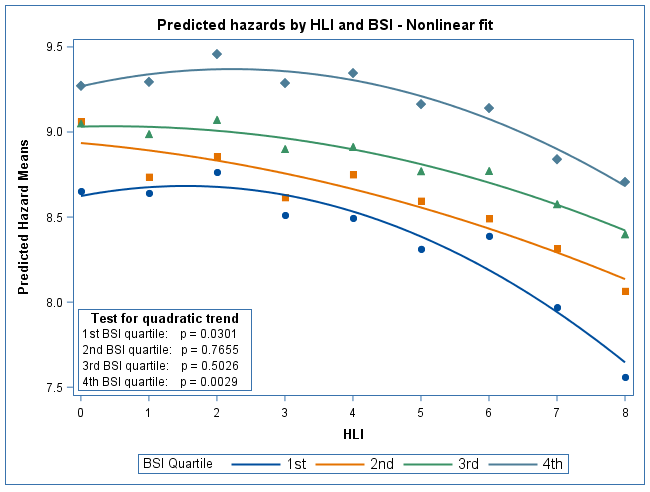
BSI was an independent predictor of mortality with risk decreasing linearly (p<0.0001) from 4th (reference), 3rd (HR=0.85, 0.75-0.95), 2nd (HR=0.77, 0.67-0.88), and 1st (HR=0.72, 0.63-0.82) BSI quartiles (Table 3). Similarly, HLI was an independent predictor with risk increasing linearly (p<0.0077) from HLI 7+ (reference), HLI 6 (HR=1.25, 1.01-1.56), HLI 5 (HR=1.27, 1.03-1.57), HLI 4 (HR=1.45, 1.18-1.78), HLI 3 (HR=1.52, 1.22-1.88), HLI 2 (HR=1.85, 1.48-2.30), HLI 1 (HR=2.00, 1.50-2.68), and HLI 0 (HR=2.03, 1.05-3.93) (Figure 2). Finally, mean hazard decreased linearly across HLI scores for each BSI quartile group with lower means observed in lower BSI quartile groups (Figure 3). However, a significant quadratic trend was observed in the 1st and 4th BSI quartiles, indicating a substantial drop in hazard at approximately HLI 4 for those BSI groups (Figure 4).


The two most important findings from this study include 1) that HLI and BSI were found to be independent predictors of all-cause mortality and 2) the risk of mortality declined as HLI scores increased across all BSI quartiles with lower trending risk observed in lower BSI groups. The HLI used in this study was also negatively correlated with mortality risk with each HLI score predictive of mortality. A similar HLI, different only in how PA was assessed, showed the same results in a large, pooled sample of older U.S. adults 18. Albeit this study did not include BSI as a main independent predictor. BSI, however, has been shown useful in predicting all-cause mortality proportionally in large national studies 19, 20. Thus, previous findings have in segments corroborated the current findings from this study. In sum then, this research provides novel evidence for the independent associations between HLI and BSI in predicting all-cause mortality in linear fashion in older adults.
The limitations in this study require at least brief mention. First, a large percentage of the baseline sample were excluded due to missing data. Moreover, the current study did not replace these data and instead used a complete-case analysis procedure. Missing data can be problematic for both statistical power and biased estimations. The current study, however, did not suffer from low statistical power. However, it cannot be ruled out that some data were missing due to non-random events. Second, three of the four health metrics used to create the HLI in this study were assessed using participant-reported means. Therefore, it is possible that the HLI scores suffer from some response bias. In sum, the study findings should be considered along with these limitations.
These findings indicate that body shape and healthy lifestyle each influence mortality risk in older adults. Additionally, HLI was negatively associated with mortality risk across all BSI quartiles with lower trending risk observed in lower BSI groups. Adopting healthy behaviors and improving abdominal fat metrics should be promoted among adult populations regardless of disease, functioning, or age.
| [1] | Jayanama K, Theou O, Godin J, Mayo A, Cahill L, Rockwood K. Relationship of body mass index with frailty and all-cause mortality among middle-aged and older adults. BMC Med. 2022; 20(1): 404. Published 2022 Oct 24. | ||
| In article | View Article PubMed | ||
| [2] | Concha-Cisternas Y, Díaz-Toro F, Castro-Piñero J, et al. Association between body mass index and all-cause mortality in older people: A prospective analysis of the Chilean National Health Survey 2009-2010. Rev Med Chil. 2024; 152(6): 645-654. | ||
| In article | View Article PubMed | ||
| [3] | Jacobs EJ, Newton CC, Wang Y, et al. Waist circumference and all-cause mortality in a large US cohort. Arch Intern Med. 2010; 170(15): 1293-1301. | ||
| In article | View Article PubMed | ||
| [4] | Jayedi A, Khan TA, Aune D, Emadi A, Shab-Bidar S. Body fat and risk of all-cause mortality: a systematic review and dose-response meta-analysis of prospective cohort studies. Int J Obes (Lond). 2022; 46(9): 1573-1581. | ||
| In article | View Article PubMed | ||
| [5] | Hart PD. An Alternative Body Shape Index (BSI) for Physically Active College Males. Journal of Physical Activity Research. 2024; 9(1): 24-29. | ||
| In article | View Article | ||
| [6] | Li HH, Wang SS, Li HW, et al. Zhong hua Liu Xing Bing Xue Za Zhi. 2025; 46(3): 393-401. | ||
| In article | |||
| [7] | Krakauer NY, Krakauer JC. A new body shape index predicts mortality hazard independently of body mass index. PLoS One. 2012; 7(7): e39504. | ||
| In article | View Article PubMed | ||
| [8] | Hart PD. A Healthy Lifestyle Index Predicts All-Cause Mortality in Older Adults Independent of Psychological Distress, Chronic Conditions, and Functional Limitations: NHIS 1997 To 2018.American Journal of Applied Psychology. 2025; 13(1): 17-22. | ||
| In article | View Article | ||
| [9] | Tang S, Mao X, Xu J, Jiao H. Healthy lifestyle, multimorbidity and all-cause mortality among older people: a retrospective cohort study based on CLHLS 2005-2018. BMC Geriatr. 2025; 25(1): 644. Published 2025 Aug 20. | ||
| In article | View Article PubMed | ||
| [10] | Yang J, Huang J, Huang Q, et al. The Impact of Social Stress and Healthy Lifestyle on the Mortality of Chinese Older Adults: Prospective Cohort Study. JMIR Aging. 2025; 8: e75942. Published 2025 Aug 12. | ||
| In article | View Article PubMed | ||
| [11] | Chen TC, Clark J, Riddles MK, Mohadjer LK, Fakhouri THI. National Health and Nutrition Examination Survey, 2015−2018: Sample design and estimation procedures. National Center for Health Statistics. Vital Health Stat 2(184). 2020. | ||
| In article | |||
| [12] | National Center for Health Statistics. Public-Use Linked Mortality Files. National Center for Health Statistics. Updated May 2022. https://www.cdc.gov/nchs/data/datalinkage/public-use-linked-mortality-file-description.pdf. | ||
| In article | |||
| [13] | Hart PD. A Healthy Lifestyle Index Predicts All-Cause Mortality in Older Adults Independent of Psychological Distress, Chronic Conditions, and Functional Limitations: NHIS 1997 To 2018. American Journal of Applied Psychology. 2025; 13(1): 17-22. | ||
| In article | View Article | ||
| [14] | Hart PD. Sleep Quality Predicts Body Shape Index While Adjusting for Physical Activity. American Journal of Public Health Research. 2024. 12(3): 40-47. | ||
| In article | View Article | ||
| [15] | Krakauer NY, Krakauer JC. Dynamic association of mortality hazard with body shape. PLoS One. 2014;9(2):e88793. Published 2014 Feb 20. | ||
| In article | View Article PubMed | ||
| [16] | Allison PD. Survival analysis using SAS: a practical guide. Sas Institute; 2010 Mar 29. | ||
| In article | |||
| [17] | SAS Institute Inc. 2013. Introduction to Survival Analysis Procedures. SAS/STAT® 13.1 User’s Guide. Cary, NC: SAS Institute Inc. | ||
| In article | |||
| [18] | Hart PD. A Healthy Lifestyle Index Predicts All-Cause Mortality in Older Adults Independent of Psychological Distress, Chronic Conditions, and Functional Limitations: NHIS 1997 To 2018. American Journal of Applied Psychology. 2025; 13(1): 17-22. | ||
| In article | View Article | ||
| [19] | Grant JF, Chittleborough CR, Shi Z, Taylor AW. The association between A Body Shape Index and mortality: Results from an Australian cohort. PLoS One. 2017; 12(7): e0181244. Published 2017 Jul 31. | ||
| In article | View Article PubMed | ||
| [20] | Lee TL, Lin FJ, Yeh CF, et al. Evaluating the potential of waist-to-BMI ratio, a body shape index, and other anthropometric parameters in predicting cardiovascular disease mortality: evidence from NHANES III. BMC Public Health. 2025; 25(1): 1828. Published 2025 May 17. | ||
| In article | View Article PubMed | ||
Published with license by Science and Education Publishing, Copyright © 2025 Peter D. Hart
 This work is licensed under a Creative Commons Attribution 4.0 International License. To view a copy of this license, visit
http://creativecommons.org/licenses/by/4.0/
This work is licensed under a Creative Commons Attribution 4.0 International License. To view a copy of this license, visit
http://creativecommons.org/licenses/by/4.0/
| [1] | Jayanama K, Theou O, Godin J, Mayo A, Cahill L, Rockwood K. Relationship of body mass index with frailty and all-cause mortality among middle-aged and older adults. BMC Med. 2022; 20(1): 404. Published 2022 Oct 24. | ||
| In article | View Article PubMed | ||
| [2] | Concha-Cisternas Y, Díaz-Toro F, Castro-Piñero J, et al. Association between body mass index and all-cause mortality in older people: A prospective analysis of the Chilean National Health Survey 2009-2010. Rev Med Chil. 2024; 152(6): 645-654. | ||
| In article | View Article PubMed | ||
| [3] | Jacobs EJ, Newton CC, Wang Y, et al. Waist circumference and all-cause mortality in a large US cohort. Arch Intern Med. 2010; 170(15): 1293-1301. | ||
| In article | View Article PubMed | ||
| [4] | Jayedi A, Khan TA, Aune D, Emadi A, Shab-Bidar S. Body fat and risk of all-cause mortality: a systematic review and dose-response meta-analysis of prospective cohort studies. Int J Obes (Lond). 2022; 46(9): 1573-1581. | ||
| In article | View Article PubMed | ||
| [5] | Hart PD. An Alternative Body Shape Index (BSI) for Physically Active College Males. Journal of Physical Activity Research. 2024; 9(1): 24-29. | ||
| In article | View Article | ||
| [6] | Li HH, Wang SS, Li HW, et al. Zhong hua Liu Xing Bing Xue Za Zhi. 2025; 46(3): 393-401. | ||
| In article | |||
| [7] | Krakauer NY, Krakauer JC. A new body shape index predicts mortality hazard independently of body mass index. PLoS One. 2012; 7(7): e39504. | ||
| In article | View Article PubMed | ||
| [8] | Hart PD. A Healthy Lifestyle Index Predicts All-Cause Mortality in Older Adults Independent of Psychological Distress, Chronic Conditions, and Functional Limitations: NHIS 1997 To 2018.American Journal of Applied Psychology. 2025; 13(1): 17-22. | ||
| In article | View Article | ||
| [9] | Tang S, Mao X, Xu J, Jiao H. Healthy lifestyle, multimorbidity and all-cause mortality among older people: a retrospective cohort study based on CLHLS 2005-2018. BMC Geriatr. 2025; 25(1): 644. Published 2025 Aug 20. | ||
| In article | View Article PubMed | ||
| [10] | Yang J, Huang J, Huang Q, et al. The Impact of Social Stress and Healthy Lifestyle on the Mortality of Chinese Older Adults: Prospective Cohort Study. JMIR Aging. 2025; 8: e75942. Published 2025 Aug 12. | ||
| In article | View Article PubMed | ||
| [11] | Chen TC, Clark J, Riddles MK, Mohadjer LK, Fakhouri THI. National Health and Nutrition Examination Survey, 2015−2018: Sample design and estimation procedures. National Center for Health Statistics. Vital Health Stat 2(184). 2020. | ||
| In article | |||
| [12] | National Center for Health Statistics. Public-Use Linked Mortality Files. National Center for Health Statistics. Updated May 2022. https://www.cdc.gov/nchs/data/datalinkage/public-use-linked-mortality-file-description.pdf. | ||
| In article | |||
| [13] | Hart PD. A Healthy Lifestyle Index Predicts All-Cause Mortality in Older Adults Independent of Psychological Distress, Chronic Conditions, and Functional Limitations: NHIS 1997 To 2018. American Journal of Applied Psychology. 2025; 13(1): 17-22. | ||
| In article | View Article | ||
| [14] | Hart PD. Sleep Quality Predicts Body Shape Index While Adjusting for Physical Activity. American Journal of Public Health Research. 2024. 12(3): 40-47. | ||
| In article | View Article | ||
| [15] | Krakauer NY, Krakauer JC. Dynamic association of mortality hazard with body shape. PLoS One. 2014;9(2):e88793. Published 2014 Feb 20. | ||
| In article | View Article PubMed | ||
| [16] | Allison PD. Survival analysis using SAS: a practical guide. Sas Institute; 2010 Mar 29. | ||
| In article | |||
| [17] | SAS Institute Inc. 2013. Introduction to Survival Analysis Procedures. SAS/STAT® 13.1 User’s Guide. Cary, NC: SAS Institute Inc. | ||
| In article | |||
| [18] | Hart PD. A Healthy Lifestyle Index Predicts All-Cause Mortality in Older Adults Independent of Psychological Distress, Chronic Conditions, and Functional Limitations: NHIS 1997 To 2018. American Journal of Applied Psychology. 2025; 13(1): 17-22. | ||
| In article | View Article | ||
| [19] | Grant JF, Chittleborough CR, Shi Z, Taylor AW. The association between A Body Shape Index and mortality: Results from an Australian cohort. PLoS One. 2017; 12(7): e0181244. Published 2017 Jul 31. | ||
| In article | View Article PubMed | ||
| [20] | Lee TL, Lin FJ, Yeh CF, et al. Evaluating the potential of waist-to-BMI ratio, a body shape index, and other anthropometric parameters in predicting cardiovascular disease mortality: evidence from NHANES III. BMC Public Health. 2025; 25(1): 1828. Published 2025 May 17. | ||
| In article | View Article PubMed | ||