Background: Using heavy metals in artisanal gold mining can harm pregnant women and their fetuses. This study investigated maternal problems in pregnant women in Sudan's traditional gold mining areas. Methodology: This study is a retrospective case-control study conducted at El-Obied Obstetrics and Gynecology teaching hospital. The study comprised a total of 300 participants, with 152 women recruited from traditional gold mining areas as the case group, and another 152 women from non-gold mining areas as the control group. The data was obtained from the hospital records spanning from January 2018 to December 2023. Results: Most cases (65.7%) and controls (63.8%) were multiparous and rural (67.1%). Cases averaged 34 weeks gestational age at presentation, hence, controls 32 weeks, with a range of 8 to 42 weeks. About 63.1% of the cases and 54.4% of the controls were 37–42 weeks pregnant. The cases had 39.4% emergency caesarean section compared to 34.3% in the control group. Around 39.4% of cases returned home in good condition, compared to 61.8% of controls. Approximately, 44% of the cases individuals needed a lengthier hospital stay, compared to 20.3% of control group participants. About 9% of both groups received blood transfusions. Among those who evacuated returned products, 3.9% were cases and 1.9% controls. Conclusion: Traditional gold mining in Sudan poses significant health risks to humans, particularly to pregnant women. Community intervention is necessary to safeguard individuals in traditional gold mining regions, with a special focus on pregnant women.
Heavy metal exposure may cause prenatal defects, serum hormone hemostasis abnormalities may also cause pregnancy problems and poor outcomes 1. Despite the difficulty of linking preeclampsia (PE) to many metals, several metal levels are risk factors 2. With insufficient data, expensive compounds of mercury (Hg), arsenic (As), lead (Pb), and cadmium (Cd) may increase the risk of endometriosis, which affects 10% of women at fertile age and may lead to subfertility 3. A high atomic weight metal may cause contact dermatitis after local or systemic exposures and damage after low-level exposures 4. Cancer prevalence increases with heavy metal ingestion 5. More than 300,000 expectant mothers have children with neural tubal defects (NTDs) due to prenatal exposure to Cd, As, Hg, and manganese occurs annually. Thus, it raises NTD rates. This association has been extensively studied in epidemiology 6.
Even low Cd exposure during early pregnancy is substantially connected to low birth weight 7. The link between neonatal health and artisanal gold mining is unclear. Recent research in Madre de Dios, Peru, link harmful metals and minerals to South American newborns' health 8.
Due to the rapid development of primitive gold mining and its detrimental effects on pregnant women, Sudan needs community-level intervention. Tradition gold mining has been linked to high rates of pregnancy-induced hypertension (PIH), preeclampsia (PE), anemia, and early pregnancy loss 9.
Cadmium, Arsenic, Mercury, Chromium, and Manganese (Mn) exposure impairs apoptosis, proliferation, cell differentiation, and cell damage repair. Heavy metals' high toxicity puts pregnant women at danger of reduced antioxidant defense, oxidative stress, enzyme inactivation, and ROS production 2. Thus, the current study sought to evaluate the maternal outcomes of women living in traditionally gold mining areas in western Sudan.
This study was conducted at the El-Obied Obs.&Gyn. Teaching Hospital in the North Kordofan state of Sudan. It is a retrospective case-control study. The study was conducted from January 2018 to December 2023.This study included an overall enrollment of 304 participants. In particular, there were 152 individuals from traditional gold mining areas who were receiving maternity services at El-Obeid Obs. & Gyn. Teaching hospital, and ascertained as a case group. The remaining 152 participants were from areas without gold mining activities and served as a control group. The participants' ages ranged from 15 to 46 years, with an average age of 27 years. The case group had an average age of 27.13 years, while the control group had an average age of 27.79 years. The sample is derived from the hospital patient's records, which offer a thorough representation of all patients during the specified time period.
Statistical Analysis: The data was first compiled in a data-sheet and subsequently inputted into a computer software termed Statistical Package for the Social Sciences (SPSS) (Version 24, Chicago, USA). Calculations were performed for frequencies, percentages, cross-tabulation, and the chi-square test. The P-Value was estimated based on a 95% confidence interval (95% CI). A p-value below 0.05 was deemed to be statistically significant.
Ethical Approval: The study proposal received approval from the Human Research Ethics Committee (HREC) at Prof. Medical Research Center-MRCC. The approval number for this document is 0003/MRCC.02/24.
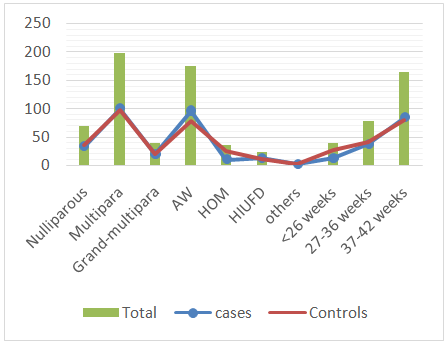
The majority of the participant have good outcomes of their previous pregnancies with a life and well babies 174/236(62.3%),96/120(80%) and 78/116(67.2%) followed by those with history of previous miscarriage 35/236(14.8%), 10/120(8.3%) and 25/116(21.5%), and those with history of intra-uterine fetal death 23/236(9.7%), 12/120(10%), and 11/116 (9.4%) from the case and the control respectively. as descriptive in Table 2 and Figure 2.
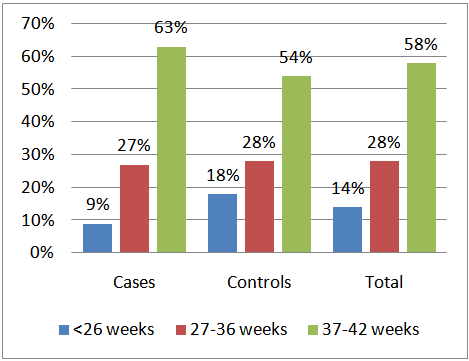
The mean gestational age of the participants was 33 weeks with a minimum of 8 weeks and maximum of 42 weeks, 34 weeks was the mean of case group and 32 weeks for the control. About 163/278(56.7%) their gestational age was between (37-42) weeks 84/133(63.1%) and 79/145(54.4%) followed by 77/278(27.6%) of (27-36) weeks 37/133(27.8%) and 40/145 (27.5%) and finally 38/278(13.6%) <26 weeks 12/133(9%) and 26/145(17.9%) for the case and the control respectively. as descriptive in Table 2 and Figure 3.
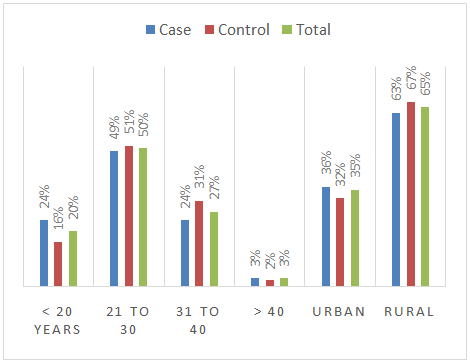
The majority of participants fell into the age range of 21-30 years, followed by 31-40 years and those under 20 years old, accounting for 49.7%, 27.3%, and 20% of the total, respectively. In the case group, the majority of participants fell within the age range of 21-30 years, followed by those under 20 and those aged 31-40 years. These age groups accounted for 48.7%, 24.3%, and 23.7% of the total participants, respectively. The majority of individuals in the control group were in the age range of 21-30 years, followed by 31-40 years and those under 20 years old. These age groups accounted for 50.7%, 31%, and 15.8% of the total, respectively, as shown in Table 1 and Figure 1. Among the 304 participants, the majority, 199 out of 304 (65.5%), hailed from rural areas, while the remaining 105 (34.5%) were from urban areas (refer to Table 1 and Figure 1).

Table 2 and Figure 2 show a brief overview of the study population's distribution by parity, past pregnancy outcomes, and gestational age at presentation. According to parity, the majority of women were multipara, followed by nulliparous and grand-multipara, with 197/304 (64.8%), 69 (22.7%), and 38 (12.5%), respectively.
Regarding previous pregnancy outcomes, 174/304 (57.2%) had AW, with 96/152 (63.2%) cases and 78/152 (51.3%) controls. Of the 23 cases with HIUFD, 12 were cases and 11 were controls. Most women visited between 37-42 weeks (58.6%), followed by 27-36 weeks (27.7%) and <26 weeks (13.7%), in that order.

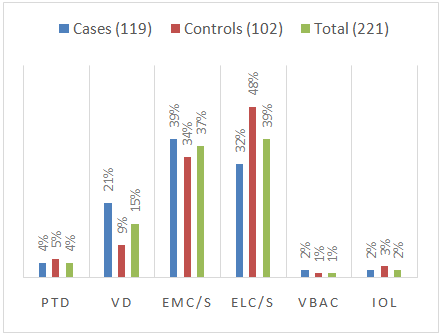
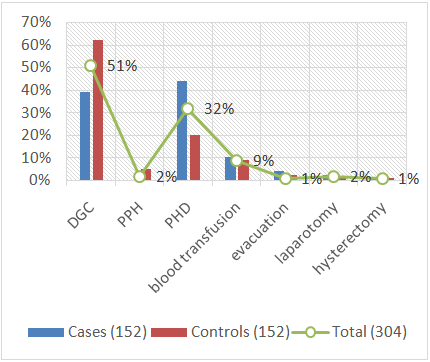
Table 3 and Figure 4 and Figure 5 summarize the distribution of the study subjects by their mood of delivery and maternal outcomes among both case and control groups. 87/221 (39.3%) of the participants underwent elective caesarean section, including 38/119 (31.9%) cases and 49/102 (48%) controls. Approximately 82/221 (37.1%) underwent emergency caesarean section, including 47/119 (39.4%) cases and 35/102 (34.3%) controls. Around 34/221 (15.3%) vaginal deliveries at term, with 25/119 (21% cases) and 9/102 (8.8%) controls. Furthermore, there were 10/221 (4.5%) preterm deliveries, with 5/119 (4.2%) cases and 5/102 (4.9%) controls. Approximately half of the patients, 154/304 (50.6%), were discharged home in good condition, with 60/152 (39.4%) cases and 94/152 (61.8%) controls. Among the 98/304 (32.2%) participants who required prolonged hospitalization, 67/152 (44%) were cases and 31/152 (20.3%) were controls. Of the 29/304 (9.5%) patients who received blood transfusions, 15/152 (9.8%) were cases and 14/152 (9.2%) were controls. Approximately 9/304 (2.9%) of the study group experienced evacuation of returning products, including 6/152 (3.9%) cases and 3/152 (1.9%) controls. Only 7/152 (4.6%) of the cases experience postpartum hemorrhage. Approximately 5/304 (1.6%) underwent laparotomy, with 3/152 (1.9%) cases and 2/152 (1.3%) controls.


Elevated levels of the five heavy metals, namely lead (pb), cadmium (cd), arsenic (as), mercury (hg), and arsenic (ac), have been found to be correlated with a notable rise in the occurrence of various maternal complications, including Preeclampsia (PE), hypertension, preterm pre-labor rupture of membranes (PPROM), and eclampsia. Additionally, these elevated levels are associated with an increased risk of miscarriage and the development of fetal congenital malformations such as neural tube defects (NTD) 9, 10. The rapid growth of traditional gold mining in Sudan has led to a growing concern about the contamination of the soil with mercury. This issue has been studied in the areas of artisanal gold mining in River Nile state (Dar-Mali locality), located north of Atbara. The findings indicate that the levels of mercury in the areas where gold is extracted are 29 times higher compared to the overall world soil 11.
The majority of the participants in this study were young women in the age groups of 21-30, with 48.6% from the case group and 50.6% from the control group. Additionally, 63.8% of the participants from the case group and 67.1% from the control group were from rural regions. The predominant demographic within the study cohorts consisted of individuals who were multiparous, accounting for 65.7% of the case group and 63.8% of the control group.
The majority of the study populations had positive previous pregnancy outcomes, with healthy babies (62.3%). However, there were a few individuals (10%) from the case group and (9.4%) from the control group who had experienced intrauterine fetal death. There were no significant statistical differences between these groups. Additionally, 8.3% of the case group had a history of miscarriage. The aforementioned findings are substantiated by the research, which has determined that elevated concentrations of heavy metals are correlated with an increased susceptibility to spontaneous miscarriages among women residing in Sudan 10, 12. Nevertheless, the assertion put forth lacks substantiation from the empirical investigation conducted in select African nations pertaining to the correlation between mild to moderate lead intoxication and the occurrence of spontaneous abortion 13. The average gestational age (GA) at presentation was 34 weeks for the case group and 32 weeks for the control group. It is worth noting that a small percentage of the case group (9%) presented with a GA less than 26 weeks, which is significantly lower compared to the control group (17.9%). This discrepancy may be attributed to the control group's easier access to hospitals. The prevailing mood during delivery was Elective C/S (ELC/S) for 48% of the control group and 31.9% of the case group. Conversely, emergency C/S (EMC/S) was observed in 39.4% of the case group and 34.3% of the control group. The data reveals that approximately 21% of the cases and 8.8% of the controls experienced spontaneous vaginal delivery at full term, while 4.2% of the case group concluded their pregnancy prematurely. Approximately 50.6% of the participants were discharged in good condition (39.4%) from the case group, while 61.8% from the control group. However, a significantly higher percentage of the case participants (44%), compared to the control group (20.3%), required prolonged hospital admission. A subset of individuals, specifically 9.8%, were administered a blood transfusion, while the remaining 9.2% were assigned to the control group. The occurrence of (3.9%) resulted in the evacuation of regenerated reproductive products from the case group, while (1.9%) occurred within the control group. The findings of this study diverge from those conducted in Nigeria, wherein an elevated blood lead level was observed to significantly elevate the occurrence of miscarriage by approximately 41.61% 11.
Traditional gold mining in Sudan poses significant health risks to humans, particularly to pregnant women. Community intervention is necessary to safeguard individuals in traditional gold mining regions, with a special focus on pregnant women.
Authors would like to thank people at Obs&GYN. teaching hospital, El-Obeid, for their help in data collection. Our thanks extend to the volunteers for offering their time and participation.
Nawal: Conceptualization, Data curation, Formal Analysis, Writing – original draft Resources.
Manahil: Data curation, Resources, Writing – original draft.
Hala: Methodology, Conceptualization.
Ahmed: Conceptualization, Resources Mohammed: Formal Analysis
Hussain: Conceptualization, Validation Writing – review & editing.
Funding: This work has been funded by MRCC. Grant number: MRCC0003.
Conflict of interest: Authors declare that no conflict of interest.
Data Availability: Data regarding this research is available and can be requested from the corresponding authors.
| [1] | Liu H, Li Z, Xie L, Jing G, Liang W, He J, Dang Y. The Relationship Between Heavy Metals and Missed Abortion: Using Mediation of Serum Hormones. Biol Trace Elem Res. 2023. | ||
| In article | View Article PubMed | ||
| [2] | He J, Pu Y, Du Y, Liu H, Wang X, He S, Ai S, Dang Y. An exploratory study on the association of multiple metals in serum with preeclampsia. Front Public Health. 2024; 12: 1336188. | ||
| In article | View Article PubMed | ||
| [3] | Shen L, Liang C, Li D, Zhang Z, Wang X, Jiang T, Su X, Yin T, Zou W, Wang X, Liu Y, Liang D, Wei Z, Cao Y, Ji D. The association between exposure to multiple toxic metals and the risk of endometriosis: Evidence from the results of blood and follicular fluid. Sci Total Environ. 2023; 855: 158882. | ||
| In article | View Article PubMed | ||
| [4] | Chamani S, Mobasheri L, Rostami Z, Zare I, Naghizadeh A, Mostafavi E. Heavy metals in contact dermatitis: A review. J Trace Elem Med Biol. 2023; 79: 127240. | ||
| In article | View Article PubMed | ||
| [5] | Parida L, Patel TN. Systemic impact of heavy metals and their role in cancer development: a review. Environ Monit Assess. 2023; 195(6): 766. | ||
| In article | View Article PubMed | ||
| [6] | Eaves LA, Choi G, Hall E, Sillé FCM, Fry RC, Buckley JP, Keil AP. Prenatal Exposure to Toxic Metals and Neural Tube Defects: A Systematic Review of the Epidemiologic Evidence. Environ Health Perspect. 2023; 131(8): 86002. | ||
| In article | View Article PubMed | ||
| [7] | Zinia SS, Yang KH, Lee EJ, Lim MN, Kim J, Kim WJ; Ko-CHENS Study group. Effects of heavy metal exposure during pregnancy on birth outcomes. Sci Rep. 2023; 13(1): 18990. | ||
| In article | View Article PubMed | ||
| [8] | Berky AJ, Weinhouse C, Vissoci J, Rivera N, Ortiz EJ, Navio S, Miranda JJ, Mallipudi A, Fixen E, Hsu-Kim H, Pan WK. In Utero Exposure to Metals and Birth Outcomes in an Artisanal and Small-Scale Gold Mining Birth Cohort in Madre de Dios, Peru. Environ Health Perspect. 2023; 131(9): 97008. | ||
| In article | View Article PubMed | ||
| [9] | Adam KhM, Abdaltam SA, Noreldeen AM, Alseed WA, Relationship between Maternal Blood Lead, Cadmium, and Zinc Levels and Spontaneous Abortion in Sudanese Women, Public Health Research 2015; 5 (6): 171-176. | ||
| In article | |||
| [10] | Mohamed AA, Mohammed Ahmed AA, Osman OA, Ebrahim EHM, Ahmed SAH, Mohamed EBS, Abibdall II, Ibrahim AMH, Mohmed EAH, Ismail MEB, Abogooda AE, Masroub AAD, Ahmed HG. Common motives of admission of pregnant ladies from traditionally gold mining areas in Sudan. Medical Research Updates 2024; 2(1): 10-22. | ||
| In article | |||
| [11] | Ali M, Elhagwa A, Elfaki J. An investigation of mercury distribution in the soils around gold mining area at Dar-Mali locality, river Nile State, Sudan. Eurasian Journal of Soil Science 2018; 7(4), 365-372. | ||
| In article | View Article | ||
| [12] | Michael, T., Kohn, E., Daniel, S. et al. Prenatal exposure to heavy metal mixtures and anthropometric birth outcomes: a cross-sectional study. Environ Health 2022; 21: 139. | ||
| In article | View Article PubMed | ||
| [13] | Amadi CN, Igweze ZN, Orisakwe OE, Heavy metals in miscarriages and stillbirths in developing nations Middle East Fertility Society Journal 2017; 22(2): 91-100. | ||
| In article | View Article | ||
Published with license by Science and Education Publishing, Copyright © 2024 Nawal Ali Ahmed Mohamed, Manahil Ibrahim Ismail Shogar, Hala Ibrahim Mohammed, Ahmed Abdelkerim Ahmed Abdallah, Mohammed Adam Mohammed Ali1 and Hussain Gadelkarim Ahmed
 This work is licensed under a Creative Commons Attribution 4.0 International License. To view a copy of this license, visit
https://creativecommons.org/licenses/by/4.0/
This work is licensed under a Creative Commons Attribution 4.0 International License. To view a copy of this license, visit
https://creativecommons.org/licenses/by/4.0/
| [1] | Liu H, Li Z, Xie L, Jing G, Liang W, He J, Dang Y. The Relationship Between Heavy Metals and Missed Abortion: Using Mediation of Serum Hormones. Biol Trace Elem Res. 2023. | ||
| In article | View Article PubMed | ||
| [2] | He J, Pu Y, Du Y, Liu H, Wang X, He S, Ai S, Dang Y. An exploratory study on the association of multiple metals in serum with preeclampsia. Front Public Health. 2024; 12: 1336188. | ||
| In article | View Article PubMed | ||
| [3] | Shen L, Liang C, Li D, Zhang Z, Wang X, Jiang T, Su X, Yin T, Zou W, Wang X, Liu Y, Liang D, Wei Z, Cao Y, Ji D. The association between exposure to multiple toxic metals and the risk of endometriosis: Evidence from the results of blood and follicular fluid. Sci Total Environ. 2023; 855: 158882. | ||
| In article | View Article PubMed | ||
| [4] | Chamani S, Mobasheri L, Rostami Z, Zare I, Naghizadeh A, Mostafavi E. Heavy metals in contact dermatitis: A review. J Trace Elem Med Biol. 2023; 79: 127240. | ||
| In article | View Article PubMed | ||
| [5] | Parida L, Patel TN. Systemic impact of heavy metals and their role in cancer development: a review. Environ Monit Assess. 2023; 195(6): 766. | ||
| In article | View Article PubMed | ||
| [6] | Eaves LA, Choi G, Hall E, Sillé FCM, Fry RC, Buckley JP, Keil AP. Prenatal Exposure to Toxic Metals and Neural Tube Defects: A Systematic Review of the Epidemiologic Evidence. Environ Health Perspect. 2023; 131(8): 86002. | ||
| In article | View Article PubMed | ||
| [7] | Zinia SS, Yang KH, Lee EJ, Lim MN, Kim J, Kim WJ; Ko-CHENS Study group. Effects of heavy metal exposure during pregnancy on birth outcomes. Sci Rep. 2023; 13(1): 18990. | ||
| In article | View Article PubMed | ||
| [8] | Berky AJ, Weinhouse C, Vissoci J, Rivera N, Ortiz EJ, Navio S, Miranda JJ, Mallipudi A, Fixen E, Hsu-Kim H, Pan WK. In Utero Exposure to Metals and Birth Outcomes in an Artisanal and Small-Scale Gold Mining Birth Cohort in Madre de Dios, Peru. Environ Health Perspect. 2023; 131(9): 97008. | ||
| In article | View Article PubMed | ||
| [9] | Adam KhM, Abdaltam SA, Noreldeen AM, Alseed WA, Relationship between Maternal Blood Lead, Cadmium, and Zinc Levels and Spontaneous Abortion in Sudanese Women, Public Health Research 2015; 5 (6): 171-176. | ||
| In article | |||
| [10] | Mohamed AA, Mohammed Ahmed AA, Osman OA, Ebrahim EHM, Ahmed SAH, Mohamed EBS, Abibdall II, Ibrahim AMH, Mohmed EAH, Ismail MEB, Abogooda AE, Masroub AAD, Ahmed HG. Common motives of admission of pregnant ladies from traditionally gold mining areas in Sudan. Medical Research Updates 2024; 2(1): 10-22. | ||
| In article | |||
| [11] | Ali M, Elhagwa A, Elfaki J. An investigation of mercury distribution in the soils around gold mining area at Dar-Mali locality, river Nile State, Sudan. Eurasian Journal of Soil Science 2018; 7(4), 365-372. | ||
| In article | View Article | ||
| [12] | Michael, T., Kohn, E., Daniel, S. et al. Prenatal exposure to heavy metal mixtures and anthropometric birth outcomes: a cross-sectional study. Environ Health 2022; 21: 139. | ||
| In article | View Article PubMed | ||
| [13] | Amadi CN, Igweze ZN, Orisakwe OE, Heavy metals in miscarriages and stillbirths in developing nations Middle East Fertility Society Journal 2017; 22(2): 91-100. | ||
| In article | View Article | ||