This study investigates the mechanical and thermal performance of eco-concretes reinforced with plant fibers, specifically Typha and date palm. Comparative analysis reveals that while compressive strengths remain comparable at moderate fiber contents (5–10%), a significant degradation is observed at higher dosages (15–20%), with values falling within the 4 to 2 MPa range. Typha-based concrete generally exhibits lower mechanical strength than date palm concrete, due to its higher flexibility and porous structure, which limit load transfer efficiency between binder and fibers. Conversely, date palm fibers, with greater rigidity and coarser granulometry, ensure superior compactness and adhesion, resulting in enhanced mechanical performance at equivalent dosage. At the same time, the incorporation of these fibers as partial sand replacements improves the thermal properties of the composites without compromising binder setting. Regarding thermal performance, Typha exhibits higher insulating capacity than date palm, reaching a conductivity of 0.28 W.m⁻¹.K⁻¹ compared to 0.31 W.m⁻¹.K⁻¹ at 20% fiber content. The findings demonstrate a direct correlation between physical and mechanical properties: reductions in density, associated with increased porosity and entrapped air, lead to diminished compressive strength. Overall, the results confirm that the performance of plant-based concretes is strongly dependent on fiber morphology, distribution, and interaction with the cementitious matrix, underscoring the need for optimized formulations to balance thermal efficiency and mechanical reliability.
Global climate change has reached a critical intensification in recent decades, with scientific consensus linking the majority of environmental shifts to anthropogenic carbon dioxide emissions and resultant global warming 1, 2, 3. Failure to restrict this warming to within the 1.5°C or 2.0°C threshold above pre-industrial levels presents a substantial risk of disrupting the climate stability that has historically facilitated human survival and economic prosperity 4, 5, 6. Long-term changes in temperature and weather patterns are primarily driven by human activities. In the context of the Paris Agreement, the international community has acknowledged that achieving complete decarbonisation by 2050 is necessary to ensure global warming remains below the 1.5°C threshold 7, 8.
The building and construction sector occupies a central role in this environmental crisis, as it is recognized as one of the largest energy consumers and contributors to global greenhouse gas emissions 7. Also the rapid urban growth has led the construction sector to consume nearly 6 billion tons of natural coarse aggregates each year for concrete production 9. Consequently, this intensive extraction places strong pressure on natural resources and poses a serious environmental concern. It is estimated that activities in the construction industry contribute about 38.6% of worldwide carbon emissions 10. Furthermore, buildings account for approximately 34% of global energy demand and nearly 34% of energy-related carbon dioxide emissions 7. This environmental burden is exacerbated by a steadily expanding global population and rising standards of living, which have led to a significant increase in energy consumption and waste generation. Between 2022 and 2023 alone, global building floor space is estimated to have increased by five billion square meters, reflecting a continued annual growth of 2.2%. Urbanization trends, particularly in emerging and developing economies, suggest that more than half of new construction occurs without applicable building energy codes, further jeopardizing international climate targets 7.
Concrete continues to be the most commonly used material in construction worldwide, with annual production surpassing 10 billion tons 11, 12. This massive production is coupled with an equally immense demand for ordinary Portland cement, which serves as the primary binding agent. However, cement production is responsible for approximately 7% to 8% of total global carbon dioxide emissions 13. Beyond emissions, the industry consumes roughly 10 billion tons of sand and natural rock annually, leading to the rapid depletion of natural aggregate resources 14. The extraction of virgin aggregates from riverbeds and quarries contributes to irreversible habitat destruction, landscape degradation, and deforestation.
In response to these challenges, the development of sustainable construction materials has emerged as a critical pathway to reducing the environmental footprint of the built environment.
Traditional insulation materials for buildings have remained largely unchanged for decades, with many presenting environmental and health concerns. With growing efforts to enhance energy efficiency, the use of insulating materials is projected to increase.
Sustainable construction emphasizes the integration of eco-friendly practices, such as the partial replacement of portland cement with supplementary cementitious materials including fly ash, ground granulated blast-furnace slag, silica fume, and metakaolin. Studies indicate that substituting 70% of cement with ground granulated blast-furnace slag can lower emissions by up to 47%, while 15% silica fume replacement can achieve a 12% reduction 15. Furthermore, circular economy principles advocate for the valorisation of industrial by-products and biomass residues, which can be reused to minimize landfill disposal and conserve natural resources 16. Bio composites, which combine natural reinforcements like bamboo, hemp, or agricultural residues with biodegradable or mineral matrices, offer additional benefits such as carbon sequestration. For example, one square meter of hemp concrete can sequester up to 35 kg of CO2 over a 100-year lifespan 17. A wide range of lignocellulosic aggregates has been explored for use in the production of bio-based concretes 11, 18, 19, 20, 21, 22, 23.
The mechanical performance of these sustainable materials is a primary focus for researchers seeking to replace traditional structural components. Traditional bio-based concretes, such as hemp-lime concrete, typically exhibit relatively low compressive strengths, which limits their application to non-load-bearing insulation or infill walls 24, 25, 26, 27. The mechanical response of bio-based materials is often characterized as elastoplastic, featuring three distinct phases: a linear quasi-elastic phase, a stress-hardening or plateau phase where voids and cells collapse, and an ultimate densification phase 28. According to Bouloc et al., the limited compressive strength of Hemp-lime concrete arises from the poor alignment of shives, the flexible nature of the aggregates under load, and their high porosity. Similar mechanisms are likely present in concretes incorporating rice husk, wood chips, sunflower stems, flax shives and corn cobs 29.
The influence of plant fibers on compressive strength is twofold. On one hand, when they are incorporated as coarse aggregates into conventional cementitious matrix, mechanical performance tends to decline with higher fiber content, mainly due to increased porosity and greater water demand 30, 31. On the other hand, advances in binder technology (such as bio-polymers) and in chemical valorisation approaches (including pozzolanic ashes) show that plant-based resources can act as genuine reinforcing agents, capable of enabling durable, low-carbon structural concretes 1, 32.
This complexity underscores the need for optimized mix design to balance mechanical performance and environmental sustainability.
Thermal performance is another vital attribute of sustainable construction materials, particularly for energy-efficient building envelopes 14. Natural fiber waste materials and bio-based composites consistently achieve low thermal conductivities, typically below 0.1 W/m.K, confirming their potential to replace synthetic insulators 33. Specifically, composites fabricated from date trunk fibers and non-edible okra bio-binders have demonstrated thermal conductivity values ranging between 0.051 and 0.067 W/m.K. reflects effective heat storage and thermal inertia 28. Mohsin et al. produced a high-performance, environmentally friendly insulating material using date-palm surface fibers combined with polyvinyl alcohol as the binding agent. The resulting composite exhibited very favourable thermal behaviour, achieving thermal conductivity values in the range of 0.038 to 0.051 W/m·K 34. in another study Mohamed et al. developed sustainable insulating composites using date-palm surface fibers and pineapple-leaf fibers bonded with a wood-based adhesive. The fabricated materials showed promising thermal performance, with thermal conductivity values ranging from 0.042 to 0.075 W/(m·K) 35.
This thermal conductivity is crucial for moderating indoor temperature fluctuations in arid climates, thereby reducing primary energy consumption. Furthermore, thermal properties are influenced physical characteristics, including bulk density, porosity, and water absorption, govern the macroscopic behaviour and long-term durability of sustainable concrete. Bio-aggregates such as hemp shives, sunflower pith, and rapeseed straw are characterized by high intrinsic porosity and substantial water absorption capacities. Biomass aggregates can exhibit water absorption rates reaching more than 100% within ten minutes, highlighting a porous microstructure that significantly affects water demand. The incorporation of these fines leads to a progressive increase in open porosity. While higher porosity generally improves thermal insulation, it often correlates with a decrease in bulk density and mechanical strength.
Despite significant progress in the characterization of individual bio-aggregates like Bamboo, hemp and meniscus, a critical research gap persists regarding the synergy between uncommon agricultural residues. In particular, the potential of the date palm (Phoenix dactylifera) as a feedstock for structural composites remains underexplored. While preliminary studies have investigated date palm wood waste as filler in polyester matrices, there is a lack of comprehensive data on completely bio-derived composites using locally abundant residues. Furthermore, the application of natural-fiber composites, including those derived from Typha, remains limited to non-structural insulation, with insufficient research addressing the simultaneous optimization of flow ability, rapid strength gain, and long-term durability in specialized structural systems.
Based on the existing literature, we notice that there is an urgent need for large-scale validation of biobased materials under real-world climatic conditions to transition them from laboratory settings to mainstream industrial implementation, that’s why we are motivated in this article to provide an in-depth overview of vegetable concrete, emphasizing their wide range of properties and relevance within the construction field. It clarifies the concept of biobased concrete, the motivations for its use, and the principal characteristics that make it attractive, particularly for residential building applications. The paper reviews both the benefits and constraints of the material and analyses how different fibres affect their mechanical performance. Particular attention is devoted to essential aspects such as density, mechanical strength, thermal and absorption behaviour, and importantly, its environmental impact. Drawing on previous research, recommendations are proposed for improving the compressive strength of fiber concrete so that it can evolve from a complementary building material into one capable of serving as a structural, load-bearing solution. The outcomes of this investigation provide a foundation for developing eco-efficient building envelopes and partition panels that align with the objectives of a circular economy while reducing the carbon footprint of the building sector.
The materials used in this study included ordinary Portland cement, natural sand, plant-based fibers, and water. A Portland cement CEM II/A-L 42.5 R, complying with EN 197-1 requirements, was employed as the binder.. Natural plant fibers consisted of Typha a. and date palm fibers. Typha plants, characterized by green stems approximately 2.5 m in height and 6–12 mm in diameter with elongated leaves, were collected in the area of Ndiawdone in northern Senegal, while date palm fibers were sourced from Atar (Mauritania). Both fibrous materials were mechanically ground using an electric grinder to obtain fibers suitable for incorporation into the cementitious matrix. The fine aggregate was classified as fine sand based on sieve analysis. The particle size distributions of sand, Typha, and date palm granular aggregates are presented in Figure 5. Standard tap water was used for all mixtures. The presentation of the materials' proportions in mixtures is provided in Table 1.
The compressive strength was evaluated on cylindrical specimens (16 × 32 cm) in accordance with the NF EN 12390-3 standard. The tests were carried out using a Forney Testing Machine 36 equipped with a hydraulic loading system with a maximum capacity of 180 kN. The maximum load sustained by each specimen prior to failure was recorded and used to calculate the compressive strength. For each concrete formulation, three specimens were tested to ensure the reproducibility of the results. Compressive strength measurements were performed at different curing ages after unmolding (7, 14, 28, and 56 days) in order to assess the strength development of the plant-based fiber-reinforced concrete over time.
Thermal properties of the composites were determined using the hot plane method to measure thermal conductivity and thermal effusivity. The experimental setup consisted of a thin heating element positioned between the test specimen and a 5 cm thick polystyrene insulation layer, enclosed by two aluminium blocks with a thickness of 4 cm each. The specimens had a parallelepiped geometry with dimensions of 10 × 10 × 2 cm³. Heat transfer was assumed to be one-dimensional, and constant temperature conditions were imposed at the aluminium boundaries. Data analysis was performed using the thermal quadrupole method 37, in which the governing heat transfer equations are transformed into the Laplace domain, allowing the thermal response to be expressed as a function of spatial variables only.
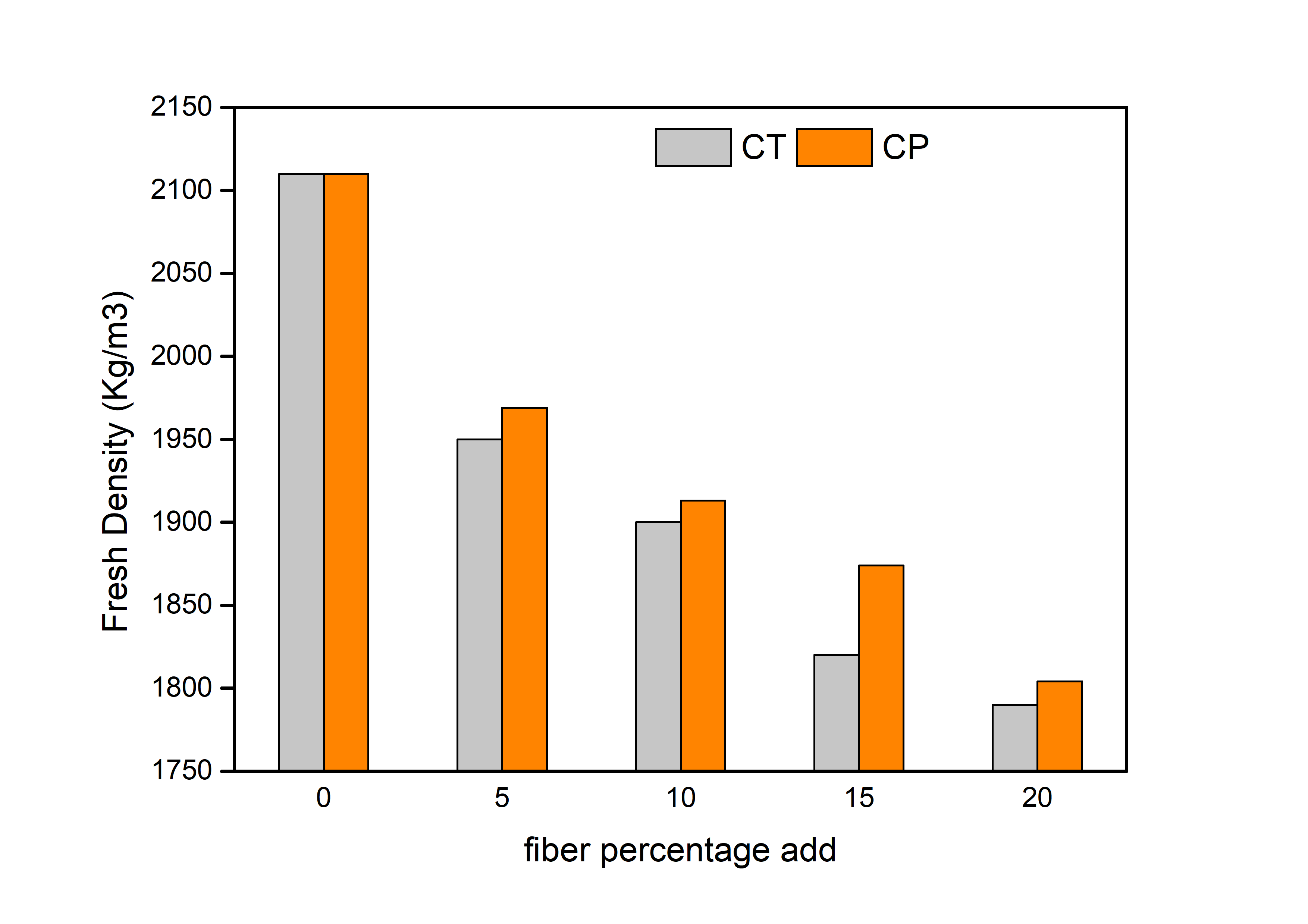
The fresh density of the bio-based concretes was evaluated using the measured mass and volume of the specimens. These measurements were taken right after unmoulding. In doing so, we aimed to examine how the incorporation level of Typha and date palm fibers affects the material properties. The reported values correspond to the mean of three specimens for each mixture. The results are shown in Figure 1. The decrease is gradual. However, it is slightly more pronounced between 0 and 5% fiber incorporation. This trend reflects the low intrinsic density of the date palm fibers. Moreover, it is linked to the increase in porosity at the fiber–cement and fiber–sand interfaces.
The results show a decrease in material density as the fiber content increases. A similar behavior is observed with Typha fibers. Moreover, the analysis in Table 2 shows that the gradual addition of date palm fibers lowers the wet density from 2102 kg/m³ to 1804 kg/m³. This corresponds to a total reduction of about 14% for the mix with 20% fibers. However, the fluctuations observed between successive mixes do not allow a clear assessment of the specific effect of the 5% increment. In the case of Typha, the wet density decreases from 2110 kg/m³ to 1790 kg/m³, giving a total reduction of 15%. The initial drop (0–5%) is the most significant. Therefore, it shows a direct effect of fiber content on the compactness of the composite and the development of internal porosity. Both materials show a similar downward trend. However, the density of the Typha-based composite becomes lower than that of the date palm composite from 5% incorporation onward. This difference can be linked to the more porous and elongated morphology of Typha fibers, which promotes a less compact matrix and a larger amount of interconnected voids. Previous studies when white rice husk ash and pulp fibers were incorporated into the specimens, a decrease in density was observed by Hamzeh and al. 38. Also Sivakumaresa Chockalingam and al. 39 noted that as the percentage of coconut fiber increased, there was a decrease in the fresh density of the concrete.

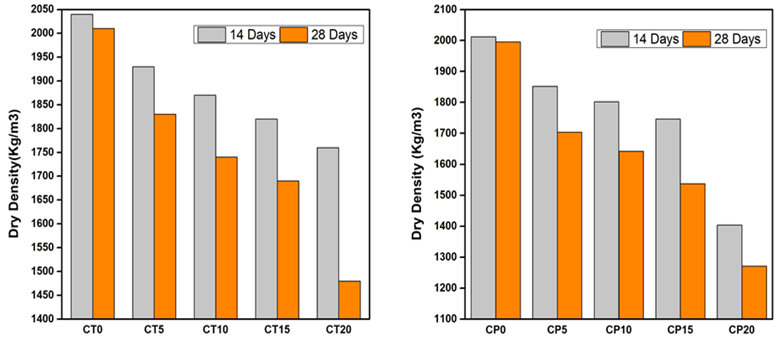
Figure 2 presents the average dry density values measured after multiple days of curing for the concretes made with date palm and Typha fibers. These results illustrate the effect of fiber incorporation on the dry density of the eco-materials. In general, the addition of plant fibers leads to a decrease in density, regardless of the type of fiber used. For the date palm concrete, the dry density decreases from 2012 kg/m³ for the reference mix to 1404 kg/m³ when the fiber content reaches 20%. This drop, which exceeds 30%, is mainly linked to the cellular structure and the low intrinsic density of the date palm fibers. Consequently, these characteristics increase porosity within the cement matrix. Moreover, the incorporation of fibers promotes the formation of porous interfacial zones caused by entrapped air during mixing, which further reduces the apparent density after all days. These findings align with previous studies 40, 41, 42, 43 that have explored the vegetal fibers in cementitious materials.
It also appears that the effect of incorporation is more pronounced for date palm fibers than for Typha fibers. Although this behaviour reflects a slight loss of compactness, it remains advantageous in applications where reducing the self-weight of the structure is desirable.
The difference in behaviour between date palm and Typha fibers becomes noticeable from 10% incorporation. Date palm fibers, being finer and more elongated, are therefore more numerous for the same added volume. This multiplication of fiber–matrix interfaces promotes the formation of interconnected voids and increases the overall porosity of the composite. In contrast, Typha fibers, which are denser and have a less developed surface, create a more compact internal structure, resulting in a higher final density.
Porosity, defined as the fraction of voids relative to the total volume of a porous material, represents the volume of air contained per unit volume of material and is generally expressed as a percentage. The addition of fibers into concrete reduces density at all ages while increasing porosity. This phenomenon explains the density variations observed between Typha and date palm reinforced concretes and the reference samples.
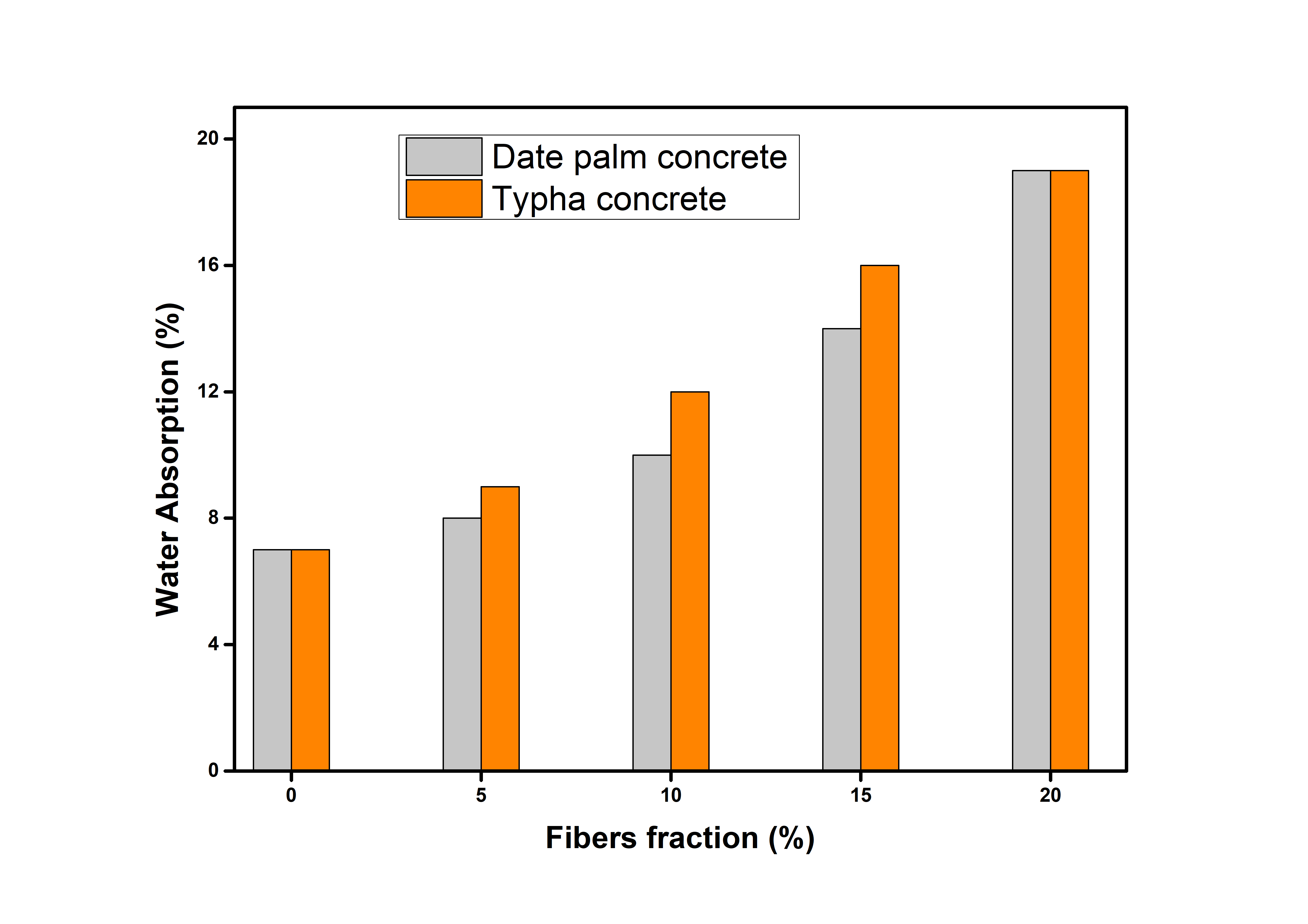
Water absorption of the composites was measured, and the results are shown in Figure 3. This figure highlights the effect of date palm and Typha fiber content on the water behaviour of the bio-based concretes. Increasing the amount of plant particles led to higher water absorption, which is a direct consequence of the increased porosity. A similar trend was observed with Typha fibers. Moreover, no proportional relationship could be established between a 5% fiber addition and the variations in absorption values.

These results show a continuous increase in water absorption as the date palm fiber content rises. Increasing the fiber content from 0% to 20% leads to an overall rise of more than 175%. This trend reflects the effect of the partial substitution of sand by lightweight fibers, whose cellulosic structure promotes water absorption and capillary retention within the fibers, and consequently throughout the concrete. The most significant increase is observed between 10% and 15% fiber content, indicating a threshold where pore connectivity becomes significant. This assertion is in concurrence with the discoveries previously documented in the literature works by various investigators 41, 44, 45.

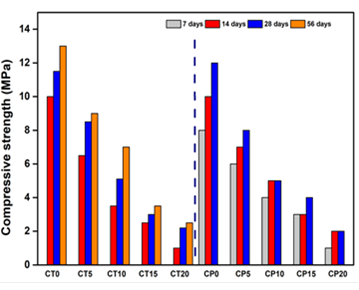
Figure 4 presents the compressive strength values measured after 14 days of curing for concretes containing date palm and Typha fibers. These results highlight the effect of plant fiber content on the mechanical behavior of the bio-based concretes, particularly on the stiffness and internal cohesion of the material.
For the date palm concrete, the compressive strength at 14 days decreases from 10 MPa for CP0 to 2 MPa when the fiber content increases from 0% to 20%. This gradual loss of mechanical performance, amounting to approximately 80%, can be explained by several physical factors. On one hand, the addition of plant fibers modifies the internal structure of the concrete by increasing total porosity and reducing the compactness of the cement matrix. On the other hand, the low density and cellular structure of date palm fibers promote the formation of voids and pores during mixing. These porous zones at the fiber–sand and fiber–binder interfaces locally weaken adhesion and reduce the transmission of stresses, leading to a notable decrease in compressive strength for the date palm concrete.
A similar trend was observed for Typha concrete: the strength decreases from 10 MPa for the reference mix to 1 MPa at 20% fiber content. The reduction is slightly higher but of the same order of magnitude as for date palm. This difference can be attributed to the finer particle size and more flexible morphology of Typha fibers, which result in less homogeneous dispersion and partial binder coating. Moreover, the internal cellulosic structure of Typha fibers can absorb part of the mixing water, locally altering the water-to-binder ratio and increasing open porosity. These combined effects reduce the stiffness and internal cohesion of the plant-based concrete. This behavior is also consistent with previous research, which attributes the reduction in strength to the combined effects of interfacial porosity, low compactness, and heterogeneous fiber dispersion within the cement matrix.

From a microstructural perspective, the decrease in compressive strength is related to the balance between the reinforcing effect of the fibers and the creation of discontinuities within the cement matrix. When the fiber content is low (5%), the fibers can contribute to a slight bridging effect. In contrast, beyond the 10% fiber threshold, the loss of cohesion due to the accumulation of air and pores becomes dominant, causing a rapid reduction in load-bearing capacity. These results confirm that compressive strength is inversely related to total porosity and the amount of entrapped air, in full agreement with observations reported in the literature 40, 46.
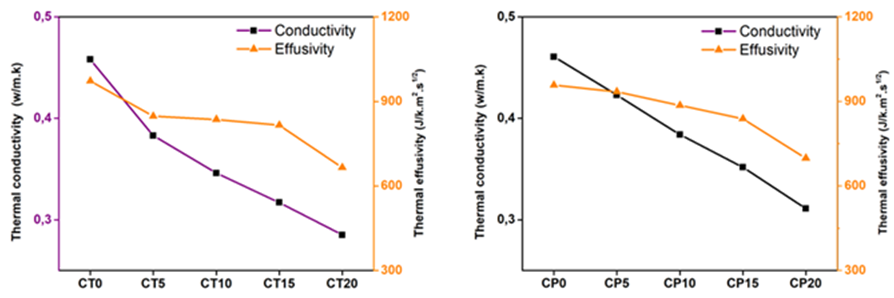
3.5. Thermal PropertiesFigure 5 shows the combined variations of thermal conductivity and thermal effusivity as a function of plant fiber content for two types of bio-based concretes: date palm and Typha. These two thermal properties, which are directly related to the material’s density and overall porosity, help to understand the insulating performance of the composites studied in this work. For the date palm concrete, thermal conductivity decreases significantly as the fiber content increases, dropping from 0.46 W/m.K to 0.31 W/m.K between 0% and 20% addition. Thermal effusivity follows the same trend, decreasing from approximately 958 J.K⁻¹.m⁻².s⁻½ to 699 J.K⁻¹·m⁻².s⁻½. This simultaneous reduction indicates improved insulating performance of the date palm concrete, which is linked to the increase in open porosity and the reduction in density. The structure of the date palm fibers, combined with their low intrinsic density, leads to a more heterogeneous distribution of pores, including entrapped air volumes that reduce the material’s ability to transmit heat.
In the case of Typha concrete, the results show a similar trend, thermal conductivity decreases from 0.46 W/m.K to 0.28 W/m.K, while thermal effusivity drops from 972 to 665 J.K⁻¹.m⁻².s⁻½ as the fiber content increases. However, the decline is slightly less pronounced than for date palm concrete. This difference is attributed to the coarser particle size, which ensures greater internal compactness and better fiber–matrix cohesion. The porous structure of date palm fibers allows a higher proportion of trapped air, resulting in slightly higher conductivity at equivalent fiber content. This behavior is consistent with previous observations on density and mechanical strength reducing the bulk density improves insulating performance but comes at the cost of decreased stiffness and internal cohesion. These findings align with the observations reported in the literature by 47, 48, 49.
This research endeavour was undertaken with the objective of exploring the viability of integrating Typha fibers and date palm fibers into concrete formulations. The primary focus was to evaluate the influence of such incorporation on the physical characteristics, mechanical performance, and thermo physical properties of the resulting bio-materials buildings. Another objective regarding the environment by replacing sand by natural fiber for producing lightweight concrete was achieved. Through the incorporation of these two natural fibers fibers, this study aimed to investigate the potential for enhancing the properties of fiber concrete while simultaneously promoting the utilization of renewable and sustainable resources. The following conclusions can be drawn based on the test results and discussions:
The incorporation of Typha fibers into concrete (20%) resulted in a significant weight reduction compared to the reference concrete without Typha.
The incorporation of Date palm fibers into concrete (20%) resulted in a significant weight reduction compared to the reference concrete without Date palm.
This decrease in weight is a valuable attribute, particularly for applications that necessitate the use of lightweight building materials.
The incorporation of Typha and date palm aggregates into concrete formulations resulted in an increase in the water absorption coefficient of the composite material. This finding suggests that the addition of natural fibers aggregates enhances the capacity of the concrete to absorb and retain moisture.
As the content of fibers aggregates increased in the concrete mixture, there was a corresponding decrease in the compressive strength of the resulting fiber concrete. This reduction in compressive strength can be attributed to the porous of the Typha and date palm introduced into the mixture, which contributed to an overall increase in porosity within the composite material.
The integration of Typha and Date palm fibers into concrete formulations resulted in a substantial enhancement of their thermal insulation properties, as evidenced by a significantly reduced thermal conductivity value. This remarkable improvement in thermal performance renders these fibers incorporated concrete highly suitable for applications that necessitate effective thermal insulation, such as in building envelopes or temperature-sensitive structures, where minimizing heat transfer and maximizing energy efficiency are objectives.
The heading of the Acknowledgment section and the References section must not be numbered.
| [1] | Sajid MA, Khan MI, Khan I, Almutairi OE. Design and optimization of eco-friendly cement grout modified with bagasse ash and nano-silica for semi-flexible pavements using RSM. Constr Build Mater 2026; 507: 144988. | ||
| In article | View Article | ||
| [2] | Bandeira Barros L, Knockaert M, Tenório Filho JR. Towards a more sustainable construction industry: Bridging the gap between technical progress and commercialization of self-healing concrete. Constr Build Mater 2023; 403: 133094. | ||
| In article | View Article | ||
| [3] | Why The Built Environment – Architecture 2030 n.d. https://www.architecture2030.org/why-the-built-environment/ (accessed January 7, 2026). | ||
| In article | |||
| [4] | Hoegh-Guldberg O, Jacob D, Taylor M, Guillén Bolaños T, Bindi M, Brown S, et al. The human imperative of stabilizing global climate change at 1.5°C. Science 2019; 365: eaaw6974. | ||
| In article | View Article PubMed | ||
| [5] | Kharin VV, Flato GM, Zhang X, Gillett NP, Zwiers F, Anderson KJ. Risks from Climate Extremes Change Differently from 1.5°C to 2.0°C Depending on Rarity. Earths Future 2018; 6: 704–15. | ||
| In article | View Article | ||
| [6] | Su B, Huang J, Fischer T, Wang Y, Kundzewicz ZW, Zhai J, et al. Drought losses in China might double between the 1.5°C and 2.0°C warming. Proc Natl Acad Sci 2018; 115: 10600–5. | ||
| In article | View Article PubMed | ||
| [7] | Global Status Report for Buildings and Construction 2024/2025. Available online: https://globalabc.org/sites/default/files/2025-03/Global-Status-Report-2024_2025.pdf (accessed on 08 January 2026). n.d. | ||
| In article | |||
| [8] | Renewables 2024 – Analysis. IEA 2024. https:// www.iea.org/ reports/renewables-2024 (accessed January 7, 2026). | ||
| In article | |||
| [9] | Mohanta NR, Murmu M. Alternative coarse aggregate for sustainable and eco-friendly concrete-A review. J Build Eng 2022; 59: 105079. | ||
| In article | View Article | ||
| [10] | Crawford RH. Greenhouse Gas Emissions of Global Construction Industries. IOP Conf Ser Mater Sci Eng 2022; 1218: 012047. | ||
| In article | View Article | ||
| [11] | Barbhuiya S, Das BB. A comprehensive review on the use of hemp in concrete. Constr Build Mater 2022; 41: 127857. | ||
| In article | View Article | ||
| [12] | Chinnu SN, Minnu SN, Bahurudeen A, Senthilkumar R. Recycling of industrial and agricultural wastes as alternative coarse aggregates: A step towards cleaner production of concrete. Constr Build Mater 2021; 287: 123056. | ||
| In article | View Article | ||
| [13] | El Hajjar M, Bourgerie S, Belayachi N. Prediction of the Development of Microorganisms on Biocomposites Based on Plant Aggregates, 2023. | ||
| In article | View Article | ||
| [14] | Afsoosbiria H, Machowska A. Development of Sustainable Concrete Using By-Products as a Green Material, and Potential Solutions for Sustainability in Mass Concrete Construction—Comprehensive Review. Sustainability 2025; 7: 9983. | ||
| In article | View Article | ||
| [15] | Kumar A, Bheel N, Ahmed I, Rizvi SH, Kumar R, Jhatial AA. Effect of silica fume and fly ash as cementitious material on hardened properties and embodied carbon of roller compacted concrete. Environ Sci Pollut Res 2021; 29: 1210–22. | ||
| In article | View Article PubMed | ||
| [16] | Oppon JA, Adinyira E, Agyekum K. A bibliometric review of agricultural waste as coarse aggregates in sustainable concrete. Discov Civ Eng 2025; 2: 127. | ||
| In article | View Article | ||
| [17] | Boutin MP, Flamin C, Quinton S, Gosse G. Etude des caractéristiques environnementales du chanvre par l’analyse de son cycle de vie. Ministère L’agriculture Pêche Fr 2006; 102. | ||
| In article | |||
| [18] | Elhaj-Maham EM, Diouf B, Ly EHB, Manga M. Study of the Physic-Mechanical Properties of a Typha Concrete Composites: A Possible New Material for Sustainable Construction. Mater Sci Forum 2024; 1122: 121–31. | ||
| In article | View Article | ||
| [19] | Nozahic V, Amziane S, Torrent G, Saïdi K, De Baynast H. Design of green concrete made of plant-derived aggregates and a pumice–lime binder. Cem Concr Compos 2012; 34: 231–41. | ||
| In article | View Article | ||
| [20] | Ali B, Azab M, Ahmed H, Kurda R, El Ouni MH, Elhag AB. Investigation of physical, strength, and ductility characteristics of concrete reinforced with banana (Musaceae) stem fiber. J Build Eng 2022; 61: 105024. | ||
| In article | View Article | ||
| [21] | Ratsimbazafy HH, Laborel-Préneron A, Magniont C, Evon P. A review of the multi-physical characteristics of plant aggregates and their effects on the properties of plant-based concrete. Recent Prog Mater 2021; 3: 1–69. | ||
| In article | View Article | ||
| [22] | Ahmad MR, Chen B, Haque MA, Ali Shah SF. Development of a sustainable and innovant hygrothermal bio-composite featuring the enhanced mechanical properties. J Clean Prod 2019; 229: 128–43. | ||
| In article | View Article | ||
| [23] | Guo Y, Zhang J, Lakhiar MT, Wang J. Eco-friendly cement mortar production using rice husk ash and oyster seashell powder: A comprehensive study of mechanical, durability and life cycle properties. Constr Build Mater 2025; 481: 141590. | ||
| In article | View Article | ||
| [24] | Arnaud L, Gourlay E. Experimental study of parameters influencing mechanical properties of hemp concretes. Constr Build Mater 2012; 28: 50–6. | ||
| In article | View Article | ||
| [25] | Gross C, Walker P. Racking performance of timber studwork and hemp-lime walling. Constr Build Mater 2014; 66: 429–35. | ||
| In article | View Article | ||
| [26] | Giroudon M, Laborel-Préneron A, Aubert J-E, Magniont C. Comparison of barley and lavender straws as bioaggregates in earth bricks. Constr Build Mater 2019; 202: 254–65. | ||
| In article | View Article | ||
| [27] | Tronet P, Lecompte T, Picandet V, Baley C. Study of lime hemp concrete (LHC) – Mix design, casting process and mechanical behaviour. Cem Concr Compos 2016; 67: 60–72. | ||
| In article | View Article | ||
| [28] | ElHassan A, Abu-Jdayil B, Ahmed W. Thermal and mechanical characteristics of natural fiber-reinforced composites using bio-binder as sustainable insulation materials. Int J Thermofluids 2025; 30: 101507. | ||
| In article | View Article | ||
| [29] | Bouloc P. Le chanvre industriel: production et utilisations. France Agricole Editions; 2006. | ||
| In article | |||
| [30] | El Hajjar M, Haddad B, Alassaad F. Valorization of biomass ash fines as a cementitious addition: Effects on the microstructural, mechanical, and thermal properties of mortars. Biomass Futur 2026; 1: 100012. | ||
| In article | View Article | ||
| [31] | Ahmad W, McCormack SJ, Byrne A. Biocomposites for sustainable construction: A review of material properties, applications, research gaps, and contribution to circular economy. J Build Eng 2025; 105: 112525. | ||
| In article | View Article | ||
| [32] | Bardouh R, Toussaint E, Amziane S, Marceau S. Mechanical behavior of bio-based concrete under various loadings and factors affecting its mechanical properties at the composite scale: A state-of-the-art review. Clean Eng Technol 2024; 23: 100819. | ||
| In article | View Article | ||
| [33] | Raza M, Farhan A, Abu-Jdayil B. Lignocellulose−based insulation materials: A review of sustainable and biodegradable solutions for energy efficiency. Int J Thermofluids 2024; 24: 10084. | ||
| In article | View Article | ||
| [34] | Raza M, Abdallah HA, Abdullah A, Abu-Jdayil B. Date Palm Surface Fibers for Green Thermal Insulation. Buildings 2022; 12: 866. | ||
| In article | View Article | ||
| [35] | Ali M, Al-Suhaibani Z, Almuzaiqer R, Albahbooh A, Al-Salem K, Nuhait A. New Composites Derived from the Natural Fiber Polymers of Discarded Date Palm Surface and Pineapple Leaf Fibers for Thermal Insulation and Sound Absorption. Polymers 2024; 16: 1002. | ||
| In article | View Article PubMed | ||
| [36] | Machine Finder. Forney Online n.d. https:// forneyonline.com/ machine-finder/ (accessed September 22, 2025). | ||
| In article | |||
| [37] | Maillet D. Thermal quadrupoles: solving the heat equation through integral transforms. No Title 2000. | ||
| In article | |||
| [38] | Hamzeh Y, Ziabari KP, Torkaman J, Ashori A, Jafari M. Study on the effects of white rice husk ash and fibrous materials additions on some properties of fiber–cement composites. J Environ Manage 2013; 117: 263–7. | ||
| In article | View Article PubMed | ||
| [39] | Sivakumaresa Chockalingam LN, Rymond NM. Strength and Durability Characteristics of Coir, Kenaf and Polypropylene Fibers Reinforced High Performance Concrete. J Nat Fibers 2022; 19: 6692–700. | ||
| In article | View Article | ||
| [40] | Chen Y, Yu QL, Brouwers HJH. Acoustic performance and microstructural analysis of bio-based lightweight concrete containing miscanthus. Constr Build Mater 2017; 157: 839–51. | ||
| In article | View Article | ||
| [41] | Wu F, Yu Q, Brouwers HJH. Long-term performance of bio-based miscanthus mortar. Constr Build Mater 2022; 324: 126703. | ||
| In article | View Article | ||
| [42] | Alsalami ZHA. Study the effect of partially replacement sand by waste pistachio shells in cement mortar. Appl Adhes Sci 2017; 5: 19. | ||
| In article | View Article | ||
| [43] | Dias PP, Waldmann D. Optimisation of the mechanical properties of Miscanthus lightweight concrete. Constr Build Mater 2020; 258: 119643. | ||
| In article | View Article | ||
| [44] | Traore YB, Messan A, Hannawi K, Gerard J, Prince W, Tsobnang F. Effect of oil palm shell treatment on the physical and mechanical properties of lightweight concrete. Constr Build Mater 2018; 161: 452–60. | ||
| In article | View Article | ||
| [45] | Olanipekun EA, Olusola KO, Ata O. A comparative study of concrete properties using coconut shell and palm kernel shell as coarse aggregates. Build Environ 2006; 41: 297–301. | ||
| In article | View Article | ||
| [46] | Yusra A, Triwulan T, Safriani M, Ikhsan M. Use of bamboo fiber on the relationship between compressive strength and split tensile strength of high strength concrete. IOP Conf. Ser. Mater. Sci. Eng., vol. 933, IOP Publishing; 2020, p. 012010. | ||
| In article | View Article | ||
| [47] | Ashour T, Wieland H, Georg H, Bockisch F-J, Wu W. The influence of natural reinforcement fibres on insulation values of earth plaster for straw bale buildings. Mater Des 2010; 31: 4676–85. | ||
| In article | View Article | ||
| [48] | Haba B, Agoudjil B, Boudenne A, Benzarti K. Hygric properties and thermal conductivity of a new insulation material for building based on date palm concrete. Constr Build Mater 2017; 154: 963–71. | ||
| In article | View Article | ||
| [49] | Panesar DK, Shindman B. The mechanical, transport and thermal properties of mortar and concrete containing waste cork. Cem Concr Compos 2012; 34: 982–92. | ||
| In article | View Article | ||
Published with license by Science and Education Publishing, Copyright © 2026 El Moustapha Elhaj-Maham, Babacar Diouf and Elhadji Babacar Ly
 This work is licensed under a Creative Commons Attribution 4.0 International License. To view a copy of this license, visit
http://creativecommons.org/licenses/by/4.0/
This work is licensed under a Creative Commons Attribution 4.0 International License. To view a copy of this license, visit
http://creativecommons.org/licenses/by/4.0/
| [1] | Sajid MA, Khan MI, Khan I, Almutairi OE. Design and optimization of eco-friendly cement grout modified with bagasse ash and nano-silica for semi-flexible pavements using RSM. Constr Build Mater 2026; 507: 144988. | ||
| In article | View Article | ||
| [2] | Bandeira Barros L, Knockaert M, Tenório Filho JR. Towards a more sustainable construction industry: Bridging the gap between technical progress and commercialization of self-healing concrete. Constr Build Mater 2023; 403: 133094. | ||
| In article | View Article | ||
| [3] | Why The Built Environment – Architecture 2030 n.d. https://www.architecture2030.org/why-the-built-environment/ (accessed January 7, 2026). | ||
| In article | |||
| [4] | Hoegh-Guldberg O, Jacob D, Taylor M, Guillén Bolaños T, Bindi M, Brown S, et al. The human imperative of stabilizing global climate change at 1.5°C. Science 2019; 365: eaaw6974. | ||
| In article | View Article PubMed | ||
| [5] | Kharin VV, Flato GM, Zhang X, Gillett NP, Zwiers F, Anderson KJ. Risks from Climate Extremes Change Differently from 1.5°C to 2.0°C Depending on Rarity. Earths Future 2018; 6: 704–15. | ||
| In article | View Article | ||
| [6] | Su B, Huang J, Fischer T, Wang Y, Kundzewicz ZW, Zhai J, et al. Drought losses in China might double between the 1.5°C and 2.0°C warming. Proc Natl Acad Sci 2018; 115: 10600–5. | ||
| In article | View Article PubMed | ||
| [7] | Global Status Report for Buildings and Construction 2024/2025. Available online: https://globalabc.org/sites/default/files/2025-03/Global-Status-Report-2024_2025.pdf (accessed on 08 January 2026). n.d. | ||
| In article | |||
| [8] | Renewables 2024 – Analysis. IEA 2024. https:// www.iea.org/ reports/renewables-2024 (accessed January 7, 2026). | ||
| In article | |||
| [9] | Mohanta NR, Murmu M. Alternative coarse aggregate for sustainable and eco-friendly concrete-A review. J Build Eng 2022; 59: 105079. | ||
| In article | View Article | ||
| [10] | Crawford RH. Greenhouse Gas Emissions of Global Construction Industries. IOP Conf Ser Mater Sci Eng 2022; 1218: 012047. | ||
| In article | View Article | ||
| [11] | Barbhuiya S, Das BB. A comprehensive review on the use of hemp in concrete. Constr Build Mater 2022; 41: 127857. | ||
| In article | View Article | ||
| [12] | Chinnu SN, Minnu SN, Bahurudeen A, Senthilkumar R. Recycling of industrial and agricultural wastes as alternative coarse aggregates: A step towards cleaner production of concrete. Constr Build Mater 2021; 287: 123056. | ||
| In article | View Article | ||
| [13] | El Hajjar M, Bourgerie S, Belayachi N. Prediction of the Development of Microorganisms on Biocomposites Based on Plant Aggregates, 2023. | ||
| In article | View Article | ||
| [14] | Afsoosbiria H, Machowska A. Development of Sustainable Concrete Using By-Products as a Green Material, and Potential Solutions for Sustainability in Mass Concrete Construction—Comprehensive Review. Sustainability 2025; 7: 9983. | ||
| In article | View Article | ||
| [15] | Kumar A, Bheel N, Ahmed I, Rizvi SH, Kumar R, Jhatial AA. Effect of silica fume and fly ash as cementitious material on hardened properties and embodied carbon of roller compacted concrete. Environ Sci Pollut Res 2021; 29: 1210–22. | ||
| In article | View Article PubMed | ||
| [16] | Oppon JA, Adinyira E, Agyekum K. A bibliometric review of agricultural waste as coarse aggregates in sustainable concrete. Discov Civ Eng 2025; 2: 127. | ||
| In article | View Article | ||
| [17] | Boutin MP, Flamin C, Quinton S, Gosse G. Etude des caractéristiques environnementales du chanvre par l’analyse de son cycle de vie. Ministère L’agriculture Pêche Fr 2006; 102. | ||
| In article | |||
| [18] | Elhaj-Maham EM, Diouf B, Ly EHB, Manga M. Study of the Physic-Mechanical Properties of a Typha Concrete Composites: A Possible New Material for Sustainable Construction. Mater Sci Forum 2024; 1122: 121–31. | ||
| In article | View Article | ||
| [19] | Nozahic V, Amziane S, Torrent G, Saïdi K, De Baynast H. Design of green concrete made of plant-derived aggregates and a pumice–lime binder. Cem Concr Compos 2012; 34: 231–41. | ||
| In article | View Article | ||
| [20] | Ali B, Azab M, Ahmed H, Kurda R, El Ouni MH, Elhag AB. Investigation of physical, strength, and ductility characteristics of concrete reinforced with banana (Musaceae) stem fiber. J Build Eng 2022; 61: 105024. | ||
| In article | View Article | ||
| [21] | Ratsimbazafy HH, Laborel-Préneron A, Magniont C, Evon P. A review of the multi-physical characteristics of plant aggregates and their effects on the properties of plant-based concrete. Recent Prog Mater 2021; 3: 1–69. | ||
| In article | View Article | ||
| [22] | Ahmad MR, Chen B, Haque MA, Ali Shah SF. Development of a sustainable and innovant hygrothermal bio-composite featuring the enhanced mechanical properties. J Clean Prod 2019; 229: 128–43. | ||
| In article | View Article | ||
| [23] | Guo Y, Zhang J, Lakhiar MT, Wang J. Eco-friendly cement mortar production using rice husk ash and oyster seashell powder: A comprehensive study of mechanical, durability and life cycle properties. Constr Build Mater 2025; 481: 141590. | ||
| In article | View Article | ||
| [24] | Arnaud L, Gourlay E. Experimental study of parameters influencing mechanical properties of hemp concretes. Constr Build Mater 2012; 28: 50–6. | ||
| In article | View Article | ||
| [25] | Gross C, Walker P. Racking performance of timber studwork and hemp-lime walling. Constr Build Mater 2014; 66: 429–35. | ||
| In article | View Article | ||
| [26] | Giroudon M, Laborel-Préneron A, Aubert J-E, Magniont C. Comparison of barley and lavender straws as bioaggregates in earth bricks. Constr Build Mater 2019; 202: 254–65. | ||
| In article | View Article | ||
| [27] | Tronet P, Lecompte T, Picandet V, Baley C. Study of lime hemp concrete (LHC) – Mix design, casting process and mechanical behaviour. Cem Concr Compos 2016; 67: 60–72. | ||
| In article | View Article | ||
| [28] | ElHassan A, Abu-Jdayil B, Ahmed W. Thermal and mechanical characteristics of natural fiber-reinforced composites using bio-binder as sustainable insulation materials. Int J Thermofluids 2025; 30: 101507. | ||
| In article | View Article | ||
| [29] | Bouloc P. Le chanvre industriel: production et utilisations. France Agricole Editions; 2006. | ||
| In article | |||
| [30] | El Hajjar M, Haddad B, Alassaad F. Valorization of biomass ash fines as a cementitious addition: Effects on the microstructural, mechanical, and thermal properties of mortars. Biomass Futur 2026; 1: 100012. | ||
| In article | View Article | ||
| [31] | Ahmad W, McCormack SJ, Byrne A. Biocomposites for sustainable construction: A review of material properties, applications, research gaps, and contribution to circular economy. J Build Eng 2025; 105: 112525. | ||
| In article | View Article | ||
| [32] | Bardouh R, Toussaint E, Amziane S, Marceau S. Mechanical behavior of bio-based concrete under various loadings and factors affecting its mechanical properties at the composite scale: A state-of-the-art review. Clean Eng Technol 2024; 23: 100819. | ||
| In article | View Article | ||
| [33] | Raza M, Farhan A, Abu-Jdayil B. Lignocellulose−based insulation materials: A review of sustainable and biodegradable solutions for energy efficiency. Int J Thermofluids 2024; 24: 10084. | ||
| In article | View Article | ||
| [34] | Raza M, Abdallah HA, Abdullah A, Abu-Jdayil B. Date Palm Surface Fibers for Green Thermal Insulation. Buildings 2022; 12: 866. | ||
| In article | View Article | ||
| [35] | Ali M, Al-Suhaibani Z, Almuzaiqer R, Albahbooh A, Al-Salem K, Nuhait A. New Composites Derived from the Natural Fiber Polymers of Discarded Date Palm Surface and Pineapple Leaf Fibers for Thermal Insulation and Sound Absorption. Polymers 2024; 16: 1002. | ||
| In article | View Article PubMed | ||
| [36] | Machine Finder. Forney Online n.d. https:// forneyonline.com/ machine-finder/ (accessed September 22, 2025). | ||
| In article | |||
| [37] | Maillet D. Thermal quadrupoles: solving the heat equation through integral transforms. No Title 2000. | ||
| In article | |||
| [38] | Hamzeh Y, Ziabari KP, Torkaman J, Ashori A, Jafari M. Study on the effects of white rice husk ash and fibrous materials additions on some properties of fiber–cement composites. J Environ Manage 2013; 117: 263–7. | ||
| In article | View Article PubMed | ||
| [39] | Sivakumaresa Chockalingam LN, Rymond NM. Strength and Durability Characteristics of Coir, Kenaf and Polypropylene Fibers Reinforced High Performance Concrete. J Nat Fibers 2022; 19: 6692–700. | ||
| In article | View Article | ||
| [40] | Chen Y, Yu QL, Brouwers HJH. Acoustic performance and microstructural analysis of bio-based lightweight concrete containing miscanthus. Constr Build Mater 2017; 157: 839–51. | ||
| In article | View Article | ||
| [41] | Wu F, Yu Q, Brouwers HJH. Long-term performance of bio-based miscanthus mortar. Constr Build Mater 2022; 324: 126703. | ||
| In article | View Article | ||
| [42] | Alsalami ZHA. Study the effect of partially replacement sand by waste pistachio shells in cement mortar. Appl Adhes Sci 2017; 5: 19. | ||
| In article | View Article | ||
| [43] | Dias PP, Waldmann D. Optimisation of the mechanical properties of Miscanthus lightweight concrete. Constr Build Mater 2020; 258: 119643. | ||
| In article | View Article | ||
| [44] | Traore YB, Messan A, Hannawi K, Gerard J, Prince W, Tsobnang F. Effect of oil palm shell treatment on the physical and mechanical properties of lightweight concrete. Constr Build Mater 2018; 161: 452–60. | ||
| In article | View Article | ||
| [45] | Olanipekun EA, Olusola KO, Ata O. A comparative study of concrete properties using coconut shell and palm kernel shell as coarse aggregates. Build Environ 2006; 41: 297–301. | ||
| In article | View Article | ||
| [46] | Yusra A, Triwulan T, Safriani M, Ikhsan M. Use of bamboo fiber on the relationship between compressive strength and split tensile strength of high strength concrete. IOP Conf. Ser. Mater. Sci. Eng., vol. 933, IOP Publishing; 2020, p. 012010. | ||
| In article | View Article | ||
| [47] | Ashour T, Wieland H, Georg H, Bockisch F-J, Wu W. The influence of natural reinforcement fibres on insulation values of earth plaster for straw bale buildings. Mater Des 2010; 31: 4676–85. | ||
| In article | View Article | ||
| [48] | Haba B, Agoudjil B, Boudenne A, Benzarti K. Hygric properties and thermal conductivity of a new insulation material for building based on date palm concrete. Constr Build Mater 2017; 154: 963–71. | ||
| In article | View Article | ||
| [49] | Panesar DK, Shindman B. The mechanical, transport and thermal properties of mortar and concrete containing waste cork. Cem Concr Compos 2012; 34: 982–92. | ||
| In article | View Article | ||