sciepub.com
 Quick Submission

Study of Haptoglobin Phenotypes in Sudanese Diabetic Patients
Nafisa M. Osman1, , Hind A. Gasim Elseed2, Atif A. Elagib1, 2
1Sudan Academy of Sciences, Council of Biological Sciences, New technology and Enviroments, Tropical Medcine Program Khartoum, Sudan
2Tropical Medicine Research Institute, National Cenre for Research
Abstract
In this case – control study conducted during the period from February 2013 to January 2015, Haptoglobin phenotypes in diabetes patients has been investigated in 300 type 2 diabetic patients and 100 non diabetic healthy controls in Sudan. The samples were obtained from Elmotakmel diabetic center in Omdurman, Sudan and were categorized by their haptoglobin phenotypes using Polyacrylamide gel electrophoresis. The result of the study showed no significant difference in the distribution of haptoglobin phenotypes. Diabetic patients with Hp 2-2 phenotype tend to had highest fasting blood glucose levels and lower hemoglobin levels.
Keywords: Haptoglobin Phenotypes; Diabetic
Copyright © 2016 Science and Education Publishing. All Rights Reserved.Cite this article:
- Nafisa M. Osman, Hind A. Gasim Elseed, Atif A. Elagib. Study of Haptoglobin Phenotypes in Sudanese Diabetic Patients. American Journal of Microbiological Research. Vol. 4, No. 2, 2016, pp 61-63. http://pubs.sciepub.com/ajmr/4/2/3
- Osman, Nafisa M., Hind A. Gasim Elseed, and Atif A. Elagib. "Study of Haptoglobin Phenotypes in Sudanese Diabetic Patients." American Journal of Microbiological Research 4.2 (2016): 61-63.
- Osman, N. M. , Elseed, H. A. G. , & Elagib, A. A. (2016). Study of Haptoglobin Phenotypes in Sudanese Diabetic Patients. American Journal of Microbiological Research, 4(2), 61-63.
- Osman, Nafisa M., Hind A. Gasim Elseed, and Atif A. Elagib. "Study of Haptoglobin Phenotypes in Sudanese Diabetic Patients." American Journal of Microbiological Research 4, no. 2 (2016): 61-63.
| Import into BibTeX | Import into EndNote | Import into RefMan | Import into RefWorks |
At a glance: Figures
1. Introduction
Haptoglobin is aplasma glycoproteins. It is a positive acute phase protein that binds free hemoglobin forming hemoglobin-haptoglobin (Hb Hp) stable Complex. This complex is then removed by macrophage via cell-surface receptor (CD163). Haptoglobin can thus prevent tissue damage caused by free hemoglobin and reduce iron loss in hemolytic conditions. From a clinical perspective, haptoglobin is one of the most important of hemolytic anemia [8]. Haptoglobin binds to free hemoglobin with extremely high affinity (kd = 1×10-15 mol/L), probably the highest in nature [9]. Hemoglobin is the richest source of iron in the body and removes it from the circulation to prevent kidney injury and iron loss following hemolysis. Also, by binding free hemoglobin, haptoglobin functions as an antioxidant. In addition, Haptoglobin acts as a potent immunosuppressor of lymphocyte function and modulates the helper T-cell type1 and type 2 (Th1/Th2) balance within the body [2].
In addition haptoglobin can inhibit prostaglandin synthesis and is believed to have anti-inflammatory and antioxidant properties in the body. Haptoglobin is present in the serum of all mammals, but polymorphism is found only in humans [3].
Diabetes is a major worldwide health problem, and long-term diabetic vascular complications are the leading cause of morbidity and mortality (DCCT, 1993). The generation of reactive oxygen species has an important role in the development of diabetic vascular complications [10]. Hp1-1 protects against vascular complications in diabetes owing to its higher antioxidant activity [11]. Haptoglobin can be used as an independent predictor of coronary vascular disorders in diabetes mellitus. In a study, people with diabetes with Hp 2-2 showed 5 times more coronary artery disease than those with Hp1-1. It is assumed that in people with coronary stenos is, the presence of Hp 2-2 predicts a poor prognosis compared with those with other haptoglobin phenotypes. On the other hand, Hp 1-1 seems to protect against rest enosis after coronary artery stent implantation in people with diabetes.
2. Materials and Method
2.1. Study Area and PopulationThis study was conducted in El motakmel diabetic center –Omdurman, Sudan. The clinical diagnosis of diabetes mellitus has been done according to the criteria of the world health organization, (1999). All participants gave informed consent for utilization of their blood samples in this study child and pregnant women were exempted.
2.2. Sample Size and CollectionA case control study designed to examine the relationship between haptoglobin, and diabetes disease. A total of 300 diabetic individuals including males and females in the age >40 years and sex matching healthy controls were examined. All the patients and healthy controls have undergone fasting over night till the time of blood collection. Three ml of venous blood were collected in heparinized vacutainer. The samples were kept on ice and centrifuged for 15 minutes then the plasma was a liquidated into storage vials and stored at –70 oC until analysis and haptoglobin electrophoresis for phenotypes.
2.3. MethodFasting Blood Glucose was determined using enzymatic oxidation in the presence of glucose oxidase (GOD) [1].
The glucose is oxidized to D.glucose by the glucose oxidase (GOD) with the formation of hydrogen peroxides. In the presence of peroxides (POD), a mixture of phenol and 4.aminoantipyrin (4.A.A) is oxidized by hydrogen peroxides to form a red quinoneimine dye, proportional to the glucose in the sample.
Mono tea gents, phosphate buffer 100 mmol/L, PH 7.5, glucose oxidase >10 ML, Peroxidase > 2 µ/L, 4 – aminaoantitipyrin 0.5 mmoL/L, phenol 5 mmol/l. Glucose standard: Glucose 100 mg/dl.
The concentration of glucose was calculated using the formula: -
 |
Where:
(AT) = Absorbance of test
(AS)= Absorbance of standard
2.4. Haptoglobin Phenotyping
 Download as
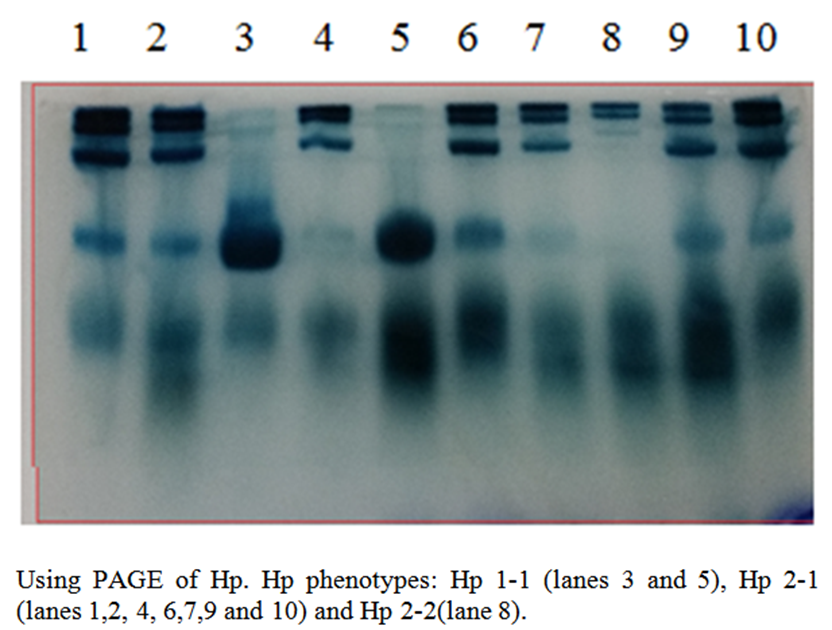
Polycarylamide gel electrophoresis separation was used for Haptoglobin phenotypes according to Linke 1986 methods. In brief 6 µl plasma samples were incubated with 1 µl erythrocyte haemolysate and mixed with 6µl loading buffer (few crystals of bromophenol blue in 40% sucrose solution). Then 8µl from the mixture were loaded to the gel. Then separated electrophoretically at 200 Volatage according to according Davis [5] method. Then stained with benzidine solution. The bands were then observed for Hp phenotyping. The phenotypic types of haptoglobin were identified by the following features (Figure 1): In Hp 1-1 phenotype, there is a band close to free hemoglobin which corresponds to the Hp bands that in Hp 1-1 type and multiple fine bands that are more catholic like in Hp2-2, but with greater distance between them. The last band in this series is not fainter than the preceeding band as observed in the Hp2-2-In Hp2-2 phenotype, from the free hemoglobin band; there are multiple cathodic bands which are fine and closer to one another. Further, the faster moving band among the multiple bands appears fainter than its preceding bands.
2.5. Statistical AnalysisResults collected from diabetics with or without complications, and non-diabetics (control) were presented as percentages and the mean ± SEM (standard error of the mean) on a table.
2.6. Data AnalysisData gained from this study were analyzed using the chi (x2) - square test and a nova test were used to evaluate association between categorical variables. All clinical data were collected through a questionnaire.
3. Results
The result in this study, the haptoglobin phenotypes of 300 diabetic patients and 100 healthy controls were determined using the Polyacrylamide gel electrophoresis separating plasma supplemented with followed by Benzedine staining. Hp phenotype patterns obtained in this study is presented in Figure 1, Table 1.
Frequencies of Haptoglobin phenotypes in diabetes mellitus and healthy controls:
Of the 300 patients, 61.40% had the haptoglobin Hp 2-1 phenotype, 21.6% had the Hp1-1 phenotype and 17.0% had the haptoglobin Hp 2-2.
Of the 100 healthy controls, 63% had Hp 2-1 phenotype, 20% had Hp 1-1 phenotype and 17% had Hp 2-2 phenotype. There was no significant difference in the distribution of haptoglobin phenotypes between the diabetic patients and the healthy controls. As shown in Table 1.





Relation between glucose level and haptoglobin phenotypes:
The fasting blood glucose levels tend to be higher in Hp2-2 diabetic patients and lower hemoglobin levels.
Haptoglobin phenotypes in diabetic patients according to gender:
There was no relation between sex and haptoglobin distribution among diabetic or


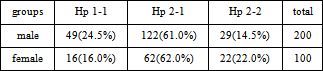


Table 3. Mean level of glucose and hemoglobin (Hb) in different types of Hp phenotypes in diabetic and healthy control

 in different types of Hp phenotypes in diabetic and healthy control)


4. Discussions
The results of the study showed that no significant association was found between haptoglobin phenotypes and type 2 diabetic in Sudan. These studies suggested that the prevalence of diabetes mellitus was haptoglobin phenotype independent. The finding of this study may depend on the population analyzed and parameters investigated. It highlights the role of genetic and ethnic variation in determining susceptibility to type 2diabetes.
The study agreed with Awadallah and Hamad, 2000, suggests that the prevalence of diabetes is independed of Hp phenotypes in Jordanians.
Controversy Amiri et al., 2013 in Iran found there was an association of Hp phenotypes Hp 2-2 with diabetes mellitus Quaye et al 2006 found that haptoglobin phenotypes 2-2 is a risk factor for type 2 diabetic in Ghana.
Also Bessa et al., 2007 found that Hp2-2 was more susceptible for development of nephropathy in Egypt.
Hamdy et al., 2014 found the Hp 2-2 was more in type 2 diabetes mellitus development of coronary artery disease in Egypt.
Adams et al., 2013 found that Hp 2-2 was high in type 2 diabetes mellitus and associated with cardiovascular diseases in USA. And with Diabatic Nepphropathy in Bengalee [20].
Acknowledgements
My gratitude is extended to my all friends, colleagues especially the staff of Elmotakamel diabetic center for their kind helps during the samples collection my thanks to Tropical medicine research institute for their contribution and to the blood donors which make it possible to achieve the planed objectives.
References
| [1] | Barham D, Trind P. 1972 An improved colour for the determination of blood glucose by oxidase system reagent. Analyst.; 97: 142-5. | ||
 In article In article | View Article | ||
| [2] | Bowman, B. 1982. Haptoglobin: evolutionary product of duplication, unequal crossing over, and point mutation. Adv. Hum. Genet. 12, 189-216, 453-454. | ||
| In article | View Article PubMed | ||
| [3] | Bowman, BH.1993 Haptoglobin. Hebtaic plasma proteins. San Deiego, Academic Press: 159-67. | ||
| In article | |||
| [4] | Carter, K. and Worwood.M. (2007). Haptogolobin: A review of the major allele frequencies worldwide and their association with diseases.IntJ Lab Hematol; 329:977-86. [PubMed: 366922. | ||
| In article | |||
| [5] | Davis BJ. Disc electrophoresis II, method and application to human serum proteins. Ann NY acad Sci. 1964; 121:404-27. | ||
| In article | View Article PubMed | ||
| [6] | Davis, B. and Orenstein, L. (1968). Disc electrophoresis, acrylamide gel columns. Methods in Immanology and Immanochemistry. Volume II(Ed. By William and Chase); p. 38 Academic Press, New York. | ||
| In article | |||
| [7] | Giblet ER. Genetic markers in human blood. Oxford: Blackwell scientific publication; 1969. | ||
| In article | |||
| [8] | JAMA. 1909 to 1911. The Predictive value of Serum Haptoglobin in Hemolytic disease; 243 (19): 1909-1911. | ||
| In article | |||
| [9] | McCormick and Atassi, 1990. Hepatic Proteins, Mechanism of Function and Regulation. El sevier. | ||
| In article | |||
| [10] | Melamed-Frank M., Lache O., Enva B., Szafrank T., Levy N., Ricklis R, 2001. Structure function analysis of the antioxidant properties of haptoglobin. Blood,98(1):3693-8. | ||
| In article | View Article PubMed | ||
| [11] | Nakhoul F, Marsh S, Hochberg I, Leibu R, Levy AP 2000.Haptoglobin phenotype and diabetic retinopathy. JAMA.; 284:1244-5. | ||
| In article | View Article PubMed | ||
| [12] | Polonovski, M. and Jayle, M.F., 1938. Existence dansle plasma humain d, une sunstance activant l, action peroxydasique de l, hemoglobin. C.R. Soc. Biol. 129, 457-461. | ||
| In article | |||
| [13] | Smithies, O., (1955). Genetic control of some serum proteins in normal humans their inheritatnce. Nature; 176. 1265-1266. | ||
| In article | View Article | ||
| [14] | Smithies O. 1955; Zone electrophoresis in starch gels: group variations in the serum proteins of normal human adults. Biochem J. 61:629-41 | ||
| In article | View Article PubMed | ||
| [15] | The DCCT Research Group. 1993. The effect of intensive diabetes treatment on the development and progression of long-term complications in insulin-dependent diabetes mellitus: the Diabetes Control and Complications Trail. N Engl. J Med 329:977-86. | ||
| In article | View Article PubMed | ||
| [16] | Awadallah S, Hamad M. . 2000 The prevalence of type 2 diabetes mellitus is Haptoglobin phenotype-independent. Cytobios; 101(398):145-50. | ||
| In article | PubMed | ||
| [17] | WHO, Diabetes Mellius. Technical Report Series. 1985; p727. | ||
| In article | |||
| [18] | Hamady G.,Hendy.O., Mahmoud H., El-sebaey A., Ali.S and Khalaf F 2014. Haptoglobin phenotypes as a risk factor for cornory artery disease in type2 diabeties mellitus: An Egptian study. The Egyptian J of Med huma gent. 15: 257-264. | ||
| In article | |||
| [19] | Quaye Ik., Ababio GR., Amoah G.2006. Haptoglobin2-2 phenotype is arik factor for type2 diabaties in Ghana. J Anthrosclero Thrombo 13(2): 90-94. | ||
| In article | View Article | ||
| [20] | Abhishikta R., Sarkar P ., bandyopadhyay 2015. Haptoglobin polymorphism and diabatic Nephropathy: Astudy among the Benglee Hindus of West Bengal. Word J Pharm Sci, 3(3):628-631. | ||
| In article | |||
| [21] | Bessa Ss., Hamady SM., Ali EM. 2007. Haptoglobin gene polymorphism in type2 diabatic patients with and without Nephropathy: anEgyptian study. Eur J Intern Med. 18(6):489-95. | ||
| In article | View Article PubMed | ||
| [22] | Amiri AA.,Hashemi-Soteh MB., Haghshenas MR., Daneshvar F., Rastegar A., Frazmand T.2013. Haptoglobin polymorphism in individuals with type2 diabatic microangiopathy. N Am J Med Sci, 5(9): 529-35. | ||
| In article | View Article PubMed | ||
| [23] | Adams J., Cox A., Freedman B., Langefeld C., Carr J., Bowden D. 2013. Genetic analysis of haptoglobin polymorphisms with cardiovascular disease and type2 diabeties heart study. Cardiovasc Diabetol 12:13. | ||
| In article | View Article PubMed | ||
 CiteULike
 Mendeley
 StumbleUpon
 Delicious
 Facebook
 Twitter
 LinkedIn