 sciepub.com
 Quick Submission

Gram Negative Super Bugs: A New Generation of ICU Infections, an Emerging Challenge for Health Care Settings
Vaibhavi Subhedar1, , Sudhir Kumar Jain2
1Consultant Microbiologist and Infection Control Incharge Bombay Hospital Indore MP India, PH.D Scholar in Microbiology Vikram University Ujjain MP India
2Reader School of Studies in Microbiology Vikram University Ujjain MP India
Abstract
Emergence of Antimicrobial resistance is a growing threat worldwide, and a major threat in India where antibiotics are readily available. The patients in Intensive care units are at 5 to 10 times more risk of acquiring hospital acquired infections due to various multi drug resistant bacterias. Gram Negative bugs are most observed in Indian ICUs, which is a major challenge for the intensivists in their clinical practice. The major mechanism of resistance in these Gram negative bacteria are the enzymes called Beta lactamases like ESBL, AmpC, and carbapenemases. The present study was undertaken to determine the spectrum of Multidrug resistant Gram negative bacteria causing infections in the ICUs and the common beta lactamases acquired by them, which were detected phenotypically and genotypically by Multiplex PCR. These findings will guide the clinicians in appropriate empirical therapy, reduce drug resistance and thus improve patient outcome.
Keywords: antimicrobial resistance, beta lactamases, intensive care units, gram negative bacteria
Copyright © 2016 Science and Education Publishing. All Rights Reserved.Cite this article:
- Vaibhavi Subhedar, Sudhir Kumar Jain. Gram Negative Super Bugs: A New Generation of ICU Infections, an Emerging Challenge for Health Care Settings. American Journal of Microbiological Research. Vol. 4, No. 1, 2016, pp 47-50. http://pubs.sciepub.com/ajmr/4/1/6
- Subhedar, Vaibhavi, and Sudhir Kumar Jain. "Gram Negative Super Bugs: A New Generation of ICU Infections, an Emerging Challenge for Health Care Settings." American Journal of Microbiological Research 4.1 (2016): 47-50.
- Subhedar, V. , & Jain, S. K. (2016). Gram Negative Super Bugs: A New Generation of ICU Infections, an Emerging Challenge for Health Care Settings. American Journal of Microbiological Research, 4(1), 47-50.
- Subhedar, Vaibhavi, and Sudhir Kumar Jain. "Gram Negative Super Bugs: A New Generation of ICU Infections, an Emerging Challenge for Health Care Settings." American Journal of Microbiological Research 4, no. 1 (2016): 47-50.
| Import into BibTeX | Import into EndNote | Import into RefMan | Import into RefWorks |
1. Introduction
Multidrug resistance has been increasing among Gram negative bacteria [8]. These MDR “superbugs” are increasingly becoming responsible for the increased morbidity and mortality particularly in hospitalised patients. The Intensive care unit is called the epicentre of infections, due to its extremely vulnerable population which are associated with severe clinical conditions along with the impaired immunity, increased risk of becoming infected through multiple procedures and use of invasive devices distorting the anatomical integrity, lapses in infection control practices and indiscriminate use of antibiotics [10, 13]. Gram negative bacteria represent the most common nosocomial isolates, primarily Pseudomonas aeruginosa, Escherichia coli, Klebsiella spp., and Acinetobacter spp. [5]. The Beta lactam antibiotics are the most commonly prescribed antibiotics in ICUs worldwide, which are favoured because of their efficacy, broad spectra and low toxicity [10]. Beta lactam antibiotics are a broad class of antibiotics consisting of agents that contain a beta lactam ring in their molecular structure. The most wide spread cause of resistance to beta lactam antibiotics is the production of enzymes called beta lactamases. The selective pressure which are generated by the indiscriminate use of the beta lactam antibiotics have led to the selection of a variety of mutated forms of beta lactamases such as the ESBLs, AmpC beta lactamases and the metallo beta lactamases which have emerged as the most worrisome resistance mechanism which poses a therapeutic challenge to the health care settings. Detection of these enzymes is highly concerned in order to prevent resistant bacteria spread and to treat the infection. At present, there are 2 groups of methods used for detection of these beta lactamases, phenotypic detection which depends on non molecular technique for enzyme detection and genotypic method which depends on molecular technique [9].
2. Aims and Objectives:
The present study will be undertaken with the following objectives:
1. To isolate and identify the Gram negative pathogenic bacteria responsible for causing infections in ICUs.
2. To characterize the isolated bacteria on the basis of standard microbiological techniques.
3. To determine the prevalence rates of multidrug resistant Gram negative bacteria in ICUs by performing the Antibiotic sensitivity testing and studying their resistance profile
4. To find out the pathogenicity and enzymatic activity of the isolated pathogenic bacteria.
5. To determine the different beta lactamases produced by the prevalent Gram negative bacteria by phenotypic methods (ESBL, AmpC, MBL and Carbapenemases) and their co-existence.
6. To detect the beta lactamase genes (ESBL, AMPc and carbapenemases) and their co-existence by genotypic methods.
3. Materials and Methods
Collection of Clinical samples: 100 clinical samples i.e. sputum, pus, Endo-tracheal secretions, urine, blood, fluids etc. were collected from the patients admitted to the Intensive Care Units in a tertiary care hospital.
Isolation and Characterization of bacteria: Isolation and characterization of pathogenic Gram negative bacteria included in the study was done using various microbiological techniques i.e., cultural, biochemical and various other techniques. (Bergey’s manual 1994, Cheesbrough 1999, Bailey and Scotts, 2010) Those Gram negative bacteria which were not identified by the routine manual methods were identified by automated VITEK-2 compact method.
Strains for the study: All the Gram negative bacterial strains isolated from the clinical specimens from the ICUs received in the Department of Microbiology, Bombay Hospital Indore within the stipulated study period were collected and subjected to various phenotypic and genotypic methods for the screening and confirmation of the beta lactamases present in the isolated Gram negative strains.
Inclusion criteria: - All the samples from the ICU’s showing Gram negative bacterial growth were included in the study. Samples with Gram negative bacterial growth from all the ICUs i.e., Medical and Surgical ICU, Neurology ICU, Neonatal ICU, Isolation or Cubical ICU and Cardiac ICU were included in the study.
Exclusion criteria: - The Gram positive bacteria, Fungal isolates, Mycobacteria isolated from the samples of the ICU’s were not included in the study. Also Gram negative bacteria isolated from specimens other than ICUs were not included in the present study.
Screening of Multidrug resistant bacteria- Resistance was identified and scrutinized with the help of various techniques i.e Biochemical, phenotypic and genotypic methods (CLSI 2014, EUCAST guidelines 2012). The Antibiotic Sensitivity Test was performed on all the isolated strains by the standard Kirby Bauer’s disc diffusion method (1967) as per the CLSI guidelines (CLSI 2014).
Phenotypic characterization:- Strains showing decreased sensitivity to ceftazidime/ cefotaxime were considered as screen positive for ESBL production and were subjected to the following confirmatory phenotypic tests-
• ESBL- A difference in the zone size of 5mm between ceftazidime and ceftazidime+ clavulanic acid and cefotaxime and cefotaxime+clavulanic acid discs was considered as confirmed ESBL producer phenotypically as per the CLSI guidelines.
Positive control strain:- Klebsiella pneumoniae ATCC 700603 ESBL positive.
Negative control strain:- E.coli ATCC 25922.
• AmpC- Strains showing high level resistance to cephalosporins including penicillin beta lactamase combinations were considered as screen positive for AmpC production. A difference in the zone size of 4mm between cefoxitin and cefoxitin + cloxacillin was considered as confirmed AmpC producer.
• Carbapenemase- Strains showing resistance to carbapenems were considered as screen positive for carbapenemase production. A positive modified hodge test
(MHT) was considered as carbapenemase producer as per the CLSI guidelines and a difference in the zone size of 7mm between Imipenem and Imienem+ EDTA disc was considered as MBL producer phenotypically [10].
Positive MHT control Strain:- Klebsiella pneumoniae ATCC BAA-1705.
Negative MHT control Strain:- Klebsiella pneumoniae ATCC BAA-1706.
Genotypic confirmation and characterization of the beta lactamase genes in selected 25 MDR Gram negative strains.Resistant genes responsible for betalactamase production were detected in selected 25 strains genotypically by Multiplex PCR. The prevalence of ESBLs and MBLs among these isolates were studied using primers, and following genes were detected;
SHV, TEM CTXM- ESBL production.
AmpC- AmpC production.
NDM, VIM and IMP - MBL production.
4. Results




 |





 |




 |



 |



5. Discussion
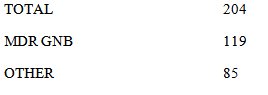
The results indicate that Gram negative bacteria isolated from the specimens of ICUs were 119 (58.33%) from the total 204 specimens received from the ICUs. The most common specimen received was ET (Endotracheal suctions) and the most common Gram negative Bacteria isolated was Klebsiella pneumoniae (50.42%), followed by Pseudomonas spp. (21.8%), Acinetobacter spp (13.44%), E.coli (10.08%), Proteus spp. and Citrobacter spp.(1.68%) and Burkholderia (0.84%) (Table 1, Table 2).
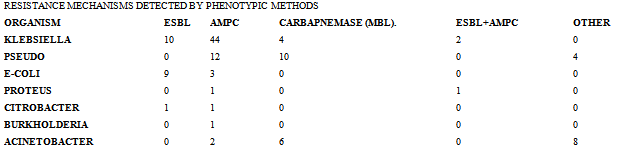
The phenotypic Resistance mechanisms detected AmpC as the most common type of beta lactamase in Klebsiella spp (73.3%) and Pseudomonas spp(46.15%). While ESBL was common beta lactamase found in E.coli (75%) which correlated with other studies (Loveena Oberoi et al.,2013).
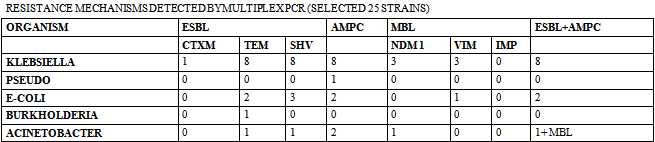
Acinetobacter spp. showed the highest rate of multidrug resistance, wherein 37.5%(6) strains were MBL producing while 12.5%(2) strains were AmpC producing while in rest 50% strains no phenotypic resistance mechanism was detected indicating some other mechanism of drug resistance like efflux which correlated with other studies [2, 6]. However the genotyping by multiplex PCR showed presence of ESBL (TEM and SHV) genes along with NDM-1 and AmpC genes in the provided Acinetobacter spp.
From the selected 25 strains sent for genotypic detection by Multiplex PCR, 17 strains (68%) showed presence of resistance genes (Table 5). 11 (44%) strains showed a coexistence of more than one type of resistant gene.
6. Conclusion
The study indicated an alarming increase in the rate of MDR Gram negative superbugs in ICUs thus increasing the morbidity, mortality and additional cost to the hospital. Constant evaluation on the following criterias should be done in order to curb this alarming situation.
1) We are entering POST ANTIBIOTIC ERA.
2) Conservation of drugs should be on priority.
3) Indiscriminate use of antibiotics should be avoided.
4) Epidemiological microbiological surveillance should be routinely done.
5) Antibiotic Stewardship should be practiced. Formulation and appropriate use of Antibiotic Policy should be done for Empirical Therapy and Policy of Deescalation should be employed.
6) Stringent Infection Control Policies and Protocols should be mandatory and emphasis on their implementation should be done STRICTLY.
7) There should be good communication between microbiologist and the clinicians.
References
| [1] | Amudhan SM, Sekar U, Arunagiri K, Sekar B (2008). OXA beta lactamase-mediated carbapenem resistance in Acinetobacter baumannii. Indian Journal of Medical Microbiology; 127:269-274. | ||
 In article In article | |||
| [2] | Afzal Azim, Mayank Dwivedi, P.Bhaskar Rao, A.K. Baronia, R.K. Singh (2010); Epidemiology of bacterial colonization at ICU admission with emphasis on ESBL and MBL producing GNB- an Indian experience. J. of Med. Microbiology; 59:955-960. | ||
| In article | View Article PubMed | ||
| [3] | Anand Manoharan, Madhan Sugumar, Anil Kumar and Hepzibah (2012). Phenotypic and molecular characterization of AmpC beta lactamases among E.coli, Klebsiella spp and Enteobacter spp. from 5 Indian Medical centers Jose (ICMR-ESBL study group); Indian J Med Res 135:359-364. | ||
| In article | PubMed | ||
| [4] | Canton R, Akova M, Carmell Y, Giske CG, Glupczynski Y, (2012). Rapid evolution and spread of carbpenemases among Enterobacteriaceae in Europe. Clinical Microbiology Infections.; 18:413-431. | ||
| In article | View Article PubMed | ||
| [5] | Carlos M. Luna, Eduardo Rodriguez-Noriega, Luis Bavestrello and Manuel-Guzman-Blanco (2014). Gram-Negative Infections in adult ICUs of Latin America and the Carribean. Critical Care research and Practice; 2014:1-12. | ||
| In article | |||
| [6] | Gupta V, Datta P, Chander J (2006). Prevalence of metallo β- lactamases (MBL) producing Pseudomonas and Acinetobacter spp in a tertiary care hospital in India. J Infect ; 52 : 311-4. | ||
| In article | View Article PubMed | ||
| [7] | Jacoby GA (2009). AmpC beta lactamases. Clinical Microbiology Review. ; 22:161-182. | ||
| In article | View Article PubMed | ||
| [8] | Bush Karen (2010). Bench-to-bedside review: The role of beta lactamases in antibiotic resistant Gram negative infections. Critical Care ; 14:224-236. | ||
| In article | View Article PubMed | ||
| [9] | Thirapanmethee K. (2012). Extended Spectrum Beta lactamases: Critical tools of Bacterial Resistance. Mahidol University Journal of Pharmaceutical Science.;39(1):1-8. | ||
| In article | |||
| [10] | Oberoi Loveen, Nachhatarjit singh, Poonam Sharma, Aruna Aggarwal (2013) ESBL, MBL and AmpC betalactamases Producing Superbugs-Havoc in the Intensive Care Units of Punjab India. Journal of Clinical and diagnostic Reseach;7(1):70-73. | ||
| In article | |||
| [11] | Chaudhary Manu, Anurag Payasi (2013). Incidence, prevalence and control of MDR carbapenemase producing Acinetobacter baumanii in Indian ICUs. Journal of Pharmacy Res: 1-6. | ||
| In article | |||
| [12] | Mita D. Wadekar, K. Anuradha and D. Venkatesha. (2013). Phenotypic detection of ESBL and MBL in clinical isolates of Enterobacteriaceae. Int J of Current Res and Academic Review; 1(3):89-95. | ||
| In article | |||
| [13] | Brusselaers Nele, Dirk Vogelaers and Stijn Blot (2011). The rising problem of antimicrobial resistance in the intensive care unit. Annals of Intensive Care; 1:47-57. | ||
| In article | View Article PubMed | ||
| [14] | Nordmann P, Cuzon G, Naas T (2009). "The real threat of Klebsiella pneumoniae carbapenemase-producing bacteria". Lancet Infect Dis ; 9(4): 228-36. | ||
| In article | View Article | ||
| [15] | Porwal Ravikant, Ram Gopalakrishnan, Naga Jawahar Rajesh, V Ramasubramanian. (2014). Carbapenem resistant Gram negative bacteremia in an Indian ICU: A review of the clinical profile and treatment outcome of 50 patients. Indian J. of Critical Care Medicine; 18 (11):750-753. | ||
| In article | |||
 CiteULike
 Mendeley
 StumbleUpon
 Delicious
 Facebook
 Twitter
 LinkedIn