Microbial biofilms pose a public health problem and are difficult to eliminate with conventional antimicrobial treatments. This study aimed to detect the anti-biofilm activity of natural peppermint essential oil against biofilm-forming bacterial strains. Sixty (60) strains, including P. aeruginosa (20), S. aureus (20), and E. coli (20), from clinical and food sources, were included in this study. The antibacterial activity of peppermint essential oil was determined by the Muller Hinton agar diffusion method. Phenotypic biofilm detection and the anti-biofilm activity of peppermint essential oil were performed using the tube method. Molecular detection of biofilm-forming genes (PelA, PslA, and ppyR) was carried out using PCR. Peppermint essential oil exhibited bactericidal activity against foodborne and clinical strains of E. coli and S. aureus. The median number of biofilms formed ranged from 0.8 ± 0.4 to 1.4 ± 0.4 (clinical strains) and from 0.7 ± 0.4 to 1.1 ± 0.2 (foodborne strains). The biofilm-forming genes PelA, PslA, and ppyR were detected in P. aeruginosa with prevalences ranging from 40% to 80% (clinical strains) and from 40% to 60% (foodborne strains). The prevalence of the PelA and PslA genes in S. aureus and E. coli ranged from 20% to 40% (clinical strains) and from 10% to 40% (foodborne strains). A significant reduction of between 101.7% and 274.8% (P<0.01) was observed in clinical and food strains at Raw peppermint (RP) doses ranging from 0.2% to 2%. At 0.1% of Raw peppermint (RP), a negligible increase of between 21.2% and 23.3% was observed in clinical strains of P. aeruginosa and S. aureus. Controlling and eliminating bacterial biofilms using local natural essential oil represents a significant therapeutic advance.
Bacterial biofilms pose a significant challenge in many sectors, particularly in the food industry and hospitals 1, 2. They are defined as organized microbial communities adhering to surfaces and enveloped in a protective extracellular matrix 3, 4. This lifestyle of microorganisms makes them particularly resistant to conventional antimicrobial agents and disinfection processes 5, 6. This increased resistance of bacteria in biofilms contributes to the persistence of contamination in food production chains, thus compromising the sanitary quality of products 5, 7.
Several studies indicate that the lifestyle, structure, and composition of biofilms lead to increased resistance to antimicrobial agents 5, 8. Among the bacterial species involved in biofilm formation, Pseudomonas aeruginosa, Staphylococcus aureus, and Escherichia coli are increasingly cited 9. These opportunistic pathogens play a role in various aspects of public health insecurity, from biofilm formation and food poisoning to nosocomial and community-acquired infections 10.
In the food industry, biofilms are the source of numerous problems, both in terms of hygiene and the alteration of the organoleptic qualities of food products 11.
In medicine, biofilms are of particular importance because they are implicated in a wide range of human infections 11. Approximately 65% of infections in developed countries are due to biofilms. Furthermore, nearly 80% of chronic bacterial infections are associated with the presence of biofilms 11, 12. Infections resulting from biofilms pose significant public health problems 13.
In Côte d’Ivoire, studies have been conducted on the virulence, resistance, and biofilm formation potential of multidrug-resistant strains of animal origin 14, 15. Other studies in Côte d’Ivoire have highlighted the biofilm formation potential of multidrug-resistant clinical strains producing metallo-β-lactamase 16. Despite these numerous studies, antibiotic therapy remains ineffective for many diseases. Consequently, interest in natural and sustainable alternatives should increase 17, 18.
Among anti-infective agents, certain natural essential oils such as those of peppermint and propolis exhibit promising therapeutic properties for combating the emergence of resistance and the formation of bacterial biofilms 17, 19, 20. Peppermint (Mentha × piperita L.), in particular, is used in various forms, including essential oils, leaves, and extracts, and is incorporated into food, cosmetics, and pharmaceuticals 17.
Indeed, peppermint (Mentha × piperita L.) possesses purifying, antibacterial, anti-inflammatory, soothing, and healing properties. These various anti-infective potentials of this natural substance are linked to its composition, structure, and intrinsic properties 14, 15.
In Côte d’Ivoire, the effect of effective natural plant products on the simultaneous formation of bacterial biofilms from food and hospital sources remains less well documented. In this context, the present study aims to evaluate the anti-biofilm activity of peppermint oil.

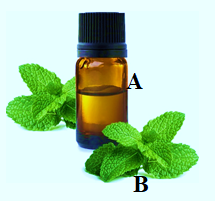
The strains used in this study consisted of clinically and foodborne strains of P. aeruginosa (20), S. aureus (20), and E. coli (20) isolated from previous studies and stored at -20°C. The reference strains of P. aeruginosa ATCC 27853, S. aureus ATCC 25923, and E. coli ATCC 25922 from the collection of the Pasteur Institute, Abidjan, Côte d'Ivoire, were used as controls for antibiotic resistance testing. The plant material used was peppermint essential oil (Figure 1).
2.2. MethodsA total of sixty (60) bacterial strains, composed of P. aeruginosa (20), S. aureus (20), and E. coli (20), were studied (Table 1). The strains were obtained from clinical samples (blood, stool, pus, and urine) isolated at the Pasteur Institute of Côte d'Ivoire, as well as from food samples (smoked fish, fresh fish, and beef). These P. aeruginosa, S. aureus, and E. coli strains were isolated on Cetrimide, Staphylococcus agar, and TBX agar, respectively. These bacterial strains isolated on selective media underwent biochemical and molecular identification by PCR.
Molecular identification by polymerase chain reaction (PCR) was performed on different strains of P. aeruginosa, E. coli, and S. aureus. The operation was carried out in several steps, including the extraction of genomic DNA, the amplification of the 16S gene characteristic of the bacterial species (P. aeruginosa, E. coli, and S. aureus), and the visualization of the amplification products.
All isolated strains of P. aeruginosa, S. aureus and E. coli were revived in brain-heart broth (BHC) for 24 h. The genomic DNA of these strains was then extracted by the thermal lysis method and purified according to the technique described by Al-Kilabi et al. 21. After extraction, the DNA was diluted and stored at -20°C to serve as a template for polymerase chain reaction (PCR).
The reaction mixture was prepared according to the technique described by Al-Kilabi et al. 21. This reaction mixture with a total volume of 25 μL consisted of 15 μL of sterile Milli-Q water (milli-Q™, Millipore Corporation, USA), 5 μL of 5X concentration loading buffer, 1.5 μL of MgCl2, 2 mM (Promega Corporation, Madison, WI 53711-5399, USA), 0.2 μL of 10 mM dNTPs, 0.1 μL of each primer, 10 mM (Integral DNA Technology, California, USA), 0.1 μL of Go Taq® G2 Flexi DNA polymerase with a final concentration of 1.5U (Promega Corporation, Madison, WI 53711-5399, USA) and 3 μL of the DNA template.
Reference strains and sterile Milli-Q water were used respectively as positive control and negative control for each step of the PCR reaction.
Amplification of the 16S rDNA gene was performed according to the technique described by Yehia et al. 22 using the different primers 27F (5'-AGAGTTTGATCMTGGCTCAG-3') and 1492R (3'TACGGYTACCTTGTTACGACTT-5') (Table 2). The amplification program consisted of an initial 5-min denaturation step at 94°C followed by 35 cycles comprising denaturation (94°C for 30 s), hybridization (55°C for 40 s), and extension (72°C for 30 s), with a single final 10-min extension at 72°C. All samples were stored at +4°C until the thermocycler was shut down.
Amplification of the genes responsible for biofilm formation (pslA, pelA, ppyR) was performed according to the method described by Yehia et al. 22. The amplification program consisted of an initial 5-min denaturation at 95°C followed by a repeated cyclic phase. The cyclic phase, repeated 33 times with each amplification cycle, comprised a 30-second denaturation step at 95°C, a 60-second primer binding (hybridization) step at 65°C, and a 90-second elongation step at 72°C. The amplification reaction concluded with a final 5-min elongation at 72°C. The amplification programs and the nucleotide sequence of the primers used for PCR are described in the Table 2.
Gene amplification products were visualized on a 1.5% agarose gel after 120 V incubation for 30 min and visualized by illumination on a UV plate of a light source and photographed (Molecular Imager Gel Doc™ EZ, Bio-Rad, USA) as described previously. A 4 μL volume of a molecular weight marker (Bench Top, 1 kb DNA Ladder, Promega Corporation, USA) introduced into the first well of the solidified gel was used as a reference scale.
The antibacterial activity of peppermint essential oil is expressed by the appearance of inhibition zones around the discs. It is assessed by measuring the diameter of the inhibition zone produced around the discs using calipers or a ruler.
By definition, the minimum inhibitory concentration (MIC) is the lowest concentration at which an essential oil is capable of inhibiting the development or growth of a particular microorganism. The MIC of an extract against a given strain will be the lowest concentration showing no visible growth of the microorganism.
The various MICs were determined in liquid medium in sterile hemolysis tubes. A range of concentrations of the essential oil to be tested was prepared in seven hemolysis tubes using the double dilution method in liquid medium. Ten milliliters of essential oil concentrated at 0.2 mL/mL were prepared and sterilized in an autoclave at 121°C for 15 minutes. For each essential oil, a range of sterile concentrations of 0.2, 0.1, 0.05, 0.025, 0.0125, and 0.00625 mL/mL was prepared in hemolysis tubes. Also for each bacterial strain, an inoculum of 108 bacteria/mL was prepared in twice concentrated Mueller-Hinton broth.
Next, using the double dilution method, 1 mL of bacterial inoculum was added to each tube of the essential oil range. The concentration range of each essential oil was then diluted by half, resulting in the following concentrations: 0.1, 0.05, 0.025, 0.0125, 0.00625, and 0.003125 mL/mL. A positive control tube containing 1 mL of sterile distilled water and 1 mL of inoculum, and a negative control tube containing 1 mL of sterile distilled water and 1 mL of sterile Mueller-Hinton broth, were also prepared. The prepared tubes were incubated at 37°C for 24 hours. After incubation, bacterial growth in each tube, indicated by turbidity of the medium, was observed.
The minimum bactericidal concentration (MBC) is defined as the smallest dose capable of killing the microorganism. After inoculating the tubes during the MIC reading, a bactericidal control was prepared from the inoculum. Using a calibrated 10 µL platinum loop, dilutions of 10⁻¹, 10¹, 10⁻², 10⁻³, and 10⁻⁴ of the inoculum, corresponding to 100%, 10%, 1%, 0.1%, and 0.01% of bacteria in suspension, respectively, were inoculated in strips onto Mueller-Hinton agar in Petri dishes. The Petri dishes were incubated at 37°C for 24 hours.
After reading the MIC, subculturing in strips from tubes without visible growth was performed onto Petri dishes containing Mueller-Hinton agar. These plates were then incubated at 37°C for 24 h. After incubation, the strips were compared to the bactericidal control. In practice, the MBC corresponds to the lowest concentration at which subculturing shows bacterial growth less than or equal to the number of colonies observed at the 10⁻⁴ dilution (0.01% survivors).
The CMB/MIC ratio helps to define the mode of action of an essential oil. When the CMB/MIC ratio is less than or equal to 2, the essential oil is considered bactericidal. Conversely, if this ratio is greater than 2, the essential oil is considered bacteriostatic.
A range of graduated concentrations was used to study the effect of crude peppermint essential oils (CPOs) on biofilm formation in P. aeruginosa, E. coli, and S. aureus. Peppermint essential oil was aseptically added to Luria Bertani broth (LB) at the following concentrations: 0.1%, 0.2%, 0.3%, 0.4%, 0.5%, 1%, 1.5%, and 2% (v/v) in the presence of three (3) drops of Twens Twens 80.
To perform this test, each bacterial strain was first inoculated onto Luria-Bertani (LB) agar. The plates were then incubated at 37°C for 24 hours. After 24 hours, a few colonies were suspended in LB broth free of peppermint oil (LB Control). Next, a few colonies were also suspended in LB broth with varying concentrations of peppermint oil added (LB Test). Finally, all optical densities at 600 nm (OD) of the resulting suspensions were adjusted to 0.20 using a spectrophotometer.
The bacterial suspensions thus prepared were dispensed into 5 mL polystyrene tubes, with 2 mL of suspension per tube. The tubes were then incubated at 37°C for 48 hours under static conditions.
After 48 hours of incubation, the tubes were removed, and the absorbance of the resulting bacterial culture was measured at 600 nm for each tube. The bacterial culture was then removed by successive rinsings with distilled water (DW). Biomass attached to the tube walls (biofilm formation) was revealed after staining with a 1% aqueous solution of crystal violet (CV). Two mL volumes of 1% (v/v) crystal violet were dispensed into each tube. The tubes were incubated for 30 minutes at room temperature. After a contact time of 1 hour, excess stain was removed by 3 to 10 successive, thorough manual washes of the tube walls with sterile distilled water (DW) (until clear droplets were obtained). The CV (color transferase) stain, which had adhered to the tube walls, was solubilized using a 75:25 ethanol-acetone solution for 1 hour.
The stain, having penetrated the biofilm bacteria and adhered to the tube walls, was then solubilized for 1 hour by adding 2 mL of 95% absolute ethanol to each tube. The absorbance of the resulting solution was then measured at 570 nm using a spectrophotometer.
Finally, the strains were grouped into: OD 570 < 0.1, non-biofilm producers (NP); OD 570 = 0.1–1.0, weak biofilm producers (WP); OD 570 = 1.1–3.0, moderate biofilm producers (MP); and OD 570 > 3.0, strong biofilm producers (SP).
In the case of a possible increase in bacterial adhesion or planktonic growth, the results are expressed as a percentage increase in biofilms. It is calculated as follows:
 |
Dans le cas d’une éventuelle inhibition de la formation de biofilms ou de la croissance des cellules non fixées, les résultats sont exprimés en pourcentage de réduction de biofilms. Il est calculé comme suit:
 |
The data underwent both manual and computer processing. SPSS 20.0 software was used to analyze the data. Excel was used to determine frequencies, means, and standard deviations.
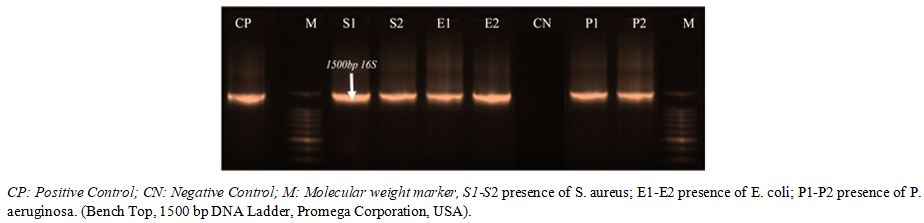
Phenotypic, biochemical, and molecular identification using the 16S marker (Table 3) allowed the selection of sixty (60) strains, including P. aeruginosa (20), E. coli (20), and S. aureus (20), from a set of ninety (90) isolates from clinical and food samples. Electrophoretic profiling detected and confirmed the presence of S. aureus, E. coli, and P. aeruginosa strains (Figure 2).

The study demonstrated the phenotypic potential of clinical and foodborne strains of P. aeruginosa, E. coli, and S. aureus to form biofilms. The median number of biofilms formed ranged from 0.8 ± 0.4 to 1.4 ± 0.4 (clinical strains) and from 0.7 ± 0.4 to 1.1 ± 0.2 (foodborne strains) (Table 4). The biofilm-producing categories showed that some strains were non-producers (NP). Other strains produced biofilms, classified as high producers (FP), moderate producers (PM), and low producers (fP).
The high-producer (22% to 32%) and moderate-producer (40% to 58%) categories were significantly higher in clinical strains (Table 4). The results indicated that clinical and food strains of E. coli have the same level of biofilm formation with a median of 0.8 ± 0.4 (Table 4).
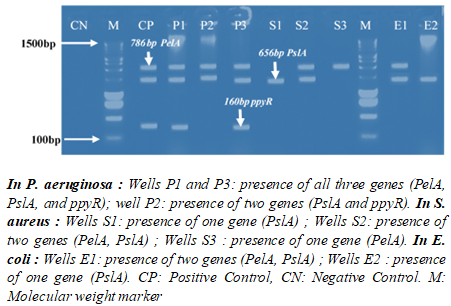
3.3. Biofilm Formation Genes in P. aeruginosa, S. aureus and E. coliFigure 3 present the electrophoretic profiles of genes involved in biofilm formation in P. aeruginosa, S. aureus, and E. coli. Some P. aeruginosa strains expressed three (3) biofilm-forming genes (PelA, PslA, and ppyR), while others had only one or two (Figure 3). The biofilm-forming genes PelA, PslA, and ppyR were detected in P. aeruginosa with prevalences ranging from 40% to 80% and 40% to 60% in clinical and foodborne strains, respectively (Table 5). S. aureus and E. coli strains harbored two (2) or one (1) biofilm-forming genes (PelA and/or PslA) (Figure 3). The prevalence of the PelA and PslA genes in S. aureus and E. coli ranged from 20% to 40% (clinical strains) and from 10% to 40% (foodborne strains). No gene encoding pyoverdine production (ppyR) was detected in S. aureus or E. coli (Table 5).

Analysis of the MBC/MIC ratio results shows that peppermint essential oil is bactericidal against foodborne and clinically acquired E. coli and S. aureus strains with MBC/MIC ratios less than or equal to two (2). As for P. aeruginosa strains, they exhibit bactericidal and bacteriostatic activity against foodborne and clinically acquired strains, respectively (Table 6).
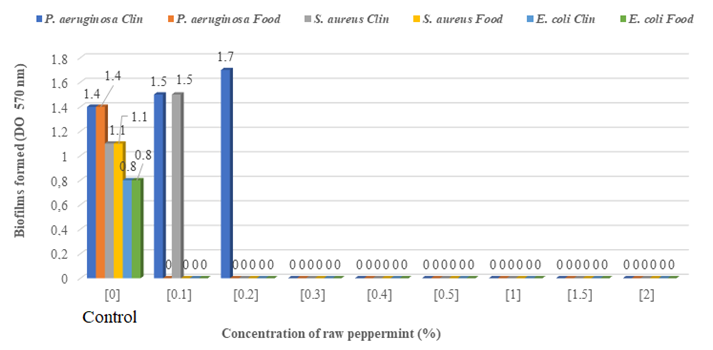
With Raw peppermint (RP) concentrations between 0.2% and 2%, the results showed no increase in the adhesion capacity of clinically and foodborne strains (Table 7). At a dose of 0.1% Raw peppermint (RP), a statistically insignificant increase of between 21.2% and 23.3% was observed in clinical strains of P. aeruginosa and S. aureus (Table 7). The effect of raw peppermint (RP) shows that the median biofilms reflecting these different increases range from 1.5 to 1.7 (Figure 4).
Furthermore, the results show, for both clinical and food strains, a reduction exceeding 100% ranging from 101.7% to 274.8% which is statistically very significant (P<0.01) for Raw peppermint (RP) doses ranging from 0.2% to 2% (Table 7).
This work enabled the phenotypic and molecular detection of genes responsible for bacterial biofilm formation in P. aeruginosa, S. aureus, and E. coli, leading to improved diagnosis and management using natural substances. Bacterial biofilms represent a significant public health problem affecting numerous sectors, including the agri-food industry and hospitals 2, 5. Biological diagnosis of these biofilm-forming bacterial infections, based on phenotypic methods, is limited in favor of molecular methods 25. In this work, the 16S marker enabled molecular identification of S. aureus, E. coli, and P. aeruginosa involved in biofilm formation using primers 27-F and 1492-R 16, 25. Several similar studies have indicated that the 16S gene provides high resolution in the molecular identification of bacteria 25.
Furthermore, the phenotypic potential of clinical and foodborne strains of P. aeruginosa, E. coli, and S. aureus to form biofilms showed a median number of biofilms formed ranging from 0.8 ± 0.4 to 1.4 ± 0.4 (clinical strains) and from 0.7 ± 0.4 to 1.1 ± 0.2 (foodborne strains). In addition to phenotypic detection, these strains harbored a diversity of genes (PelA, PslA, and ppyR) involved in biofilm formation, conferring antimicrobial resistance 1, 4, 6. These molecular supports for biofilm formation could justify multi-resistance at the level of different clinical and food strains 2, 7, 26.
Indeed, numerous studies have shown that biofilm-forming bacteria can become 10 to 1000 times more resistant to antimicrobial agents than their planktonic counterparts of the same strain 27. Consequently, combating these biofilms responsible for multidrug resistance represents a significant microbiological and medical challenge. Thus, the development of new strategies and the discovery of new targets are clearly essential to combat bacterial biofilms 26, 28. Anti-infective agents that selectively disrupt virulence pathways to prevent or cure infection are less likely to promote the emergence of resistance 1, 3, 28. Among these anti-infective agents, some natural essential oils have promising therapeutic properties to combat bacterial biofilms 17, 18.
This study investigated the potential effects of raw peppermint (RP) essential oil on the adhesion of P. aeruginosa, S. aureus, and E. coli 17. This natural plant product was tested in its raw form at various concentrations on clinical and foodborne strains. At a dose of 0.1% raw peppermint (RP), a statistically insignificant increase of between 21.2% and 23.3% was observed in clinical strains of P. aeruginosa and S. aureus.
Furthermore, the results showed a statistically significant reduction (P<0.01) of between 101.7% and 274.8% for both clinical and foodborne strains, with Raw peppermint (RP) concentrations ranging from 0.2% to 2%.
Therefore, peppermint oil, with its known characteristics, exhibited a bactericidal and anti-biofilm effect, capable of modifying biofilm formation kinetics and significantly reducing the number of adherent cells 17, 29. These results are similar to those of Benie et al. (2021), who indicated in their study that, with characteristics similar to furanone, peppermint oil exhibited an inhibitory effect on biofilm formation and quorum sensing (QS) activity.
The bactericidal and anti-biofilm efficacy of this oil in eliminating and dispersing bacterial biofilms has shown that this molecule may act on the various communication systems involved in quorum sensing in bacteria 29, 31 (Rosignoli et al., 2026; Wang et al., 2025; Maisuria et al., 2016). A toxicity study could define the potential benefit of peppermint oil in the preventive or curative treatment of bacterial biofilm infections.
Strains of P. aeruginosa, E. coli, and S. aureus exhibited phenotypic and molecular potential to form biofilms. The biofilm-forming genes PelA, PslA, and ppyR were predominantly detected in P. aeruginosa. This study demonstrated that peppermint essential oil is effective in eradicating biofilms of P. aeruginosa, E. coli, and S. aureus. This natural essence may be a promising candidate for treating bacterial biofilms in the food industry and in hospital settings.
Acknowledgments: The authors thank the Institut Pasteur of Côte d’Ivoire (IPCI), and the Université Félix Houphouët Boigny for their excellent technical assistance. The authors thank also the molecular biology platform, and the unit dealing with Antibiotics, Natural Substances and Surveillance of Resistance of Microorganisms to Anti-infective Drugs (ASSURMI) at the IPCI.
Author’s Contributions: Comoé Koffi Donatien BENIE, Amin Paulin YAPI, and Bourahima BAMBA carried out sample collection and processing, data collection, laboratory analyses, and interpretation. Adjaratou TRAORE, Koua ATOBLA, and Aya Carole BONNY performed data analysis, statistical analyses, results visualization, and literature reviews. Nohya Delvina OKONDZA, KPODA Dissinviel Stéphane, Nathalie GUESSENND, and Adjéhi DADIE provided essential comments on the manuscript and supervised this study. All authors contributed to the drafting, review, and approval of the final version of the manuscript.
Funding Sources: This research did not receive any specific grant.
Declaration of Competing Interest: The authors declare that they have no known competing financial interests or personal relationships that could have appeared to influence the work reported in this article.
| [1] | Yang D., Hao S., Zhao L., Shi F., Ye G., Zou Y., Song X., Li L., Yin Z., He X., Feng S., Chen H., Zhang Y., Gao Y., Li Y., Tang H. Paeonol Attenuates Quorum-Sensing Regulated Virulence and Biofilm Formation in Pseudomonas aeruginosa, Front. Microbiol. 12, 692474, 2021. | ||
| In article | View Article | ||
| [2] | Yan S., Wu G. Can biofilm be reversed through quorum sensing in Pseudomonas aeruginosa? Front. Microbiol. 10, 1582, 2019. | ||
| In article | View Article PubMed | ||
| [3] | Ugwu C.N., Ezeibe E.N., Emencheta S.C., Nwagwu C.S., Attama A.A., Biofilms: structure, resistance mechanism, emerging control strategies, and applications, RSC Pharm. 2, 1376–1407, 2025. | ||
| In article | View Article | ||
| [4] | Raya J., Montagut E-J., Marco M-P. Analysing the integrated quorum sensing (iqs) system and its potential role in Pseudomonas aeruginosa pathogenesis, Front. Cell. Infect. Microbiol. 15, 1575421, 2025. | ||
| In article | View Article | ||
| [5] | Grari O., Ezrari S., Yandouzi I.E., Benaissa E., Maleb A.A. comprehensive review on biofilm-associated infections: Mechanisms, diagnostic challenges, and innovative therapeutic strategies, The Microbe, 8, 100436, 2025. | ||
| In article | View Article | ||
| [6] | Flemming H-C., van H.E.D., Neu T.R., Nielsen P.H., Seviour T.P. The biofilm matrix: Multitasking in a shared space, Nat. Rev. Microbiol. 2, 70–86, 2023 | ||
| In article | View Article PubMed | ||
| [7] | Soto-Aceves, M.P., Cocotl-Yanez, M., Servin-Gonzalez, L., Soberon-Chavez, G. The Rhl Quorum-Sensing System Is at the Top of the Regulatory Hierarchy under Phosphate-Limiting Conditions in Pseudomonas aeruginosa PAO1. J. Bacteriol. 203, e00475-20, 2021. | ||
| In article | View Article PubMed | ||
| [8] | Gajdács M., Baráth Z., Kárpáti K., Szabó D., Usai D., Zanetti S., Donadu M.G. No Correlation between Biofilm Formation, Virulence Factors, and Antibiotic Resistance in Pseudomonas aeruginosa: Results from a Laboratory-Based In Vitro Study, Antibiotics, 10, 11284-1134, 2021. | ||
| In article | View Article PubMed | ||
| [9] | Garcia-Reyes S., Soberon-Chavez G., Cocotl-Yanez M. The third quorum-sensing system of Pseudomonas aeruginosa: Pseudomonas quinolone signal and the enigmatic PqsE protein. J. Med. Microbiol. 1, 25–34, 2020. | ||
| In article | View Article PubMed | ||
| [10] | Li Y., Dong R., Ma L., Qian Y., Liu Z. Combined anti-biofilm enzymes strengthen the eradicate effect of Vibrio parahaemolyticus biofilm: Mechanism on cpsA-J expression and application on different carriers. Foods, 11, 1305, 2022. | ||
| In article | View Article PubMed | ||
| [11] | MirzaHosseini H.K., Hadadi-Fishani M., Morshedi K., Khaledi A. Meta-analysis of biofilm formation, antibiotic resistance pattern, and biofilm-related genes in Pseudomonas aeruginosa isolated from clinical samples. Microb. Drug Resist. 26, 815–824, 2020. | ||
| In article | View Article PubMed | ||
| [12] | Shehab M., Almajdi A., Abdullah I., Alrashed F. Safety and Effectiveness of Multi-Switch Between Adalimumab Originator and Biosimilars: A Multicenter (SUSTAIN) Study. J. Clin. Med. 1, 8819, 2025. | ||
| In article | View Article PubMed | ||
| [13] | Fiscarelli E., Rossitto M., Rosati P., Essa N., Crocetta V., Di Giulio A., Lupetti V., Di B.G., Pompilio A. In vitro newly isolated environmental phage activity against biofilms preformed by Pseudomonas aeruginosa from patients with cystic fibrosis. Microorganisms, 9, 478, 2021. | ||
| In article | View Article PubMed | ||
| [14] | Benie C.K.D., Dadié A., Guessennd N., N’gbesso-Kouadio N.A., Kouame N.D., N’golo D.C., Dosso M. Characterization of virulence potential of Pseudomonas aeruginosa isolated from bovine meat, fresh fish, and smoked fish. Eur J Microbiol Immunol (Bp) 7, 55-64, 2017. | ||
| In article | View Article PubMed | ||
| [15] | Benie C.K.D., Attien P.Y., Toe E., TraBi Y.C., Atobla K., Dadié A. Biofilm Formation and Inhibitory Effect of Essential Oils in Multidrug-Resistant Pseudomonas aeruginosa. J Bacteriol Mycol. 8, 1192, 2021. | ||
| In article | |||
| [16] | Traoré A., Benie C.K.D., Diarrassouba A., Tuo W-TA., Wayoro O.Z., Dadie A., Guessennd N., Dosso M. Virulence Factors and Biofilm Formation in Multidrug-Resistant Metallo-β-Lactamase-Producing Clinical Strains of Pseudomonas aeruginosa. Adv. Appl. Microbiol. 14, 589-604, 2024. | ||
| In article | View Article | ||
| [17] | Physicochemical, Biochemical, and Essential Oil Diversity among Peppermint (Mentha × piperita L. “Almira”, Mentha × piperita L. “Granada”, and Mentha × piperita L. “Multimentha”) Cultivars? Pol. J. Environ. Stud. 10, 1–9, 2025. | ||
| In article | |||
| [18] | Kumar V., Mathela C.S., Kumar M., Tewari G. Antioxidant Potential of Essential Oils from Some Himalayan Asteraceae and Lamiaceae species. Med. Drug Discov. 1, 100004, 2019. | ||
| In article | View Article | ||
| [19] | Allyson M.E., Simone-Finstrom M., Quentin R., Husseneder C., Ricigliano V. Effects of ingested essential oils and propolis extracts on honey bee (Hymenoptera : Apidae) health and gut microbiota. Journal of Insect Science, 15, 1–13, 2023. | ||
| In article | |||
| [20] | Ikeda N.Y., Ambrosio C.M.S., Miano A.C., Rosalen P.L., Gloria E.M., Alencar S.M. Essential Oils Extracted from Organic Propolis Residues: An Exploratory Analysis of Their Antibacterial and Antioxidant Properties and Volatile Profile. Molecules, 26, 4694, 2023. | ||
| In article | View Article PubMed | ||
| [21] | Al-Kilabi A.A.K., Al-Turaihi T.S., Al Mohammed HS. Molecular detection of Quorum sensing genes in Pseudomonas aeruginosa isolated from CSOM patients and their relationship to biofilm ability. EurAsian Journal of BioSciences. 14, 4929-4934, 2020. | ||
| In article | |||
| [22] | Yehia H.M., Al-Masoud A.H., Alarjani K.M., Alamri M.S. Prevalence of methicillin-resistant (mecA gene) and heat-resistant Staphylococcus aureus strains in pasteurized camel milk.J. Dairy Sci., 103, 59475963, 2020. | ||
| In article | View Article PubMed | ||
| [23] | Amutha K., Kokila V. PCR Amplification, Sequencing of 16S rRNA Genes with Universal Primers and Phylogenetic Analysis of Pseudomonas aeruginosa. International Journal of Science Research. 3, 257-261, 2014. | ||
| In article | |||
| [24] | Pournajaf A., Razavi S., Irajian G., Ardebili A., Erfani Y., Solgi S. Intégrons types, antimicrobial resistance genes, virulence gene profile, alginate production and biofilm formation in Iranian cystic fibrosis P. aeruginosa isolates. L’infezioni in medicina : periodica di eziologia, epidemiologia, diagnostica, clinica e terapia delle patologie infettive. 1, 226236, 2018. | ||
| In article | |||
| [25] | Stecher G., Tamura K., Kumar S.. Molecular evolutionary genetics analysis (MEGA) for macOS. Mol Biol Evol. 37,1237–1239, 2020. | ||
| In article | View Article PubMed | ||
| [26] | Han B., Feng C., Jiang Y., Ye C., Wei Y., Liu J. Mobile genetic elements encoding antibiotic resistance genes and virulence genes in Klebsiella pneumoniae: important pathways for the acquisition of virulence and resistance. Front. Microbiol. 1, 1529157, 2025. | ||
| In article | View Article PubMed | ||
| [27] | Costa S.P., Carvalho C.M. Burden of bacterial bloodstream infections and recent advances for diagnosis. Pathogens and Disease, 80, 1–13, 2022. | ||
| In article | View Article PubMed | ||
| [28] | Touaitia R., Mairi A., Ibrahim N.A., Basher N.S., Idres T., Touati A. Staphylococcus aureus: A Review of the Pathogenesis and Virulence Mechanisms. Antibiotics, 14, 470, 2025. | ||
| In article | View Article PubMed | ||
| [29] | Maisuria V.B., Santos Y.L., Tufenkji N., Déziel E. Cranberry-derived proanthocyanidins impair virulence and inhibit quorum sensing of Pseudomonas aeruginosa. Scientific Reports, 6, 30169, 2016. | ||
| In article | View Article PubMed | ||
| [30] | Rosignoli S., Elisa L., Olga S., Serena R., Elisabetta R., Alessandro P., Ivana C. Bioinformatics-Driven, Plant-Based Antibiotic Research Against Quorum Sensing and Biofilm Formation in Pseudomonas aeruginosa and Escherichia coli Multiresistant Microbes. Biomolecules, 16, 197, 2026. | ||
| In article | View Article PubMed | ||
| [31] | Wang R., Wang S., Liu L., Qiu,C., Xiao S., Ouyang Q., Ji M. Research Progress on the Influence Factors of the Quorum Sensing System Regulating the Growth ofWastewater Treatment Biofilm. Water, 17, 1944, 2025. | ||
| In article | View Article | ||
Published with license by Science and Education Publishing, Copyright © 2026 Comoé Koffi Donatien BENIE, Bourahima BAMBA, Amin Paulin YAPI, Adjaratou TRAORE, Moussa NONKA, Koua ATOBLA, Aya Carole BONNY, Nohya Delvina OKONDZA, Dissinviel Stéphane KPODA, Nathalie GUESSENND and Adjéhi DADIE
 This work is licensed under a Creative Commons Attribution 4.0 International License. To view a copy of this license, visit
http://creativecommons.org/licenses/by/4.0/
This work is licensed under a Creative Commons Attribution 4.0 International License. To view a copy of this license, visit
http://creativecommons.org/licenses/by/4.0/
| [1] | Yang D., Hao S., Zhao L., Shi F., Ye G., Zou Y., Song X., Li L., Yin Z., He X., Feng S., Chen H., Zhang Y., Gao Y., Li Y., Tang H. Paeonol Attenuates Quorum-Sensing Regulated Virulence and Biofilm Formation in Pseudomonas aeruginosa, Front. Microbiol. 12, 692474, 2021. | ||
| In article | View Article | ||
| [2] | Yan S., Wu G. Can biofilm be reversed through quorum sensing in Pseudomonas aeruginosa? Front. Microbiol. 10, 1582, 2019. | ||
| In article | View Article PubMed | ||
| [3] | Ugwu C.N., Ezeibe E.N., Emencheta S.C., Nwagwu C.S., Attama A.A., Biofilms: structure, resistance mechanism, emerging control strategies, and applications, RSC Pharm. 2, 1376–1407, 2025. | ||
| In article | View Article | ||
| [4] | Raya J., Montagut E-J., Marco M-P. Analysing the integrated quorum sensing (iqs) system and its potential role in Pseudomonas aeruginosa pathogenesis, Front. Cell. Infect. Microbiol. 15, 1575421, 2025. | ||
| In article | View Article | ||
| [5] | Grari O., Ezrari S., Yandouzi I.E., Benaissa E., Maleb A.A. comprehensive review on biofilm-associated infections: Mechanisms, diagnostic challenges, and innovative therapeutic strategies, The Microbe, 8, 100436, 2025. | ||
| In article | View Article | ||
| [6] | Flemming H-C., van H.E.D., Neu T.R., Nielsen P.H., Seviour T.P. The biofilm matrix: Multitasking in a shared space, Nat. Rev. Microbiol. 2, 70–86, 2023 | ||
| In article | View Article PubMed | ||
| [7] | Soto-Aceves, M.P., Cocotl-Yanez, M., Servin-Gonzalez, L., Soberon-Chavez, G. The Rhl Quorum-Sensing System Is at the Top of the Regulatory Hierarchy under Phosphate-Limiting Conditions in Pseudomonas aeruginosa PAO1. J. Bacteriol. 203, e00475-20, 2021. | ||
| In article | View Article PubMed | ||
| [8] | Gajdács M., Baráth Z., Kárpáti K., Szabó D., Usai D., Zanetti S., Donadu M.G. No Correlation between Biofilm Formation, Virulence Factors, and Antibiotic Resistance in Pseudomonas aeruginosa: Results from a Laboratory-Based In Vitro Study, Antibiotics, 10, 11284-1134, 2021. | ||
| In article | View Article PubMed | ||
| [9] | Garcia-Reyes S., Soberon-Chavez G., Cocotl-Yanez M. The third quorum-sensing system of Pseudomonas aeruginosa: Pseudomonas quinolone signal and the enigmatic PqsE protein. J. Med. Microbiol. 1, 25–34, 2020. | ||
| In article | View Article PubMed | ||
| [10] | Li Y., Dong R., Ma L., Qian Y., Liu Z. Combined anti-biofilm enzymes strengthen the eradicate effect of Vibrio parahaemolyticus biofilm: Mechanism on cpsA-J expression and application on different carriers. Foods, 11, 1305, 2022. | ||
| In article | View Article PubMed | ||
| [11] | MirzaHosseini H.K., Hadadi-Fishani M., Morshedi K., Khaledi A. Meta-analysis of biofilm formation, antibiotic resistance pattern, and biofilm-related genes in Pseudomonas aeruginosa isolated from clinical samples. Microb. Drug Resist. 26, 815–824, 2020. | ||
| In article | View Article PubMed | ||
| [12] | Shehab M., Almajdi A., Abdullah I., Alrashed F. Safety and Effectiveness of Multi-Switch Between Adalimumab Originator and Biosimilars: A Multicenter (SUSTAIN) Study. J. Clin. Med. 1, 8819, 2025. | ||
| In article | View Article PubMed | ||
| [13] | Fiscarelli E., Rossitto M., Rosati P., Essa N., Crocetta V., Di Giulio A., Lupetti V., Di B.G., Pompilio A. In vitro newly isolated environmental phage activity against biofilms preformed by Pseudomonas aeruginosa from patients with cystic fibrosis. Microorganisms, 9, 478, 2021. | ||
| In article | View Article PubMed | ||
| [14] | Benie C.K.D., Dadié A., Guessennd N., N’gbesso-Kouadio N.A., Kouame N.D., N’golo D.C., Dosso M. Characterization of virulence potential of Pseudomonas aeruginosa isolated from bovine meat, fresh fish, and smoked fish. Eur J Microbiol Immunol (Bp) 7, 55-64, 2017. | ||
| In article | View Article PubMed | ||
| [15] | Benie C.K.D., Attien P.Y., Toe E., TraBi Y.C., Atobla K., Dadié A. Biofilm Formation and Inhibitory Effect of Essential Oils in Multidrug-Resistant Pseudomonas aeruginosa. J Bacteriol Mycol. 8, 1192, 2021. | ||
| In article | |||
| [16] | Traoré A., Benie C.K.D., Diarrassouba A., Tuo W-TA., Wayoro O.Z., Dadie A., Guessennd N., Dosso M. Virulence Factors and Biofilm Formation in Multidrug-Resistant Metallo-β-Lactamase-Producing Clinical Strains of Pseudomonas aeruginosa. Adv. Appl. Microbiol. 14, 589-604, 2024. | ||
| In article | View Article | ||
| [17] | Physicochemical, Biochemical, and Essential Oil Diversity among Peppermint (Mentha × piperita L. “Almira”, Mentha × piperita L. “Granada”, and Mentha × piperita L. “Multimentha”) Cultivars? Pol. J. Environ. Stud. 10, 1–9, 2025. | ||
| In article | |||
| [18] | Kumar V., Mathela C.S., Kumar M., Tewari G. Antioxidant Potential of Essential Oils from Some Himalayan Asteraceae and Lamiaceae species. Med. Drug Discov. 1, 100004, 2019. | ||
| In article | View Article | ||
| [19] | Allyson M.E., Simone-Finstrom M., Quentin R., Husseneder C., Ricigliano V. Effects of ingested essential oils and propolis extracts on honey bee (Hymenoptera : Apidae) health and gut microbiota. Journal of Insect Science, 15, 1–13, 2023. | ||
| In article | |||
| [20] | Ikeda N.Y., Ambrosio C.M.S., Miano A.C., Rosalen P.L., Gloria E.M., Alencar S.M. Essential Oils Extracted from Organic Propolis Residues: An Exploratory Analysis of Their Antibacterial and Antioxidant Properties and Volatile Profile. Molecules, 26, 4694, 2023. | ||
| In article | View Article PubMed | ||
| [21] | Al-Kilabi A.A.K., Al-Turaihi T.S., Al Mohammed HS. Molecular detection of Quorum sensing genes in Pseudomonas aeruginosa isolated from CSOM patients and their relationship to biofilm ability. EurAsian Journal of BioSciences. 14, 4929-4934, 2020. | ||
| In article | |||
| [22] | Yehia H.M., Al-Masoud A.H., Alarjani K.M., Alamri M.S. Prevalence of methicillin-resistant (mecA gene) and heat-resistant Staphylococcus aureus strains in pasteurized camel milk.J. Dairy Sci., 103, 59475963, 2020. | ||
| In article | View Article PubMed | ||
| [23] | Amutha K., Kokila V. PCR Amplification, Sequencing of 16S rRNA Genes with Universal Primers and Phylogenetic Analysis of Pseudomonas aeruginosa. International Journal of Science Research. 3, 257-261, 2014. | ||
| In article | |||
| [24] | Pournajaf A., Razavi S., Irajian G., Ardebili A., Erfani Y., Solgi S. Intégrons types, antimicrobial resistance genes, virulence gene profile, alginate production and biofilm formation in Iranian cystic fibrosis P. aeruginosa isolates. L’infezioni in medicina : periodica di eziologia, epidemiologia, diagnostica, clinica e terapia delle patologie infettive. 1, 226236, 2018. | ||
| In article | |||
| [25] | Stecher G., Tamura K., Kumar S.. Molecular evolutionary genetics analysis (MEGA) for macOS. Mol Biol Evol. 37,1237–1239, 2020. | ||
| In article | View Article PubMed | ||
| [26] | Han B., Feng C., Jiang Y., Ye C., Wei Y., Liu J. Mobile genetic elements encoding antibiotic resistance genes and virulence genes in Klebsiella pneumoniae: important pathways for the acquisition of virulence and resistance. Front. Microbiol. 1, 1529157, 2025. | ||
| In article | View Article PubMed | ||
| [27] | Costa S.P., Carvalho C.M. Burden of bacterial bloodstream infections and recent advances for diagnosis. Pathogens and Disease, 80, 1–13, 2022. | ||
| In article | View Article PubMed | ||
| [28] | Touaitia R., Mairi A., Ibrahim N.A., Basher N.S., Idres T., Touati A. Staphylococcus aureus: A Review of the Pathogenesis and Virulence Mechanisms. Antibiotics, 14, 470, 2025. | ||
| In article | View Article PubMed | ||
| [29] | Maisuria V.B., Santos Y.L., Tufenkji N., Déziel E. Cranberry-derived proanthocyanidins impair virulence and inhibit quorum sensing of Pseudomonas aeruginosa. Scientific Reports, 6, 30169, 2016. | ||
| In article | View Article PubMed | ||
| [30] | Rosignoli S., Elisa L., Olga S., Serena R., Elisabetta R., Alessandro P., Ivana C. Bioinformatics-Driven, Plant-Based Antibiotic Research Against Quorum Sensing and Biofilm Formation in Pseudomonas aeruginosa and Escherichia coli Multiresistant Microbes. Biomolecules, 16, 197, 2026. | ||
| In article | View Article PubMed | ||
| [31] | Wang R., Wang S., Liu L., Qiu,C., Xiao S., Ouyang Q., Ji M. Research Progress on the Influence Factors of the Quorum Sensing System Regulating the Growth ofWastewater Treatment Biofilm. Water, 17, 1944, 2025. | ||
| In article | View Article | ||