Rabies virus is a neurotropic lyssavirus transmitted by the saliva of an infected animal after either biting, scratching or licking injured skin or mucous membranes. Rabies is endemic in Ivory Coast with around twenty deaths every year. With the aim of improving the knowledge and data on rabies viruses, we propose to carry out a comparative study of saliva sampling and skin biopsy samples by molecular detection by PCR at the Virus and Epidemic Department (DVE) of the Pasteur Institute of Ivory Coast, Adiopodoume site. This idea arose from the question of knowing whether saliva sampling is equivalent to the skin biopsy for the molecular or biological diagnosis of rabies? For the present study, all relevant data were extracted from the rabies database and imported into Microsoft Excel in order to select the subjects of study and perform analyses on rabies samples. The analysis of 15 samples (PCR) from each collection was carried out and the TC means were compared using the T-Student test. However, the two series did not differ significantly. In other words, the difference between the threshold value (TC) of the skin and saliva was not significant, so we can use one of the two samples for the diagnosis of rabies.
Rabies virus is a neurotropic lyssavirus transmitted by the saliva of an infected animal after either biting, scratching or licking damaged skin or mucous membranes. It is responsible for inevitably fatal encephalitis in humans 1. Infection can be prevented by rapid post-exposure management (washing, antisepsis and vaccination supplemented with anti-rabies immunoglobulins depending on severity) 2. More than 95% of fatal cases of rabies in humans result from transmission of the virus through the bite of an infected dog 3. It is a neglected disease, 100% fatal from the onset of the first signs 4.
Rabies has an almost worldwide distribution with the exception of Antarctica, Japan, Australia, the United Kingdom and the Pacific Islands. It occurs in more than 90% of developing countries (Africa, Asia, South America) 5.
According to the World Health Organisation (WHO), human rabies remains a real public health problem in developing countries, despite the existence of an effective rabies vaccine 6. This fatal condition constitutes a constant threat to rural and urban populations due to frequent contact with dogs and other unvaccinated domestic animals 7.
Recent worldwide figures show that there are almost 70,000 deaths per year and more than 40% of victims are children aged from 5 to 14 years 8. The incidence of human rabies is 3 cases per 10,000,000 inhabitants. Consequently, rabies continues to be a serious threat in Asia and Africa. In this vein, Africa is the second most affected continent (44% of cases = 24,000 deaths/year) after Asia 9. Thus, the pathology remains a serious public health problem in many countries around the world, particularly in developing countries.
In Ivory Coast, according to the National Institute of Public Health's Human Rabies Monitoring Unit, rabies is endemic with around twenty (20) deaths each year; the dog risk being very high in rural areas 10.
The number of rabies cases is underestimated due to the lack of a good monitoring system and the difficulties of biological confirmation of diagnosis leading to under-reporting of cases to health authorities. Effective rabies monitoring requires health professionals, veterinarians and technical staff trained in symptom recognition, sample collection and data management. However, these skills are often in short supply, notably in rural areas.
With the aim of improving knowledge and data on rabies, training was carried out on rabies epidemiology and sampling in several health districts in Ivory Coast. This permitted to reinforce the capacities of health workers on the different types of samples that generally consist of skin and saliva. Skin biopsy sampling for the diagnosis of rabies appears traumatic for both the samplers and the patient himself. This sample could be replaced by the saliva sample.
In Ivory Coast, like in many sub-Saharan African countries, national-scale data on comparative aspects of saliva samples and skin biopsy are rare. Very few studies have been carried out to support the substitution of skin biopsy by saliva sampling for rabies diagnosis in Africa in general and in Ivory Coast in particular. Faced with this situation, the question was to know whether saliva sampling is equivalent to skin biopsy for the molecular or biological diagnosis of rabies?
Thus, our comparative study of saliva sampling and skin biopsy for the diagnosis of rabies in the laboratory was aimed at identifying the biological product giving the best performance for the detection of rabies virus by real-time PCR
The study took place at the nervous system virus unit of the Institut Pasteur de Côte d’Ivoire. This unit houses the national reference centre for rabies. The population targeted by the study consisted of people suspected of having rabies, from whom saliva and skin biopsies had been collected and stored at -80°C at the Institut Pasteur Biobank. For each positive case, information regarding district of residence, gender, age, occupation, sample collection date was gathered.
The technical equipment consisted of an autoclave (Tommy, Japan), a centrifuge (Eppendorf, Germany), a thermal cycler (Applied Bio systems 7500 Real-time PCR System) for real-time PCR), micropipettes (Gilson, France) (p1000, p100 and p20), refrigerator, freezer, and Tembrok type glass crusher. The BIOFACT kit (HiGene™ viral RNA/DNA Prep Kit) was used as a chemical compound for the extraction of rabies virus RNA from saliva and skin biopsy samples.
The polymerase chain reaction reagents consisted of Nuclease free water, 2universal SYBR® Green reaction mix (Bio-Rad), primers JW12 (10 uM) and N165-146 (10uM) targeting the nucleoprotein gene recommended by the WHO and OIE and d iTaq RT enzyme mix (Bio-Rad). Two primers (SYBR Lyssavirus) were used JW12 and N165-146 with respectively primer sequences following forward primers (5’-ATGTAACACCYCTACAATG-3’) and reverse primers (5’-GCAGGGTAYTTRTACTCATA- 3’) 11
2.2. MethodsThis is a cross-sectional analytical study designed to compare the RT-PCR results obtained from two samples (saliva and skin biopsy) collected between October 2021 and April 2022.
The commercially available BIOFACT kit (HiGene™ viral RNA/DNA Prep Kit) intended for rapid and efficient purification of total RNA was used.
Principle: It is based on the property of silica fixed on micro-columns of ion exchange resin to attach nucleic acid molecules. The contaminating proteins were removed by washing and then eluted from the silica using a neutral buffer. (Example TE).
Operating mode:
The saliva and skin biopsy samples were placed at room temperature, and under a type II class biological safety cabinet. The processing was carried out as follows:
The physicochemical characteristics of the column are such that proteins and other contaminants which could inhibit PCR are not retained on the membrane; The RNA retained on the column after two successive centrifugations were washed using two other buffers 500 µl VW1 and 500 µl VW2. This operation made it possible to eliminate all possible contaminants by centrifugation without affecting the binding of the RNA to the column; the collector tube was removed and the silica column placed in a new 1.5 µl micro tube; 50 µl of RNase free water was added to the newly placed capsule column, incubated for 1 minute, then the tube was centrifuged at 13,000 rpm for 1 min, which made it possible to obtain purified RNA directly usable in PCR; The purified RNA was directly stored at -20 °C or -80 °C for later use.
Principle:
RT-PCR is a technique that permitted to make PCR (reaction in chain by polymerase) from a sample of RNA. RNA was first retro transcribed while using an enzyme called reverse transcriptase, which allows the synthesis of DNA complementary (cDNA). The latter was then used to carry out a PCR and the amplification was then carried out on quantitative thermocyclers, hence, the expression RT-qPCR.
For the validation of a test, a positive control and a negative control were used.
When performing RT-PCR, certain laboratory rules must be followed 12. First, since the technique is very sensitive, the manipulations must be carried out with great rigor in a dedicated room, because the tiniest viral particle leads to an inhibition of the manipulation.
The molecular detection of Lyssaviruses in our study is based on the pan-lyssa RT-qPCR technique. This technique targets the viral polymerase gene and also other lyssavirus species 11.
Operating mode: Beforehand, the reaction mixture was prepared by mixing the JW 12/N162-146 mix (pan lyssavirus RT-qPCR on the N gene) whose constituents were 2.35 µL
Nuclease free Water 10 µL, 2*universal SYBR® Green reaction mix (BioRad) 10 µL, JW12 (10ul) 1.2ul of N165-146 (10 µL) 1.2 µL, iTaq RT enzyme mix (BioRad) 0.25 µL.
For each of this system and for each sample, a reaction mixture of 15 μL was finally obtained, to which 5 μL of RNA diluted 1/5 in water (nuclease-Free Water) was added. Each sample was tested in duplicate on the same plate. The following program was used for amplification.
The data were recorded in an Excel database and analysed using the R software version 4.4.1
Qualitative variables were described by frequencies and quantitative ones were described by means, standard deviation and median.
The T-Student test was used to compare the average CT values from the amplification of rabies virus RNA from saliva samples and skin samples after verification of the conditions of use. For the T-student test application conditions, the Shapiro-Wilk test was performed to check normality and Fisher’s F test was performed to compare variances. When the p-value was less than 0.05 the difference was said to be significant.
The average age of patients was 34.33 ± 21.5 years with extremes ranging from 3 to 70 years. The median age was 30.0 years. Subjects in the 15-30- year- old age group were the most affected with 33.3% of positive cases, followed by the 60-70- year -old age group with 20% of positive cases. (Table 1)
In the present study, there were eight (8) men (53.3%) and the sex ratio was 1.1 male to female.
Table 2 shows that the socio-professional category of operators (homemakers and farmers) represented the most affected population by rabies with a proportion of 53.3%, followed by 26.7% of Artisans (tailor, carter, driver and trader).
Concerning receipt per year, Table 3 summarizes the number of samples at the reference laboratory. The trend here seems to be on the rise.
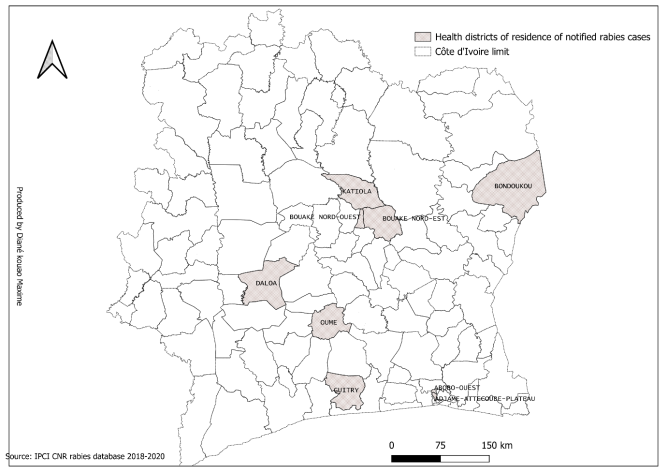
The distribution of patients by district of residence showed that the districts of Abidjan has four cases (26.7%) against 73.3% of cases for districts located in the interior (hinterland) of the country. For instance, the Bouaké North-West districts with 6 cases equivalent to 40% had the highest number of cases. (Table 4 and Figure 1).

The rabies virus genome was extracted from 30 patients, including 15 skin samples and 15 saliva samples. However, during amplification using the RT-PCR technique, the samples were analysed separately. Our results showed that 14 out of 15, or 93.3%, for both the saliva sample and the skin biopsy were positive for PCR.
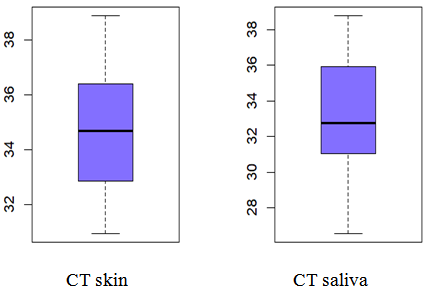
Figure 2 relating to the comparison of CT shows that the average CT observed between the 2 series, namely the CT of saliva samples and the CT of skin biopsies were not statistically significant since the p-value was greater than 0.05. However, the H0 was not rejected, but accepted.

The present study permitted to determine the biology that offers the best results for real-time PCR detection of the rabies virus. It compared the detection of rabies virus by real-time PCR in saliva samples to that of skin biopsy.
4.1. Sociodemographic DataThe average age of the subjects in our study was 34.33 ± 21.49 years with extremes ranging from 3 to 70 years, 60% of our patients had an age ≥20 years. Unlike that of Koné 2010 13, of Ndioubnane in 2020 14 and of DIOP SA & al in Senegal 15 which respectively found a value of 68.3%, 71% and 53.7 for patients of less than 20 years. This difference could be explained by the duration of the study as well as the inclusion criteria.
The most exposed subjects were male with a percentage of 53.3%. This result is consistent with the study carried out in France in 2008 16, that carried out by Sylla & al in Senegal in 2019 17 and the one carried out by Youla & al in Guinea in 2013 18 which respectively obtained 52.4%, 66.4% and 60.4% of male predominance. These results demonstrated that men are more at risk because they carry out extra-home activities.
The category of operators (homemakers and farmers) of our work represented the most affected population by rabies with a proportion of 53.3%, followed by 26.7% of Artisans (tailor, driver and trader) and 20% of students (pupils and students). Our results agree with those of Chergaoui & al in Morocco 2008 19 and Mfupa in Mali 2014 20 who found that the profession of farmer was predominant in 34.89% and 40% of cases respectively. This can be explained by the fact that farmers use dogs as pets.
The distribution of human skin and saliva samples examined from 2018 to 2020 shows that the Bouaké North-West district was the most affected with 33.3% of cases followed by the Adjamé plateau districts with 20% of cases and the districts of Abobo, Béoumi, Bondoukou, Daloa, Divo, Katiola, Oumé with 6.7% of cases. These results are different from those of Tiembré & al whom from their study in Ivory Coast in 2009 5 discovered that 62.7% of affected people came from the Abidjan district. This difference could be explained by the training of internal health personnel on the notification of rabies cases. The year 2020 was the most affected year with 40% followed by 2019 with 33% 2018 with 27% its results are similar to those of Ouattara & al whom, in their studies carried out in 2012 10 noticed that the number of cases increased over years. This could be due to the lack of awareness among the population regarding this disease.
4.2. Virological DataThe rabies virus genome was extracted from 30 patients, notably 14 skin and 14 saliva samples and amplified using the RT-PCR technique. In this study, skin biopsies gave the same results as those of saliva samples. Indeed, rabies virus RNA was detected in 93.3% of cases for both saliva samples and skin biopsy. These results are different from those of Dacheux & al 11 whom in 2016 in France found that skin biopsies gave superior results to those of saliva samples. This difference could be due to the number of samples used. However, in their study Dacheux & al 21 worked on 140 samples, which is much greater than the number samples mobilise in the present study. Because a skin sample is an easily collected superficial tissue sample, it is strongly recommended that skin biopsies should be collected from patients with risk factors for rabies and neurological symptoms consistent with rabies.
An alternative method would be to collect at least 3 saliva samples in series daily in order to obtain a positive test. This will enable rapid ante mortem diagnosis of rabies and provide a more reliable picture of the true incidence of human rabies.
The CT average of the patients’ skin biopsy was 34.85 ± 2 and the CT average of the saliva samples was 32.84 ± 3. These values are close to the CT values obtained in Thailand and Indonesia according to the work of Dacheux & al. 2016 11 in a study on Lyssaviruses.
Unlike other African countries whose CT values have not been determined due to a low quantity of viruses (very low viral load), our results highlight a good implementation of the virus detection technique. From sampling to analysis. The CT average observed between the 2 series, namely the CT of saliva samples and the CT of skin biopsies, are not statistically different, meaning that in the present study the two types of biological products give the same results.
In Ivory Coast, as in many countries of sub-Saharan Africa, national-scale data on comparative diagnostic aspects of rabies samples are rare. This situation is due to the absence of enough data studies initiated in the region. It is in this context that the present study covering the period from September to December 2021 at the Pasteur Institute in Abidjan was initiated.
At the end of this study, it appears that the two CT averages, namely that of skin biopsies and that of saliva samples, do not differ significantly, therefore one or the other of these two samples can be chosen for the diagnosis of rabies.
We sincerely thank the management of the IPCI and the staff of the DVE, particularly to the nervous system viruses unit.
AEV, NMCA designed the methodology and DKM performed the data analysis. AEV approved this study. The manuscript was written and edited by AEV, DKM, NMCA, KAH, BM, FKH, TI, DM. DKM has created the map of sampling. All authors contributed to the article and approved the submitted version.
The authors declare that they have no known competing financial interests or personal relationships that could have appeared to influence the work reported in this article.
| [1] | Direction des affaires vétérinaires alimentaires et rurales nouvelle Calédonie « La rage : Tous pour un, une seule santé pour tous » Disponible sur: https://davar.gouv.nc/actualites/27-09-2023/ journee- mondiale-contre-la-rage-2023. | ||
| In article | |||
| [2] | D. L. Knobel et al., « Re-evaluating the burden of rabies in Africa and Asia », Bulletin of the World Health Organization, 2005. | ||
| In article | |||
| [3] | J. P. Dembélé et al., « Rage Humaine au Centre Hospitalier et Universitaire du Point G de Bamako : à Propos de Cinq Observations », HEALTH SCIENCES AND DISEASE, vol. 21, no 12, Art. no 12, nov. 2020. | ||
| In article | |||
| [4] | Ashok Moloo et al «Les dirigeants de la FAO, de l’OIE et de l’OMS annoncent un effort collectif pour éliminer les décès dus à la rage humaine d’ici à 2030». Disponible sur: https:// www.who.int/fr/ news/item/28-09-2020-world-rabies-day-2020. | ||
| In article | |||
| [5] | I. Tiembré et al., « Adherence to rabies vaccine treatment for people exposed to rabies in Abidjan (Côte d’Ivoire) », Sante Publique, vol. 21, no 6, Art. no 6, 2009. | ||
| In article | |||
| [6] | OMS, «Recommendations for inactivated rabies vaccine for human use produced in cell substrates and embryonated eggs». Disponible sur: https:// www.who.int/ publications/ m/item/ inactivated-rabies-vaccine-for-human-use-annex-2-trs-no-941, 2007. | ||
| In article | |||
| [7] | John Ellis et al «AAHA Canine Vaccination Guidelines». Disponible sur: https:// www.aaha.org/ resources/2022-aaha-canine-vaccination-guidelines 2022. | ||
| In article | View Article PubMed | ||
| [8] | WHO, «Rabies». Consulté le: 19 septembre 2024. [En ligne]. Disponible sur: https:// www.who.int/ news-room/ fact-sheets/ detail/rabies. | ||
| In article | |||
| [9] | H. Gan et al., «Global burden of rabies in 204 countries and territories, from 1990 to 2019: results from the Global Burden of Disease Study 2019», International Journal of Infectious Diseases, vol. 126, p. 136‑144, janv. 2023. | ||
| In article | View Article PubMed | ||
| [10] | S. Ouattara et al., «Human rabies in Abidjan (Côte d’Ivoire): Recent cases», Medecine et sante tropicales, vol. 22, p. 157‑161, mai 2012. | ||
| In article | View Article PubMed | ||
| [11] | L. Dacheux et al., «Dual Combined Real-Time Reverse Transcription Polymerase Chain Reaction Assay for the Diagnosis of Lyssavirus Infection », PLoS Negl Trop Dis, vol. 10, no 7, Art. no 7, juill. 2016. | ||
| In article | View Article PubMed | ||
| [12] | J. F. Williams, «Optimization strategies for the polymerase chain reaction», Biotechniques, vol. 7, no 7, Art. no 7, juill. 1989. | ||
| In article | |||
| [13] | O. Koné, «Contribution à l’épidémiologie de la rage humaine dans les localités urbaines du mali», thèses, Université de Bamako, 2010. Consulté le: 26 août 2024. [En ligne]. Disponible sur: https://www.bibliosante.ml/handle/123456789/9486. | ||
| In article | |||
| [14] | I. E. M. Ndioubnane, «Aspects épidémio-cliniques et thérapeutiques de la rage au service des maladies infectieuses et tropicales.», Thèses, Université des Sciences, des Techniques et des Technologies de Bamako, 2021. Consulté le: 16 septembre 2024. [En ligne]. Disponible sur: https:// www.bibliosante.ml/ handle/123456789/4693. | ||
| In article | |||
| [15] | S. A. Diop et al., «[The point on human rabies in Senegal from 1986 to 2005]», Med Mal Infect, vol. 37, no 12, Art. no 12, déc. 2007. | ||
| In article | View Article PubMed | ||
| [16] | H. Bourhy, P. E. Rollin, J. Vincent, et P. Sureau, « Comparative field evaluation of the fluorescent-antibody test, virus isolation from tissue culture, and enzyme immunodiagnosis for rapid laboratory diagnosis of rabies», J Clin Microbiol, vol. 27, no 3, Art. no 3, mars 1989. | ||
| In article | View Article PubMed | ||
| [17] | K. Sylla et al., «Exposition à un risque d’infection rabique à l’unité de prévention du service de maladies infectieuses et tropicales du CHNU de Fann à Dakar: Caractéristiques et prise en charge thérapeutique», Revue Malienne d’Infectiologie et de Microbiologie, vol. 13, no 1, Art. no 1, mai 2019. | ||
| In article | View Article | ||
| [18] | A. S. Youla, F. A. Traore, F. B. Sako, R. M. Feda, et M. A. Emeric, « La rage canine et humaine a Conakry: aspects épidémiologiques et prophylactique », Guinée Médicale, p. 21‑24, nov. 2013, Consulté le: 16 août 2024. [En ligne]. Disponible sur: https:// www.guineemedicale.org/ index.php/ guineemed/ article/view/9. | ||
| In article | View Article PubMed | ||
| [19] | C. Fadwa, «Épidémiologie descriptive des expositions a la rage au CAR de Sidi Kacem: 2005-2008», Fadwa C, Morocco, 2008. | ||
| In article | |||
| [20] | T. Y. MFUPA, «A propos de la rage humaine au service de maladies infectieuses du CHU du Point G à Bamako», UNIVERSITÉ DES SCIENCES, DES TECHNIQUES ET DES TECHNOLOGIES DE BAMAKO, Bamako, 2014. [En ligne]. Disponible sur: https:// www.bibliosante.ml/ bitstream/handle/ 123456789/532/14M115.pdf?sequence=1. | ||
| In article | |||
| [21] | L. Dacheux et al., «A Reliable Diagnosis of Human Rabies Based on Analysis of Skin Biopsy Spécimens», CLIN INFECT DIS, vol. 47, no 11, Art. no 11, déc. 2008. | ||
| In article | View Article PubMed | ||
Published with license by Science and Education Publishing, Copyright © 2025 Nkakene Mouliom Carole Alida, Diané Kouao Maxime, Adjogoua Edgard Valery, Hervé A. Kadjo, Brou Martial, Faye Kete Hortence, Tiembre Issiaka and Dosso Mireille
 This work is licensed under a Creative Commons Attribution 4.0 International License. To view a copy of this license, visit
http://creativecommons.org/licenses/by/4.0/
This work is licensed under a Creative Commons Attribution 4.0 International License. To view a copy of this license, visit
http://creativecommons.org/licenses/by/4.0/
| [1] | Direction des affaires vétérinaires alimentaires et rurales nouvelle Calédonie « La rage : Tous pour un, une seule santé pour tous » Disponible sur: https://davar.gouv.nc/actualites/27-09-2023/ journee- mondiale-contre-la-rage-2023. | ||
| In article | |||
| [2] | D. L. Knobel et al., « Re-evaluating the burden of rabies in Africa and Asia », Bulletin of the World Health Organization, 2005. | ||
| In article | |||
| [3] | J. P. Dembélé et al., « Rage Humaine au Centre Hospitalier et Universitaire du Point G de Bamako : à Propos de Cinq Observations », HEALTH SCIENCES AND DISEASE, vol. 21, no 12, Art. no 12, nov. 2020. | ||
| In article | |||
| [4] | Ashok Moloo et al «Les dirigeants de la FAO, de l’OIE et de l’OMS annoncent un effort collectif pour éliminer les décès dus à la rage humaine d’ici à 2030». Disponible sur: https:// www.who.int/fr/ news/item/28-09-2020-world-rabies-day-2020. | ||
| In article | |||
| [5] | I. Tiembré et al., « Adherence to rabies vaccine treatment for people exposed to rabies in Abidjan (Côte d’Ivoire) », Sante Publique, vol. 21, no 6, Art. no 6, 2009. | ||
| In article | |||
| [6] | OMS, «Recommendations for inactivated rabies vaccine for human use produced in cell substrates and embryonated eggs». Disponible sur: https:// www.who.int/ publications/ m/item/ inactivated-rabies-vaccine-for-human-use-annex-2-trs-no-941, 2007. | ||
| In article | |||
| [7] | John Ellis et al «AAHA Canine Vaccination Guidelines». Disponible sur: https:// www.aaha.org/ resources/2022-aaha-canine-vaccination-guidelines 2022. | ||
| In article | View Article PubMed | ||
| [8] | WHO, «Rabies». Consulté le: 19 septembre 2024. [En ligne]. Disponible sur: https:// www.who.int/ news-room/ fact-sheets/ detail/rabies. | ||
| In article | |||
| [9] | H. Gan et al., «Global burden of rabies in 204 countries and territories, from 1990 to 2019: results from the Global Burden of Disease Study 2019», International Journal of Infectious Diseases, vol. 126, p. 136‑144, janv. 2023. | ||
| In article | View Article PubMed | ||
| [10] | S. Ouattara et al., «Human rabies in Abidjan (Côte d’Ivoire): Recent cases», Medecine et sante tropicales, vol. 22, p. 157‑161, mai 2012. | ||
| In article | View Article PubMed | ||
| [11] | L. Dacheux et al., «Dual Combined Real-Time Reverse Transcription Polymerase Chain Reaction Assay for the Diagnosis of Lyssavirus Infection », PLoS Negl Trop Dis, vol. 10, no 7, Art. no 7, juill. 2016. | ||
| In article | View Article PubMed | ||
| [12] | J. F. Williams, «Optimization strategies for the polymerase chain reaction», Biotechniques, vol. 7, no 7, Art. no 7, juill. 1989. | ||
| In article | |||
| [13] | O. Koné, «Contribution à l’épidémiologie de la rage humaine dans les localités urbaines du mali», thèses, Université de Bamako, 2010. Consulté le: 26 août 2024. [En ligne]. Disponible sur: https://www.bibliosante.ml/handle/123456789/9486. | ||
| In article | |||
| [14] | I. E. M. Ndioubnane, «Aspects épidémio-cliniques et thérapeutiques de la rage au service des maladies infectieuses et tropicales.», Thèses, Université des Sciences, des Techniques et des Technologies de Bamako, 2021. Consulté le: 16 septembre 2024. [En ligne]. Disponible sur: https:// www.bibliosante.ml/ handle/123456789/4693. | ||
| In article | |||
| [15] | S. A. Diop et al., «[The point on human rabies in Senegal from 1986 to 2005]», Med Mal Infect, vol. 37, no 12, Art. no 12, déc. 2007. | ||
| In article | View Article PubMed | ||
| [16] | H. Bourhy, P. E. Rollin, J. Vincent, et P. Sureau, « Comparative field evaluation of the fluorescent-antibody test, virus isolation from tissue culture, and enzyme immunodiagnosis for rapid laboratory diagnosis of rabies», J Clin Microbiol, vol. 27, no 3, Art. no 3, mars 1989. | ||
| In article | View Article PubMed | ||
| [17] | K. Sylla et al., «Exposition à un risque d’infection rabique à l’unité de prévention du service de maladies infectieuses et tropicales du CHNU de Fann à Dakar: Caractéristiques et prise en charge thérapeutique», Revue Malienne d’Infectiologie et de Microbiologie, vol. 13, no 1, Art. no 1, mai 2019. | ||
| In article | View Article | ||
| [18] | A. S. Youla, F. A. Traore, F. B. Sako, R. M. Feda, et M. A. Emeric, « La rage canine et humaine a Conakry: aspects épidémiologiques et prophylactique », Guinée Médicale, p. 21‑24, nov. 2013, Consulté le: 16 août 2024. [En ligne]. Disponible sur: https:// www.guineemedicale.org/ index.php/ guineemed/ article/view/9. | ||
| In article | View Article PubMed | ||
| [19] | C. Fadwa, «Épidémiologie descriptive des expositions a la rage au CAR de Sidi Kacem: 2005-2008», Fadwa C, Morocco, 2008. | ||
| In article | |||
| [20] | T. Y. MFUPA, «A propos de la rage humaine au service de maladies infectieuses du CHU du Point G à Bamako», UNIVERSITÉ DES SCIENCES, DES TECHNIQUES ET DES TECHNOLOGIES DE BAMAKO, Bamako, 2014. [En ligne]. Disponible sur: https:// www.bibliosante.ml/ bitstream/handle/ 123456789/532/14M115.pdf?sequence=1. | ||
| In article | |||
| [21] | L. Dacheux et al., «A Reliable Diagnosis of Human Rabies Based on Analysis of Skin Biopsy Spécimens», CLIN INFECT DIS, vol. 47, no 11, Art. no 11, déc. 2008. | ||
| In article | View Article PubMed | ||