sciepub.com
 Quick Submission

Properties of the Distributions Generated by Mixing Weibull and Inverse Weibull Distributions with Zero Truncated Poisson
Salah H Abid1, , Sajad H Mohammed1
1Mathematics department, Education College, Al-Mustansiriya University, Baghdad, Iraq
Abstract
In reliability analysis, a lot of failure distributions are used to represent lifetime data. Recently, new distributions are derived to extend some of well-known families of distributions, such that the new distributions are more flexible than the others to model real data. In this paper, properties of Weibull-Poisson distribution (WPD) and inverse Weibull-Poisson distribution (IWPD) will be considered. We provide forms for characteristic function, rth raw moment, mean, variance, median, Shannon entropy function, Rényi entropy function and Relative entropy function. This paper deals also with the determination of R = P[Y < X] when X and Y are two independent WPD (IWPD) distributions with different parameters.
Keywords: Weibull-Poisson distribution, inverse Weibull-Poisson distribution, Shannon entropy, Rényi entropy, Relative entropy, stress-strength reliability
Copyright © 2016 Science and Education Publishing. All Rights Reserved.Cite this article:
- Salah H Abid, Sajad H Mohammed. Properties of the Distributions Generated by Mixing Weibull and Inverse Weibull Distributions with Zero Truncated Poisson. American Journal of Modeling and Optimization. Vol. 4, No. 1, 2016, pp 19-28. http://pubs.sciepub.com/ajmo/4/1/3
- Abid, Salah H, and Sajad H Mohammed. "Properties of the Distributions Generated by Mixing Weibull and Inverse Weibull Distributions with Zero Truncated Poisson." American Journal of Modeling and Optimization 4.1 (2016): 19-28.
- Abid, S. H. , & Mohammed, S. H. (2016). Properties of the Distributions Generated by Mixing Weibull and Inverse Weibull Distributions with Zero Truncated Poisson. American Journal of Modeling and Optimization, 4(1), 19-28.
- Abid, Salah H, and Sajad H Mohammed. "Properties of the Distributions Generated by Mixing Weibull and Inverse Weibull Distributions with Zero Truncated Poisson." American Journal of Modeling and Optimization 4, no. 1 (2016): 19-28.
| Import into BibTeX | Import into EndNote | Import into RefMan | Import into RefWorks |
At a glance: Figures
1. Introduction
Statistical lifetime distributions are used extensively in data modeling. They are widely applied in areas such as reliability engineering, survival analysis, social sciences and a huddle of other applications. The Weibull distribution is a very widespread model in reliability and it has been exceedingly used for analyzing lifetime data. Several new models have been derived, either from or in some way are related to the Weibull distribution. When modeling monotone hazard rates, the Weibull distribution may be an initial choice because of its negatively and positively skewed density shapes. However, it does not provide a reasonable parametric fit for modeling phenomenon with non-monotone failure rates such as the bathtub shaped and the unimodal failure rates that are common in reliability and biological studies.
Recently, various methods of generating new distributions have been studied in the statistical literature. Among these methods, the compounding of some discrete and important lifetime distributions has been in the foreword of lifetime modeling. So, several families of distributions were proposed by compounding some useful lifetime and truncated discrete distributions.
In this paper, properties of Weibull-Poisson distribution (WPD) and inverse Weibull-Poisson distribution (IWPD) will be considered. We provide forms for characteristic function, rth raw moment, mean, variance, median, Shannon entropy function, Rényi entropy function and Relative entropy function. This paper deals also with the determination of R = P[Y < X] when X and Y are two independent WPD (IWPD) distributions with different parameters.
2. Weibull-Poisson Distribution
In 2009 [3], DeMorais introduced Weibull Poisson distribution (WPD). He assumed that  has a truncated Poisson distribution with parameter
  and probability mass function given by,
 | (1) |
Where,  is the gamma function. DeMorais assumed also that
  to be independent and identically random variable having the Weibull density function defined by,
 |
Where  is the shape parameter and
  is the scale parameter.
If the random variables  and
and  are independent, then the random variable
  , Will distributed as Weibull Poisson with the following probability density function,
 | (2) |
In this paper we will refer to Weibull Poisson distribution by  which is mean that the random variable
  follow Weibull Poisson distribution with parameters
  .
.
The WPD is well-stimulated for industrial and biological implementations. As an example, consider the time to recrudesce of tumor under the first-activation scheme. Suppose that  is the number of cells which Causing tumor for an individual left active after the initial treatment follows a truncated Poisson distribution and let
  be the time spent for the ith cell to produce a detectable tumor mass, for
  . If
. If  is a sequence of independent and identically distributed (iid) Weibull random variables independent of
  , then the time to recrudesce of tumor of a squeamish individual can be modeled by the WPD. Another example considers that the failure of a device occurs due to the presence of an unknown number
  of initial defects of the same type, which can be distinguishable only after causing failure and are repaired completely. Let
  be the time to the failure of the system owing to the ith defect, for
  , and
, and  are iid Weibull random variables independent of
  , which is a truncated Poisson random variable, then the time to the first failure is fittingly represented by the WPD. In reliability analysis, the distributions for
  and
and  can be used in serial and parallel systems with identical components, which appear in many industrial and biological implementations. The first stimulation scheme may be queried by certain diseases. Consider that the number
  of latent factors that must all be activated by failure follows a truncated Poisson distribution and assume that
  represents the time of impedance to a disease appearance owing to the ith latent factor has the Weibull distribution. In the last- stimulation scheme, the failure occurs after all
  factors have been activated. So, the WPD is suitable to fit the time of failure under last- stimulation scheme.

 Download as

Percontini, et al. in 2013 [5], proposed new five-parameter distribution by compounding the Weibull Poisson and beta distributions. They called it the beta Weibull Poisson distribution.
The cdf of WPD, corresponding to (2) is obtained by [3],
 | (3) |
So, the reliability function of WPD is,
 | (4) |
And the Hazard function is,
 |
 |
 | (5) |
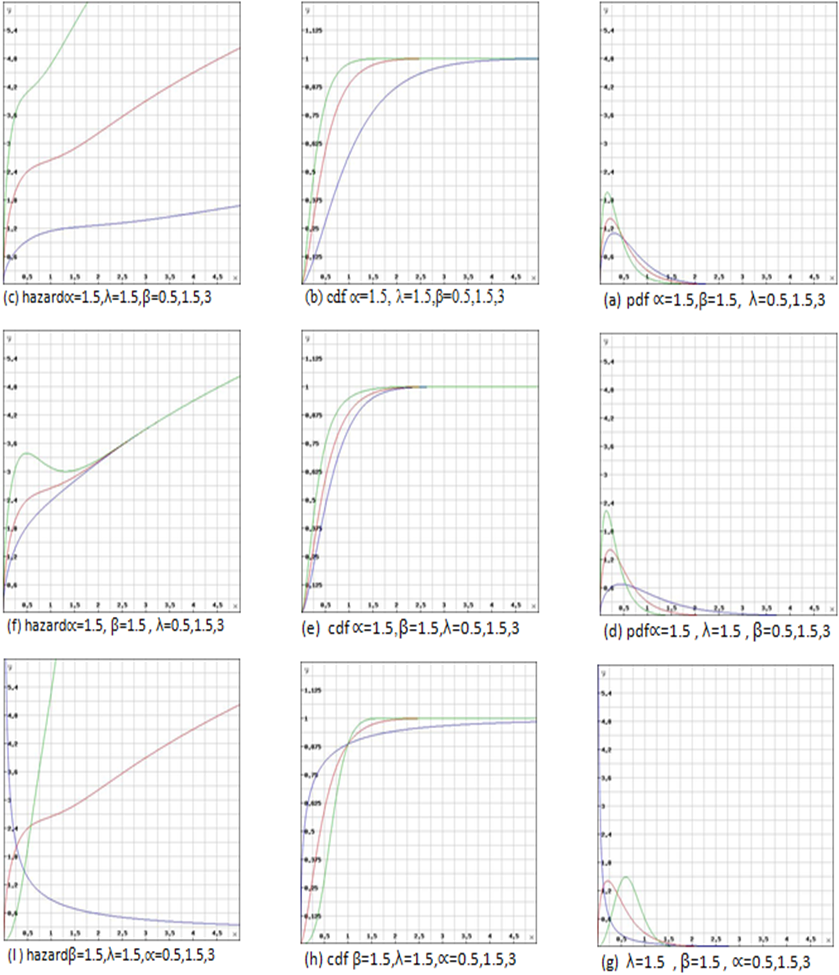
Figure 1 plots some shapes of the pdf, cdf and hazard functions of WPD.
2.1. The MomentsThe rth raw moment of the WP random variable  is,
is,
 |
Since  , then,
 | (6) |
The mean and variance of WP variable  are respectively,
 | (7) |
 | (8) |
The characteristic function of  is,
is,
 | (9) |
An entropy of a random variable  is a measure of variation of the uncertainty. The Shannon entropy (SE) of
  random variable
  can be found as follows,
 |
T0 solve
 |
T0 solve
 |
Since  , then,
 |
Let 
 |
Since 
Where  and
and  ,
, 
Put  ,
,  , then
 |
To solve
 |
So, the Shannon entropy is,
 | (10) |
Rènyi entropy of  random variable
  can be found as follows,
 | (11) |
The Kullback–Leibler divergence (KL) (or the relative entropy) is a measure of the difference between two probability distributions  and
and  . It is not symmetric in
  and
and  . In applications,
  typically represents the "true" distribution of data, observations, or a precisely calculated theoretical distribution, while
  typically represents a theory, model, description, or approximation of
  . Specifically, the Kullback–Leibler divergence of
  from
from  , denoted DKL(
 ), is a measure of the information gained when one revises ones beliefs from the prior probability distribution
  to the posterior probability distribution
  . More exactly, it is the amount of information that is lost when
  is used to approximate
  ,defined operationally as the expected extra number of bits required to code samples from
  using a code optimized for
  rather than the code optimized for
  .
.
Let  and
and 
Then,  , and,
 |
The Kullback–Leibler divergence can be found as follows,
 |
Since  and
and  and
and
 |
and
 |
Since  , then,
 |
and
 |
Then
 | (12) |
Inferences about R = P[Y < X], where  and
and  are two independent random variables, is very common in the reliability literature. For example, if
  is the strength of a component which is subject to a stress
  , then R is a measure of system performance and arises in the context of mechanical reliability of a system. The system fails if and only if at any time the applied stress is greater than its strength.
Let  and
and  be the stress and the strength random variables, independent of each other, follow respectively
  and
and  , then, the Stress-Strength reliability is,
 |
Since  and
and 
 | (13) |
3. Inverse Weibull-Poisson Distribution
In 2015 [2], Bera introduced Inverse Weibull-Poisson distribution (IWPD). He assumed that  has a truncated Poisson distribution with parameter
  with probability mass function which is defined in (1). Bera assumed also that
  to be independent and identically random variable having the Inverse Weibull density function defined by,
 |
Where  is the scale parameter and
  is the shape parameter.
If the random variables  and
and  are independent, then the random variable
  , Will distributed as Inverse Weibull-Poisson with the following probability density function,
 | (14) |
In this paper we will refer to Inverse Weibull-Poisson distribution by  , which is mean that the random variable
  follow Inverse Weibull-Poisson distribution with parameters
  and
and  .
.
Hassan, et al. in 2016 [4], studied Exponentiated Inverse Weibull-Power Series Family of Distributions by compounding the Inverse Weibull and Power Series distributions. In fact, they studied inclusively Inverse Weibull-Poisson distribution, since the Poisson distribution is special case from Power Series distribution.
The cdf of WPD, corresponding to (14) is obtained by,
 | (15) |
So, the reliability function of IWPD is,
 | (16) |
And the Hazard function is,
 | (17) |
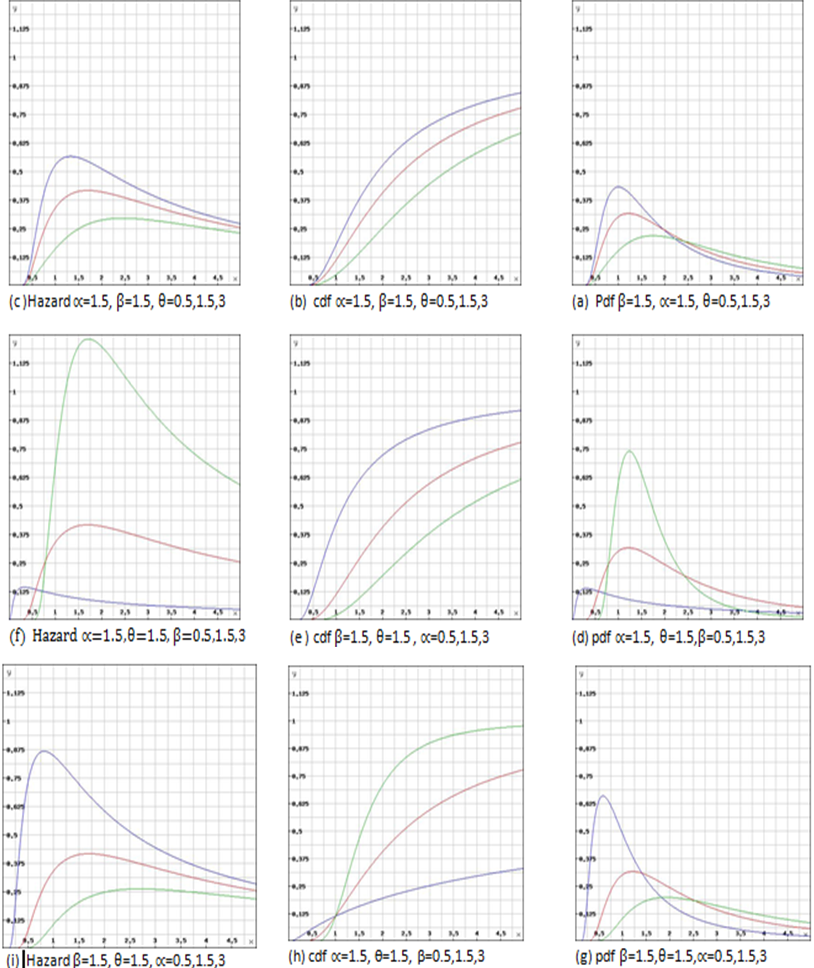
Figure 2 plots some shapes of the pdf, cdf and hazard functions of IWPD.
3.1. The MomentsThe rth raw moment of the IWP random variable is,
is,
 |
Since,  then,
then,
 | (18) |
So, the mean and variance of WP variable  are respectively,
 |
 |
 | (19) |
 Download as
The characteristic function of  is,
is,
 | (20) |
The Shannon entropy (SE) of  random variable
  can be found as follows,
 |
To solve 
Since 
 |
Let 
 |
By 
Where  , and
, and  ,
, 
 |
To solve
 |
To solve
 |
Then,
 | (21) |
Rènyi entropy of  random variable
  can be found as follows,
 | (22) |
Now, let  and
and 
Then,  , and
, and
 |
Then, the Kullback–Leibler divergence can be found as follows,
 |
Since 
 and
and 
and
 |
and
 |
To solve
 |
Then,
 | (23) |
Let Y and X be the stress and the strength random variables, independent of each other, follow respectively  and
and  , then the Stress-Strength reliability is,
 | (24) |
4. Summary and Conclusions
In view of the great importance of the Statistical lifetime distributions in lifetime data modeling. Recently, various methods of generating new distributions have been proposed in the statistical literature. Among these methods, the compounding of some discrete and important lifetime distributions has been in the foreword of lifetime modeling. So, several families of distributions were derived by compounding some useful lifetime and truncated discrete distributions. In this paper, properties of Weibull-Poisson distribution (WPD) and inverse Weibull-Poisson distribution (IWPD) is derived. We provide forms for characteristic function, rth raw moment, mean, variance, Shannon entropy function, Rényi entropy function and Relative entropy function. This paper deals also with the determination of stress-strength reliability R = P[Y < X] when X (strength) and Y (stress) are two independent WPD (IWPD) distributions with different parameters.
References
| [1] | Abramowitz, M. and Stegun, I. (1970). “Handbook of Mathematical Functions: with Formulas, Graphs, and Mathematical Tables”, 9-Revised edition, Dover Publications, USA. | ||
 In article In article | |||
| [2] | Bera, W. (2015). “The Kumaraswamy inverse Weibull Poisson distributions with applications”, MSc thesis of mathematics, Indiana University of Pennsylvania. | ||
| In article | |||
| [3] | DeMorais, A. (2009). “A class of generalized Beta distributions, Pareto power series and Weibull power series”, MSc thesis of statistics, Federal University of De Pernambuco. | ||
| In article | |||
| [4] | Hassan, A., Abd-Elfattah, A. and Moktar, A. (2016). “The Complementary Exponentiated Inverted Weibull Power Series Family of Distributions and its Applications”, British Journal of Mathematics & Computer Science 13(2): 1-20. | ||
| In article | View Article | ||
| [5] | Percontini, A., Blas, B. and Cordeiro, G. (2013). “The Beta Weibull Poisson distribution”, Chilean Journal of statistics, Vol.4, No.2, P.3-26. | ||
| In article | |||
 CiteULike
 Mendeley
 StumbleUpon
 Delicious
 Facebook
 Twitter
 LinkedIn