This paper presents a simple practical method to show the forces of the surface propeller during one cycle and the effect of the immersion depth and blade number on the performance of the surface propeller (SP). During one cycle of the propeller rotation, each blade enters the water and exits from it. The entry and exit angles are determined by the geometrical formulas. Three forces (thrust, horizontal and vertical forces) and torque are calculated by assuming that the thrust and torque are uniformly distributed on the blade. The results are presented at three immersed ratios (IT=0.25, 0.33, 0.5) for three blade numbers (Z=3, 4, 5). Many results of thrust and torque as well as horizontal and vertical forces are presented and discussed.
The purpose of designing high-speed vessels is to achieve the high speed that can be provided by the surface propeller. As in the case of the surface propeller apart from the design, choosing the propeller has its difficulties. The effective parameters are the selection of propeller, diameter, round shaft, immersion depth, and speed vessel design. There are several methods for the hydrodynamic analysis of the bodies with different mechanisms in surface or subsurface modes.
The use of software based on numerical analysis is one of the low-cost methods that facilities and equipment necessary for academic and industrial researchers are available to the public. But the results of these analyses cannot be trusted until they are validated by valid laboratory tests. Therefore, doing laboratory tests are the best way to achieve results and high accuracy. Today, related to the propeller, studies and different tests are done to increase efficiency. Because of the difficulties in this case, unfortunately, changing the maximum efficiency of about 2 to 4 percent, but how to use and the propeller working conditions, can be up to 30 percent efficiency is changing it. Since surface propellers operate in different operating conditions, they do not put into the category of standard propellers. The operating conditions of these types of propellers are such that part of the propeller is located underwater and the propeller shaft has expanded in the rear of the vessel. One of the features of a surface propeller is the low depth of the vessel underwater. This advantage is very impressive in high-speed applications, although it is evident throughout the performance range. In terms of the forces and moments entered on the propeller, the condition of the fluid flow is uniform and the water is free.
In the past, due to the advancement of software system processing power, most studies on surface piercing propellers have been based on a series of experimental tests. Most notably by Shiba 1, Hadler and Hecker 2, Roze and Kruppa 3, and Wang 4. The focus of all these studies was on determining the mean thrust, torque, bending moment, and lateral forces. The main weakness of these activities is not determining the amount of thrust and torque. In another experimental activity in which the amount of force is determined Olofsson 5, Miller and Szantyr 6, Dyson 7. The main activities in this research have been focused on determining the dynamic efficiency of SPPs. These researchers have been investigating the dynamical efficiency of SPPs and induction forces on shaft blades, and hub. The first numerical modeling of SPPs was carried out by Oberembt 8 using a numerical method and without taking into account the aeration parameter. In the following, Furuya 9 modeled on semi-immobility butterfly using a numerical method and taking into account the aeration parameter. Furuya also used the visualization method to examine the free surface but chose the primitive edge as the aeration site. Then, Wang et al. 10 Analyzed a three-dimensional hydrophilic using a numerical method in an unstable mode. 11 Savineau and Kinnas used numerical methods of the Two-dimensional boundary element to analyze the flow around a semi-submerged hydrofoil with full aeration 11. Caponnetto analyzes the SPPs using the RANS method 12. Ghassemi has studied the hydrodynamic parameters of the SPPs for the planning crafts 13. Himei investigated the numerical analysis of the SPPs in a steady-state and open-water mode using the RANS method. In this research, the geometry of the surfaces piercing propellers, related to Olafsson, has been analyzed and the obtained data are compared and verified by experimental test results 14. Ghassemi and Yari studied the behavior of the fluid flow around the SPPs and the effect of the aeration parameter using a calculating fluid dynamics method based on RANS equations. The results are compared with experimental results. These results have shown an increase in the thickness of the air area near the tip of the blade 15. In 2013, Himei, examined the behavior of the SPPs using two methods of the Vortex lattice method and VOF simulation. The results of numerical simulation RANS are shown to fit the experimental data 16. In 2022, Nouri et al. 17 investigated the effect of trailing edge shape on ventilation cavity development and SPP performance. The results showed, there was a 40% change in thrust and torque coefficients due to the trailing edge shape changes, which is a significant effect. However, changes in efficiency are about 7%. Meanwhile, the results revealed SPPs with a larger angle to the chord line and shorter height have better performance and ventilation cover behind the blade. Yousefi and Shafaghat 18 numerically investigated formation and development of ventilation in an SPP5.74 5-blade SPP by defining proper geometrical and physical parameters. The results showed that in the suction surface and the points where ventilation starts, the pressure tends to the atmospheric pressure, by reducing the advance coefficient, the thickness, and the length of the ventilation zone increase, in this condition, the ventilation zone moves towards the leading edge. In constant advance coefficients, increasing the radius ratio reduces the thickness and the length of the ventilation zone. Javanmard et al. 19 investigated the behavior of fluid flow around an optimized surface-piercing propeller and showed the highest thrust and efficiency of the key blade achieved at the regions near the rotation angle of 180°. Additionally, the total thrust of the blade section was decreased with increase of advance coefficient. Ghassemi et al. 20 reviewed and compared several surface drives system been designed for planing boats and the important factors to evaluate a surface drive system have later been investigated. The overall results showed that the best propulsion system have higher safety and reasonable price and lower maintenance cost per year and can provide more speed for boats. Hence, the articulated surface drives while having high hydrodynamic efficiency will be a priority for installation on most new planing craft.
As mentioned, most of the research has been carried out in a very limited range of advance coefficients. So far, no research has been done on the effect of immersion depth and shaft angle on the performance of Olofsson propeller. In this research, the effect of depth of immersion and number of blades are presented on thrust, torque and tangential force.
The most commonly used parameters in the design of a SP include the number of blades ( ), the Extended surface ratio
  the Diameter to Pitch ratio
  the advance coefficient (
 ), the Cavitation number (
 ), the Reynolds number (
 ). In equation (1), the effecting parameters on the hydrodynamic behavior of the surface propeller have been shown.
These parameters are including the coefficient of immersion and Weber's number ( ) to examine the performance of the propeller at the common surface of the water and air, the longitudinal angle (
 ) and the shaft axis horizontal angle (
 ).
).
 | (1) |
Another parameter is affecting the performance of the surface propeller is the immersion coefficient that is shown with ( ).
).
Changing the value of this parameter is making the thrust change 1.
The immersion coefficient is defined in equation (2):
 | (2) |
In this equation, ( ) is the depth immersion and (
 ) is the diameter of the propeller.
The advance coefficient is defined according to equation (3).
 | (3) |
According to equations (2) and (3), the coefficients of the thrust and torque of the propeller in the SP are defined as equations (4) and (5).
 | (4) |
 | (5) |
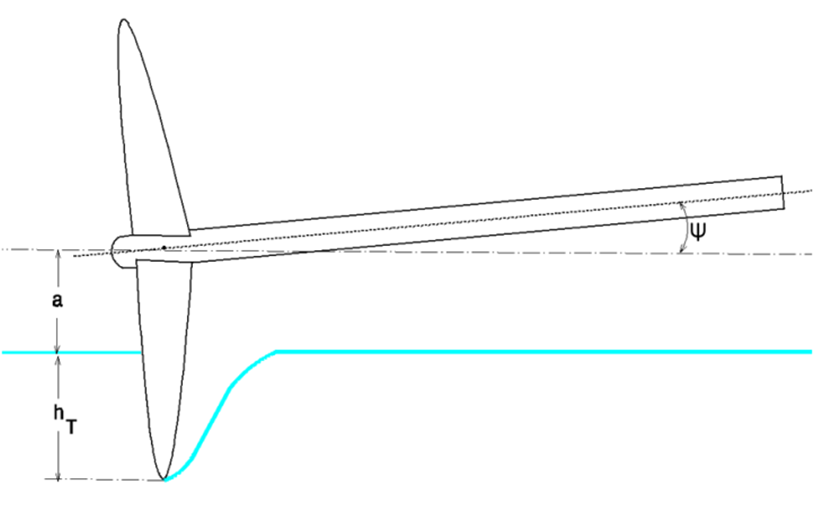
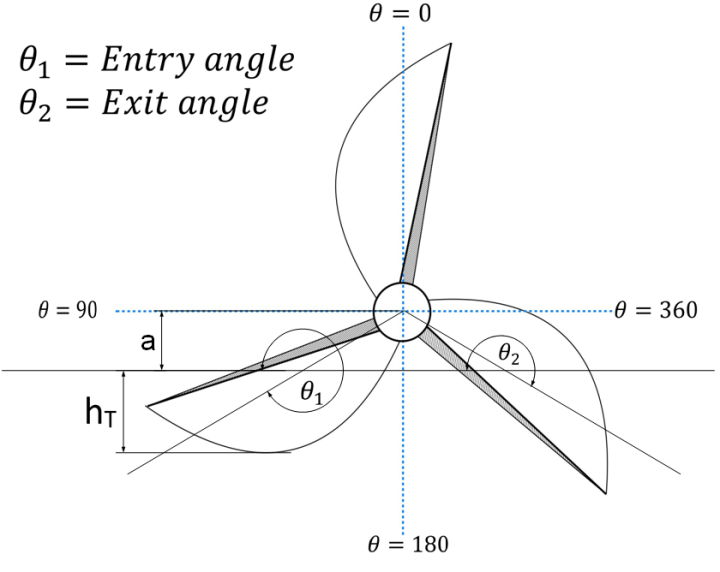
The geometric characteristics of the surface propeller, which have been investigated in this analysis, are shown in the following table. Table 1 includes all items which we will use on the way to a solution such as the diameter of propeller, diameter of the hub, number of blades, advance speed, rotating speed, advance coefficient, and immersion depth to diameter. In Figure 1 and Figure 2 some of the important characters are introduced. For instance, in Figure 1 side view of the surface propeller has been represented which the back of the propeller is dry due to the pressure drop. In Figure 2 the entry angle ( ) and exit angle (
 ) are clearly shown. According to the figures propeller axis above water is displayed as a and hT is the distance between open water and the lead of the blade of the propeller which it places lowest from the surface. The a and hT are shown in both side and front views in Figure 1 and Figure 2. The symbol of (
 ) in Figure 1 is the trust angle of the propeller which is an angle between the shaft and the horizon.

In this paper, the thrust and torque of the SP are investigated based on immersion depth variations, number of blades, and propeller pitch ratio.
First, the range of entry angle into the water and the exit angle from the water should be determined.
So, those angles are obtained from the following equations:
 | (6) |
 | (7) |
The angle range of  is between
  and
and  , and it depends both on the radius of the propeller and the propeller’s axial distance to the water.
The MATLAB code is a regression and variable, it means based on the propeller radius is constant and is variable in the distance between the propeller shaft to the water in the desired range. The  is changed with a 2-degree step in MATLAB code.
The radius on the inner edge of the immersed blade depends on the  and the distance between the impeller axis and the water surface. The regression code for each (
 ) It changes, at different angles.
The radius of the inner edge of the immersed blade is obtained from the following equation:
 | (8) |
The length of the immersed blade is obtained by subtracting the radius at the inner edge of the blade immersed and the propeller radius.
 | (9) |
The thrust and torque of the blade are obtained from the following equations:
 | (10) |
 | (11) |
The rate of thrust rate and rate of torque are fixed and the length of the immersed edge is varied. The thrust and torque formulas are dependent on the length of the change of the immersed edge, which depends on changes in the radius at the inner edge of the blade. In this code, the thrust and torque of the blade are introduced into regression and change according to the radius changes on the blade's inner edge.
According to the following equation to the torque rate, the radius of the impeller and the radius on the inner edge of the immersed blade depend on:
 | (12) |
Horizontal component:
 | (13) |
Vertical component:
 | (14) |
As mentioned, the  is changed with a 2-degree step in MATLAB code. Thus, the tabular of thrust and torque and tangential force (tangential force can be divided into two vertical and horizontal components) and the radius at the internal edge of the blade is obtained as regression. Equation (15) is the thrust of the he propeller, based on the number of blades.
 | (15) |
Table 1 is prepared with a 2-degree step. According to equation (15), each blade after 360 / z is repeated alternatively.
By collecting the thrust blades at any angle, the total thrust is obtained at any angle. The average thrust was gotten by Simpson’s rules.
First, at each angle, the Simpson coefficient and the total thrust in any angle were multiplied. Then, the results were obtained from each angle and put in the formula given by Simpson's rules, and the average thrust was obtained. This method is also used to obtain torque and vertical force and horizontal force. Using the extracted results in each ( ), the force loading diagram of your propeller can be displayed.
The coding results in the MATLAB program are presented in graphs at different immersion depths and a different number of blades. Three immersion depths and three different numbers are considered for the present calculations. Here, for all calculations, the rate of thrust and torque are 45kN/m and 14.5kN-m/m respectively, and they are given for one blade. All operating conditions are given in Table 1.
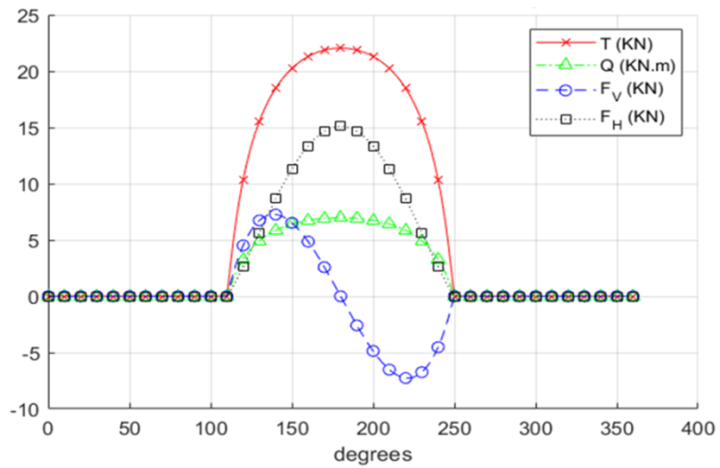
At first, the model test was chosen from the Basic ship propulsion book 21. The results of which were perfectly consistent. Then, the results on one blade with the dimensions and specifications are presented and shown in diagram one in Figure 3. From each chart, the average of each parameter was extracted and the results presented in the following diagram (from Figure 4 to Figure 12).
As described, Figure 3 represents loading of a surface propeller for one blade during one cycle which is in the water from an angle of 100 degrees to 250 degrees.


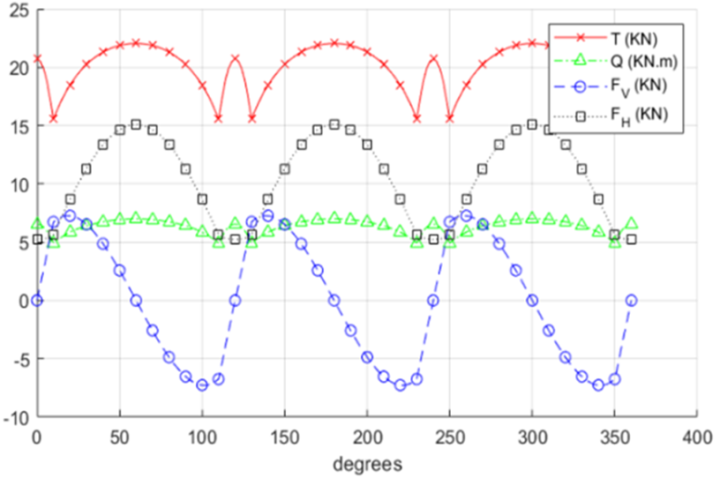
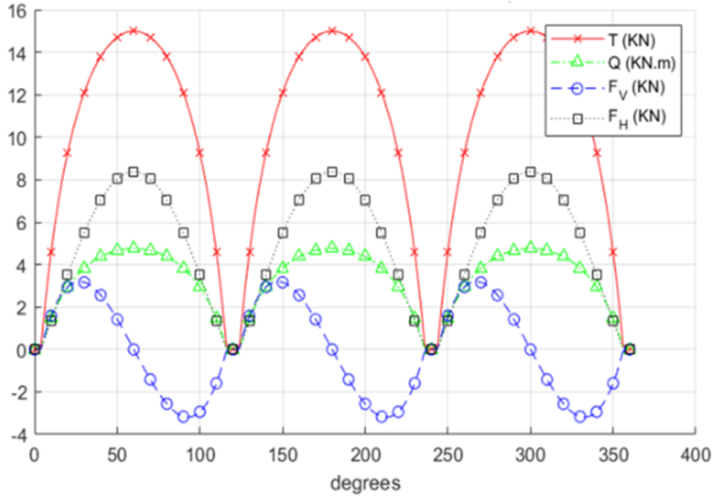
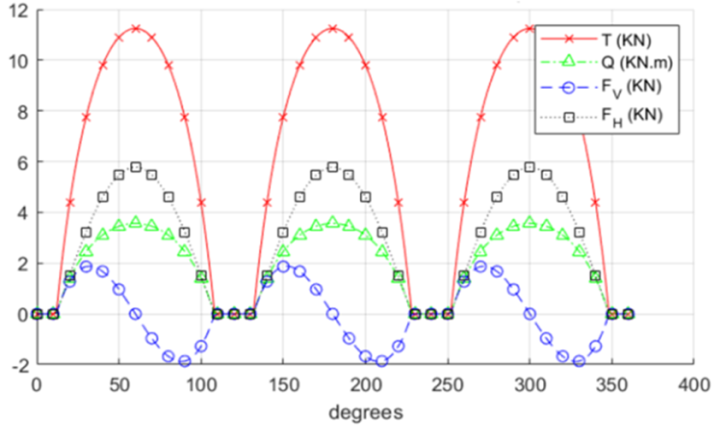
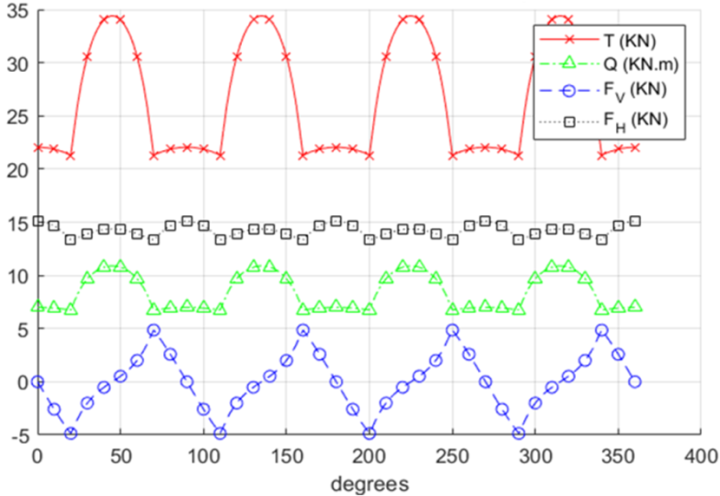
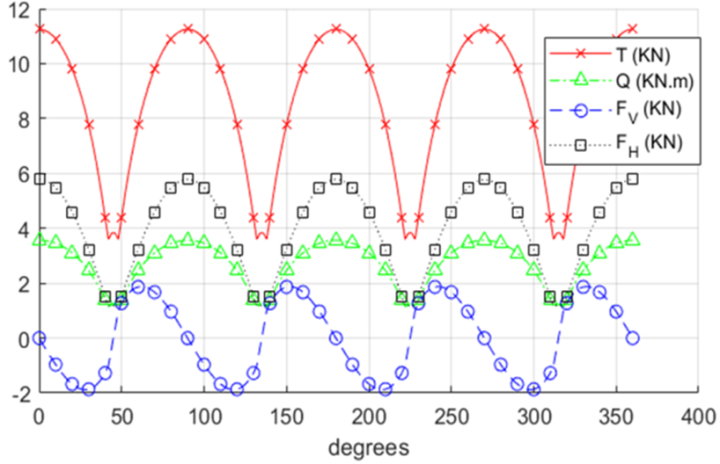
Figure 4, Figure 5 and Figure 6 display the loading of a three-blade surface propeller with various immersion depths.

 =0.5
=0.5


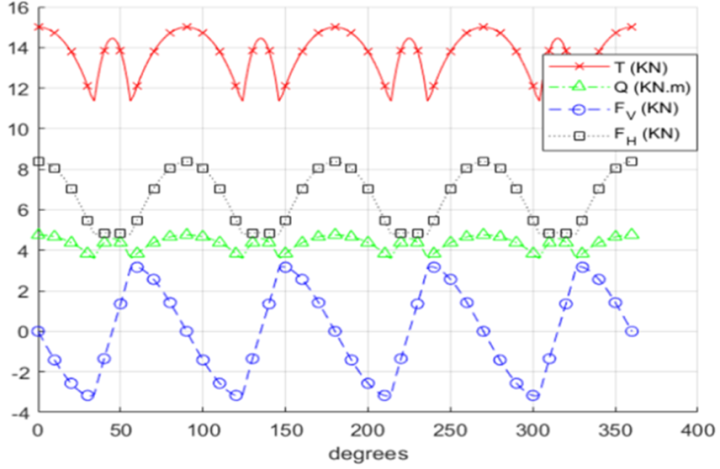
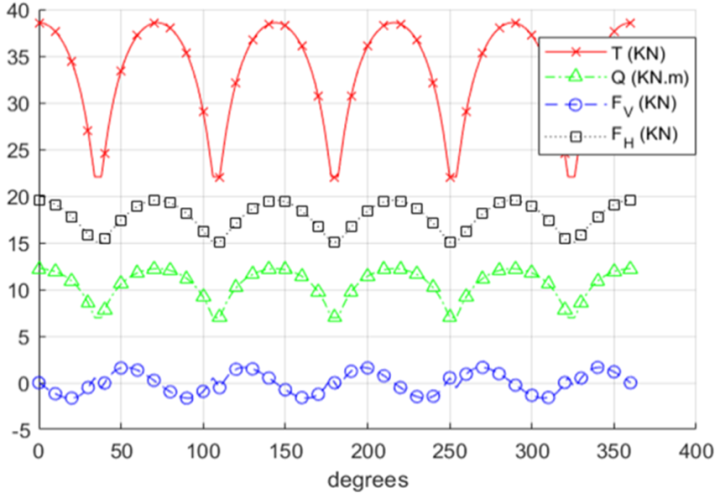
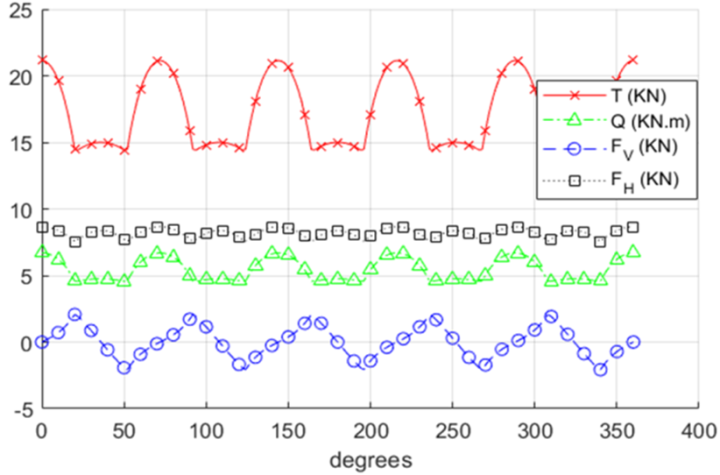
Same as previous Figures, we can observe loading of a four-blade surface propeller with various immersion depths in Figure 7, Figure 8 and Figure 9.

 =4 and


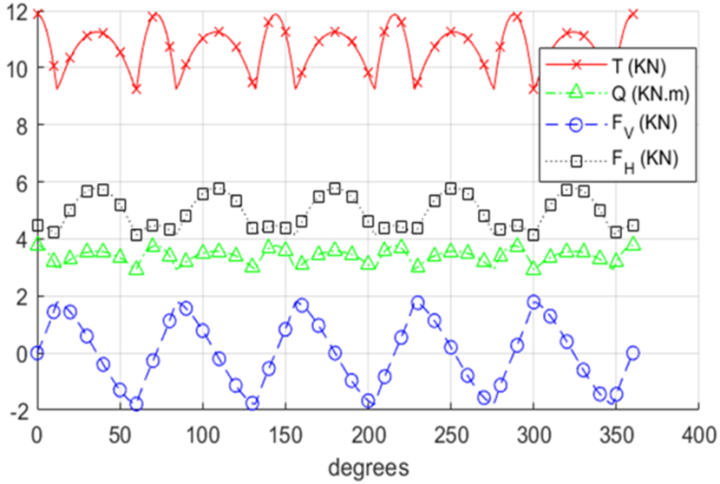
Also, Figure 10, Figure 11 and Figure 12 show loading of a five-blade surface propeller with various immersion depths.


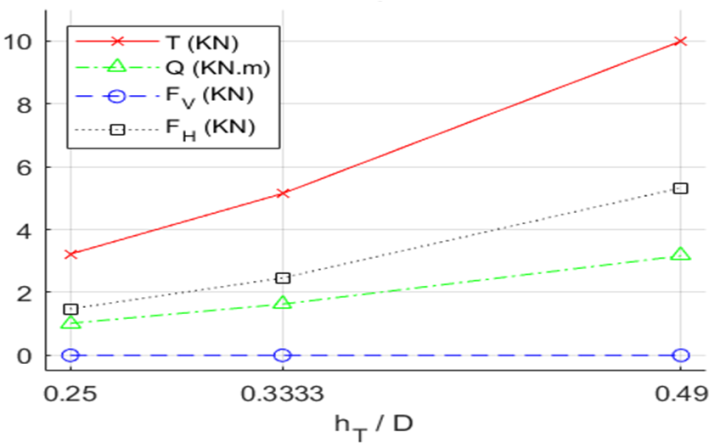
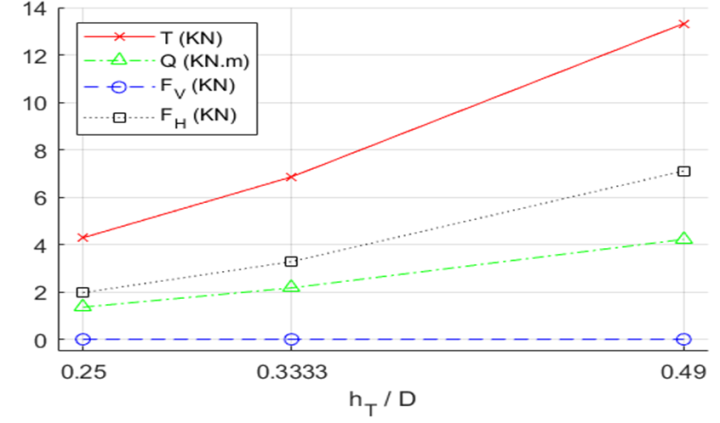
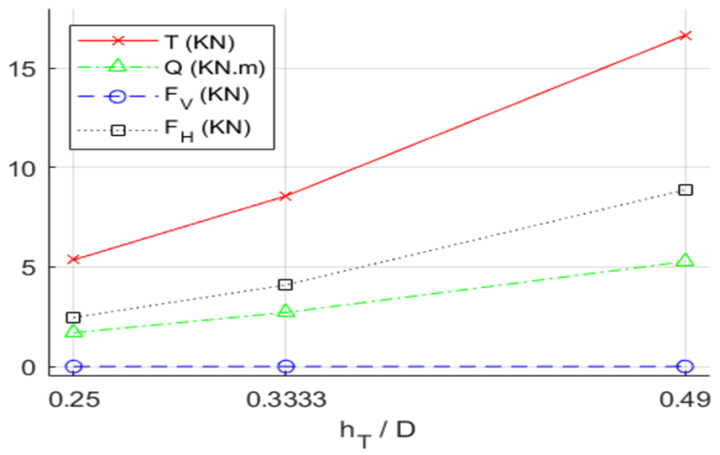
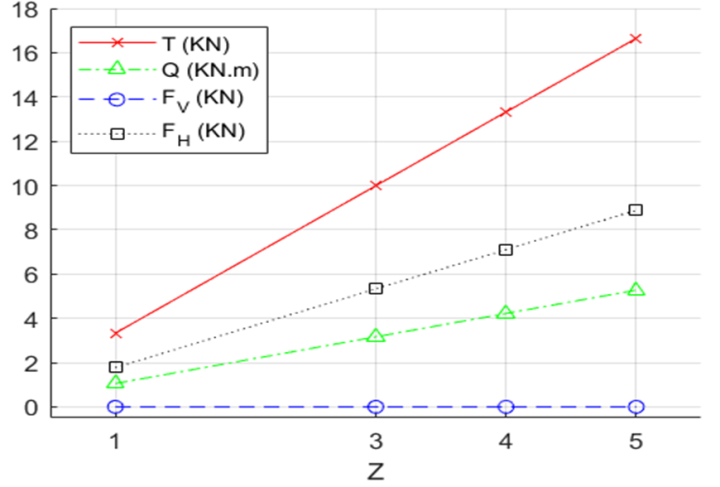
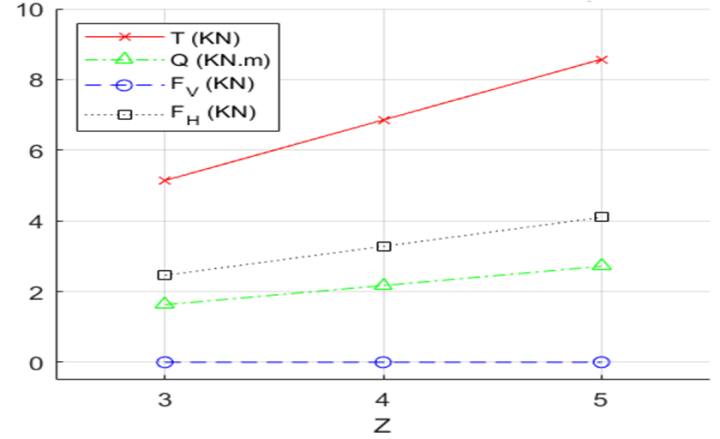
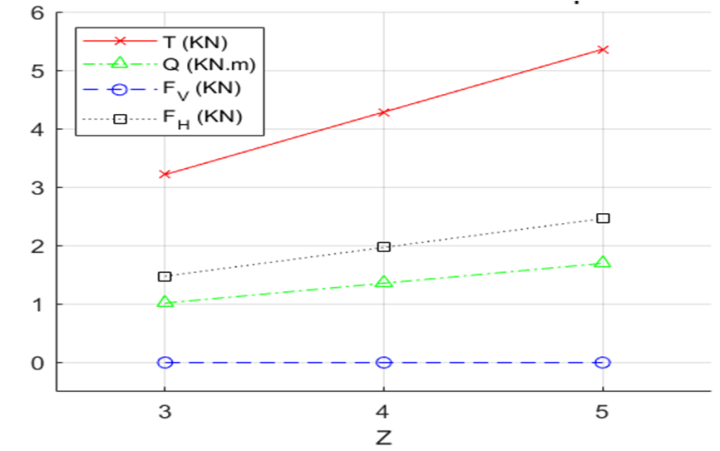
Figure 13, Figure 14 and Figure 15 are display the thrust, torque and horizontal and vertical forces against an immersed ratio for different blade numbers. Based on these results, thrust, torque and horizontal force are increased when the immersed ratio increases, while the vertical force is constant at all immersed ration.

 when
when 

 when
when 

 when
when 
Then, the effect of the number of blades on each immersion depth were investigated. The diagram of each blade is based on the average value of the parameters as follows in Figure 16, Figure 17 and Figure 18.


It can be seen that increasing the number of blades caused the parameters of torque and tangential force to increase.
In Figure 16, the average values of the parameters for one blade are also given and at immersion depth hT/D=0.5, the increasing number of blades made more thrust, torque, and horizontal force, but no change on the vertical force.
Practical formulas are employed to calculate the thrust, torque, and horizontal and vertical forces of the SP during one cycle. Different blade numbers and immersion depths are considered. Based on the results, the following conclusions can be drawn:
• All forces and torque have fluctuating loads during one cycle.
• With increasing the immersion depth, all forces and torque acting on the propeller increased except vertical force.
• The amplitude for the loads is decreased when the immersion depth and blade number are increased.
| [1] | Shiba, H., Air-drawing of marine propellers, Technical Report 9, Transportation Technical Research Institute. (1953). | ||
| In article | |||
| [2] | Hadler, J. and Hecker, R., Performance of partially submerged propellers, In The 7th ONR Symposium on Naval Hydrodynamics, Rome, Italy. (1968). | ||
| In article | |||
| [3] | Rose, J. C. and Kruppa, C. F. L., Surface piercing propellers –methodical series model test results, In FAST’91, Norway. (1991). | ||
| In article | |||
| [4] | Wang, D, Water entry and exit of a fully ventilated foil, Journal of Ship Research, 21:pp. 44-68. (1977). | ||
| In article | View Article | ||
| [5] | Olofsson, N, Force and Flow Characteristics of a Partially Submerged Propeller, PhD thesis, Department of Naval Architecture and Ocean Engineering, Chalmers University of Technology, G¨oteborg, Sweden, (1996). | ||
| In article | |||
| [6] | Miller, W. and Szantyr, J, Model experiments with surface piercing propellers, Ship Technology Research, 45: pp.14-21, (1998). | ||
| In article | |||
| [7] | Dyson, P. K, The Modelling, Testing and Design, of a Surface Piercing Propeller Drive, PhD thesis, Department of Mechanical and Marine Engineering, Plymouth University. (2000). | ||
| In article | |||
| [8] | Oberembt, H, Zur bestimmung der instation¨aren fl¨ugelkr¨afte bei einem propeller mit aus dem wasserherausschlagenden fl¨ugeln, Technical report, Inst.f¨ur Schiffau der Universit¨at Hamburg, Bericht Nr. 247. (1968). | ||
| In article | |||
| [9] | Furuya, O, A performance prediction theory for partially submerged ventilated propellers, Journal of Fluid Mechanics, 151:pp. 311-335. (1985). | ||
| In article | View Article | ||
| [10] | Wang, G., Jia, D., and Sheng, Z, Hydrodynamic performance of partially submerged ventilated propeller, Shipbuilding of China, (2). (1990). | ||
| In article | |||
| [11] | Savineau, C. and Kinnas, S, A numerical formulation applicable to surface piercing hydrofoils and propellers, In 24th American Towing Tank Conference, Texas A&M University, College Station, TX (1995). | ||
| In article | View Article | ||
| [12] | Mario Caponnetto, RANSE Simulations of Surface Piercing Propellers, Rolla Research. (2002). | ||
| In article | |||
| [13] | Ghassemi, H., Hydrodynamic characteristics of the surface-piercing propellers for the planing craft. J. Mar. Sci. Appl. 8 (4), 2009. | ||
| In article | View Article | ||
| [14] | Kohei Himei, Numerical Analysis of Unsteady Open Water Characteristics of Surface Piercing Propeller". Third International Symposium on Marine Propulsors smp’13, Launceston, Tasmania, Australia, 292-297 (2013). | ||
| In article | |||
| [15] | Yari E, Gassemi H, Investigation behavior of spp in free surface phenomena, 17th marine conference. (2015). | ||
| In article | |||
| [16] | Himei, Kohei., Numerical analysis of unsteady open water characteristics of surface piercing propeller, Third International Symposium on Marine Propulsors smp. Vol. 13. | ||
| In article | |||
| [17] | Kamran M., Nouri N.M., Askarpour H., Numerical Investigation of the Effect of Trailing Edge Shape on Surface-Piercing Propeller Performance, Applied Ocean Research. (2022). | ||
| In article | View Article | ||
| [18] | Yousefi, A., Shafaghat, R., Numerical study of the parameters affecting the formation and growth of ventilation in a surface-piercing propeller, Applied Ocean Research. (2020). | ||
| In article | View Article | ||
| [19] | Javanmard R., Yari E., Javad Mehr A., Mansoorzadeh S., Hydrodynamic characteristic curves and behavior of flow around a surface-piercing propeller using computational fluid dynamics based on FVM, Ocean Engineering. (2019). | ||
| In article | View Article | ||
| [20] | Ali Eskafi Noghani, Hassan Ghassemi, and Gholam Reza Parvizi., A Review of the Surface Drives Employed for High Speed Planing Craft, American Journal of Mechanical Engineering, vol. 5, no. 4 (2017). | ||
| In article | |||
| [21] | Ghose, J. P. & Gokarn, R. P. Basic ship propulsion (Chapter 12), New Delhi, Sunil Sachedev. (2004). | ||
| In article | |||
Published with license by Science and Education Publishing, Copyright © 2022 Mahan Eskandari and Hassan Ghassemi
 This work is licensed under a Creative Commons Attribution 4.0 International License. To view a copy of this license, visit
http://creativecommons.org/licenses/by/4.0/
This work is licensed under a Creative Commons Attribution 4.0 International License. To view a copy of this license, visit
http://creativecommons.org/licenses/by/4.0/
| [1] | Shiba, H., Air-drawing of marine propellers, Technical Report 9, Transportation Technical Research Institute. (1953). | ||
| In article | |||
| [2] | Hadler, J. and Hecker, R., Performance of partially submerged propellers, In The 7th ONR Symposium on Naval Hydrodynamics, Rome, Italy. (1968). | ||
| In article | |||
| [3] | Rose, J. C. and Kruppa, C. F. L., Surface piercing propellers –methodical series model test results, In FAST’91, Norway. (1991). | ||
| In article | |||
| [4] | Wang, D, Water entry and exit of a fully ventilated foil, Journal of Ship Research, 21:pp. 44-68. (1977). | ||
| In article | View Article | ||
| [5] | Olofsson, N, Force and Flow Characteristics of a Partially Submerged Propeller, PhD thesis, Department of Naval Architecture and Ocean Engineering, Chalmers University of Technology, G¨oteborg, Sweden, (1996). | ||
| In article | |||
| [6] | Miller, W. and Szantyr, J, Model experiments with surface piercing propellers, Ship Technology Research, 45: pp.14-21, (1998). | ||
| In article | |||
| [7] | Dyson, P. K, The Modelling, Testing and Design, of a Surface Piercing Propeller Drive, PhD thesis, Department of Mechanical and Marine Engineering, Plymouth University. (2000). | ||
| In article | |||
| [8] | Oberembt, H, Zur bestimmung der instation¨aren fl¨ugelkr¨afte bei einem propeller mit aus dem wasserherausschlagenden fl¨ugeln, Technical report, Inst.f¨ur Schiffau der Universit¨at Hamburg, Bericht Nr. 247. (1968). | ||
| In article | |||
| [9] | Furuya, O, A performance prediction theory for partially submerged ventilated propellers, Journal of Fluid Mechanics, 151:pp. 311-335. (1985). | ||
| In article | View Article | ||
| [10] | Wang, G., Jia, D., and Sheng, Z, Hydrodynamic performance of partially submerged ventilated propeller, Shipbuilding of China, (2). (1990). | ||
| In article | |||
| [11] | Savineau, C. and Kinnas, S, A numerical formulation applicable to surface piercing hydrofoils and propellers, In 24th American Towing Tank Conference, Texas A&M University, College Station, TX (1995). | ||
| In article | View Article | ||
| [12] | Mario Caponnetto, RANSE Simulations of Surface Piercing Propellers, Rolla Research. (2002). | ||
| In article | |||
| [13] | Ghassemi, H., Hydrodynamic characteristics of the surface-piercing propellers for the planing craft. J. Mar. Sci. Appl. 8 (4), 2009. | ||
| In article | View Article | ||
| [14] | Kohei Himei, Numerical Analysis of Unsteady Open Water Characteristics of Surface Piercing Propeller". Third International Symposium on Marine Propulsors smp’13, Launceston, Tasmania, Australia, 292-297 (2013). | ||
| In article | |||
| [15] | Yari E, Gassemi H, Investigation behavior of spp in free surface phenomena, 17th marine conference. (2015). | ||
| In article | |||
| [16] | Himei, Kohei., Numerical analysis of unsteady open water characteristics of surface piercing propeller, Third International Symposium on Marine Propulsors smp. Vol. 13. | ||
| In article | |||
| [17] | Kamran M., Nouri N.M., Askarpour H., Numerical Investigation of the Effect of Trailing Edge Shape on Surface-Piercing Propeller Performance, Applied Ocean Research. (2022). | ||
| In article | View Article | ||
| [18] | Yousefi, A., Shafaghat, R., Numerical study of the parameters affecting the formation and growth of ventilation in a surface-piercing propeller, Applied Ocean Research. (2020). | ||
| In article | View Article | ||
| [19] | Javanmard R., Yari E., Javad Mehr A., Mansoorzadeh S., Hydrodynamic characteristic curves and behavior of flow around a surface-piercing propeller using computational fluid dynamics based on FVM, Ocean Engineering. (2019). | ||
| In article | View Article | ||
| [20] | Ali Eskafi Noghani, Hassan Ghassemi, and Gholam Reza Parvizi., A Review of the Surface Drives Employed for High Speed Planing Craft, American Journal of Mechanical Engineering, vol. 5, no. 4 (2017). | ||
| In article | |||
| [21] | Ghose, J. P. & Gokarn, R. P. Basic ship propulsion (Chapter 12), New Delhi, Sunil Sachedev. (2004). | ||
| In article | |||