Neurenteric cysts, also known as endodermal cysts and enterogenous cysts, are rare benign cysts. Neurenteric cysts may be associated with congenital malformations, such as spinal dysraphism, or may occur as solitary lesions. Most are located in the spine, in the intradural, extramedullary and intraspinal space. Rare examples may occur intracranially, and rarer examples may occur at the craniovertebral junction. Clinically, solitary neurenteric cysts present with mass effect symptoms such as compression of spinal cord and adjacent nerve roots. We present a case of a 28-year-old male patient with a histologically confirmed neurenteric cyst located at the cervicomedullary or craniovertebral junction with presenting symptoms of neck pain and severe debilitating weakness of all four limbs. The patient underwent successful surgical resection, with gradual improvement in his symptoms. We also present a review of literature, including the clinical features, histological characteristics, and management options for patients with neurenteric cyst in the craniovertebral junction.
Neurenteric cysts (NCs), also known as endodermal cysts and enterogenous cysts, are rare benign cysts that are lined by the endodermal-derived epithelium. NCs of the central nervous system are most commonly seen in the ventral location of the lower cervical and upper thoracic region of the spinal cord and rarely in the intracranial compartment, making up to 1.3% of all spinal tumors and 0.15%-0.35% of all intracranial tumors 1. Intracranial NCs are extremely rare, and only about 80 cases of intracranial NCs have been reported in the literature, with location including midline posterior fossa, cerebellopontine angle, lateral and fourth ventricle, brain stem and very rarely in the supratentorial cerebral hemispheres 2. The NCs at the craniovertebral junction (CVJ) are even more uncommon, with lesser than 40 reported cases in published literature 2.
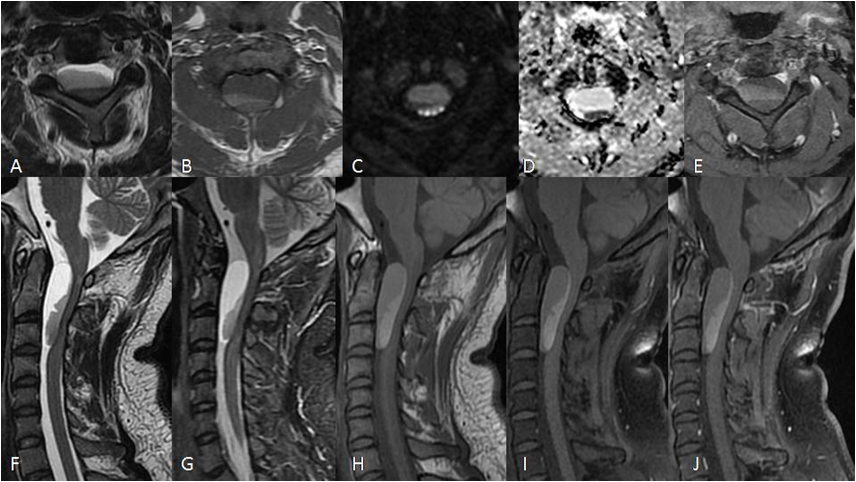
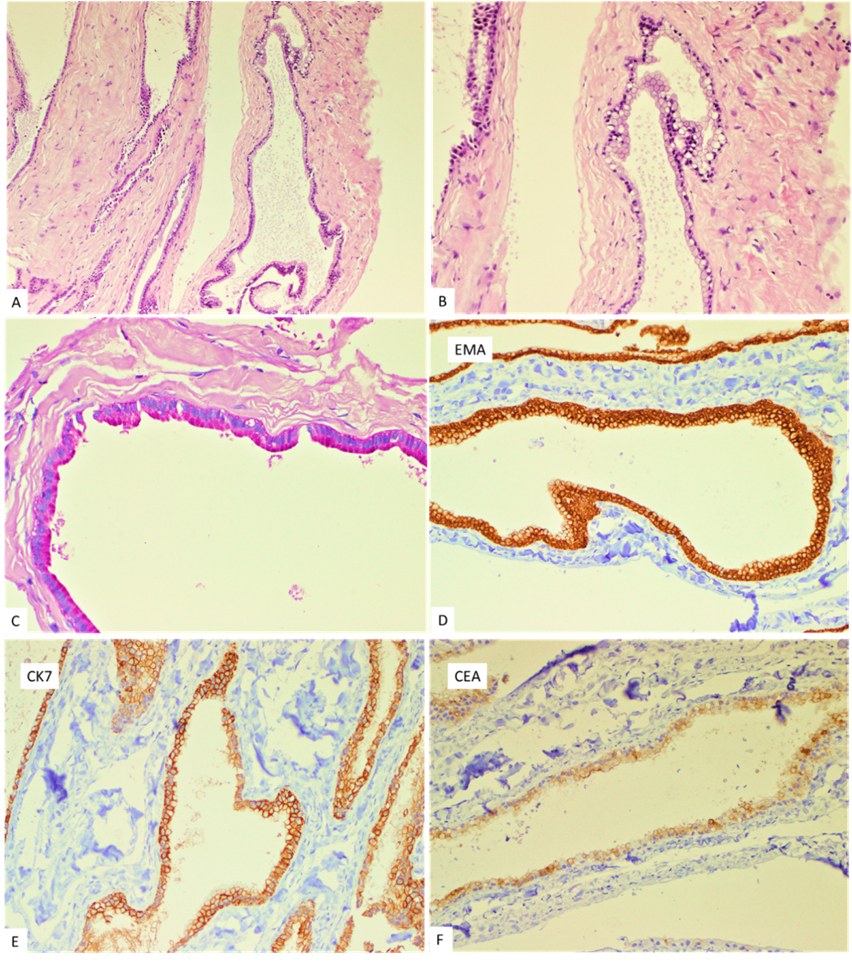
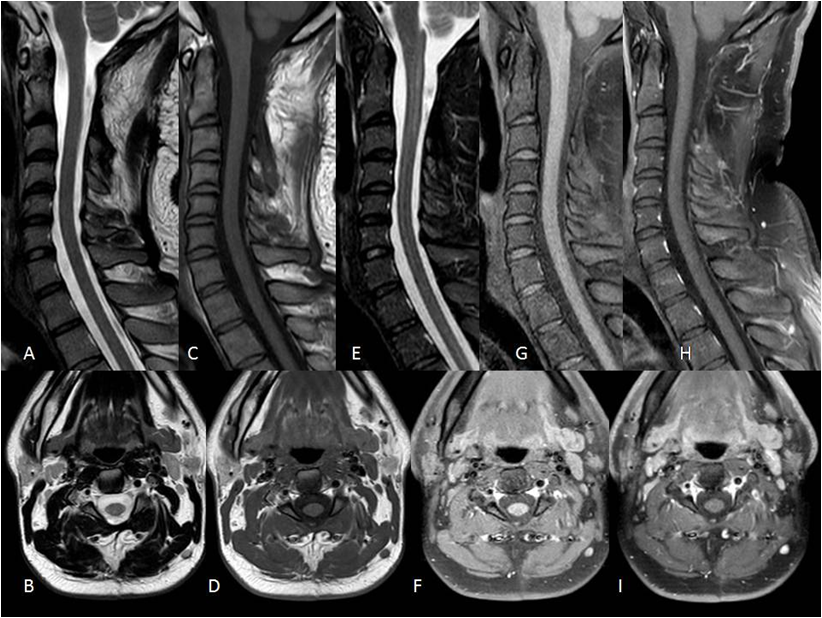
We report a case of 28-year-old healthy male who presented to our hospital with complaints of neck pain for 1 month and progressively increasing weakness in all four limbs, with inability to walk since 3 days, to the extent of being bed ridden at hospital admission. Patient on physical examination had weakness in all four limbs, with power of 2/5, increased muscle tone and exaggerated tendon reflexes with positive Hoffman test. Magnetic resonance image (MRI) of the cervical spine (Figure 1) showed a large 5.1 x 1.6 cm anterior cervicomedullary - cervical extradural non-enhancing hemorrhagic cystic mass, with posterior non-enhancing slightly lobulated soft tissue component. The spinal cord showed marked compression at the cervicomedullary junction down to C3 level with early myelopathic cord signal changes. A radiological differential diagnosis of a solitary neurenteric cyst or an arachnoid cyst complicated with hemorrhage was considered. Patient was explained all the possible risks and benefits of the surgery, and once he consented, he underwent surgery, which included far-lateral approach with cervical laminectomy of C1 to C3 and excision of the cystic mass. During the surgery the cyst revealed yellowish contents. Patient had an uneventful post-operative period, and he started improving gradually with physiotherapy, and he was later seen in our out-patient clinic, a few months after the operation, walking with a walking stick. Histopathology reported the lesion to be a neurenteric cyst as per Figure 2. Patient had a post-operative MRI as per Figure 3, which showed complete excision of the cyst.
Neurenteric cysts are rare benign, endodermal-derived cysts encountered mostly in the intradural extramedullary spinal compartment, with very rare examples occurring intracranially, and at the craniovertebral junction 1. Neurenteric cysts occur usually as solitary lesions, but they may also occur with additional congenital malformations, especially those in the lumbosacral region, which are often associated with spinal dysraphism. Occasional cases are encountered in the setting of additional developmental vertebral, visceral, or cardiac malformations, and rare cases may be associated with Currarino-Silverman syndrome 3. There is a male predominance (> 60%) in both groups 4.


Clinically, solitary neurenteric cysts present with symptoms associated with mass effect such as compression of adjacent structures such as the spinal cord and adjacent nerve roots. Neurenteric cysts associated with malformations usually present with symptoms caused by the particular defect (e.g. symptoms associated vertebral deformity, cardiac anomalies, etc.) 3.
Histologically, neurenteric cysts are lined endodermal-derived epithelium, which may be composed of single-layered or pseudostratified cuboidal or columnar, ciliated or non-ciliated epithelium, resembling gastrointestinal or respiratory epithelium, sitting on a basement membrane 5.
Surgically, the ideal surgical approach to the lesions at the craniovertebral junction is the transcondylar or a far-lateral approach. Other approaches that have been used by various surgeons include transoral, transclival, endoscopic endonasal, suboccipital, retrosigmoid, and subtemporal approaches 6. Failure of employing an appropriate surgical approach leads to a higher chance of subtotal resection and subsequent recurrence. By employing the far-lateral approach in 2013, team lead by Sathwik were able to achieve total excision in two of their patients with craniovertebral neurenteric cysts, but he opined that for a more ventrally located neuroenteric cyst, the transcondylar approach might be better 2. In 1998, Fuse reported two cases of craniovertebral junction neurenteric cysts, presenting with delayed diagnosis due to intermittent progression of neurologic symptoms. In one case, there was marked enlargement of the cyst, which was detected on serial imaging studies, and the subsequent pathological examination of the excised cystic lesion revealed neurenteric cyst with rupture, confirmed by immunohistochemical analysis of the cyst wall. Fuse’s team did total resection of the cysts by utilizing transoral or suboccipital approaches, as the cysts were not firmly adherent to surrounding neural structures 7. In 1992, Lee reported a rare case of neurenteric cyst in the foramen magnum, in which the patient presented with a central cord syndrome and dysfunction of the lower cranial nerves. The magnetic resonance imaging of the patient revealed a cystic lesion over the lower medulla oblongata and C1-2 spinal cord, with a radiological differential diagnosis of a neurenteric cyst or an epidermoid cyst. A successful total resection of the cyst was performed by the surgeons. Histology revealed the lesion to be a neurenteric cyst lined by a mucus-secreting columnar epithelium, with lumen containing highly proteinaceous supernatant and thick mucus deposits, and the patient recovered dramatically after surgery 8. In 1999, K Abbe reported a case of a 60-year-old female presenting with occipital headache and limitation of neck movement. Neurological examination revealed weakness of the right sternocleidomastoid muscle. Magnetic resonance imaging revealed a cystic lesion at the craniovertebral junction causing posterior compression of the brain stem. The lesion was totally excised through transcondylar approach and the histological diagnosis revealed the lesion to be a neurenteric cyst. The surgeon felt that the transcondylar approach gave him a direct operative view of the clivus and anterior craniovertebral junction 9.
Post-operatively, it is recommended the patients are clinically and radiologically followed-up for a period of at least 10 years 10. The reason for the long follow-up is due to the variability of recurrence of these lesions which ranges from 11.9 to 37%, with timeline of recurrence ranging from 4 months to 14 years postoperatively. Recurrence rate is especially higher when suboptimal surgical approach leads to partial resection of the neurenteric cyst 11.
To conclude neurenteric cyst at craniovertebral junction is a rare condition and excision may be achieved by various approaches as mentioned in the literature. Our case was tackled by a far-lateral approach, with a fair outcome and is currently under follow-up with aggressive rehabilitation.
| [1] | L. Wang, J. Zhang, Z. Wu, L. Zhang, S Hao, et al. Diagnosis and management of adult intracranial neurenteric cysts. Neurosurgery, 68 (1) (2011), pp. 44-52. | ||
| In article | View Article PubMed | ||
| [2] | Sathwik Raviraj, Shetty, Manas Panigrahi, Satish Rao, et al. Neurenteric cyst at the craniovertebral junction: A report of two cases. Asian J Neurosurg. 2013 Oct-Dec; 8(4): 188-191. | ||
| In article | View Article PubMed | ||
| [3] | CR Thambidorai, I Muin, J Razman, et al. Currarino triad with dual pathology in the presacral mass: report of a case. Dis Colon Rectum. 46: 974-977. 2003 12847376. | ||
| In article | View Article PubMed | ||
| [4] | TS Paleologos, M Thom, DG Thomas. Spinal neurenteric cysts without associated malformations. Are they the same as those presenting in spinal dysraphism? Br J Neurosurg. 14: 185-194 2000. 1091219. | ||
| In article | View Article PubMed | ||
| [5] | R Wilkins, G Odom. Spinal intradural cysts. In; Vinken P, Bruyn G eds. Handbook of Clinical Neurology. Amsterdam: North-Holland, 1976; 55-102. | ||
| In article | |||
| [6] | Shi W, Cui DM, Shi JL, Gu ZK, Ju SQ, Chen J. Microsurgical excision of the craniocervical neurenteric cysts by far-lateral transcondylar approach: Case report and review of the literature. Skull base. 2010; 20: 435-42. | ||
| In article | View Article PubMed | ||
| [7] | T Fuse , K Yamada, K Kamiya, H Inagaki, Formos. Neurenteric cyst at the craniovertebral junction: report of two cases. Surg Neurol 1998 Nov; 50(5): 431-6. | ||
| In article | View Article | ||
| [8] | W Y Lee, H M Tseng, M C Lin, S M Chuang. Neurenteric cyst at craniocervical junction: report of a case. Med Assoc 1992 Jul; 91(7): 722-4. | ||
| In article | |||
| [9] | K Abe , K Oyama, K Mori, S Ishimaru, M Eguchi, M Maeda. Neurenteric cyst of the craniocervical junction-case report. Neurol Med Chir (Tokyo) 1999 Nov; 39(12): 875-80. | ||
| In article | View Article PubMed | ||
| [10] | A.J. Gauden, V. G. Khurana, A.E. Tsui, A.H. Kaye. Intracranial neuroenteric cysts: a concise review including an illustrative patient. J Clin Neurosci, 19 (3) (2012), pp. 352-359. | ||
| In article | View Article PubMed | ||
| [11] | C.T. Chen, C.Y. Lee, S.T. Lee, C.N. Chang, K.C. Wei, C.T. Wu. Neurenteric cysts: risk factors and management of recurrence. Acta Neurochirurgica, 158 (7) (2016), pp. 1325-1331. | ||
| In article | View Article PubMed | ||
Published with license by Science and Education Publishing, Copyright © 2021 Sharif Al Qadhi, Simin Laiq, Neeraj Salhotra, Jospaul Lukas, Zahra Al Hajri, Bashar Al Tunbi, Fahad Al Kheder, Mohammad Hashim, Muna Al Jabri and Afaf Rashid Al Hatmi
 This work is licensed under a Creative Commons Attribution 4.0 International License. To view a copy of this license, visit
http://creativecommons.org/licenses/by/4.0/
This work is licensed under a Creative Commons Attribution 4.0 International License. To view a copy of this license, visit
http://creativecommons.org/licenses/by/4.0/
| [1] | L. Wang, J. Zhang, Z. Wu, L. Zhang, S Hao, et al. Diagnosis and management of adult intracranial neurenteric cysts. Neurosurgery, 68 (1) (2011), pp. 44-52. | ||
| In article | View Article PubMed | ||
| [2] | Sathwik Raviraj, Shetty, Manas Panigrahi, Satish Rao, et al. Neurenteric cyst at the craniovertebral junction: A report of two cases. Asian J Neurosurg. 2013 Oct-Dec; 8(4): 188-191. | ||
| In article | View Article PubMed | ||
| [3] | CR Thambidorai, I Muin, J Razman, et al. Currarino triad with dual pathology in the presacral mass: report of a case. Dis Colon Rectum. 46: 974-977. 2003 12847376. | ||
| In article | View Article PubMed | ||
| [4] | TS Paleologos, M Thom, DG Thomas. Spinal neurenteric cysts without associated malformations. Are they the same as those presenting in spinal dysraphism? Br J Neurosurg. 14: 185-194 2000. 1091219. | ||
| In article | View Article PubMed | ||
| [5] | R Wilkins, G Odom. Spinal intradural cysts. In; Vinken P, Bruyn G eds. Handbook of Clinical Neurology. Amsterdam: North-Holland, 1976; 55-102. | ||
| In article | |||
| [6] | Shi W, Cui DM, Shi JL, Gu ZK, Ju SQ, Chen J. Microsurgical excision of the craniocervical neurenteric cysts by far-lateral transcondylar approach: Case report and review of the literature. Skull base. 2010; 20: 435-42. | ||
| In article | View Article PubMed | ||
| [7] | T Fuse , K Yamada, K Kamiya, H Inagaki, Formos. Neurenteric cyst at the craniovertebral junction: report of two cases. Surg Neurol 1998 Nov; 50(5): 431-6. | ||
| In article | View Article | ||
| [8] | W Y Lee, H M Tseng, M C Lin, S M Chuang. Neurenteric cyst at craniocervical junction: report of a case. Med Assoc 1992 Jul; 91(7): 722-4. | ||
| In article | |||
| [9] | K Abe , K Oyama, K Mori, S Ishimaru, M Eguchi, M Maeda. Neurenteric cyst of the craniocervical junction-case report. Neurol Med Chir (Tokyo) 1999 Nov; 39(12): 875-80. | ||
| In article | View Article PubMed | ||
| [10] | A.J. Gauden, V. G. Khurana, A.E. Tsui, A.H. Kaye. Intracranial neuroenteric cysts: a concise review including an illustrative patient. J Clin Neurosci, 19 (3) (2012), pp. 352-359. | ||
| In article | View Article PubMed | ||
| [11] | C.T. Chen, C.Y. Lee, S.T. Lee, C.N. Chang, K.C. Wei, C.T. Wu. Neurenteric cysts: risk factors and management of recurrence. Acta Neurochirurgica, 158 (7) (2016), pp. 1325-1331. | ||
| In article | View Article PubMed | ||