 OPEN ACCESS
  PEER-REVIEWED
Conservative Management of a Large-sized Pancreatic Pseudocyst: A Case Report
GUÈYE ML1, , TOURÉ AO2, KONATÉ I3, SECK M4, THIAM O1, CISSE M2, KÂ O2, DIENG M2, DIA A5, TOURÉ CT2
1General surgeon, surgical resident, Aristide Le Dantec Hospital, Dakar, Sénégal
2General surgeon, Aristide Le Dantec Hospital, Dakar Sénégal
3Department of Surgery, University Gaston Berger, St Louis/Senegal
4General surgeon, professor assistant chief, Aristide Le Dantec Hospital, Dakar Sénégal
55General surgeon, surgical resident, Aristide Le Dantec Hospital, Dakar, Sénégal
Abstract
Background: The management of pancreatic pseudocyst involves several treatment options. Among them figure predominantly the surgical, endoscopic and percutaneous drainages. Conservative management is a therapeutic alternative especially for small sized pseudocysts. Larger cysts, more than 6 cm in diameter, are usually treated surgically. However, it had been reported some cases of large-sized pancreatic pseudocyst that had regressed spontaneously. It raises the question about the systematic treatment in large-sized pancreatic pseudocyst. Case presentation: A 55-year-old man who had a 40-year history of alcoholism and a medical history of acute pancreatitis 3 weeks prior to his presentation was sent for an abdominal exploration by CT scan. The CT scan showed a pancreatic pseudocyst of 13 cm in diameter. Meanwhile the patient was just complaining of epigastric pain that was well managed by analgesics. A conservative management was then decided. At the follow-up, CT scan was realized at the 1st, the 3rd and the 5th month. It showed a decreasing of the size of the cyst. Moreover, the CT scan done 3 years after the onset, showed a strictly normal pancreatic parenchyma. Conclusion: Conservative management is a feasible alternative therapy in large pancreatic pseudocysts, bearing in mind a rigorous clinical and radiological monitoring of the patient.
At a glance: Figures
Keywords: pancreatic pseudocyst, conservative treatment, alcoholic pancreatitis, complication
American Journal of Medical Case Reports, 2015 3 (6),
pp 170-173.
DOI: 10.12691/ajmcr-3-6-6
Received April 29, 2015; Revised May 05, 2015; Accepted May 19, 2015
Copyright © 2015 Science and Education Publishing. All Rights Reserved.Cite this article:
- ML, GUÈYE, et al. "Conservative Management of a Large-sized Pancreatic Pseudocyst: A Case Report." American Journal of Medical Case Reports 3.6 (2015): 170-173.
- ML, G. , AO, T. , I, K. , M, S. , O, T. , M, C. , O, K. , M, D. , A, D. , & CT, T. (2015). Conservative Management of a Large-sized Pancreatic Pseudocyst: A Case Report. American Journal of Medical Case Reports, 3(6), 170-173.
- ML, GUÈYE, TOURÉ AO, KONATÉ I, SECK M, THIAM O, CISSE M, KÂ O, DIENG M, DIA A, and TOURÉ CT. "Conservative Management of a Large-sized Pancreatic Pseudocyst: A Case Report." American Journal of Medical Case Reports 3, no. 6 (2015): 170-173.
| Import into BibTeX | Import into EndNote | Import into RefMan | Import into RefWorks |
1. Background
Pancreatic pseudocyst is a systematized collection of pancreatic fluids with a non-epithelial wall arising as a complication of pancreatitis or pancreatic trauma [1]. Many therapeutic options are available. Surgical drainage, which has formerly been the reference treatment, nowadays presents alternatives such as endoscopic and percutaneous drainage and laparoscopic treatment [1]. Withholding treatment combined with radiological follow-up has led to many cases of spontaneous regression of the pancreatic pseudocyst. On the one hand, it questions the systematic treatment of pseudocyst and on the other, the indications of conservative management remain to be defined. We report our experience of a conservative management of a large pancreatic pseudocyst with a favorable outcome.
2. Case report
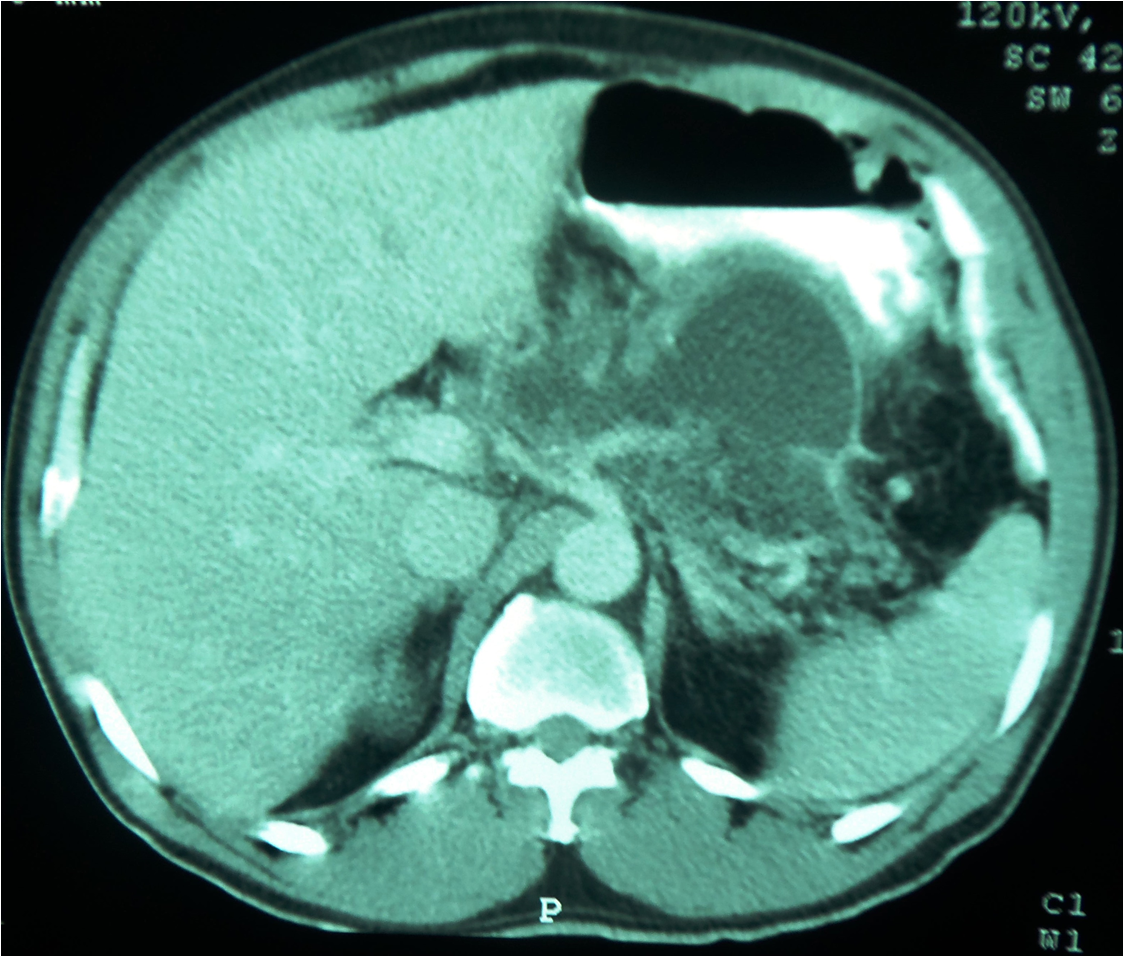
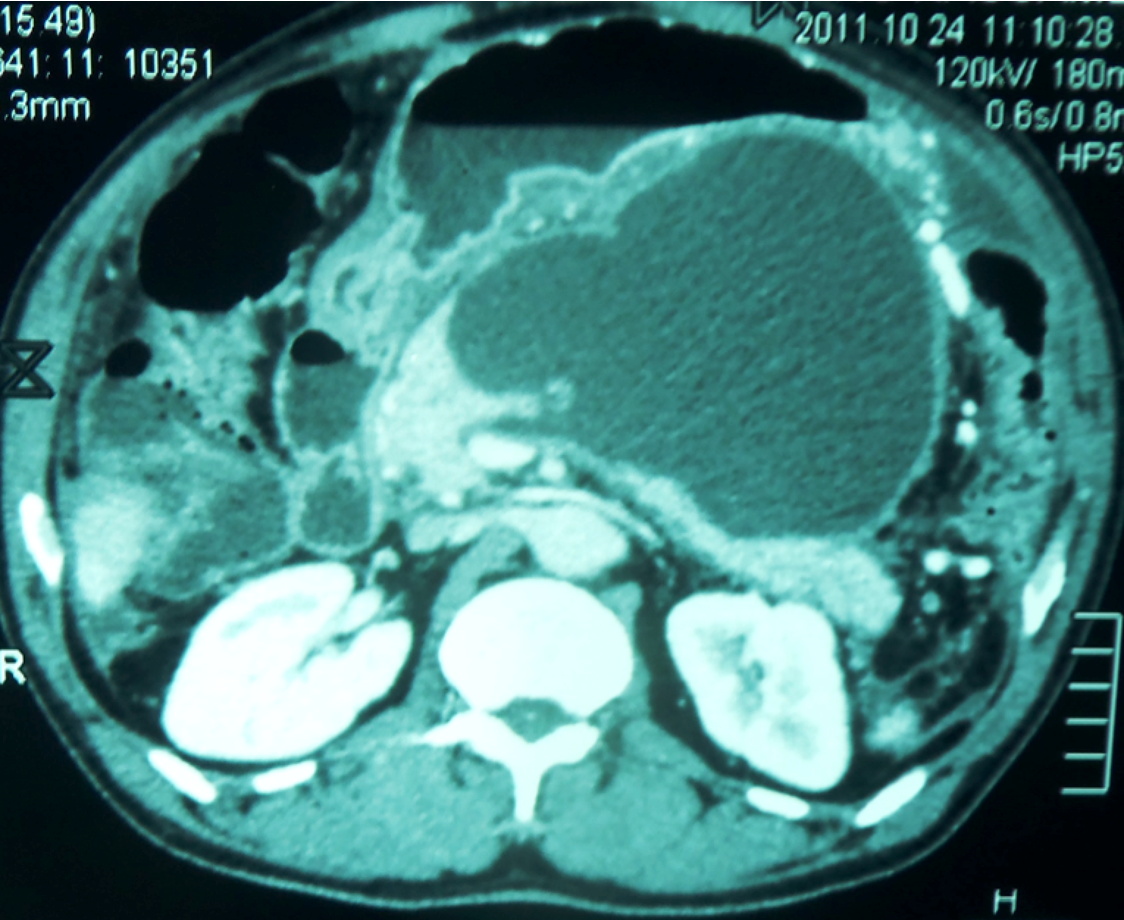
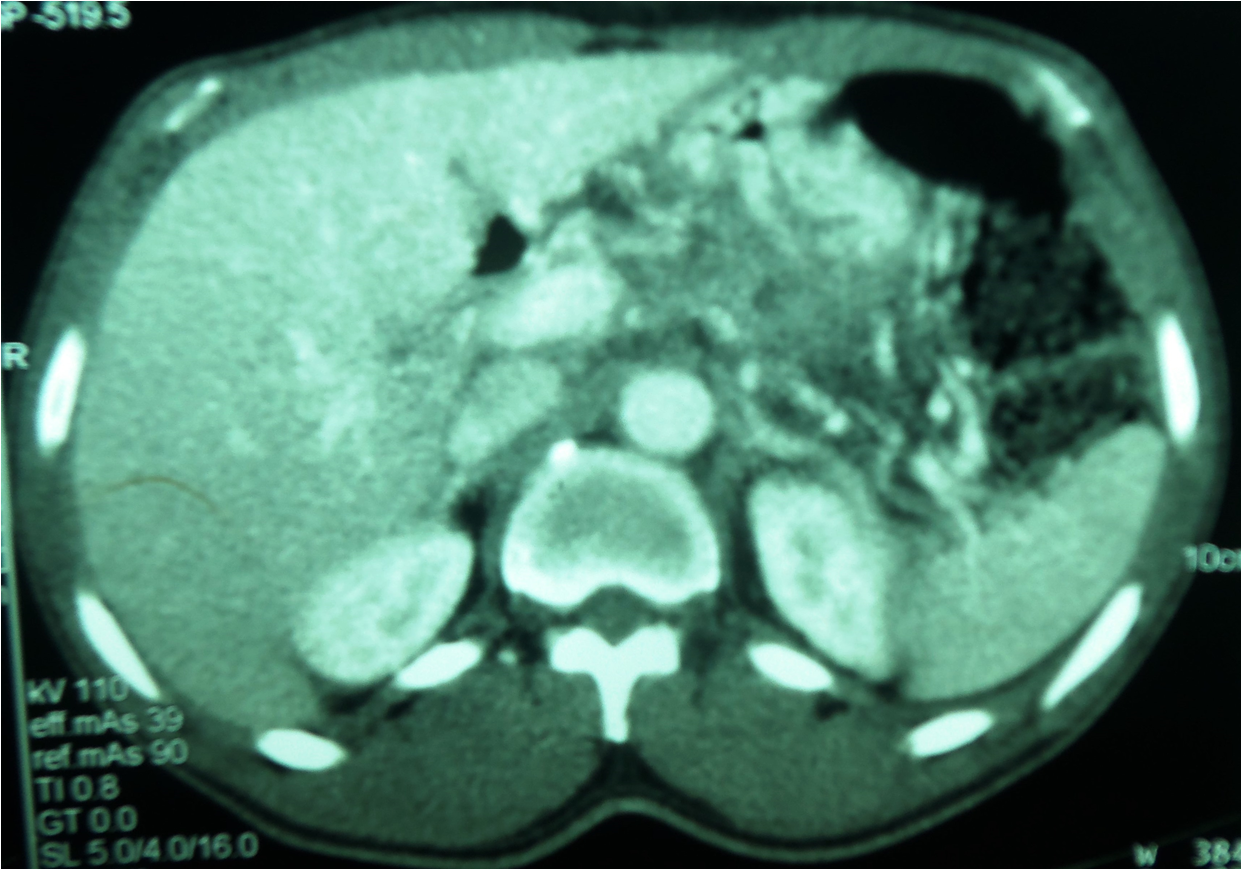
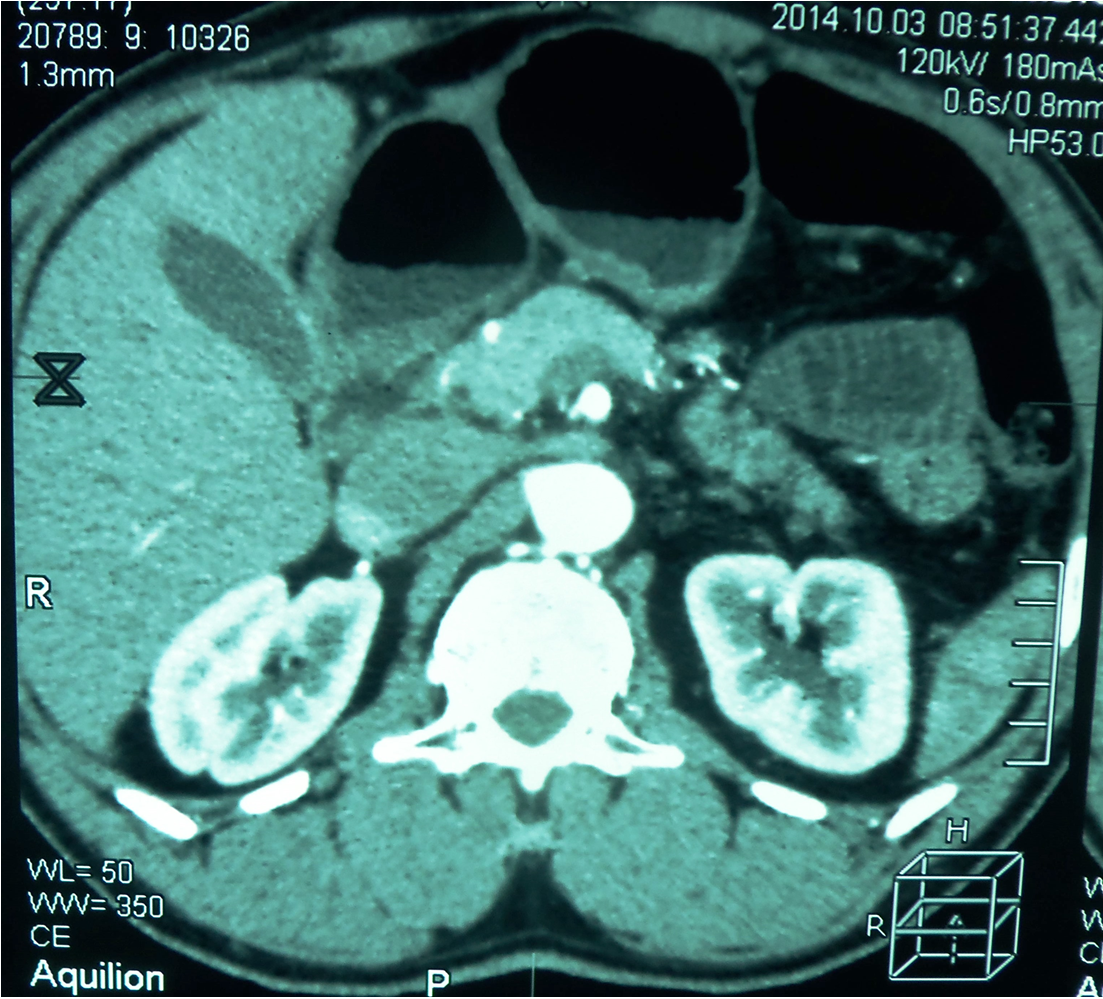
A 55-year-old man was sent to the service of radiology for an abdominal exploration by CT scan. The indication was an abdominal mass localized in the left upper quadrant that occured in the outcomes of an acute pancreatitis. He had a 40-year history of alcoholism and smocking. He reported also an acute pancreatitis that was successfully managed 3 weeks prior to the presentation. Physical examination revealed a painless and regular mass localized in the left upper quadrant of the abdomen. The CT scan showed a pancreatic pseudocyst of 13 cm in diameter confined by a shell which was developped into the pancreatic parenchyma (Figure 1). The patient was mean while just complaining of recurrent epigastric pain that was well managed by analgesics. At the 1st month, the CT scan revealed an increasing of the size of the pseudocyst (17cm) which was compressing the stomach (Figure 2). Meanwhile, the patient was complaining of intermittent post prandial vomiting. At the 5thmonth, the CT scan showed an enlarged pancre as with some hypodense areas without any mass displayed (Figure 3). Physical examination was normal. Analgesics were stopped as the patient was painfulless and there were no more vomiting since the 2ndmonth. Three years later, the patient did not complain of any pain and the CT scan showed a strictly normal pancreatic parenchyma (Figure 4).


 PowerPoint Slide
 Larger image(png format)


 PowerPoint Slide
 Larger image(png format)

 PowerPoint Slide
 Larger image(png format)
 PowerPoint Slide
 Larger image(png format)
3. Discussion
The indications for conservative management of pancreatic pseudocysts are still controversial. It is widely agreed that pseudocysts over 6 cm evolving for more than 6 weeks, are unlikely to regress spontaneously and need to be treated surgically [2, 3, 4, 5]. However, in our patient, the size of the cysts was greater than 10 cm. There were no complications. Furthermore, follow-up CT scan had noted a decline in the size of the cyst from the 8th week. In a serie of 36 patients, Cheruvu observed cysts between 4 and 15 cm in diameter. He nevertheless noted a success of the conservative management in 39% of his patients, among whom 4 presented a cyst of more than 10 cm [1]. As for Vitas, he recorded a success rate of 57 % for the conservative management, and among his patients, 7 presented a cyst of more than 10 cm [3]. As Cheruvu and Ragland’ studies suggest, our observation call into question the systematic therapeutic indication advocated by Lerch for symptomatic pseudocyst larger than 6 cm and evolving for more than six weeks [1, 4, 6]. Furthermore, Gouyon, in his study, reported some predictive factors of failure of conservative management in pseudocysts complicating alcoholic pancreatitis [7]. According to him, the cyst greater than 4 cm in size with an intrapancreatic and cephalic locations are more likely to fail to conservative treatment [7]. In our patient, the cyst had an intrapancreatic and corporeal location, and its size was greater than 4 cm. In contrast, Vitas and Sarr showed that the size of pseudocysts was not significantly associated with their outcome [3]. In addition, Ragland reported a case of large-sized pancreatic pseudocyst compressing the duodenum, which had regressed under conservative management [6]. These facts suggest that conservative treatment may be indicated if the symptoms can be controlled regardless of the size of the cyst. However, careful monitoring is appropriate, given the potential complications of pancreatic pseudocyst.
4. Conclusion
Conservative management is a feasible alternative therapy in large pancreatic pseudocysts, bearing in mind a rigorous clinical and radiological monitoring of the patient. Nonetheless, indications of the conservative treatment still remain to be defined.
Statement of Competing Interests
The authors have no competing interests.
Sources of Funding for Research
Personal fund of the corresponding author.
References
| [1] | Cheruvu CVN, Clarke MG, Prentice M, Eyre-Brook IA. Conservative treatment as an option in the management of pancreatic pseudocyst. Ann R CollSurg Engl. 2003; 85:313-16. | ||
 In article In article | CrossRef PubMed | ||
| [2] | Yeo CL, Bastidas JA, Lunch-Nyhan A, Fishman EK, Zinner MJ, Cameron JL. The natural history of pancreatic pseudocysts documented by computed tomography. SurgGynecol Obstet. 1990; 170: 411-17. | ||
| In article | PubMed | ||
| [3] | Vitas GJ, Sarr MG. Selected management of pancreatic pseudocysts: operative versus expectant management. Surgery 1992; 111: 123-30. | ||
| In article | PubMed | ||
| [4] | Binmoeller KF, Seifert H, Walter A, Soehendra N: Transpapillary and transmural drainage of pancreatic pseudocysts. GastrointestEndosc. 1995;42:219-24. | ||
| In article | CrossRef | ||
| [5] | Lerch MM, Stier A, Wahnschaffe U, Mayerle J. Pancreatic Pseudocysts. Observation, Endoscopic Drainage, or Resection? DtschArztebl Int. 2009; 106: 614-21. | ||
| In article | PubMed | ||
| [6] | Ragland R, Press HCJ, Washington MD. Non operative management in aCase of complicated pancreatic Pseudocyst. J Natl Med Assoc1988, 80:449-51. | ||
| In article | PubMed | ||
| [7] | Gouyon B, Lévy P, Ruszniewski P, Zins M, Hammel P, Vilgrain V, Sauvanet A, Belghiti J, Bernades P. Predictive factors in the outcome of pseudocysts complicating alcoholic chronic. Gut1997, 41:821-25. | ||
| In article | CrossRef PubMed | ||

 CiteULike
 Mendeley
 StumbleUpon
 Delicious
 Facebook
 Twitter
 LinkedIn
 Print
Print