 OPEN ACCESS
  PEER-REVIEWED
Idiopathic Encapsulating Peritoneal Sclerosis
Raouf Hajji1, , Imed Ben Ghorbel2, Amin Makni3, Mohamed Jouini3, Montassar Kacem3, Zoubeir Ben Safta3, Mohamed Habib Houman2
1Internal Medicine Department, Sidi Bouzid Regional Hospital, Sidi Bouzid, Tunisia
2Internal Medicine Department, La Rabta University Hospital, Tunis, Tunisia
3Surgery Department ‘A’, La Rabta University Hospital, Tunis, Tunisia
Abstract
Encapsulating peritoneal sclerosis (EPS) also is a rare syndrome is usually characterized by a total or partial encasement of the small bowel by a thick fibrotic membrane. It has primary or idiopathic and secondary types. Its clinical features are atypical and nonspecific; therefore, preoperative diagnosis is difficult. Herein, we present a case of a man who presented an idiopathic EPS confirmed by a laparotomy and the histopathology and we detail its management and its outcomes after treatment.
At a glance: Figures
Keywords: idiopathic encapsulating peritoneal sclerosis, surgery, immunosupressive drugs
American Journal of Medical Case Reports, 2014 2 (12),
pp 280-282.
DOI: 10.12691/ajmcr-2-12-6
Received November 17, 2014; Revised December 02, 2014; Accepted December 05, 2014
Copyright © 2013 Science and Education Publishing. All Rights Reserved.Cite this article:
- Hajji, Raouf, et al. "Idiopathic Encapsulating Peritoneal Sclerosis." American Journal of Medical Case Reports 2.12 (2014): 280-282.
- Hajji, R. , Ghorbel, I. B. , Makni, A. , Jouini, M. , Kacem, M. , Safta, Z. B. , & Houman, M. H. (2014). Idiopathic Encapsulating Peritoneal Sclerosis. American Journal of Medical Case Reports, 2(12), 280-282.
- Hajji, Raouf, Imed Ben Ghorbel, Amin Makni, Mohamed Jouini, Montassar Kacem, Zoubeir Ben Safta, and Mohamed Habib Houman. "Idiopathic Encapsulating Peritoneal Sclerosis." American Journal of Medical Case Reports 2, no. 12 (2014): 280-282.
| Import into BibTeX | Import into EndNote | Import into RefMan | Import into RefWorks |
1. Introduction
Encapsulating peritoneal sclerosis (EPS) also known as abdominal cocoon syndromeis usually characterized by a total or partial encasement of the small bowel by a thick fibrotic membrane [1]. It can be classified as primary (idiopathic) and secondary types. Its early clinical features are nonspecific; therefore, preoperative diagnosis is difficult [2, 3]. Herein, we present a case of a man who presented with symptoms of intestinal obstruction in which a diagnosis of idiopathic EPS was made preoperatively, and was confirmed by a laparotomy and the histopathology.


 PowerPoint Slide
 Larger image(png format)


 PowerPoint Slide
 Larger image(png format)

 PowerPoint Slide
 Larger image(png format)
2. Case Report
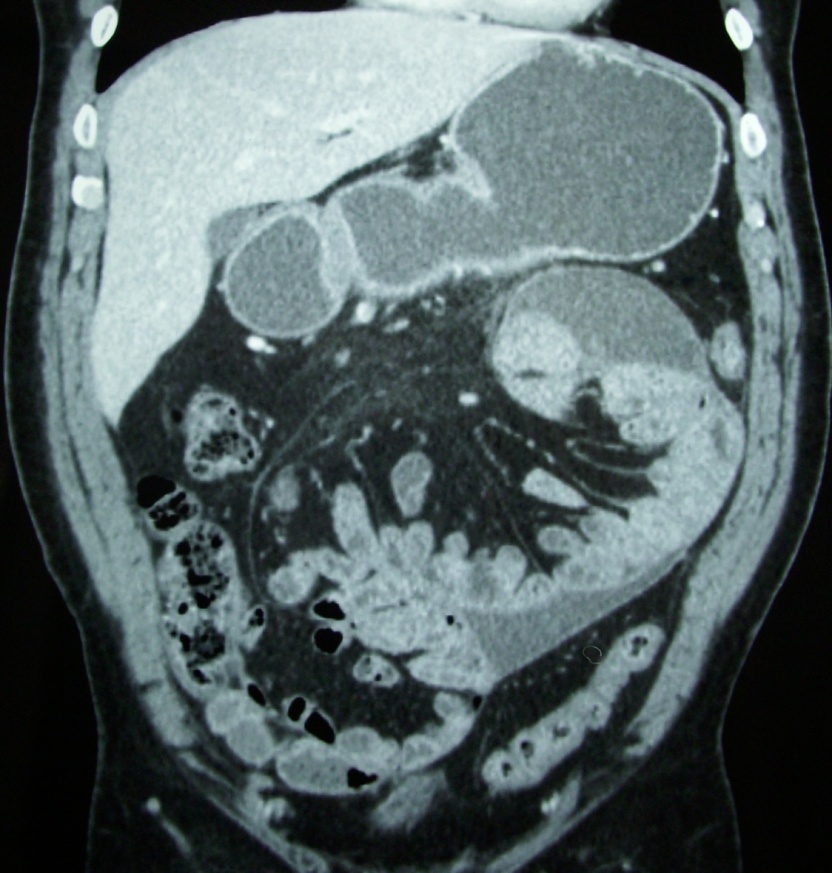
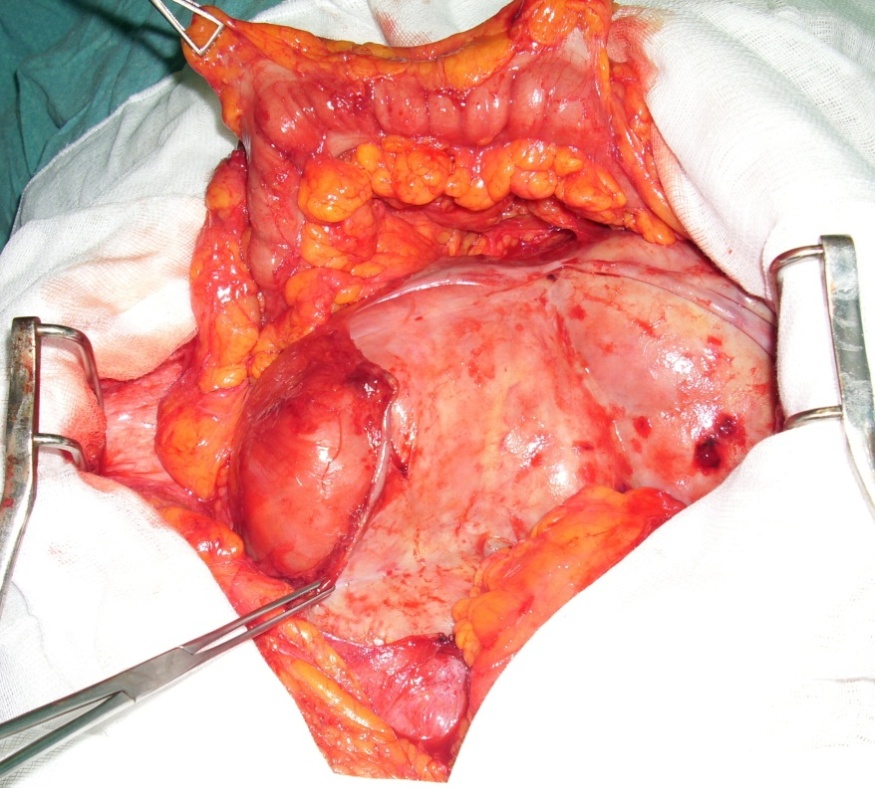
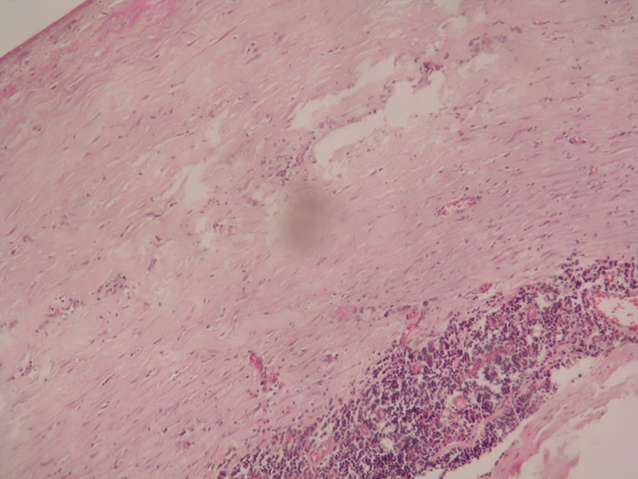
In March 2011, a 45 year-old man presented in emergency department with 48-hour history of colicky abdominal pain without vomiting or impaired general condition. He reported many similar episodes, attributed to small bowel obstruction in the past 2 months, which resolved with conservative treatment. He had no surgical or other medical history. On examination, he was afebrile and hemodynamically stable. His abdomen was distended but non-tender. There was an abdominal mass of 15 cm with neither organomegaly nor external hernia. Laboratory blood analyses were within normal limits. Plain abdominal X-ray showed few air-fluid levels centrally located, without free intraperitoneal gas. Ultrasound of the abdomen did not reveal any abnormality. Contrast-enhanced abdomen computed tomography confirmed the diagnosis of small bowel ileus without providing any diagnostic clues (Figure 1). The patient was admitted to the general surgical ward and ileus resolved in 2 days with conservative treatment. Endoscopy of upper and lower gastrointestinal tract and biopsies from the duodenum and colon provided normal findings. Although, symptoms of obstruction had abated, the history of multiple relapses, the patient's complaints and multiple admissions, as well as the undefined origin of the underlying pathology led to an exploratory laparotomy in June 2011. On surgery, a fibrous capsule of 30 centimeters covering all the small bowel from the jejunum to the ileum, in which small bowel loops were encased, with the presence of inter-loop adhesions (Figure 2). It had many connections with the colon and the anterior abdominal wall. The liver, stomach, appendix, right and left colon were out of capsule. Incision of the thick membrane and extensive adhesiolysis of small bowel loops were performed without loop resection. Histology of the membrane showed thickened fibrocollagenous tissue with mild inflammation (Figure 3). A diagnosis of idiopathic encapsulating peritoneal sclerosis was established, due to intraoperative findings and by ruling-out any other condition explaining the patient's pathology. He has been treated by oral corticosteroids (1mg/Kg/day) and methotrexate. Two months later, he was admitted in the general surgical ward for light abdominal pain that had regressed in the same day with conservative treatment. It was the unique relapse during two months. Contrast-enhanced abdomen computed tomography had showed a disappearance of the EPS. He had been discharged with the same treatment. The follow-up along 24 months now didn’t show any other event.
3. Discussion
In 1978, Foo et al had described a new entity named “abdominal cocoon” [4]. Since then, there have been only a few sporadic reports and at our best knowledge, only about 90 cases of idiopathic type have been reported in the world [5-10][5].
Its pathogenesis remains unknown; however, the etiopathogenesis correlates to congenital dysplasia, chronic asymptomatic peritonitis, some medicines (i.e., Beta-blockers), continuous ambulatory peritoneal dialysis, systemic lupus erythematosus, tuberculosis and abdominal surgery [11, 12, 13, 14].
The primary clinical manifestations of EPS are intestinal obstruction and/or abdominal mass.
Pre-operative diagnosis is difficult since the clinical signs and radiologic findings are non-specific. Nevertheless, the diagnosis should be considered when small bowel obstruction with proximal dilatation, ascites, and thickened or calcified peritoneum are seen on imaging.
The clues to a pre-operative diagnosis are, attacks of colicky pain abdomen, nausea and vomiting with intestinal obstruction that is subacute in nature, the absence of other etiologies for the intestinal obstruction, a history of similar episodes in the past that resolved spontaneously, a soft, non-tender mass on abdominal palpation and radiological findings.
Sonography may show localized dilated intestinal loops and sometimes may be useful in demonstrating the fibrous sac [15]. CT is the method of choice in the diagnosis of EPS. Intestinal loops congregated to the center of the abdomen, also surrounded with thickened membrane is the typical appearance of abdominal cocoon, but that surrounding membrane may be thin and difficult to identify on CT images [16]. Careful examination of conglomerated intestinal loops on CT may be helpful [17]. In a review of the literature, most authors confirm the diagnosis during a laparotomy like in our case.
Surgery remains the cornerstone in the management of EPS. A careful dissection and excision of the thick sac with the release of the small intestine leads to complete recovery and rarely a resection of adherent bowel loops is required [2, 3].
Nevertheless, conservative treatment carries a poor outcome, and immunosuppressive drugs are now used frequently. Most commonly, these immunosuppressive regimens include steroids with or without azathioprine or cyclosporine [18]. Our patient received steroid and methotrexate. The disease evolution was marked by the occurrence of only one mild relapse and the disappearance of the EPS on CT. The short-term outcomes are good but regular and long follow-up should be managed in similar cases because of the risk of new relapses.
4. Conclusion
EPS is rare and it is difficult to make a definite pre-operative diagnosis. Clinical suspicion may be generated by the recurrent episodes of small intestinal obstruction combined with relevant imaging findings and lack of other plausible etiologies. Surgery is important to confirm the diagnosis and immunosuppressive therapy is necessary in the management of EPS.
References
| [1] | Kumar A, Ramakrishnan TS, Sahu S, Mishra KB. Idiopathic sclerosing encapsulating peritonitis. Is a preoperative diagnosis possible? Report of three cases. Surg Today. 2009; 39 (7): 610-4. | ||
 In article In article | CrossRef PubMed | ||
| [2] | Deeb LS, Mourad FH, El-Zein YR, Uthman SM. Abdominal cocoon in a man: preoperative diagnosis and literature review. J Clin Gastroenterol. 1998; 26 (2): 148-50. | ||
| In article | CrossRef PubMed | ||
| [3] | Hamaloglu E, Altun H, Ozdemir A, Ozenc A. The abdominal cocoon: a case report. Dig Surg. 2002; 19 (5): 422-4. | ||
| In article | CrossRef PubMed | ||
| [4] | Foo KT, Ng KC, Rauff A, Foong WC, Sinniah R. Unusual small intestinal obstruction in adolescent girls: the abdominal cocoon. Br J Surg. 1978; 65(6): 427-30. | ||
| In article | CrossRef PubMed | ||
| [5] | Serafimidis C, Katsarolis I, Vernadakis S, Rallis G, Giannopoulos G, Legakis N, et al. Idiopathic sclerosing encapsulating peritonitis (or abdominal cocoon). BMC Surg. 2006: 13; 6: 3. | ||
| In article | |||
| [6] | Cai J, Wang Y, Xuan Z, Hering J, Helton S, Espat NJ. The abdominal cocoon: a rare cause of intestinal obstruction in two patients. Am Surg. 2007; 73 (11): 1133-5. | ||
| In article | PubMed | ||
| [7] | Githeko AK, McFarlane GA. Abdominal cocoon: report of five cases. East Afr Med J. 2000; 77 (5): 286-8. | ||
| In article | PubMed | ||
| [8] | Al-Abassi AA, Emad M. Abdominal cocoon. An unusual cause of intestinal obstruction. Saudi Med J. 2004; 25 (10): 1482-5. | ||
| In article | PubMed | ||
| [9] | Matone J, Herbella F, Del Grande JC. Abdominal cocoon syndrome. Clin Gastroenterol Hepatol. 2006; 4(6): 31. | ||
| In article | CrossRef PubMed | ||
| [10] | Wei B, Wei HB, Guo WP, Zheng ZH, Huang Y, Hu BG, et al. Diagnosis and treatment of abdominal cocoon: a report of 24 cases. Am J Surg. 2009; 198 (3): 348-53. | ||
| In article | CrossRef PubMed | ||
| [11] | Mann RD. An instructive example of long-latency adverse drug reaction–sclerosing peritonitis due to practolol. Pharmacoepidemiol Drug Saf. 2007; 16 (11): 1211-6. | ||
| In article | CrossRef PubMed | ||
| [12] | Levine S, Saltzman A. Abdominal cocoon: an animal model for a complication of peritoneal dialysis. Perit Dial Int. 1996; 16 (6): 613-6. | ||
| In article | PubMed | ||
| [13] | Suh WN, Lee SK, Chang H, Hwang HJ, Hyung WJ, Park YN, et al. Sclerosing encapsulating peritonitis (abdominal cocoon) after abdominal hysterectomy. Korean J Intern Med. 2007; 22 (2): 125-9. | ||
| In article | CrossRef PubMed | ||
| [14] | Gadodia A, Sharma R, Jeyaseelan N. Tuberculous abdominal cocoon. Am J Trop Med Hyg. 2011; 84: 1-2. | ||
| In article | CrossRef PubMed | ||
| [15] | Rokade ML, Ruparel M, Agrawal JB. Abdominal cocoon. J Clin Ultrasound. 2007; 35 (4): 204-6. | ||
| In article | CrossRef PubMed | ||
| [16] | Gupta S, Shirahatti RG, Anand J. CT findings of an abdominal cocoon. Am J Roentgenol. 2004; 183(6): 1658-60. | ||
| In article | CrossRef PubMed | ||
| [17] | Taşdelen N, Demirag A, KalayciM, Gürses B,Kılıçkesmez NÖ¸ Çomunoğlu N et al. Intestinal obstruction due to abdominal cocoon: CT findings. Eur J Rad Extra.2009; 70 (2): e79-81. | ||
| In article | CrossRef | ||
| [18] | Lafrance JP, Létourneau I, Ouimet D, Bonnardeaux A, Leblanc M, Mathieu N, et al. Successful treatment of encapsulating peritoneal sclerosis with immunosuppressive therapy. Am J Kidney Dis. 2008; 51 (2): e7-10. | ||
| In article | CrossRef PubMed | ||

 CiteULike
 Mendeley
 StumbleUpon
 Delicious
 Facebook
 Twitter
 LinkedIn
 Print
Print