Cervical lymphadenopathy is a common clinical presentation of reactive changes and hematological malignancies. In the tropics, tuberculosis has been reported by several authors as the leading cause of lymph node enlargement in adults. Pediatric thyroid carcinoma is rare. It accounts for 1.5–3% of all carcinomas in the USA and Europe. Cervical lymphadenopathy is an unusual clinical presentation of thyroid carcinoma, especially in the absence of palpable thyroid enlargement. Thyroid carcinoma is the most prevalent endocrine cancer in the world. Papillary thyroid carcinoma is the most common histologic type of thyroid carcinoma. It accounts for 80 to 85% of all thyroid cancer cases. The primary risk factors include exposure to radiation, genetic predisposition, high dietary iodine intake, and exposure to other environmental factors. High levels of iodine trigger rapid cell division of thyroid follicular cells and promote gene mutation. Occult presentation in the form of metastasis to the cervical lymph node without a palpable thyroid mass is even rarer, and this made the clinical diagnosis very challenging. A high index of suspicion is required in the diagnosis and management of head and neck masses.
Pediatric thyroid carcinoma is rare. Clinical presentation in the form of cervical lymphadenopathy without a palpable thyroid mass is even rarer. We report a case of occult papillary thyroid carcinoma presenting as a case of lymphadenopathy with cervical lymph node metastasis in a 14–year–old female without clinical signs of thyroid disease. The patient had an excisional biopsy of the enlarged cervical lymph node, and following histopathologic diagnosis of papillary thyroid carcinoma, the patient had total thyroidectomy. The histopathologic diagnosis of the thyroidectomy specimen confirmed the initial diagnosis of papillary thyroid carcinoma.
PA, a 14-year-old student, presented with right-sided neck swelling of one (1) year duration. The swelling was insidious in onset, located at the right side of the anterior neck, slowly progressive in size, hard, and associated with pain. The pain was intermittent, throbbing, moderate, and radiating to the right side of the head, with no known aggravating or relieving factor. There was a positive history of low-grade intermittent fever with no associated chills or rigors. There was no history of cough, vomiting, diarrhoea, dysuria, or abnormal vaginal discharge.
There was no history of anterior midline neck swelling of any significance. She does not reside in a mountainous or hilly region. She consumes ionised salt. There is a positive history of significant weight loss as evidenced by loosening of her tight clothing. There was no history of change in bowel habit, no tremor, and no palpitation. The patient had taken native herbal concoctions with no significant relief. She had been presented in a private hospital, where she was subsequently referred to the surgical outpatient department of our hospital.
The patient has yet to attain menarche. She is not a known diabetic, asthmatic, or peptic ulcer disease patient. There is no family history of thyroid disease. She has no history of prior hospital admission, blood transfusion, or surgery. She is the only child of her mother. She has no known drug allergy. On examination, she is a teenage girl with physical characteristics consistent with the stated age, afebrile, not pale, anicteric, not cyanosed, and not dehydrated.
Clinical examination of the neck shows a hard right cervical mass that measures 4×3cm. The neck mass was noted in the right anterior triangle of the neck. The mass is tender and mobile. It is neither attached to the overlying skin nor the underlying structures. Ultrasound screening of the neck detected a lymph node with suspicious foci. The mass was scheduled for an excisional biopsy. The results of pre-operative investigations show PCV – 38%, and urinalysis was essentially normal. Electrolytes, urea & creatinine are within normal limits.
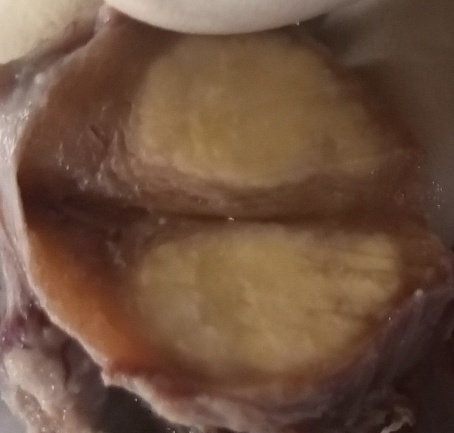
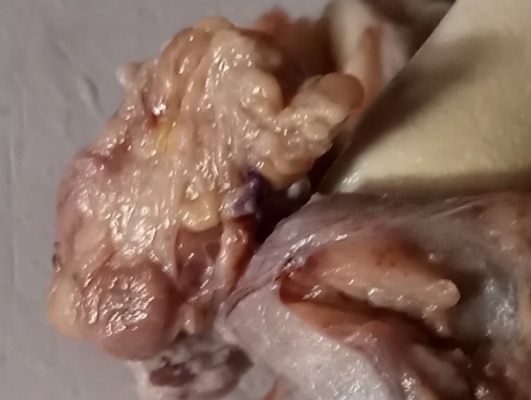
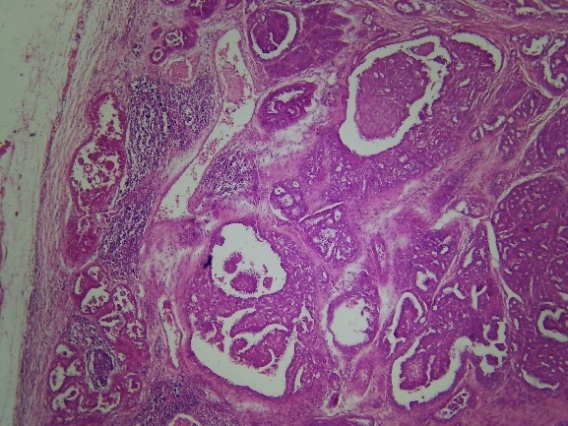
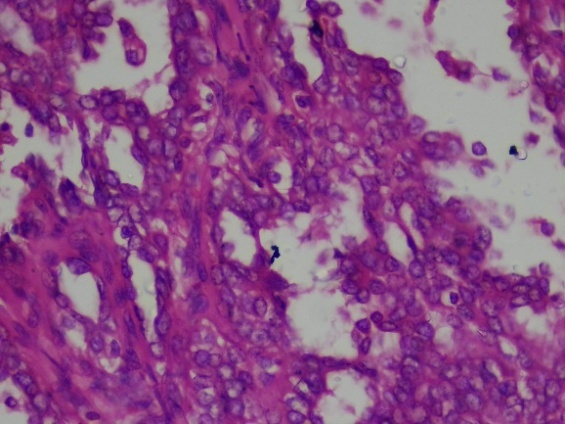
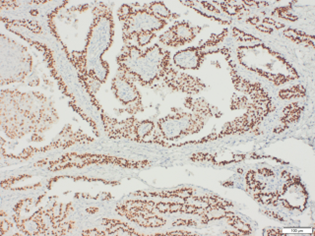
Intraoperative findings include enlarged, matted right cervical lymph nodes in the anterior triangle of the neck. The enlarged lymph node was excised and sent for histology. Grossly, the excised specimen shows an irregular lymph node measuring 4×2×2cm. The cut surfaces of the specimen are solid and greyish-white. Microscopically, sections from the specimen show lymph nodal tissue with total effacement of its architecture by complex branching papillae with fibrovascular cores. The cells lining the papillae have enlarged overlapping nuclei with optically clear chromatin patterns to give the characteristic ‘Orphan Annie eye nuclei’. In other cells, the nuclear membranes are grooved with pseudoinclusions. Some microfollicles are also seen. A diagnosis of metastatic papillary carcinoma most probably from the thyroid gland was made. A paraffin tissue block was sent for TTF-1 Immunostaining. It shows 100% diffuse nuclear densely positive staining consistent with metastatic papillary thyroid carcinoma to the lymph node.
As a result of the histology report and immunohistochemistry report, the patient was scheduled for thyroidectomy. Intraoperative findings during thyroidectomy revealed a hard nodule occupying the whole of the right lobe and extending to the left lobe and the isthmus.


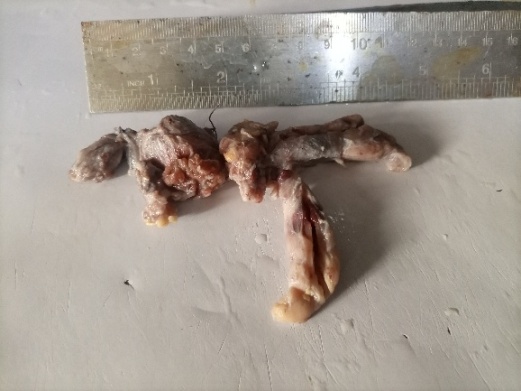
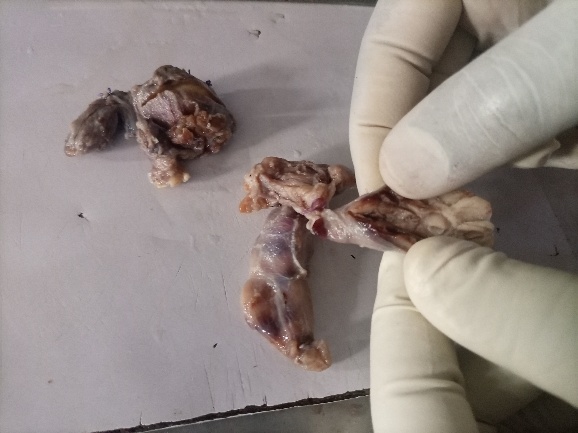
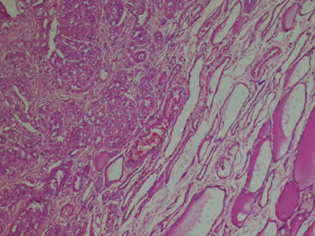
The thyroidectomy specimen weighs 15g. The right lobe measures 6×2.0×1cm. The left lobe measures 5×2×1cm. The isthmus measures 3.0×2×1cm. Cut sections of the right lobe show a nodular mass measuring 1×1cm in diameter. The left lobe and the thymus show similar masses measuring 1×0.5cm and 0.5×0.5cm, respectively. Microscopic findings from the thyroid mass show histologic features similar to those of the sections from the earlier excised cervical lymph nodes. A diagnosis of thyroid papillary carcinoma and TNM staging of pT3N1Mx was made. Following thyroidectomy, the patient was referred to the University College Hospital, Ibadan, Nigeria, Oncology Centre for radioactive iodine treatment and further management. Unfortunately, the patient was lost to follow-up.


Pediatric thyroid carcinoma is rare. According to Shah 1, it accounts for 1.5–3% of all carcinomas in the USA and Europe. Out of the 63 cases of thyroid carcinoma seen over 15 years in South-Eastern Nigeria, Ukekwe et al. 2 reported only one (1) case (1,7%) in the pediatric age group. In another retrospective study in Ibadan covering 40 years, 25 out of 320 (7.8%) cases of thyroid carcinoma were reported in the pediatric age group 3. Thyroid carcinoma (TC) is the most prevalent endocrine cancer in the world 4, 5. Papillary thyroid carcinoma is the most common histologic type of thyroid carcinoma, accounting for 80 to 85% of all thyroid cancer cases 6. The primary risk factors include exposure to radiation, genetic predisposition, high dietary iodine intake, and exposure to other environmental factors. Both external and internal (from radioiodine) are important aetiologic factors in the development of thyroid cancer 7. It is responsible for 1.5–3% of all carcinomas in this age group in the USA and Europe 8.
The term “Occult Thyroid Carcinoma” is highly controversial and could depict several meanings in different clinical scenarios from the literature 9. The Merriam-Webster dictionary 10, in the current online version, explains “Occult carcinoma” as “not manifest or detectable by clinical methods alone” and as “not present in macroscopic amounts”. Segen 11 in the McGraw-Hill Concise Dictionary of Modern Medicine defines “occult primary malignancy” as “unknown primary malignancy that is symptomless, which first manifests as metastases or secondary paraneoplastic phenomena”. Moosa & Mazzaferri 12 defined “Occult thyroid carcinoma” as an “impalpable thyroid carcinoma that is generally smaller than 1cm”. Occult thyroid cancers can also be defined as small carcinomas in the thyroid gland following histologic diagnosis of lymph node or distant metastasis. Occult thyroid carcinomas are commonly detected after patients show swelling in the cervical lymph nodes 9.
Most occult thyroid carcinomas are small thyroid carcinomas that are ≤ 1 cm, and the prognosis is poor when metastatic lesions are evident 9. We report a case of occult papillary thyroid carcinoma presenting as a case of lymphadenopathy with cervical lymph node metastasis in a 14–year–old female without clinical and radiological signs of thyroid disease.
According to Bauer 13, over 85% of childhood thyroid carcinomas are papillary thyroid cancer (PTC), with the remainder divided between follicular thyroid cancer (FTC) and medullary thyroid cancer (MTC). Family history and previous radiation exposure are possible risk factors of childhood papillary thyroid carcinoma 14. However, the patient presented in this case had no identifiable risk factor. Sporadic papillary thyroid cancer represented only 1.4% of newly diagnosed childhood carcinomas in the USA from 1975 to 1995, according to the Surveillance, Epidemiology, and End Results SEER database 15.
Papillary thyroid carcinoma (PTC) behaves as a different clinical disease in children and adults. Children with locally advanced disease, lymph node involvement, and distant metastasis have a better long-term prognosis than adults. Children with PTC can be expected to have a normal life expectancy, and optimal surgery is the treatment of choice 16. This is the situation in this case, as the patient shows no clinical features of a thyroid disease. Differentiated thyroid carcinomas are associated with a more aggressive clinical behaviour in children and adolescents, with a reported rate of lymph node metastases ranging between 60 and 80 % and lung metastasis in approximately 20 % of the cases at diagnosis 16. Apart from the cervical lymph node involvement, the case we present shows no evidence of a systemic disease.
Cervical lymphadenopathy is not an uncommon clinical presentation of papillary thyroid carcinoma. The incidence at the time of diagnosis is estimated at 20-25% 17 18. It is important to note that PTC metastasis in cervical LN without a detectable tumor in the thyroid gland has been reported 19. Fumarola et al. 20 reported other unusual presentations, such as papillary thyroid carcinoma arising in ectopic thyroid tissue within a neck branchial cyst.
We present a case of childhood papillary thyroid carcinoma with an unusual presentation. The clinical diagnosis of occult thyroid carcinoma in the form of metastasis to the cervical lymph node is very challenging. A high index of suspicion is required in the diagnosis and management of thyroid cancers and other head and neck masses, especially during childhood, as seen in this case. While most cases are treatable, early identification of patients requiring more aggressive treatment and follow-up poses a significant challenge. Careful staging is critical for determining the extent of surgery, treatment options, and prognosis.
The patient’s tissue sections were not subjected to molecular studies, as facilities for molecular testing are not available not only in our centre but also in Nigeria. As the facility for radioactive iodine treatment is not available at our centre, the patient was referred for further management to a better-equipped oncology centre but was subsequently lost to follow-up.
We declare that we have no conflict of interest.
Consent for publication statement: Informed consent was obtained from the patient’s mother for publication of this case report and the accompanying images.
Funding: We received no funding for this publication
Ethical approval: Being a case report, conditions for ethical considerations were met.
| [1] | Shah J. P. (2015). Thyroid carcinoma: epidemiology, histology, and diagnosis. Clinical advances in hematology & oncology: H&O, 13(4 Suppl 4), 3–6. | ||
| In article | |||
| [2] | Ukekwe, F. I., Olusina, D. B., & Okere, P. C. N. (2017). Patterns of Thyroid Cancers in Southeastern Nigeria: A 15 Year Histopathologic Review (2000-2014). Journal of clinical and diagnostic research: JCDR, 11(8), EC16–EC19. | ||
| In article | View Article PubMed | ||
| [3] | Ajani, M. A., Omenai, S. A., Nwadiokwu, J. I., & Salami, A. A. (2020). Histopathological profile of childhood thyroid carcinoma in Ibadan, Southwestern Nigeria. Malawi medical journal: the journal of Medical Association of Malawi, 32(4), 213–217. | ||
| In article | |||
| [4] | Wells S. A., Jr (2016). Progress in Endocrine Neoplasia. Clinical cancer research: an official journal of the American Association for Cancer Research, 22(20), 4981–4988. | ||
| In article | View Article PubMed | ||
| [5] | Morris, L. G., Sikora, A. G., Tosteson, T. D., & Davies, L. (2013). The increasing incidence of thyroid cancer: the influence of access to care. Thyroid: official journal of the American Thyroid Association, 23(7), 885–891. | ||
| In article | View Article PubMed | ||
| [6] | Davies, L., & Welch, H. G. (2006). Increasing incidence of thyroid cancer in the United States, 1973-2002. JAMA, 295(18), 2164–2167. | ||
| In article | View Article PubMed | ||
| [7] | Nagataki, S., & Nyström, E. (2002). Epidemiology and primary prevention of thyroid cancer. Thyroid: official journal of the American Thyroid Association, 12(10), 889–896. | ||
| In article | View Article PubMed | ||
| [8] | Greenlee, R.T., Hill-Harmon, M. B., Murray, T. & Thun, M. (2001). Cancer Statistics, 2001 CA: A Cancer Journal for Clinicians, 51: 15-36. | ||
| In article | View Article PubMed | ||
| [9] | Afolabi, A. O., Alegbeleye, B.J., & Olagunju, N. (2021). Occult Thyroid Carcinoma: A Tertiary Hospital Experience in Ibadan, Nigeria. Iberoam J Med. 3(3), 212–220. | ||
| In article | View Article | ||
| [10] | Merriam-Webster online dictionary. (accessed February 2023). Available from: http://www.merriam-webster.com. | ||
| In article | |||
| [11] | Segen J. C. (2002), Concise Dictionary of Modern Medicine. New York: McGraw-Hill. | ||
| In article | |||
| [12] | Moosa, M., & Mazzaferri, E.L. (1997). Occult thyroid carcinoma. Cancer Journal, 10, 180-188. | ||
| In article | |||
| [13] | Bauer A. J. (2020). Papillary and Follicular Thyroid Cancer in children and adolescents: Current approach and future directions. Seminars in pediatric surgery, 29(3), 150920. | ||
| In article | View Article PubMed | ||
| [14] | Parad, M. T., Fararouei, M., Mirahmadizadeh, A. R., & Afrashteh, S. (2021). Thyroid cancer and its associated factors: A population-based case-control study. International journal of cancer, 149(3), 514–521. | ||
| In article | View Article PubMed | ||
| [15] | Hung, W., & Sarlis, N. J. (2002). Current controversies in the management of pediatric patients with well-differentiated non-medullary thyroid cancer: a review. Thyroid: official journal of the American Thyroid Association, 12(8), 683–702. | ||
| In article | View Article PubMed | ||
| [16] | Palmer, B. A., Zarroug, A. E., Poley, R. N., Kollars, J. P., & Moir, C. R. (2005). Papillary thyroid carcinoma in children: risk factors and complications of disease recurrence. Journal of Pediatric Surgery, 40(8), 1284–1288. | ||
| In article | View Article PubMed | ||
| [17] | Ahn, J. E., Lee, J. H., Yi, J. S., Shong, Y. K., Hong, S. J., Lee, D. H., Choi, C. G., & Kim, S. J. (2008). Diagnostic accuracy of CT and ultrasonography for evaluating metastatic cervical lymph nodes in patients with thyroid cancer. World journal of surgery, 32(7), 1552–1558. | ||
| In article | View Article PubMed | ||
| [18] | De Jong, S. A., Demeter, J. G., Jarosz, H., Lawrence, A. M., & Paloyan, E. (1993). Primary papillary thyroid carcinoma presenting as cervical lymphadenopathy: the operative approach to the "lateral aberrant thyroid". The American surgeon, 59(3), 172–177. | ||
| In article | |||
| [19] | Singh, A., Butuc, R., & Lopez, R. (2013). Metastatic papillary thyroid carcinoma with the absence of tumor focus in the thyroid gland. The American journal of case reports, 14, 73–75. | ||
| In article | View Article PubMed | ||
| [20] | Fumarola, A., Trimboli, P., Cavaliere, R., Coletta, I., Veltri, A., Di Fiore, A., Ciardi, A., & Piccirilli, F. (2006). Thyroid papillary carcinoma arising in ectopic thyroid tissue within a neck branchial cyst. World journal of surgical oncology, 4, 24. | ||
| In article | View Article PubMed | ||
Published with license by Science and Education Publishing, Copyright © 2026 John Adetunji Omotayo, Joshua Taye Ige, Ademola Idowu Soremekun, Joshua Seye Olorunfunmi and Olugbenga Tosin Alade
 This work is licensed under a Creative Commons Attribution 4.0 International License. To view a copy of this license, visit
http://creativecommons.org/licenses/by/4.0/
This work is licensed under a Creative Commons Attribution 4.0 International License. To view a copy of this license, visit
http://creativecommons.org/licenses/by/4.0/
| [1] | Shah J. P. (2015). Thyroid carcinoma: epidemiology, histology, and diagnosis. Clinical advances in hematology & oncology: H&O, 13(4 Suppl 4), 3–6. | ||
| In article | |||
| [2] | Ukekwe, F. I., Olusina, D. B., & Okere, P. C. N. (2017). Patterns of Thyroid Cancers in Southeastern Nigeria: A 15 Year Histopathologic Review (2000-2014). Journal of clinical and diagnostic research: JCDR, 11(8), EC16–EC19. | ||
| In article | View Article PubMed | ||
| [3] | Ajani, M. A., Omenai, S. A., Nwadiokwu, J. I., & Salami, A. A. (2020). Histopathological profile of childhood thyroid carcinoma in Ibadan, Southwestern Nigeria. Malawi medical journal: the journal of Medical Association of Malawi, 32(4), 213–217. | ||
| In article | |||
| [4] | Wells S. A., Jr (2016). Progress in Endocrine Neoplasia. Clinical cancer research: an official journal of the American Association for Cancer Research, 22(20), 4981–4988. | ||
| In article | View Article PubMed | ||
| [5] | Morris, L. G., Sikora, A. G., Tosteson, T. D., & Davies, L. (2013). The increasing incidence of thyroid cancer: the influence of access to care. Thyroid: official journal of the American Thyroid Association, 23(7), 885–891. | ||
| In article | View Article PubMed | ||
| [6] | Davies, L., & Welch, H. G. (2006). Increasing incidence of thyroid cancer in the United States, 1973-2002. JAMA, 295(18), 2164–2167. | ||
| In article | View Article PubMed | ||
| [7] | Nagataki, S., & Nyström, E. (2002). Epidemiology and primary prevention of thyroid cancer. Thyroid: official journal of the American Thyroid Association, 12(10), 889–896. | ||
| In article | View Article PubMed | ||
| [8] | Greenlee, R.T., Hill-Harmon, M. B., Murray, T. & Thun, M. (2001). Cancer Statistics, 2001 CA: A Cancer Journal for Clinicians, 51: 15-36. | ||
| In article | View Article PubMed | ||
| [9] | Afolabi, A. O., Alegbeleye, B.J., & Olagunju, N. (2021). Occult Thyroid Carcinoma: A Tertiary Hospital Experience in Ibadan, Nigeria. Iberoam J Med. 3(3), 212–220. | ||
| In article | View Article | ||
| [10] | Merriam-Webster online dictionary. (accessed February 2023). Available from: http://www.merriam-webster.com. | ||
| In article | |||
| [11] | Segen J. C. (2002), Concise Dictionary of Modern Medicine. New York: McGraw-Hill. | ||
| In article | |||
| [12] | Moosa, M., & Mazzaferri, E.L. (1997). Occult thyroid carcinoma. Cancer Journal, 10, 180-188. | ||
| In article | |||
| [13] | Bauer A. J. (2020). Papillary and Follicular Thyroid Cancer in children and adolescents: Current approach and future directions. Seminars in pediatric surgery, 29(3), 150920. | ||
| In article | View Article PubMed | ||
| [14] | Parad, M. T., Fararouei, M., Mirahmadizadeh, A. R., & Afrashteh, S. (2021). Thyroid cancer and its associated factors: A population-based case-control study. International journal of cancer, 149(3), 514–521. | ||
| In article | View Article PubMed | ||
| [15] | Hung, W., & Sarlis, N. J. (2002). Current controversies in the management of pediatric patients with well-differentiated non-medullary thyroid cancer: a review. Thyroid: official journal of the American Thyroid Association, 12(8), 683–702. | ||
| In article | View Article PubMed | ||
| [16] | Palmer, B. A., Zarroug, A. E., Poley, R. N., Kollars, J. P., & Moir, C. R. (2005). Papillary thyroid carcinoma in children: risk factors and complications of disease recurrence. Journal of Pediatric Surgery, 40(8), 1284–1288. | ||
| In article | View Article PubMed | ||
| [17] | Ahn, J. E., Lee, J. H., Yi, J. S., Shong, Y. K., Hong, S. J., Lee, D. H., Choi, C. G., & Kim, S. J. (2008). Diagnostic accuracy of CT and ultrasonography for evaluating metastatic cervical lymph nodes in patients with thyroid cancer. World journal of surgery, 32(7), 1552–1558. | ||
| In article | View Article PubMed | ||
| [18] | De Jong, S. A., Demeter, J. G., Jarosz, H., Lawrence, A. M., & Paloyan, E. (1993). Primary papillary thyroid carcinoma presenting as cervical lymphadenopathy: the operative approach to the "lateral aberrant thyroid". The American surgeon, 59(3), 172–177. | ||
| In article | |||
| [19] | Singh, A., Butuc, R., & Lopez, R. (2013). Metastatic papillary thyroid carcinoma with the absence of tumor focus in the thyroid gland. The American journal of case reports, 14, 73–75. | ||
| In article | View Article PubMed | ||
| [20] | Fumarola, A., Trimboli, P., Cavaliere, R., Coletta, I., Veltri, A., Di Fiore, A., Ciardi, A., & Piccirilli, F. (2006). Thyroid papillary carcinoma arising in ectopic thyroid tissue within a neck branchial cyst. World journal of surgical oncology, 4, 24. | ||
| In article | View Article PubMed | ||