The coronavirus disease 2019 (COVID-19) pandemic was one of the most disruptive events in modern healthcare, and dentistry was uniquely affected due to its reliance on aerosol-generating procedures and close patient contact. This review highlights how the pandemic reshaped dentistry, transitioning the field from crisis management to long-term transformation. Enhanced infection control protocols, including advanced personal protective equipment, air purification, and patient screening, redefined safety standards within dental practice. Patient care delivery shifted toward teledentistry, minimally invasive and non-aerosol procedures, and prioritization of emergencies, while patient anxiety and fear of infection reduced routine visits. Dental education underwent a rapid transition to online learning, virtual simulations, and remote continuing education, although reduced clinical exposure remained a challenge. Long-term transformations included accelerated adoption of digital dentistry tools such as CAD/CAM, intraoral scanners, 3D printing, and artificial intelligence, as well as the permanent role of teledentistry in preventive and follow-up care. Overall, COVID-19 accelerated the modernization of dental practice, emphasizing safety, digital integration, and preventive strategies, leaving dentistry more resilient, technologically advanced, and interconnected with broader healthcare systems.
The coronavirus disease 2019 (COVID-19) pandemic, caused by severe acute respiratory syndrome coronavirus 2 (SARS-CoV-2), was one of the most disruptive events in modern healthcare. Dentistry was uniquely impacted because it relied on aerosol-generating procedures, close patient–provider proximity, and frequent face-to-face interactions. 1 Early in the pandemic, dental practices worldwide were forced to shut down or limit their services to emergency care, fundamentally altering the delivery of oral healthcare. 2
As the pandemic unfolded, dentistry transitioned from a state of crisis management to an era of transformation. Enhanced infection control protocols, advanced personal protective equipment (PPE), patient screening, and environmental disinfection became standard practice. While initially viewed as temporary emergency measures, many of these protocols have been retained, reshaping routine dental care in the post-pandemic era. 3
Another defining transformation was the rapid adoption of teledentistry. Virtual consultations, triage, and follow-up visits, once considered peripheral, became essential tools for maintaining continuity of care while reducing infection risk. This digital shift not only changed patient-dentist communication during the pandemic but also opened new avenues for remote care, preventive dentistry, and patient education in the long term. 4 COVID-19 also catalyzed the integration of digital dentistry. Technologies such as intraoral scanning, computer-aided design/ computer-aided-manufacturing (CAD/CAM), and 3D printing gained momentum, as they minimized chairside time, reduced multiple patient visits, and improved treatment efficiency. Similarly, artificial intelligence (AI) has begun to play a larger role in diagnostics, treatment planning, and practice management, reflecting a broader digital transformation of dental practice. 5
Beyond clinical changes, the pandemic had profound economic and educational implications. Private dental practices faced significant financial challenges due to reduced patient flow and increased operational costs associated with PPE and infection control. Dental education underwent a paradigm shift toward online learning, virtual simulation, and remote continuing professional development, accelerating the acceptance of digital teaching modalities. 6
Importantly, the pandemic highlighted the intersection of dentistry with overall systemic health. Saliva gained recognition as a non-invasive diagnostic fluid for SARS-CoV-2 detection, reinforcing the role of dentistry in public health surveillance. Furthermore, the crisis emphasized the importance of interdisciplinary collaboration between medical and dental professionals in managing infectious diseases. 7
This review aims to synthesize current evidence on how COVID-19 reshaped dentistry, highlighting the transition from crisis to transformation. By exploring changes in infection control, patient care delivery, education, economics, and technological adoption, this paper underscores how the pandemic accelerated modernization and positioned dentistry for a more resilient, technology-driven future.
The COVID-19 pandemic fundamentally reshaped infection control protocols in dentistry, emphasizing the dual priority of protecting both patients and providers. Given the high risk of transmission through aerosols and close proximity during dental procedures, practices worldwide adopted enhanced safety standards that continue to influence clinical workflows.
Enhanced Personal Protective Equipment (PPE)
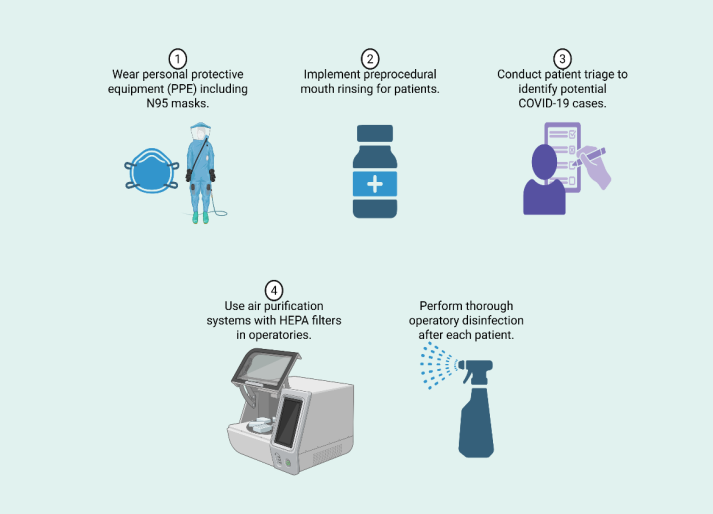
The routine use of surgical masks was replaced or supplemented with N95 respirators, along with full-face shields, eyewear, disposable gowns, and head covers. These layers of protection significantly reduced exposure to aerosols and droplets, though they also increased financial and logistical burdens on dental clinics. 8
Environmental Disinfection and Air Quality Control
Beyond surface sterilization, attention turned to airborne transmission. High-efficiency particulate air (HEPA) filtration units, extraoral suction devices, and ultraviolet (UV-C) disinfection systems were integrated into operatories to reduce viral load in the environment. Improved ventilation, including negative-pressure rooms where feasible, became an important strategy to minimize risk. 9
Appointment Scheduling and Operatory Turnover
To accommodate extended disinfection protocols, many clinics lengthened the interval between appointments. This not only allowed thorough cleaning of surfaces and instruments but also ensured adequate air exchange between patients. While necessary for safety, these changes reduced patient throughput and impacted clinical revenue. 10
Patient Screening and Pre-procedural Measures
Comprehensive screening protocols, including temperature checks, health questionnaires, and triage for respiratory symptoms, became standard. Patients were often instructed to use pre-procedural antimicrobial mouth rinses (such as povidone-iodine or hydrogen peroxide) to reduce oral microbial load before treatment. These preventive measures, though simple, contributed to lowering potential viral transmission during procedures. Collectively, these strategies represented a paradigm shift in infection control within dentistry. What was once considered “extraordinary” became routine, embedding a culture of heightened vigilance that is likely to persist in the post-pandemic era (Figure 1).
The COVID-19 pandemic prompted major changes in how dental care was delivered worldwide.
Teledentistry
One of the most significant innovations during the COVID-19 pandemic was the rise of teledentistry, which enabled remote consultations, triage, and follow-ups. This approach minimized unnecessary in-person visits, allowed for continuity of care, and proved especially valuable in rural and underserved areas. Teledentistry also facilitated patient education, preventive guidance, and monitoring of post-procedural recovery without exposing patients or staff to potential infection. In addition, virtual consultations allowed dentists to prioritize urgent cases and allocate clinic resources more efficiently. 11
Delay in Elective Procedures
Early in the pandemic, elective and non-urgent dental treatments were postponed in line with public health mandates, while emergency care (e.g., trauma, severe infections, uncontrolled pain) was prioritized. This shift not only altered patient flow but also highlighted the essential role of dentistry in managing systemic health risks. 12
Minimally Invasive and Non-Aerosol Procedures
Given the risks associated with aerosol-generating procedures, dentists increasingly adopted minimally invasive techniques such as atraumatic restorative treatment (ART), silver diamine fluoride (SDF) application, and hand instrumentation over high-speed drilling. These methods reduced exposure risk while maintaining treatment effectiveness. 13
Psychological Aspects
Patient behavior was also significantly influenced by the pandemic. Fear of contracting infection in dental settings led to reduced visits, delayed treatments, and worsening of untreated dental conditions. Dentists had to actively address patient anxiety and rebuild trust through transparent communication and visible safety measures. 14
The COVID-19 pandemic significantly disrupted dental education and training, necessitating rapid adaptations to ensure continuity of learning.
Shift to Online Learning and Simulation-Based Teaching
Traditional face-to-face lectures were swiftly replaced by virtual classrooms, online platforms, and digital resources. Dental schools adopted simulation-based training and virtual reality modules to substitute for preclinical exercises and to help students maintain psychomotor skills when patient contact was restricted. 15
Virtual Conferences and Continuing Education
With restrictions on travel and gatherings, dental education expanded into webinars, virtual conferences, and online continuing dental education (CDE). These formats increased accessibility and allowed for global collaboration, though they lacked the networking and hands-on benefits of in-person events. 16
Changes in Clinical Training
Perhaps the greatest challenge was the limitation on direct patient care in dental schools and teaching hospitals. Clinical requirements were adjusted, with greater reliance on digital simulations, case-based discussions, and virtual patient encounters. While these adaptations ensured educational progression, concerns remain regarding reduced clinical exposure and preparedness for independent practice. 17
The COVID-19 pandemic had a profound effect on the economic sustainability of dental practices, with challenges ranging from reduced revenue to rising operational costs.
Financial Strain
The temporary closure of clinics, reduced patient flow due to social distancing, and extended appointment times contributed to a significant decline in income for many practitioners. At the same time, expenditures increased as practices invested in enhanced infection control measures, such as PPE, air purification systems, and disposable supplies. 12
Shift Toward Group Practices and Corporate Dentistry
Solo practices were disproportionately affected by the financial downturn. As a result, there was a growing shift toward group practices and corporate dental chains, which allowed resource pooling, shared infrastructure, and greater resilience against economic shocks. This trend may lead to a more collaborative and integrated practice model across the dental industry. 18
Insurance and Policy Adaptations
Insurance companies and policymakers introduced temporary measures to mitigate the crisis, such as coverage for teledentistry, adjustments in reimbursement models, and emergency financial aid programs for healthcare providers. These adaptations highlighted the need for long-term policy reforms to strengthen the financial security of dental practices during future public health emergencies (Table 1). 19
The COVID-19 pandemic accelerated trends that are likely to permanently reshape dental practice.
Digital Dentistry
Technologies such as computer-aided design/computer-aided manufacturing (CAD/CAM), intraoral scanners, and 3D printing became more widely adopted as they reduced chairside time, minimized patient visits, and improved treatment efficiency. These digital workflows are expected to remain integral in post-pandemic dental care. 20
Artificial Intelligence (AI)
AI-based diagnostic tools and predictive analytics gained traction during the pandemic. From caries detection to radiographic interpretation and practice management, AI offers data-driven support to improve accuracy and efficiency in dentistry. 21 Once viewed as an emergency solution, teledentistry is now established as a permanent modality for consultations, follow-ups, and preventive care. It enhances access to underserved populations and supports continuity of care beyond the clinical setting. 11
Sustainability and Eco-Friendly Practices
The surge in single-use PPE raised concerns about environmental impact. Consequently, there is growing interest in sustainable dentistry, including eco-friendly materials, energy-efficient devices, and waste reduction strategies to balance infection control with environmental responsibility (Table 2, Table 3).
COVID-19 emphasized the close relationship between oral health and systemic health, strengthening the call for interdisciplinary care.
Dentistry as a Screening Point
Saliva emerged as a reliable diagnostic fluid for SARS-CoV-2 detection, positioning dental clinics as potential public health surveillance points for infectious diseases. Saliva-based testing offers several advantages over traditional nasopharyngeal swabs, including non-invasiveness, ease of collection, reduced risk of exposure for healthcare personnel, and suitability for repeated sampling. Dental professionals, due to their routine close contact with the oral cavity and ability to access large patient populations, are uniquely positioned to implement early screening and monitor community-level trends. Integrating saliva testing into dental visits could facilitate early detection of asymptomatic carriers, timely referral, and targeted public health interventions. Moreover, such a framework could be expanded beyond COVID-19 to other viral or bacterial pathogens detectable in oral fluids, transforming dental clinics into sentinel sites for broader infectious disease surveillance. 22
Medical-Dental Collaboration
The pandemic fostered greater collaboration between dental and medical professionals in infection control, triage, and patient management. Integrating dentistry into broader healthcare networks can improve preparedness and enhance comprehensive patient care in future pandemics. 23
Patient–Dentist Relationships
Long-term studies are needed to understand how COVID-19 affected patient trust, healthcare-seeking behavior, and perceptions of dental safety. Investigations could explore patient anxiety, willingness to attend routine visits, and adherence to preventive measures. Understanding these behavioral shifts can inform strategies to rebuild confidence, enhance communication, and foster patient-centered care in a post-pandemic environment. 24
Aerosol-Free Techniques
Further innovation is required in developing non-aerosol alternatives, such as chemomechanical caries removal, improved laser technologies, and minimally invasive restorative approaches. 25 Research is needed to evaluate the efficacy, safety, and cost-effectiveness of these methods compared to conventional aerosol-generating procedures. Additionally, studies could focus on integrating aerosol mitigation devices, improved suction systems, and ventilation strategies to further reduce airborne transmission risks in clinical settings.
Policy and Preparedness
The pandemic highlighted the importance of updated infection control policies and contingency planning. 26 Future research should focus on developing standardized, evidence-based pandemic preparedness guidelines tailored to dental practice, including rapid response protocols, supply chain resilience, and workforce training. Evaluating the effectiveness of such policies during outbreaks can strengthen the overall resilience of dental healthcare systems and ensure continuity of care under future global health crises.
The COVID-19 pandemic was an unprecedented crisis that fundamentally reshaped dentistry. What initially began as a disruption forced dental professionals to rapidly adapt their clinical workflows, patient management strategies, and educational methods. Enhanced infection control protocols, including advanced PPE, air purification, and strict patient screening, redefined safety standards and strengthened preparedness for future outbreaks.
Equally transformative was the acceleration of digital integration. The adoption of teledentistry, CAD/CAM, intraoral scanners, and AI-driven diagnostics not only allowed safe continuity of care during the pandemic but also set a new benchmark for efficiency and patient-centered treatment. Educational models shifted toward online learning, simulation-based training, and virtual collaboration, ensuring continuity despite restricted clinical exposure. Economically, the pandemic highlighted vulnerabilities in solo practices while fostering trends toward group practice models, insurance adaptations, and sustainability efforts.
Perhaps most importantly, dentistry emerged as a more resilient and interconnected discipline. By contributing to systemic health surveillance through saliva diagnostics and strengthening collaboration with medical professionals, the field demonstrated its broader role within healthcare. Moving forward, dentistry will remain more digitally driven, prevention-oriented, and adaptable, ensuring that lessons learned from COVID-19 continue to guide practice, education, and policy.
| [1] | Benzian H, Niederman R. A Dental Response to the COVID-19 Pandemic-Safer Aerosol-Free Emergent (SAFER) Dentistry. Front Med (Lausanne). 2020 Aug 12; 7: 520. | ||
| In article | View Article PubMed | ||
| [2] | Ali S, Farooq I, Abdelsalam M, AlHumaid J. Current Clinical Dental Practice Guidelines and the Financial Impact of COVID-19 on Dental Care Providers. Eur J Dent. 2020 Dec; 14(S 01): S140-S145. | ||
| In article | View Article PubMed | ||
| [3] | Goriuc A, Sandu D, Tatarciuc M, Luchian I. The Impact of the COVID-19 Pandemic on Dentistry and Dental Education: A Narrative Review. Int J Environ Res Public Health. 2022 Feb 22; 19(5): 2537. | ||
| In article | View Article PubMed | ||
| [4] | Alsulami M, Kattan W, Alsamadani L, Alahmari G, Al Juhani W, Almabadi M. An Outlook on Dental Practices to Avoid the Oral Transmission of COVID-19. Microorganisms. 2023 Jan 6; 11(1): 146. | ||
| In article | View Article PubMed | ||
| [5] | Mahesh Batra A, Reche A. A New Era of Dental Care: Harnessing Artificial Intelligence for Better Diagnosis and Treatment. Cureus. 2023 Nov 23; 15(11): e49319. | ||
| In article | View Article PubMed | ||
| [6] | Hattar, S., AlHadidi, A., Sawair, F.A. et al. Impact of COVID-19 pandemic on dental education: online experience and practice expectations among dental students at the University of Jordan. BMC Med Educ 21, 151 (2021). | ||
| In article | View Article PubMed | ||
| [7] | Manu Rathee et al (2022). “Reconstruction and Rehabilitation of Maxillary Defects Secondary to Mucormycosis”. Saudi J Oral Dent Res, 7(1): 1-7. | ||
| In article | View Article | ||
| [8] | Caggiano M, Acerra A, Martina S, Galdi M, D'Ambrosio F. Infection Control in Dental Practice during the COVID-19 Pandemic: What Is Changed? Int J Environ Res Public Health. 2023 Feb 22; 20(5): 3903. | ||
| In article | View Article PubMed | ||
| [9] | Sun ZP, Yang SY, Cai X, Han WD, Hu GW, Qian Y, Wang YY, Zhang R, Xie YH, Qu D. Survival of SARS-CoV-2 in artificial seawater and on the surface of inanimate materials. J Med Virol. 2022 Aug; 94(8): 3982-3987. | ||
| In article | View Article PubMed | ||
| [10] | Ahmed MA, Alshayeb FR, Alshehry LH, Alshakhs SA, Alshahrani NH, Almutairi AZ, et al. The impact of COVID-19 on infection control practices in dentistry: adaptations and challenges: a literature review. Int J Community Med Public Health 2025; 12: 570-7. | ||
| In article | View Article | ||
| [11] | Krutika Sangani, Amrit Kaur Gill, Manjiri Chakor, Hoorieh Sadat Alamolhoda, Kiranprasad Chileveru, Ridhi Bhola, Sandeep Singh. Teledentistry: A Comprehensive Review of Methods, Applications, and Future Directions. Sch J Dent Sci, 2025 Jun 12(5): 74-80. | ||
| In article | View Article | ||
| [12] | Coulthard, P. (2020). Dentistry and coronavirus (COVID-19) – moral decision-making. British Dental Journal, 228(7), 503–505. | ||
| In article | View Article PubMed | ||
| [13] | Banerjee, A. (2020). Minimally invasive dentistry: A COVID-19 perspective. British Dental Journal, 229(7), 349–352. | ||
| In article | |||
| [14] | Kranz AM, Gahlon G, Dick AW, Stein BD. Characteristics of US Adults Delaying Dental Care Due to the COVID-19 Pandemic. JDR Clinical & Translational Research. 2020; 6(1): 8-14. | ||
| In article | View Article PubMed | ||
| [15] | Iyer, P., Aziz, K., & Ojcius, D. M. (2020). Impact of COVID-19 on dental education in the United States. Journal of Dental Education, 84(6), 718–722. | ||
| In article | View Article PubMed | ||
| [16] | Amir, L.R., Tanti, I., Maharani, D.A. et al. Student perspective of classroom and distance learning during COVID-19 pandemic in the undergraduate dental study program Universitas Indonesia. BMC Med Educ 20, 392 (2020). | ||
| In article | View Article PubMed | ||
| [17] | Wu, D. T., Wu, K. Y., Nguyen, T. T., & Tran, S. D. (2021). The impact of COVID-19 on dental education in North America—Where do we go next? European Journal of Dental Education, 25(2), 232–235. | ||
| In article | |||
| [18] | Lu X, Lin Z. COVID-19, Economic Impact, Mental Health, and Coping Behaviors: A Conceptual Framework and Future Research Directions. Front Psychol. 2021 Nov 11; 12: 759974. | ||
| In article | View Article PubMed | ||
| [19] | Pauch D, Bera A. Digitization in the insurance sector - challenges in the face of the Covid-19 pandemic. Procedia Comput Sci. 2022; 207: 1677-1684. | ||
| In article | View Article PubMed | ||
| [20] | De Vries E, Deshpande S, Kalalota S,Manandhar S, Bhola R, Singh S. Digital dentistry: Evolution,current applications, and future directions. Int J Oral Health Dent.2025; 11(2): 90–95. | ||
| In article | View Article | ||
| [21] | Schwendicke F, Samek W, Krois J. Artificial Intelligence in Dentistry: Chances and Challenges. Journal of Dental Research. 2020; 99(7): 769-774. | ||
| In article | View Article PubMed | ||
| [22] | Eva Chauhan, Samreen Shaguftha, Bhavani Sukka, Surabhi Sakchhi, Manjiri Chakor, Islam Abdelaziz Mohamed Eweis, Sandeep Singh (2025). Oral Health as a Window to Systemic Disease: Pathophysiology, Diagnostics, and Clinical Implications. EAS J Dent Oral Med, 7(5), 183-191. | ||
| In article | View Article | ||
| [23] | Jaber L, Smith S. COVID-19 focuses attention on medical-dental collaboration. Int J Med Educ. 2021 Jul 29; 12: 150-151. | ||
| In article | View Article PubMed | ||
| [24] | Parvaie P, Osmani F. Dentistry during COVID-19: patients' knowledge and satisfaction toward health protocols COVID-19 during dental treatment. Eur J Med Res. 2022 Jan 11; 27(1): 3. | ||
| In article | View Article PubMed | ||
| [25] | Maashi MS, Elkhodary HM, Alamoudi NM, Bamashmous NO. Chemomechanical caries removal methods: A literature review. Saudi Dent J. 2023 Mar; 35(3): 233-243. | ||
| In article | View Article PubMed | ||
| [26] | Maccaro A, Audia C, Stokes K, Masud H, Sekalala S, Pecchia L, Piaggio D. Pandemic Preparedness: A Scoping Review of Best and Worst Practices from COVID-19. Healthcare (Basel). 2023 Sep 18; 11(18): 2572. | ||
| In article | View Article PubMed | ||
| [27] | Pan Y, Liu H, Chu C, Li X, Liu S, Lu S. Transmission routes of SARS-CoV-2 and protective measures in dental clinics during the COVID-19 pandemic. Am J Dent. 2020 Jun; 33(3): 129-134. | ||
| In article | |||
| [28] | Amante LFLS, Afonso JTM, Skrupskelyte G. Dentistry and the COVID-19 Outbreak. Int Dent J. 2021 Oct; 71(5): 358-368. | ||
| In article | View Article PubMed | ||
| [29] | Wu KY, Wu DT, Nguyen TT, Tran SD. COVID-19's impact on private practice and academic dentistry in North America. Oral Dis. 2021 Apr; 27 Suppl 3(Suppl 3):684-687. | ||
| In article | View Article PubMed | ||
| [30] | Tysiąc-Miśta M, Dubiel A, Brzoza K, Burek M, Pałkiewicz K. Air disinfection procedures in the dental office during the COVID-19 pandemic. Med Pr. 2021 Feb 3; 72(1): 39-48. | ||
| In article | View Article | ||
| [31] | Siles-Garcia AA, Alzamora-Cepeda AG, Atoche-Socola KJ, Peña-Soto C, Arriola-Guillén LE. Biosafety for Dental Patients During Dentistry Care After COVID-19: A Review of the Literature. Disaster Med Public Health Prep. 2021 Jun; 15(3): e43-e48. | ||
| In article | View Article PubMed | ||
| [32] | Gherlone E, Polizzi E, Tetè G, Capparè P. Dentistry and Covid-19 pandemic: operative indications post-lockdown. New Microbiol. 2021 Jan; 44(1): 1-11. | ||
| In article | |||
| [33] | Sarkodie B, Asiedu-Bekoe F, Laryea DO, Ampofo WK, Phillips RO, Samba A, Da Costa A, Nsiah-Asare A, Asamoah-Baah A, Odame E, Ohene SA, Amoako YA, Kuma-Aboagye P. Overview of preparedness and response to COVID-19 in Ghana. Ghana Med J. 2021 Jun; 55(2 Suppl): 38-47. | ||
| In article | View Article PubMed | ||
| [34] | Al-Omiri MK, Al-Shayyab MH, Al Nazeh AA, Alraheam IA, Malkawi ZA, Alomiri AK, Alzoubi IA, Patil S, Lynch E. COVID-19 and Dentistry: An Updated Overview of Dental Perspectives and a Recommended Protocol for Dental Care and Emergency Dental Treatment. J Contemp Dent Pract. 2021 May 1; 22(5): 572-586. | ||
| In article | View Article PubMed | ||
| [35] | Dimkov A, Gjorgievska E, Stevanovic M, Pavlevska M, Simonoska J. COVID-19 outbreak in North Macedonia: an overview of its impact on dentistry. Minerva Dent Oral Sci. 2022 Feb; 71(1): 39-47. | ||
| In article | View Article PubMed | ||
| [36] | Ebrahimi T, Shamshiri AR, Alebouyeh M, Mohebbi SZ. Effectiveness of mouthwashes on reducing SARS-CoV-2 viral load in oral cavity: a systematic review and meta-analysis. BMC Oral Health. 2023 Jul 3; 23(1): 443. | ||
| In article | View Article PubMed | ||
Published with license by Science and Education Publishing, Copyright © 2025 Mahrukh, Yazeed Sakarna, Sonali Badve, Franceska Ademi, Manjiri Chakor, Varsha Vangapalli, Sandeep Singh and Ridhi Bhola
 This work is licensed under a Creative Commons Attribution 4.0 International License. To view a copy of this license, visit
http://creativecommons.org/licenses/by/4.0/
This work is licensed under a Creative Commons Attribution 4.0 International License. To view a copy of this license, visit
http://creativecommons.org/licenses/by/4.0/
| [1] | Benzian H, Niederman R. A Dental Response to the COVID-19 Pandemic-Safer Aerosol-Free Emergent (SAFER) Dentistry. Front Med (Lausanne). 2020 Aug 12; 7: 520. | ||
| In article | View Article PubMed | ||
| [2] | Ali S, Farooq I, Abdelsalam M, AlHumaid J. Current Clinical Dental Practice Guidelines and the Financial Impact of COVID-19 on Dental Care Providers. Eur J Dent. 2020 Dec; 14(S 01): S140-S145. | ||
| In article | View Article PubMed | ||
| [3] | Goriuc A, Sandu D, Tatarciuc M, Luchian I. The Impact of the COVID-19 Pandemic on Dentistry and Dental Education: A Narrative Review. Int J Environ Res Public Health. 2022 Feb 22; 19(5): 2537. | ||
| In article | View Article PubMed | ||
| [4] | Alsulami M, Kattan W, Alsamadani L, Alahmari G, Al Juhani W, Almabadi M. An Outlook on Dental Practices to Avoid the Oral Transmission of COVID-19. Microorganisms. 2023 Jan 6; 11(1): 146. | ||
| In article | View Article PubMed | ||
| [5] | Mahesh Batra A, Reche A. A New Era of Dental Care: Harnessing Artificial Intelligence for Better Diagnosis and Treatment. Cureus. 2023 Nov 23; 15(11): e49319. | ||
| In article | View Article PubMed | ||
| [6] | Hattar, S., AlHadidi, A., Sawair, F.A. et al. Impact of COVID-19 pandemic on dental education: online experience and practice expectations among dental students at the University of Jordan. BMC Med Educ 21, 151 (2021). | ||
| In article | View Article PubMed | ||
| [7] | Manu Rathee et al (2022). “Reconstruction and Rehabilitation of Maxillary Defects Secondary to Mucormycosis”. Saudi J Oral Dent Res, 7(1): 1-7. | ||
| In article | View Article | ||
| [8] | Caggiano M, Acerra A, Martina S, Galdi M, D'Ambrosio F. Infection Control in Dental Practice during the COVID-19 Pandemic: What Is Changed? Int J Environ Res Public Health. 2023 Feb 22; 20(5): 3903. | ||
| In article | View Article PubMed | ||
| [9] | Sun ZP, Yang SY, Cai X, Han WD, Hu GW, Qian Y, Wang YY, Zhang R, Xie YH, Qu D. Survival of SARS-CoV-2 in artificial seawater and on the surface of inanimate materials. J Med Virol. 2022 Aug; 94(8): 3982-3987. | ||
| In article | View Article PubMed | ||
| [10] | Ahmed MA, Alshayeb FR, Alshehry LH, Alshakhs SA, Alshahrani NH, Almutairi AZ, et al. The impact of COVID-19 on infection control practices in dentistry: adaptations and challenges: a literature review. Int J Community Med Public Health 2025; 12: 570-7. | ||
| In article | View Article | ||
| [11] | Krutika Sangani, Amrit Kaur Gill, Manjiri Chakor, Hoorieh Sadat Alamolhoda, Kiranprasad Chileveru, Ridhi Bhola, Sandeep Singh. Teledentistry: A Comprehensive Review of Methods, Applications, and Future Directions. Sch J Dent Sci, 2025 Jun 12(5): 74-80. | ||
| In article | View Article | ||
| [12] | Coulthard, P. (2020). Dentistry and coronavirus (COVID-19) – moral decision-making. British Dental Journal, 228(7), 503–505. | ||
| In article | View Article PubMed | ||
| [13] | Banerjee, A. (2020). Minimally invasive dentistry: A COVID-19 perspective. British Dental Journal, 229(7), 349–352. | ||
| In article | |||
| [14] | Kranz AM, Gahlon G, Dick AW, Stein BD. Characteristics of US Adults Delaying Dental Care Due to the COVID-19 Pandemic. JDR Clinical & Translational Research. 2020; 6(1): 8-14. | ||
| In article | View Article PubMed | ||
| [15] | Iyer, P., Aziz, K., & Ojcius, D. M. (2020). Impact of COVID-19 on dental education in the United States. Journal of Dental Education, 84(6), 718–722. | ||
| In article | View Article PubMed | ||
| [16] | Amir, L.R., Tanti, I., Maharani, D.A. et al. Student perspective of classroom and distance learning during COVID-19 pandemic in the undergraduate dental study program Universitas Indonesia. BMC Med Educ 20, 392 (2020). | ||
| In article | View Article PubMed | ||
| [17] | Wu, D. T., Wu, K. Y., Nguyen, T. T., & Tran, S. D. (2021). The impact of COVID-19 on dental education in North America—Where do we go next? European Journal of Dental Education, 25(2), 232–235. | ||
| In article | |||
| [18] | Lu X, Lin Z. COVID-19, Economic Impact, Mental Health, and Coping Behaviors: A Conceptual Framework and Future Research Directions. Front Psychol. 2021 Nov 11; 12: 759974. | ||
| In article | View Article PubMed | ||
| [19] | Pauch D, Bera A. Digitization in the insurance sector - challenges in the face of the Covid-19 pandemic. Procedia Comput Sci. 2022; 207: 1677-1684. | ||
| In article | View Article PubMed | ||
| [20] | De Vries E, Deshpande S, Kalalota S,Manandhar S, Bhola R, Singh S. Digital dentistry: Evolution,current applications, and future directions. Int J Oral Health Dent.2025; 11(2): 90–95. | ||
| In article | View Article | ||
| [21] | Schwendicke F, Samek W, Krois J. Artificial Intelligence in Dentistry: Chances and Challenges. Journal of Dental Research. 2020; 99(7): 769-774. | ||
| In article | View Article PubMed | ||
| [22] | Eva Chauhan, Samreen Shaguftha, Bhavani Sukka, Surabhi Sakchhi, Manjiri Chakor, Islam Abdelaziz Mohamed Eweis, Sandeep Singh (2025). Oral Health as a Window to Systemic Disease: Pathophysiology, Diagnostics, and Clinical Implications. EAS J Dent Oral Med, 7(5), 183-191. | ||
| In article | View Article | ||
| [23] | Jaber L, Smith S. COVID-19 focuses attention on medical-dental collaboration. Int J Med Educ. 2021 Jul 29; 12: 150-151. | ||
| In article | View Article PubMed | ||
| [24] | Parvaie P, Osmani F. Dentistry during COVID-19: patients' knowledge and satisfaction toward health protocols COVID-19 during dental treatment. Eur J Med Res. 2022 Jan 11; 27(1): 3. | ||
| In article | View Article PubMed | ||
| [25] | Maashi MS, Elkhodary HM, Alamoudi NM, Bamashmous NO. Chemomechanical caries removal methods: A literature review. Saudi Dent J. 2023 Mar; 35(3): 233-243. | ||
| In article | View Article PubMed | ||
| [26] | Maccaro A, Audia C, Stokes K, Masud H, Sekalala S, Pecchia L, Piaggio D. Pandemic Preparedness: A Scoping Review of Best and Worst Practices from COVID-19. Healthcare (Basel). 2023 Sep 18; 11(18): 2572. | ||
| In article | View Article PubMed | ||
| [27] | Pan Y, Liu H, Chu C, Li X, Liu S, Lu S. Transmission routes of SARS-CoV-2 and protective measures in dental clinics during the COVID-19 pandemic. Am J Dent. 2020 Jun; 33(3): 129-134. | ||
| In article | |||
| [28] | Amante LFLS, Afonso JTM, Skrupskelyte G. Dentistry and the COVID-19 Outbreak. Int Dent J. 2021 Oct; 71(5): 358-368. | ||
| In article | View Article PubMed | ||
| [29] | Wu KY, Wu DT, Nguyen TT, Tran SD. COVID-19's impact on private practice and academic dentistry in North America. Oral Dis. 2021 Apr; 27 Suppl 3(Suppl 3):684-687. | ||
| In article | View Article PubMed | ||
| [30] | Tysiąc-Miśta M, Dubiel A, Brzoza K, Burek M, Pałkiewicz K. Air disinfection procedures in the dental office during the COVID-19 pandemic. Med Pr. 2021 Feb 3; 72(1): 39-48. | ||
| In article | View Article | ||
| [31] | Siles-Garcia AA, Alzamora-Cepeda AG, Atoche-Socola KJ, Peña-Soto C, Arriola-Guillén LE. Biosafety for Dental Patients During Dentistry Care After COVID-19: A Review of the Literature. Disaster Med Public Health Prep. 2021 Jun; 15(3): e43-e48. | ||
| In article | View Article PubMed | ||
| [32] | Gherlone E, Polizzi E, Tetè G, Capparè P. Dentistry and Covid-19 pandemic: operative indications post-lockdown. New Microbiol. 2021 Jan; 44(1): 1-11. | ||
| In article | |||
| [33] | Sarkodie B, Asiedu-Bekoe F, Laryea DO, Ampofo WK, Phillips RO, Samba A, Da Costa A, Nsiah-Asare A, Asamoah-Baah A, Odame E, Ohene SA, Amoako YA, Kuma-Aboagye P. Overview of preparedness and response to COVID-19 in Ghana. Ghana Med J. 2021 Jun; 55(2 Suppl): 38-47. | ||
| In article | View Article PubMed | ||
| [34] | Al-Omiri MK, Al-Shayyab MH, Al Nazeh AA, Alraheam IA, Malkawi ZA, Alomiri AK, Alzoubi IA, Patil S, Lynch E. COVID-19 and Dentistry: An Updated Overview of Dental Perspectives and a Recommended Protocol for Dental Care and Emergency Dental Treatment. J Contemp Dent Pract. 2021 May 1; 22(5): 572-586. | ||
| In article | View Article PubMed | ||
| [35] | Dimkov A, Gjorgievska E, Stevanovic M, Pavlevska M, Simonoska J. COVID-19 outbreak in North Macedonia: an overview of its impact on dentistry. Minerva Dent Oral Sci. 2022 Feb; 71(1): 39-47. | ||
| In article | View Article PubMed | ||
| [36] | Ebrahimi T, Shamshiri AR, Alebouyeh M, Mohebbi SZ. Effectiveness of mouthwashes on reducing SARS-CoV-2 viral load in oral cavity: a systematic review and meta-analysis. BMC Oral Health. 2023 Jul 3; 23(1): 443. | ||
| In article | View Article PubMed | ||