A 76-year-old male patient presented at a local medical facility with complaints of upper abdominal pain. He was subsequently referred to our hospital for emergency care due to an abdominal aneurysm, as well as leukopenia and thrombocytopenia. Upon arrival, the patient exhibited moderate fever. A physical examination revealed a flat abdomen with tenderness and recoil pain in the upper abdomen. Consequently, a comprehensive blood test revealed bicytopenia, an inflammatory reaction, abnormal glucose tolerance, and hyperlactate dehydrogenase (LDH)emia. A whole body computed tomographic scan revealed an enlarged pancreatic head and abdominal aorta with mural thrombus without significant lymph node enlargement. The patient was administered steroids under the diagnosis of hemophagocytic syndrome, resulting in the resolution of fever, a decline in LDH and CRP levels. On the 19th day, a skin biopsy revealed a diagnosis of intravascular large B-cell lymphoma (IVLBCL). Consequently, the patient underwent repeated chemotherapy. However, the patient developed multiple organ failure and died on day 74.
Intravascular large B-cell lymphoma (IVLBCL) is a rare clinical entity characterized by malignant B-lymphocyte growth in the lumina of small-sized blood vessels, mostly capillaries and post-capillary venules, and usually, there is no lymphadenopathy and mass formation. 1, 2 The incidence is estimated to be around one in a million. 1 The median age at diagnosis is 70 years old and no sex prevalence. 1 The hallmark of the condition are the presence of B-symptoms (sweating, weight loss, or fever), anemia, and an increase of serum lactate dehydrogenase. A wide variety of skin lesions can be seen in patients with IVLBCL, and neurological symptoms are present in 35% of patients. 1 The symptoms associated with this condition are diverse and can manifest in a variety of organ-specific ways. 1 Due to the lack of lymphadenopathy and mass formation, and its unspecific symptoms, IVLBCL is always challenging to diagnose. Therefore, many cases have been diagnosed by autopsy. 2 Sampling from normal-appearing skin, called random skin biopsy (RSB), has been reported useful for diagnosing IVLBCL. 1, 2
We herein report a case of IVLBCL with abdominal pain, diagnosed by the RSB.
A 76-year-old male patient presented with a history of hypertension, diabetes, ureteral stones, cataracts, and back pain. He sought medical attention at a local medical facility due to upper abdominal pain and was subsequently referred to our hospital for emergency care. His case was further evaluated using computed tomography (CT) imaging, which revealed an abdominal aneurysm, and a complete blood count revealed low platelet levels. Prior to his visit, the patient had experienced a headache and undergone magnetic resonance imaging (MRI) that did not reveal any abnormalities, resulting in his discharge from the initial facility. The following day, the patient reported nasal bleeding and bloody mucus, and he presented to a different hospital. However, he was discharged without undergoing any medical examinations. The patient's medication regimen included esaxerenone, valsartan, and empagliflozin/linagliptin. The vital signs at the time of presentation were as follows: The Glasgow Coma Scale score was E4V5M6; systolic blood pressure, 133/72 mmHg; heart rate, 71 beats per minute; respiratory rate, 16 breaths per minute; percutaneous saturated oxygen under room air, 95%.; and body temperature, 38.0°C. A physical examination revealed a flat abdomen with tenderness and recoil pain in the upper abdomen. Additionally, there were transient scattered small erythematous patches on the abdomen and both lower extremities. A venous blood gas analysis revealed the following results: pH, 7.381; pCO2, 32.5 mmHg; pO2, 61.1 mmHg; HCO3- 18.8 mmol/L; base excess, -4.8 mmol/L and metabolic acidosis. Furthermore, complete blood counts and biochemical tests revealed leukopenia, an inflammatory reaction, abnormal glucose tolerance, and hyperlactate dehydrogenase (LDH)emia (see Table 1 for details).
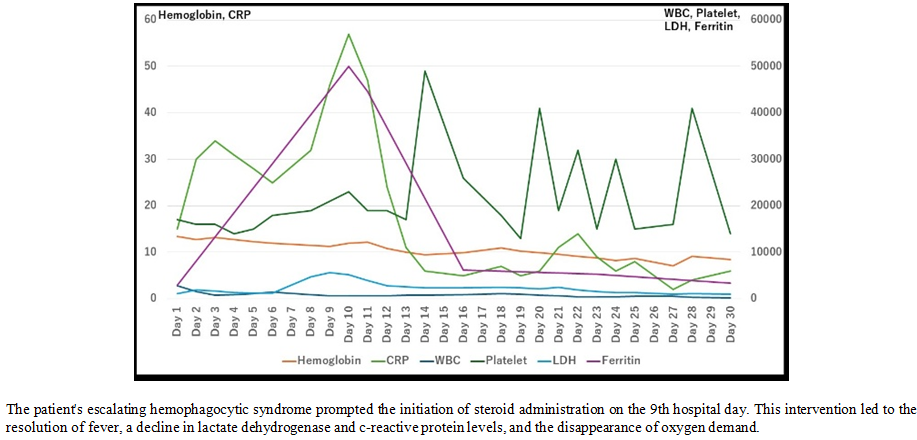
A whole body CT scan revealed an enlarged pancreatic head and abdominal aorta (maximum short diameter 3.7 mm) with mural thrombus. No significant lymph node enlargement or splenomegaly was observed. Therefore, the etiology of the abdominal pain could potentially be attributed to various factors, including an impending rupture of an abdominal aneurysm, an infected aneurysm, pancreatitis, or an infectious lesion of the gastrointestinal tract. With regard to thrombocytopenia, viral infections—including rickettsia or severe fever with thrombocytopenia syndrome (SFTS)—and coagulopathy were unremarkable, suggesting idiopathic thrombocytopenic purpura (ITP), thrombotic thrombocytopenic purpura (TTP), and malignant homological disease based on elevated LDH levels. Given the high inflammatory response, cefmetazole was administered in consideration of intestinal bacterial infection, and minocycline was also administered with fasting. On the second day, abdominal pain disappeared, and blood samples showed no elevation of amylase and no diarrhea, ruling out complications of pancreatitis or gastroenteritis. On the third day, oral intake was started with a small amount of drinking water. A bone marrow aspiration was performed to determine the etiology of the patient's low platelet and high LDH levels. On the fifth day, the patient was found to be negative for rickettsia and SFTS, and minocycline was discontinued. Bone marrow puncture results showed hemophagocytosis and atypical cells; however, the number of cells observed was insufficient to diagnose malignant disease. The patient's blood test results exhibited signs of improvement, with the exception of leukopenia, and he was able to perform daily activities independently and had a good appetite. On the 7th day of the illness, the patient experienced a worsening of his chronic back pain after falling on his buttocks, and he began to show signs of delirium at night. On the 8th day of the illness, at the weekend, the patient began to experience fever and an increased oxygen demand. The patient tested negative for both SARS-CoV-2 and influenza, which were prevalent during that period. Serum LDH levels were elevated at 4,721 IU/L, and CRP levels were elevated at 32 mg/dL. Additionally, an elevated blood ferritin level (50,022 [norma range, 25-250] ng/ml) prompted the performance of the RSB on Monday, the 10th day of the disease, based on the findings from a bone marrow aspiration that were deemed inconsequential. The patient's escalating hemophagocytic syndrome prompted the initiation of steroid administration (dexamethasone, 33 mg/kg) and subsequent taper. This intervention led to the resolution of fever, a decline in LDH and CRP levels (Figure 1), and the disappearance of oxygen demand.
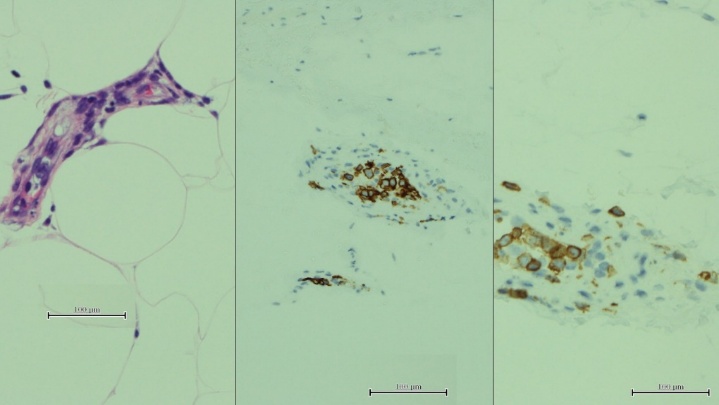
On the 19th day, immunostaining results of the RSB revealed a diagnosis of IVLBCL [CD20(+), CD5(+)] (Figure 2).
Large atypical cells are present in some vessels in Hematoxylin and eosin stain (x 400, left). Immunostaining shows CD20 (+, middle), CD5 (+, right) and a diagnosis was intravascular B-cell lymphoma.
Consequently, first-line THP-COP therapy [pirarubicin, cyclophosphamide, vincristine, and prednisolone] was initiated on day 20, followed by rituximab on day 33, a second course of THP-COP on day 47, rituximab on day 48, and intrathecal administration of methotrexate, cytarabine, and prednisolone on day 66. On day 68 of illness, the patient developed multiple organ failure and died on day 74.

(a) Diagnostic process
The patient presented to a medical institution with abdominal pain and underwent the RSB based on the results of bicytopenia (leukocytes and platelets), elevated LDH levels, and elevated CRP. A definitive diagnosis of IVLBCL was obtained. The final bone marrow biopsy also confirmed the diagnosis of malignant lymphoma, but the cell count was too low to determine the type of lymphoma. In this case, the RSB was useful in confirming the diagnosis.
(b) Mechanism of abdominal pain
The etiology of the abdominal pain in this case remains unclear. To address this knowledge gap, we conducted a review of previously reported cases of intravascular lymphoma (IVL) patients who also experienced abdominal pain. This review aimed to elucidate the pathogenesis of the abdominal pain in this particular case. A comprehensive literature search was conducted using the keywords "intravascular lymphoma (IVL)" and "abdominal pain," yielding a total of ten reports (Table 2). 3, 4, 5, 6, 7 8, 9, 10, 11, 12 Of these, one report was an original Chinese article that documented two cases of abdominal pain among a total of fourteen cases of IVL. 4 Notably, this report only provided an English abstract, and the underlying mechanism of abdominal pain remains to be elucidated. The report by Williams et al. was a case of T cell IVL. 12 When we analyzed the reports of nine cases, excluding the one from China, we found that eight cases were mainly due to organ ischemia symptoms caused by vascular occlusion, and only one case was presumed to be due to myelo-radiculo-neuropathy. In the present case, abdominal pain resolved spontaneously after follow-up, there were no neurological abnormalities other than peritoneal irritation symptoms, and blood gas results at the time of admission showed abnormal values for base excess, which can be caused by organ ischemia, suggesting that abdominal pain may be caused by symptoms of organ ischemia due to temporary vascular occlusion caused by IVLBCL, which may be spontaneously relieved by infusion.
(c) Role of RSB
In this particular instance, the definitive diagnosis was rendered by the RSB rather than a bone marrow aspiration. Historically, the diagnosis of IVLBCL was frequently made using bone marrow aspiration; however, recently, the RSB has become more prevalent due to its ease of execution when compared with bone marrow aspiration. 13 Additionally, the intra-vascular malignant lymphoma in pathology results from bone marrow aspiration, and the low sensitivity of bone marrow aspiration for the diagnosis of IVLBCL is problematic, similar to us. 13 With regard to the indications for the RSB, the following criteria should be considered: First, an unexplained fever (≥ 38°C) is to be considered. Second, altered consciousness is to be noted. Third, hypoxemia (≤ 95%) is to be assessed. (<120 × 103/μL) to be considered. Fifth, high serum lactate dehydrogenase (LDH) is to be evaluated (>800 IU/L), and sixth, high soluble interleukin-2 receptor (sIL-2R) (>5,000 U/mL). 14 The presence of a greater number of applicable criteria indicates a higher probability of IVLBCL diagnosis. Notably, the present case in question exhibited fulfillment of all six criteria during the RSB procedure, a finding that extends to include nocturnal delirium as an altered state of consciousness. Conversely, it has been reported that the RSB should not be performed when LDH and soluble interleukin-2 receptor are normal. 15
We present a case in which a patient presented to a medical institution with abdominal pain and underwent a bone marrow examination based on the results of two blood cell counts (leukocytes and platelets), hyper LDHemia, and elevated CRP. A definitive diagnosis of IVLBCL was made, and a discussion of the literature is provided.
This work was supported in part by a Grant-in-Aid for Special Research in Subsidies for ordinary expenses of private schools from The Promotion and Mutual Aid Corporation for Private Schools of Japan.
| [1] | Staessens S, De Beule N, Van Nedervelde E, Allard S. Intravascular Large B-cell Lymphoma Associated With Hemophagocytosis as a Cause of Fever of Unknown Origin: A Review of Literature. Cureus. 2024 Nov 10; 16(11): e73385. | ||
| In article | View Article PubMed | ||
| [2] | Enzan N, Kitadate A, Kono M. Optimizing random skin biopsies: a review of techniques and indications for intravascular large B-cell lymphoma. Int J Hematol. 2024 Jun; 119(6): 619-625. | ||
| In article | View Article PubMed | ||
| [3] | Nakamoto H, Yokota R, Namba H, Yamada K, Hosoda M, Taguchi K. Effectiveness of Intraoperative Indocyanine Green Fluorescence-Navigated Surgery for Superior Mesenteric Vein Thrombosis that Developed During Treatment for Intravascular Lymphoma: A Case Report. Am J Case Rep. 2021 Apr 30; 22: e929549. | ||
| In article | View Article PubMed | ||
| [4] | Zhang DD, Zhang L, Zhou J, Jiang GZ, Li P, Zhang YP, Wang GN, Zhao WG, Li WC. Clinicopathological features and MYD88 L265P mutation status of intravascular large B cell lymphoma]. Zhonghua Bing Li Xue Za Zhi. 2021 Mar 8; 50(3): 217-221. Chinese. | ||
| In article | |||
| [5] | Aasfara J, Guessous F, Al Bouzidi A, Ouhabi H, Schiff D. Encephalomyeloradiculoneuropathy Revealing a Rare Case of Intravascular Large B-Cell Lymphoma.Cureus. 2021 Jan 17; 13(1): e12749. | ||
| In article | View Article | ||
| [6] | Atalar SC, Akay OM, Osmanbaşoğlu E, Masyan H, Taşkın OÇ, Ferhanoğlu B. Intravascular Large B-Cell Lymphoma Within the Appendix Presenting as Acute Abdomen: A Challenging Diagnosis for Hematologists.Turk J Haematol. 2021 Feb 25; 38(1): 89-91. | ||
| In article | View Article PubMed | ||
| [7] | Ronny FMH, Black MA, Arbini AA. Intravascular large B-cell lymphoma with multi-organ failure presenting as a pancreatic mass: a case with atypical presentation and definite diagnosis postmortem. Autops Case Rep. 2017 Dec 8; 7(4): 30-36. | ||
| In article | View Article PubMed | ||
| [8] | Kumar V, Soni P, Dave V, Harris J. Unusual Presentation of Diffuse Large B-Cell Lymphoma with Splenic Infarcts. J Investig Med High Impact Case Rep. 2017 Feb 1; 5(1): 2324709617690748. | ||
| In article | View Article PubMed | ||
| [9] | Crane GM, Ambinder RF, Shirley CM, Fishman EK, Kasamon YL, Taube JM, Borowitz MJ, Duffield AS. HHV-8-positive and EBV-positive intravascular lymphoma: an unusual presentation of extracavitary primary effusion lymphoma. Am J Surg Pathol. 2014 Mar; 38(3): 426-32. | ||
| In article | View Article PubMed | ||
| [10] | Ishii W, Ito S, Kondo Y, Tsuboi H, Mamura M, Goto D, Matsumoto I, Tsutsumi A, Sumida T, Okoshi Y, Hasegawa Y, Kojima H, Sakashita S, Aita K, Noguchi M.J Clin Oncol. 2008 Mar 20; 26(9):1553-5. | ||
| In article | View Article PubMed | ||
| [11] | Kröber SM. ntravascular lymphoma causing acute abdomen.Pathologe. 2007 Feb; 28(1): 51-4. | ||
| In article | View Article PubMed | ||
| [12] | Williams G, Foyle A, White D, Greer W, Burrell S, Couban S.Am J Hematol. 2005 Mar; 78(3): 207-11. | ||
| In article | View Article PubMed | ||
| [13] | Enzan N, Kitadate A, Kono M. Optimizing random skin biopsies: a review of techniques and indications for intravascular large B-cell lymphoma. Int J Hematol. 2024 Jun; 119(6): 619-625. | ||
| In article | View Article PubMed | ||
| [14] | Matsue K, Abe Y, Kitadate A, Miura D, Narita K, Kobayashi H, et al. Sensitivity and specifcity of incisional random skin biopsy for diagnosis of intravascular large B-cell lymphoma. Blood. 2019; 133: 1257-9. | ||
| In article | View Article PubMed | ||
| [15] | Sumi-Mizuno M, Fukunaga A, Kosaka H, Imai Y, Nagano T. Appropriate indication and procedure for random skin biopsy in the diagnosis of intravascular large B-cell lymphoma. Australas J Dermatol. 2021; 62: 225-7. | ||
| In article | View Article PubMed | ||
Published with license by Science and Education Publishing, Copyright © 2025 Chihiro Maekawa, Noriko Tanaka, Kouhei Yamada, Toshio Hasegawa and Youichi Yanagawa
 This work is licensed under a Creative Commons Attribution 4.0 International License. To view a copy of this license, visit
http://creativecommons.org/licenses/by/4.0/
This work is licensed under a Creative Commons Attribution 4.0 International License. To view a copy of this license, visit
http://creativecommons.org/licenses/by/4.0/
| [1] | Staessens S, De Beule N, Van Nedervelde E, Allard S. Intravascular Large B-cell Lymphoma Associated With Hemophagocytosis as a Cause of Fever of Unknown Origin: A Review of Literature. Cureus. 2024 Nov 10; 16(11): e73385. | ||
| In article | View Article PubMed | ||
| [2] | Enzan N, Kitadate A, Kono M. Optimizing random skin biopsies: a review of techniques and indications for intravascular large B-cell lymphoma. Int J Hematol. 2024 Jun; 119(6): 619-625. | ||
| In article | View Article PubMed | ||
| [3] | Nakamoto H, Yokota R, Namba H, Yamada K, Hosoda M, Taguchi K. Effectiveness of Intraoperative Indocyanine Green Fluorescence-Navigated Surgery for Superior Mesenteric Vein Thrombosis that Developed During Treatment for Intravascular Lymphoma: A Case Report. Am J Case Rep. 2021 Apr 30; 22: e929549. | ||
| In article | View Article PubMed | ||
| [4] | Zhang DD, Zhang L, Zhou J, Jiang GZ, Li P, Zhang YP, Wang GN, Zhao WG, Li WC. Clinicopathological features and MYD88 L265P mutation status of intravascular large B cell lymphoma]. Zhonghua Bing Li Xue Za Zhi. 2021 Mar 8; 50(3): 217-221. Chinese. | ||
| In article | |||
| [5] | Aasfara J, Guessous F, Al Bouzidi A, Ouhabi H, Schiff D. Encephalomyeloradiculoneuropathy Revealing a Rare Case of Intravascular Large B-Cell Lymphoma.Cureus. 2021 Jan 17; 13(1): e12749. | ||
| In article | View Article | ||
| [6] | Atalar SC, Akay OM, Osmanbaşoğlu E, Masyan H, Taşkın OÇ, Ferhanoğlu B. Intravascular Large B-Cell Lymphoma Within the Appendix Presenting as Acute Abdomen: A Challenging Diagnosis for Hematologists.Turk J Haematol. 2021 Feb 25; 38(1): 89-91. | ||
| In article | View Article PubMed | ||
| [7] | Ronny FMH, Black MA, Arbini AA. Intravascular large B-cell lymphoma with multi-organ failure presenting as a pancreatic mass: a case with atypical presentation and definite diagnosis postmortem. Autops Case Rep. 2017 Dec 8; 7(4): 30-36. | ||
| In article | View Article PubMed | ||
| [8] | Kumar V, Soni P, Dave V, Harris J. Unusual Presentation of Diffuse Large B-Cell Lymphoma with Splenic Infarcts. J Investig Med High Impact Case Rep. 2017 Feb 1; 5(1): 2324709617690748. | ||
| In article | View Article PubMed | ||
| [9] | Crane GM, Ambinder RF, Shirley CM, Fishman EK, Kasamon YL, Taube JM, Borowitz MJ, Duffield AS. HHV-8-positive and EBV-positive intravascular lymphoma: an unusual presentation of extracavitary primary effusion lymphoma. Am J Surg Pathol. 2014 Mar; 38(3): 426-32. | ||
| In article | View Article PubMed | ||
| [10] | Ishii W, Ito S, Kondo Y, Tsuboi H, Mamura M, Goto D, Matsumoto I, Tsutsumi A, Sumida T, Okoshi Y, Hasegawa Y, Kojima H, Sakashita S, Aita K, Noguchi M.J Clin Oncol. 2008 Mar 20; 26(9):1553-5. | ||
| In article | View Article PubMed | ||
| [11] | Kröber SM. ntravascular lymphoma causing acute abdomen.Pathologe. 2007 Feb; 28(1): 51-4. | ||
| In article | View Article PubMed | ||
| [12] | Williams G, Foyle A, White D, Greer W, Burrell S, Couban S.Am J Hematol. 2005 Mar; 78(3): 207-11. | ||
| In article | View Article PubMed | ||
| [13] | Enzan N, Kitadate A, Kono M. Optimizing random skin biopsies: a review of techniques and indications for intravascular large B-cell lymphoma. Int J Hematol. 2024 Jun; 119(6): 619-625. | ||
| In article | View Article PubMed | ||
| [14] | Matsue K, Abe Y, Kitadate A, Miura D, Narita K, Kobayashi H, et al. Sensitivity and specifcity of incisional random skin biopsy for diagnosis of intravascular large B-cell lymphoma. Blood. 2019; 133: 1257-9. | ||
| In article | View Article PubMed | ||
| [15] | Sumi-Mizuno M, Fukunaga A, Kosaka H, Imai Y, Nagano T. Appropriate indication and procedure for random skin biopsy in the diagnosis of intravascular large B-cell lymphoma. Australas J Dermatol. 2021; 62: 225-7. | ||
| In article | View Article PubMed | ||