Abstract Wilms' tumor, or nephroblastoma, is a rare pediatric kidney cancer that poses significant challenges, particularly in bilateral cases where preserving kidney function is critical. A 3-year-old girl presented with tumors in both kidneys, detected via ultrasonography and further evaluated with computed tomography (CT), revealing masses measuring 9.5 × 10 × 11 cm in the right kidney and 10 × 11 × 13.5 cm in the left. After ten weeks of chemotherapy with vincristine, dactinomycin, and doxorubicin, she underwent laparoscopic partial nephrectomy of the left kidney and excision of three tumors from the right-—histopathological analysis confirmed stage 5 intermediate-risk Wilms' tumor. Postoperatively, systemic adjuvant chemotherapy was administered, and routine follow-up evaluations confirmed no tumor recurrence and stable kidney function. This case underscores the complexity of treating bilateral Wilms' tumor and highlights the need for a delicate balance between aggressive oncologic treatment and the preservation of essential organ function.
Wilms' tumor, or nephroblastoma, is the most common renal malignancy in children, accounting for nearly 90% of pediatric kidney cancers 1. It primarily affects children aged two to five years and is rare after the age of ten 3. There is a slight female predominance 4. Approximately 10% of cases are bilateral or multifocal, often presenting at a younger age 5, 6. The classic presentation involves an abdominal mass that may be discovered incidentally or through symptoms such as hematuria, abdominal pain, or hypertension in about 25% of cases 7. Ultrasonography is the initial diagnostic tool, followed by CT or MRI to assess tumor extent and potential metastases, most commonly to the lungs or liver 8, 9. For unilateral tumors, radical nephrectomy followed by adjuvant chemotherapy is standard, achieving over 90% survival for localized disease 11, 12, 13. In contrast, bilateral Wilms' tumor requires a more conservative approach to preserve renal tissue. Neoadjuvant chemotherapy is usually administered to shrink the tumors before surgery, followed by nephron-sparing surgery (NSS) whenever possible 12, 14. This report describes a rare case of large, bilateral Wilms' tumors managed successfully with single-stage bilateral NSS after neoadjuvant chemotherapy, illustrating the surgical and oncologic strategies required to achieve optimal outcomes.
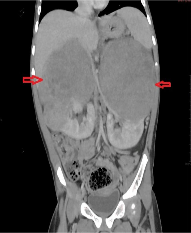
The patient was a 3-year-old girl with no significant medical or surgical history and an unremarkable prenatal and neonatal history who achieved all her developmental milestones appropriately. She started experiencing constant abdominal pain for three weeks before presenting to the hospital. The pain was intermittent and minimally relieved with traditional treatment. One week before admission to the hospital, her family noticed that her abdomen had become more distended and sought medical advice; she was admitted to the hospital. Abdominal ultrasonography revealed bilateral renal masses. Further investigation was performed, including a CT scan of the abdomen, which showed asymmetrical large masses in both kidneys using oral and intravenous contrast. Results showed several masses in the right kidney, with the largest one measuring 9.5 x 10 x 11 cm, causing a significant mass effect on the liver. The larger mass in the left kidney measured 10 x 11 x 13.5 cm, pushing against nearby bowel structures, touching the end of the pancreas, and putting pressure on the rest of the kidney. Necrosis was present in the masses; however, no calcification was detected. There was no inferior vena cava invasion, and both renal veins were patent. Laboratory evaluation revealed a creatinine level of 0.27 mg/dL. Figure 1

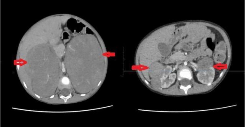
The patient underwent a ten-week chemotherapy regimen with vincristine, dactinomycin, and doxorubicin. An abdominal computed tomography (CT) scan was then performed, revealing a significant reduction in the size of the tumors in both the left and right kidneys (10 × 11 × 13.5 cm to 5 × 5 × 4.5 cm and 9.5 × 10 × 13 cm to 5.5 × 5 × 7 cm, respectively) Figure 2.

The patient underwent nephron-sparing surgery (NSS) despite significant tumor size following the completion of chemotherapy. The procedure began with inserting a 10 Fr Foley catheter after releasing labial fusion. A 7 cm transverse incision was made on the left side, approximately 2 cm below the costal margin. The incision was carefully deepened layer by layer until the retroperitoneum was reached, where the left kidney was encountered. A mass was identified at the medial superior pole of the kidney, and a partial nephrectomy was performed using electrocautery to remove the tumor while preserving the renal artery and vein. Due to the tumor's proximity, partial resection of the suprarenal gland was also required. The resection site was secured. Attention was then directed to the right side, where a 6 cm skin incision was made 2 cm below the costal margin. The peritoneum was carefully entered, exposing the right kidney. Three palpable hard masses were meticulously resected. During the procedure, an inadvertent opening of the right renal pelvic calyceal system occurred, necessitating the insertion of a 4.18 Double-J stent and subsequent closure. The renal artery, vein, and part of the right suprarenal gland were preserved. The kidney border was approximated. Examination of the bowel and mesentery confirmed their integrity. Hemostasis was achieved, and two Biovac drains were placed—one in the right and one in the left gutter. The surgical wounds were closed in two layers, with skin edges approximated in a subcuticular fashion. Postoperatively, the Foley catheter was replaced with a 12 Fr catheter.
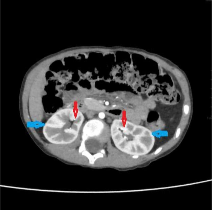
Histopathological analysis confirmed a Wilms tumor of intermediate risk, classified as International Society of Pediatric Oncology (SIOP) stage 5. Following initial pediatric intensive care unit monitoring, the patient was transferred to the ward and discharged in good general condition within 10 days. A postoperative CT scan confirmed normal kidney anatomy with no signs of hydronephrosis Figure 3. Her creatinine was 0.41 mg/dL immediately after surgery and decreased to 0.26 mg/dL after 10 days, indicating preserved kidney function. The patient then commenced Stage II high-risk chemotherapy, consisting of four cycles over 13 weeks. Follow-up tests showed that the tumor had gone entirely, and the kidneys were still functioning properly.

Wilms' tumor represents the most common renal malignancy in children, with bilateral or multifocal cases comprising approximately 10% 5, 6. The management of bilateral Wilms' tumor is particularly challenging, as it demands a careful balance between achieving complete tumor resection and preserving renal function. While staged or sequential NSS has been more commonly reported, successful single-stage bilateral NSS for large tumors remains rare. Previous studies have reported limited numbers of such cases, often favoring two-stage approaches to minimize ischemic time and surgical complexity 17. Our case demonstrates that with adequate tumor shrinkage after neoadjuvant chemotherapy, single-stage bilateral NSS can be safely performed with excellent renal and oncologic outcomes.
Genetic predispositions, including WT1 and WT2 mutations, play roles in bilateral disease development 15, 16; however, our patient had no syndromic or familial risk factors. Intraoperative challenges, such as right renal pelvic injury managed with stent placement, emphasize the need for readiness to address complications while maintaining renal viability.
From a surgical planning perspective, multidisciplinary coordination is critical—preoperative imaging guides safe resection planes, and intraoperative precision ensures vascular preservation. Postoperative care should focus on renal monitoring and prevention of chemotherapy-related late effects such as cardiotoxicity or chronic kidney disease 18, 19, 20.
This case provides valuable insights: (1) single-stage bilateral NSS can be feasible in well-selected patients after adequate tumor downstaging, (2) careful surgical technique enables kidney preservation even in complex anatomy, and (3) long-term follow-up is essential to monitor renal and oncologic outcomes.
Upon presentation, the patient had large, asymmetrical bilateral tumors, both of which were displacing adjacent structures like the pancreas, bowel, and liver, without involvement of the inferior vena cava (IVC). Nephron-sparing surgery (NSS) is typically the standard of care for bilateral Wilms' tumor and can be performed as either a one- or two-stage procedure. Some medical practices recommend starting with neoadjuvant chemotherapy before surgery, followed by surgical tumor resection and postoperative chemotherapy or radiotherapy 17. For this patient, chemotherapy was initiated after diagnosis, followed by a one-stage surgery despite the challenging size and location of the tumors near critical structures. The surgical resection preserved the function of both kidneys. Follow-up over the next year showed no deterioration in kidney function or recurrence, suggesting the success of this aggressive but nephron-sparing approach. An intraoperative complication occurred when the renal pelvis on the right side was inadvertently opened, requiring the placement of a Double-J stent, a rare issue in such cases.
With improved survival rates for Wilms' tumor, the focus has shifted to manage late complications resulting from treatment. Chemotherapy that includes doxorubicin carries the risk of developing congestive heart failure 18, and other late complications include secondary cancers due to chemotherapy or radiation therapy 9. Chronic kidney disease is another significant concern, particularly for patients with bilateral Wilms' tumor, with approximately 12% of patients developing end-stage renal disease 19. While this can also occur in survivors of non-syndromic unilateral Wilms' tumor, it is less common. Given these risks, long-term follow-up is essential to monitor for potential renal complications later in life 20.
This case highlights that single-stage nephron-sparing surgery is a feasible option for large bilateral Wilms' tumors when tumor shrinkage allows for safe surgical margins. Additionally, the successful management of renal pelvic injury during surgery, without compromising renal function, provides valuable insights that may guide future nephron-sparing protocols.
This case is an example of the difficulties arising in the management of bilateral tumors of the Wilms type, with the main problem being the balance between tumor excision and kidney preservation in a child. In this case, neoadjuvant chemotherapy followed by nephron-sparing surgery was efficient, thereby allowing complete resection of large tumors while maintaining kidney function. This case highlights the feasibility of single-stage bilateral NSS in large, organ-displacing tumors, a less commonly reported approach. The absence of inferior vena cava invasion, suprarenal involvement, and the need for renal pelvic repair during NSS adds to the surgical complexities. Our findings contribute to the evolving discussion on optimizing renal preservation strategies in bilateral Wilms' tumor.
Not applicable.
The authors declare no conflicts of interest.
Informed consent was obtained from the patient. Our institution does not require ethical approval for the case reports.
The parents signed an informed consent form allowing the use of clinical data, imaging, and anonymized information related to their child's diagnosis and treatment in diagnostics, scientific research, and publication. They also provided consent for anonymized images and details of this case report for educational and research purposes.
| [1] | Xie W, Wei L, Guo J, et al.: Physiological functions of Wilms' tumor 1-associating protein and its role in tumourigenesis. J Cell Biochem. 2019, 120: 10884-92. 10.1002/jcb.28402. | ||
| In article | View Article PubMed | ||
| [2] | Stiller CA, Allen MB, Eatock EM: Childhood cancer in Britain: the National Registry of Childhood Tumours and incidence rates 1978-1987. Eur J Cancer. 1995, 31: 2028-34. 10.1016/0959-8049(95)00428-9. | ||
| In article | View Article PubMed | ||
| [3] | Hol JA, Lopez-Yurda MI, Van Tinteren H, et al.: Prognostic significance of age in 5631 patients with Wilms tumour registered in International Society of Paediatric Oncology. PLoS One. 2019, 14: 0221373. 10.1371/journal.pone.0221373. | ||
| In article | View Article PubMed | ||
| [4] | Steliarova-Foucher E: International incidence of childhood cancer, 2001-10: a population-based registry study. Lancet Oncol. 2017, 18: 719-31. 10.1016/S1470-2045(17)30186-9. | ||
| In article | |||
| [5] | Rivera MN, Haber DA: Wilms’ tumor: connecting tumorigenesis and organ development in the kidney. Nat Rev Cancer. 2005, 5:699-712. 10.1038/nrc1696. | ||
| In article | View Article PubMed | ||
| [6] | Buckley KS: Pediatric genitourinary tumors. Curr Opin Oncol. 2011, 23: 297-302. 10.1097/CCO.0b013e3283458613. | ||
| In article | View Article PubMed | ||
| [7] | Rais, F., Benhmidou, et al.: Wilms tumor in childhood: Single centre retrospective study from the National Institute of Oncology of Rabat and literature review. Pediatric Hematology Oncology Journal. 1: 28-34. 10.1016/j.phoj.2016.07.006. | ||
| In article | View Article | ||
| [8] | Chung EM, Graeber AR, Conran RM: Renal tumors of childhood: radiologic-pathologic correlation part 1. The 1st decade: from the Radiologic Pathology Archives. Radiographics. 2016, 36: 499-522. 10.1148/rg.2016150230. | ||
| In article | View Article PubMed | ||
| [9] | Balis F, Green DM, Anderson C, et al.: Wilms tumor (nephroblastoma), version 2.2021, NCCN clinical practice guidelines in oncology. J Natl Compr Canc Netw. 2021, 19: 945-77. 10.6004/jnccn.2021.0037. | ||
| In article | |||
| [10] | Tagoe, L. G., Bonney, et al.: Unusual metastatic patterns of Wilms tumor: A case series. Cureus. 16:54640-10. 10.7759/cureus.54640 | ||
| In article | |||
| [11] | Spreafico F, Fernandez CV, Brok J, et al.: Wilms tumour. Nat Rev Dis Primers. 2021, 7: 1-17. 10.1038/s41572-021-00308-8. | ||
| In article | View Article PubMed | ||
| [12] | Davidoff AM. Wilms tumor: Adv Pediatr. 2012: 247-67. 10.1016/j.yapd.2012.04.001. | ||
| In article | View Article PubMed | ||
| [13] | Elli M, Sungur M, Genç G, Ayyıldız P, Dağdemir A, Güçlü Pınarlı F, Acar S: The late effects of anticancer therapy after childhood Wilm's tumor: the role of diastolic function and ambulatory blood pressure monitoring. Jpn J Clin Oncol. 2013, 43: 1004-11. 10.1093/ jjco/hyt105. | ||
| In article | View Article PubMed | ||
| [14] | Shamberger RC, Haase GM, Argani P, et al.: Bilateral Wilms’ tumors with progressive or nonresponsive disease. J Pediatr Surg. 2006, 41:652-7. 10.1016/j.jpedsurg.2005.12.004. | ||
| In article | View Article PubMed | ||
| [15] | Fischbach BV, Trout KL, Lewis J, et al.: WAGR syndrome: a clinical review of 54 cases. Pediatrics. 2005, 116:984-8. 10.1542/peds.2004-0467. | ||
| In article | View Article PubMed | ||
| [16] | Choufani S, Shuman C, Weksberg R: Molecular findings in Beckwith-Wiedemann syndrome. Am J Med Genet C Semin Med Genet. 2013, 163: 131-40. 10.1002/ajmg.c.31363. | ||
| In article | View Article PubMed | ||
| [17] | Blute ML, Kelalis PP, Offord KP, et al.: J Urol. 1987, 138:968-73. 10.1016/s0022-5347(17)43474-4. | ||
| In article | View Article PubMed | ||
| [18] | Belger C, Abrahams C, Imamdin A, Lecour S: Doxorubicin-induced cardiotoxicity and risk factors. IJC Heart Vasculature. 2023, 50: 101332. 10.1016/j.ijcha.2023.101332. | ||
| In article | View Article PubMed | ||
| [19] | Breslow, N. E., Collins, et al.: End-stage renal disease in patients with Wilms tumor: Results from the National Wilms Tumor Study Group and the United States Renal Data System. Journal of Urology. 174: 1972-1975. 10.1097/01.ju.0000176800.00994.3a. | ||
| In article | View Article PubMed | ||
| [20] | Bal AS, Yalcin B, Susam-Şen H, et al.: Renal late effects after the treatment of unilateral nonsyndromic Wilms tumor. J Pediatr Hematol Oncol. 2016, 38:147-50. 10.1097/ MPH. 0000000000000557. | ||
| In article | View Article PubMed | ||
Published with license by Science and Education Publishing, Copyright © 2025 Salma Alhajj Qasem, Adil A. A. Alsweis, Samer Bustame and Amna Akkawi
 This work is licensed under a Creative Commons Attribution 4.0 International License. To view a copy of this license, visit
http://creativecommons.org/licenses/by/4.0/
This work is licensed under a Creative Commons Attribution 4.0 International License. To view a copy of this license, visit
http://creativecommons.org/licenses/by/4.0/
| [1] | Xie W, Wei L, Guo J, et al.: Physiological functions of Wilms' tumor 1-associating protein and its role in tumourigenesis. J Cell Biochem. 2019, 120: 10884-92. 10.1002/jcb.28402. | ||
| In article | View Article PubMed | ||
| [2] | Stiller CA, Allen MB, Eatock EM: Childhood cancer in Britain: the National Registry of Childhood Tumours and incidence rates 1978-1987. Eur J Cancer. 1995, 31: 2028-34. 10.1016/0959-8049(95)00428-9. | ||
| In article | View Article PubMed | ||
| [3] | Hol JA, Lopez-Yurda MI, Van Tinteren H, et al.: Prognostic significance of age in 5631 patients with Wilms tumour registered in International Society of Paediatric Oncology. PLoS One. 2019, 14: 0221373. 10.1371/journal.pone.0221373. | ||
| In article | View Article PubMed | ||
| [4] | Steliarova-Foucher E: International incidence of childhood cancer, 2001-10: a population-based registry study. Lancet Oncol. 2017, 18: 719-31. 10.1016/S1470-2045(17)30186-9. | ||
| In article | |||
| [5] | Rivera MN, Haber DA: Wilms’ tumor: connecting tumorigenesis and organ development in the kidney. Nat Rev Cancer. 2005, 5:699-712. 10.1038/nrc1696. | ||
| In article | View Article PubMed | ||
| [6] | Buckley KS: Pediatric genitourinary tumors. Curr Opin Oncol. 2011, 23: 297-302. 10.1097/CCO.0b013e3283458613. | ||
| In article | View Article PubMed | ||
| [7] | Rais, F., Benhmidou, et al.: Wilms tumor in childhood: Single centre retrospective study from the National Institute of Oncology of Rabat and literature review. Pediatric Hematology Oncology Journal. 1: 28-34. 10.1016/j.phoj.2016.07.006. | ||
| In article | View Article | ||
| [8] | Chung EM, Graeber AR, Conran RM: Renal tumors of childhood: radiologic-pathologic correlation part 1. The 1st decade: from the Radiologic Pathology Archives. Radiographics. 2016, 36: 499-522. 10.1148/rg.2016150230. | ||
| In article | View Article PubMed | ||
| [9] | Balis F, Green DM, Anderson C, et al.: Wilms tumor (nephroblastoma), version 2.2021, NCCN clinical practice guidelines in oncology. J Natl Compr Canc Netw. 2021, 19: 945-77. 10.6004/jnccn.2021.0037. | ||
| In article | |||
| [10] | Tagoe, L. G., Bonney, et al.: Unusual metastatic patterns of Wilms tumor: A case series. Cureus. 16:54640-10. 10.7759/cureus.54640 | ||
| In article | |||
| [11] | Spreafico F, Fernandez CV, Brok J, et al.: Wilms tumour. Nat Rev Dis Primers. 2021, 7: 1-17. 10.1038/s41572-021-00308-8. | ||
| In article | View Article PubMed | ||
| [12] | Davidoff AM. Wilms tumor: Adv Pediatr. 2012: 247-67. 10.1016/j.yapd.2012.04.001. | ||
| In article | View Article PubMed | ||
| [13] | Elli M, Sungur M, Genç G, Ayyıldız P, Dağdemir A, Güçlü Pınarlı F, Acar S: The late effects of anticancer therapy after childhood Wilm's tumor: the role of diastolic function and ambulatory blood pressure monitoring. Jpn J Clin Oncol. 2013, 43: 1004-11. 10.1093/ jjco/hyt105. | ||
| In article | View Article PubMed | ||
| [14] | Shamberger RC, Haase GM, Argani P, et al.: Bilateral Wilms’ tumors with progressive or nonresponsive disease. J Pediatr Surg. 2006, 41:652-7. 10.1016/j.jpedsurg.2005.12.004. | ||
| In article | View Article PubMed | ||
| [15] | Fischbach BV, Trout KL, Lewis J, et al.: WAGR syndrome: a clinical review of 54 cases. Pediatrics. 2005, 116:984-8. 10.1542/peds.2004-0467. | ||
| In article | View Article PubMed | ||
| [16] | Choufani S, Shuman C, Weksberg R: Molecular findings in Beckwith-Wiedemann syndrome. Am J Med Genet C Semin Med Genet. 2013, 163: 131-40. 10.1002/ajmg.c.31363. | ||
| In article | View Article PubMed | ||
| [17] | Blute ML, Kelalis PP, Offord KP, et al.: J Urol. 1987, 138:968-73. 10.1016/s0022-5347(17)43474-4. | ||
| In article | View Article PubMed | ||
| [18] | Belger C, Abrahams C, Imamdin A, Lecour S: Doxorubicin-induced cardiotoxicity and risk factors. IJC Heart Vasculature. 2023, 50: 101332. 10.1016/j.ijcha.2023.101332. | ||
| In article | View Article PubMed | ||
| [19] | Breslow, N. E., Collins, et al.: End-stage renal disease in patients with Wilms tumor: Results from the National Wilms Tumor Study Group and the United States Renal Data System. Journal of Urology. 174: 1972-1975. 10.1097/01.ju.0000176800.00994.3a. | ||
| In article | View Article PubMed | ||
| [20] | Bal AS, Yalcin B, Susam-Şen H, et al.: Renal late effects after the treatment of unilateral nonsyndromic Wilms tumor. J Pediatr Hematol Oncol. 2016, 38:147-50. 10.1097/ MPH. 0000000000000557. | ||
| In article | View Article PubMed | ||