Diagnosis of pheochromocytoma, a rare, largely-incidentally found tumor of the adrenal glands, is typically challenging due to its frequently variable, nonspecific, and atypical presentations as it can mimic many other diagnoses, notably menopause. This study details a case of a 47-year-old female who primarily presented with flushing and insidious weight loss; further studies also revealed a new hyperglycemia. Initially thought to be menopausal symptoms, she then returned months later with chest pain and dyspnea and underwent cardiac work-up for a diagnosis of myopericarditis and eventually cardiomyopathy. After being hospitalized for pneumonia, her pheochromocytoma was finally incidentally discovered on abdominal CT. Pheochromocytomas should be considered in the differential diagnoses of flushing in menopause-age women and can occur with normotensive, atypical presentations, particularly patients with more concerning features such as weight loss. Furthermore, pheochromocytomas can cause long-lasting cardiac damage, and should be acknowledged as a possible cause of cardiomyopathy.
A pheochromocytoma is a tumor that develops in the adrenal glands, arising from adrenomedullary chromaffin cells. These cells are mainly responsible for producing catecholamines, such as epinephrine and norepinephrine. In the body, these catecholamines serve as both hormones and neurotransmitters and they play a crucial role in the mounting of sympathetic responses 1. Therefore, most patients with pheochromocytoma present with a variety of symptoms related to this activation in sympathetic stimulation. The classic triad of symptoms consists of headaches, sweating, and palpitations 2. However, recent research suggests that this triad is only observed in 17% of patients 3. Another typical feature seen in patients with pheochromocytoma is hypertension; it is present in up to 65-80% of cases 4. In addition to classic symptoms, patients have also presented with anxiety, dyspnea, visual changes, paresthesia, abdominal, flank, or chest pain 4. However, limited data exists on patients presenting with chest pain as their primary complaint. The pathogenesis of chest pain in pheochromocytoma is thought to arise from excessive catecholamine-induced stimulation of cardiac myocytes. The damage to these cells can manifest itself in several forms, ranging from Takotsubo and dilated cardiomyopathies to myocardial infarctions 5, 6. To our knowledge, this is the first case that emphasizes the need for suspicion in specifically menopausal patients. We describe a case of pheochromocytoma in a menopausal-age female who predominantly presented with flushing and vasomotor disturbance and subsequently developed catecholamine-induced cardiomyopathy.
A healthy female in her late 40s presented with initial symptoms of hot flashes and unexplained weight loss of 4.5 kg within the last year without intention to lose weight or changes in diet or behavior. Her visit was originally an annual follow-up with her primary physician. She had no complaints of headaches, palpitations, or diaphoresis. Her vitals were normal and the only notable labs at the time included a high cholesterol level, expected given her history of hyperlipidemia, and a new onset hyperglycemia and an increased hemoglobin A1C of 6.1. She had no history of hypertension and has not needed to take anti-hypertensives. She also did not have a history of diabetes. She did have a family history of hypertension, hyperlipidemia, and Type II diabetes in both her parents and one of her sisters. Her last menstrual period was in 2021; she had been taking oral hormonal contraceptives and had not experienced menstruation since. Her height, body weight, and body mass index at that initial visit were 158.8 cm, 52.6 kg, and 20.88 kg/m2.
At first, given her age and her symptoms of flushing, it was thought that she may be experiencing menopause. Her follicle-stimulating hormone (FSH) level at the time was 29.1 mIU/mL, which was within the post-menopausal range. She was prescribed hormone therapy and told to follow-up in 3 months. Over the course of the next several months, she had continued to lose weight, was still experiencing flushing, and had no relief with the hormone therapy. She was also now experiencing feelings of anxiety and having trouble sleeping at night.
6 months after her initial visit, she presented with new onset symptoms of shortness of breath and chest tightness that had worsened within the last week. Her physical exam showed tachycardia and a friction rub. She was promptly sent to the cardiologist and underwent an echocardiogram and a nuclear stress test, where she was diagnosed with myopericarditis with a depressed left ventricular ejection fraction (LVEF) of 30-35%. After resolution of her chest pain and friction rub with Colchicine, she was then found to have cardiomyopathy, after which the cardiologist started her on Losartan and Metoprolol. She then underwent a coronary angiography and left heart catheterization, which showed normal coronary arteries.
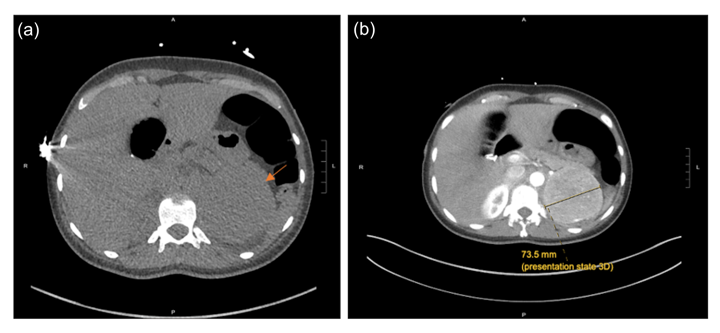
One month later, she presented to the emergency department (ED) twice for her shortness of breath and chest pain. She was sent home with Furosemide on her first visit. On her second visit four days later, she was admitted to the hospital for increasing dyspnea on exertion and palpitations. Table 1 displays her laboratory values on admission; notable values include significantly elevated metanephrines, slightly elevated troponin and renin, and hyperglycemia. Computed tomography angiography (CTA) with intravenous (IV) contrast showed no evidence of a pulmonary embolism but showed areas of consolidation in the lower lobes consistent with pneumonia, which she was then treated for with IV antibiotics. Additionally, the CTA showed poor visualization of a mass lesion in the upper left quadrant of her abdomen, concerning for a solid mass (Figure 1a). Abdominal contrast-enhanced CT then uncovered a heterogenous 7.5 x 6.7 cm adrenal mass centered around the left adrenal gland (Figure 1b). The mass appeared separate from the left kidney and had somewhat of a mass effect on a portion of the upper pole of the left kidney.

For her pneumonia, she was treated with IV Ceftriaxone, of which she completed a 5-day course. She was also given a dose of IV Furosemide, to which she reported improvement in her shortness of breath. She was started on oral Doxazosin, Hydralazine, and Furosemide after discharge, and scheduled for surgery with the urologist.
Two weeks later, she presented to the ED again with severe right flank pain. Her CT scan showed geographic hypoperfusion of the right kidney consistent with multifocal right renal infarcts. Her echocardiogram showed an LVEF that had improved to about 55-60% without significant left ventricular hypertrophy, and a mobile mass in the mid-anterior anteroseptal walls, consistent with a left ventricular thrombus. She was also found to be COVID-positive at the time. She was given Enoxaparin for anticoagulation and eventually discharged.
She underwent a successful laparoscopic left adrenalectomy two weeks later. Her blood pressure and cardiac medications were discontinued, and she was discharged on Warfarin for the clots. The pathology of the pheochromocytoma was notable for a 9 cm mass without malignant features. One month after surgery, her normetanephrine level was 201 pg/mL, significantly decreased after the procedure. Her hyperglycemia had also resolved as well.
She eventually underwent genetic testing with the Hereditary Paraganglioma-Pheochromocytoma panel (FH, MAX, NF1, RET, SDHA, SDHAF2, SDHB, SDHC, SDHD, TMEM127, VHL) and received negative results. It was determined that her disease pathophysiology was likely sporadic.
Given the patient’s age, initial symptoms of flushing, and lack of the typical triad associated with pheochromocytoma, her case was mistaken for menopausal symptoms. This was complicated by her history of taking oral contraceptives as a hormone replacement therapy, in which she hasn’t had a menstrual cycle since 2021, and her elevated FSH level in the postmenopausal range. Her new onset of chest pain and palpitations then led to an exhaustive investigation for cardiac causes, which included invasive imaging (left heart catheterization showing normal coronary arteries), and she was found to have acute myopericarditis-related cardiomyopathy. She presented to the emergency department several times throughout this process, and it was not until she was hospitalized for pneumonia that her large pheochromocytoma was incidentally found on abdominal CT.
There have been other reported cases of pheochromocytoma-related catecholamine-induced myocarditis or cardiomyopathy 7, 8, 9, 10, 11, 12. However, it is a relatively un-studied sequelae of pheochromocytomas and notably, literature analyses such as Zhang et al. 5 have reported that only 4% of those that presented with cardiomyopathy concurrently experienced symptoms of the classic triad, and that only 65% presented with the disease-defining symptom of hypertension. They also reported that diagnosis is generally delayed due to the atypical presentation associated with these types of cases 5; our patient lacked both presentations, which may have led to a delay in her diagnosis. Within our literature review, there have been cases where the effects of catecholamine-caused cardiomyopathy are both reversible and irreversible 5, 9, 13; in our case, the patient’s ejection fraction recovered fully and she regained to her baseline weight with her symptoms completely resolving. However, other cases show significant long-term effects of cardiac damage resulting in cardiac transplants and even death 5, 7, 9. The mechanism for catecholamine-induced cardiomyopathy and the degree of irreversibility of its effects are relatively unknown, but some studies suggest a combination of different processes, including direct toxic metabolites and free radicals associated with catecholamine production, chronic inflammation and necrosis that impairs myocardial contractility and structure, and long-term ischemia leading to cardiac dysfunction 7, 9, 14, 15, 16.
There are also limited data and research on the concurrence of women at the menopausal age with pheochromocytomas, although there are several reports detailing specific cases of women with pheochromocytomas that manifest during pregnancy 16, 17, 18. Many of the symptoms of pregnancy can be confounded with the signs of pheochromocytoma, including hypertension, nausea, diaphoresis, and vasomotor disturbances 19. There are several papers detailing guidelines on the diagnosis and management of pheochromocytomas in pregnancy, as the risk is significant for both the mother and fetus. However, although menopausal symptoms can also overlap with those of pheochromocytomas, it is less studied and considered as a possible diagnosis. To our knowledge, this is the first case study published detailing the specific case of a pheochromocytoma mimicking menopausal symptoms. Other studies reviewing the differential diagnoses of vasomotor instability and excessive sweating in women over the age of 45 do include several endocrine conditions that can mimic flushing, such as medullary carcinoma of the thyroid, pancreatic islet-cell tumors, carcinoid syndrome, and pheochromocytomas 20, 21, 22. These studies also stress the importance of the knowledge of rare disease pathophysiology and the ability to anticipate the possibility of these serious diagnoses 22.
In conclusion, this case study highlights an atypical presentation of pheochromocytoma mistaken for menopause in a woman greater than the age of 45, and its subsequent rare sequelae of catecholamine-induced cardiomyopathy. This case report serves as a caution to consider dangerous differentials of flushing in menopause-age women, especially those with more concerning symptoms such as inconspicuous weight loss or new onset chest pain. Additionally, this case provides further discussion on pheochromocytoma-related causes of cardiomyopathy and its mechanisms and prospects after treatment and management.
• Pheochromocytoma is a serious diagnosis that should be considered in menopause-age patients with flushing as their primary complaint.
• Many cases of pheochromocytoma are atypical in presentation, and providers should be vigilant and knowledgeable in considering a wide differential of endocrine conditions.
• Cardiac complications associated with pheochromocytomas can be transient or permanent and should be quickly managed with surgical resection.
This research received no specific grant from any funding agency in the public, commercial, or not-for-profit sectors.
We wish to confirm that there are no known conflicts of interest associated with his publication and there has been no significant financial support for this work that could have influenced its outcome.
| [1] | Lenders JWM, Duh QY, Eisenhofer G, Gimenez-Roqueplo AP, Grebe SKG, Murad MH, et al. Pheochromocytoma and Paraganglioma: An Endocrine Society Clinical Practice Guideline. J Clin Endocrinol Metab. 2014 Jun 1; 99(6): 1915–42. | ||
| In article | View Article PubMed | ||
| [2] | Kiriakopoulos A, Giannakis P, Menenakos E. Pheochromocytoma: a changing perspective and current concepts. Ther Adv Endocrinol Metab. 2023 Jan; 4: 20420188231207544. | ||
| In article | View Article PubMed | ||
| [3] | Falhammar H, Kjellman M, Calissendorff J. Initial clinical presentation and spectrum of pheochromocytoma: a study of 94 cases from a single center. Endocr Connect. 2018 Jan; 7(1): 186–92. | ||
| In article | View Article PubMed | ||
| [4] | Soltani A, Pourian M, Davani BM. Does this patient have Pheochromocytoma? a systematic review of clinical signs and symptoms. J Diabetes Metab Disord. 2016 Dec; 15(1): 6. | ||
| In article | View Article PubMed | ||
| [5] | Zhang R, Gupta D, Albert SG. Pheochromocytoma as a reversible cause of cardiomyopathy: Analysis and review of the literature. Int J Cardiol. 2017 Dec; 249: 319–23. | ||
| In article | View Article PubMed | ||
| [6] | Yu R, Nissen NN, Bannykh SI. Cardiac Complications as Initial Manifestation of Pheochromocytoma: Frequency, Outcome, and Predictors. Endocr Pract. 2012 Jul; 18(4): 483–92. | ||
| In article | View Article PubMed | ||
| [7] | Cho T, Tanimura A, Saito Y. CATECHOLAMINE‐INDUCED CARDIOPATHY ACCOMPANIED WITH PHEOCHROMOCYTOMA. Acta Pathol Jpn. 1987 Jan; 37(1): 123–32. | ||
| In article | View Article PubMed | ||
| [8] | Kaneto H, Kamei S, Tatsumi F, Shimoda M, Kimura T, Nakanishi S, et al. Case Report: Malignant Pheochromocytoma Without Hypertension Accompanied by Increment of Serum VEGF Level and Catecholamine Cardiomyopathy. Front Endocrinol. 2021 Jun 25; 12: 688536. | ||
| In article | View Article PubMed | ||
| [9] | Khattak S, Sim I, Dancy L, Whitelaw B, Sado D. Phaeochromocytoma found on cardiovascular magnetic resonance in a patient presenting with acute myocarditis: an unusual association. BMJ Case Rep. 2018 Jun 8; 2018: bcr2017222621, bcr-2017–222621. | ||
| In article | View Article PubMed | ||
| [10] | Wang AR, Dean SA, Grebe SK, Hood IC. Fatal Catecholamine-Induced Cardiotoxicity Associated with Pheochromocytoma: Report of a Postpartum Case and Review of the Literature. Acad Forensic Pathol. 2016 Jun; 6(2): 315–24. | ||
| In article | View Article PubMed | ||
| [11] | Davide Muratori, Patrizia Pedrotti, Matteo Baroni, Armando Belloni, Giuseppina Quattrocchi, Angela Milazzo, et al. Miocardite indotta da catecolamine in feocromocitoma. G Ital Cardiol [Internet]. 2017 Feb 1 [cited 2024 Jan 22]; (2017Febbraio). | ||
| In article | |||
| [12] | de Miguel V, Arias A, Paissan A, de Arenaza DP, Pietrani M, Jurado A, et al. Catecholamine-induced myocarditis in pheochromocytoma. Circulation. 2014 Mar 25; 129(12): 1348–9. | ||
| In article | View Article PubMed | ||
| [13] | Ferreira VM, Marcelino M, Piechnik SK, Marini C, Karamitsos TD, Ntusi NAB, et al. Pheochromocytoma Is Characterized by Catecholamine-Mediated Myocarditis, Focal and Diffuse Myocardial Fibrosis, and Myocardial Dysfunction. J Am Coll Cardiol. 2016 May; 67(20): 2364–74. | ||
| In article | View Article PubMed | ||
| [14] | Wittstein IS, Thiemann DR, Lima JAC, Baughman KL, Schulman SP, Gerstenblith G, et al. Neurohumoral Features of Myocardial Stunning Due to Sudden Emotional Stress. N Engl J Med. 2005 Feb 10; 352(6): 539–48. | ||
| In article | View Article PubMed | ||
| [15] | Singal PK, Kapur N, Dhillon KS, Beamish RE, Dhalla NS. Role of free radicals in catecholamine-induced cardiomyopathy. Can J Physiol Pharmacol. 1982 Nov 1; 60(11): 1390–7. | ||
| In article | View Article PubMed | ||
| [16] | Santos DRPD, Barbisan CC, Marcellini C, Santos RMVRD. Pheochromocytoma and pregnancy: A case report and review. J Bras Nefrol [Internet]. 2015 [cited 2024 Mar 19]; 37(4). Available from: http:// www.scielo.br/ scielo.php? script= sci_arttext& pid=S0101-28002015000400496. | ||
| In article | View Article | ||
| [17] | Chen HF, Su JY, Tong JR, Chen Y, Huang LL, Deng L. Pheochromocytoma in pregnancy: a case report. Eur Rev Med Pharmacol Sci. 2023 Jun; 27(12): 5700–5. | ||
| In article | |||
| [18] | Palomba G, Dinuzzi VP, Palumbo M, Amendola A, Errico C, Basile R, et al. Management of pheochromocytoma during pregnancy from diagnosis to laparoscopic adrenalectomy. A case report and review of literature. Ann Ital Chir. 2021; 92: 254–9. | ||
| In article | |||
| [19] | Wyskida M, Wyskida K, Maruniak-Chudek I, Sikora J, Chudek J. Pheochromocytoma in pregnancy. Postępy Hig Med Dośw. 2014 Jun 9; 68: 749–53. | ||
| In article | View Article PubMed | ||
| [20] | Huguet I, Grossman A. MANAGEMENT OF ENDOCRINE DISEASE: Flushing: current concepts. Eur J Endocrinol. 2017 Nov; 177(5): R219–29. | ||
| In article | View Article PubMed | ||
| [21] | Izikson L, English JC, Zirwas MJ. The flushing patient: Differential diagnosis, workup, and treatment. J Am Acad Dermatol. 2006 Aug; 55(2): 193–208. | ||
| In article | View Article PubMed | ||
| [22] | Mohyi D, Tabassi K, Simon J. Differential diagnosis of hot flashes. Maturitas. 1997 Jul 1; 27(3): 203–14. | ||
| In article | View Article PubMed | ||
Published with license by Science and Education Publishing, Copyright © 2024 Vivian Zhang BA, Emma Barry BA and Lyn Dea DO
 This work is licensed under a Creative Commons Attribution 4.0 International License. To view a copy of this license, visit
https://creativecommons.org/licenses/by/4.0/
This work is licensed under a Creative Commons Attribution 4.0 International License. To view a copy of this license, visit
https://creativecommons.org/licenses/by/4.0/
| [1] | Lenders JWM, Duh QY, Eisenhofer G, Gimenez-Roqueplo AP, Grebe SKG, Murad MH, et al. Pheochromocytoma and Paraganglioma: An Endocrine Society Clinical Practice Guideline. J Clin Endocrinol Metab. 2014 Jun 1; 99(6): 1915–42. | ||
| In article | View Article PubMed | ||
| [2] | Kiriakopoulos A, Giannakis P, Menenakos E. Pheochromocytoma: a changing perspective and current concepts. Ther Adv Endocrinol Metab. 2023 Jan; 4: 20420188231207544. | ||
| In article | View Article PubMed | ||
| [3] | Falhammar H, Kjellman M, Calissendorff J. Initial clinical presentation and spectrum of pheochromocytoma: a study of 94 cases from a single center. Endocr Connect. 2018 Jan; 7(1): 186–92. | ||
| In article | View Article PubMed | ||
| [4] | Soltani A, Pourian M, Davani BM. Does this patient have Pheochromocytoma? a systematic review of clinical signs and symptoms. J Diabetes Metab Disord. 2016 Dec; 15(1): 6. | ||
| In article | View Article PubMed | ||
| [5] | Zhang R, Gupta D, Albert SG. Pheochromocytoma as a reversible cause of cardiomyopathy: Analysis and review of the literature. Int J Cardiol. 2017 Dec; 249: 319–23. | ||
| In article | View Article PubMed | ||
| [6] | Yu R, Nissen NN, Bannykh SI. Cardiac Complications as Initial Manifestation of Pheochromocytoma: Frequency, Outcome, and Predictors. Endocr Pract. 2012 Jul; 18(4): 483–92. | ||
| In article | View Article PubMed | ||
| [7] | Cho T, Tanimura A, Saito Y. CATECHOLAMINE‐INDUCED CARDIOPATHY ACCOMPANIED WITH PHEOCHROMOCYTOMA. Acta Pathol Jpn. 1987 Jan; 37(1): 123–32. | ||
| In article | View Article PubMed | ||
| [8] | Kaneto H, Kamei S, Tatsumi F, Shimoda M, Kimura T, Nakanishi S, et al. Case Report: Malignant Pheochromocytoma Without Hypertension Accompanied by Increment of Serum VEGF Level and Catecholamine Cardiomyopathy. Front Endocrinol. 2021 Jun 25; 12: 688536. | ||
| In article | View Article PubMed | ||
| [9] | Khattak S, Sim I, Dancy L, Whitelaw B, Sado D. Phaeochromocytoma found on cardiovascular magnetic resonance in a patient presenting with acute myocarditis: an unusual association. BMJ Case Rep. 2018 Jun 8; 2018: bcr2017222621, bcr-2017–222621. | ||
| In article | View Article PubMed | ||
| [10] | Wang AR, Dean SA, Grebe SK, Hood IC. Fatal Catecholamine-Induced Cardiotoxicity Associated with Pheochromocytoma: Report of a Postpartum Case and Review of the Literature. Acad Forensic Pathol. 2016 Jun; 6(2): 315–24. | ||
| In article | View Article PubMed | ||
| [11] | Davide Muratori, Patrizia Pedrotti, Matteo Baroni, Armando Belloni, Giuseppina Quattrocchi, Angela Milazzo, et al. Miocardite indotta da catecolamine in feocromocitoma. G Ital Cardiol [Internet]. 2017 Feb 1 [cited 2024 Jan 22]; (2017Febbraio). | ||
| In article | |||
| [12] | de Miguel V, Arias A, Paissan A, de Arenaza DP, Pietrani M, Jurado A, et al. Catecholamine-induced myocarditis in pheochromocytoma. Circulation. 2014 Mar 25; 129(12): 1348–9. | ||
| In article | View Article PubMed | ||
| [13] | Ferreira VM, Marcelino M, Piechnik SK, Marini C, Karamitsos TD, Ntusi NAB, et al. Pheochromocytoma Is Characterized by Catecholamine-Mediated Myocarditis, Focal and Diffuse Myocardial Fibrosis, and Myocardial Dysfunction. J Am Coll Cardiol. 2016 May; 67(20): 2364–74. | ||
| In article | View Article PubMed | ||
| [14] | Wittstein IS, Thiemann DR, Lima JAC, Baughman KL, Schulman SP, Gerstenblith G, et al. Neurohumoral Features of Myocardial Stunning Due to Sudden Emotional Stress. N Engl J Med. 2005 Feb 10; 352(6): 539–48. | ||
| In article | View Article PubMed | ||
| [15] | Singal PK, Kapur N, Dhillon KS, Beamish RE, Dhalla NS. Role of free radicals in catecholamine-induced cardiomyopathy. Can J Physiol Pharmacol. 1982 Nov 1; 60(11): 1390–7. | ||
| In article | View Article PubMed | ||
| [16] | Santos DRPD, Barbisan CC, Marcellini C, Santos RMVRD. Pheochromocytoma and pregnancy: A case report and review. J Bras Nefrol [Internet]. 2015 [cited 2024 Mar 19]; 37(4). Available from: http:// www.scielo.br/ scielo.php? script= sci_arttext& pid=S0101-28002015000400496. | ||
| In article | View Article | ||
| [17] | Chen HF, Su JY, Tong JR, Chen Y, Huang LL, Deng L. Pheochromocytoma in pregnancy: a case report. Eur Rev Med Pharmacol Sci. 2023 Jun; 27(12): 5700–5. | ||
| In article | |||
| [18] | Palomba G, Dinuzzi VP, Palumbo M, Amendola A, Errico C, Basile R, et al. Management of pheochromocytoma during pregnancy from diagnosis to laparoscopic adrenalectomy. A case report and review of literature. Ann Ital Chir. 2021; 92: 254–9. | ||
| In article | |||
| [19] | Wyskida M, Wyskida K, Maruniak-Chudek I, Sikora J, Chudek J. Pheochromocytoma in pregnancy. Postępy Hig Med Dośw. 2014 Jun 9; 68: 749–53. | ||
| In article | View Article PubMed | ||
| [20] | Huguet I, Grossman A. MANAGEMENT OF ENDOCRINE DISEASE: Flushing: current concepts. Eur J Endocrinol. 2017 Nov; 177(5): R219–29. | ||
| In article | View Article PubMed | ||
| [21] | Izikson L, English JC, Zirwas MJ. The flushing patient: Differential diagnosis, workup, and treatment. J Am Acad Dermatol. 2006 Aug; 55(2): 193–208. | ||
| In article | View Article PubMed | ||
| [22] | Mohyi D, Tabassi K, Simon J. Differential diagnosis of hot flashes. Maturitas. 1997 Jul 1; 27(3): 203–14. | ||
| In article | View Article PubMed | ||