 OPEN ACCESS
  PEER-REVIEWED
Hypertriglyceridemia Induced Acute Pancreatitis in Pregnancy
Adil Elghanmi1, , Ilham Bahra1, Fatima Ezzahara Nour1, Hicham Seffar2
1MoulayAbdeallah Hospital, Essaouira, Morocco
2Maternite Souissi, Rabat, Morocco
Abstract
Hypertriglyceridemia induced acute pancreatitis in pregnancy is a rare and life threatening situation.This pathology is associated with high maternal and fetal mortality and morbidity. Case report: A 24 years old Moroccan women Para 1 Gravida 1 was presented to our Emergency Department of Gynecology and Obstetrics of Moulayabdeallah Hospital, Essaouira, Morocco, at 38 weeks of gestation for acute onset of abdominal pain and uterine contractions. Physical exam revealed signs of severe sepsis. Immediate measures of resuscitation were performed. Emergent cesarean delivery and laparotomy revealed chylous ascites in the abdomen. Blood tests showed a high rate of triglyceride. Through this case report, we want to raise awareness of this medical situation that require immediate recognition because any delay can cause catastrophic consequences for both, the mother and the fetus.
At a glance: Figures
Keywords: hypertriglyceridemia, pregnancy, acute pancreatitis
American Journal of Medical and Biological Research, 2015 3 (2),
pp 53-54.
DOI: 10.12691/ajmbr-3-2-1
Received March 02, 2015; Revised April 02, 2015; Accepted April 10, 2015
Copyright © 2015 Science and Education Publishing. All Rights Reserved.Cite this article:
- Elghanmi, Adil, et al. "Hypertriglyceridemia Induced Acute Pancreatitis in Pregnancy." American Journal of Medical and Biological Research 3.2 (2015): 53-54.
- Elghanmi, A. , Bahra, I. , Nour, F. E. , & Seffar, H. (2015). Hypertriglyceridemia Induced Acute Pancreatitis in Pregnancy. American Journal of Medical and Biological Research, 3(2), 53-54.
- Elghanmi, Adil, Ilham Bahra, Fatima Ezzahara Nour, and Hicham Seffar. "Hypertriglyceridemia Induced Acute Pancreatitis in Pregnancy." American Journal of Medical and Biological Research 3, no. 2 (2015): 53-54.
| Import into BibTeX | Import into EndNote | Import into RefMan | Import into RefWorks |
1. Introduction
Hypertriglyceridemia is a known cause of acute pancreatitis. Cholesterol and triglyceride plasma levels physiologically increase during pregnancy. [1] It represent a physiologic response to the hormonal changes; however, not sufficient to cause acute pancreatitis [2].
We report a case of an acute pancreatitis due to hypertriglyceridemia diagnosed at time of delivery.
2. Case Report
A 24 year old Moroccan woman, Para 1, Gravida 1, was presented to our Emergency Department of Gynecology and Obstetrics of MoulayAbdeallah Hospital, Essaouira, Morocco, at 38 weeks of gestation for acute onset of abdominal pain and uterine contraction.
This patient had a history of recurrent acute abdominal pain with nausea and vomiting during this pregnancy for which she was treated symptomatically.
She had no personnel or familial history of lipid abnormalities.
On physical exam, this patient was pale, with major dyspnea, her heart rate was at 110 pulses per minute, and her blood pressure was at 90/60mmhg. Her abdomen was in defense. Her cervical os was dilated to 2 cm.
The fetal heart rate revealed fetal tachycardia.
Intravenous access was established and plasma expenders and oxygen were given to this patient. Her situation deteriorates. Her vital signs were as follows: blood pressure 70/50 mmHg, pulse rate 145beats/min, respiratory rate 36/min. Immediate cesarean section was performed under general anesthesia for maternel shock and fetal distress.
It gave birth to a healthy mal infant of 3600 grammes.


 PowerPoint Slide
 Larger image(png format)


 PowerPoint Slide
 Larger image(png format)
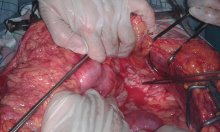
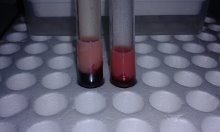
Intraoperative findings include a milky abundant peritoneal fluid consisting with chylous ascites and fat necrosis in the retroperitoneal pancreatic space [Figure 1]. Blood sample revealed a milky turbid serum [Figure 2].
Laboratory finding included a triglyceridemia at 17.25 mg/dl and HDL of 2.39mmol/L and LDL of 0.12 mmol/L and C –reactive protein of 183.7 mg/L.
The patient situation worsens immediately after the operation. She developed a refractor shock to all measures of resuscitation.
She died of septic shock secondary to acute pancreatitis related to pregnancy hypertriglyceridemia.
3. Discussion
Acute pancreatitis has many causes; the most common aregallstones and alcoholism.Among the less frequent is Hypertriglyceridemiawhich might be primary or secondary due to alcohol abuse, diabetes mellitus, drug uses, or pregnancy [3].
During pregnancy, plasma triglicerid increase two-fold to four-fold, principally in the third trimester, because of increased triglicerid-rich lipoprotein production and decreased lipoprotein lipase activity. [1] This lipid profil physiologic change isn’t severe enough to cause acute pancreatitis [2].
Hypertriglyceridemia-induced pancreatitis during pregnancy has been reported previously andoccur for 23./. in the second trimester, 53./. in the third trimester, and 2./. in the puerperium [1].
In our case, the diagnosis was made at time of delivery.
The mechanism of how Hypertriglyceridemia leads to pancreatitis is not clear. A well-accepted mechanism is as follows; hydrolysis of triglicerid in and around the pancreas by pancreatic lipase promotes the accumulation of free fatty acids, which is highly concentrated with chylomicrons in the pancreatic capillaries. This causes capillary plugging and leads to ischemia and acidosis, and in the acidic environment, free fatty acids cause activation of trypsinogenand initiate acute pancreatitis [3].
The diagnosis of acute pancreatitis in pregnancy is very difficult.
Most symptoms, which are common in acute pancreatitis such as nausea, vomiting, abdominal discomfort, or pain, are frequently reported in pregnancy. Moreover, clinical evaluation of acute abdomen in pregnancy can be confusing, due to anatomical displacement of abdominal organs by the gravid uterus [2].
In our case, the patient was treated for recurrent abdominal pain and vomiting with antalgic and anti-emetic drugs during this pregnancy witch delayed the diagnosis of acute pancreatitis.
In hypertriglyceridemia-induced acute pancreatitis, amylase levels may be reported as normal or even low in more than 50% of the patients. This phenomenon has been attributed to an interference of plasma lipids with the assay and/or to the presence of a circulating inhibitor of amylase in serum and urine. In such cases, dilution or ultracentrifugation of the sample is recommended to ensure accurate analysis [2].
The mainstay of treatment of pregnancy related acute panceatitis includes dietary restriction of fatty meals, lipid lowering medication, plasmpheresis, and insulin and heparin application [4].
Low fat diet and long intake of diets rich in omega 3 fatty acids may reduce triglyceride levels significantly.
Lipid lowering medication such as Niacin, fibrates, and statins take time to reduce triglyceride levels.[5]
Plasmapheresis is indicated when (a) patient is refractory to nutritional and pharmacological approaches, (b) serum triglycerides exceed 1000mg/dL, (c) serum lipase is three times the upper limit of normal, (d) patient develops hypocalcemia, (e) lactic acidosis occurs, and (f) there is worsening inflammation and organ dysfunction. [4]
When plasmapheresis is unavailable or contraindicated, intravenous infusion of regular insulin and 5% dextrose can be used. Blood sugar is maintained between 150 and 200mg/dL during this therapy.
Insulin and heparin infusions act by stimulating LPL activity, which then removes triglycerides from the plasma. [4, 5].
Our case illustrates the importance of diagnosing the etiology of abdominal pain in pregnancy and prompt treatment of hypertriglyceridemia before its catastrophic consequences such as acute pancreatitis.
4. Conclusion
Hypertriceridemia related acute pancreatitis in pregnancy is a rare obstetric complication. It is associated with a high maternal death and fetal loss rate however these rates can bereduced with earlier diagnosis and appropriatetreatment of the disease.
References
| [1] | D. Altun, G. Eren, Z. Cukurova, O. Herg¨unsel, L. Yasar, “An alternative treatment in hypertriglyceridemia-induced acute pancreatitis in pregnancy: plasmapheresis,” Journal of AnaesthesiologyClinical Pharmacology, vol. 28, no. 2, pp. 252-254, 2012. | ||
 In article In article | CrossRef PubMed | ||
| [2] | M. Serpytis, V. Karosas, R. Tamosauskas et al., “Hypertriglyceridemia- induced acute pancreatitis in pregnancy,” Journal ofthe Pancreas, vol. 13, no. 6, pp. 677-680, 2012. | ||
| In article | |||
| [3] | Joong HoBae, Sang Hyun Baek, Ho Soon Choi et al, “Acute Pancreatitis due to Hypertriglyceridemia: Report of 2 Cases” Korean J Gastroenterol 46: 475-480;2005. | ||
| In article | PubMed | ||
| [4] | N. Gupta, A. Seema, L. Shaffer, P. Cavens, J. Blankstein “Severe Hypertriglyceridemia Induced Pancreatitis in Pregnancy” Case Reports in Obstetrics and Gynecology Volume 2014, Article ID 485493, 5 pages. | ||
| In article | |||
| [5] | A. Goldberg, R.Hegele. “Severe Hypertriglyceridemia in Pregnancy”. ClinEndocrinolMetab 97: 2589-2596, 2012. | ||
| In article | CrossRef PubMed | ||

 CiteULike
 Mendeley
 StumbleUpon
 Delicious
 Facebook
 Twitter
 LinkedIn
 Print
Print