The selection of diesel generators is a critical decision in environments requiring reliable and uninterrupted power supply. This study presents a structured multi-criteria decision-making (MCDM) approach for evaluating and selecting the most suitable diesel generator using the Technique for Order of Preference by Similarity to Ideal Solution (TOPSIS). Four key performance criteria, fuel consumption, lifespan, estimated maintenance time, and mean time between failures (MTBF)were considered. Criteria weights were determined using the Analytic Hierarchy Process (AHP), ensuring consistency and objectivity. A case study involving four 75 kVA diesel generator alternatives was conducted. The results indicate that Alternative C achieved the highest closeness coefficient (0.970), making it the most preferred option due to its superior reliability, longer lifespan, and lower maintenance requirements. The study demonstrates the effectiveness of integrating AHP and TOPSIS for rational and data-driven decision-making in equipment selection.
Reliable power supply is fundamental to industrial, commercial, and residential operations. However, persistent instability in national power grids, particularly in developing regions, necessitates the use of backup power systems such as diesel generators 1, 2, 3. Diesel generators are widely preferred due to their durability, cost-effectiveness, and fuel availability 4, 5.
Selecting an appropriate diesel generator constitutes a complex decision-making problem involving multiple, often conflicting criteria, including fuel consumption, lifespan, estimated maintenance time, and mean time between failures (MTBF) 6, 7, 8. Traditional selection approaches based solely on cost or brand are inadequate and may result in suboptimal long-term performance 3, 9.
To overcome this limitation, this study applies a multi-criteria decision-making (MCDM) approach using the Technique for Order Preference by Similarity to Ideal Solution (TOPSIS). This method facilitates the systematic evaluation of alternatives based on their relative proximity to ideal and negative-ideal solutions, thereby ensuring a robust and objective selection process 10, 11, 12.
The analysis of the alternatives was conducted using the following approach 13, 14, 15.
|
The Technique for Order Preference by Similarity to Ideal Solution (TOPSIS) was developed by Hwang and Yoon in 1981 to address decision-making problems involving multiple, often conflicting criteria 16. The method was applied in this study through the following steps:
• Normalized Decision Matrix (R):
The decision matrix was normalized using vector normalization
 |
• Weighted Normalized Decision Matrix:
Each normalized value was multiplied by its corresponding weight (obtained from AHP)
 |
• Determination of Ideal Solutions:
The positive ideal solution (A⁺) and negative ideal solution (A⁻) were determined by maximizing benefit criteria (lifespan and MTBF) and minimizing cost criteria (fuel consumption and maintenance time).
• Separation Measures:
The distances from the ideal and negative-ideal solutions were computed as
 |
• ClosenessCoefficient:
The relative closeness to the ideal solution was calculated as
 |
The criteria-weighting order obtained from the AHP reflects the relative importance of each criterion based on pairwise comparisons and the decision objective. In this study, MTBF received the highest weight due to its critical role in ensuring system reliability and minimizing downtime. Lifespan was ranked second as it represents long-term durability, while maintenance and fuel consumption were assigned lower weights as they primarily influence operational cost rather than system performance. This weighting structure highlights the prioritization of reliability and sustainability over short-term cost considerations.
Each element in Table 4 was divided by the sum of its respective columns in Table 5.
3.2. Final Analytic Hierarchy Process (AHP) WeightingThe AHP weights were obtained by averaging each row of the normalized matrix. For example, the weight for Fuel is calculated as:
(0.10 + 0.087 + 0.077 + 0.120)/4 = 0.095
Lifespan = 0.284, Maintenance = 0.170, MTBF = 0.451 respectively.

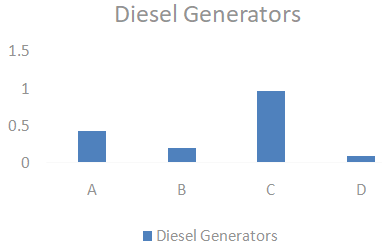
The results displayed on Figure 1 shows Alternative C is the most preferred diesel generator. This is primarily due to:
• Highest MTBF (3500 hours), indicating superior reliability.
• Longest lifespan (10 years).
• Lowest maintenance requirement (3 hours).
Although Alternative C has the highest fuel consumption, its advantages in reliability and durability outweigh this drawback. This highlights the importance of using a multi-criteria approach rather than relying on a single factor such as cost.
The integration of AHP and TOPSIS proved effective in balancing conflicting criteria and providing a rational basis for decision-making.
This study demonstrates the applicability of the TOPSIS method in selecting the most suitable diesel generator based on multiple performance criteria. By incorporating AHP-derived weights, the approach ensures consistency and objectivity in evaluation.
The findings confirm that Alternative C is the optimal choice, offering the best trade-off among fuel consumption, lifespan, maintenance, and reliability. The proposed methodology provides a robust framework for decision-makers in engineering and procurement.
4.2. Recommendations• Organizations should adopt MCDM methods such as TOPSIS for equipment selection.
• Future studies should include additional criteria such as emissions, noise levels, and acquisition cost.
• Sensitivity analysis should be conducted to evaluate the impact of weight variations.
Real-world data should be incorporated to validate the model further.
| [1] | Durairaj, S., Sathiya Sekar, K., Ilangkumaran, M., RamManohar, M., Thyalan, B., Yuvaraj, E., & Ramesh, S. (2014). Multi-criteria decision model for biodiesel selection in an electrical power generator based on FAHP-GRA-TOPSIS. International Journal of Research in Engineering and Technology, 3(23), 226-233. | ||
| In article | View Article | ||
| [2] | Hoseinpour, M., Sadrnia, H., Tabasizadeh, M., &Ghobadian, B. (2018). Evaluation of the effect of gasoline fumigation on performance and emission characteristics of a diesel engine fueled with B20 using an experimental investigation and TOPSIS method. Fuel, 223, 277-285. | ||
| In article | View Article | ||
| [3] | Sakthivel, G., Senthil Kumar, S., & Ilangkumaran, M. (2019). A genetic algorithm-based artificial neural network model with TOPSIS approach to optimize the engine performance. Biofuels, 10(6), 693-717. | ||
| In article | View Article | ||
| [4] | Mehra, K. S., Goel, V., Singh, S., Pant, G., & Singh, A. K. (2023). Experimental investigation of emission characteristics of CI engine using biodiesel-diesel blends and best fuel selection: An AHP-TOPSIS approach. Materials Today: Proceedings. | ||
| In article | View Article | ||
| [5] | Muqeem, M., Sherwani, A. F., Ahmad, M., & Khan, Z. A. (2019). Application of the Taguchi based entropy weighted TOPSIS method for optimisation of diesel engine performance and emission parameters. International Journal of Heavy Vehicle Systems, 26(1), 69-94. | ||
| In article | View Article | ||
| [6] | Abdulvahitoglu, A., & Kilic, M. (2022). A new approach for selecting the most suitable oilseed for biodiesel production; the integrated AHP-TOPSIS method. Ain Shams Engineering Journal, 13(3), 101604. | ||
| In article | View Article | ||
| [7] | Galgali, V. S., Vaidya, G. A., & Ramachandran, M. (2016, September). Selection of distributed generation system using multicriteria-decision making fuzzy TOPSIS optimization. In 2016 5th International Conference on Reliability, Infocom Technologies and Optimization (Trends and Future Directions)(ICRITO) (pp. 86-89). IEEE. | ||
| In article | View Article | ||
| [8] | Sarkar, A. (2013). A TOPSIS method to evaluate the technologies. International Journal of Quality & Reliability Management, 31(1), 2-13. | ||
| In article | View Article | ||
| [9] | Yadav, S. K., Joseph, D., &Jigeesh, N. (2018). A review on industrial applications of TOPSIS approach. International Journal of Services and Operations Management, 30(1), 23-28. | ||
| In article | View Article | ||
| [10] | Bhutia, P. W., &Phipon, R. (2012). Application of AHP and TOPSIS method for alternative selection problem. IOSR Journal of Engineering, 2(10), 43-50. | ||
| In article | View Article | ||
| [11] | Deb, M., Debbarma, B., Majumder, A., & Banerjee, R. (2016). Performance–emission optimization of a diesel-hydrogen dual fuel operation: A NSGA II coupled TOPSIS MADM approach. Energy, 117, 281-290. | ||
| In article | View Article | ||
| [12] | Mathebula, J., & Mbuli, N. (2024, July). Application of TOPSIS in Power Sytems: A Review. In 2024 International Conference on Electrical, Computer and Energy Technologies (ICECET (pp. 1-6). IEEE. | ||
| In article | View Article | ||
| [13] | Kelemenis, A., &Askounis, D. (2010). A new TOPSIS-based multi-criteria approach to personnel selection. Expert systems with applications, 37(7), 4999-5008. | ||
| In article | View Article | ||
| [14] | Kumar, C., Rana, K. B., & Tripathi, B. (2020). Performance evaluation of diesel–additives ternary fuel blends: An experimental investigation, numerical simulation using hybrid Entropy–TOPSIS method and economic analysis. Thermal Science and Engineering Progress, 20, 100675. | ||
| In article | View Article | ||
| [15] | Lootsma, F. A. (1999). Multi-criteria decision analysis via ratio and difference judgement. Kluwer Academic Publishers. | ||
| In article | View Article | ||
| [16] | Hwang, C. L., & Yoon, K. (1981). Multiple attributes decision making methods and applications. Berlin: Springer. | ||
| In article | View Article | ||
Published with license by Science and Education Publishing, Copyright © 2026 Friday Erhimudia Ukrakpor, Musa Momodu Omokhafe and Chukwuka Uboh
 This work is licensed under a Creative Commons Attribution 4.0 International License. To view a copy of this license, visit
http://creativecommons.org/licenses/by/4.0/
This work is licensed under a Creative Commons Attribution 4.0 International License. To view a copy of this license, visit
http://creativecommons.org/licenses/by/4.0/
| [1] | Durairaj, S., Sathiya Sekar, K., Ilangkumaran, M., RamManohar, M., Thyalan, B., Yuvaraj, E., & Ramesh, S. (2014). Multi-criteria decision model for biodiesel selection in an electrical power generator based on FAHP-GRA-TOPSIS. International Journal of Research in Engineering and Technology, 3(23), 226-233. | ||
| In article | View Article | ||
| [2] | Hoseinpour, M., Sadrnia, H., Tabasizadeh, M., &Ghobadian, B. (2018). Evaluation of the effect of gasoline fumigation on performance and emission characteristics of a diesel engine fueled with B20 using an experimental investigation and TOPSIS method. Fuel, 223, 277-285. | ||
| In article | View Article | ||
| [3] | Sakthivel, G., Senthil Kumar, S., & Ilangkumaran, M. (2019). A genetic algorithm-based artificial neural network model with TOPSIS approach to optimize the engine performance. Biofuels, 10(6), 693-717. | ||
| In article | View Article | ||
| [4] | Mehra, K. S., Goel, V., Singh, S., Pant, G., & Singh, A. K. (2023). Experimental investigation of emission characteristics of CI engine using biodiesel-diesel blends and best fuel selection: An AHP-TOPSIS approach. Materials Today: Proceedings. | ||
| In article | View Article | ||
| [5] | Muqeem, M., Sherwani, A. F., Ahmad, M., & Khan, Z. A. (2019). Application of the Taguchi based entropy weighted TOPSIS method for optimisation of diesel engine performance and emission parameters. International Journal of Heavy Vehicle Systems, 26(1), 69-94. | ||
| In article | View Article | ||
| [6] | Abdulvahitoglu, A., & Kilic, M. (2022). A new approach for selecting the most suitable oilseed for biodiesel production; the integrated AHP-TOPSIS method. Ain Shams Engineering Journal, 13(3), 101604. | ||
| In article | View Article | ||
| [7] | Galgali, V. S., Vaidya, G. A., & Ramachandran, M. (2016, September). Selection of distributed generation system using multicriteria-decision making fuzzy TOPSIS optimization. In 2016 5th International Conference on Reliability, Infocom Technologies and Optimization (Trends and Future Directions)(ICRITO) (pp. 86-89). IEEE. | ||
| In article | View Article | ||
| [8] | Sarkar, A. (2013). A TOPSIS method to evaluate the technologies. International Journal of Quality & Reliability Management, 31(1), 2-13. | ||
| In article | View Article | ||
| [9] | Yadav, S. K., Joseph, D., &Jigeesh, N. (2018). A review on industrial applications of TOPSIS approach. International Journal of Services and Operations Management, 30(1), 23-28. | ||
| In article | View Article | ||
| [10] | Bhutia, P. W., &Phipon, R. (2012). Application of AHP and TOPSIS method for alternative selection problem. IOSR Journal of Engineering, 2(10), 43-50. | ||
| In article | View Article | ||
| [11] | Deb, M., Debbarma, B., Majumder, A., & Banerjee, R. (2016). Performance–emission optimization of a diesel-hydrogen dual fuel operation: A NSGA II coupled TOPSIS MADM approach. Energy, 117, 281-290. | ||
| In article | View Article | ||
| [12] | Mathebula, J., & Mbuli, N. (2024, July). Application of TOPSIS in Power Sytems: A Review. In 2024 International Conference on Electrical, Computer and Energy Technologies (ICECET (pp. 1-6). IEEE. | ||
| In article | View Article | ||
| [13] | Kelemenis, A., &Askounis, D. (2010). A new TOPSIS-based multi-criteria approach to personnel selection. Expert systems with applications, 37(7), 4999-5008. | ||
| In article | View Article | ||
| [14] | Kumar, C., Rana, K. B., & Tripathi, B. (2020). Performance evaluation of diesel–additives ternary fuel blends: An experimental investigation, numerical simulation using hybrid Entropy–TOPSIS method and economic analysis. Thermal Science and Engineering Progress, 20, 100675. | ||
| In article | View Article | ||
| [15] | Lootsma, F. A. (1999). Multi-criteria decision analysis via ratio and difference judgement. Kluwer Academic Publishers. | ||
| In article | View Article | ||
| [16] | Hwang, C. L., & Yoon, K. (1981). Multiple attributes decision making methods and applications. Berlin: Springer. | ||
| In article | View Article | ||