 OPEN ACCESS
  PEER-REVIEWED
Viral and Fungal Diarrhea in Children Under 5 Years of Age in a Tertiary Health Institution in Edo State, Nigeria
Paul Erhunmwunse Imade1, , Nosakhare Odeh Eghafona2
1Department of Medical Microbiology, University of Benin Teaching Hospital, Benin City, Nigeria
2Department of Microbiology, Faculty of Life Sciences, University of Benin, Benin City, Nigeria
Abstract
Introduction: Diarrhea infections are caused by various microbial agents such as bacteria, parasites, viruses and fungi. However, in many developing countries, less attention is focused on viral and fungal agents. This work is aimed at determining the viral and fungal agents of diarrhea in children under 5 years of age in Edo State, Nigeria. Methodology: Fecal specimens were collected from diarrheal and non diarrheal children under 5 years of age. A total of 153 children with clinical signs of diarrhea and 54 apparently healthy age matched control were tested for viral and fungal agents. Viral agents were analyzed by the immunochromatographic technique (ICT) while fungal agents were analyzed by cultural method using standard microbiological technique. Results: The overall results showed that at least one viral or fungal agent was found in 56(36.6%) of patients with diarrhea. No viral agent was detected in the control. Although there were Candida growth in nine of the control, but counts obtained were less than 104cfu/ml. The viral agents had 42(275%), fungal agents 12(78%) and mixed viral and fungal agents 2(1.3%). Rotavirus prevalence was 19.6%, adenovirus 9.2% and norovirus 2.0%. The prevalence of Candida albicans was 7.2% and Candida krusei 2.0%. On the whole, rotavirus was the most predominant enteropathogen. There was an association between Candida species and diarrhea (P=0.030). Sex and age of patients were not statistically significant (P>0.05). Conclusion: Viral and fungal diarrhea are not uncommon in this locality as showed by the 36.6% prevalence. There is need to perform viral and fungal tests as part of the routine tests for patients with diarrheal infections.
Keywords: diarrheal infection, viral agents, fungal agents, prevalence, enteropathogens
American Journal of Infectious Diseases and Microbiology, 2015 3 (2),
pp 87-90.
DOI: 10.12691/ajidm-3-2-5
Received April 09, 2015; Revised April 20, 2015; Accepted April 24, 2015
Copyright © 2015 Science and Education Publishing. All Rights Reserved.Cite this article:
- Imade, Paul Erhunmwunse, and Nosakhare Odeh Eghafona. "Viral and Fungal Diarrhea in Children Under 5 Years of Age in a Tertiary Health Institution in Edo State, Nigeria." American Journal of Infectious Diseases and Microbiology 3.2 (2015): 87-90.
- Imade, P. E. , & Eghafona, N. O. (2015). Viral and Fungal Diarrhea in Children Under 5 Years of Age in a Tertiary Health Institution in Edo State, Nigeria. American Journal of Infectious Diseases and Microbiology, 3(2), 87-90.
- Imade, Paul Erhunmwunse, and Nosakhare Odeh Eghafona. "Viral and Fungal Diarrhea in Children Under 5 Years of Age in a Tertiary Health Institution in Edo State, Nigeria." American Journal of Infectious Diseases and Microbiology 3, no. 2 (2015): 87-90.
| Import into BibTeX | Import into EndNote | Import into RefMan | Import into RefWorks |
1. Introduction
Diarrhea is a major cause of childhood morbidity and mortality in socio-economically developing countries. More than one million episodes of diarrhea occur every year among children under five years of age causing approximately 2.5million deaths [1, 2] Various microbial agents have been incriminated in diarrhea among which are enteric bacteria, parasites and viruses [3, 4, 5]. Candida, Trichosporon and Geotrichum are fungi that have been reported to cause diarrhea [6, 7]. Different groups of viruses have been showed to be responsible for the high incidence of acute viral diarrhea among children during their first years of life [8]. These viruses include rotavirus, norovirus, adenovirus and astrovirus [9, 10, 11]. The contribution of the various pathogens to diarrhea may differ substantially between regions depending on local meteorological, geographic and socio-economic conditions. Underlying reasons for the spread of diarrheal diseases are found in poor hygiene and sanitation, limited access to safe drinking water as well as inadequate education of health care providers and recipients [12, 13].
In many developing countries including Nigeria, research works have mainly focused on bacterial and parasitic agents of diarrheal diseases, with little information on viral and fungal diarrhea. This research work tends to look into the aforementioned areas of need in this locality. It may be interesting to note that in many Nigerian hospitals, routine viral and fungal analysis of stool specimens are not carried out on patients with diarrhea infections. This may be due to the poor attention given to health issues in the country. Against this background, this research work was carried out to determine the prevalence of viral agents of diarrhea with particular emphasis on rotavirus, adenovirus and norovirus as causative agents as well as fungal agents with emphasis on Candida species. This work was carried out among children under 5 years of age with diarrhea in a tertiary health institution in Edo State, Nigeria.
2. Methodology
Study Area and Population: This study was carried out at the University of Benin Teaching Hospital, Benin City, Edo State and it is located in the Southern part of Nigeria. A total of two hundred and seven (207) stool specimens comprising 153 diarrheic stools and 54 non-diarrheic stool specimens were collected from children under 5 years of age.. This study was carried out between February 2011 and August 2012. Verbal informed consent was obtained from patients or guardian of the children prior to sample collection. Children who had taken antibiotics and/ or antifungal drugs in the last one month were excluded from this study. Ethical approval was obtained from the hospital ethics committee.
Specimen collection and processing: The samples were collected into sterile wide mouth specimen containers and were processed immediately for viral and fungal pathogens..
Detection of viral enteropathogens: Rotavirus, adenovirus and norovirus were detected by the immunochromatographic method. Rotavirus and adenovirus antigens were detected in the stool specimens of patients with clinical symptoms of diarrhea using VIKIA Rota-Adeno rapid test device (BioMerieux, France). The results were interpreted according to manufacturer’s instructions. Similarly, norovirus was detected using RIDA Quick Norovirus (N1403) rapid test device (R-Biopharm AG, Germany). The results were interpreted according to the manufacturer’s instructions.
Isolation and identification of fungal agents: This was carried out following standard microbiological technique. Yeast counts were determined by colony count and counts of >104 cfu/ml were considered as overgrowth and therefore significant for diarrheal infection [7].
Statistical Analysis: This was carried out using odd ratio and chi-square(X2) test. A P-value of less than 0.05 was taken as statistically significant.
3. Results
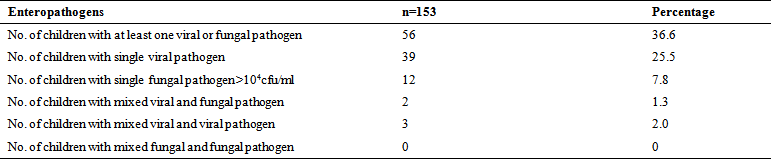
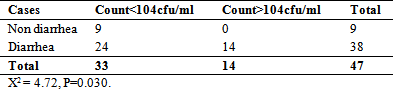
A total of 153 children with diarrhea were tested for three viral agents (rotavirus, adenovirus and norovirus) and Candida species associated diarrhea. 56(36.6%) were pathogenic for at least one viral or fungal agent while none of the 54 children without diarrhea was pathogenic for viral or fungal agent. Fungal pathogenicity was based on fungal colony count greater than. 104 cfu/ml which was considered as overgrowth and significant for diarrheal infection. Among patients with diarrheal infection, Candida growth were observed in 38 cases, but only 14 cases were found with Candida overgrowth (i.e >104 cfu/ml). The control group had nine of Candida growth, but none had overgrowth.


 PowerPoint Slide
 Larger image(png format)
 View current table in a new window

 PowerPoint Slide
 Larger image(png format)
 View current table in a new window

 PowerPoint Slide
 Larger image(png format)
 View current table in a new window
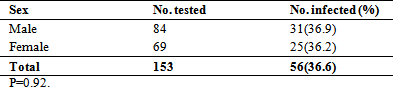
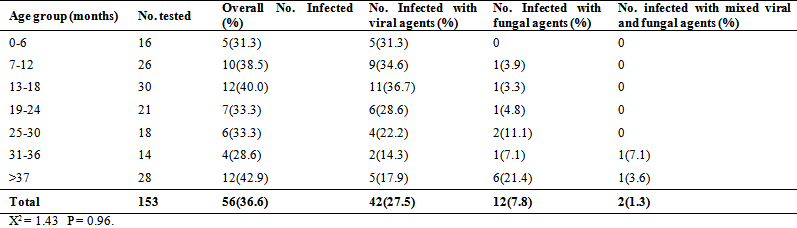
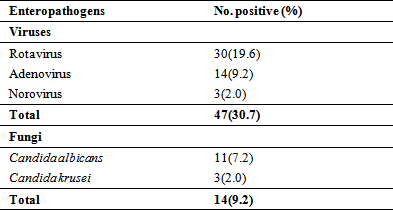
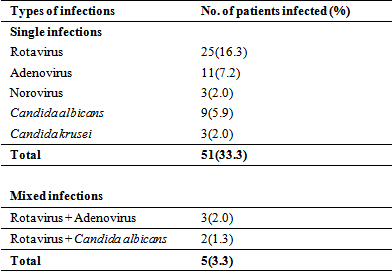
Single viral pathogen had 39(25.5%), single fungal pathogen had 12 (7.8%) and mixed viral and fungal pathogens had 2(1.3%). (Table 1). There was an association between Candida species and diarrhea (X2= 4.72; P=0.030) (Table 2). The sex distribution of infection showed that males had 31 (36.9%) while females had 25(36.2%), but this was not statistically significant (P=0.92) (Table 3). Age group of the children did not show statistical significant (P=0.96) with infection (Table 4). The frequency distribution of viral and fungal enteropathogens of diarrhea showed rotavirus as the most predominant with 19.6% (Table 5). The distribution of patients with single and mixed infections is showed in Table 6.

 PowerPoint Slide
 Larger image(png format)
 View current table in a new window
 PowerPoint Slide
 Larger image(png format)
 View current table in a new window
 PowerPoint Slide
 Larger image(png format)
 View current table in a new window
4. Discussion
The prevalence of three viral agents namely rotavirus, adenovirus and norovirus as well as fungal agents (Candida species associated diarrhea were investigated among children with diarrhea who were under 5 years of age. The overall prevalence of infection was 56(36.6%). A breakdown of infection rate showed that viral infection was 42(27.5%), fungal infection was 12(7.8%) and mixed viral and fungal infection was 2 (1.3%). The results of this survey showed the contribution of viral and fungal agents to diarrheal infections in this locality which are usually missed out due to non-performance of such investigations. However, it has been reported that 30 to 40% of all acute episodes of gastroenteritis are caused by viruses [14]. Similarly, fungal agents have been reported to cause diarrhea [15, 16, 17]..
In this study an association was observed between Candida species overgrowth and diarrhea (X2=4.72; P=0.030). This is consistent with the report of Nkuo-Akenji et al. ( 17), who also found an association between Candida and diarrhea. Moreover, in a group of Nigerian children with diarrhea, 77% had fungi isolated from the stools; Candida was the most predominant isolates and was strongly associated with diarrhea [18]. A subsequent study in India reported Candida as the sole pathogen in 15% of diarrheal stool specimens [19]. Thus, these aforementioned studies further support the association between Candida and diarrhea.
There was no association between sex and infection (P=0.92), This could be due to the fact that risk factors associated with diarrhea are environmental and socio-demographic, rather than biological [20]. Age group of children also did not show statistical significance (P=0.96) as infection was found in all age group. However, 34 out of the 56 infected children were between 0 and 24 months. This is consistent with the reports of Patwari et al [21] and Orlandi et al [22] who stated that diarrhea is highly prevalent in children in the first two years of life. This could be attributed to the fact that children within this age bracket are exposed to a lot of playful activities which make them come in contact with potential pathogens.
The distribution of enteropathogens showed that rotavirus was the most prevalent with 16.3%, and was also found in both single and mixed infections. This is consistent with other reports [23, 24].
5. Conclusion
A prevalence of 36.6% viral and fungal associated diarrhea was found in this study. This goes to show that viral and fungal agents played significant role in childhood diarrhea in this locality and they should not be undermined when investigating diarrhea. The non-inclusion of viral and fungal tests as part of routine analysis of stool specimens for diarrheal patients means that such important pathogens of interest are missed out (i.e unidentified), thereby compounding data collation as regards diarrheal infection. Thus, there is great need for health practitioners to look inward and see viral and fungal agents as possible causes of diarrheal infections and thus provide the means for carrying out such tests on routine bases and this will go a long way in checking the indiscriminate use of antibiotics which can give rise to bacterial resistance as well as antibiotic-associated diarrhea.
Conflict of Interest
The authors declare no conflict of interest.
Acknowledgement
We thank the Management of the hospital for permission to use the facility. We also thank the clinicians, medical laboratory scientists and other health staff for their support.
References
| [1] | Kosek M, Bern C, Guerrant R.L. The global burden of diarrheal disease, as estimated from studies published between 1992 and 2000. Bull. World Health Organ: 81(3):197-204: 2003. | ||
 In article In article | PubMed | ||
| [2] | O’Ryan M, Prado V, Pickering L.K. A millennium update of pediatric diarrheal illness in the developing world. Semm. Pediatr. Infect. Dis.: 16(2):125-136: 2005. | ||
| In article | CrossRef PubMed | ||
| [3] | Henry F.G. Combating childhood diarrhea through international collaborative research. J. Diarrh. Dis. Res.: 9:165-167: 1991. | ||
| In article | PubMed | ||
| [4] | Babaniyi O.A. Oral rehydration of children with diarrhea in Nigeria: a 12-year review of impact on morbidity and mortality from diarrhea diseases and diarrhea treatment practices. J. Trop. Pediatr.: 37:57-62: 1991. | ||
| In article | CrossRef PubMed | ||
| [5] | Bignan F.U, Unicomb L, Rahim Z, Banu N.M, Podder G, Clemens J. Rotavirus associated diarrhea in rural Bangladesh: two year study of incidence and serotype distribution. J. Clin. Microbiol.: 7:1359-1363.:1991. | ||
| In article | |||
| [6] | Talwar O, Chakrabarti A, Chawla A, Mehta S, Walia B.N.S, Kumar L, et al Fungal diarrhea: association of different fungi and seasonal variation in their in incidence. Mycopathology.: 110:101-105:1990. | ||
| In article | CrossRef | ||
| [7] | Danna P.L, Urban C, Bellin E, Rahall J.J. Role of Candida in pathogenesis of antibiotic-associated diarrhea in elderly patients. Lancet.: 337:511-514.: 1991. | ||
| In article | CrossRef | ||
| [8] | Giordano M.O, Ferreyra L.J, Isa M.B, Martinez L.C, Yudowsky S.I, Nates S.V. : The epidemiology of acute viral gastroenteritis in hospitalized children in Cordoba City, Argentina: an insight of disease burden. Rev. Inst. Med. Trop. Sao Paulo. 43(4):193-197: 2001. | ||
| In article | CrossRef PubMed | ||
| [9] | Wilhelm I, Roman E, Sanchez-Fauquer A. Viruses Causing gestronteritis. Clin. Microbiol Infect.: 93(4): 247-262.: 2003. | ||
| In article | CrossRef | ||
| [10] | Castello A.A, Arguelles M.H, Rota R.P, Oithoff A, Jiang B, Glass R.I, et.al. Molecular epidemiology of group A Rotavirus diarrhea among children in Buemos Aires, Argentina, from 1999 to 2003 and emergence of the infrequent genotype G12. J Chin Microbiol.: 44(6):2046-2050 :2006. | ||
| In article | CrossRef PubMed | ||
| [11] | Walter J.E, Mitcheu D.K. Role of astroviruses in childhood diarrhea. Curr. Opin. Pediatr.: 12(3):275-279: 2000. | ||
| In article | CrossRef PubMed | ||
| [12] | Curtis V, Cairncross S, Yonli R. Domestic hygiene and diarrhea-pinpointing the problem. Trop. Med. Int. Health.: 5(1): 22-32: 2000. | ||
| In article | CrossRef PubMed | ||
| [13] | Thapar N, Sanderson I.R. Diarrhea in children: an interface between developing and developed countries. Lancet.: 363(9409):641-653.: 2004. | ||
| In article | CrossRef | ||
| [14] | Dunda,S., and Todd, WTA. Acute diarrhea and fever. JR Coll. Physicians Edinb..:36: 236-240: 2006. | ||
| In article | |||
| [15] | Talwar P, Chakrabarti, A, Chawa A, Mehta S, Walia B.NS, Kumar L, et.al. Fungal diarrhea: association of different fungi and seasonal variation on their incidence. Mycopathologia.: 110(2):101-105.: 1990. | ||
| In article | CrossRef PubMed | ||
| [16] | Danna P.L, Urban C, Bellin E, Rahall J.J.. Role of Candida in pathogenesis of antibiotic-associated diarrhea in elderly patients. Lancet. : 337:511-514.: 1991. | ||
| In article | CrossRef | ||
| [17] | Nkuo-Akenji J.K, Ndip R.N and Ntoko T.A. The prevalence of Candida albicans – Associated Diarrhea in Buea, Southwest Cameroon. Afr. J. Health. Sci.: 9(384): 153-157.: 2002. | ||
| In article | PubMed | ||
| [18] | Enweani J.B, Obi C.I, Jokpeyibo M. Prevalence of Candida species in Nigerian children with diarrhea. J. Diarrhea. Dis. Res.:12:133-135. 1994. | ||
| In article | PubMed | ||
| [19] | Chaudhury A, Nath G, Shukia B. Diarrhea associated with Candida species: Incidence and seasonal variation. J. Diarrhea Dis. Res. 14:110-112. 1996. | ||
| In article | PubMed | ||
| [20] | Manun`ebo, MN., Haggert, PA.,Kalengaie,M., Ashworth, A.and Kirkwood,BR. Influence of demographic, socioeconomic and environmental variables on childhood diarrhea in a rural area of Zaire. J. Trop. Med. Hyg.:97(1):31-38.:1994. | ||
| In article | |||
| [21] | Patwari, AK., Deb, M and Duidyai. Clinical and laboratory prediators of massive diarrhea in children less than five years old. J. Diarrhea Dis.Res:11(4):211-216:1993. | ||
| In article | PubMed | ||
| [22] | Orlandi PP., Silva, T., Magachaes, GF., Alves,F,. Cunha, RPA,, Durlacher, R. Enteropathogens associated with diarrheal disease in infants of poor Urban Arias of Porto Velho, Rondonia: a preliminary study. Mem. Inst. Oswaldo Cruz, Riode Janeiro. :96(5):621-625:2001. | ||
| In article | |||
| [23] | Ogbu O, Agumedu N, Uneke C.J, Amadi E.S. Etiology of Acute Infantile Diarrhea in the South-Eastern Nigeria: An Assessment of Microbiological and Antibiotic Sensitivity Profile. The Internet J. Third World Med.: 5(2).: 2008. | ||
| In article | |||
| [24] | Turhanoglu M, Gulsun S, Onur, A, Bilman F. The frequency of Escherichia coli (EPEC, ETEC, EIEC and Serotypes), Shigella, rotavirus and parasite agents among children with acute gastroenteritis in South east Anatolia, Turkey. Afr. J. Microbiol. Res.: 6(23):5020-5024: 2012. | ||
| In article | |||

 CiteULike
 Mendeley
 StumbleUpon
 Delicious
 Facebook
 Twitter
 LinkedIn
 Print
Print