Introduction: Many patients having HIV present to the health care system with advanced HIV disease. Patients with advanced HIV disease have CD4 cell count of less than 200cells/mm3 or WHO stage III or IV clinical events. The primary culprits responsible for severe morbidity and mortality are tuberculosis, severe bacterial infections and cryptococcal meningitis. Methods: A retrospective multi-centered facility based cross-sectional study was conducted among newly diagnosed HIV patients whose age was ≥ 15 years over a period of one year (October 2023-January 2024). The prevalence of advanced HIV disease was estimated with advanced HIV disease defined as WHO clinical stage 3, stage 4 or CD4 count less than 200 cells/μ. The baseline characteristic of the study participants was compared with and without advanced HIV disease. Pretested and structured questionnaires were adopted. The data was checked for completeness, cleaned and exported to SPSS version 26 for analysis. Descriptive statistics, chi square test, nonparametric tests and multi variable logistic regression were used for data analysis. P-value less than 0.05 were considered to be statistically significant. Results: Among the 400 patients, about 49% of them were males and 51% were females. The prevalence of advanced HIV disease at presentation was 65.5%. The patients were likely to be bedridden (AOR 10.6, 95% CI 1.24-91, P =0.03), have lower BMI (AOR 3.2, 95% CI 1.14-8.9, P =0.03) and diagnosed due to presence of symptoms of opportunistic infections (AOR 44.6, 95% CI 22.8-87.2, P <0.001). Conclusions: The study showed that advanced HIV disease was very high among newly diagnosed HIV patients emphasizing timely intervention to reduce the increased morbidity and mortality associated with advanced HIV disease.
In 2021, an estimated 38.4 million people globally were living with HIV. Of these, 1.5 million were newly infected. Nearly half (49%) of new infections occurred in women and girls. The number of deaths from HIV/AIDS-related illnesses has shown a positive trend. There were 650,000 deaths in 2021, a significant decrease compared to 2 million in 2004 and 1.4 million in 2010. The greatest proportions of individuals affected by HIV primarily reside within nations of low- and middle-income economy. Low- and middle-income countries have the highest burden of HIV. In 2021, over half (53%) of all diagnosed HIV cases (20.6 million people) were in Eastern and Southern Africa, while 13% (5 million people) were in Western and Central Africa. In addition, 6 million individuals (15%) were detected in Asia and the Pacific, whereas 2.3 million (5% of cases) were found within Western and Central Europe and North America. According to UNAIDS, 85% of HIV patients knew their status, 75% were accessing ART and 68% were virally suppressed worldwide 1.
Advanced HIV disease (AHD) is defined by a CD4 cell count of less than 200cells/mm3 or by WHO clinical stage III or IV events in adults and adolescents according to WHO criteria. Children under the age of five are all classified as having advanced HIV disease due to their increased risk of disease progression and mortality. Despite no longer being a requirement to initiate treatment, CD4 cell count test is an indispensable tool for identifying individuals with AHD 2.
Individuals diagnosed with AHD have an increased risk of mortality even following initiation of Antiretroviral Therapy whose risk increase with a drop in CD4 cell count. The primary culprits responsible for severe morbidity and mortality are tuberculosis, severe bacterial infections and cryptococcal meningitis 3
Significant strides have been made in the recognition of persons afflicted with HIV and initiating ART so far. 21.7 million out of the projected global population of 36.9 million individuals with HIV are currently on treatment. The number of AIDS related fatalities in 2017 reached an all-time low in the 21st century and the incidence of HIV infections were exceedingly low. But, the above heartening statistical figures obscure the entire narrative. The 21.7 million persons who commence ART encompass those who are lost to follow up and redundantly tallied when they re-enter the care 4. In spite of concerted endeavors to enhance HIV testing and treatment accessibility, a significant proportion of individuals afflicted with HIV in Sub-Saharan Africa including Ethiopia manifest advanced disease at presentation 5, 6.
A study conducted in the rural SNNP region, Ethiopia showed that 60% of newly diagnosed HIV patients present to the health care system with AHD. Majority of the patients were males and had advanced clinical and immunological diseases 6. Currently, the local prevalence of AHD is not known as there is a scarcity of data regarding the current magnitude of advanced HIV disease at presentation in Ethiopia as well as its temporal trends. We conducted this study to show the magnitude of advanced HIV disease so that policy makers, health care providers and HIV program managers can utilize the data to design strategies tailored to early detection and management of HIV positive individuals.
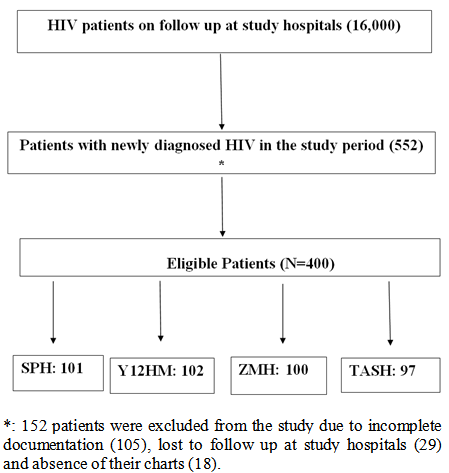
A retrospective multi-centered facility based cross-sectional study was conducted among newly diagnosed HIV patients whose age was ≥ 15 years over a period of one year (October 2023-January 2024) at four major public hospitals namely Tikur Anbessa Specialized Hospital, Zewuditu Memorial Hospital, Yekatit 12 Hospital Medical College and St, Peter Specialized Hospital, Addis Ababa, Ethiopia. Advanced HIV disease was defined as WHO clinical stage 3, stage 4 or CD4 count less than 200 cells/μL. There was a total of 16,000 HIV positive patients on follow up of which 552 patients were newly diagnosed during the study period. Four hundred patients were found to be eligible for the study (Figure 1 summarize the sampling methods). One hundred two patients were enrolled from Yekatit 12 Hospital Medical College, 101 patients were from St. Peter Specialized Hospital, 100 patients were from Zewuditu Memorial Hospital and 97 patients were from Tikur Anbessa Specialized Hospital.
Data was collected from patients’ medical charts using pretested and structured questionnaires to assess socio demographic factor, clinical presentation, certain laboratory values and other factors. The data was checked for completeness, cleaned and exported to SPSS version 26 for analysis. Descriptive statistics, chi square test, nonparametric tests and multi variable logistic regression were used for data analysis. Multivariable logistic regression was done to explore the association between advanced HIV disease and all independent variables such as age, gender, CD4 count, clinical factors, etc.) while controlling for other variables. The results of the regression analysis were reported as OR with 95% confidence interval. P-value less than 0.05 were considered to be statistically significant.
Baseline Characteristics of Study Participants
From October 2022 to October 2023, a total of 400 study participants were enrolled in the current study from the four public hospitals in Addis Ababa, Ethiopia. Hundred two (25.5%) of the study participants were from Yekatit 12 Hospital Medical College, 101(25.3%) from St. Peter Specialized Hospital, 100(25%) from Zewuditu Memorial Hospital and 97(24.3%) were from Tikur Anbessa Specialized Hospital (Table 1).
Out of the total study participants, 205 (51.3%) were female and 195 (48.8%) male and the median age was 38 years (IQR 30-48). One hundred seventy-three of the study participants (43.3%) were married, 100 (25%) were divorced, 98 (24.5%) were single and 29 (7.3%) were widowed. Most of the study participants (51.1%) were employees; 31.1% were unemployed, 5.5% were students, 3.3% were merchants, 2.5% were farmer and 6.5% had other jobs.
Majority of the study participants were Orthodox Christian (78.8%), 13.3% were Protestant, 7.5% were Muslims and 2 of them were other religion followers.When it comes to education, 157 of the study participants (39.3%) had tertiary level of education, 114 (28.5%) had attended secondary high school, 88 (22%) went to primary school and 41(10.3%) had no formal education.
The largest number of the study participants 347(86.8%) were from Addis Ababa followed by 39(9.8%) from Oromia region, 6(1.5%) from Amhara region, 5(1.3%) from Tigray region, 2(0.5%) from SNNRP and 1(0.3%) from Dire Dawa.
Seventy-nine (81.4%) of the study participants from Tikur Anbessa Specialized Hospital had advanced HIV disease at presentation followed by those from St. Peter Specialized Hospital by 67.3%, Yekatit 12 hospital medical college by 66.7% and Zewuditu Memorial Hospital by 47%.
Clinical Profiles of the Study Participants
With regards to gender distribution of advanced HIV disease, more than two-thirds (70.3%) of male had advanced disease at presentation where as 61% of female presented with advanced HIV disease. Seventy-five percent of divorced study participants had advanced HIV disease at presentation. The cumulative proportion of advanced HIV disease among new presenters is 65.5%.
Two hundred fifty-four of the participants (63.5%) were diagnosed with HIV because of signs and symptoms consistent with opportunistic infections. Fourteen percent were diagnosed with HIV by means of patients’ request and VCT. Reason for testing with HIV was not known in 64 (16%) of the study participants. Eleven percent of the study groups were diagnosed with HIV during ANC follow-up. Eleven percent of the participants received HIV diagnosis concomitant with STI diagnosis. Sixty-two of the study participants (15.5%) had other comorbidities; 16(4%) of them were smokers and 41(10.3%) were alcoholics. One study participant was IV drug user.
Two hundred eleven of the study participants (72.8%) had CD4 count below 200cells/µL. The median CD4 count was 138.5 (IQR 58.75 – 214.5). Seventeen percent of the study participants had BMI lower than 18.5 kg/m2. The median BMI was 20.1(IQR 19.2 - 22). One hundred sixty-six of the study participants (41.5%) were able to work; 179(44.8%) were ambulatory and 55(13.8%) were bedridden.
When it comes to clinical manifestations, the study participants had pulmonary tuberculosis 125(31.3%), extra pulmonary tuberculosis 82(20.5%), cerebral toxoplasmosis 50(12.5%), severe bacterial infections 38(9.5%), oral candidiasis 37(9.3%), Pneumocystis carinii pneumonia 32(8%), unintentional weight loss > 10% 32(8%), unintentional weight < 10% 31(7.8%), cryptococcal meningitis 15(3.8%), lymphoma 16(4.1%), recurrent upper respiratory tract infections 16(4%) and asymptomatic HIV infection 123(30.8%) respectively.
One hundred thirty-four (33.5%) of the study participants had WHO stage 1 HIV disease, WHO Stage 2 HIV disease 20 (5%), WHO Stage 3 HIV disease 109 (27.3%) and WHO Stage 4 HIV disease 137(34.3%). The clinical profiles were summarized in Table 2 and Table 3.
Factors associated with advanced HIV disease
Chi-square test for independent variables and Mann-Whitney test for BMI and CD4 count were carried out to look for association with outcome variable, ‘’advanced HIV disease’’. Binary and multivariate logistic regressions were performed after chi-square and nonparametric tests for which p- value in the bivariate analysis based on Wald test from the logistic regression less than 0.2 was taken to examine the effect of hospitals, gender, marital status, BMI, functional status and reason for HIV testing on advanced HIV disease. The Hosmer-Lemeshow test was used to assess the model's goodness-of-fit. The data includes crude odds ratios (COR) and adjusted odds ratios (AOR) with 95% confidence intervals.
Among the variables that were examined, having follow up at Tikur Anbessa Specialized Hospital (χ2 of 26.3 with P <0.001). Being male (χ2 of 3.8 with P=0.05), divorced marital status (χ2 of 8.0 with P=0.02), low BMI (P <0.001), bedridden functional status (χ2 of 139.3 with P <0.001) and HIV testing reason due to symptoms of opportunistic infections (χ2 of 227 with P<0.001) had statistically significant association with advanced HIV disease.
On multivariate logistic regression, patients with low BMI had 3.2 times higher odds of having advanced HIV disease in contrast to other patients with normal or higher BMI (AOR 3.2, 95% CI 1.14 -8.9, P =0.03). Patients having bedridden functional status had 10.6 times higher odds of advanced HIV disease as compared to other groups of patients (AOR 10.6, 95% CI 1.24-91, P =0.03). HIV testing reason due to symptoms of opportunistic infections had 44.6 times higher odds of advanced HIV disease as compared to those who had HIV testing reasons (AOR 44.6, 95% CI 22.8-87.2, P <0.001).
No significant difference was obtained when comparison was made among patients having follow-up at Tikur Anbessa Specialized Hospital and other hospitals, between male and female and marital status. It was summarized by Table 4.
HIV disease is a global problem that has affected large proportion of individuals around the world. In spite of significant progress in the treatment and prevention of HIV disease, large number of newly diagnosed patients have advanced HIV disease at presentation resulting in increased morbidity and mortality rates 7.
Although more than half of both male and female patients had advanced HIV disease at presentation in many studies, males were more prone to manifesting with stage III or IV HIV disease or having CD4 counts below 200 cells per cubic millimeter according to WHO reports despite less gender disparity in this study 6.
In this study conducted at four public hospitals in Addis Ababa, the prevalence of advanced HIV was 65.5% among newly diagnosed HIV positive patients. The prevalence was higher than studies conducted in rural parts of SNNPR where the prevalence of advanced HIV disease upon entering into care was 60% 7. It was lower than Senegal (71%), higher than South Africa (22%-26%) and Botswana (24.7%) 8.
Eighty-one percent of patients who were seen at Tikur Anbessa Specialized Hospital had advanced HIV disease as compared to other patients seen in the other hospitals. This might be due to many of the patients having complicated and advanced disease have been referred for specialists’ evaluation at tertiary care. St. Peter Specialized Hospital and Yekatit 12 Hospital Medical College were also high burden sites of advanced HIV disease having a prevalence rate of 67.3% and 66.7% respectively. Zewuditu Memorial Hospital had relatively lower prevalence of advanced HIV disease at presentation (47%) in contrast to other hospitals.
The commonest opportunistic infections diagnosed in patients who had advanced HIV disease at presentation to health cares were tuberculosis (51.8%) which is higher than studies done in Zambia (18%) and Cameroon (14%) 9, 10. The incidence of cerebral toxoplasmosis and oropharyngeal and esophageal candidiasis is 12.5% and 9.6% respectively which are lower as compared to Ghanaian study which showed oropharyngeal candidiasis (36.9%) and cerebral toxoplasmosis (19.9%) 11. The incidence of PCP is 8%, lymphoma 16(4.1%), cryptococcal meningitis (3.8%) and two patients (0.5%) had PML. One hundred twenty-three (30.8%) of the study participants were asymptomatic upon linkage into the HIV care. More than seventy percent of the study participants (72.5%) had CD4 counts at diagnosis. Of these, 72.8% of them had CD4 counts less 200cells/µL. The median CD4 count was 139 with inter quartile range of 59-214 which is in accord with previous studies in Africa 12, 13, 14.
Consistent with the previous studies, men were more likely to WHO clinical stage 3 and 4 defining illnesses, lower CD4 count and lower BMI upon presentation to hospitals have various. Bedridden patients and those who were diagnosed with HIV due to symptoms of OIs had advanced HIV disease while entering into care 6, 15, 16.
There was a significant association between lower BMI and advanced HIV disease (AOR 3.2, 95% CI 1.14-8.9, P=0.03), bedridden functional status and advanced HIV disease (AOR 10.6, 95% CI 1.24-91, P=0.03) and HIV diagnosis due to symptoms of OIs and advanced HIV disease (AOR 44.6, 95% CI 22.8-87.2, P < 0.001) after adjusting for other independent variables like age, education, gender, marital status, occupation and hospitals. There was no association between older age and male gender with advanced HIV disease although it was reported in other studies 8, 17, 18.
The current finding shows that many patients from Addis Ababa have advanced HIV disease at presentation to health care which is consistent with many studies from Sub-Saharan 6, 19. There may be various reasons for advanced HIV disease at presentation. These factors include lack of awareness to HIV status, absence of universal HIV screening and impact of COVID global pandemic. There must be a prospective study to assess the determinants of late presentation and advanced HIV disease 6, 12, 20.
The study's strength is its inclusion of all individuals who were diagnosed with HIV at the study hospitals within the study period. The study has relatively larger sample by including all patients at the study sites. Important information including date of diagnosis and clinical profiles were documented.
Nevertheless, the result needs to be interpreted in the context of specific limitations. One limitation is that it is a retrospective study limited to Public Hospitals in Addis Ababa. The other limitation of the study is it only involved specialized hospital and it wouldn’t reflect the true picture of advanced HIV disease in Addis Ababa. Some important information like CD4 count, reason for testing, socio-demographic characteristics in certain patients and BMI have not been determined. For instance, 110 (28.2%) patients had no CD4 count highlighting the importance of complete patient evaluation and documentation of clinical and laboratory data. There is some incongruity between WHO clinical staging of patients and their actual diagnoses documented on their charts.
This study provides the current status of advanced HIV disease among newly diagnosed HIV patients in Addis Ababa. The prevalence of advanced HIV disease is 65.5% among newly diagnosed HIV patients portraying the steady increment recently. Considering the fact that advanced HIV disease has shown an upward trend recently, targeted programs aimed at early detection, public awareness creation and universal access to testing should be urgently designed to reduce the burden of advanced HIV disease while entering into care.
AHD: Advanced HIV Disease
ANC: Antenatal Care
AOR: Adjusted Odds Ratio
BMI: Body Mass Index
CD4: Cluster of Differentiation 4
CI: Confidence Interval
COR: Crude Odds Ratio
HIV: Human Immunodeficiency Virus
IQR: Interquartile Range
OIs: Opportunistic Infections
PCP: Pneumocystis carinii pneumonia
SNNPR: Southern Nations, Nationalities, and Peoples' Region
STI: Sexually Transmitted Infection
UNAIDS: The Joint United Nations Program on HIV/AIDS
VCT: Voluntary Counselling and Testing
WHO: World Health Organization
Ethical clearance was obtained from Department of Internal Medicine, School of Medicine, College of Health Sciences, Addis Ababa University, Ethical Board Review of Addis Ababa Health Bureau and St. Peter Specialized Hospital.
An informed consent was not necessary as the data was obtained from secondary sources. However, privacy and confidentiality of collected information was ensured throughout the process.
All the data and materials for this study are available from the corresponding author.
Berhanu M. Abera, Zekarias S. Ayalew, Abel T. Tasamma, Bereket A. Molla: Conceptualization, Methodology, Writing - Original Draft
Amir Muhdin, Yared Getachew, Biruk Abate, Asrat Berihun: Software, Data Curation, Investigation
Wondwossen A. Degu, Eyob Beyene, Anteneh Eshetu, Eskedar F. Azerefegne, Tilahun Bizuayehu: Supervision, Visualization, Validation
Sibehatleab T. Mulate, Abel Andargie, Surafel Adugna, Mehariw W. Netsere, Kemer Kedir, Zelalem B. Ayele, Abraham Workneh: Writing - Reviewing and Editing
We declare that there are no competing interests.
We received no financial support for this study.
I would like to acknowledge College of Health Sciences, Addis Ababa University for offering me the opportunity to undergo this research project including funding for conducting the study. I would also like to thank Addis Ababa Health Bureau, Zewuditu memorial Hospital, Yekatit 12 Hospital Medical College and St. Peter Specialized Hospital for their cooperation and assistance during the entire process of data collection. Last but not least, I would also like to extend my appreciation to those who have helped me in guiding and supporting during thesis proposal development, data collection and data analysis.
| [1] | UNAIDS. (n.d.). UNAIDS data 2021. https:// www.unaids.org/ en/resources/documents/2021/2021_unaids_data. | ||
| In article | |||
| [2] | Boyd AT, Oboho I, Paulin H, Ali H, Godfrey C, Date A, et al. Addressing advanced HIV disease and mortality in global HIV programming. AIDS research and therapy. 2020; 17(1): 40. | ||
| In article | View Article PubMed | ||
| [3] | Programmes, G. H. H. a. S. (2023, March 27). Providing care to people with advanced HIV disease who are seriously ill. https://www.who.int/publications/i/item/9789240068650. | ||
| In article | |||
| [4] | UNAIDS. (n.d.-a). 2017 Global AIDS update - Ending AIDS: progress towards the 90–90–90 targets. https:// www.unaids.org/ en/resources/ documents/2017/20170720_Global_AIDS_update_2017. | ||
| In article | |||
| [5] | Benzekri NA, Sambou JF, Ndong S, Tamba IT, Faye D, Diallo MB, et al. Prevalence, predictors, and management of advanced HIV disease among individuals initiating ART in Senegal, West Africa. BMC infectious diseases. 2019; 19(1): 261. | ||
| In article | View Article PubMed | ||
| [6] | Lifson AR, Workneh S, Hailemichael A, MacLehose RF, Horvath KJ, Hilk R, et al. Advanced HIV Disease among Males and Females Initiating HIV Care in Rural Ethiopia. Journal of the International] Association of Providers of AIDS Care. 2019; 18: 2325958219847199. | ||
| In article | View Article PubMed | ||
| [7] | Adal M. Systematic review on HIV situation in Addis Ababa, Ethiopia. BMC Public Health. 2019; 9(1): 1544. | ||
| In article | View Article PubMed | ||
| [8] | Musengimana G, Umugisha JP, Habinshuti P, Anderson T, Mukesharurema G, Remera E, et al. Characteristics and clinical outcomes of patients presenting with advanced HIV disease in the "treat all" era: a retrospective cohort study from rural Rwanda. BMC infectious diseases. 2022; 22(1): 706. | ||
| In article | View Article PubMed | ||
| [9] | Henostroza G, Harris JB, Chitambi R, Siyambango M, Turnbull ER, Maggard KR, et al. High prevalence of tuberculosis in newly enrolled HIV patients in Zambia: need for enhanced screening approach. The international journal of tuberculosis and lung disease: the official journal of the International Union against Tuberculosis and Lung Disease. 2016; 20(8): 1033-9. | ||
| In article | View Article PubMed | ||
| [10] | Mbu ET, Sauter F, Zoufaly A, Bronsvoort BMC, Morgan KL, Noeske J, et al. Tuberculosis in people newly diagnosed with HIV at a large HIV care and treatment center in Northwest Cameroon: Burden, comparative screening and diagnostic yields, and patient outcomes. PloS one. 2018; 13(6): e0199634. | ||
| In article | View Article PubMed | ||
| [11] | Puplampu P, Asafu-Adjaye O, Harrison M, Tetteh J, Ganu VJ. Opportunistic Infections among newly diagnosed HIV patients in the largest tertiary facility in Ghana. Annals of global health. 2024; 90(1): 13. | ||
| In article | View Article PubMed | ||
| [12] | Lahuerta M, Wu Y, Hoffman S, Elul B, Kulkarni SG, Remien RH, et al. Advanced HIV disease at entry into HIV care and initiation of antiretroviral therapy during 2006-2011: findings from four sub-saharan African countries. Clinical infectious diseases: an official publication of the Infectious Diseases Society of America. 2014; 58(3): 432-41. | ||
| In article | View Article PubMed | ||
| [13] | Fomundam HN, Tesfay AR, Mushipe SA, Mosina MB, Boshielo CT, Nyambi HT, et al. Prevalence and predictors of late presentation for HIV care in South Africa. South African medical journal = Suid-Afrikaanse tydskrif vir geneeskunde. 2017; 107(12): 1058-64. | ||
| In article | View Article PubMed | ||
| [14] | Benzekri NA, Sambou JF, Ndong S, Tamba IT, Faye D, Diallo MB, et al. Prevalence, predictors, and management of advanced HIV disease among individuals initiating ART in Senegal, West Africa. BMC infectious diseases. 2019; 19(1): 261. | ||
| In article | View Article PubMed | ||
| [15] | Lebelonyane R, Mills LA, Mogorosi C, Ussery F, Marukutira T, Theu J, et al. Advanced HIV disease in the Botswana combination prevention project: prevalence, risk factors, and outcomes. AIDS (London, England). 2020; 34(15): 2223-30. | ||
| In article | View Article PubMed | ||
| [16] | Shi L, Tang W, Liu X, Hu H, Qiu T, Chen Y, et al. Trends of late HIV presentation and advance HIV disease among newly diagnosed HIV cases in Jiangsu, China: A serial cross-sectional study from 2008 to 2020. Frontiers in public health. 2022; 10: 1054765. | ||
| In article | View Article PubMed | ||
| [17] | Oliva J, Díez M, Galindo S, Cevallos C, Izquierdo A, Cereijo J, et al. Predictors of advanced disease and late presentation in new HIV diagnoses reported to the surveillance system in Spain. Gaceta Sanitaria. 2014; 28(2): 116-22. | ||
| In article | View Article PubMed | ||
| [18] | Baldeh M, Kizito S, Lakoh S, Sesay D, Dennis F, Barrie U, et al. Prevalence and factors associated with advanced HIV disease among young people aged 15 - 24 years in a national referral hospital in Sierra Leone: A cross-sectional study. medRxiv : the preprint server for health sciences. 2023. | ||
| In article | View Article | ||
| [19] | Chihana M, Huerga H, Van Cutsem G, Ellman T, Goemaere E, Wanjala S, et al. Distribution of advanced HIV disease from three high HIV prevalence settings in Sub-Saharan Africa: a secondary analysis data from three population-based cross-sectional surveys in Eshowe (South Africa), Ndhiwa (Kenya) and Chiradzulu (Malawi). Global health action. 2019; 12: 1679472. | ||
| In article | View Article PubMed | ||
| [20] | Chihana ML, Huerga H, Van Cutsem G, Ellman T, Goemaere E, Wanjala S, et al. Distribution of advanced HIV disease from three high HIV prevalence settings in Sub-Saharan Africa: a secondary analysis data from three population-based cross-sectional surveys in Eshowe (South Africa), Ndhiwa (Kenya) and Chiradzulu (Malawi). Global health action. 2019; 12(1): 1679472. | ||
| In article | View Article PubMed | ||
Published with license by Science and Education Publishing, Copyright © 2024 Berhanu M. Abera, Zekarias S. Ayalew, Abel T. Tasamma, Amir Muhdin, Eyob Beyene, Anteneh Eshetu, Eskedar F. Azerefegne, Tilahun Bizuayehu, Yared Getachew, Biruk Abate, Asrat Berihun, Sibehatleab T. Mulate, Abel Andargie, Surafel Adugna, Mehariw W. Netsere, Kemer Kedir, Zelalem B. Ayele, Abraham Workneh, Bereket Abraha Molla and Wondwossen A. Degu
 This work is licensed under a Creative Commons Attribution 4.0 International License. To view a copy of this license, visit
https://creativecommons.org/licenses/by/4.0/
This work is licensed under a Creative Commons Attribution 4.0 International License. To view a copy of this license, visit
https://creativecommons.org/licenses/by/4.0/
| [1] | UNAIDS. (n.d.). UNAIDS data 2021. https:// www.unaids.org/ en/resources/documents/2021/2021_unaids_data. | ||
| In article | |||
| [2] | Boyd AT, Oboho I, Paulin H, Ali H, Godfrey C, Date A, et al. Addressing advanced HIV disease and mortality in global HIV programming. AIDS research and therapy. 2020; 17(1): 40. | ||
| In article | View Article PubMed | ||
| [3] | Programmes, G. H. H. a. S. (2023, March 27). Providing care to people with advanced HIV disease who are seriously ill. https://www.who.int/publications/i/item/9789240068650. | ||
| In article | |||
| [4] | UNAIDS. (n.d.-a). 2017 Global AIDS update - Ending AIDS: progress towards the 90–90–90 targets. https:// www.unaids.org/ en/resources/ documents/2017/20170720_Global_AIDS_update_2017. | ||
| In article | |||
| [5] | Benzekri NA, Sambou JF, Ndong S, Tamba IT, Faye D, Diallo MB, et al. Prevalence, predictors, and management of advanced HIV disease among individuals initiating ART in Senegal, West Africa. BMC infectious diseases. 2019; 19(1): 261. | ||
| In article | View Article PubMed | ||
| [6] | Lifson AR, Workneh S, Hailemichael A, MacLehose RF, Horvath KJ, Hilk R, et al. Advanced HIV Disease among Males and Females Initiating HIV Care in Rural Ethiopia. Journal of the International] Association of Providers of AIDS Care. 2019; 18: 2325958219847199. | ||
| In article | View Article PubMed | ||
| [7] | Adal M. Systematic review on HIV situation in Addis Ababa, Ethiopia. BMC Public Health. 2019; 9(1): 1544. | ||
| In article | View Article PubMed | ||
| [8] | Musengimana G, Umugisha JP, Habinshuti P, Anderson T, Mukesharurema G, Remera E, et al. Characteristics and clinical outcomes of patients presenting with advanced HIV disease in the "treat all" era: a retrospective cohort study from rural Rwanda. BMC infectious diseases. 2022; 22(1): 706. | ||
| In article | View Article PubMed | ||
| [9] | Henostroza G, Harris JB, Chitambi R, Siyambango M, Turnbull ER, Maggard KR, et al. High prevalence of tuberculosis in newly enrolled HIV patients in Zambia: need for enhanced screening approach. The international journal of tuberculosis and lung disease: the official journal of the International Union against Tuberculosis and Lung Disease. 2016; 20(8): 1033-9. | ||
| In article | View Article PubMed | ||
| [10] | Mbu ET, Sauter F, Zoufaly A, Bronsvoort BMC, Morgan KL, Noeske J, et al. Tuberculosis in people newly diagnosed with HIV at a large HIV care and treatment center in Northwest Cameroon: Burden, comparative screening and diagnostic yields, and patient outcomes. PloS one. 2018; 13(6): e0199634. | ||
| In article | View Article PubMed | ||
| [11] | Puplampu P, Asafu-Adjaye O, Harrison M, Tetteh J, Ganu VJ. Opportunistic Infections among newly diagnosed HIV patients in the largest tertiary facility in Ghana. Annals of global health. 2024; 90(1): 13. | ||
| In article | View Article PubMed | ||
| [12] | Lahuerta M, Wu Y, Hoffman S, Elul B, Kulkarni SG, Remien RH, et al. Advanced HIV disease at entry into HIV care and initiation of antiretroviral therapy during 2006-2011: findings from four sub-saharan African countries. Clinical infectious diseases: an official publication of the Infectious Diseases Society of America. 2014; 58(3): 432-41. | ||
| In article | View Article PubMed | ||
| [13] | Fomundam HN, Tesfay AR, Mushipe SA, Mosina MB, Boshielo CT, Nyambi HT, et al. Prevalence and predictors of late presentation for HIV care in South Africa. South African medical journal = Suid-Afrikaanse tydskrif vir geneeskunde. 2017; 107(12): 1058-64. | ||
| In article | View Article PubMed | ||
| [14] | Benzekri NA, Sambou JF, Ndong S, Tamba IT, Faye D, Diallo MB, et al. Prevalence, predictors, and management of advanced HIV disease among individuals initiating ART in Senegal, West Africa. BMC infectious diseases. 2019; 19(1): 261. | ||
| In article | View Article PubMed | ||
| [15] | Lebelonyane R, Mills LA, Mogorosi C, Ussery F, Marukutira T, Theu J, et al. Advanced HIV disease in the Botswana combination prevention project: prevalence, risk factors, and outcomes. AIDS (London, England). 2020; 34(15): 2223-30. | ||
| In article | View Article PubMed | ||
| [16] | Shi L, Tang W, Liu X, Hu H, Qiu T, Chen Y, et al. Trends of late HIV presentation and advance HIV disease among newly diagnosed HIV cases in Jiangsu, China: A serial cross-sectional study from 2008 to 2020. Frontiers in public health. 2022; 10: 1054765. | ||
| In article | View Article PubMed | ||
| [17] | Oliva J, Díez M, Galindo S, Cevallos C, Izquierdo A, Cereijo J, et al. Predictors of advanced disease and late presentation in new HIV diagnoses reported to the surveillance system in Spain. Gaceta Sanitaria. 2014; 28(2): 116-22. | ||
| In article | View Article PubMed | ||
| [18] | Baldeh M, Kizito S, Lakoh S, Sesay D, Dennis F, Barrie U, et al. Prevalence and factors associated with advanced HIV disease among young people aged 15 - 24 years in a national referral hospital in Sierra Leone: A cross-sectional study. medRxiv : the preprint server for health sciences. 2023. | ||
| In article | View Article | ||
| [19] | Chihana M, Huerga H, Van Cutsem G, Ellman T, Goemaere E, Wanjala S, et al. Distribution of advanced HIV disease from three high HIV prevalence settings in Sub-Saharan Africa: a secondary analysis data from three population-based cross-sectional surveys in Eshowe (South Africa), Ndhiwa (Kenya) and Chiradzulu (Malawi). Global health action. 2019; 12: 1679472. | ||
| In article | View Article PubMed | ||
| [20] | Chihana ML, Huerga H, Van Cutsem G, Ellman T, Goemaere E, Wanjala S, et al. Distribution of advanced HIV disease from three high HIV prevalence settings in Sub-Saharan Africa: a secondary analysis data from three population-based cross-sectional surveys in Eshowe (South Africa), Ndhiwa (Kenya) and Chiradzulu (Malawi). Global health action. 2019; 12(1): 1679472. | ||
| In article | View Article PubMed | ||